Alif the Unseen Summary, Characters and Themes
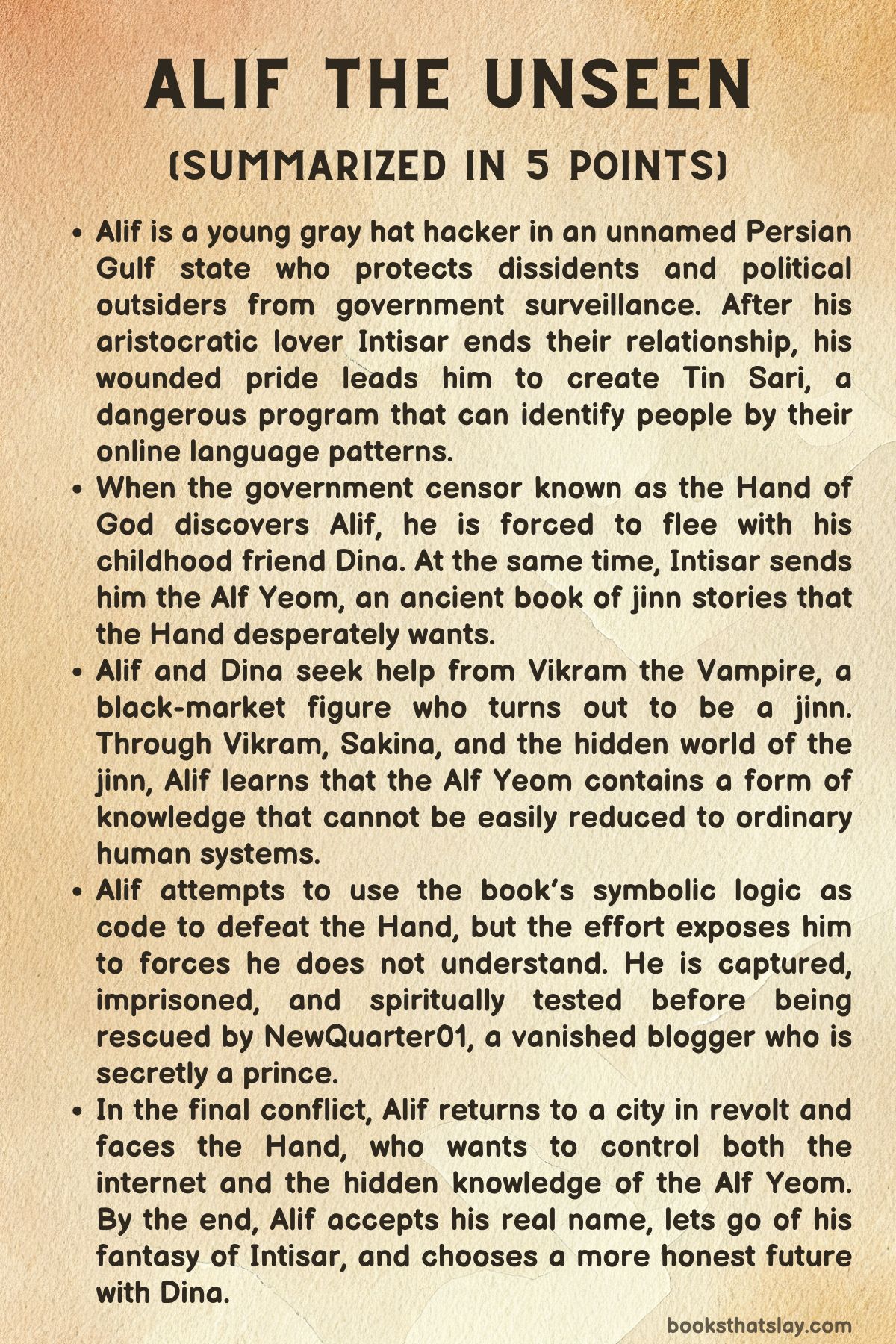
Alif the Unseen by G. Willow Wilson is a fantasy-inflected cyberpunk novel set in an unnamed Persian Gulf state, where digital rebellion, class division, faith, folklore, and political control collide. The book follows Alif, a young hacker who protects dissidents online while hiding behind a coded identity of his own.
After a failed romance pulls him into the path of a powerful state censor, he receives an ancient manuscript tied to the jinn. What begins as a fight for online freedom becomes a larger struggle over language, identity, belief, and the limits of human knowledge.
Summary
Alif the Unseen begins with an old story about Reza, a grieving man in ancient Persia who has trapped a jinn and forced it to tell him the secret stories of its people. Reza believes that if he gathers every tale into a single book and understands them all, he can gain power great enough to bring his dead wife back.
The jinn warns him that the final story will change him, but Reza demands to hear it anyway. This frame introduces the Alf Yeom, a mysterious book containing the hidden knowledge of the jinn.
The main story moves to a modern Persian Gulf city, where a young hacker known as Alif lives between worlds. He is half-Arab and half-Indian, poor, technically gifted, angry, and lonely.
He works as a gray hat hacker, protecting bloggers, activists, Islamists, secularists, and anyone else targeted by the state’s online surveillance. The government’s digital censorship system is feared by the underground internet community and known as the Hand of God.
Alif is also in love with Intisar, an aristocratic woman far above his social class. Their relationship has always been fragile, and when Intisar tells him her father has chosen a husband for her, Alif is devastated.
Her fiancé is Abbas Al Shehab, a powerful man whose public identity hides something far more dangerous. Intisar tells Alif to erase himself from her life, and he takes the command literally.
Driven by hurt pride and obsession, Alif creates a program called Tin Sari. The program can identify a person by patterns in their typing, language, rhythm, and word choice.
Alif intends to use it only to hide himself from Intisar online, but the idea has frightening implications. If the government gets it, no dissident can hide behind a screen name again.
Alif’s friend Abdulla warns him that the program is too dangerous, but Alif ignores him.
Soon afterward, the Hand of God finds Alif. Alif realizes too late that he had left a connection open to Intisar’s computer, and through it the Hand may have gained access to Tin Sari.
At the same time, Intisar returns a box Alif sent her, but the box now contains something unexpected: the Alf Yeom, the ancient book of jinn stories. Alif does not understand why she sent it, but the book quickly becomes the center of the chase.
Alif and his childhood friend Dina flee their apartment building after spotting a state agent nearby. Dina is practical, brave, religious, and far more clear-sighted than Alif, though he has long failed to appreciate her.
Abdulla sends them to Vikram the Vampire, a feared black-market figure who turns out not to be human at all, but a jinn. At first, Vikram refuses to help.
When Dina is shot while she and Alif run from state agents, Vikram’s sister rescues them. She is the black-and-orange cat Alif had once sheltered during a sandstorm.
Because of that act of kindness, Vikram agrees to protect them.
Vikram recognizes the Alf Yeom as a book of enormous importance. To humans, it looks like a collection of strange tales.
To the jinn, it contains another kind of knowledge, a way of thinking built through metaphor, story, and layered meaning. Alif still struggles to accept that the jinn are real, even while impossible things happen around him.
His rational, technological worldview begins to crack.
Vikram brings Alif, Dina, and an American convert to Islam to the Immovable Alley, a hidden jinn meeting place. The convert is an archival sciences student who confirms that the manuscript is centuries old and may be original.
In the alley, the jinn Sakina explains that the Alf Yeom had been missing until Intisar bought it. She also reveals that a prince became interested in the book.
That prince is Intisar’s fiancé: the Hand of God.
Alif tries to contact Intisar and is nearly captured. He takes refuge in a mosque led by Sheikh Bilal, a wise and patient religious scholar.
The sheikh helps Alif and speaks to him in terms he understands, comparing faith, prayer, and divine order to machines and computer systems. Alif, who has often treated religion as something peripheral, begins to see that faith and technology are not as separate as he imagined.
Intisar comes to the mosque, but Alif realizes she has been used to lure him out. She explains that she originally sent him the book to spite her father and fiancé, but she has begun to respect Abbas and doubt Alif’s online life.
Alif finally sees that his romance with Intisar was built partly on fantasy and class resentment. State forces surround the mosque, and Alif concludes that the Hand wants the Alf Yeom because he is trying to build a new kind of computer.
Alif attempts to translate the book’s symbolic logic into code. He believes the jinn stories may function like programs, allowing a machine to think through metaphor rather than ordinary binary limits.
As he codes, reality and story blur. He encounters figures from the Alf Yeom and battles the Hand in cyberspace.
For a moment, Alif’s work seems powerful enough to damage the state’s systems, but the code becomes unstable. The beautiful princess who appears to guide him is revealed as a demon, and the experiment burns out the computer and injures Alif.
With the mosque about to fall, Vikram sends Dina and the convert to the Empty Quarter for protection among the jinn. Alif is captured and taken to a secret prison.
In darkness, hunger, and isolation, he is tormented by the demon from the failed code. He survives by reciting holy verses.
The Hand visits him, not merely to interrogate him, but to prove that he has won. Alif begins to break down, but he also gains a strange awareness of the body, faith, fear, and endurance.
Alif is eventually rescued by NewQuarter01, the city’s first famous blogger, long thought to have vanished. NewQuarter is actually Prince Abu Talib, a royal dissident.
He rescues Alif and Sheikh Bilal, and they flee toward the Empty Quarter. There they discover Irem, the hidden City of Pillars, where jinn live beyond the ordinary rules of the human world.
In Irem, Alif finds Dina and the convert alive. Vikram has died, and the convert is pregnant with his child.
Dina has kept the Alf Yeom safe the whole time. Alif and Dina finally speak honestly.
He apologizes for his blindness over Intisar, and Dina admits that she saw the better man he could become even when he could not. Their relationship shifts from friendship and irritation into love.
The Hand’s failed attempt to use the Alf Yeom has crashed the city’s internet and power grid, helping spark a popular uprising. Alif realizes the Hand cannot truly control the book because he wants to force its meanings into a rigid system.
Alif offers the jinn a bargain: he will face the Hand, while they fight the demons aiding him.
Alif, Dina, and NewQuarter return to a city in chaos. Protesters fill the streets, state power is collapsing, and the line between human politics and unseen forces has broken open.
The Hand gets hold of the real Alf Yeom and tries to master it. When he reaches the final story, he finds it is “The Tale of Alif the Unseen.” The story turns the Hand’s desire for control against him.
During the uprising, Alif confronts the Hand and explains the truth about Tin Sari. It does not read souls or hearts.
It identifies what people reveal through habit, language, and action. The Hand cannot accept this limitation.
In the struggle, Alif is pushed from a window but is saved by Sakina. The crowd later kills the Hand, mistaking him for a prince.
In the aftermath, Alif sees Intisar being harassed and helps her, but he no longer belongs to her world or to the fantasy he built around her. Dina calls him by his real name, Mohammad, and he accepts it.
By the end of Alif the Unseen, Alif has stopped hiding behind a single letter. He has faced the cost of anonymity, the danger of control, and the power of stories that cannot be reduced to code.
He walks away with Dina, changed by both the seen and unseen worlds.
Characters
Alif / Mohammad
Alif is the central figure of Alif the Unseen, and his journey is built around identity, pride, love, faith, and responsibility. At the beginning, he hides behind the letter “Alif,” a chosen name that gives him distance from his ordinary life as Mohammad, a lower-class young man of mixed Arab and Indian background.
Online, he is powerful, skilled, and defiant, protecting dissidents from government surveillance. Offline, he is insecure, impulsive, and emotionally immature, especially in his relationship with Intisar.
His heartbreak pushes him to create Tin Sari, a program that begins as a private act of wounded obsession but becomes a political weapon when it falls into the wrong hands. This mistake forces him to confront the consequences of treating technology as a personal escape rather than a public responsibility.
Alif’s growth comes through suffering, exile, imprisonment, and his encounters with faith and the unseen world. His name matters because he begins as a symbol, almost an abstraction, but ends by accepting the human self beneath it.
When Dina calls him Mohammad and he accepts it, he finally stops hiding behind code, romance, class resentment, and anonymity.
Dina
Dina is one of the novel’s strongest moral centers. She begins as Alif’s neighbor and childhood friend, but she is far more than a secondary companion.
Her decision to veil at a young age shows her independence and her willingness to define herself despite social judgment. She is religious without being passive, modest without being weak, and loyal without surrendering her intelligence.
Dina often sees what Alif refuses to see, especially about Intisar and about his own selfishness. Her arguments with him are not just personal conflicts; they expose his immaturity and his tendency to mistake desire for devotion.
Dina’s courage becomes clear when she follows Alif into danger, suffers injury, protects the Alf Yeom, and survives among the jinn. She also represents a form of faith that is active and clear-minded.
Unlike Alif, who often uses abstraction and technology to avoid emotional truth, Dina has a grounded sense of reality. Her love for Alif is patient but not submissive.
She waits for him to become better, but she does not excuse his foolishness. By the end, she is the person who helps him accept his real name and his real self.
Intisar
Intisar is central to Alif’s emotional crisis, but she is not simply a love interest. She represents class privilege, romantic illusion, and the distance between fantasy and reality.
To Alif, she is almost unreal: beautiful, aristocratic, educated, and socially unreachable. His love for her is intense, but it is mixed with projection.
He wants her to choose him not only because he loves her, but because such a choice would seem to defeat the class system that has always made him feel inferior. Intisar, however, is more practical and more bound to her world than Alif wants to admit.
Her engagement to Abbas reveals the limits of her rebellion. She sends Alif the Alf Yeom partly as an act of anger toward the men controlling her life, but she later begins to respect her fiancé and questions Alif’s own moral position.
Her treatment of Alif can seem cold, yet she is also trapped within family expectation, gendered control, and elite politics. By the end, Alif’s ability to help her without returning to his fantasy of her shows his emotional growth.
Intisar remains important because she pushes the plot forward, but her larger function is to force Alif to separate love from obsession.
Vikram the Vampire
Vikram is one of the most memorable figures in the story because he bridges the human criminal underworld and the supernatural world of the jinn. At first, he appears as a dangerous black-market fixer, someone Alif and Dina approach out of desperation.
His nickname suggests menace, and his manner carries threat, humor, and unpredictability. Once revealed as a jinn, Vikram becomes more complex.
He is not purely benevolent, but he has a code of honor. His decision to help Alif is rooted in obligation, because Alif once sheltered his sister in the form of a cat.
This reveals how deeply the unseen world values acts whose importance humans may not understand at the time. Vikram’s roughness hides loyalty and courage.
He protects Dina, guides the group through hidden spaces, and ultimately dies helping them survive. His relationship with the convert adds tenderness and surprise to his character, especially when it is revealed that she carries his child.
Vikram’s presence also expands the novel’s sense of reality. Through him, myth is not distant or decorative; it lives beside markets, hackers, police, and political unrest.
The Convert
The convert is an American student of archival sciences and a recent convert to Islam. She brings an outsider’s perspective into the story without being reduced to an outsider stereotype.
Her academic knowledge makes her useful in identifying the Alf Yeom, since she can evaluate its age and material history. At the same time, her religious conversion places her in a complicated position.
She belongs and does not belong, understands some things deeply and misunderstands others. Alif initially distrusts her because she is foreign, but her intelligence and steadiness prove important.
She is curious, brave, and more adaptable than Alif expects. Her relationship with Vikram is one of the novel’s surprising developments, and her pregnancy gives the human-jinn connection a lasting consequence.
Her choice to remain in Irem suggests that she has moved beyond merely studying old texts or adopting a new faith from a distance. She becomes part of a world that most humans cannot even perceive.
In this way, she represents transformation through belief, study, love, and risk.
Sheikh Bilal
Sheikh Bilal is a spiritual guide whose wisdom is practical rather than abstract. He offers Alif shelter in the mosque, but he also insists that Alif clean the floor, immediately connecting faith with discipline, responsibility, and order.
His conversations with Alif are important because he explains religious ideas through technological comparisons Alif can understand. He does not reject computers or modernity; instead, he shows that faith and reason can speak to one another.
His view of prayer as an ordered act helps Alif think differently about systems, patterns, and meaning. Sheikh Bilal also challenges the false divide between sacred life and political life.
By protecting Alif, he risks himself, and he is later imprisoned for it. His presence in the story prevents religion from being shown as mere background culture.
He embodies a faith that is intellectual, compassionate, and brave. In Irem, his decision to stay and teach suggests that knowledge is not limited to human institutions.
He is humble enough to learn from the unseen world and strong enough to carry his own tradition into it.
The Hand / Abbas Al Shehab
The Hand is the main human antagonist, and his danger comes from his combination of state power, technical intelligence, aristocratic privilege, and hunger for control. Publicly, he is Abbas Al Shehab, Intisar’s fiancé and a prince-like figure connected to the ruling order.
In the digital underground, he is the Hand of God, the feared force behind state surveillance and censorship. His goal is not only to catch dissidents but to eliminate the possibility of hidden identity.
When he gains access to Tin Sari, he becomes even more dangerous because he can use Alif’s invention to strip anonymity from the internet. His interest in the Alf Yeom reveals his deeper ambition.
He wants to convert metaphor, story, and jinn knowledge into a system he can command. His failure comes from the same flaw that defines him: he believes understanding means possession.
He cannot accept ambiguity, mystery, or limits. When the book resists him, he becomes unstable.
He is a figure of authoritarian thinking, convinced that every hidden thing can be exposed and every living system can be mastered.
NewQuarter01 / Prince Abu Talib
NewQuarter01 is first known as a legendary blogger who vanished from the internet, making him a symbol of early digital resistance. His later appearance as Prince Abu Talib complicates that image.
He is both a dissident and a member of the ruling class, which makes him a bridge between privilege and rebellion. His rescue of Alif and Sheikh Bilal from prison shows courage and loyalty to the ideals he once represented online.
He does not immediately believe Alif’s claims about the jinn, which grounds him in a more rational political worldview. Yet he continues moving with Alif because the human crisis is undeniable, even if the unseen explanation seems impossible.
His royal identity becomes dangerous during the uprising, when the crowd nearly turns against him simply because he is a prince. Through him, the story questions whether revolution can distinguish between individuals and symbols.
NewQuarter’s character suggests that resistance is never socially simple. A person may come from power and still oppose it, but in moments of public rage, nuance can disappear quickly.
Sakina
Sakina is a jinn who serves as a source of knowledge, caution, and assistance. She understands the importance of the Alf Yeom and helps explain its place in jinn history.
Her role is not to solve every problem for Alif, but to reveal enough for him to understand the scale of what he is carrying. She is connected to the hidden structures of jinn society, especially the Immovable Alley and Irem.
Sakina’s actions show that the jinn are not a single unified force. They have politics, fears, loyalties, and disagreements of their own.
Her rescue of Alif after he falls from the window is a significant act, both physically and symbolically. It confirms that his alliance with the unseen world has become real, not just transactional.
Sakina represents guarded wisdom. She knows more than the human characters, but she also understands danger too well to act carelessly.
Through her, the unseen world gains depth, history, and moral complexity.
Vikram’s Sister
Vikram’s sister first appears as the black-and-orange cat that lives near Alif’s apartment. Her role begins quietly, almost casually, when Alif shelters her during a sandstorm.
Later, that small act saves his life and Dina’s. Her transformation from stray cat to jinn rescuer emphasizes one of the story’s key moral patterns: actions done without expectation can return with unexpected force.
She is mysterious, swift, and powerful, knocking down the state agent when Alif and Dina are nearly captured. Though she is not as developed as Vikram, her presence is essential because she reveals that the unseen world has been near Alif long before he recognized it.
She also shows that kindness toward the vulnerable, even when the vulnerable appear ordinary, matters. Her character is a reminder that perception is limited, and that the world contains witnesses and debts beyond human awareness.
Reza
Reza appears in the frame story, but his ambition echoes through the entire plot. He is a man consumed by grief, determined to force the jinn to give him all their stories so he can gain power over death.
His desire is emotionally understandable, but his method is violent and controlling. He imprisons a jinn and treats story as a tool to be extracted, mastered, and used.
In this way, Reza foreshadows the Hand. Both men believe hidden knowledge can be captured and turned into personal power.
Reza’s tragedy lies in his refusal to accept limits. Rather than mourn, he tries to break the boundary between life and death.
Rather than listen, he compels. The warning that the final story will change him suggests that stories are not passive objects.
They act upon the listener. Reza’s presence gives the novel a mythic foundation and shows that the human hunger to dominate mystery is ancient, not merely modern.
Princess Farukhuaz / The Demon
Princess Farukhuaz appears to Alif during his attempt to code the Alf Yeom, seeming at first like a beautiful guide from the book’s stories. Her later revelation as a demon marks a turning point in Alif’s understanding of the unseen world.
Not everything supernatural is wise, noble, or safe. The demon exploits Alif’s ambition, confusion, and desire for mastery.
In prison, it torments him in the dark, circling him and pushing him toward fear and madness. Alif’s defense against it comes not through code but through recitation and faith, which is important for his development.
The demon represents the danger of misreading mystery through ego. Alif thinks he can convert the book’s deeper logic into a usable program, but he opens himself to forces he does not understand.
Princess Farukhuaz is therefore both a literal threat and a symbol of seductive false knowledge. She looks like an answer but becomes a punishment for arrogance.
Abdulla
Abdulla is Alif’s fellow gray hat hacker and one of the earliest voices of warning in the story. He understands the technical brilliance of Alif’s idea for Tin Sari, but he also sees its danger more clearly than Alif does.
Abdulla’s role is important because he represents the ethical conscience of the hacker world. He knows that a tool designed for private reasons can become a weapon when placed in the hands of the state.
His warning that Alif should not waste his noble purpose on romantic frustration cuts directly to Alif’s flaw. Abdulla may not travel through the whole adventure with Alif, but his early insight shapes the reader’s understanding of the central technological conflict.
He sees that code is never just code. It carries the intentions, weaknesses, and blind spots of its maker, and once released, it can move far beyond its original purpose.
Themes
Identity, Names, and the Self Behind the Mask
Identity in Alif the Unseen is treated as something people construct, hide, perform, and eventually must answer for. Alif’s chosen name gives him power online, but it also helps him avoid the vulnerability of being Mohammad.
His digital identity allows him to move through political spaces with confidence, yet it also separates him from his body, class, family background, and emotional responsibilities. Tin Sari turns this problem into technology.
The program suggests that identity is not only a declared name but a pattern of behavior: how a person writes, chooses words, reacts, and repeats habits. This makes anonymity both powerful and fragile.
The Hand misunderstands this idea because he wants identity to be something he can fully expose and control. Alif slowly learns a different lesson.
A name can protect, but it can also become a hiding place. Intisar’s idea of him, Dina’s knowledge of him, and his own fear of being ordinary all compete throughout the story.
His acceptance of the name Mohammad at the end is not a rejection of Alif, but a fuller acceptance of himself. He no longer needs to live only as a symbol.
Technology, Control, and Moral Responsibility
Technology in the novel is never neutral. It can protect dissidents, create communities, challenge censorship, and give the powerless a voice.
It can also expose, monitor, punish, and erase people. Alif begins with a strong sense of political purpose, using his skills to defend those targeted by the state.
Yet his creation of Tin Sari comes from heartbreak rather than principle. That matters because the tool’s origin reveals how private emotion can have public consequences.
Once the Hand gains access to the program, Alif’s personal mistake becomes a threat to everyone he has tried to protect. The novel treats coding as an act of moral authorship.
A programmer creates systems that shape what others can do, hide, say, or become. The Hand represents technology as domination.
He wants systems that classify every person and eliminate uncertainty. Alif’s later understanding is more humble.
He sees that some forms of knowledge cannot be forced into clean categories. The failure to code the Alf Yeom shows that intelligence without wisdom becomes dangerous.
Technology must be joined to ethics, restraint, and awareness of human cost.
Faith, Reason, and the Unseen World
The story refuses to place faith and reason in simple opposition. Alif begins as a hacker who trusts systems, evidence, and code, even though his world is full of religious language and belief.
When the jinn become impossible to ignore, his rational framework starts to fail, but the novel does not ask him to abandon intelligence. Instead, it asks him to widen his idea of reality.
Sheikh Bilal is central to this theme because he speaks about faith through order, design, and comparison to machines. He helps Alif see that religious practice is not irrational habit but a disciplined way of aligning the self with a larger pattern.
The jinn also complicate faith. Their existence does not make belief simple; it makes reality larger and more demanding.
The demon’s attack in prison shows that the unseen is not automatically comforting. Faith becomes a form of survival when Alif’s technical skill cannot help him.
His recitation in darkness marks a major shift: he is no longer relying only on screens, aliases, and cleverness. The novel presents faith as a way of facing mystery without needing to own it.
Stories, Metaphor, and the Limits of Power
Stories in the novel are not decorative objects. They carry knowledge, danger, memory, and transformation.
The Alf Yeom appears to be a collection of tales, but its stories contain a logic that human characters struggle to understand. Alif begins to recognize them as a kind of code, but that comparison is only partly correct.
The Hand’s mistake is believing that if stories contain structure, they can be reduced to a system and used as instruments of rule. Reza makes a similar mistake in the older frame, forcing a jinn to surrender stories because he wants power over death.
Both men treat narrative as something to possess. The book resists that kind of ownership.
Its meanings shift, answer back, and expose the reader. Metaphor becomes a form of intelligence that cannot be flattened into command.
This is why the final story matters so much: it turns the gaze back on the person trying to master it. Stories reveal character as much as they convey information.
They demand humility, interpretation, and participation. The novel suggests that power fails when it tries to control meaning completely.
Real understanding requires listening, not conquest.