Kiss the Villain Summary, Characters and Themes
Kiss the Villain by Rina Kent, is a dark romance centered on Gareth Carson and Kayden Lockwood, two dangerous men who recognize the worst parts of themselves in each other.
Gareth appears to be a flawless law student, but beneath his polished image are violent instincts, obsession, and a desperate need for control. Kayden enters his life as a professor, enemy, punisher, and temptation, dragging hidden truths into the open. Their relationship begins with revenge and power games, then turns into a possessive bond shaped by trauma, secrecy, jealousy, and a love that refuses to become safe or ordinary.
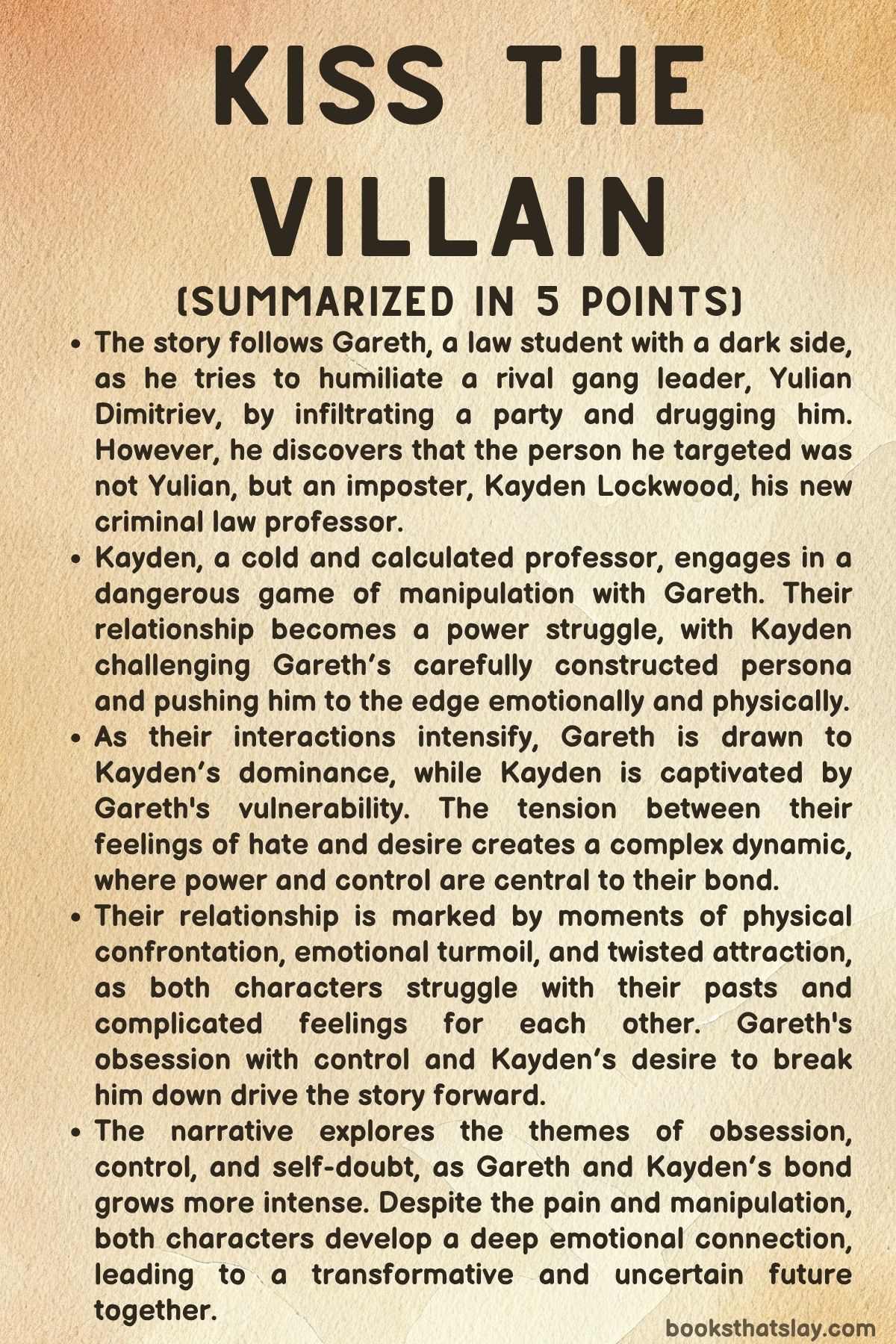
Summary
Gareth Carson is known as the perfect law student: intelligent, composed, charming, and destined for success. He hides the truth behind that polished surface. Beneath the image of the golden boy, he carries violent impulses, a need for control, and a talent for manipulation.
He is also connected to the Heathens, a secret society locked in rivalry with the Serpents. Gareth enters a Serpents party with a calculated plan to destroy Yulian Dimitriev, the Serpents’ leader. He intends to drug and publicly humiliate him, choosing ruin over murder because he fears what killing might awaken inside him.
The plan fails when Gareth realizes he has followed the wrong man. Before he can escape, a masked stranger catches him at gunpoint and exposes him. Gareth is used to controlling every room he enters, but this man is faster, crueler, and far more dangerous than he expects.
The stranger overpowers him and turns Gareth’s planned cruelty back on him. The encounter is coercive, violent, and meant as punishment for what Gareth intended to do to Yulian. Gareth leaves shaken, furious, and humiliated, but what disturbs him most is not only the violation. It is the way his body responds to pain, domination, and the stranger’s control.
Afterward, Gareth spirals. He scrubs himself, hurts himself, and tries to erase the memory, but nothing works. His rage becomes fixed on the stranger, and revenge becomes his new obsession.
Killian notices that Gareth is injured and unsettled, but Gareth hides the truth. He learns from Killian that Yulian has been provoking Vaughn, which gives Gareth new material for manipulation. Yet his focus is shattered when he attends class and discovers that his new criminal law professor is the same man who attacked him.
The professor is Kayden Lockwood.
Kayden immediately unsettles Gareth because he knows too much. His lectures on criminal responsibility and sexual assault feel aimed directly at Gareth. After class, their private exchange turns into a battle of threats, taunts, and barely restrained violence. Kayden offers Gareth an internship under him, but Gareth refuses, determined not to let Kayden hold power over his academic life too.
From Kayden’s point of view, Gareth is not simply a student. He is a dangerous puzzle. Kayden sees through the charming mask and recognizes Gareth’s cruelty, narcissism, and hidden brutality. Instead of avoiding him, Kayden becomes fascinated by him.
Kayden pushes Gareth in class, especially through a mock trial involving a rape case. He assigns Gareth the role of defense attorney, forcing him to use his intelligence in a way that exposes his moral emptiness and legal brilliance at the same time. Gareth performs well, but Kayden’s reaction is unexpectedly intense and angry, suggesting that the subject connects to something deeply personal in Kayden’s past.
Gareth decides to retaliate. He studies Kayden’s routine, hires a private investigator, breaks into his apartment, and injects him with a drug meant to make him lose control. Gareth wants to humiliate Kayden the way Kayden humiliated him.
But Kayden reverses the trap almost instantly. He turns the drug back on Gareth, restrains him, and once again breaks through his defenses. Gareth is terrified by how accurately Kayden reads him. Kayden identifies the masochistic reactions Gareth cannot admit to himself and uses praise, pain, and control to expose desires Gareth has buried under denial.
Gareth tries to flee the connection. He blocks Kayden, tells himself the game is over, and attempts to return to his old life. Kayden refuses to let him go. He attends the Heathens’ initiation, watches Gareth with Cherry, and reacts with possessive jealousy.
Their confrontation in the woods confirms that their conflict is no longer only revenge. Kayden claims Gareth with a terrifying certainty, demanding not only his body but his entire self. Gareth insists he cannot be owned, but the words affect him because Kayden has already reached a part of him no one else has touched.
After the initiation, Gareth begins questioning his sexuality and his desire for Kayden. He asks Nikolai for blunt advice, trying to understand attraction, roles, and the difference between choosing submission and being forced into surrender. Gareth insists he is not gay and not submissive, but his denial grows weaker.
The relationship shifts through repeated confrontations. Gareth tries to take control with weapons, threats, and manipulation, but Kayden usually turns the situation around. Yet the dynamic begins changing. Kayden does not only hurt Gareth; he cleans him, tends to him, praises him, and cares for him afterward. That gentleness confuses Gareth almost more than the violence.
Gareth crosses further into Kayden’s private life when he meets Kayden’s mothers, Rachel and Jina. He charms Rachel and irritates Jina, using the dinner to gather information about Kayden. What begins as a tactic becomes something more complicated, because Gareth finds himself drawn to the warmth of Kayden’s family.
Kayden is horrified by the meeting because Gareth has entered a part of his life he wanted to keep separate. His mothers sense that Gareth is not just a student. Rachel even suggests Kayden may have feelings for him, though Kayden denies it because of Gareth’s age, gender, student status, and their dangerous beginning.
As the weeks pass, Gareth’s jealousy grows harder to hide. He sees Kayden with Jessica, a colleague, and reacts with possessive anger. He also notices Morgan’s manipulation of Zara and becomes unexpectedly protective of Zara, showing that his own emotional awakening is making him more aware of harm around him.
Gareth and Kayden begin moving toward a clearer relationship, though neither is healthy or gentle in ordinary terms. Gareth admits he wants Kayden to overpower him, because forced surrender lets him experience desire without feeling like he has chosen vulnerability. Kayden understands this and gives Gareth the kind of control and loss of control he craves.
Their secret life becomes domestic in strange ways. Kayden stocks strawberries for Gareth. Gareth stays at his apartment. They take in an injured kitten named Moka, and the cat becomes a source of humor, tenderness, and partnership. Gareth is comically afraid of the kitten, while Kayden enjoys seeing him softer and less guarded.
Gareth also begins speaking with Vaughn anonymously online, not realizing at first who he is. Their conversations help Gareth process his attraction to Kayden and the terrifying intensity of his obsession. At the same time, Gareth wants to claim Kayden openly but knows the professor-student scandal could destroy Kayden’s career.
The relationship reaches an emotional milestone when Gareth finds Kayden sick with a fever and immediately takes care of him. In that vulnerable state, Kayden becomes more open, and they discuss a possible future. Gareth considers transferring to the United States, while Kayden hints that returning there is dangerous because of his family.
Soon after, Gareth receives proof that Kayden has a wife named Cassandra. The revelation devastates him. Kayden’s real name and past begin to surface, exposing that he is Kayden Davenport, heir to a powerful family tied to Vencor, a secretive organization built around political, corporate, and violent power.
Declan O’Connor, Cassandra’s brother, contacts Gareth and reveals Cassandra’s rape and murder, Kayden’s revenge campaign, and the possible involvement of Gareth’s family. Gareth meets Declan, already emotionally destroyed by the idea that Kayden lied to him and may have used him as part of a revenge plot.
Declan captures and tortures Gareth. Physical pain does not break him the way Declan expects, but Cassandra does. Gareth is forced to watch videos of Kayden with Cassandra, making him feel replaceable, deceived, and trapped by a dead woman he cannot fight.
Gareth’s childhood trauma also resurfaces. He remembers being warned by his grandfather never to become attached, never to let obsession control him, and never to let the world see him as a monster. Kayden has made him fail at every rule he was taught to survive by.
Kayden’s full history explains the deception. He was born into the Davenport family and raised by an abusive father, Harrod. He learned discipline, violence, and strategy as survival tools. His marriage to Cassandra was practical and based on partnership, not romantic love, but her murder triggered his revenge against everyone connected to her death.
Kayden originally planned to destroy Alexander Carson by killing his family, including Gareth. Instead, Gareth became the flaw in the plan. Kayden became obsessed with him, then attached, then unable to sacrifice him.
Kayden, Simone, and Jethro rescue Gareth from Declan. Gareth is injured, dissociated, and psychologically broken. Kayden takes him to a safe house and calls Alexander Carson, choosing Gareth’s safety over his original revenge.
When Gareth wakes, he is devastated by the betrayal. Kayden admits he first approached him for revenge but insists that his feelings became real. Gareth cannot accept it easily. Cassandra, the lies, and the idea of being a replacement cut too deeply.
Gareth returns home to recover and finally confronts parts of his family history. His father, Asher, reveals that he has long known Gareth carries darkness like Killian, but he avoided labeling him because he feared losing another son. Gareth realizes his father does not hate him the way he always believed.
Meanwhile, Declan releases footage exposing Gareth and Kayden’s relationship, endangering Kayden within Vencor. Kayden kills Declan but is forced into hiding. Gareth learns of the danger and finds him, unable to stay away despite the betrayal.
Their reunion is full of rage, longing, jealousy, and pain. Gareth confronts Kayden about Cassandra and the lies, while Kayden accepts his anger and still claims him. Kayden finally gives Gareth the truth he needs most: Cassandra mattered, but Gareth is the one who changed him completely.
Before they can fully repair the damage, the safe house is attacked. Gareth reacts to danger with excitement rather than fear, making him hard to protect. Kayden takes a bullet meant for Gareth, proving through action that Gareth’s life matters more than his own.
At the hospital, Gareth is terrified in a way he has never been before. Kayden’s possible death breaks through his final defenses. When Kayden wakes, they talk about their toxicity, violence, jealousy, and inability to be normal.
Gareth finally says he loves Kayden. Their love is obsessive and dangerous, but it is real because each man sees the other clearly and does not look away.
Months later, Gareth brings Kayden home to meet his family. The Carsons remain suspicious, especially Alexander, but Gareth openly claims and protects Kayden. He also comes out to his friends, creating chaos among the Heathens.
In the later future, Kayden and Gareth are together in Manhattan, still jealous, dramatic, possessive, and intense. What began as revenge has become commitment. They remain dangerous men, but now their bond is chosen rather than forced by revenge, secrecy, or fear.
Characters
Gareth Carson
In Kiss the Villain, Gareth Carson is the golden boy with a monster carefully locked beneath the surface. He is brilliant, elegant, controlled, and socially polished, which makes him frightening because his public identity is not fake in a simple way. It is a mask built from discipline, family pressure, and survival. Gareth knows how to perform perfection so well that people trust him even when he is planning harm behind their backs.
His darkness is rooted in control, obsession, and a deep fear of exposure. Gareth does not merely want to win; he wants to dominate the emotional and social meaning of every situation. His failed plan against Yulian shows how calculating he can be, but Kayden’s arrival destroys the illusion that Gareth is untouchable. Once Kayden sees through him, Gareth becomes obsessed not only because he hates being violated, but because Kayden recognizes the truth he has hidden from everyone else.
Gareth’s character arc is about unwanted self-knowledge. His desire for Kayden forces him to confront his sexuality, his need for pain, his hunger for praise, and his terror of emotional dependence. He repeatedly denies what he wants, then returns to it because Kayden gives form to needs he cannot safely admit.
His family relationships add another layer to him. Gareth fears being seen as defective, especially by his father, and he carries his grandfather’s warnings like survival rules. His eventual conversations with Asher and Alexander expose how much of his cruelty is tied to fear, shame, and the belief that love comes with the risk of being caged or rejected.
By the end, Gareth does not become gentle or morally clean. He becomes more honest about what he is and whom he loves. His devotion to Kayden is possessive, jealous, and extreme, but it is also the first bond that makes him feel fully seen.
Kayden Lockwood / Kayden Davenport
Kayden Lockwood, later revealed as Kayden Davenport, stands at the center of Kiss the Villain as Gareth’s enemy, professor, punisher, protector, and lover. He enters the story as a masked threat, then reappears as a criminal law professor, making his power over Gareth both physical and institutional. That dual position makes him dangerous from the start, because he uses knowledge, authority, and psychological insight as weapons.
Kayden is controlled in a colder, older way than Gareth. He has learned to survive through discipline, planning, and violence. His history with the Davenport family explains much of that hardness. Raised under an abusive father and shaped by Vencor’s brutal world, Kayden became someone who could endure pain, inflict it, and treat revenge as a long-term mission.
His relationship with Cassandra is essential to understanding him. Their marriage was based on partnership and loyalty rather than romantic passion, but her murder became the event that fixed him on revenge. His original plan to use Gareth as a route to destroy the Carson family makes him morally compromised long before he admits his feelings.
Kayden’s growth comes through the failure of that revenge plan. Gareth stops being a target and becomes the person Kayden cannot sacrifice. Kayden still remains controlling, possessive, jealous, and dangerous, but his care becomes undeniable through repeated acts: tending Gareth’s injuries, protecting him from Declan, choosing to alert Alexander, and taking a bullet for him.
Kayden is not redeemed in a clean or traditional way. He is changed by love, but not softened into someone harmless. His final bond with Gareth works because he accepts Gareth’s darkness while also giving him care, structure, and fierce loyalty.
Cassandra Davenport
Cassandra is dead before the main relationship fully unfolds, yet her presence shapes the emotional and revenge plot. She represents Kayden’s past, his guilt, and the wound that turned his life into a mission. Her rape and murder are the foundation of his campaign against those he believes were connected to her death.
Cassandra is not presented as a simple romantic rival. Her marriage to Kayden was important, but it was practical and rooted in alliance, friendship, and shared circumstances. This distinction becomes crucial because Gareth’s jealousy turns her into a haunting figure in his mind. He cannot compete with a dead woman, cannot punish her, and cannot erase what she meant to Kayden.
For Gareth, Cassandra becomes the proof of every insecurity. She makes him feel like a replacement, a secret, and a pawn in Kayden’s revenge. Declan exploits that weakness by forcing Gareth to watch evidence of Kayden’s past with her, knowing emotional jealousy will hurt Gareth more than physical torture.
Cassandra’s role is tragic because her suffering fuels the destructive choices of the living. She is not active in the present, but she forces Kayden and Gareth to confront the difference between loyalty to the past and love in the present.
Alexander Carson
Alexander Carson is Gareth’s grandfather and one of the strongest influences on his psychology. He understands Gareth’s darkness better than most people and has spent years teaching him rules meant to keep him controlled, protected, and hidden. His warnings about obsession reveal that he knows attachment can become dangerous for Gareth.
Alexander is protective, but his protection often feels cold. He treats Gareth like someone who must be managed, not simply loved. That approach helps Gareth survive, but it also teaches him to fear his own emotions and to view love as a weakness that can expose him.
His possible connection to the events around Cassandra’s death makes him central to the revenge plot. Kayden’s original plan targets the Carson family because of what Alexander may have enabled or protected. This makes Alexander both a family patriarch and a symbol of inherited power, secrecy, and moral compromise.
His hostility toward Kayden later comes from more than pride. He sees Kayden as a threat who hurt Gareth, used him, and dragged him into deadly politics. Yet Alexander’s relationship with Gareth remains complicated because his control is mixed with real concern.
Asher Carson
Asher Carson is Gareth’s father, and his relationship with Gareth carries years of misunderstanding. Gareth believes Asher sees him as wrong, damaged, or unwanted. That fear feeds Gareth’s polished performance because he wants approval while also expecting rejection.
Asher’s later confession changes the emotional meaning of their bond. He admits that he has long known Gareth shares traits with Killian, but he avoided naming them because he feared what a diagnosis or label could do to his son. His silence was not hatred, though Gareth experienced it as distance.
Asher represents a quieter form of parental love. He is not always emotionally direct, and his fear creates harm even when his intention is protection. When Gareth finally reveals what happened to him and admits that some wounds were self-inflicted, Asher’s response helps Gareth see that his father does not despise him.
Their relationship is important because it loosens one of Gareth’s deepest fears. Gareth has spent much of his life believing he must hide to remain accepted. Asher’s reaction suggests that love can exist even after the truth is spoken.
Killian Carson
Killian is Gareth’s brother and one of the few people who senses when Gareth is not in control. He notices Gareth’s injuries and unstable behavior early, which shows that he understands the darker emotional language of their family. Killian’s presence often reminds Gareth of what he both fears and envies.
Gareth sees Killian’s bond with their father and feels the ache of comparison. Killian appears to occupy a place Gareth wants but does not believe he deserves. This makes Killian important not only as a brother but as a mirror for Gareth’s insecurity about paternal approval.
Killian is sharp, suspicious, and protective. His reactions to Kayden are shaped by loyalty to Gareth and awareness that something dangerous has happened. He is not easily fooled by surface charm, which makes him one of the characters who can challenge Gareth’s performance of normality.
In the wider friend group, Killian also adds tension and dark humor. He belongs to the same world of dangerous young men, but his role in Gareth’s arc is especially personal because he reflects the family pattern Gareth has always struggled to understand.
Nikolai
Nikolai is one of the most direct and chaotic voices in Gareth’s circle. He becomes important because Gareth turns to him when he is confused about sexuality, desire, and what it means to want a man. Nikolai’s bluntness cuts through Gareth’s denial in a way softer advice could not.
He does not treat Gareth’s questions with the same shame Gareth feels. Instead, Nikolai speaks with frankness, humor, and a lack of fear around labels. This matters because Gareth is used to controlling language and image, but Nikolai makes attraction seem messier and less controllable.
Nikolai also brings energy to the group dynamic. His reactions are often loud, teasing, and dramatic, especially later when Gareth comes out to his friends. Beneath that chaos, however, he functions as a kind of emotional pressure valve. He says what others might avoid saying.
His friendship with Gareth matters because he helps normalize confusion without making it gentle or sentimental. For a character like Gareth, that blunt honesty is more useful than comfort.
Yulian Dimitriev
Yulian Dimitriev begins as Gareth’s intended target. As the leader of the Serpents, he represents rivalry, danger, and a social order that Gareth wants to disrupt. Gareth’s plan to humiliate him reveals more about Gareth than about Yulian, but Yulian’s importance grows through his connection to Vaughn and Kayden.
Yulian’s obsession with Vaughn creates tension across the wider social network. His provocation of Vaughn through Cherry and his casual closeness with Kayden become triggers for jealousy and conflict. To Gareth, Yulian is not only an enemy; he becomes part of the emotional landscape that exposes Gareth’s possessiveness.
His relationship with Kayden also unsettles Gareth because Yulian can touch or approach Kayden publicly in ways Gareth cannot. This makes Yulian a symbol of everything Gareth resents about secrecy. Gareth wants ownership, but secrecy forces him to watch others move around Kayden without the same limits.
Yulian’s role is partly external conflict and partly emotional provocation. He helps expose how quickly Gareth’s rivalry turns into jealousy once Kayden becomes the center of his world.
Vaughn
Vaughn is tied closely to Yulian’s storyline and also becomes an unexpected sounding board for Gareth. Through anonymous texts, Gareth talks to “V” about attraction, obsession, and confusion before fully realizing he is speaking with Vaughn. This creates an unusual intimacy between two characters caught in dangerous emotional situations.
Vaughn’s role is important because he gives Gareth space to process his feelings without the pressure of direct confession. Gareth can ask questions and reveal uncertainty because the conversation feels removed from his public identity. For someone obsessed with image, that distance matters.
Vaughn also reflects a parallel struggle. His connection to Yulian suggests another relationship marked by tension, obsession, and unresolved desire. This parallel makes Gareth’s situation feel part of a wider pattern among the characters, where attraction often arrives through conflict rather than safety.
Although Vaughn is not the central focus, he helps Gareth move from denial toward acknowledgment. His presence also sets up future conflict beyond Gareth and Kayden’s story.
Cherry
Cherry is connected to the Heathens’ initiation and to the conflict between Yulian and Vaughn. Gareth invites her as part of his wider attempt to use social tension as leverage. In that sense, Cherry initially appears as a tool in Gareth’s plans.
Her presence at the initiation helps show how Gareth’s old methods work. He is used to positioning people like pieces in a game, especially when he wants to provoke rivals or gather advantage. Cherry becomes part of that strategy before Kayden’s arrival disrupts the entire event.
Cherry also matters because Kayden sees Gareth with her and reacts possessively. Her role therefore shifts from social pawn to emotional trigger. She helps reveal that Kayden is no longer observing Gareth from a distance; he wants to control who gets access to him.
Though Cherry is not deeply explored, her function is clear. She helps expose the difference between Gareth’s old life of manipulation and the new obsession that makes those old games harder to maintain.
Morgan
Morgan represents emotional manipulation in a more everyday but still damaging form. Gareth observes how she treats Zara and recognizes a pattern of keeping someone attached while using their affection for attention and support. His anger at Morgan is important because it shows his perception changing.
Earlier in the story, Gareth might have dismissed that kind of emotional harm unless it served his own plans. His relationship with Kayden makes him more sensitive to possessiveness, dishonesty, and being emotionally used. Morgan becomes a mirror through which Gareth sees exploitation outside himself.
She also triggers questions about attachment and power. Morgan’s behavior toward Zara is not as extreme as the violence around Gareth and Kayden, but it belongs to the same emotional world of control, need, and imbalance. Gareth’s reaction suggests that he is beginning to understand how painful it is to be kept in uncertainty.
Morgan’s role is small but useful. She shows that emotional cruelty does not always need weapons or secret societies; sometimes it appears through selfish attention and refusal to let someone go.
Zara
Zara is important because she becomes the person Gareth unexpectedly defends. Her attachment to Morgan places her in a vulnerable position, and Gareth sees that vulnerability more clearly as his own relationship with Kayden forces him to understand jealousy and longing.
Zara’s situation matters because it shows how uneven attachment can damage someone. She appears emotionally hooked on Morgan, while Morgan benefits from that devotion without giving her the honesty or commitment she deserves. Gareth’s anger on Zara’s behalf reveals an emerging protective instinct.
Through Zara, the story shows that Gareth is not incapable of recognizing pain in others. His empathy is limited, rough, and filtered through his own possessive nature, but it exists. He understands being consumed by someone who may not fully belong to you.
Zara’s role also broadens the emotional field of the book. Her pain is quieter than Gareth’s trauma or Kayden’s revenge, but it still adds to the story’s interest in longing, imbalance, and emotional dependency.
Rachel
Rachel is one of Kayden’s mothers and brings warmth into a story dominated by violence, secrecy, and control. Her presence reveals a softer part of Kayden’s life that he has tried to keep protected. When Gareth meets her, he sees a domestic world he did not expect.
Rachel is perceptive and emotionally open. She quickly senses that Gareth is not merely a student and that Kayden’s feelings are more complicated than he admits. Her gentle confrontation with Kayden shows her understanding of him and her willingness to push past his defenses.
Her warmth also affects Gareth. He initially uses charm as a weapon, hoping to gather information and irritate Kayden, but Rachel’s kindness gives him something he is not fully prepared for. She becomes part of the comfort and belonging that slowly attach him to Kayden’s world.
Rachel’s role is important because she humanizes Kayden without excusing him. Through her, readers see that Kayden is not only a product of abuse and revenge; he is also someone loved by people who want him safe.
Jina
Jina, Kayden’s other mother, is more suspicious and protective than Rachel. She does not receive Gareth’s charm as easily, which makes her a strong contrast to Rachel’s warmth. Her guarded reaction shows that she understands danger when it enters her family’s space.
Jina’s protectiveness adds realism to Kayden’s family dynamic. She is not eager to welcome Gareth simply because he is charming or important to Kayden. Given Kayden’s hidden life, his trauma, and the risk surrounding him, her suspicion feels earned.
Her presence also challenges Gareth’s usual social strategy. Gareth can often manipulate people through polish, but Jina is harder to impress. This matters because it places Gareth in a family setting where performance alone may not be enough.
Jina helps show the cost of Kayden’s secrets. Her concern is not just about Gareth as a person, but about Kayden’s habit of hiding pain and danger from the people who love him.
Declan O’Connor
Declan O’Connor is one of the most destructive external antagonists in the book. As Cassandra’s brother, he carries grief, rage, and a desire for revenge that mirrors Kayden’s own mission. His actions force the hidden past into the present and nearly destroy Gareth emotionally.
Declan understands that Gareth’s body is not the easiest way to break him. Physical torture does not produce the reaction Declan wants, so he targets jealousy, insecurity, and Cassandra. This makes him dangerous because he can identify emotional pressure points and use them without hesitation.
His decision to force Gareth to watch Kayden’s past with Cassandra is calculated cruelty. He turns love into a weapon and makes Gareth doubt every moment he shared with Kayden. In doing so, he exposes the weakest part of Gareth’s obsession: the fear of being replaceable.
Declan’s final act of releasing footage also extends his damage beyond death. He threatens Kayden’s position in Vencor and forces Gareth and Kayden into another crisis. His role is vital because he is the character who makes betrayal public, personal, and deadly.
Simone
Simone is one of Kayden’s trusted allies and becomes a key figure in the rescue and protection parts of the plot. She belongs to Kayden’s dangerous world, but she also shows loyalty that is practical, steady, and grounded in action.
Her role becomes especially important after Gareth is taken. She helps Kayden rescue him and later shadows Gareth, even when he resents being watched. Her protection shows how seriously Kayden values Gareth’s safety, even when he is trying to give Gareth space.
Simone also acts as a source of information. She tells Gareth more about Vencor, Declan, and the danger surrounding Kayden. When she reveals the leaked footage, she becomes the person who pushes Gareth to understand that staying away from Kayden will not restore normal life.
She is not emotionally loud, but she is effective. Simone represents loyalty in a world where loyalty often comes with violence, secrecy, and difficult choices.
Jethro
Jethro is another important ally in Kayden’s circle. He helps Kayden gain access to the Heathens’ initiation and later takes part in the dangerous operations surrounding Gareth’s rescue and Kayden’s survival. His presence connects Kayden to a wider network of people who understand the risks he is taking.
Jethro also serves as a warning voice. He recognizes that Kayden’s obsession with Gareth is becoming reckless and tries to confront him with that reality. This matters because Kayden is usually the one analyzing others, but Jethro sees through him.
His role emphasizes how far Kayden’s priorities shift. People around Kayden can see that Gareth has become more than a target or distraction. Jethro’s concern helps underline the danger of Kayden allowing emotion to disrupt revenge and strategy.
Jethro is not central emotionally in the same way Gareth, Kayden, or Cassandra are, but he helps show the structure around Kayden’s life. Through him, Kayden’s secret world feels organized, loyal, and dangerous.
Harrod Davenport
Harrod Davenport is Kayden’s abusive father and one of the roots of Kayden’s hardness. His punishments teach Kayden that survival requires discipline, endurance, and control. The ice bath ritual shows how deeply Harrod’s cruelty has marked Kayden’s body and mind.
Harrod’s influence explains why Kayden approaches pain with such cold familiarity. Kayden does not treat suffering as unusual; he treats it as a language he learned early. This makes his relationship with Gareth more complex because Kayden recognizes darkness through experience, not theory.
Harrod also represents the violence of inherited power. The Davenport name is tied to Vencor, status, and control, and Harrod’s abuse reflects the personal brutality beneath that public power. He shapes Kayden into someone capable of both strategy and cruelty.
Although Harrod is not present in every major event, his shadow is everywhere in Kayden’s behavior. He is one of the reasons Kayden fears vulnerability and uses control before he risks trust.
Glyn
Glyn appears within the wider Heathens and family-adjacent circle, contributing to the social world Gareth moves through while trying to hide his fixation on Kayden. Her presence helps show that Gareth does not exist only inside his relationship. He has friends, loyalties, and group dynamics that continue even as Kayden consumes his thoughts.
Glyn is also connected to Killian and the emotional atmosphere around the Carsons and their circle. Through characters like her, the book gives glimpses of other relationships and tensions that run alongside Gareth’s main arc.
Her role is not as dominant as Gareth’s or Kayden’s, but she helps reveal how difficult it is for Gareth to act normal once his private life begins changing. Around people like Glyn, he must maintain the mask even when he is internally unstable.
Glyn’s importance lies in the social texture she adds. She helps make the Heathens feel like a living circle rather than a background label.
Jeremy
Jeremy is part of the Heathens’ wider circle and functions as one of the people who reacts to Gareth’s changing life. His calm response when Gareth comes out contrasts with the louder reactions of others, especially Nikolai’s excitement and Killian’s sharpness.
That calmness matters because Gareth’s world is often built on extremes. Jeremy’s steadier presence helps balance the group and shows that not every reaction to Gareth’s truth is chaotic or threatening.
Jeremy also helps define the social stakes of Gareth and Kayden’s relationship. Gareth’s coming out is not just private; it changes how he stands among friends who know him through danger, secrecy, and loyalty.
Though Jeremy does not drive the central plot, his role strengthens the later scenes of acceptance and adjustment. He helps show that Gareth’s life continues beyond crisis and that his social circle must make room for the truth.
Brandon
Brandon appears in the wider circle surrounding Gareth, the Heathens, and the later family-social scenes. His role helps build the sense of a connected world where each relationship hints at other stories, loyalties, and emotional complications.
In Gareth’s arc, Brandon matters less as a direct influence and more as part of the environment Gareth must face after choosing Kayden. The later scenes show Gareth interacting with friends and family in a more open way, and Brandon belongs to that expanded space.
Brandon’s presence also highlights how Gareth’s relationship with Kayden does not exist in isolation. Once Gareth becomes more open, everyone around him must adjust to the reality of Kayden’s place in his life.
He is a supporting figure, but he contributes to the social continuity of the ending. His presence makes the world feel ongoing rather than closed after the central couple’s resolution.
Jessica
Jessica is Kayden’s colleague and becomes important because of Gareth’s jealousy. When Gareth sees Kayden smiling at her, he reacts with possessive anger that he tries to deny or reframe. Jessica herself is not the problem; Gareth’s fear of replacement is.
Her role exposes how little control Gareth has over his attachment. He can rationalize violence and strategy, but a simple smile between Kayden and another person destabilizes him. This reveals that his relationship with Kayden has moved far beyond curiosity or revenge.
Jessica also helps show the secrecy problem. Because Gareth cannot publicly claim Kayden, ordinary interactions become unbearable to him. He reads closeness as threat because he has no official place in Kayden’s life.
As a character, Jessica functions mainly as a catalyst. She brings Gareth’s jealousy into the open and forces him to admit, at least indirectly, that he wants Kayden exclusively.
Nadine
Nadine appears as someone Gareth uses to investigate Kayden’s past lovers. Her role is small but revealing because Gareth’s need for information exposes the possessive and insecure side of his attachment.
Gareth does not simply want Kayden; he wants to map every person who came before him. Nadine becomes part of that attempt to control the unknown. Through her, the story shows Gareth trying to turn jealousy into research, as if facts can protect him from emotional pain.
Her role also shows how Gareth’s old methods still operate inside his new feelings. He investigates, gathers, analyzes, and compares. Love does not make him less controlling; it gives him more reasons to control.
Nadine’s importance lies in what she reveals about Gareth rather than in her own arc. She helps expose how deeply Kayden has entered Gareth’s mind.
David
David is connected to Gareth’s past violence and the darker history Gareth carries before Kayden. The mention of his killing reveals that Gareth’s danger is not hypothetical. He has already crossed lines that most people never approach.
David’s role matters because it prevents Gareth’s darkness from being treated as mere fantasy or attitude. Gareth’s violent impulses have consequences, and his family’s efforts to protect or manage him are tied to real events.
This past also shapes Gareth’s fear of being discovered. He knows what he is capable of, and he knows others have helped keep parts of him hidden. That secrecy feeds his dependence on control.
David is not a present-tense character in the romantic arc, but he is crucial to understanding Gareth’s self-image. He is part of the evidence Gareth carries against himself.
Moka
Moka, the injured kitten Kayden and Gareth rescue, becomes one of the clearest symbols of unexpected tenderness in the book. The cat enters during a moment that could have stayed tense and dark, but instead creates humor, care, and domestic intimacy.
Gareth’s fear of Moka is both funny and revealing. He can face weapons, pain, and dangerous men with disturbing calm, yet a tiny kitten makes him suspicious and uneasy. This contrast shows a side of Gareth that is almost absurdly vulnerable.
Moka also gives Kayden and Gareth something to care for together. Feeding, shopping for, and living around the cat turns their relationship into something that looks like partnership. Their bond is still toxic and intense, but Moka brings routine and softness into it.
The kitten matters because care becomes physical and ordinary. In a relationship built on revenge, violence, and obsession, Moka creates space for small acts of shared responsibility.
Kane
Kane appears later as Kayden’s nephew and becomes a source of humor and jealousy. Gareth is delighted by him, which irritates Kayden in a comically possessive way. This scene shows that Kayden’s jealousy has not vanished, even after the relationship becomes more stable.
Kane’s role is also connected to the future of the wider story world. His appearance suggests that Kayden and Gareth’s ending is not the end of every conflict, especially with Vencor and other relationships still active around them.
For Gareth, Kane’s presence reveals a lighter side. His excitement around Kayden’s nephew shows that he can attach with enthusiasm outside violence and rivalry, even if Kayden reacts dramatically to sharing his attention.
Kane helps close the book on a note of ongoing life. Gareth and Kayden remain intense, but their world has expanded into family, future, and new complications.
Themes
Obsession as Possession
Obsession in Kiss the Villain is not treated as a temporary fixation or simple attraction. It becomes a form of possession, where wanting someone means needing control over their body, attention, past, and future. Gareth’s attachment to Kayden begins through rage, humiliation, and revenge, but it soon becomes clear that hatred is only one layer of his fixation. He cannot stop watching Kayden, thinking about him, reacting to him, and measuring everyone else by their access to him.
Kayden’s obsession develops in a parallel way. He initially approaches Gareth as part of revenge, but Gareth becomes the one person who disrupts his discipline. Kayden wants to punish him, study him, own him, protect him, and keep him. The danger comes from the fact that neither man understands love as freedom. Their emotional language is built from claims, marks, jealousy, threats, and devotion that borders on destruction.
The theme becomes most intense through Cassandra. Gareth’s jealousy of a dead woman proves that possession in this story reaches beyond the present. He wants Kayden so completely that even Kayden’s past feels like an enemy. The book uses this obsession to show love at its most extreme, where being chosen is not enough unless every rival, memory, and doubt is defeated.
Control, Surrender, and Power
Control shapes nearly every important exchange between Gareth and Kayden. Gareth’s life is built around control: his image, his academic success, his family reputation, his violence, and his desires. He survives by making sure no one sees too much. Kayden destroys that safety by recognizing what Gareth hides and forcing him into situations where control becomes unstable.
What makes the power dynamic complicated is that Gareth does not simply want to lose control. He wants to fight, resist, and be overpowered, because that allows him to experience surrender without admitting he chose it. This creates one of the central tensions of the relationship. Gareth wants the emotional relief of being taken apart, but he also needs to preserve the belief that he did not willingly hand over power.
Kayden understands this contradiction with frightening accuracy. He uses pain, praise, restraint, and care to reach Gareth in ways ordinary intimacy cannot. Yet Kayden’s own control also weakens. The more he tries to own Gareth, the more Gareth begins to own him emotionally. Their relationship becomes a constant exchange where the person holding physical power is not always the person with the deepest emotional power.
By the end, control is no longer something either man fully wins. It becomes the language through which they negotiate fear, need, trust, and love.
Trauma, Revenge, and the Cost of Survival
Trauma in the novel is not limited to memory. It becomes behavior, strategy, instinct, and identity. Kayden’s past with Harrod Davenport teaches him that pain is discipline and that survival requires obedience, violence, and secrecy. Cassandra’s murder then transforms his life into a revenge mission, giving him a target but also trapping him inside the past.
Gareth’s trauma is different but equally shaping. He grows up knowing there is something dangerous inside him, something his family tries to manage through silence, rules, and protection. His grandfather’s warnings teach him to fear obsession, while his father’s emotional distance makes him believe he is unwanted or defective. Gareth’s self-harm after losing control shows that his greatest fear is not pain itself, but exposure and helplessness.
Revenge gives both men a sense of purpose, but it also distorts everything it touches. Kayden’s plan against the Carsons brings him to Gareth, but it also poisons their relationship with deception. Declan’s revenge for Cassandra’s death leads him to torture Gareth, repeating the cycle of harm rather than ending it.
The theme shows that survival can create monsters without making them simple villains. Kayden and Gareth are responsible for their choices, but their worst actions are tied to worlds that taught them cruelty before they knew safety.
Love Outside Normal Morality
The love between Gareth and Kayden is not presented as healthy by ordinary standards. It is jealous, violent, possessive, secretive, and shaped by betrayal. Yet the story does not ask the reader to mistake it for a gentle romance. Instead, it examines a bond between two people who would not fit safely into a softer version of love.
Gareth needs someone who sees the full extent of his darkness and does not recoil. Kayden needs someone who breaks through his revenge, discipline, and emotional numbness. Their connection works in the story because neither man is asking the other to become normal. They demand honesty, ownership, and devotion, even when those demands become dangerous.
The hospital scene clarifies this theme. When Kayden takes a bullet for Gareth and Gareth finally admits love, their relationship reaches truth through crisis rather than peace. They know they are toxic. They know jealousy and violence will not disappear. What changes is the choice to face those truths together instead of hiding behind revenge or denial.
This theme is unsettling because it separates love from moral cleanliness. The book presents a relationship that is wrong by many external measures, yet emotionally necessary for the two people inside it.ous men, but they now belong to each other by choice rather than manipulation.