Whidbey Summary, Characters and Themes
Whidbey by T. Kira Mahealani Madden is a dark literary novel about survival, public exposure, revenge, and the uneasy space between truth and justice. The story follows Birdie Chang, a woman trying to escape the renewed attention around the man who abused her as a child.
When another survivor publishes a bestselling memoir that includes Birdie’s story without her consent, Birdie flees to Whidbey Island under a false name. What begins as an attempt to hide becomes a tense reckoning with memory, blame, anger, and the consequences of what survivors are forced to carry.
Summary
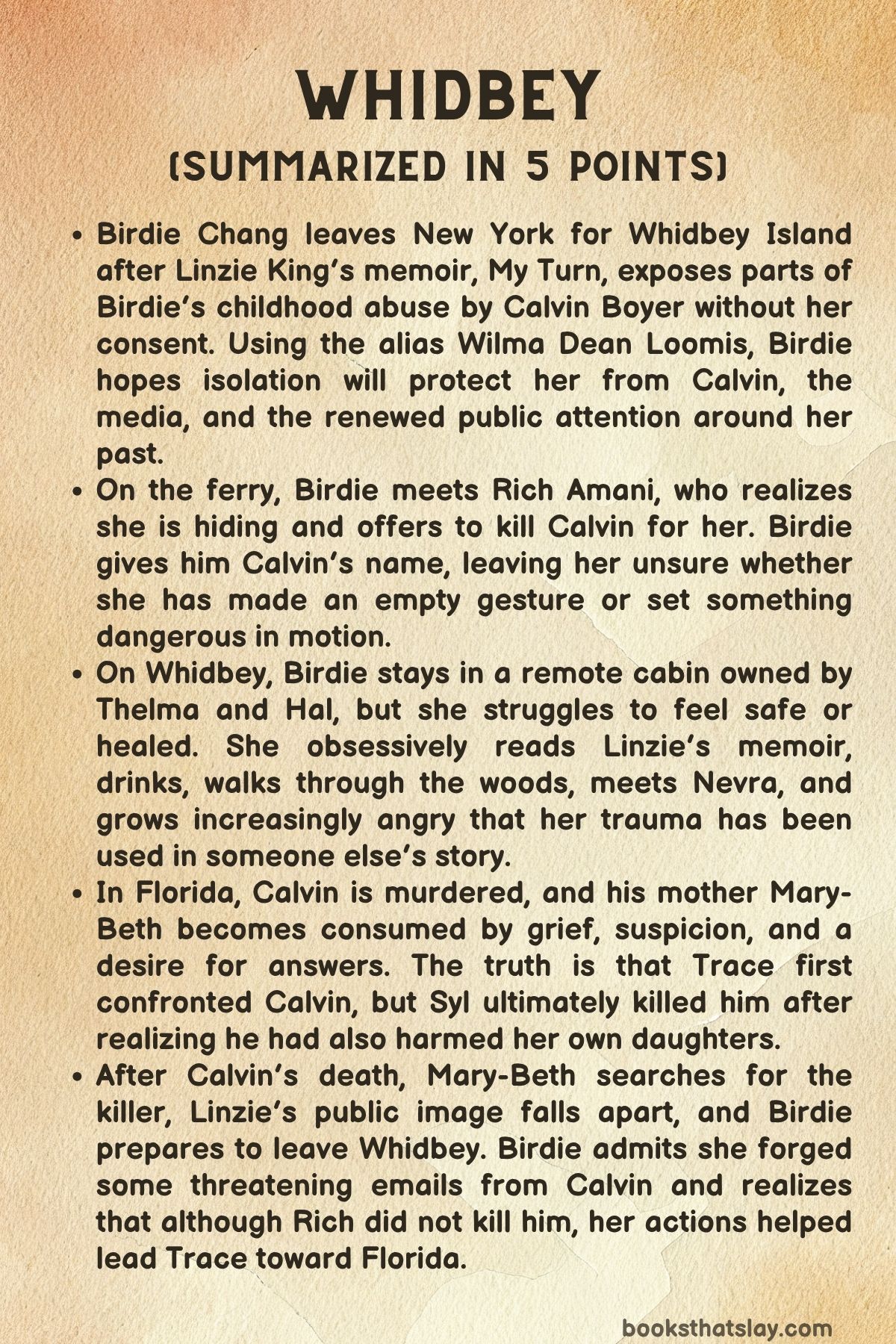
Birdie Chang leaves New York after Linzie King publishes Whidbey, a bestselling memoir about surviving Calvin Boyer, the man who abused Birdie when she was nine years old. Linzie’s book becomes a major public event, and although Birdie is not named directly, her story appears under the disguised name Jade Suzuki.
The details are close enough to make Birdie feel recognized, exposed, and used. Linzie has relied on court records and private material, turning Birdie’s childhood trauma into part of her own story without Birdie’s permission.
For Birdie, the memoir does not feel like justice. It feels like another violation.
Birdie flees to Whidbey Island using the alias Wilma Dean Loomis. She hopes the distance from New York, the island’s isolation, and the lack of reliable cell service will protect her from Calvin, from journalists, from Linzie’s fame, and from everyone suddenly interested in the case again.
On the ferry, she meets Rich Amani, an unsettling stranger who quickly senses that she is hiding. He presses her until she admits that she is afraid of Calvin.
Rich responds by offering to kill Calvin for her. Birdie does not fully believe him, but she also does not completely reject the idea.
In a moment shaped by fear, rage, and curiosity, she gives him Calvin’s name.
On Whidbey, Birdie rents a remote cabin owned by Thelma and Hal. She intends to rest, recover, and vanish into the quiet, but the island does not bring peace.
Instead, she becomes consumed by Linzie’s memoir. She reads it obsessively, drinking heavily and moving through the woods in a state of agitation.
Every page seems to reopen what Calvin did and what the legal system failed to stop. Birdie is furious that Linzie has become the public face of survival while using Birdie’s pain as part of her own rise.
The book has made Calvin visible again, and by doing so, it has made Birdie feel hunted.
Birdie tries to hide inside her alias, but the past keeps reaching her. She meets Nevra, another tenant, and becomes involved in the quiet rhythms of Thelma and Hal’s property.
These relationships offer some human contact, yet Birdie remains guarded and unstable. Her thoughts return again and again to Calvin, Linzie, and Rich.
She wonders whether Rich was serious, whether she wanted him to be serious, and whether giving him Calvin’s name has made her responsible for something she cannot control.
Meanwhile, in Florida, Calvin’s mother, Mary-Beth Boyer, learns that her son has been killed. Her sister Syl arrives and takes control of the situation, driving Mary-Beth to Gateway to Grace, the reentry compound where Calvin had been living.
Mary-Beth expects to identify Calvin’s body, but instead she is shown the road where he was struck. Later, at the station, she sees graphic photographs of his injuries.
Her grief hardens into anger. She believes Calvin was targeted because of the sex offender registry, because of Linzie’s memoir, and because the public had already decided he deserved harm.
Mary-Beth begins looking for someone to blame. She suspects locals near Gateway to Grace, Calvin’s father Tommy, Linzie, Birdie, and Birdie’s girlfriend Trace.
To Mary-Beth, Calvin is still her child, and she cannot accept that anyone had the right to kill him, no matter what he did. Her grief exists beside denial, bitterness, and the need to defend the son she loved.
As she searches for answers, she becomes part of the same public story that Birdie is trying to escape.
Trace visits Birdie on Whidbey, but her presence does not calm Birdie. Their relationship is strained by Birdie’s secrecy, anger, and inability to feel safe.
Trace wants to help, but she cannot reach the part of Birdie that is still trapped in the past. Birdie learns that Linzie is scheduled to appear at a bookstore event in Seattle and secretly goes there.
The event is canceled when news breaks that Calvin has been murdered. Birdie stays with Trace’s cousin Havi and later calls Trace.
During that call, Trace tells her that Calvin’s death was not an accident but murder.
The truth of Calvin’s death emerges gradually. After leaving Birdie, Trace did not return to New York as expected.
Instead, she flew to Florida. She went to a bar near Gateway to Grace, where she met locals who were angry about the men living at the compound.
Trace joined them as they drove to Gateway during Fourth of July fireworks. There, they found Calvin outside.
Trace confronted him and attacked him with a golf club, but Calvin managed to run away. Trace’s actions came from love, rage, and a desire to do what the system had not done.
Yet she did not kill him.
At the same time, Syl had also gone to Gateway to Grace. Her reasons were private and far more complicated than Mary-Beth knew.
Syl had discovered that Calvin had harmed her own daughters years earlier. She had carried that knowledge in silence, and her visit to the compound was shaped by fury, guilt, and the need to face what had happened within her own family.
After leaving Gateway, Syl saw Calvin injured, barefoot, and running in the road with attackers behind him. Instead of helping him, she drove into him.
Then she reversed and ran over him again and again, killing him.
Calvin’s murder remains publicly unresolved. Mary-Beth continues to grieve and search for answers.
She appears on television and works with a podcaster named Odette, hoping to control the story of her son’s death and expose whoever killed him. Her search is filled with suspicion, but she does not know the full truth.
She sees Calvin as a victim of public hatred, while others see his death as the result of harm he caused and harm that was never properly answered.
Linzie’s public success begins to collapse as more truths come out. Her memoir had made her famous, but the story around her becomes less stable when it is revealed that her father, Doug, also abused her.
Linzie’s own life is marked by damage, anger, and performance. Eventually, she poisons Doug.
This act changes the meaning of her public image and complicates the idea that telling the truth automatically leads to healing or justice. Linzie is both survivor and exploiter, both wounded and dangerous.
Birdie eventually prepares to leave Whidbey. She plans to find Francine, another survivor connected to Calvin, and then return to New York.
She also intends to end her relationship with Trace and begin again, though she understands that a clean beginning may not be possible. Near the end, Birdie admits that she forged some of Calvin’s threatening emails, hoping authorities would finally treat him as dangerous.
This confession reveals how desperate she had become and how little faith she had in any system meant to protect her.
Birdie also realizes that Rich did not kill Calvin. The danger did not come from the strange man on the ferry, but from the chain of fear and anger Birdie helped set in motion.
By telling Trace about Rich and Calvin, she pushed Trace toward Florida, and Trace’s actions helped lead Calvin into Syl’s path. Birdie did not murder Calvin, but she is not untouched by what happened.
Whidbey ends with Birdie facing the difficult truth that survival does not free a person from consequence, and that justice, revenge, and healing can become painfully hard to separate.
Characters
T. Kira Mahealani Madden’s Whidbey presents its characters through trauma, secrecy, guilt, public exposure, and the complicated desire for justice. Each character is shaped by what they reveal, what they hide, and how they respond when private pain becomes public knowledge.
Birdie Chang
Birdie Chang is the central figure of the book and one of its most emotionally complex characters. She leaves New York for the island because she wants to escape Calvin Boyer, the media attention surrounding Linzie King’s memoir, and the sudden revival of a past she has spent years trying to survive.
Her use of the alias Wilma Dean Loomis shows how deeply she wants to disappear, but it also reveals that she cannot fully separate herself from what happened to her. Birdie’s journey is not simply a search for safety; it is a struggle with identity, memory, anger, and the feeling that other people have taken ownership of her suffering.
Birdie’s relationship with Linzie’s memoir is especially important because it exposes the difference between being remembered and being used. She is furious that Linzie includes her story under the name Jade Suzuki, because even though the name is changed, the emotional violation remains real.
Birdie feels that her trauma has been turned into material for someone else’s fame, and this deepens her sense of helplessness. Her obsessive reading of the memoir shows that she cannot look away from the version of herself that has been placed before the public.
She wants to reject the book, but she also keeps returning to it because it contains pieces of her life that she never agreed to share.
Birdie is also morally complicated because her fear and anger push her into choices that have serious consequences. When Rich Amani offers to kill Calvin, Birdie gives him Calvin’s name partly as a test and partly because some part of her wants Calvin gone.
Later, the revelation that she forged some of Calvin’s threatening emails shows how desperate she had become for the system to recognize him as dangerous. This does not make Birdie cruel or simple; instead, it shows how abandoned she feels by official justice.
Her actions come from pain, but the book does not allow that pain to erase the consequences of what she sets in motion.
By the end of the story, Birdie begins to face the truth that escape alone cannot heal her. Leaving the island, planning to find Francine, and deciding to return to New York all suggest that she is ready to move toward a more honest life.
Her decision to end things with Trace also shows that she recognizes how deeply their relationship has become tied to fear, secrecy, and violence. Birdie’s character arc is not about perfect recovery, but about beginning again after years of being defined by danger, silence, and survival.
Linzie King
Linzie King is one of the most powerful and troubling figures in the book because she turns trauma into public testimony, fame, and controversy. Her memoir about surviving Calvin Boyer gives her a platform and briefly makes her a symbol of survival.
However, her decision to include Birdie’s story without Birdie’s consent complicates her role as a survivor. Linzie is not simply brave or exploitative; she is both wounded and capable of wounding others.
Her character shows how public storytelling can become morally dangerous when one person’s healing depends on exposing someone else’s private pain.
Linzie’s use of Birdie’s experience under the name Jade Suzuki reveals her need to control the larger story around Calvin. She may believe that including more victims strengthens the truth of what happened, but the book shows that truth without consent can still become a violation.
Birdie’s anger toward Linzie is therefore deeply justified, because Linzie’s memoir makes Birdie feel hunted all over again. Linzie becomes a character who forces the reader to think about the ethics of survival narratives, especially when personal testimony becomes a bestselling product.
As more truths about Linzie emerge, her public image begins to collapse. The revelation that her father Doug also abused her complicates the source of her pain and suggests that Calvin was not the only figure who shaped her trauma.
Linzie’s later poisoning of Doug shows how her suffering eventually turns into direct revenge. This act places her in the same morally unstable world as Birdie, Trace, and Syl, where justice, punishment, and vengeance become difficult to separate.
Linzie’s character is tragic because she tries to reclaim power through storytelling and violence, but both forms of control damage her and others.
Calvin Boyer
Calvin Boyer is the central source of harm in the book, even though much of his power comes through memory, fear, and the aftermath of his actions. He abused Birdie when she was nine, harmed Linzie, and is later revealed to have harmed Syl’s daughters as well.
Calvin’s character represents predatory violence, but the book also presents him through the social and legal systems that surround him: the registry, the reentry compound, public hatred, and the unresolved question of what justice should look like after terrible harm has already been done.
Calvin’s presence continues to control the lives of the people he hurt long after the abuse itself. Birdie leaves her home because she fears him.
Linzie builds a public identity around surviving him. Trace travels to Florida because of him.
Syl kills him after discovering the damage he caused within her own family. Mary-Beth’s grief also revolves around him, though she sees him as her son rather than as the figure of terror others know.
Calvin is therefore less a fully sympathetic character than a force that reveals the moral limits of everyone around him.
His death does not bring clean closure, which is one of the most important things about his role in the story. The murder remains publicly unresolved, and the private truth is scattered among people with different forms of guilt.
Calvin’s death exposes how many lives he has damaged and how many people are willing, openly or secretly, to imagine a world without him. He is a character whose absence becomes almost as powerful as his presence, because after he dies, the survivors and relatives still have to live with what he did and what was done to him.
Trace
Trace is Birdie’s girlfriend and one of the book’s most intense examples of love turning into action, obsession, and violence. She initially seems like someone who wants to support Birdie, but her inability to stabilize Birdie shows that love alone cannot heal trauma.
Trace is emotionally connected to Birdie’s fear, and instead of simply comforting her, she eventually tries to act on it. Her decision not to return to New York and to fly to Florida instead reveals that she has crossed from concern into vengeance.
Trace’s confrontation with Calvin shows how deeply she has absorbed Birdie’s pain. When she attacks him with a golf club, she is not only acting out of anger at Calvin but also out of frustration with a world that has failed to protect Birdie.
However, the book does not present this act as heroic in a simple way. Trace’s violence contributes to the chain of events that leads to Calvin’s death, even though she is not the one who finally kills him.
Her character raises difficult questions about what it means to love a survivor and whether revenge can ever truly belong to someone who was not the direct victim.
Her relationship with Birdie becomes impossible to separate from secrecy and guilt. Birdie later realizes that by telling Trace about Rich and Calvin, she helped set Trace in motion.
This realization changes the meaning of their relationship, because Trace becomes both a lover and a participant in the violence surrounding Calvin’s death. Birdie’s plan to end things with her suggests that their bond has become too entangled with fear, protection, and moral damage to continue.
Trace is a tragic character because her love is real, but it becomes destructive when it tries to become justice.
Rich Amani
Rich Amani is a strange and unsettling figure whose role is to draw out Birdie’s hidden desires and fears. He meets Birdie on the ferry and pressures her into admitting that she is hiding from Calvin.
His offer to kill Calvin is disturbing because it appears suddenly, almost like a dark temptation placed in Birdie’s path. Rich does not need to kill Calvin to matter; his importance lies in making Birdie say Calvin’s name and briefly imagine murder as a possible solution.
Rich functions as a test of Birdie’s moral exhaustion. When Birdie gives him Calvin’s name, she is not making a clear, practical plan, but she is also not innocent of wanting Calvin gone.
This ambiguity makes Rich important because he exposes the part of Birdie that has been pushed beyond ordinary ideas of justice. He becomes a symbol of how trauma can create dangerous fantasies, especially when official systems have failed to make a survivor feel safe.
The later realization that Rich did not kill Calvin changes his role in the book. He is not the murderer, but he still helps create the emotional conditions that lead Birdie to speak about Calvin in a way that eventually reaches Trace.
Rich is therefore a catalyst rather than a final actor. His character shows that even words spoken in fear, anger, or half-belief can travel outward and affect other people’s choices.
Mary-Beth Boyer
Mary-Beth Boyer is Calvin’s mother, and her character brings grief, denial, anger, and maternal loyalty into the story. When she learns that Calvin has been killed, she is devastated, and her pain is presented as real even though Calvin caused immense harm to others.
Mary-Beth sees Calvin first as her son, not as the monster that other people see. This creates one of the book’s most uncomfortable emotional tensions, because her grief exists beside the suffering of Calvin’s victims.
Mary-Beth’s suspicion of everyone reveals how desperately she wants Calvin’s death to have a clear enemy. She suspects locals, Tommy, Linzie, Birdie, Trace, and others because accepting uncertainty would mean accepting powerlessness.
Her belief that Calvin was targeted because of the registry, the memoir, and public hatred shows that she understands the social forces around him, but she does not fully confront why those forces exist. She wants justice for Calvin without fully facing the people who needed justice because of Calvin.
Her later television appearance and work with Odette show her need to keep Calvin’s story alive publicly. In this way, Mary-Beth becomes a mirror to Linzie: both women use public narrative to seek power after trauma, but they are defending opposite versions of the past.
Mary-Beth is not written as purely villainous; she is a grieving mother whose love is tangled with denial. Her character matters because she reminds the reader that even people who cause terrible harm are mourned by someone, and that mourning can become its own kind of blindness.
Syl
Syl is Mary-Beth’s sister and one of the most quietly devastating characters in the book. At first, she appears to be a practical presence who arrives to help Mary-Beth after Calvin’s death.
However, her true importance emerges when it becomes clear that she knows more about Calvin than she initially admits. Her discovery that Calvin harmed her own daughters transforms her from a supporting relative into a figure carrying buried rage, guilt, and delayed recognition.
Syl’s murder of Calvin is one of the book’s most morally charged actions. She sees him injured, barefoot, and pursued, and instead of helping him, she drives into him and then runs him over repeatedly.
This is not an accidental act or a moment of panic; it is a deliberate killing shaped by years of hidden knowledge and maternal fury. Syl’s violence comes from the discovery that Calvin’s harm reached into her own family, but the brutality of the act prevents it from being read as simple justice.
Her character shows how silence can become unbearable once the truth is known. Syl is not only punishing Calvin for what he did; she may also be punishing herself for not knowing, not stopping him, or not protecting her daughters sooner.
Her secrecy after the murder adds another layer to the story’s unresolved public truth. Syl is a deeply tragic figure because her act ends Calvin’s life, but it cannot undo the damage he caused.
Thelma
Thelma is one of the owners of the remote cabin where Birdie stays, and she represents the uneasy possibility of care in a place Birdie has chosen for isolation. Thelma’s presence helps ground Birdie in the physical world of the island, but Birdie’s fear prevents her from fully trusting the people around her.
Thelma becomes part of the small community that Birdie enters while trying not to be known.
Thelma’s importance lies in the contrast between ordinary human connection and Birdie’s desire to disappear. Birdie does not arrive ready to heal through friendship or hospitality; she arrives wanting distance, no cell service, and protection from being recognized.
Thelma’s role therefore highlights how difficult it is for Birdie to receive care when exposure itself feels dangerous. Even simple interactions become complicated because Birdie is living through aliases and suspicion.
As a character, Thelma helps show that safety is not only about geography. Birdie can move into a remote cabin, but she still carries Calvin, Linzie, and the public story with her.
Thelma’s presence makes the island feel less empty, yet that does not automatically make it safe. She is important because she belongs to the world Birdie might enter if Birdie were not so trapped by the past.
Hal
Hal, like Thelma, is connected to the cabin and the life Birdie tries to build while hiding. His character contributes to the atmosphere of remote domestic stability that surrounds Birdie but never fully reaches her.
He is part of the ordinary world that continues around Birdie while she is consumed by fear, alcohol, aliases, and obsessive reading.
Hal’s role is quieter than that of the characters directly connected to Calvin’s death, but that quietness matters. He helps represent the kind of normal life that Birdie cannot easily access.
In a different story, a cabin, landlords, woods, and distance might offer peace. In this book, those things become only temporary cover, because Birdie’s inner life remains dominated by threat and exposure.
Hal also helps show that Birdie’s isolation is emotional as much as physical. Even when she is near people who are not trying to harm her, she cannot simply relax into safety.
Hal’s character therefore supports the book’s larger concern with the limits of escape. A new place can create distance, but it cannot automatically restore trust.
Nevra
Nevra is another tenant and an important part of Birdie’s life on the island because she offers a possible connection outside Birdie’s fear. Birdie gradually becomes tangled with Nevra, which suggests that even while trying to disappear, Birdie is still drawn toward other people.
Nevra’s presence complicates Birdie’s isolation by making the island not only a hiding place but also a place where new relationships can form.
Nevra matters because she exists outside the central public drama of Calvin, Linzie, and the memoir. This gives her a different kind of importance.
She is not primarily a figure from Birdie’s past; she belongs to the uncertain present. Through Nevra, the book shows that Birdie is not only a victim or a survivor, but also a person still capable of curiosity, attachment, and uneasy intimacy.
At the same time, Birdie’s connection with Nevra cannot be simple because Birdie herself is not living honestly. Her aliases, fear, and emotional instability shape every interaction she has.
Nevra’s character therefore helps reveal the cost of hiding: Birdie may be physically present with others, but she cannot fully be known. Nevra represents the possibility of new connection, but also the difficulty of reaching it while carrying so much secrecy.
Havi
Havi, Trace’s cousin, provides temporary shelter for Birdie after Birdie secretly goes to the canceled bookstore event. Havi’s role is brief but meaningful because she offers Birdie a place to stay during a moment when the public news of Calvin’s murder has intensified everything.
Birdie is once again caught between flight, fear, and the need for someone else’s help.
Havi represents a form of practical support rather than deep emotional rescue. Her presence shows that Birdie is not completely alone, even when she feels trapped by events beyond her control.
At the same time, staying with Havi does not solve Birdie’s crisis. The truth about Calvin’s death, Trace’s actions, and Birdie’s own responsibility still has to surface.
As a character, Havi helps move Birdie through a transitional moment. She belongs to the network around Trace, which means her presence also reminds the reader that Birdie’s relationship with Trace extends into other lives and spaces.
Havi’s role is not central, but it supports the book’s larger structure of temporary refuge, partial safety, and emotional uncertainty.
Odette
Odette is the podcaster who works with Mary-Beth after Calvin’s death. Her character represents the media’s appetite for unresolved crime, grief, and competing versions of truth.
Through Odette, the book expands its concern with storytelling beyond Linzie’s memoir and into the world of true-crime attention, public suspicion, and emotional performance.
Odette’s work with Mary-Beth gives Mary-Beth a platform, but it also turns Calvin’s death into content. This parallels the way Linzie’s memoir turns survival into a public object of consumption.
Odette’s presence suggests that stories of harm rarely remain private once the media becomes involved. They are shaped, packaged, investigated, and consumed by audiences who may never understand the people at the center.
Odette is important because she shows how public narratives can keep wounds open. For Mary-Beth, the podcast may feel like a path toward answers.
For others, it may feel like another invasion or distortion. In Whidbey, Odette’s role reinforces the idea that truth becomes unstable when everyone wants to own the story.
Doug
Doug is Linzie’s father, and his character deepens the book’s portrayal of abuse by revealing that Calvin was not the only source of Linzie’s trauma. The later truth that Doug also abused Linzie changes how the reader understands her anger, ambition, and instability.
Her public identity as Calvin’s survivor is only part of her history, while Doug represents a more private and perhaps more deeply buried source of harm.
Doug’s role is significant because he exposes the layered nature of trauma. Linzie’s actions cannot be understood only through Calvin; she has been shaped by more than one abuser.
This does not excuse the damage she causes by exposing Birdie’s story, but it helps explain why Linzie’s relationship to truth, power, and revenge is so complicated. She has lived with violation both inside and outside the family.
Linzie’s decision to poison Doug is a brutal expression of revenge against a man whose harm remained hidden for too long. Doug therefore becomes part of the book’s larger pattern in which formal justice seems absent or inadequate, and characters take punishment into their own hands.
He is a character who appears most strongly through the damage he has done, and his presence expands the story’s moral darkness beyond Calvin alone.
Francine
Francine is another survivor, and although she is not as central as Birdie or Linzie, she carries strong symbolic importance. Birdie’s plan to find Francine near the end suggests that Birdie is ready to seek connection with someone who may understand survival outside the distorted public narratives created by others.
Francine represents a possible future conversation that is not controlled by Calvin, Linzie, the media, or the legal system.
Francine matters because Birdie’s desire to find her signals movement rather than escape. Earlier, Birdie hides behind aliases and distance, but by the end, she begins to move toward another survivor.
This does not guarantee healing, but it suggests a healthier form of recognition. Instead of being exposed without consent, Birdie may be choosing to connect on her own terms.
As a character, Francine also reminds the reader that the known story is not the whole story. Calvin’s harm reaches beyond the most visible victims, and each survivor has a separate life, memory, and relationship to the past.
Francine’s importance lies partly in what she represents: the possibility of survivor connection that is private, chosen, and not turned into spectacle.
Tommy
Tommy, Calvin’s father, exists mainly through Mary-Beth’s suspicion and the family history surrounding Calvin. Mary-Beth considers him a possible suspect, which shows how Calvin’s death causes distrust to spread through every part of his world.
Even family members become possible enemies in Mary-Beth’s mind because she cannot accept the uncertainty around Calvin’s murder.
Tommy’s role is limited, but he helps show the fractured family background around Calvin. The fact that Mary-Beth can suspect him suggests that Calvin’s family relationships are not simple or peaceful.
His presence adds to the atmosphere of accusation that follows the murder, where almost anyone connected to Calvin might have had a motive, a grievance, or a secret.
As a character, Tommy also reflects the book’s interest in unanswered questions. He is part of the cloud of suspicion, even though he is not revealed as Calvin’s killer.
His function is to widen the circle of possible guilt and show how Calvin’s life has left behind mistrust rather than clarity.
Themes
Survival After Abuse
Survival in Whidbey is shown as something far more unstable than simple escape. Birdie has physically removed herself from New York, Calvin, the media, and the people who know her story, yet her mind remains trapped in the fear and shame created by the abuse she suffered as a child.
Her alias, isolation, drinking, and obsession with secrecy show how trauma can make safety feel impossible even when danger is not directly present. Birdie’s survival is not neat or inspiring in a simple way; it is defensive, anxious, and morally complicated.
She wants to disappear because being seen has always meant being vulnerable to judgment, disbelief, or control. Even the public exposure of Calvin does not free her, because it forces her private pain into the open again.
The theme shows that survival often means carrying the past into every new place, while still trying to build enough strength to keep moving.
Consent and Ownership of Trauma
Birdie’s anger at Linzie’s memoir comes from the feeling that her suffering has been taken from her and reshaped for someone else’s success. Linzie changes Birdie’s name, but the private details remain recognizable and painful, making Birdie feel exposed rather than protected.
This raises a serious question about who has the right to tell a story of harm when that story involves other victims. Linzie may see herself as speaking truth and confronting Calvin, but Birdie experiences the memoir as a second violation because it uses court records and personal history without her permission.
The theme becomes especially powerful because the memoir is celebrated publicly while Birdie is left to deal with the emotional damage in private. The book suggests that truth-telling is not automatically healing if it ignores consent.
A survivor’s story is not only a fact to be reported; it is also part of their body, memory, and sense of control.
Justice, Revenge, and Moral Responsibility
The killing of Calvin forces the story to examine the difference between justice and revenge without offering an easy answer. Calvin has caused deep harm, and the legal system has failed to make the survivors feel safe, but his murder still creates new pain, confusion, and guilt.
Birdie’s casual but charged conversation with Rich shows how a fantasy of revenge can become dangerous when spoken aloud. Trace’s decision to go to Florida and confront Calvin comes from love, rage, and helplessness, yet it pushes her into violence.
Syl’s final act is even more complicated because she is both a grieving family member and someone who has learned that Calvin harmed her own daughters. The theme shows how unresolved abuse can spread damage across many lives, making people desperate for a form of justice that the system has not provided.
At the same time, revenge does not truly repair the original harm; it only creates another secret to carry.
Identity, Disguise, and the Desire to Disappear
Birdie’s use of aliases reveals a deep wish to become someone untouched by her past. By calling herself Wilma Dean Loomis and hiding on an island with no cell service, she tries to separate her present self from the child Calvin abused, the survivor in court records, and the woman exposed through Linzie’s memoir.
These false names are not just tricks; they are emotional shelters. They allow Birdie to control what others can know about her, at least for a while.
Yet the more she hides, the more divided she becomes. Her fear, guilt, and anger follow her into the new identity, proving that changing names cannot erase memory.
The theme also appears in the way other characters hide parts of themselves, including Trace, Linzie, and Syl. Each person carries secrets that shape their actions.
The story suggests that disappearing may offer temporary protection, but real change begins only when Birdie starts facing what she has hidden from others and from herself.