Wolf Worm Summary, Characters and Themes
Wolf Worm by T. Kingfisher is a Southern Gothic horror novel about science, cruelty, folklore, and the dangerous border between human and monster. Set in rural North Carolina, the book follows Sonia Wilson, a scientific illustrator hired to work for a harsh entomologist whose studies of flesh-feeding insects hide a far darker purpose.
The story mixes parasitic horror with local superstition, creating a world where old sins rot beneath polite households and ordinary woods may hold terrible secrets. At its center is Sonia, a practical woman forced to decide what kind of truth deserves to survive.
Summary
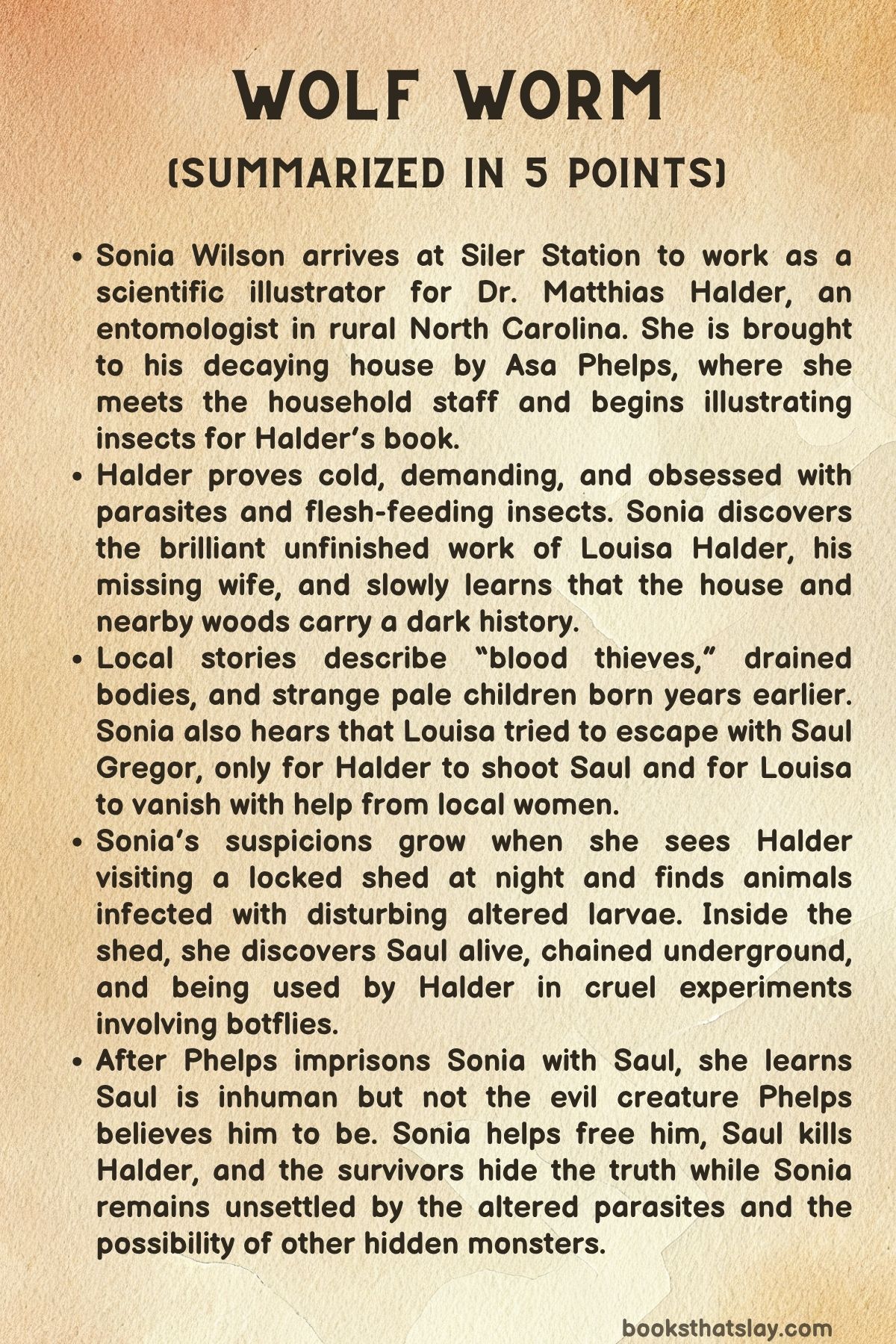
Sonia Wilson, a thirty-year-old scientific illustrator, arrives at Siler Station in rural North Carolina to begin a new position with Dr. Matthias Halder, an entomologist known for his work on insects that feed on carrion, wounds, and living flesh. Her arrival is immediately awkward.
No one has come to meet her, and she soon learns that Halder’s house is ten miles away. Stranded and uncertain, she accepts a ride from Asa Phelps, a grim local man whose manner is severe and unsettling.
During the journey, Phelps warns her that the Devil walks in the nearby woods, a warning that seems less like superstition than a belief he has built his life around.
When Sonia reaches Halder’s large, decaying house, she finds that her employer has simply forgotten to arrange for her arrival. She is received instead by Rose Kent, the housekeeper, who manages the house with calm efficiency.
Sonia also meets Rose’s husband Jackson, the maid Sally, and an orange cat named Smilodon. The household is strange but not immediately hostile.
Rose and Jackson are practical, kind in their own guarded ways, and far easier to endure than Halder himself.
Halder proves to be rude, demanding, and deeply absorbed in his research. He hires Sonia to complete illustrations for his book on parasitic and carrion-feeding insects.
His chief interests include screwworms, botflies, and other species that live in or on damaged flesh. Sonia is disturbed by the subject matter but accepts the work.
She needs employment, and scientific illustration is her trade. She is given an old studio suite, where she discovers fine supplies, sketchbooks, and unfinished insect illustrations made by Louisa Halder, Matthias Halder’s wife.
Louisa’s work is extraordinary, far better than Sonia’s own. This discovery makes Sonia uneasy.
She wonders why Halder would need her at all when his wife had such talent. Still, Halder judges Sonia’s paintings as acceptable, and she slowly settles into the house.
Her days become organized around painting insects, taking meals with the Kents, attending church with them, and learning the rhythms of the surrounding community. Beneath that routine, however, she senses that the household is built around secrets.
The woods near Halder’s property carry old stories. Sally speaks fearfully of “blood thieves,” and Jackson tells Sonia about events from years earlier, when animals and people were found drained of blood and hung in trees.
Two strange young people were blamed for the killings, and the locals hunted them down. Asa Phelps and Halder were among those involved.
Jackson is not convinced that the truth was ever fully known, and his uncertainty deepens Sonia’s concern.
Ma Kersey, a respected healer in the area, later gives Sonia another piece of the story. During the war, Ma Kersey helped deliver two unnatural babies.
They were pale, sharp-toothed infants who seemed aware even before opening their eyes. Ma Kersey believes that one of the women involved in the old blood-thief panic may have been one of those babies grown into adulthood.
Her account suggests that the local legends may not be simple fear or gossip. Something inhuman may truly have passed through the region, and some of it may still remain.
Sonia grows more suspicious of Halder when she sees him moving through the woods at night with a lantern. She also notices him returning from a locked shed on the property.
Around the same time, disturbing events begin near the house. Chickens vanish from the Kents’ henhouse.
A possum violently attempts to break into Sonia’s room and is later found dead, its body infested with strange botfly larvae. The insects are not behaving as ordinary insects should, and Sonia begins to fear that Halder’s work is not limited to observation.
She also learns more about Louisa Halder. According to Jackson, Louisa tried to flee her husband with a man named Saul Gregor.
Halder shot Saul, and Louisa managed to escape with help from local women. Everyone believed Saul died, but the story feels unfinished.
Sonia begins to connect Halder’s night visits, the locked shed, Louisa’s disappearance, and the strange parasites.
Eventually, Sonia investigates the shed and discovers a hidden underground chamber. Inside, she finds Saul Gregor chained to a table, alive more than a year after Halder supposedly killed him.
Saul’s body is filled with enormous botfly larvae. The sight is horrifying.
Halder has been using him as a living subject for experiments, keeping him trapped while parasites breed in his flesh. Sonia flees the chamber in terror, but soon falls ill with malaria.
Ma Kersey nurses her through the fever, and Sonia survives, though weakened.
When Sonia recovers, Asa Phelps realizes that she knows about the shed. He kidnaps her and locks her underground with Saul.
Phelps explains that he has been helping Halder because he believes Saul is the Devil and must be contained. To Phelps, cruelty has become a form of righteousness.
He thinks the suffering inflicted on Saul is justified because Saul is not fully human.
Trapped with Saul, Sonia learns the truth is more complicated. Saul is not ordinary, but he is also not the simple evil Phelps imagines.
He can survive terrible wounds, heal from injuries that would kill a human being, and feed on blood. Halder has spent months experimenting on him, hoping to understand creatures like him and perhaps find ways to destroy them.
In the process, Halder has changed the parasites. The botflies have adapted to Saul’s body and become more dangerous.
They can infest other animals, spread beyond the chamber, and may even influence the behavior of their hosts.
Sonia tries to escape while also helping Saul. She works at the earth around the chamber, searching for a way out, and begins to understand that Saul has been tortured under the cover of scientific study.
Halder may claim to be defending humanity, but his methods have created something worse. His obsession has turned the local danger into a larger threat.
Phelps returns to the chamber, but by then he is no longer fully in control of himself. One of the altered larvae has infected him, lodging in his skull and affecting his behavior.
He becomes violent and unstable. Sonia strikes him with an enamel pan, giving Saul the chance to feed on him.
With Phelps’s blood, Saul regains enough strength to act.
Sonia frees Saul, and together they confront Halder. Halder tries to justify everything he has done.
He insists that his experiments were necessary because beings like Saul exist and must be understood before they can be destroyed. Sonia refuses to accept this reasoning.
She sees that Halder’s fear and hatred have made him monstrous in his own right. Saul kills Halder, ending the experiments and the long imprisonment.
Afterward, Sonia, Saul, Rose, and Jackson work together to hide the truth. They allow people to believe that Halder and Phelps died in a violent confrontation with each other.
This false story protects Saul and shields everyone else from the full horror of what Halder had done beneath his own property.
Louisa eventually returns and reunites with Saul. She inherits Halder’s house and later marries Saul, reclaiming both her home and the man she had tried to save.
Rose and Jackson leave Halder’s service but remain nearby, no longer bound to the household’s cruelty. Sonia stays on for a time, helping organize Halder’s papers and continuing her work.
Yet Sonia is not left with peace. She remains haunted by the altered botflies, by Halder’s experiments, and by the knowledge that inhuman creatures may still be hidden among ordinary people.
Wolf Worm ends with survival, but not comfort. The visible evil has been destroyed, while the deeper fears remain alive in the woods, in memory, and in the fragile boundary between scientific curiosity and human cruelty.
Characters
In Wolf Worm by T. Kingfisher, the characters are shaped by fear, secrecy, violence, curiosity, and survival. The book uses each figure not only as a person within the story, but also as a way to explore questions about monstrosity, scientific obsession, moral courage, and the dangers of believing too easily in simple explanations.
Sonia Wilson
Sonia Wilson is the central character of the book and the person through whom the strange world of Siler Station gradually becomes visible. At thirty years old, she arrives as a scientific illustrator, practical and professionally uncertain, hoping simply to do her work for Dr. Halder.
Her early insecurity comes from comparing herself to Louisa Halder, whose insect illustrations are more beautiful and accomplished than her own. This makes Sonia feel inadequate, but it also shows her honesty: she knows the limits of her skill and does not pretend to be greater than she is.
Her work requires careful observation, and that same habit of looking closely becomes one of her most important qualities in the story.
Sonia’s development depends on the movement from outsider to witness to participant. At first, she is dependent on others for information about the house, the woods, and the local history.
She listens to Rose, Jackson, Sally, Asa Phelps, and Ma Kersey, slowly piecing together a hidden truth from rumors, warnings, and half-spoken memories. What makes Sonia compelling is that she is not fearless.
She is disturbed by the house, frightened by the stories of blood thieves, horrified by the infected animals, and physically weakened by illness. Yet she continues to pay attention.
Her bravery is not dramatic at first; it is the bravery of noticing what others want hidden.
Her moral strength becomes clearest after she discovers Saul chained beneath the shed. Sonia could choose denial or self-preservation, but the sight of his suffering forces her to recognize the cruelty at the heart of Halder’s work.
Even when she learns that Saul is not fully human, she does not accept Halder’s argument that inhumanity justifies torture. This is one of Sonia’s defining traits: she understands that being frightening or unnatural does not automatically make someone deserving of cruelty.
Her compassion is cautious, not naive, but it is real.
By the end of the book, Sonia has been changed by what she has seen. She survives kidnapping, illness, confinement, and direct contact with the results of Halder’s experiments.
She helps uncover the truth, participates in the cover-up, and remains connected to the house afterward. Her ending is not simple peace.
She continues working and living, but she is haunted by the altered botflies and by the possibility that hidden forms of monstrosity still exist around ordinary people. Sonia’s character therefore represents both survival and knowledge.
She cannot return to innocence, but she can continue forward with a clearer, darker understanding of the world.
Dr. Matthias Halder
Dr. Matthias Halder is one of the most disturbing characters in the book because his monstrosity is intellectual, controlled, and self-justifying. He is an entomologist whose knowledge of parasitic and carrion-feeding insects gives him authority, but his scientific discipline has become corrupted by obsession.
His rudeness toward Sonia, his exacting standards, and his emotional coldness establish him early as a man who values work, control, and classification more than human connection. He is not merely unpleasant; he is someone who has trained himself to see living beings as specimens.
Halder’s fascination with screwworms, botflies, and flesh-feeding insects reflects his deeper moral decay. He studies creatures that invade, consume, and transform bodies, and his own behavior mirrors that parasitism.
His experiments on Saul are not accidental excesses but the logical result of his belief that knowledge excuses cruelty. By chaining Saul underground and allowing parasites to infest him, Halder turns scientific inquiry into torture.
He claims that his purpose is to understand and destroy monsters, but the book exposes the hypocrisy of this claim. In trying to define Saul as monstrous, Halder becomes monstrous himself.
His relationship with Louisa also reveals his need for possession. Louisa’s attempt to escape with Saul suggests that Halder’s household was never a place of safety or mutual respect.
When Halder shoots Saul and later imprisons him, he is not only acting as a scientist but also as a jealous husband and a man determined to punish those who defy his authority. His violence is therefore both personal and ideological.
He wants to control bodies, knowledge, women, servants, and the story others tell about him.
Halder’s final confrontation with Sonia shows that he cannot understand moral refusal. He expects Sonia to see the world through his categories: human and inhuman, useful and disposable, researcher and subject.
Sonia’s rejection of him matters because it denies the entire foundation of his thinking. Halder is ultimately a warning about intelligence without humility.
His education and expertise make him powerful, but because he lacks compassion, they also make him dangerous. In Wolf Worm, he is not frightening because he is ignorant, but because he is learned and still chooses cruelty.
Saul Gregor
Saul Gregor is one of the most tragic and morally complex figures in the book. For much of the story, he exists as a rumor, a dead man, or a hidden secret before Sonia discovers that he is still alive.
His body has become the site of Halder’s experiments, chained to a table and infested with altered botfly larvae. The horror of Saul’s condition immediately challenges the reader’s assumptions about monstrosity.
He is not ordinary, and he is capable of feeding on blood and surviving terrible injury, but when Sonia finds him, he is also a victim of prolonged suffering.
Saul’s inhuman nature makes him frightening, but the book does not present him as evil simply because he is different. He has needs and abilities that separate him from ordinary humans, yet his imprisonment reveals that he can be harmed, degraded, and exploited.
This makes him a character who exists between categories. He is both dangerous and vulnerable, both predator and captive, both supernatural figure and abused prisoner.
His presence forces Sonia to think beyond simple ideas of innocence and guilt.
His relationship with Louisa adds emotional depth to his character. The fact that Louisa tried to run away with him suggests that Saul was not merely a monster hiding among people; he was capable of connection, loyalty, and love.
Halder’s violence against him is therefore not only an act of scientific cruelty but also an attempt to destroy a rival and erase Louisa’s choice. Saul’s endurance after being shot and imprisoned makes him seem almost impossible to destroy, but endurance is not the same as freedom.
His survival has been turned into a trap because Halder uses his regenerative nature as an excuse to continue experimenting on him.
When Saul feeds on Phelps and later kills Halder, his violence is disturbing but also understandable within the logic of the story. He is not transformed into a pure hero by his suffering, nor is he reduced to a villain by his appetite.
He remains unsettling. His marriage to Louisa at the end suggests a restoration of the life Halder tried to destroy, but it does not remove the unease surrounding him.
Saul represents the book’s refusal to make monstrosity simple. He may be inhuman, but he is not the greatest monster in the story.
Louisa Halder
Louisa Halder is absent for much of the book, but her presence shapes the story from the beginning. Sonia first encounters her through her studio, supplies, sketchbooks, and unfinished insect illustrations.
These remnants reveal Louisa as talented, disciplined, observant, and artistically gifted. Her work intimidates Sonia because it is superior, but it also becomes a silent testimony to the life Louisa once lived in Halder’s house.
Even before Louisa appears directly, the reader understands that she mattered and that her absence has left a powerful emptiness behind.
Louisa’s attempted escape with Saul reveals her courage and desperation. She was trapped in a marriage and household dominated by Halder, and her decision to flee shows that she refused to remain under his control.
Her relationship with Saul complicates the moral atmosphere of the book because she chose someone the community might label monstrous over the respectable scientist who was her husband. Through Louisa, the book suggests that outward respectability can hide greater cruelty than outward strangeness.
Her artistic ability also connects her to Sonia. Both women are scientific illustrators, both work with insects, and both are placed under Halder’s authority.
However, Louisa’s life shows what Sonia might become trapped inside if she fails to recognize the danger of the household. Louisa is therefore both a predecessor and a warning.
Her drawings are beautiful, but they belong to a life marked by fear, secrecy, and attempted escape. Sonia’s discovery of Louisa’s work helps create an invisible bond between them long before they meet.
When Louisa returns and reunites with Saul, her ending offers one of the few forms of emotional restoration in the book. She inherits the house and marries Saul, reclaiming both space and love from Halder’s control.
Yet her return does not erase the suffering that came before. Louisa’s character represents survival after confinement, the courage to choose an unacceptable truth over a respectable lie, and the possibility of rebuilding a life after violence.
Asa Phelps
Asa Phelps is a severe and frightening character whose actions are driven by fear, superstition, and rigid certainty. From the beginning, he presents himself as a man who knows the dangers of the woods and believes that the Devil walks there.
His warning to Sonia seems strange and extreme, but it also reflects the atmosphere of suspicion surrounding Siler Station. Phelps is not simply a background local figure; he is one of the people who has helped turn fear into violence.
His role in the old blood-thief panic reveals his dangerous moral simplicity. He participated in the killing of the strange young people blamed for the drained bodies, and he continues to believe that supernatural evil must be contained or destroyed.
Unlike Jackson, who suspects the truth may have been more complicated, Phelps clings to certainty. This makes him useful to Halder.
Because he believes Saul is the Devil, he can help imprison and torture him while imagining himself righteous.
Phelps’s kidnapping of Sonia marks the full revelation of his fanaticism. Once he realizes she knows about the shed, he does not hesitate to imprison her underground with Saul.
His belief system leaves no room for doubt, mercy, or reconsideration. He sees himself as defending the world from evil, but his actions show how easily fear can become cruelty when joined to absolute conviction.
In this sense, Phelps is not a scientist like Halder, but he becomes Halder’s accomplice through a different kind of blindness.
His infection by the altered larva in his skull is symbolically fitting. Phelps has spent the book acting under the influence of fear and violent belief; by the end, his body is literally invaded and controlled.
His loss of control makes visible what has already been true morally. He is a man consumed from within.
Phelps represents the danger of superstition without compassion, and his fate shows that the monsters people help create may eventually turn on them.
Rose Kent
Rose Kent is one of the stabilizing figures in the book. As Halder’s housekeeper, she manages the household and serves as Sonia’s first real point of welcome at the decaying house.
Her practical explanations help Sonia understand the basic situation: Halder has forgotten to arrange her arrival, the household runs according to its own rhythms, and life there requires endurance. Rose is not naive about Halder’s nature, but she has learned how to survive within his orbit.
Her importance lies in her quiet competence. Rose helps create a sense of domestic normality in a place filled with secrecy and decay.
Meals, routines, church attendance, and household order all pass through her and Jackson. Because of this, she helps Sonia settle into the house even as the darker truth remains hidden.
Rose’s kindness does not erase the danger of the setting, but it gives Sonia a human anchor.
Rose also represents the limited choices available to people in Halder’s world. She and Jackson work for him, but they are not emotionally loyal to his cruelty.
They know more than they say, and their silence reflects caution rather than approval. In a rural community shaped by class, gender, employment, and local fear, speaking openly can be dangerous.
Rose’s restraint is therefore part of her survival strategy.
After Halder’s death, Rose participates in covering up the truth and then leaves his service while remaining nearby. This ending fits her character because she is practical enough to understand what must be hidden and strong enough to step away when the opportunity comes.
Rose is not a dramatic rebel, but her steadiness, loyalty, and quiet moral sense make her essential to the book’s emotional balance.
Jackson Kent
Jackson Kent is a thoughtful and observant character who helps Sonia understand the local past. As Rose’s husband, he is part of the household structure, but his role extends beyond service.
He becomes one of Sonia’s sources of historical knowledge, especially regarding the old blood-thief panic. His account of drained bodies, people hung in trees, and the killing of the strange young people gives the book much of its deeper background.
What distinguishes Jackson from characters like Phelps is his uncertainty. He does not simply accept the official local explanation.
He suspects that the truth was more complicated, and this makes him morally important. In a community where fear has hardened into legend, Jackson’s doubt becomes a form of wisdom.
He understands that stories can conceal as much as they reveal, especially when they are used to justify violence.
Jackson’s relationship with Sonia is grounded in quiet trust. He shares information gradually, helping her see that the present mystery is tied to older acts of fear and bloodshed.
Like Rose, he does not dominate the story, but his presence gives Sonia a connection to the community beyond Halder’s house. He is a bridge between everyday rural life and the darker hidden history surrounding the woods.
By the end, Jackson helps manage the aftermath of Halder and Phelps’s deaths. His willingness to take part in the cover-up suggests both loyalty and practicality.
He understands that the full truth would likely create more violence, not justice. Jackson represents ordinary decency under pressure.
He is cautious, imperfectly informed, and sometimes silent, but he is not cruel. His strength lies in his ability to doubt frightening stories and still act with loyalty when it matters.
Sally
Sally is a smaller but meaningful character whose presence adds to the atmosphere of unease in the household. As the maid, she belongs to the domestic world of Halder’s house, but her talk of “blood thieves” connects everyday life to local folklore and terror.
Through Sally, the book shows how fear circulates in a community not only through formal stories, but also through whispered warnings, rumors, and half-understood beliefs.
Her reference to blood thieves helps prepare Sonia for the darker history of Siler Station. Sally does not provide a full explanation, but her words suggest that the community has long lived with the idea of hidden predators.
This makes the setting feel layered with old panic. The strange events Sonia witnesses do not appear suddenly; they emerge from a place already shaped by disturbing memories.
Sally also reflects the vulnerability of those lower in the household hierarchy. Like Rose and Jackson, she lives and works near Halder’s secrets, but she does not have power over them.
Her knowledge is fragmentary, shaped by fear rather than investigation. This makes her a believable part of the domestic setting: she senses danger, repeats what she has heard, and contributes to the atmosphere without being able to change the situation directly.
Although Sally does not have the same narrative weight as Sonia, Halder, Saul, or Louisa, she is important because she helps create the book’s social world. She shows how the supernatural and the everyday coexist in local speech.
Her character reminds the reader that horror often survives in communities through rumor before anyone uncovers the truth behind it.
Ma Kersey
Ma Kersey is one of the book’s most powerful figures of local knowledge. As a respected healer, she stands outside formal science but possesses insight that Halder lacks.
Her authority comes from experience, memory, and practical care rather than academic study. When Sonia falls ill with malaria, Ma Kersey nurses her, showing that her role is not only mystical or folkloric but deeply practical and compassionate.
Her account of delivering two unnatural babies during the war is one of the most important revelations in the story. She remembers pale infants with sharp teeth who seemed to watch through closed eyelids, and she connects this memory to the later blood-thief panic.
Unlike Phelps, however, Ma Kersey does not respond to strangeness with immediate violence. Her knowledge is unsettling, but it is not simplistic.
She understands that the world contains unnatural things, yet she does not reduce every mystery to a reason for cruelty.
Ma Kersey functions as a counterpoint to Halder. Both know about bodies, blood, birth, infestation, and survival, but they approach knowledge differently.
Halder dissects and experiments in order to dominate. Ma Kersey observes, remembers, heals, and warns.
Her wisdom is rooted in responsibility. She knows terrible things, but she does not use that knowledge as permission to torture.
Her care for Sonia also helps Sonia survive physically and morally. After the shock of discovering Saul, Sonia is weakened and vulnerable, and Ma Kersey’s nursing gives her the chance to recover before the story’s final crisis.
Ma Kersey represents old knowledge, female authority, and the kind of practical compassion that stands against both scientific arrogance and violent superstition.
Smilodon
Smilodon, the orange cat, is a minor character, but his presence is still meaningful within the book’s atmosphere. In a household filled with decay, secrecy, and tension, the cat adds a touch of ordinary life.
His name, which evokes a prehistoric predator, gives him a slightly humorous and sharp quality, fitting the book’s mixture of domestic detail and lurking danger.
Animals in the story often become signs of something wrong. Chickens vanish, a possum attacks Sonia’s room, and infected creatures reveal the spread of Halder’s altered parasites.
Against this background, Smilodon’s ordinary presence becomes more noticeable. He belongs to the house, but unlike the insects and infected animals, he is not primarily a symbol of corruption.
He helps make the household feel lived-in rather than merely Gothic.
Smilodon also contributes to the contrast between the familiar and the horrifying. A cat moving through a decaying house is ordinary, even comforting, but the world around him is filled with hidden chambers, blood-feeding beings, and parasitic transformation.
His presence reminds the reader that horror in the book does not exist in a separate realm. It lives beside meals, chores, pets, and daily routines.
Although he does not shape the plot in the way the human characters do, Smilodon helps establish tone. He gives the house personality and reinforces the strange blend of coziness and dread that surrounds Sonia’s time there.
As a minor presence, he makes the setting feel more real.
Themes
The Corruption of Scientific Curiosity
In Wolf Worm, scientific study becomes frightening because it is separated from compassion. Halder begins as an entomologist, someone whose work should depend on careful observation, patience, and discipline, but his interest in parasites turns into a hunger for control.
Saul becomes less of a living being to him and more of an experimental surface on which theories can be tested. This theme shows how knowledge can become dangerous when a person treats pain as useful data and suffering as a reasonable price for discovery.
Halder’s language of research allows him to excuse cruelty, and his certainty that he is protecting humanity makes him even more dangerous. He does not see himself as evil; he sees himself as necessary.
That is what makes his actions disturbing. The novel suggests that intelligence without morality can become a form of violence, especially when the person in power decides who counts as human and who does not.
Fear, Superstition, and Mob Justice
The local fear of the Devil and the old stories of blood thieves reveal how easily a frightened community can turn suspicion into punishment. People in the area explain what they do not understand through religion, rumor, and inherited dread.
The killings from the earlier panic show that once a group decides someone is monstrous, evidence becomes less important than fear. Phelps represents this theme strongly because he believes his violence is righteous.
His certainty gives him permission to kidnap, imprison, and harm others while imagining himself as a defender of ordinary people. The novel does not present superstition as foolishness alone; some strange things in the woods are real.
However, it questions what happens when fear becomes the only way people understand the unknown. Instead of seeking truth, the community creates enemies, and that makes human cruelty just as terrifying as any supernatural threat.
The Uncertainty of Monstrosity
Saul’s existence challenges the simple division between human and monster. He drinks blood, survives injuries, and is clearly not ordinary, yet he is also a victim of imprisonment, torture, and experimentation.
Halder, who appears respectable and educated, behaves with far greater cruelty than the being he calls dangerous. This contrast raises an important question: is monstrosity defined by nature, or by action?
Saul may be physically frightening, but he is capable of attachment, suffering, and loyalty. Halder, meanwhile, uses reason and social authority to justify abuse.
Sonia’s changing view of Saul is central to this theme because she must move beyond fear and decide what kind of moral response he deserves. The story suggests that appearances, species, and reputation are unreliable measures of goodness.
A person can look normal and still commit horrifying acts, while someone marked as unnatural may still deserve mercy.
Survival, Female Courage, and Quiet Resistance
Sonia’s courage is not the dramatic confidence of a trained hero; it grows out of observation, fear, sympathy, and moral refusal. She arrives as an outsider with limited power, dependent on the household and uncertain of her own abilities, yet she slowly learns to trust what she sees.
Her work as an illustrator matters because it trains her to notice detail, and that habit becomes a tool of survival. The women around her also shape this theme.
Rose, Louisa, Ma Kersey, and Sonia all resist male control in different ways, often through practical action rather than open confrontation. They nurse, hide, warn, help, endure, and protect.
Their resistance is quiet but powerful because it operates in a world where men like Halder and Phelps hold social authority. The novel values this steady courage, showing that survival often depends on attention, solidarity, and the refusal to accept cruelty as normal.