Wretch Summary, Characters and Themes
Wretch: or, The Unbecoming of Porcelain Khaw by Eric LaRocca is a dark horror novel about grief, obsession, and the dangerous wish to touch the dead again. The story follows Simeon Link, a man broken by the loss of his partner, Jonathan, and drawn into a strange group that claims photography can reveal dead loved ones hidden in the world.
His search leads him to Porcelain Khaw, a mysterious figure who offers reunion through pain. The book examines how sorrow can make people vulnerable to manipulation, and how the desire for one more moment can become a trap.
Summary
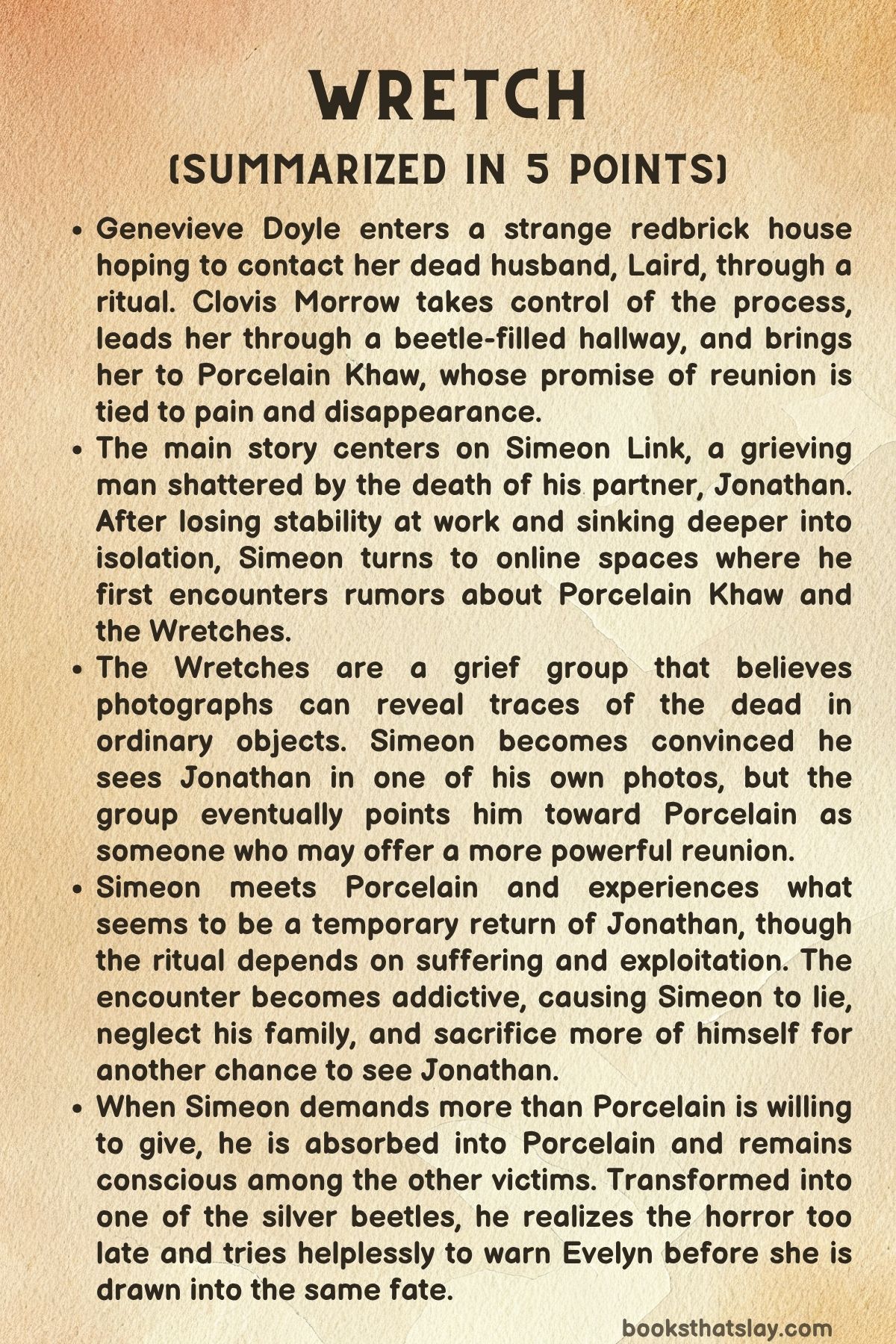
Wretch begins with Genevieve Doyle arriving at a redbrick house for a ritual that promises to reconnect her with her dead husband, Laird. She is met by Clovis Morrow, a severe and watchful man who controls every detail of the encounter.
He takes away her phone, checks that she has brought a photograph with emotional meaning, and sends her down a dark hallway crawling with tiny silver beetles. The insects move across the floor like a warning, but Genevieve continues forward because her grief has already pushed her past ordinary fear.
At the end of the hallway, she enters a bare, windowless bedroom and meets Porcelain Khaw. He appears strangely beautiful, dressed in white, with an almost angelic presence that hides something deeply cruel.
Porcelain tells Genevieve that the ritual requires suffering. The scene leaves her fate uncertain at first, but a later online missing-person notice reveals that she has vanished.
One commenter says she is “with Porcelain now,” suggesting that the ritual has not reunited her with her husband in any merciful way. Instead, it has taken her into something far worse.
The main story then follows Simeon Link, a gay man devastated by the death of his partner, Jonathan, who died from brain cancer. Simeon is not simply mourning; he is barely functioning.
His life has narrowed into isolation, despair, and thoughts of suicide. He struggles at work, misses shifts, and cannot keep up with his responsibilities.
His boss, Mr. Whittaker, finally places him on unpaid leave because of his poor productivity and repeated absences. Simeon leaves the meeting ashamed and defeated.
Outside, he sees a rat eating another rat in the gutter, an ugly image that mirrors the book’s view of survival, hunger, and decay. Simeon returns home, where he spends more time online than in the real world.
The internet becomes his hiding place, a space where he can distract himself from the pain of Jonathan’s absence, though it also leads him toward darker influences.
While browsing forums and chat rooms, Simeon finds a disturbing post about “The Ordeal of Porcelain Khaw.” The post describes a dream in which a couple considers selling their twelve-year-old son to Porcelain. Porcelain claims he wants the boy as an assistant, but the real purpose is exploitation and destruction.
The name Porcelain Khaw unsettles Simeon, though he does not yet understand why. Soon after, an online user called babyfacexoxo tells him about the Wretches, a secretive grief group that uses photography to search for images of dead loved ones hidden in ordinary objects.
Simeon attends a Wretches meeting in a church recreation hall. The group’s origin is tied to Melvin Cartwright, who believed he saw his dead wife in a photograph.
An invitation from Daniel Westmacott explains the group’s purpose: members take pictures of everyday scenes and search them for signs of those they have lost. To Simeon, this sounds strange but possible.
His grief makes him open to anything that might bring Jonathan closer, even if only as a shape in vines or shadows.
At the meeting, Simeon meets Kent Simmons, a photographer who encourages him and helps him buy a camera. Simeon later photographs a trellis in a park and believes he sees Jonathan’s face in the vines.
Kent confirms the image, giving Simeon the validation he needs to keep believing. Simeon brings the photograph to the group, where the Wretches discuss unsettling ideas about predators and prey, grief, and transformation.
Their language suggests that mourning is not only emotional pain but also a process that can change a person into something else.
Kent eventually admits that the Wretches cannot truly bring Jonathan back. The images may offer comfort, but they are not enough.
Then he tells Simeon that someone else might be able to give him what he wants: Porcelain Khaw. Kent says Porcelain once transformed him by taking his sorrow.
He gives Simeon Clovis Morrow’s card, opening the path to the same redbrick house where Genevieve disappeared.
Simeon contacts Clovis and arranges a meeting. To pay for it, he borrows money from his ex-wife, Evelyn, but lies about why he needs it.
This lie marks a deeper stage in his collapse. Simeon is no longer only grieving; he is beginning to betray the living people who still care about him.
Evelyn and their son, Carter, become secondary to his need to reach Jonathan again.
At the house, Clovis leads Simeon through the hallway filled with silver beetles. Simeon meets Porcelain and submits to the ritual.
Through Porcelain’s power, Simeon experiences Jonathan again, apparently through a suffering body provided for that purpose. The reunion overwhelms him.
It feels real enough to break through his despair, but it is also built on pain, exploitation, and something morally monstrous. Simeon understands, on some level, that what has happened is wrong.
Still, the chance to be near Jonathan again becomes addictive almost immediately.
After the first meeting, Simeon begins to deteriorate further. He wants another encounter, then another.
The ritual does not heal him; it sharpens his need. He lies more often, neglects Carter, and takes advantage of Evelyn’s concern.
His relationship with the living weakens as his obsession with the dead grows stronger. Porcelain’s gift is not a cure for grief.
It is a trap that feeds on grief by offering just enough comfort to make escape impossible.
Simeon’s second meeting with Porcelain deepens his dependence. The experience leaves him hollow afterward, as if each reunion takes something from him rather than restoring him.
Clovis warns him not to ask for a third meeting, but Simeon refuses to listen. He has reached the point where denial no longer matters.
He believes one more meeting with Jonathan will be worth any cost, even though every step has already cost him more of himself.
Driven by desperation, Simeon goes to the house without an invitation. Inside, he discovers signs of Porcelain and Clovis’s long partnership.
He realizes the redbrick house is only one temporary site used for these rituals, not a permanent home. Porcelain and Clovis have likely moved from place to place, taking people in through their sorrow and leaving disappearances behind them.
Simeon confronts Porcelain and begs to see Jonathan one final time. Porcelain refuses, telling him that he has already taken enough.
This refusal breaks the illusion that Porcelain is a helper or guide. He is not offering peace.
He controls access, feeds on need, and decides when a grieving person has become useless or excessive. Simeon’s pleading turns to anger, but anger cannot save him.
Porcelain consumes him into his own essence.
Simeon does not die in any simple sense. He remains conscious inside Porcelain, trapped among other victims.
There, he recognizes Genevieve and understands that she suffered the same fate. He also learns the truth about the silver beetles crawling through the hallway.
They are transformed people, the remains of those who came seeking reunion and were reduced to tiny, helpless forms. The hallway was not merely disgusting or strange.
It was filled with victims.
Inside Porcelain, Simeon reflects on the damage he has done. He thinks of Evelyn and Carter and understands how badly he failed them.
He allowed grief to excuse selfishness, lies, and neglect. He wanted Jonathan back so badly that he ignored the people still alive around him.
His punishment is not only physical transformation but also awareness. He knows what he has become, and he knows what he has lost.
The ending turns even darker when Clovis brings Evelyn to Porcelain. She has been lured into the same ritual, likely through the grief and confusion caused by Simeon’s disappearance.
Now Simeon, reduced to one of the tiny silver beetles, crawls near her and tries desperately to warn her. He wants to stop her from making the same mistake.
He wants, at last, to protect someone living.
But Evelyn does not notice him. To her, he is only an insect.
She moves toward Porcelain’s invitation, unaware that Simeon is right beside her and that the house is full of people who once made the same choice. Simeon understands that she is about to share his fate.
The story closes on this terrible recognition: grief has become a chain, passed from one wounded person to another, while Porcelain waits to consume whoever still believes the dead can be reached without a price.
Characters
Genevieve Doyle
Genevieve Doyle is one of the earliest figures used to introduce the book’s world of ritual, loss, and predatory false hope. Her journey to the redbrick house shows that she is a grieving woman desperate enough to place her trust in something secretive and dangerous.
The fact that she arrives with a sentimental photograph suggests that her grief is tied to memory and emotional attachment, and it also shows how vulnerable she is to people who understand how to exploit mourning. Genevieve’s disappearance makes her more than just an opening victim; she becomes proof that the ritual is not merely mysterious but actively destructive.
Her fate also foreshadows Simeon’s later downfall, because both characters are drawn toward Porcelain through the promise of contact with a dead loved one. By the end of the story, Genevieve’s presence inside Porcelain reveals the horrifying permanence of what has happened to her.
She represents the many grieving people who have been swallowed by the same promise of reunion and reduced to part of something monstrous.
Laird
Laird is Genevieve’s dead husband, and although he does not appear as an active living character, his importance comes from the emotional power he still holds over Genevieve. He represents the beloved dead as an absence that shapes the actions of the living.
Genevieve’s desire to reconnect with him is what brings her into danger, making Laird central to her motivation even though he is physically absent from the story. His role also helps establish one of the book’s major ideas: the dead can become powerful not because they act directly, but because the living continue to ache for them.
Laird’s memory is used as bait by the ritual system surrounding Porcelain, showing how love and grief can be manipulated when a person is at their weakest. In this way, Laird functions less as a developed individual and more as a symbol of the emotional wound that makes Genevieve vulnerable.
Clovis Morrow
Clovis Morrow is one of the most chilling human figures in the story because his cruelty is controlled, administrative, and deliberate. He is not presented as chaotic or visibly monstrous in the same way Porcelain is; instead, he behaves like a gatekeeper who has turned suffering into a process.
His actions at the redbrick house reveal his role as an organizer of horror: he takes phones, verifies sentimental objects, gives instructions, manages access, and guides victims toward Porcelain. This makes him terrifying because he treats supernatural exploitation almost like a professional service.
Clovis’s severity suggests emotional detachment, but his long partnership with Porcelain implies a deeper loyalty to the ritual and to the system of consumption behind it. He is also important because he bridges the ordinary world and the monstrous one.
Victims do not simply wander into Porcelain’s grasp; Clovis helps bring them there, making him an accomplice who understands exactly what is being done. His ability to lure Evelyn later in the story confirms that he is not just a servant but an active predator who continues the cycle of grief-based destruction.
Porcelain Khaw
Porcelain Khaw is the central monstrous presence in the book and one of its most disturbing figures because he combines beauty, gentleness, cruelty, and appetite. His angelic appearance in white contrasts sharply with the suffering he demands and the destruction he causes.
This contrast makes him feel especially dangerous, because he does not initially appear as a conventional monster. Instead, he presents himself as someone who can offer grieving people what they most want: contact with the dead.
His power lies not only in supernatural ability but also in emotional manipulation. He understands that grief can make people desperate, and he uses that desperation to draw them closer until they are dependent on him.
Porcelain’s rituals are not acts of compassion; they are acts of exploitation disguised as comfort. His connection to the silver beetles and the trapped consciousnesses inside him reveals that he consumes people in a way that preserves their awareness, turning them into living evidence of his cruelty.
Porcelain represents grief’s darkest temptation: the desire to return to the dead at any cost, even when that desire destroys the living.
Simeon Link
Simeon Link is the emotional center of the story, and his character is defined by grief, longing, self-destruction, and moral collapse. After Jonathan’s death, Simeon is unable to rebuild his life or remain connected to the responsibilities that still surround him.
His grief is not quiet or healing; it is consuming, isolating, and corrosive. He fails at work, withdraws from ordinary life, and begins seeking escape through the internet and eventually through the Wretches.
What makes Simeon tragic is that his desire to see Jonathan again begins as a deeply human need, but it gradually becomes an obsession that harms everyone around him. He lies to Evelyn, neglects Carter, and repeatedly chooses the illusion of reunion over the living relationships that still matter.
His meetings with Porcelain expose the addictive nature of his longing. Each encounter gives him a temporary emotional high but leaves him more hollow afterward, making him crave another experience despite the obvious danger.
Simeon’s final transformation into a silver beetle is both punishment and revelation. Only after he is trapped does he fully understand what he has lost, what he has done, and how completely Porcelain’s promise has destroyed him.
Jonathan
Jonathan is Simeon’s dead partner, and his role in the story is built around absence, memory, and desire. He represents the love Simeon cannot release and the past Simeon keeps trying to recover.
Because Jonathan died of brain cancer, his death carries a sense of physical suffering and helpless decline, which intensifies Simeon’s grief. Jonathan is not merely a symbol of loss; he is also the emotional ideal Simeon uses to justify increasingly destructive choices.
Simeon’s longing for him becomes so overwhelming that the memory of Jonathan begins to compete with the needs of the living. Through Jonathan, the story examines how love can become distorted when grief refuses to accept finality.
The tragedy is that Simeon’s love for Jonathan may be genuine, but his pursuit of reunion becomes selfish and damaging. Jonathan’s presence in the story therefore reveals the difference between honoring the dead and sacrificing the living to remain trapped with them.
Mr. Whittaker
Mr. Whittaker is Simeon’s boss, and his role is important because he represents the outside world’s limited patience with private grief. He does not appear as a villain in the supernatural sense, but his decision to place Simeon on unpaid leave deepens Simeon’s humiliation and isolation.
Through Mr. Whittaker, the story shows how grief can make ordinary responsibilities feel impossible, while the world continues to demand productivity and discipline. His presence also marks a turning point in Simeon’s downward spiral.
Losing stability at work pushes Simeon further away from normal life and closer to the online spaces and secretive groups that promise emotional escape. Mr. Whittaker’s function in the book is therefore practical and symbolic: he shows the social consequences of Simeon’s collapse and helps reveal how quickly a grieving person can become disconnected from the structures that once held his life together.
babyfacexoxo
babyfacexoxo is a mysterious online user who acts as one of the first guides leading Simeon toward the Wretches. This character’s importance comes from the way they show how grief can be redirected through digital spaces.
Simeon is already isolated and vulnerable when babyfacexoxo appears, which makes their information especially influential. They do not need to physically force Simeon anywhere; they simply provide the right suggestion at the right moment.
In that sense, babyfacexoxo functions as a quiet catalyst. Their role also adds to the story’s atmosphere of internet unease, where anonymous users can become messengers for dangerous communities and obscure rituals.
The character suggests that the path to Porcelain is not limited to one house or one person. It spreads through whispers, forums, stories, and invitations, reaching people who are already searching for something to fill the emptiness left by death.
Daniel Westmacott
Daniel Westmacott is important because he helps give the Wretches a sense of history, structure, and legitimacy. Through the invitation connected to him, the group appears less like a random gathering and more like an established community with its own origin story and beliefs.
This matters because Simeon is not simply drawn into chaos; he is drawn into something that presents itself as meaningful, organized, and almost therapeutic. Daniel’s role shows how dangerous groups often become more persuasive when they wrap themselves in tradition and shared purpose.
He helps frame the Wretches as people united by grief and by a belief that images can reveal the dead. While he is not as directly predatory as Clovis or Porcelain, his association with the group’s invitation makes him part of the wider system that prepares Simeon for exploitation.
Daniel therefore represents the respectable surface of a deeply disturbing movement.
Melvin Cartwright
Melvin Cartwright is the founder of the Wretches, and his importance lies in the origin of the group’s central belief. His claim that he saw his dead wife in a photograph turns private grief into a collective practice.
Melvin’s experience may have begun as a personal act of longing, but it becomes the foundation for a group that teaches others to search for the dead in ordinary images. This makes him a key figure in the story’s exploration of grief and pattern-seeking.
His belief suggests that mourning can cause people to find meaning in random shapes, textures, shadows, and objects because they desperately want the dead to still be present. Melvin is not necessarily portrayed as malicious in the same way Porcelain is, but the movement that grows from his experience becomes dangerous because it encourages people like Simeon to deepen their obsession instead of healing from it.
He represents the point where sorrow turns into doctrine.
Kent Simmons
Kent Simmons is one of the most significant supporting characters because he serves as Simeon’s personal bridge between the Wretches and Porcelain. As a photographer, Kent gives Simeon the practical tool he needs to participate in the group’s rituals of seeing.
He helps Simeon buy a camera, encourages him to interpret Jonathan’s face in the vines, and validates the image Simeon wants to believe in. This validation is crucial because Simeon is looking for confirmation that Jonathan is still reachable in some form.
Kent’s kindness therefore has a dangerous edge. He appears helpful, but his guidance pushes Simeon further into obsession.
His later admission that the Wretches cannot bring Jonathan back, followed by his suggestion that Porcelain might be able to, reveals that he knows more than he initially admits. Kent is unsettling because he seems to understand both grief and manipulation.
His claim that Porcelain once transformed him by taking his sorrow suggests that he is himself a survivor, believer, recruiter, or some troubling mixture of all three. In Wretch, Kent represents the seductive danger of someone who appears compassionate while leading another person toward ruin.
Evelyn
Evelyn is Simeon’s ex-wife and one of the clearest representatives of the living relationships he damages through his obsession with the dead. She is important because she connects Simeon to a life beyond Jonathan, including his responsibilities as a father and as someone still tied to a family.
Simeon’s decision to borrow money from her under false pretenses shows how far he is willing to go to continue accessing Porcelain. Evelyn’s role exposes the selfishness that grows inside Simeon’s grief.
Although he is suffering, he still makes choices that exploit her trust and place her in danger. Her later arrival at the redbrick house is especially tragic because it shows that the cycle of manipulation does not end with Simeon.
Clovis and Porcelain can reach the people connected to him, and Simeon’s failure to protect Evelyn becomes one of his deepest realizations after his transformation. Evelyn represents the living person Simeon should have valued more, and her threatened fate makes his remorse even more painful.
Carter
Carter is Simeon and Evelyn’s son, and his role is emotionally important because he represents innocence, responsibility, and the future Simeon neglects. Carter does not need to dominate the plot to matter; his significance comes from what he reveals about Simeon’s failure as a father.
While Simeon becomes increasingly consumed by his need to see Jonathan again, Carter remains part of the living world that still needs him. This contrast makes Simeon’s decline more morally serious.
His grief is not only self-destructive; it also damages a child who depends on him. Carter represents the life that continues after loss, the life Simeon cannot fully return to because he is fixated on the dead.
By the end of the story, Simeon’s reflections on Carter sharpen the tragedy of his fate. He understands too late that his obsession cost him the chance to be present for his son.
Themes
Grief as a Force That Distorts Reality
Grief in Wretch is not shown as a quiet sadness that fades with time, but as a force that changes how a person sees the world, makes choices, and understands what is real. Simeon’s mourning for Jonathan becomes so powerful that ordinary life begins to lose meaning.
His job, his responsibilities, his friendships, and even his role as a father become secondary to the need to feel close to Jonathan again. The Wretches offer him a way to look for the dead inside photographs, and this reflects how grief can make a person search for signs everywhere.
A vine, a shadow, or a shape can become proof that the lost person is still present. This need is deeply human, but the story shows how dangerous it becomes when longing replaces judgment.
Simeon does not simply miss Jonathan; he begins to value moments of false reunion more than the living people who still need him. His grief becomes a trap because it promises comfort while slowly removing him from reality.
Exploitation of Vulnerability
The rituals surrounding Porcelain Khaw reveal how easily suffering people can be manipulated when they are desperate for relief. Genevieve and Simeon both arrive at the redbrick house because they are wounded by loss, and that pain makes them willing to accept conditions they would normally reject.
Clovis’s cold control, the removal of phones, the strange rules, and the secretive atmosphere all create a system where the grieving person is stripped of safety and independence. Porcelain presents himself as someone who can offer reunion, but the comfort he provides depends on harm, control, and consumption.
The story suggests that predators do not always attack through open violence; sometimes they offer exactly what a broken person wants most. Simeon is not forced into the ritual at first.
He chooses it because his pain has made the promise irresistible. That makes the exploitation more disturbing, because it grows from emotional need rather than simple ignorance.
The horror lies in how grief becomes a doorway through which others can enter and take possession.
Addiction to the Past
Simeon’s repeated visits to Porcelain show how memory can become addictive when it is treated as a replacement for life. His first encounter gives him the impossible feeling of being close to Jonathan again, and after that experience, ordinary mourning is no longer enough.
He wants repetition, not healing. Each return makes him less connected to the present and more dependent on the temporary illusion of reunion.
This addiction follows a familiar pattern: he lies, borrows money under false pretenses, ignores warnings, neglects Carter, and damages his relationship with Evelyn. The ritual does not restore Jonathan to him; it gives Simeon a moment that leaves him emptier afterward.
Because the relief is brief, he needs more of it, and because it is forbidden, his desire becomes even stronger. The story presents the past as something sacred but also dangerous when a person refuses to release it.
Simeon’s tragedy is that he mistakes contact with memory for love, even as that contact destroys the life still available to him.
Failed Responsibility and Moral Consequence
Simeon’s final awareness as a transformed beetle gives the story a painful moral weight. His punishment is not only physical horror; it is the full understanding of what he failed to protect.
Throughout the story, Evelyn and Carter remain connected to the life Simeon still has, but he treats them as obstacles or tools because his attention is fixed on Jonathan. He lies to Evelyn for money and emotionally abandons Carter, even though his son also needs stability and care.
By the time Simeon realizes the cost of his choices, he no longer has the power to repair them. His attempt to warn Evelyn is heartbreaking because it comes too late.
The transformation into a small, helpless creature reflects the collapse of his agency. He can see danger clearly, but he cannot make himself heard.
The ending suggests that grief does not erase responsibility. Pain may explain Simeon’s actions, but it does not free him from their consequences, especially when his choices help lead another person toward the same fate.