Upward Bound Summary, Characters and Themes
Upward Bound by Woody Brown is a novel about Walter, a nonspeaking autistic young man whose intelligence and inner life are often missed by the people around him. Set largely inside an adult day program, the book examines disability, communication, care, neglect, and the fragile systems that shape the lives of vulnerable adults.
Walter’s story is also tied to Jorge, Tom, Carlos, Ann, Mike, and others whose lives cross inside the center. Through them, Upward Bound shows how small acts of attention can change a life, and how failure to listen can lead to lasting harm.
Summary
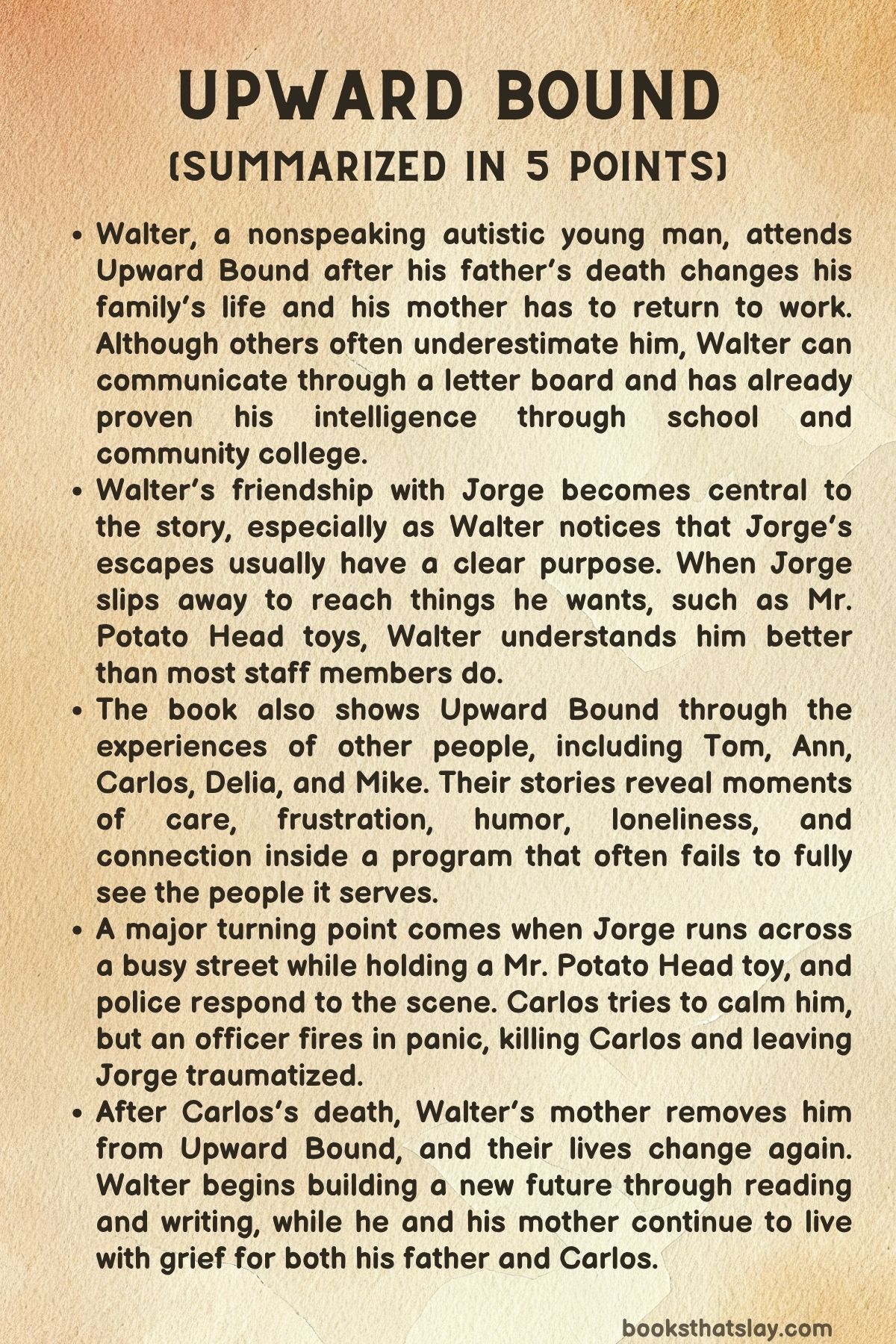
Upward Bound follows Walter, a nonspeaking autistic young man who attends an adult day program called Upward Bound. To the outside world, Walter is often treated as someone with limited understanding, but his inner life is sharp, observant, and full of judgment about the place where he spends his days.
He sees Upward Bound not as a meaningful program, but as a holding place for adults whom society does not know how to support. He is aware of the staff’s habits, the other clients’ patterns, and the ways people make decisions about him without fully knowing him.
Walter has known Jorge, another nonspeaking autistic man, since they were children. Their lives have taken different paths, though both have been shaped by misunderstanding.
Walter learned to communicate by pointing to letters with trained support from his mother. That ability changed his life.
It allowed him to finish high school, go to community college, and earn excellent grades. His success showed what had always been present beneath his silence: intelligence, memory, and a strong desire to be heard.
But after Walter graduates from community college, his father dies suddenly. The loss breaks the life his family had built.
Walter’s mother has to return to work, and because Walter cannot safely stay home alone, she enrolls him in Upward Bound.
At the center, Walter watches Jorge closely. Jorge is known among the staff as an “eloper” because he slips away when no one is watching.
Staff members treat this as a behavior problem, but Walter understands there is more behind it. Jorge is usually trying to reach something specific.
One of his strongest fixations is Mr. Potato Head toys, especially the ones at Target. Walter sees that Jorge’s actions are not random escapes.
They are attempts to get to something he wants, needs, or associates with comfort. This understanding separates Walter from many of the workers around him, who often manage behavior without asking what it means.
One incident shows how badly Walter is misunderstood. Jorge leaves the rec room and hides in a tunnel outside.
Walter follows him, not because he is trying to cause trouble, but because he wants to make sure Jorge is safe. Walter tries to warn the staff through echolalic speech, but they ignore or misread him.
When both men are found, they are treated as rule-breakers. Carlos, a calm and patient staff member who is close to Jorge, understands that Walter was trying to help.
Still, Mike, the director of Upward Bound, files incident reports. At home, Walter uses his letter board to explain the truth to his mother, revealing once again the gap between what others assume and what he actually knows.
The novel also shows Upward Bound through the lives of other people connected to the center. Tom, a man with cerebral palsy who cannot speak or move freely, becomes attached to Ann, a young summer lifeguard.
At first, Ann is nervous and inexperienced. She does not know how to work with the clients and is unsure of herself.
Over time, she grows more comfortable with Tom, Emma, Drew, Jorge, and the others. Pool time becomes one of the happiest parts of the program because Ann treats the clients with warmth and humor.
She jokes with Tom, lets Jorge have small moments of freedom during Target trips, and helps decorate the rec room with the clients.
Tom’s attachment to Ann becomes especially important because her attention makes him feel seen. Inspired by the way she notices him, he begins to discover that he may be able to answer yes-or-no questions by blinking.
Ann does not recognize the signal before she leaves at the end of the summer, but Carlos notices it afterward. This moment suggests that communication may exist in places where people have not taken the time to look carefully.
Tom, like Walter and Jorge, has more inside him than others expect.
Carlos’s own story is also important. Earlier in the novel, his sister Delia, who works as Upward Bound’s administrative assistant, helps him get hired after he is released from jail.
She hopes the job will give him direction and a stable path forward. Carlos becomes one of the few people at the center who truly tries to understand the clients.
He is especially close to Jorge. He does not treat Jorge as a problem to be contained, but as a person whose actions have meaning.
His patience gives Jorge a sense of safety that few others provide.
Mike, the director, is shown as a flawed and lonely man. He struggles with money, isolation, and a strong need to feel in control.
He wants the program to run smoothly, but his decisions are often shaped by authority rather than understanding. During rehearsals for a holiday show, Mike depends heavily on Carlos and other staff.
The show is messy and nearly falls apart, but it eventually succeeds. Walter participates, and Anthony helps carry the performance.
For Mike, the event offers a rare sense of belonging and achievement. Afterward, he even trusts Carlos with the keys, a small sign that his view of Carlos has changed.
Other episodes expand the world of the center. Andy accidentally damages Mike’s car while trying to avoid hitting Jorge.
Avery, a cashier at Target, notices the Upward Bound group and becomes another outside observer of their routines. Walter and Emma share quiet companionship, a connection built without conventional speech.
Walter also remembers a failed adult camp experience, which reinforces his sense that many programs meant to help disabled adults are really built around convenience, control, and low expectations.
The central crisis begins when Jorge arrives at Upward Bound distressed and focused on getting a Mr. Potato Head toy from a locked closet. His need grows stronger, and Carlos finally buys him one at Target.
For a time, this seems to help. But later, Jorge runs across a busy street to a park, still holding the toy.
Police arrive and approach him while he rocks, screams, and clutches it. Jorge cannot explain himself in a way they understand.
Carlos tries to reach him and calm him, using the trust he has built over time. In the confusion, one officer panics and fires.
The bullet hits Carlos instead of Jorge.
Carlos dies on the way to the hospital. Jorge is taken for a psychiatric hold.
The shooting becomes the tragic result of many failures: failure to understand Jorge, failure to value Carlos’s knowledge, failure to recognize communication outside speech, and failure to respond with patience rather than fear. For Walter, the event confirms what he has long known about the danger of being misunderstood.
His mother immediately removes him from Upward Bound for good.
Walter attends Carlos’s memorial and says goodbye to the center and the people there. He sees Jorge afterward, changed and diminished without Carlos.
The loss is not only personal but also symbolic. Carlos had been one of the few people who understood Jorge, and without him, Jorge seems smaller, less protected, and more alone.
After leaving Upward Bound, Walter and his mother rebuild their lives. She becomes his paid caregiver, allowing them to avoid returning to the system that failed him.
They sell their house and move into a smaller townhouse. Their new life is quieter and more focused.
They build routines around reading, writing, and remembering both Walter’s father and Carlos. Walter begins to write stories and considers what his future might become.
He thinks about attending a university, but he also wonders whether a writing life may be his true path.
By the end of Upward Bound, Walter has escaped the adult day program, but he has not escaped grief. His father’s absence remains with him, and Carlos’s death becomes another loss he must carry.
Still, the ending leaves Walter with a stronger sense of purpose. Through writing, he begins to claim his own voice, not by speaking aloud, but by shaping his experience into words.
The novel closes on a life still marked by pain, but also by intelligence, memory, and the possibility of being heard.
Characters
Walter
Walter is the emotional and intellectual center of Upward Bound, and his character reveals the gap between how people are often perceived from the outside and who they truly are inside. As a nonspeaking autistic young man, Walter is frequently underestimated by the staff around him, yet the book shows that he is observant, reflective, educated, and deeply aware of the world.
His ability to communicate through pointing to letters gives him access to education and self-expression, but it does not fully protect him from being treated as dependent or incapable. His placement at the adult day program after his father’s death marks a painful turning point because it forces him into a space he sees as limiting and beneath his abilities.
Walter’s frustration does not come from arrogance, but from the knowledge that he has already proven his intelligence and still remains trapped by other people’s assumptions.
Walter’s relationship with Jorge is one of the most important parts of his character. He understands Jorge not as a problem to be managed, but as a person with reasons behind his actions.
When Jorge slips away, Walter recognizes that there is usually purpose behind the behavior, especially Jorge’s intense desire to reach Mr. Potato Head toys. This makes Walter more perceptive than many of the staff, who often respond to behavior before trying to understand meaning.
His decision to follow Jorge into the tunnel shows courage and loyalty, but it also exposes how powerless he can be in an environment where his communication is ignored. Walter’s echolalic warning is dismissed, and he is treated as a rule-breaker even though he is trying to help.
This moment shows the injustice of a world that fails to listen to him even when he is right.
Walter also carries a quiet grief that shapes his development. His father’s death removes not only a parent but also part of the stable structure that allowed Walter to thrive.
His mother’s need to return to work leads to his placement at the center, and this makes Walter’s life feel smaller after a period of achievement and possibility. Yet Walter is not defined only by loss.
By the end of the story, he begins to rebuild his life through reading, writing, and imagining a future beyond the day program. His interest in writing is especially meaningful because it represents self-definition.
After being misunderstood by systems, staff, and society, Walter begins creating stories of his own, suggesting that his future may depend not on being fitted into a program, but on being allowed to shape his own voice.
Jorge
Jorge is one of the most vulnerable and tragic characters in the book. Like Walter, he is nonspeaking and autistic, but unlike Walter, he does not have the same reliable method of communication.
This difference shapes the way others treat him. Jorge is often labeled through his behavior, especially as an “eloper,” a term that reduces him to the fact that he runs away.
The story gradually shows that this label is too simple. Jorge is not wandering without meaning; he is often moving toward something he wants or needs.
His repeated attempts to reach Mr. Potato Head toys reveal a strong inner focus, and the failure of others to understand this focus turns his needs into crises.
Jorge’s bond with Carlos is central to his character. Carlos sees Jorge more fully than most people do and responds to him with patience rather than fear.
This connection gives Jorge some degree of safety in a world that often reacts to him with confusion or control. When Carlos allows Jorge small moments of freedom at Target or tries to calm him during moments of distress, he is recognizing Jorge’s humanity.
Jorge’s attachment to the Mr. Potato Head toy is not presented as childish in a mocking way; instead, it becomes a symbol of comfort, desire, and the difficulty of being understood without speech. The toy matters because Jorge has few other ways to make his wants known.
Jorge’s final crisis is devastating because it shows what can happen when disability, fear, and authority collide. When he runs across the street to the park and is confronted by police, his rocking, screaming, and clutching of the toy are misunderstood as danger rather than distress.
Carlos knows how to approach him, but the officer’s panic turns the scene into tragedy. After Carlos is shot and Jorge is taken for psychiatric hold, Jorge appears diminished, as though the loss of Carlos has taken away one of the only people who truly knew how to reach him.
Jorge’s character exposes the consequences of a society that responds to disabled people with control before comprehension.
Walter’s Mother
Walter’s mother is a loving, practical, and exhausted figure whose choices are shaped by grief, responsibility, and limited options. She is the person who helped Walter gain access to communication through the letter board, and because of her support, Walter was able to graduate high school, attend community college, and earn excellent grades.
Her role in his life is therefore not passive; she is one of the main reasons Walter has been able to show his intelligence to the world. At the same time, the book does not present caregiving as simple or effortless.
After her husband dies, she has to return to work, and this forces her to place Walter at the adult day program even though it is not the future either of them would have chosen.
Her relationship with Walter is built on trust and understanding. When Walter explains what really happened during the tunnel incident, she listens to him through the letter board.
This is important because it contrasts sharply with the staff members who dismiss Walter’s attempts to communicate. To his mother, Walter is not a case, a client, or a problem; he is her son, and his words matter.
Still, she is also constrained by financial and practical realities. Her decision to send him to the center is not a failure of love but a sign of how families are often forced into imperfect choices when support systems are limited.
After Carlos’s death, Walter’s mother acts decisively by removing Walter from the center for good. This decision shows both protectiveness and moral clarity.
She understands that the place meant to provide care has become unsafe, not only physically but emotionally. In the later part of the story, she restructures their lives by becoming Walter’s paid caregiver, selling the house, and moving with him into a smaller townhouse.
Her character represents adaptation after loss. She is grieving her husband and trying to protect her son, but she also helps create the conditions for Walter’s new life as a reader, writer, and person with a future beyond institutional routines.
Walter’s Father
Walter’s father is not present for much of the active story, but his absence strongly shapes Walter’s life. His sudden death after Walter’s community-college graduation changes the family’s entire structure.
Before his death, Walter’s home life appears to have given him stability, support, and the possibility of achievement. His graduation should have marked a moment of pride and expansion, but his father’s death turns that moment into the beginning of loss and restriction.
Because of this, the father’s character functions partly through memory and consequence.
His importance lies in the emotional space he leaves behind. Walter and his mother continue living with his absence even after they restructure their lives.
The grief is not treated as something that disappears once practical problems are solved. Instead, it remains part of Walter’s inner world.
His father represents the life Walter had before the adult day program, a life connected to education, family, and hope. Remembering him becomes part of Walter’s later routine, especially as he and his mother build a quieter life around reading, writing, and memory.
Tom
Tom is one of the most moving characters in the story because he embodies both extreme physical limitation and deep emotional responsiveness. He has cerebral palsy, cannot speak, and cannot move freely, which means that much of his inner life is hidden from the people around him.
Yet the book makes clear that Tom is not empty or unaware. His attachment to Ann reveals his longing for attention, tenderness, and recognition.
Through him, the story asks readers to look beyond visible disability and consider the emotional lives that may remain unseen when communication is limited.
Tom’s relationship with Ann is especially significant because her presence awakens something in him. Ann begins as frightened and inexperienced, but her growing warmth allows Tom to feel seen in a way he may not often experience.
His feelings for her are not simply a childish crush; they reveal his desire to be noticed as a person with preferences, attachments, and emotional depth. Pool time becomes joyful partly because Ann brings energy and playfulness into a setting that can otherwise feel routine and institutional.
Tom’s response to her attention shows how powerful even small acts of recognition can be.
The discovery that Tom may be able to answer yes-or-no questions through blinking is one of the most important developments connected to his character. It suggests that Tom has had more communicative potential than others realized.
Ann misses the signal, which is painful because she matters so much to him, but Carlos notices it after she leaves. This detail gives Tom’s character both sadness and hope.
His life has been shaped by being unreadable to others, but the possibility of communication means that he may still be able to claim more agency. Tom represents the hidden personhood that can exist beneath severe physical barriers.
Ann
Ann is a character who grows through contact with the clients at the adult day program. When she first arrives as a summer lifeguard, she is frightened and inexperienced.
Her fear is important because it reflects how unfamiliarity with disability can create distance. However, Ann does not remain trapped in that fear.
Over time, she bonds with Tom, Emma, Drew, Jorge, and others, and her role becomes more than simply supervising pool time. She brings joy, humor, and freshness into a setting that often feels controlled by rules and limitations.
Ann’s greatest strength is her ability to create moments of ordinary happiness. She jokes with Tom, helps make pool time exciting, decorates the rec room with the clients, and allows Jorge small experiences of freedom at Target.
These actions may seem simple, but they matter because the clients’ lives are often structured around safety, supervision, and routine. Ann helps them experience pleasure and companionship rather than only management.
Her presence shows how care can become meaningful when it includes imagination, respect, and play.
At the same time, Ann is not perfect. She misses Tom’s blinking signal, which shows that affection alone is not always enough to understand someone’s communication.
Her departure at the end of summer leaves sadness behind, especially for Tom, but her impact remains. Ann’s character represents temporary connection: she enters the lives of the clients for a short time, changes the emotional atmosphere around them, and then leaves.
Through her, the story shows both the beauty and the ache of relationships that are meaningful but brief.
Carlos
Carlos is one of the most compassionate and morally important characters in the book. He is introduced partly through Delia’s efforts to help him get hired after his release from jail, which gives his character a sense of renewal.
The job at the center becomes a chance for him to find direction and purpose. Rather than being defined by his past, Carlos gradually proves himself through patience, steadiness, and emotional intelligence.
He understands the clients not as tasks but as people, and this makes him one of the few staff members who consistently responds to them with genuine care.
His connection with Jorge is especially powerful. Carlos knows how to calm Jorge, how to read his distress, and how to give him small freedoms without treating him as a danger.
He also understands Walter better than the more rigid authority figures do. During the tunnel incident, Carlos recognizes that Walter was trying to help rather than break rules.
This ability to see intention beneath behavior separates Carlos from the institutional mindset around him. He is not careless, but he is humane.
He understands that safety without dignity can become another form of harm.
Carlos’s death is the central tragedy of the story. When Jorge is surrounded by police, Carlos tries to do what he has done throughout the book: approach with calm, familiarity, and care.
The fact that he is shot while trying to protect Jorge makes his death especially devastating. He dies because he moves toward someone in distress while others react with fear.
His memorial confirms the depth of his impact, and even Mike’s earlier decision to entrust him with the keys shows how far Carlos had come in earning trust. Carlos represents the possibility of redemption, the power of patient care, and the terrible cost of a world that does not understand vulnerability.
Delia
Delia is a quieter but important character because she helps set Carlos’s path in motion. As Carlos’s sister and the administrative assistant at the center, she occupies a practical position within the institution, but her role is also personal.
She arranges for Carlos to be hired after he is released from jail because she hopes the job will help him find stability and direction. This shows that Delia believes in second chances.
She sees Carlos not only in terms of his past mistakes but in terms of what he might become.
Her character also reveals how family responsibility can operate behind the scenes. Delia does not transform the center directly in the way Carlos does, but her decision to help him matters deeply.
Without her intervention, Carlos may never have formed his bond with Jorge or become such an important presence in the lives of the clients. Delia’s faith in him is therefore one of the quiet causes of the story’s emotional development.
She represents hope, loyalty, and the belief that meaningful work can help a person rebuild a life.
Mike
Mike, the director of the center, is a complicated figure because he is neither purely cruel nor fully admirable. He struggles with loneliness, money problems, and a strong need for authority.
These pressures shape how he runs the program. He often clings to rules and procedures, such as filing incident reports after the tunnel event, even when the human reality of the situation is more complicated.
His leadership can feel rigid because he is anxious to maintain control, and this sometimes prevents him from seeing the clients and staff clearly.
At the same time, Mike is not without vulnerability. His work on the holiday show reveals his desire for success, recognition, and community.
The show is chaotic, but when it succeeds, especially through Walter’s participation and Anthony’s performance, Mike experiences a rare sense of belonging. This moment softens him and suggests that his need for authority may partly come from insecurity and isolation.
His decision to entrust Carlos with the keys afterward is significant because it shows a moment of trust and perhaps growth.
Mike’s character represents the limitations of institutional leadership. He is responsible for a place that is supposed to care for vulnerable adults, but he is often more focused on order than understanding.
Still, the story allows him moments of humanity. He wants the center to function, and he wants to feel that his work matters.
His tragedy is that his need for control can blind him to the deeper needs of the people around him.
Emma
Emma is a quiet but meaningful presence in the story, especially through her silent companionship with Walter. Her character shows that connection does not always need spoken language or dramatic action.
In a setting where many people are misunderstood or overlooked, Emma’s companionship offers Walter a form of recognition that is gentle and undemanding. Their shared silence suggests comfort rather than emptiness.
Emma also belongs to the larger community of clients who are affected by the atmosphere of the center. Through her interactions with Ann and others, she becomes part of the emotional world that Ann helps brighten during the summer.
Emma’s importance lies in how she contributes to the sense that the clients are not background figures but individuals with relationships, preferences, and inner lives. Her quietness does not make her insignificant; instead, it reminds readers that presence itself can be a form of character.
Drew
Drew is one of the clients who helps show the social world of the center beyond the main conflicts. His bond with Ann places him among the group of people whose lives are touched by her warmth and energy.
Though he is not as central as Walter, Jorge, Tom, or Carlos, Drew helps create the sense of a community made up of many different personalities. His presence broadens the story’s view of the center, making it feel like a real place rather than a setting built around only a few characters.
Drew’s role is also important because he is part of the group that responds to joy, attention, and shared activity. Through characters like Drew, the book shows that the clients need more than supervision.
They need stimulation, kindness, humor, and chances to participate. Drew contributes to the emotional texture of the story by reminding readers that every person at the center has a life that matters, even when the narrative focuses more closely on others.
Anthony
Anthony becomes especially important during the holiday show. His performance helps carry the event and contributes to its surprising success.
In a story where many characters are underestimated, Anthony’s role in the show demonstrates how public moments of participation can reveal abilities that might otherwise go unnoticed. He helps transform what could have been a chaotic failure into a meaningful communal experience.
Anthony’s character also affects Mike’s development. The success of the show gives Mike a rare feeling of community, and Anthony is central to that success.
This means Anthony is not merely a performer within the event; he becomes part of a moment that changes the emotional atmosphere of the center. Through Anthony, the story shows that achievement can appear in unexpected forms and that people often flourish when given a space to be seen.
Andy
Andy appears in a shorter episode, but his role still adds to the book’s picture of the center’s unpredictable daily life. His accidental damage to Mike’s car while trying not to hit Jorge places him in a moment where panic, responsibility, and accident collide.
The incident reflects the constant tension surrounding Jorge’s elopement and the difficulty staff and others face when trying to respond quickly to unexpected situations.
Andy’s action is not presented as malicious. He is trying to avoid harming Jorge, which makes the damage to Mike’s car a consequence of urgency rather than carelessness.
This episode also helps show how Jorge’s misunderstood behavior affects everyone around him. Andy’s character briefly reveals how easily a normal day at the center can turn into confusion, risk, and blame.
Avery
Avery, the Target cashier, offers an outside view of the Upward Bound group. Her role is brief, but it matters because Target is one of the few public spaces where the clients are seen beyond the center.
Through Avery’s observations, the story widens its lens to include how strangers notice and interpret the group. She represents the ordinary public world that the clients enter only under supervision and often with difficulty.
Avery’s presence also connects to Jorge’s attachment to Mr. Potato Head toys. Since Target is the place Jorge repeatedly wants to reach, Avery stands near one of the story’s recurring symbols of desire and misunderstanding.
Her character helps show that the clients’ lives are not confined entirely to the institution. They exist in stores, streets, parks, and public spaces, where their actions are interpreted by people who may not know their needs or histories.
Themes
The Need to Be Heard Beyond Speech
Walter, Jorge, and Tom all show how silence is often mistaken for absence of thought, desire, or intelligence. Walter’s letter board gives him access to education, memory, argument, and self-defense, yet even he is ignored when his communication does not fit what staff expect.
Jorge’s actions are often treated as problems to be controlled, but Walter understands that Jorge usually has a purpose, whether he is seeking comfort, routine, or something meaningful to him. Tom’s blinking becomes another powerful example of communication that almost goes unseen because people are not trained to notice it.
The theme is not simply about disability; it is about the failure of others to listen carefully. Upward Bound presents communication as something wider than speech, including movement, repetition, attention, escape, gesture, and presence.
The tragedy is that many people speak around these men instead of learning how they speak back.
Institutions, Control, and Human Dignity
The adult day program is meant to provide structure, safety, and care, but it often becomes a place where people are managed more than understood. Rules, reports, routines, and staff authority shape daily life, sometimes protecting clients but often reducing them to behaviors and risks.
Walter sees the center as a dead-end holding place because it does not match his intelligence, education, or inner life. Jorge is labeled an “eloper,” a word that turns his fear, longing, and intention into a category of trouble.
Mike’s leadership reflects the pressure of running such a place: he wants order, but his need for control can prevent compassion. Against this system, Carlos and Ann offer a different model of care.
They notice individuals, adapt to them, and allow moments of joy or freedom. The theme shows that dignity depends not only on services, but on whether people are treated as full human beings.
Care, Responsibility, and Emotional Labor
Care in the story is shown as demanding, imperfect, and deeply personal. Walter’s mother builds his communication, supports his education, and reshapes her life after his father’s death, yet her devotion comes with exhaustion and sacrifice.
Carlos cares for Jorge with patience that goes beyond duty, understanding his needs when others see only disruption. Ann begins uncertain and afraid, but through her summer work she learns that care requires attention, humor, trust, and emotional openness.
Delia also participates in care by helping Carlos find work and direction after jail, showing that responsibility extends across families and workplaces. The story does not romanticize caregiving.
It shows how much effort is required to keep vulnerable people safe and respected, and how easily that work is overlooked until something goes wrong. Care becomes both an act of love and a burden placed unevenly on mothers, staff, siblings, and those willing to notice what others ignore.
Loss, Change, and the Search for a Future
Walter’s life is shaped by sudden loss: his father’s death changes his home, his routine, and his future, while Carlos’s death destroys the fragile safety he had found at the center. These losses do not lead to a simple recovery.
Instead, Walter and his mother must rebuild around absence. Their move to a smaller townhouse and their new routine show that survival often means accepting a changed life rather than returning to the old one.
Walter’s writing becomes especially important because it allows him to preserve memory, process grief, and imagine a future outside the limits others have placed on him. Jorge’s decline after Carlos’s death reveals another side of loss: when one trusted person disappears, an entire world can shrink.
The theme suggests that grief is not only sadness but also rearrangement. Walter does not escape pain, but he begins to turn memory into language, and language into possibility.