Voidverse Summary, Characters and Themes
Voidverse by Damien Ober is a strange and imaginative science fiction novel set in a universe of drifting rocks, falling societies, false beliefs, and hidden machines. The story begins with Emery, a mother trapped by the customs of Fairviel, a small world where people accept old rules without knowing the larger truth.
When her son’s life depends on medicine from beyond her home, she is forced into the void and discovers that nearly everything she has been taught is incomplete or wrong. The novel grows into a wider journey about survival, truth, loss, and the dangerous dream of escape.
Summary
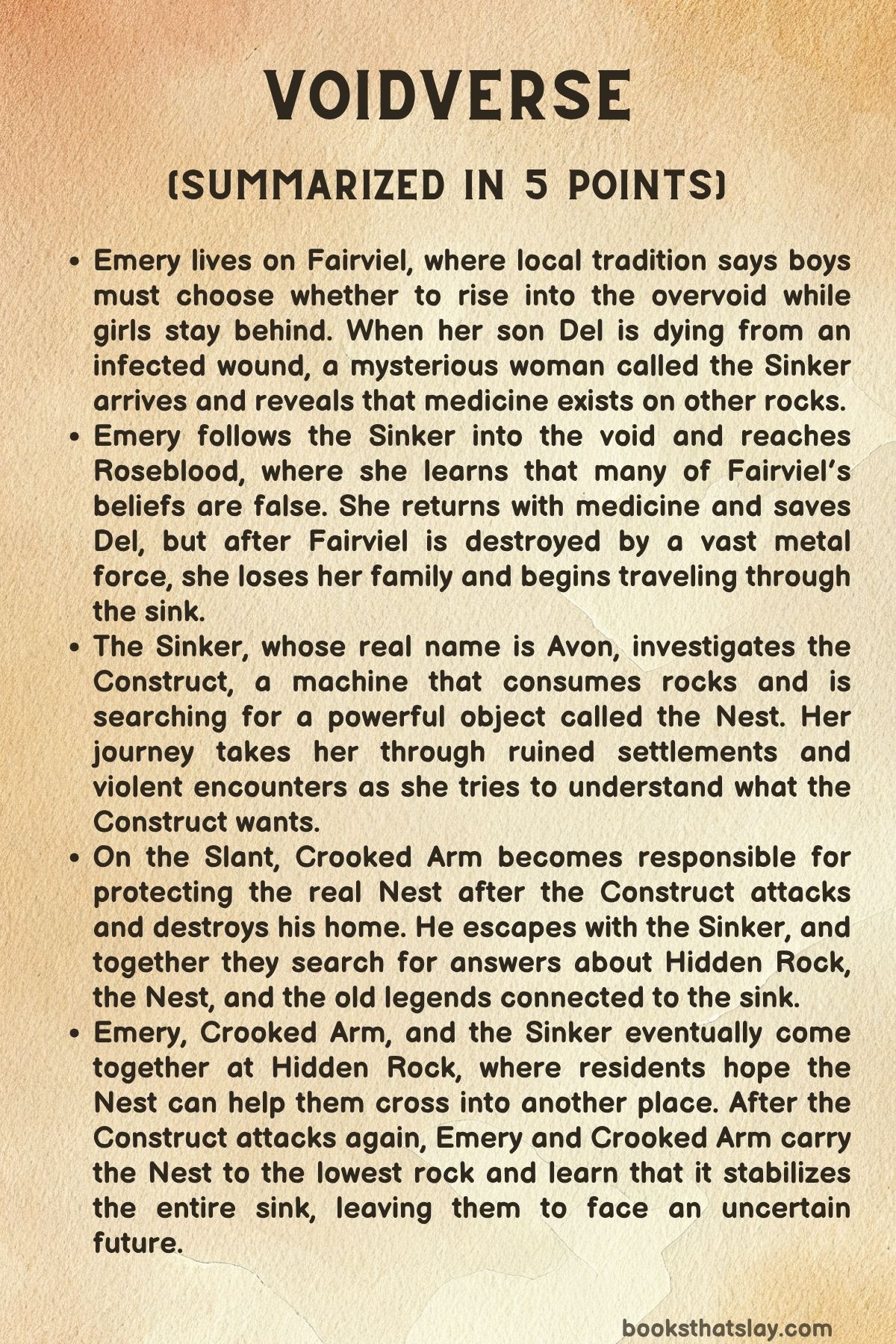
Emery lives on Fairviel, a small rock moving through the endless sink, a vast void where people travel between floating worlds by rising or sinking. Fairviel is ruled by old customs and narrow beliefs.
Its people think boys must eventually face the Deciding, a ceremony in which they choose whether to leap into the void and rise toward the overvoid. Girls are expected to remain behind and live within the limits of the rock.
Emery has accepted much of this life, but she is under terrible strain because her young son, Del, is dying from an infected knife wound.
Her husband, Tim, thinks the Deciding will only upset her, but the ceremony still goes on. During it, several boys leap away into the void, trusting that they will rise.
One boy loses his courage and cannot jump. Then a mysterious woman known as the Sinker arrives from above, bringing a letter for Emery’s mother.
Because of Fairviel’s code of hospitality, the Sinker is taken into Emery’s home. She is an outsider, confident and capable, and she knows much more about the sink than the people of Fairviel do.
The Sinker notices Del’s infection and tells Emery that medicine exists on other rocks. This is a shocking possibility for Emery, who has been raised to think of her world as small and fixed.
The Sinker offers to take her to Roseblood, a larger rock several rests below Fairviel, where Del’s life might be saved. Emery makes the dangerous choice to leave home and follow her into the void.
The journey changes Emery’s understanding of reality. She learns how sinking works and begins to see that travel between rocks is not the mystical, impossible thing Fairviel’s stories made it seem.
The void is dangerous, but it is also full of people, trade, violence, knowledge, and lies. On the way to Roseblood, Emery and the Sinker are attacked by two predatory risers, but they survive.
By the time Emery reaches Roseblood, she has already begun to understand that her home’s teachings about Center City, rising, and the place of women were built on myth and control rather than truth.
On Roseblood, the Sinker obtains the medicine needed to save Del. She also gives Emery a map and a bolt sling, tools that represent a new kind of independence.
Emery returns to Fairviel alone, no longer the same woman who left. She cures Del, but her view of her home has been permanently altered.
The customs that once seemed natural now feel like walls. She knows the sink is larger, stranger, and more open than she had ever been allowed to imagine.
Emery decides she cannot stay on Fairviel. She prepares to leave again, this time not only to save someone else but to claim a life beyond the limits placed on her.
She says goodbye to Del, and Tim gives her trade coins. He admits that he knew more about the wider sink than he had told her.
This confession deepens Emery’s sense of betrayal, but before she can leave, Fairviel is attacked by a vast metal force.
The attack destroys everything. Emery is knocked unconscious and thrown into the void.
When she wakes, Fairviel has been shattered, stripped, and bundled. Its people are dead, including Tim and Del.
The home she wanted to escape has been erased, and the son she saved has been taken from her. With nothing left behind her, Emery chooses to sink downward.
Her personal journey becomes part of a larger disaster moving through the sink.
The story then shifts to the Sinker, whose real name is Avon. She has heard rumors of a terrifying machine called the Construct, a rock-devouring force that moves through the sink destroying entire worlds.
Avon tracks the Construct to Frozen Rock and learns from a pilot that it is heading toward the Slant, the Kingdom of the Scorched Dome. Its goal is to seize an anomaly known as the Nest.
Avon is wounded during the attack on Frozen Rock and later recovers at Big Iron. There, she discovers that her host, Randy, murdered his wife Dot.
Avon executes him and continues her pursuit of the Construct.
On the Slant, the story follows Crooked Arm, the son of the lord. His world is shaped by traditions surrounding the Nest, an object believed to preserve the alignment of seven rocks.
The Nest is guarded through old rituals and the role of the First Sword, but Crooked Arm does not fully understand its true importance. When the Construct attacks the Slant, its power becomes impossible to dismiss.
It uses Far Machines, razor devices, grapples, and transports to overwhelm the kingdom.
Crooked Arm’s father is killed during the attack, but before he dies, he tells his son that the Nest matters not only to the Slant but to the entire sink. He orders Crooked Arm to take it to the Immortal First Sword.
Crooked Arm retrieves the real Nest and escapes with Avon. Together, they watch Vertex and the Slant fall to the Construct’s violence.
Like Emery, Crooked Arm loses his home and is forced into the void with only fragments of truth to guide him.
Crooked Arm and Avon travel together, trying to protect the Nest and understand where it belongs. They hide it inside a mirrored shell and seek out Crooked Arm’s exiled brother, Mighty.
Their search leads them toward Hidden Rock, an invisible place connected to the Nest and the old legends of the sink. They visit an archive to uncover more information, but an assistant linked to Hidden Rock betrays them.
After a fight, they gain directions and continue toward the hidden place.
Meanwhile, Emery has been pulled by dreams of water and something called the Overlap. Her visions also lead her to Hidden Rock, a secret community concealed inside a mirrored shell.
Hidden Rock is unlike the places she has known. Its people believe the Nest may help them cross the Overlap into another place beyond the sink.
This dream of escape gives them purpose, but it also makes them willing to imprison and manipulate others. Emery finds Avon and Crooked Arm captured there and frees them.
The three confront Foster and the residents of Hidden Rock. The people there see the Nest as a possible key to leaving their broken universe, but their plans are cut short when the Construct finds Hidden Rock and attacks.
The machine’s reach proves almost impossible to escape. Avon chooses to stay behind and fight, delaying the Construct so Emery and Crooked Arm can flee with the Nest.
Her decision gives them a chance to continue, though it leaves her fate uncertain.
Emery and Crooked Arm follow the alignment line of the Slant downward through the sink. Their path takes them to the lowest rock, the Spear.
There, they meet the Immortal First Sword, now known as the Endless. He reveals the deeper truth behind the Nest and the Construct.
The Nest did not merely stabilize the Slant; it helped hold the entire sink in balance. The Construct was created by the Endless’s old counterpart, someone who wanted to escape the sink and return to a lost world.
This revelation reframes the destruction that has followed Emery, Avon, and Crooked Arm. Fairviel, the Slant, and Hidden Rock were not isolated tragedies.
They were casualties in a much older struggle over the nature of the sink, the possibility of escape, and the cost of trying to return to what was lost. Emery began as a mother trying to save her child.
Crooked Arm began as a son shaped by duty and tradition. Both are stripped of home, family, and certainty.
By the end, they carry the Nest and the burden of knowledge into an uncertain future, standing at the edge of a truth that may decide the fate of every rock in the sink.
Characters
Emery
Emery is the emotional center of Voidverse and one of the most important characters in the book because her journey begins in grief, fear, and confinement, but gradually becomes a search for truth, movement, and survival. At the beginning, she is defined by the limits of Fairviel: its customs, its false beliefs, its gender roles, and its narrow understanding of the sink.
Her love for Del gives her courage before she has a larger sense of purpose. She does not leave Fairviel because she wants adventure; she leaves because her child is dying and the world she knows has failed to save him.
This makes her bravery deeply personal rather than heroic in a simple way. Her journey to Roseblood forces her to confront not only the danger of the void but also the fact that almost everything she has been taught is incomplete or untrue.
Emery’s transformation is therefore both physical and intellectual. She learns to move through the sink, but she also learns to question the social order that kept her ignorant.
After Del is cured, Emery’s character becomes more complicated because she can no longer return to being the woman she was before. The knowledge of the wider sink changes her permanently.
Her decision to leave Fairviel shows that she has outgrown the role assigned to her, even though leaving means separating herself from the life she once protected. The destruction of Fairviel then turns her growth into trauma.
Losing Tim, Del, and her home gives Emery’s later journey a tragic weight, but it does not make her passive. Instead, she becomes a survivor who continues downward after losing everything that once gave her identity.
Her dreams of water and the Overlap suggest that she is connected to mysteries larger than her original world, and her arrival at Hidden Rock places her at the center of the larger conflict surrounding the Nest. Emery represents the painful cost of truth: once she sees beyond Fairviel’s myths, she gains freedom, but that freedom comes with loneliness, grief, and responsibility.
Avon, the Sinker
Avon, known for much of the story as the Sinker, is a guide, fighter, wanderer, and truth-bearer. She enters the book as a mysterious outsider from above, and her presence immediately disrupts Fairviel’s closed worldview.
To Emery, she is both frightening and liberating because she represents everything Fairviel’s people do not understand. Avon knows that the sink is larger, stranger, and more dangerous than Fairviel’s myths allow.
Her practical knowledge of movement, medicine, trade, weapons, and other rocks makes her seem almost legendary at first, but the later parts of the story reveal that she is not simply a wise guide. She is a wounded and morally burdened traveler who has seen the cruelty of the sink and learned to survive it.
Avon’s importance comes from the way she connects separate parts of the story. She brings Emery out of ignorance, investigates the Construct, helps Crooked Arm escape the Slant, and becomes part of the struggle over the Nest.
She is decisive and often ruthless, as shown when she executes Randy after discovering the murder of Dot. This moment reveals her harsh personal code.
Avon does not simply survive violence; she answers it with judgment. At the same time, she is not cold or empty.
Her decision to help Emery save Del shows compassion, and her later decision to stay behind at Hidden Rock to delay the Construct shows courage and sacrifice. Avon is a character shaped by motion.
She belongs nowhere permanently, yet she repeatedly becomes necessary wherever the truth is hidden or danger arrives. Her role in Voidverse is that of a bridge between ordinary people and the terrifying reality of the wider sink.
Del
Del is Emery’s son and the character whose suffering begins Emery’s transformation. Though he is not active in the same way as Emery, Avon, or Crooked Arm, his importance is enormous because his infected wound forces Emery to act against the limits placed on her.
Del represents love, vulnerability, and the fragile life Emery is trying to protect. His illness reveals the cruelty of Fairviel’s isolation.
The people of Fairviel live with beliefs that keep them cut off from help, and Del’s wound shows that ignorance is not harmless; it can become deadly. Through Del, the book shows how false traditions and limited knowledge can endanger the innocent.
Del also becomes one of the deepest sources of tragedy in Emery’s life. After Emery risks herself to obtain medicine and save him, his later death in the destruction of Fairviel makes the loss even more devastating.
The reader understands that Emery’s courage worked once, but it could not protect him from the larger violence of the Construct. Del’s death changes Emery’s journey from a rescue mission into a grief-stricken search for meaning and survival.
He remains important even after he is gone because Emery’s love for him continues to shape her choices. Del is not just a victim; he is the emotional force that pushes Emery into the wider world and makes her later losses feel deeply personal.
Tim
Tim is Emery’s husband, and his character reflects the compromises and failures of life on Fairviel. At first, he seems protective in a limited and traditional way.
He thinks watching the Deciding will upset Emery, which suggests that he sees emotional safety as more important than truth or participation. However, his later admission that he knew more about the wider sink than he told Emery makes him more morally complicated.
Tim is not merely ignorant; he has helped preserve Emery’s ignorance. His silence shows how ordinary people can become part of a restrictive system even when they care for those harmed by it.
Tim’s relationship with Emery is marked by love, concealment, and inequality. He gives her trade coins before she leaves, which shows that he does care about her and recognizes her need to go.
Yet this gesture cannot erase the fact that he withheld knowledge that might have changed her life earlier. Tim embodies the tragedy of a person who is neither openly cruel nor truly brave enough to challenge the world he lives in.
His death during the attack on Fairviel freezes his relationship with Emery in unresolved pain. He never fully repairs the damage caused by his silence, and Emery is left to carry both grief and the knowledge that her old life was built partly on deception.
Crooked Arm
Crooked Arm is one of the major figures in the second half of the book, and his journey mirrors Emery’s in important ways. Like Emery, he begins inside a closed culture shaped by tradition, hierarchy, and myth.
As the son of the lord of the Slant, he is tied to duty and inheritance, especially through the traditions surrounding the Nest and the First Sword. His name suggests physical difference or imperfection, but his character is defined less by weakness than by endurance and responsibility.
He is not introduced as a perfect warrior or chosen savior. Instead, he becomes important because disaster forces him to act.
The destruction of the Slant transforms Crooked Arm from a protected noble son into a bearer of a dangerous truth. When his father tells him that the Nest matters to all the sink, Crooked Arm inherits not just an object but a burden he does not fully understand.
His escape with Avon and his later partnership with Emery show that he must learn to trust people outside his own traditions. Like Emery, he discovers that the stories he inherited are incomplete.
His journey toward Hidden Rock and then the Spear is a journey away from local loyalty and toward a larger understanding of the sink itself. Crooked Arm is important because he carries the Nest physically, but also because he carries the collapse of his homeland emotionally.
His grief gives him depth, while his willingness to continue makes him a figure of persistence rather than simple heroism.
Crooked Arm’s Father
Crooked Arm’s father, the lord of the Slant, represents authority, inheritance, and the burden of guarded knowledge. He appears as a ruler shaped by tradition, especially the belief that the Nest must be protected and that the First Sword is central to that protection.
His importance becomes clearest during the Construct’s attack, when he reveals that the Nest matters far beyond the Slant. This moment changes him from a local ruler into a keeper of a much larger secret.
He may not have told Crooked Arm everything earlier, but in his final moments he gives his son the responsibility of carrying the truth forward.
His death is significant because it marks the collapse of the old order. The Slant’s traditions, titles, and defenses cannot withstand the Construct.
By ordering Crooked Arm to take the Nest to the Immortal First Sword, he passes authority from the world of inherited rule to the world of desperate action. He is not explored as intimately as Emery or Avon, but he functions as a tragic father figure whose final act gives purpose to his son’s survival.
His character shows that even powerful leaders in the sink are small before the ancient forces and hidden histories that govern the world.
Mighty
Mighty, Crooked Arm’s exiled brother, represents family division and the shadow of the Slant’s past. Though he does not dominate the story, his existence expands Crooked Arm’s character by showing that the ruling family of the Slant has its own fractures.
The fact that Crooked Arm and Avon seek him out suggests that exile does not erase importance. Mighty remains someone connected to knowledge, survival, or possibility, even after being pushed away from his original place in society.
His name suggests strength, but his exile complicates that impression, implying that strength alone does not guarantee belonging.
Mighty’s role also helps develop the theme of broken inheritance. The Slant is not a perfectly unified kingdom; it contains banishment, secrets, and unresolved relationships.
Through Mighty, the book suggests that families and societies often hide their failures beneath tradition. His presence matters because Crooked Arm’s search for him is also a search for help outside the official structures that have collapsed.
Mighty stands as a reminder that survival may depend on those who were once rejected by the very systems now in ruins.
Foster
Foster is one of the central figures connected to Hidden Rock, and his character represents the dangerous pull of escape. He and the residents of Hidden Rock believe the Nest can help them cross the Overlap into another place.
This makes Foster different from characters who want to defend a home or preserve a tradition. His desire is directed outward, toward departure from the sink itself.
In this way, he reflects one of the book’s major temptations: the dream that there may be another world beyond suffering, violence, and endless falling.
Foster is not simply evil, but his beliefs make him dangerous. He is willing to imprison Avon and Crooked Arm, and his community’s secrecy shows how hope can become controlling when people believe they are close to salvation.
Hidden Rock seems like a refuge at first because it is invisible and protected, but Foster’s actions reveal that hidden places can contain their own forms of coercion. He represents the moral danger of a community that justifies harm in the name of transcendence.
Through Foster, the story explores how the longing to escape a broken world can lead people to betray others who are trying to survive within it.
The Endless, the Immortal First Sword
The Endless, once known as the Immortal First Sword, is a figure of myth who becomes a figure of explanation. For much of the book, the First Sword exists as part of Slant tradition, almost like a sacred or legendary protector.
When Emery and Crooked Arm finally meet him at the Spear, the myth becomes real, but reality is stranger and heavier than legend. He explains that the Nest helped stabilize not only the Slant but the entire sink, which makes him a keeper of ancient knowledge rather than merely a warrior.
The Endless is important because he connects the personal losses of Emery and Crooked Arm to the deep history of the sink. Through him, the characters learn that the Construct was created by an old counterpart who wanted to escape and return to a lost world.
This revelation changes the conflict from a simple struggle against a destructive machine into a tragedy rooted in ancient desire, memory, and desperation. The Endless represents endurance across time, but his endurance also feels lonely and burdensome.
He has survived long enough to understand truths that others only discover after catastrophe. His character gives the ending a sense of scale, showing that the characters’ suffering is part of a much older conflict.
Randy
Randy is a dark minor character whose role reveals the cruelty that can exist beneath ordinary hospitality. When Avon recovers at Big Iron, Randy appears at first as a host, someone connected to shelter and recovery.
However, the discovery that he murdered his wife Dot exposes him as a figure of domestic violence and hidden corruption. His crime is intimate rather than grand, but it is no less horrifying.
In a book filled with vast machines and collapsing rocks, Randy shows that evil also exists in private spaces.
Avon’s execution of Randy is a key moment because it reveals both Randy’s guilt and Avon’s moral severity. Randy is not treated as a complicated tragic figure; he is a man whose violence has destroyed someone close to him.
His presence sharpens the harshness of the sink by showing that danger does not only come from the void, predators, or the Construct. It can also come from the people who offer shelter.
Randy’s character helps build the book’s atmosphere of distrust, where survival requires judgment as much as courage.
Dot
Dot is Randy’s murdered wife, and although she does not have an active role in the present action, her death matters because it exposes the truth about Randy and gives Avon a moral test. Dot represents the hidden victims of the sink, people whose suffering might remain unseen if no one looked closely enough.
Her death turns Big Iron from a place of recovery into a place of horror. Through Dot, the story briefly shifts from large-scale destruction to personal violence, reminding the reader that individual lives matter even in a world full of enormous dangers.
Dot’s importance lies in what her absence reveals. She cannot speak for herself, but the truth of what happened to her demands action.
Avon’s response shows that Dot’s life is not treated as meaningless. Even though the book moves quickly through vast settings and major conflicts, Dot’s murder creates a moment of moral clarity.
Her character shows how the dead can still shape the living by forcing them to confront injustice.
Themes
Gender Roles and Social Control
Fairviel’s customs show how deeply social control can shape people’s lives before they even recognize it as control. In Voidverse, boys are raised to believe they must eventually leave, rise, and seek a greater destiny, while girls are expected to remain behind and accept a smaller, fixed role.
This division is treated as natural by the community, but Emery’s journey exposes it as a belief system built on fear, repetition, and withheld knowledge. Tim’s silence also shows how control survives not only through harsh rules, but through people who know more and still choose comfort over truth.
Emery’s discovery of other rocks proves that Fairviel’s traditions are not universal laws but local myths used to limit imagination. Her movement into the wider sink becomes an act of rebellion against the identity assigned to her.
The theme suggests that oppressive systems often appear ordinary because they are taught early, repeated often, and protected by those afraid of change.
Truth, Myth, and Hidden Knowledge
The world of the story is shaped by half-truths, legends, and secrets that determine how people understand their place in the sink. Fairviel’s people believe in a version of reality that keeps them obedient, while the Slant protects the Nest through rituals whose full meaning has been lost or concealed.
Hidden Rock represents another form of secrecy, where people preserve knowledge but also distort it through their own desire to escape. Across these places, truth is never simple or easily available.
It must be earned through risk, travel, loss, and confrontation. Emery learns that the world is larger than she was told, Crooked Arm learns that his inherited traditions have a deeper purpose, and the Sinker moves through places where rumors often carry fragments of fact.
The theme shows that myths can protect important truths, but they can also trap people when the meaning behind them is forgotten. Knowledge becomes powerful because it changes action, identity, and responsibility.
Loss as a Force of Transformation
Emery’s transformation begins with fear for Del, but it becomes irreversible after the destruction of Fairviel. Her grief is not treated as a temporary wound; it becomes the force that separates her from her old life completely.
The deaths of Tim and Del remove the possibility of returning to the person she once was, and her decision to sink downward marks the start of a harsher, freer existence. Crooked Arm experiences a similar break when the Slant is destroyed and his father dies, forcing him to carry a duty he does not fully understand.
The Sinker also carries a life shaped by violence, survival, and hard choices. Loss in the story does not simply create sadness; it strips away illusion and demands movement.
Characters are pushed into new roles because the worlds that defined them no longer exist. This theme gives the story emotional weight, showing that survival is not only about staying alive, but about learning how to act after everything familiar has been taken.
Survival, Duty, and Moral Choice
Survival in the sink is never only physical. Characters must decide what kind of people they will become while facing danger, hunger, violence, and the collapse of entire communities.
Emery first leaves Fairviel to save Del, but later her survival becomes tied to carrying truth forward after personal devastation. Crooked Arm inherits the Nest as a duty before he understands its importance, yet he continues because others have sacrificed to protect it.
The Sinker’s choices are often severe, especially when she kills Randy after discovering his crime, but her actions reflect a moral code shaped by the brutal world she moves through. The Construct represents survival without conscience: a force driven by escape, consumption, and domination.
Against it, the main characters stand for a more difficult form of survival, one that includes responsibility to others. The theme suggests that staying alive matters, but what gives survival meaning is the willingness to protect something beyond the self, even when the cost is high.