Where the Girls Were Summary, Characters and Themes
Where the Girls Were by Kate Schatz is a coming-of-age novel set in 1968, a time of social change, strict family expectations, and limited choices for young women. The story follows seventeen-year-old Elizabeth “Baker” Phillips, a gifted and obedient student whose carefully planned future is disrupted after one secret night in San Francisco.
Through Baker’s experience, the book examines first love, shame, pregnancy, family control, and the harsh treatment of unmarried pregnant girls in that era. It is a story about a young woman forced to question everything she has been taught and decide what kind of life she wants to claim for herself.
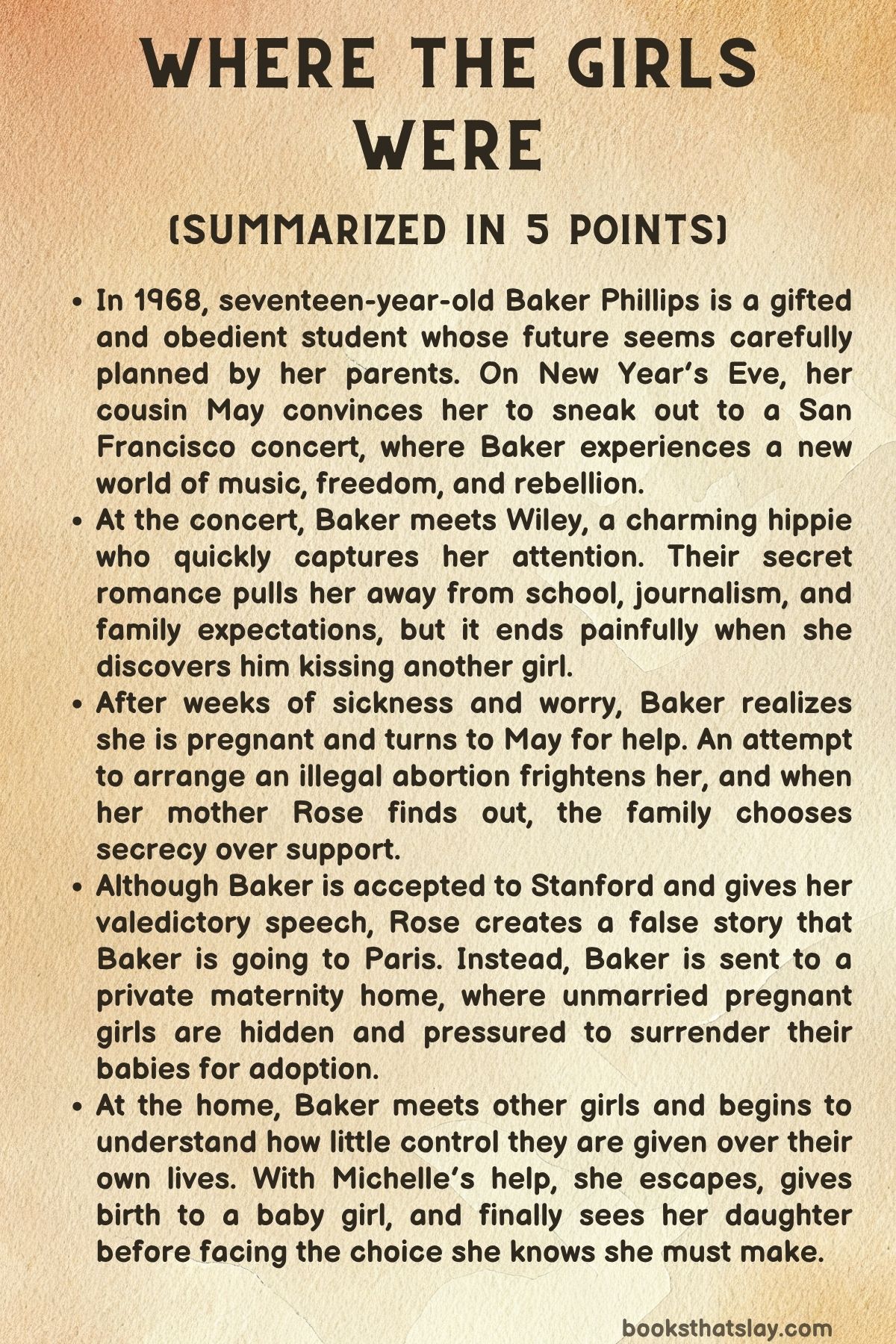
Summary
Baker Phillips is seventeen, bright, disciplined, and used to doing exactly what is expected of her. In 1968, she is finishing high school with a reputation as the kind of girl who will become valedictorian, attend Stanford, and make her parents proud.
Her mother, Rose, has clear ideas about who Baker should be: proper, hardworking, respectable, and useful to the family business. Baker has spent most of her life fitting into that role, but on New Year’s Eve, her older cousin May offers her a chance to step outside it.
May persuades Baker to lie to Rose and go to a concert in San Francisco. Baker begins the evening dressed in the safe, mother-approved outfit chosen for her, but she changes into a suede miniskirt and halter top, clothes that make her feel daring and unlike her usual self.
She joins May and May’s friends in a crowded van, where she meets Wiley, a relaxed, handsome hippie who quotes poetry and seems to belong to an entirely different world. Baker is immediately fascinated by him.
He appears free in a way she has never been allowed to be.
At the Fillmore, Baker is hit by a rush of noise, color, music, smoke, bodies, and movement. The night feels alive and strange.
She loses track of May, drinks beer, dances, and lets herself be pulled further from the careful girl she has always been. Wiley stays close, and Baker’s attraction to him grows stronger.
At midnight, during the New Year countdown, she kisses him. The kiss feels like a break from her old life and a step toward something new.
After the concert, Baker leaves with Wiley. They walk through the city and end up near the van, lying together on a blanket.
Baker is inexperienced and does not truly understand sex or pregnancy. Wiley gives her a careless and false reassurance that they are safe because of timing and the moon.
Trusting him, and caught up in the intensity of the night, Baker sleeps with him. By morning, she returns home, hides what happened, and tries to behave as though nothing has changed.
In the weeks that follow, Baker begins meeting Wiley in secret with May’s help. Her life starts to shift.
Schoolwork, journalism, family duties, and the pressure to remain perfect all begin to matter less than seeing him. The romance consumes her.
Wiley represents escape, and Baker wants to believe that what they share is real. But at May’s Valentine’s party, she sees him kissing another girl, the one she knows as Fur Hat.
The moment humiliates her and breaks the fantasy she has built around him. Baker runs away from the party, cries alone in a park, eats the cookies she had baked with Rose, and becomes sick.
Soon, her sickness begins to feel like more than heartbreak. She is exhausted and nauseated, and her body feels different.
When she realizes she has missed her period, fear settles in. She tells May, who quickly understands that Baker is probably pregnant.
May tries to help by pointing her toward abortion contacts through the Society for Humane Abortion. Baker attempts to arrange an illegal procedure, but when she goes alone to the address she has been given, the man there frightens her and threatens to call the police.
Terrified, she runs away.
Baker can no longer keep the secret hidden. Rose notices her sickness and the changes in her body.
She takes Baker to an OB-GYN, where the doctor confirms that Baker is about thirteen weeks pregnant. On the very same day, Baker is accepted to Stanford.
What should have been a moment of triumph becomes shadowed by fear and shame. Rose and Gerald are horrified.
For Rose, the greatest danger is exposure. She believes that if anyone finds out, Baker could be expelled, rejected, and permanently disgraced.
The family chooses secrecy. Baker continues through graduation and gives her valedictory speech, still carrying the truth no one is allowed to know.
Afterward, Rose announces a false story to the public: Baker is going to Paris for a Sorbonne program and will begin Stanford later. In reality, Rose takes her to a private maternity home run by Ms. White.
The home is a place where unmarried pregnant girls are hidden until they give birth, after which they are expected to surrender their babies for adoption.
At the maternity home, Baker meets other girls whose lives have also been taken over by secrecy and adult decisions. Among them is Michelle, who has already lost one baby to adoption and fears losing another.
Baker observes how Ms. White and the social worker, Mary Ann, manage the girls through pressure, polite language, and emotional control. They tell the girls that their babies will go to better families and that giving them up is the responsible choice.
The girls are treated less like people making life-changing decisions and more like problems to be handled quietly.
As Baker spends more time there, she begins to see the machinery behind the home’s calm surface. Files, lies, and rehearsed explanations reveal how little power the girls truly have.
The adults around them speak as though the future has already been decided. Baker is expected to give birth, sign the papers, return home, and resume the life her parents planned for her.
But the more she sees, the less willing she is to accept that path. Her pregnancy began in confusion and secrecy, but her response to it becomes increasingly clear: she does not want other people deciding everything for her.
Baker and Michelle begin planning an escape. When a nighttime fire creates chaos at the home, Baker uses the confusion as cover.
She and Michelle flee, meet Michelle’s boyfriend Barry, and travel to a commune where May is staying. For the first time in months, Baker feels some distance from Rose, Ms. White, and all the rules built around hiding her.
Yet freedom does not make her situation simple. She is still young, scared, pregnant, and unsure what future is possible for her.
When labor begins, Baker makes a surprising choice. Rather than stay away, she insists that May drive her home.
At the hospital, Baker gives birth under anesthesia to a healthy baby girl. When she wakes, she searches for her child.
The adults around her still seem prepared to control what happens next, but Baker’s focus is on seeing the baby. A nurse brings the child near the nursery window, and Baker sees her daughter for the first time.
She whispers hello and tells her she loves her.
That brief meeting gives Baker a sense of certainty. She turns back toward Rose knowing what she is going to do.
The ending leaves Baker at the edge of a decision, but it shows how much she has changed. She began as a dutiful daughter shaped by obedience, shame, and expectation.
By the end, she has seen the cost of silence and the cruelty of systems that erase young women’s choices. Her love for her daughter gives her the strength to act not as the girl others tried to manage, but as someone ready to claim her own voice.
Characters
Elizabeth Baker Phillips
Baker Phillips is the central character in Where the Girls Were, and her journey is shaped by the painful gap between who she has been trained to be and who she slowly begins to become. At the beginning of the book, she is intelligent, obedient, ambitious, and deeply aware of the expectations placed on her.
She is expected to become valedictorian, attend Stanford, and eventually serve the needs of her family, especially through the family business. Her life is carefully planned by the adults around her, and she has learned to measure herself through achievement, respectability, and approval.
This makes her New Year’s Eve rebellion especially important, because it is not simply a night out; it is her first major step away from the controlled identity her mother has built for her.
Baker’s attraction to Wiley reveals her innocence, curiosity, and emotional hunger. She is drawn to him because he seems to belong to a freer, more poetic world than the one she knows.
His sleepy charm, casual confidence, and connection to the hippie atmosphere make him appear mysterious and romantic to her. However, Baker’s inexperience makes her vulnerable.
She does not fully understand sex, pregnancy, or the risks of trusting someone who gives her false reassurance. Her relationship with Wiley becomes a turning point because it pulls her away from school, journalism, and responsibility, showing how quickly desire and secrecy can disrupt the life she once controlled so carefully.
Her pregnancy forces Baker into a harsh confrontation with the realities of being a young unmarried girl in 1968. She is not only frightened by the pregnancy itself but also trapped by the shame, silence, and lack of safe choices surrounding her.
Her failed attempt to arrange an illegal abortion shows how dangerous and lonely her situation is. She has no real protection from society, medicine, or even her own family’s fear of disgrace.
Yet Baker is not written as passive. Her fear gradually becomes awareness, and her awareness becomes resistance.
At the maternity home, she begins to understand that girls like her are being managed, hidden, and pressured into surrendering their children for the comfort of others.
By the end of the story, Baker has changed from a dutiful daughter into someone capable of making a decision for herself. Her final moments with her baby daughter are quiet but powerful because they show her emotional clarity.
She has moved beyond shame and confusion into love, recognition, and resolve. Baker’s character represents the struggle for bodily autonomy, the pain of growing up under social control, and the courage it takes to claim one’s future when everyone else has already decided it.
May
May is Baker’s older cousin and one of the most important forces of change in the book. She represents freedom, rebellion, and the possibility of living outside the strict rules that shape Baker’s world.
When May persuades Baker to lie to Rose and go to the San Francisco concert, she opens the door to a life Baker has never experienced before. May is daring, socially confident, and connected to the countercultural world of music, parties, communes, and unconventional relationships.
To Baker, May seems exciting because she does not appear trapped by obedience or fear in the same way.
However, May is not simply a symbol of freedom. She is also careless at times, and her choices expose Baker to situations Baker is not prepared to handle.
May brings Baker into Wiley’s orbit, but she does not fully protect her from the consequences of that world. Her influence is complicated because she gives Baker access to independence, yet that independence comes before Baker has the knowledge or emotional maturity to navigate it safely.
In this way, May is both a liberating and risky presence.
May’s role becomes more serious after Baker realizes she may be pregnant. She is the first person Baker confides in, and she responds with practical knowledge rather than moral judgment.
By mentioning abortion contacts through the Society for Humane Abortion, May shows that she understands the hidden systems women rely on when official society fails them. Later, her connection to the commune gives Baker and Michelle somewhere to go after escaping the maternity home.
May’s world may be unstable, but it also offers refuge from the suffocating respectability of Baker’s family and the coercive control of the maternity home.
May’s character matters because she shows both the promise and limits of rebellion. She cannot solve Baker’s problems, and she cannot fully undo the harm caused by secrecy, sexism, and shame.
Still, she helps Baker imagine alternatives. Through May, the story presents freedom as messy, imperfect, and sometimes dangerous, but also necessary for a young woman trying to escape a life built entirely around obedience.
Rose Phillips
Rose Phillips, Baker’s mother, is one of the most complex adult characters in the story. She loves Baker, but her love is deeply tied to control, reputation, and fear.
Rose has a clear vision of who Baker should be: proper, successful, respectable, and useful to the family’s future. She approves Baker’s clothing, monitors her behavior, and expects her daughter to follow the path already laid out for her.
Rose’s parenting reflects the values of her time, especially the belief that a girl’s respectability determines her worth and her family’s standing.
When Rose discovers Baker’s pregnancy, her reaction is shaped less by emotional comfort and more by panic over exposure. She immediately understands the social danger Baker faces: expulsion, disgrace, and public judgment.
Yet instead of centering Baker’s emotional needs, Rose focuses on concealment. Her fake story about Baker going to Paris shows how committed she is to preserving appearances.
This lie is not just a cover story; it reveals the world Rose believes she is living in, one where scandal can destroy a girl’s future and a family’s name.
Rose’s decision to take Baker to the maternity home shows the painful contradiction in her character. She thinks she is protecting Baker, but she also participates in a system that strips Baker of choice.
Rose’s fear makes her controlling, and her desire to save Baker from public shame leads her to support private suffering. She does not appear cruel in a simple way.
Instead, she is a character shaped by the same social pressures that harm her daughter. She has internalized the idea that secrecy and surrender are the only respectable solutions.
By the end of the book, Rose stands as both Baker’s protector and obstacle. Her presence reminds the reader that harm can come from people who believe they are doing the responsible thing.
Rose’s character reflects generational conflict, the pressure of social respectability, and the tragedy of a mother whose fear prevents her from fully seeing her daughter’s humanity.
Wiley
Wiley is the young man whose brief but intense relationship with Baker changes the course of her life. He is introduced as handsome, sleepy, poetic, and alluring, a figure who seems to belong naturally to the freer world Baker longs to enter.
His habit of quoting poetry and his relaxed manner make him appear romantic and mature to Baker. For a girl used to rules, schedules, and expectations, Wiley seems like a doorway into spontaneity and emotional excitement.
Yet Wiley’s charm hides selfishness and irresponsibility. He gives Baker a false assurance about sex, telling her they are safe because of timing and the moon.
This moment is crucial to understanding him because it shows either ignorance, manipulation, or a careless mixture of both. Baker trusts him because she is inexperienced, but Wiley does not treat that trust with seriousness.
His casual attitude has life-altering consequences for her, while he remains largely free from the burden that follows.
His later betrayal at May’s Valentine’s party deepens the sense that he is emotionally unreliable. When Baker sees him kissing Fur Hat, the romantic image she had built around him collapses.
Wiley is not the devoted, poetic figure she imagined; he is a young man drifting through pleasures without taking responsibility for the people he affects. The humiliation Baker feels in that moment is not only romantic heartbreak.
It is the beginning of her understanding that the world Wiley represents is not automatically kinder or more honest than the respectable world she is trying to escape.
Wiley’s importance lies in how he exposes Baker’s vulnerability and the unequal consequences of sexual freedom. For him, the relationship appears temporary and casual.
For Baker, it leads to pregnancy, secrecy, shame, and a battle over her future. He represents the danger of charm without accountability and the way young women often bear the consequences of choices made by both people.
Gerald Phillips
Gerald Phillips, Baker’s father, is less dominant than Rose but still important as part of the family structure that surrounds Baker. He represents expectation, achievement, and conventional success.
Baker is expected not only to attend Stanford but eventually to help improve the family business, which shows that Gerald’s world also has plans for her. His daughter’s brilliance is valued, but it is valued within a framework of family ambition and social respectability.
Gerald’s horror at Baker’s pregnancy reflects the values of the household and the period. He is not presented as the primary decision-maker in the crisis, but his reaction contributes to the atmosphere of shame and fear.
Baker’s pregnancy is not treated as something the family can openly face with tenderness. Instead, it becomes a threat to everything they have imagined for her and for themselves.
Gerald’s presence reinforces the pressure Baker feels to be perfect.
As a character, Gerald shows how patriarchal expectations can operate even when a father is not the loudest or most controlling figure in the room. His hopes for Baker still shape her life.
His disappointment still matters. His investment in her future contributes to the sense that Baker’s body, choices, and reputation are tied to family plans larger than herself.
He helps create the world Baker must eventually resist, even if Rose is the more active enforcer of that world.
Michelle
Michelle is one of the most emotionally significant characters Baker meets at the maternity home. She has already experienced the pain that Baker fears: losing a baby to adoption.
Because of this, Michelle carries a kind of knowledge that Baker does not yet have. She understands the system from the inside, and her fear of losing another child gives her character urgency and depth.
She is not simply another pregnant girl at the home; she is a warning, a guide, and a partner in resistance.
Michelle’s past makes visible the cruelty behind the language used by the maternity home. Adults like Ms. White and Mary Ann speak as if adoption is clean, moral, and best for everyone, but Michelle embodies the grief that such language tries to erase.
Her pain proves that surrendering a baby is not a simple act of correction or social repair. It is a loss that can haunt a mother deeply.
Through Michelle, Baker begins to see that the girls are not being helped as much as they are being managed.
Michelle is also important because she pushes the story toward action. Her desire to escape is not abstract; it is rooted in the desperate need to avoid repeating the trauma of losing another child.
Her relationship with Baker becomes a form of solidarity. The two girls are different, but they recognize each other’s fear and longing.
Together, they challenge the authority of the maternity home and refuse to remain obedient subjects in a system designed to silence them.
Michelle’s character represents maternal grief, survival, and resistance. She shows Baker what is at stake and helps transform Baker’s uncertainty into courage.
Her presence makes the book’s critique of forced adoption and social shame more personal and emotionally powerful.
Ms. White
Ms. White is the head of the private maternity home and represents institutional control disguised as care. She runs a place where pregnant unmarried girls are hidden from public view until they give birth and surrender their babies.
On the surface, her work may appear orderly, respectable, and charitable. In reality, she helps maintain a system that removes girls from their communities, limits their choices, and pressures them into giving up their children.
Her power comes from rules, secrecy, and moral authority. Ms. White does not need to be openly violent to be frightening.
Her control is quieter and more socially acceptable. She manages the girls’ lives by presenting surrender as inevitable and by encouraging them to believe that other families are more deserving of their babies.
This makes her especially disturbing because she frames coercion as responsibility. She uses the language of what is “better” to make the girls doubt their own right to motherhood.
Ms. White’s character also reveals how institutions can turn private shame into organized control. The maternity home exists because society refuses to accept pregnant unmarried girls openly.
Ms. White benefits from that refusal by becoming the person who decides how these girls should disappear and what should happen to their children. Her presence shows that Baker’s struggle is not only against her family but against a larger system with procedures, files, staff, and carefully polished justifications.
As an antagonist, Ms. White is effective because she represents a respectable form of cruelty. She does not see Baker and the other girls as full people with futures, desires, and bonds to their babies.
She sees them as problems to be handled. Her role in Where the Girls Were makes the maternity home one of the clearest symbols of social control in the story.
Mary Ann
Mary Ann, the social worker at the maternity home, is another figure who helps enforce the system that traps Baker and the other girls. Her role is especially troubling because social work is supposed to involve care, guidance, and protection.
Instead, Mary Ann participates in emotional pressure. She helps persuade the girls that signing adoption papers is reasonable, moral, and necessary.
This makes her a character who shows how professional authority can be used to limit rather than expand a vulnerable person’s choices.
Mary Ann’s power lies in persuasion. She does not simply order the girls to surrender their babies; she helps create the emotional conditions in which surrender feels unavoidable.
By suggesting that the babies will go to “better” families, she reinforces the idea that the girls are unfit because they are young, unmarried, and socially disgraced. Her words carry the weight of adult approval and institutional legitimacy, which makes them difficult for the girls to resist.
Her character also highlights the cruelty of respectability politics. Mary Ann appears to work within a moral framework, but that framework values appearances and conventional family structures over the emotional truth of the mothers.
She helps turn shame into compliance. In Baker’s development, Mary Ann becomes part of what Baker must learn to question.
Baker’s growing distrust of the files, lies, and manipulation at the home includes a rejection of Mary Ann’s version of what is best.
Mary Ann is important because she shows that harmful systems are not maintained only by obviously cruel people. They are also maintained by calm, professional, reasonable-sounding adults who believe, or claim to believe, that they are helping.
Her character adds realism to the book’s portrayal of institutional pressure.
Barry
Barry is Michelle’s boyfriend and a practical link between the maternity home and the possibility of escape. Though he is not as central as Baker, May, or Michelle, his role matters because he represents movement, assistance, and connection to a world outside institutional control.
When Baker and Michelle flee, Barry is part of the plan that helps them get away from Ms. White’s authority and toward the commune where May is staying.
Barry’s importance is less psychological than functional, but he still contributes to the emotional structure of the story. For Michelle, he represents someone connected to her life beyond the maternity home.
His presence suggests that Michelle is not merely a hidden pregnant girl waiting for others to decide her future. She has attachments, history, and hopes outside the institution’s version of her identity.
This matters because the maternity home tries to reduce the girls to their pregnancies and their expected surrender.
In the larger story, Barry helps make escape possible, but he does not become the savior of the girls. The courage belongs mainly to Baker and Michelle.
Barry’s role supports their agency rather than replacing it. He is significant because he helps open a path, but the decision to resist still comes from the girls themselves.
Fur Hat
Fur Hat is a minor character, but she has a major emotional impact on Baker. Baker sees Wiley kissing her at May’s Valentine’s party, and that moment destroys Baker’s romantic illusion.
Fur Hat is not deeply developed as a person, but her presence forces Baker to confront the truth about Wiley’s casualness. Until then, Baker has been consumed by the romance and has allowed it to pull her away from her responsibilities and former sense of self.
Seeing Wiley with another girl humiliates her and marks a turning point in her emotional awakening.
Fur Hat functions as a symbol of Baker’s replaceability in Wiley’s world. Baker may have experienced the relationship as intimate and transformative, but Wiley’s behavior suggests that he does not attach the same meaning to it.
This painful contrast helps Baker understand that her feelings do not guarantee commitment from him. The scene also intensifies Baker’s isolation, because shortly afterward she must face the possibility of pregnancy without the emotional security she once imagined Wiley offered.
Although Fur Hat is not responsible for Baker’s suffering, her role in the story is to expose the fragility of Baker’s fantasy. She is part of the moment when Baker begins to move from romantic innocence toward painful knowledge.
Themes
Control Over Female Bodies
Social rules around pregnancy, reputation, and obedience shape Baker’s life more strongly than her own wishes. In Where the Girls Were, Baker’s pregnancy is treated less as a private human crisis and more as a public threat that must be managed, hidden, and explained away.
Rose’s decision to send her to a maternity home shows how unmarried pregnant girls are pushed out of ordinary life so that families can protect appearances. The maternity home continues this control through softer but still forceful methods: social workers and authority figures suggest that adoption is the only responsible choice, while quietly removing the girls’ power to decide.
Baker’s body becomes something other people discuss, judge, schedule, and plan around. Her fear, confusion, and silence show how little truthful guidance she has been given.
The theme becomes especially powerful because the pressure does not come only from strangers; it also comes from family, institutions, and social expectations that claim to know what is best for her.
Coming of Age Through Disillusionment
Baker begins as someone who has been trained to succeed by following rules, meeting expectations, and trusting the adults around her. Her first steps into independence feel exciting because they offer music, romance, movement, and a world beyond duty.
However, that freedom quickly becomes painful when she discovers that attraction does not guarantee care, that charm can hide selfishness, and that one mistake can change how others see her future. Her relationship with Wiley forces her to face the difference between fantasy and reality.
The pregnancy then pushes her into situations where she must make adult decisions before she fully understands the world she has entered. This coming of age is not simple rebellion; it is a painful education in consequences, secrecy, and unequal power.
Baker matures because she stops relying on the promises of others and begins to recognize when people are using shame to control her. Her growth comes from seeing clearly, even when that clarity hurts.
Shame, Silence, and Reputation
The fear of disgrace controls nearly every response to Baker’s pregnancy. Her family’s concern is not only about her health or emotional state, but also about what neighbors, teachers, and institutions might think.
The fake story about Paris shows how reputation can become more important than truth. Instead of allowing Baker to be seen as a young woman in crisis, her family creates a polished lie that protects public respectability.
This silence isolates her further because she cannot openly ask for help, explain her fear, or grieve the future she thought she would have. The maternity home depends on the same culture of secrecy.
Girls are hidden away so society can pretend they do not exist, and their babies can be absorbed into more acceptable families. Shame works as a form of punishment, even before any official punishment occurs.
The more Baker is told to hide, the more she understands that silence benefits the people protecting appearances, not the girls who are suffering.
Female Solidarity and Resistance
The strongest support Baker receives comes from other girls and women who understand parts of her struggle, even when they are imperfect or afraid themselves. May first represents escape from Baker’s controlled life, but later becomes part of Baker’s path toward real choice.
Michelle is especially important because her pain reveals what can happen when girls are pressured into surrendering their children without genuine consent. Through Michelle, Baker sees that obedience may not bring peace; it may create lasting regret.
The bond between the girls at the maternity home matters because they recognize each other as people, not problems to be solved. Their conversations and shared fears give Baker the courage to question the system around her.
Resistance here is not shown as a dramatic speech, but as a series of choices: refusing to accept lies, planning an escape, seeking help, and finally facing the truth of motherhood directly. Female solidarity gives Baker the strength to imagine a future beyond the one others prepared for her.