When I Was Death Summary, Characters and Themes
When I Was Death by Alexis Henderson is a dark coming-of-age novel about grief, sisterhood, and the cost of answers. The story follows Roslyn Volk, a teenager haunted by the unexplained death of her older sister, Adeline.
When a group of strange girls arrives in her fading Michigan town, Roslyn discovers they may know what happened to Adeline during the summer before she died. Her search for the truth leads her into a bargain with Death himself, forcing her to face loss, loyalty, and the painful ways love can become sacrifice.
Summary
Roslyn Volk lives in a dying Michigan town, surrounded by grief, silence, and unanswered questions. Eight months earlier, her beloved older sister, Adeline, was found dead inside a plastic playhouse deep in the woods.
The official ruling on Adeline’s death was inconclusive, but Roslyn cannot accept that as the whole truth. She remembers the sister who left home the previous summer and came back changed, emptied out, and distant.
Something happened to Adeline while she was away, and Roslyn is certain it led to her death.
Roslyn’s family has been broken by the loss. Her parents are locked in their own sorrow, while Roslyn moves through each day with a mixture of anger, guilt, and longing.
She works at a local diner and tries to keep functioning, but Adeline’s absence follows her everywhere. Then one morning, Roslyn sees a caravan of teenage girls passing her house.
They are strange, magnetic, and out of place in her small town. Their names are Shiloh, Naomi, Riley, Iona, Chloe, and Skye.
Roslyn later sees them again at the diner, where they eat with intense hunger, pay in cash, and speak in ways that make her feel they are hiding something.
The youngest girl, Skye, invites Roslyn to meet them for a late-night swim at a foreclosed house. Roslyn knows it is risky, but she goes anyway.
The girls remind her of Adeline, especially of the summer when Adeline returned home altered and unreachable. At the pool, Roslyn meets Shiloh, the clear center of the group.
Roslyn notices that Shiloh is wearing a pearl bracelet that Roslyn made for Adeline. The sight shocks her.
When Roslyn confronts Shiloh, Shiloh admits that she knew Adeline and that Adeline once traveled with them.
That admission is enough to pull Roslyn in. Shiloh offers her a chance to leave town with the group.
Roslyn lies to her parents, claiming she is going on a camping trip, and joins the girls on the road. She tells herself that she is doing it for Adeline.
She needs to know where her sister went, what she did, and why she died. But from the beginning, Roslyn senses that the girls are not telling her everything.
At a motel, Roslyn overhears Riley and Chloe talking about whether she will survive what is coming. They mention “dispatches” and refer to Adeline as someone who failed.
Roslyn does not understand what they mean, but the conversation confirms her suspicion that Adeline’s death was connected to the girls. Soon after, Shiloh introduces Roslyn to a strange man wearing a priest’s collar.
He reveals himself as Death.
Death explains the truth behind the girls’ lives. Each of them was supposed to die young, but he spared them.
In exchange, they work for him by killing people whose deaths are already due. These killings are called dispatches.
The girls do not choose victims at random; they are sent to people whose time has come. Death also tells Roslyn that Adeline made the same bargain after nearly drowning.
Adeline worked for him, too, but something went wrong near the end.
Roslyn wants the truth more than she fears the bargain. Death offers her a trial lasting three weeks.
If she carries out dispatches for him, he will show her what happened to Adeline. Roslyn is horrified by the idea of killing, even under Death’s rules, but she accepts.
She believes this is the only way to understand her sister’s fate.
Her first dispatch is Stewart Gavin, an elderly widower in Wisconsin. Shiloh guides her through the task.
When Roslyn touches him, she experiences his memories, his loneliness, his love, and the long life that has brought him to this final moment. Then he dies.
The experience shakes Roslyn deeply. She is not simply ending a life from the outside; she is feeling the weight of that life as it ends.
The act frightens and sickens her, but she continues because Death has promised her the truth about Adeline.
As the group travels west, Roslyn carries out more dispatches. She kills Jasmine Wu, a young dancer at a music festival, and later Corbin, a man trapped in a burning car.
Each death leaves a mark on her. She begins to understand that the girls live in a constant state of borrowed time.
They are alive because of Death, but their freedom is limited by his demands. Their bond with him is not simple gratitude.
It is fear, need, resentment, dependence, and habit all at once.
Roslyn also grows closer to the girls. She learns pieces of their histories and begins to see them as more than mysterious companions.
They have all faced death before, and each carries private wounds. Shiloh, in particular, draws Roslyn’s attention.
She is confident, guarded, and powerful within the group, but she is also trapped by her own bargain. Roslyn’s connection to Shiloh becomes one of the strongest parts of her journey, especially because Shiloh knew Adeline and seems to hold back truths Roslyn desperately wants.
The road trip brings moments of wild freedom, but the threat beneath it never disappears. Death watches, appears, and tests them.
Roslyn begins to understand that his bargains are built on control. He offers survival, but the price is obedience.
The girls may seem free as they travel from place to place, but Death can demand almost anything from them.
In Las Vegas, Roslyn receives her final task. Death tells her that one of the girls must die.
This is the cruelest demand yet. Roslyn has spent the journey becoming attached to them, and now she is expected to choose one of them as the final dispatch.
The group refuses to accept this order. They will not vote, and Roslyn will not choose.
Skye makes the decision for them. Believing her death will satisfy Death and save the others, she secretly sacrifices herself by drowning in her mother Monica’s pool.
Roslyn reaches her too late. When she touches Skye, she experiences the terror and sadness of Skye’s final moments.
Skye’s death devastates the group, but it does not end the bargain. At Skye’s wake, Death reveals that the sacrifice does not count because Roslyn did not choose it herself.
His rule is cold and exacting: Roslyn was meant to decide.
The girls rebel against him. Their anger, grief, and exhaustion finally break through.
Shiloh attempts suicide, and Death threatens to end all of their bargains. The fragile arrangement that has kept them alive begins to collapse.
Roslyn realizes that Death has never been a savior. He has used their fear of dying to keep them bound to him.
Roslyn confronts Death on the beach and demands the truth about Adeline. At last, he shows her what happened.
Adeline’s final task was to kill Roslyn. Death had ordered her to take her own sister’s life.
Adeline refused. Instead, she chose to die herself.
She went to the playhouse in the woods and begged Death to spare Roslyn. Her death was not abandonment, weakness, or failure.
It was an act of protection.
This revelation changes everything for Roslyn. For months, she has been haunted by the idea that Adeline left her behind without explanation.
Now she understands that Adeline loved her enough to give up her own life. The truth does not erase Roslyn’s grief, but it gives that grief a shape she can bear.
Adeline’s final act was terrible and beautiful at the same time, a choice made from love in the face of an impossible demand.
Roslyn then makes one last bargain with Death. Instead of giving him another life, she offers him the story and emotional force of Adeline’s sacrifice.
She understands that Death is drawn not only to endings, but to the meaning carried inside them. Adeline’s choice has power because it was made freely, against fear and command.
Death accepts Roslyn’s offering. He releases the surviving girls from their bargains and disappears.
Afterward, the girls are finally free. They continue traveling together for the rest of the summer, no longer bound by Death’s orders.
Their time together becomes something chosen rather than owed. Eventually, they part ways and move into separate lives.
Roslyn returns home changed. She is still grieving, but she is no longer trapped inside uncertainty.
She knows what happened to Adeline, and she knows that her sister’s death was rooted in love.
Years later, Roslyn understands that Death will come for her one day, as he comes for everyone. She imagines he may arrive wearing a familiar face.
Until then, she carries the memory of Adeline, Skye, Shiloh, and the girls who shared that strange, painful summer with her. She hopes to see them again before the end, not as girls owned by Death, but as people who once found a way to live beyond his bargain.
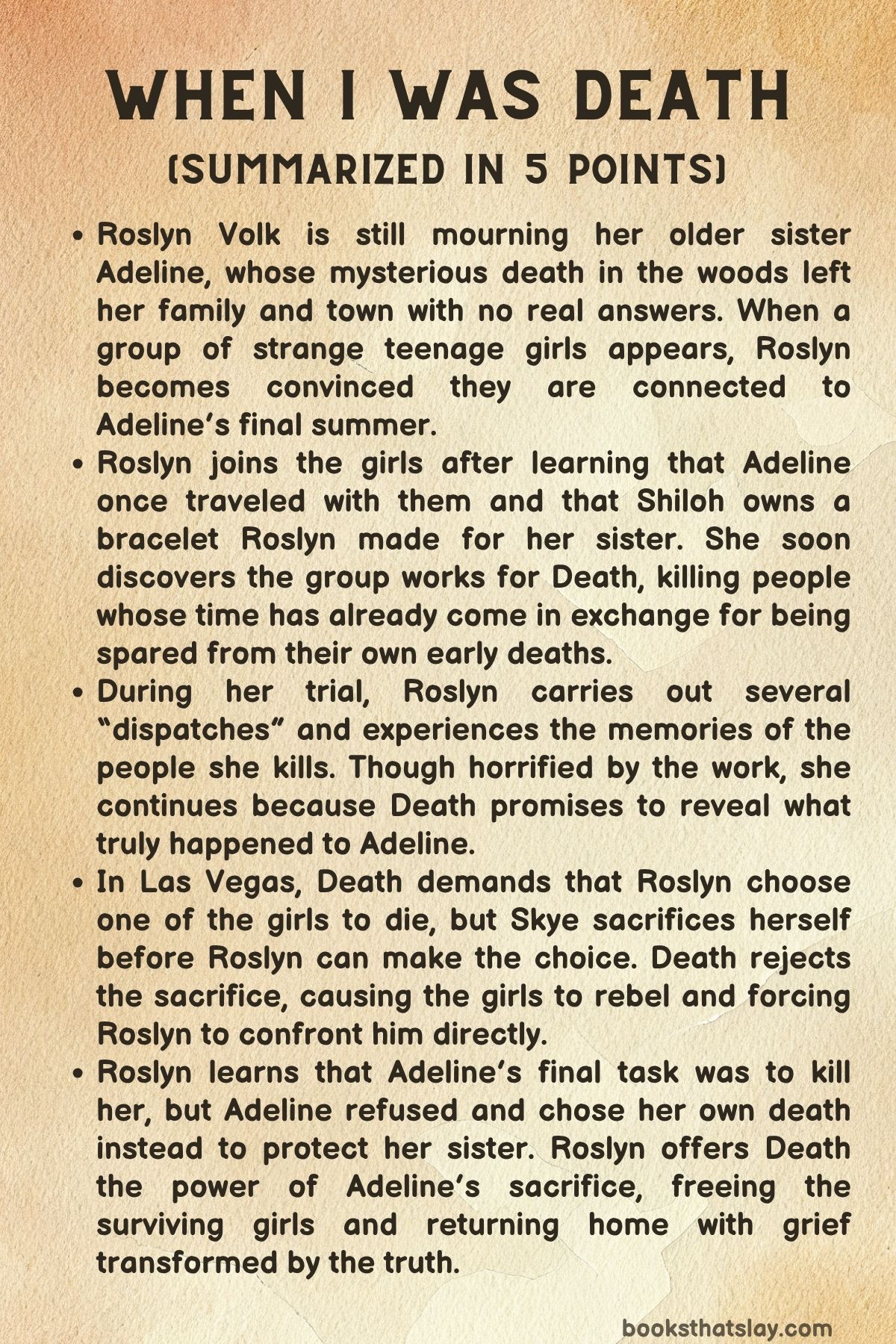
Characters
Roslyn Volk
Roslyn Volk is the emotional center of When I Was Death, a grieving teenager whose sorrow has hardened into obsession. Eight months after Adeline’s death, Roslyn is unable to accept uncertainty, and this makes her vulnerable to the strange pull of Shiloh and the other girls.
Her grief is not quiet or passive; it drives her to lie, leave home, and enter a world where death is no longer an abstract fear but a person, a bargain, and a task. Roslyn’s journey is shaped by the tension between her need for truth and her horror at what that truth costs.
Each dispatch forces her to confront the intimate weight of a human life, because she does not simply kill; she witnesses memory, love, regret, and fear. This makes her morally complex, since she participates in Death’s work while still retaining a deep emotional sensitivity.
By the end of the book, Roslyn changes from a girl trapped inside unanswered grief into someone who understands Adeline’s final act as love rather than abandonment. Her growth comes through pain, but also through the recognition that grief can become survivable when it is joined with truth.
Adeline Volk
Adeline Volk is physically absent for most of the story, yet her presence shapes nearly every major choice. To Roslyn, Adeline begins as an idealized older sister, adored and mysterious, someone whose death has left a wound that cannot close.
As the story unfolds, Adeline becomes more complicated than Roslyn’s memory of her. She was not merely a victim of something unknowable; she was a young woman who made a desperate bargain after nearly dying and later faced an impossible final task.
Her refusal to kill Roslyn reveals the depth of her love and gives her death a tragic nobility. Adeline’s choice transforms the meaning of the entire story, because what looked like abandonment becomes protection.
She represents the kind of love that does not announce itself dramatically but sacrifices everything in silence. Her character also shows how Death’s bargains exploit vulnerable young people by turning survival into debt, making Adeline both a victim of Death’s cruelty and a figure of quiet resistance.
Shiloh
Shiloh is one of the most magnetic and unsettling figures in the book, a girl who seems to carry authority, danger, and sorrow at the same time. She draws Roslyn into the group partly because she knows the truth about Adeline, but also because she understands how to use mystery as power.
Shiloh’s connection to Death has made her experienced and guarded, and she often appears more comfortable with the rules of this strange life than the others. Yet beneath her confidence is a deep exhaustion.
Her bond with Roslyn becomes emotionally important because Roslyn sees in her both a guide and a warning: Shiloh knows how to survive Death’s work, but survival has damaged her. Her attempted suicide later in the story shows the breaking point beneath her controlled surface.
Shiloh is not simply a leader or temptress; she is a girl who has been living under an unbearable bargain for too long. Her character brings out the seductive and destructive sides of escape, showing how freedom gained through Death is not freedom at all.
Death
Death is the story’s most powerful and disturbing presence because he is not only a force of nature but also a manipulator who appears in human form. By wearing a priest’s collar and speaking in the language of bargains, Death gives himself an air of authority, almost as if his cruelty is sacred or inevitable.
He does not randomly murder; he claims the girls are only dispatching people whose time has already come. This makes him more frightening, because his evil lies not in obvious chaos but in control, persuasion, and emotional exploitation.
Death targets girls who were already close to dying and offers them survival at a terrible cost. His fascination with stories, memory, and emotional weight makes him feel less like a simple villain and more like a being who feeds on meaning itself.
His final acceptance of Roslyn’s offering shows that he can be negotiated with, but it does not make him kind. Death represents the terrifying bargain at the heart of the story: the chance to keep living, but only by becoming intimate with loss.
Skye
Skye is the youngest of the traveling girls and one of the most heartbreaking characters in When I Was Death. Her youth gives her a different emotional quality from the others; she feels more vulnerable, more openly longing, and more desperate to belong.
Skye’s invitation to Roslyn at the beginning helps pull Roslyn into the group, but her role grows far beyond that first connection. Her secret sacrifice in her mother Monica’s pool reveals how deeply she wants to save the others, even if it means surrendering herself.
Skye’s death is tragic because it comes from love, fear, and misunderstanding. She believes she can satisfy Death’s demand by choosing herself, but Death rejects the act because Roslyn did not choose it.
This makes Skye’s sacrifice devastatingly unfair. Her character exposes the cruelty of Death’s rules and the emotional damage inflicted on the girls, especially the youngest among them.
Skye is innocent without being simple, and her death becomes the moment when the group’s fragile obedience finally turns into rebellion.
Naomi
Naomi is part of the traveling group of girls who live under Death’s bargain, and her character helps create the sense of a chosen but wounded sisterhood. Even though she is not given the same central focus as Roslyn, Shiloh, or Skye, Naomi matters because she represents one of the many lives caught inside Death’s system.
Her presence contributes to the atmosphere of hunger, secrecy, and restless movement that defines the group. Like the others, she is both survivor and prisoner.
Naomi’s life has been extended, but that extension comes with obedience to Death and participation in dispatches. Her character helps show that the group is not a collection of carefree runaways; they are young people bound together by fear, guilt, and shared knowledge.
Through Naomi, the story expands beyond Roslyn’s personal grief and suggests that many girls have been forced into similar bargains, each carrying private trauma beneath the surface of their strange freedom.
Riley
Riley is one of the girls who helps reveal the darker reality behind the group before Roslyn fully understands it. When Roslyn overhears Riley and Chloe discussing whether she will last, Riley becomes associated with the practical, almost hardened side of Death’s work.
Her language suggests that the girls have become used to evaluating new members through the logic of survival. Riley’s character shows how repeated exposure to death can change a person’s instincts.
She does not necessarily come across as cruel, but she has learned to speak about terrifying things as if they are routine. This makes her important to the story’s moral atmosphere.
Riley reflects the emotional numbness that Death’s bargain can create, especially when young people are forced to keep moving, killing, and pretending that the work is manageable. Her presence reminds the reader that surviving something unnatural does not mean escaping damage; sometimes survival means learning to sound calm about horror.
Iona
Iona is another member of the traveling group whose importance lies in the collective portrait of the girls bound to Death. She helps form the eerie, almost mythic image of the caravan: teenage girls moving from place to place, hungry, secretive, and strangely alive because they were once meant to die.
Iona’s character contributes to the story’s sense of sisterhood under pressure. She is part of a group that looks free from the outside but is actually controlled by an invisible debt.
Even when she is not at the center of the action, her presence matters because the story depends on the group feeling real, varied, and emotionally burdened. Iona represents the hidden histories that each girl carries.
She helps show that Roslyn has entered not only a mystery about Adeline but a larger world of girls whose lives were interrupted, extended, and reshaped by Death’s bargain.
Chloe
Chloe is important because she helps expose the group’s guarded and suspicious attitude toward Roslyn. Her conversation with Riley about whether Roslyn will last suggests that Chloe has seen others fail before, including Adeline.
This gives her character an edge of experience and emotional caution. Chloe seems to understand the danger of becoming attached to someone who may not survive the trial, and that makes her part of the group’s defensive structure.
Like Riley, she reflects how Death’s work has normalized fear and loss among the girls. Her role is not simply to create suspicion; it is to show that the girls have developed their own language and habits around a life that should be impossible.
Chloe’s character helps build the sense that Roslyn is entering a system with rules, history, and previous casualties. Through Chloe, the book shows how trauma can make people protective, wary, and blunt.
Stewart Gavin
Stewart Gavin is Roslyn’s first dispatch, and his role is crucial because he turns Death’s bargain from an idea into an intimate reality. As an elderly widower, Stewart is not presented as a monster or an enemy, which makes his death deeply unsettling for Roslyn.
When she touches him and experiences his memories, she is forced to understand him as a full human being rather than a name on a task. Stewart’s death teaches Roslyn that dispatching is not emotionally clean, even if Death insists the victims are already due to die.
His character gives weight to the moral cost of Roslyn’s choice. Through Stewart, the story shows that every death contains a lifetime, and that taking a life, even under supernatural rules, means touching the grief, love, and history attached to it.
He is a brief character, but he leaves a lasting effect because he becomes Roslyn’s first true encounter with the burden of Death’s work.
Jasmine Wu
Jasmine Wu is another dispatch who deepens Roslyn’s understanding of what Death demands. As a young dancer at a music festival, Jasmine represents youth, beauty, movement, and possibility, which makes her death especially painful.
Her presence challenges any comforting idea that the people Roslyn kills are distant, finished, or emotionally easy to release. Jasmine’s life feels active and unfinished, and this makes Roslyn’s task more disturbing.
Through Jasmine, the story emphasizes that being “due” for death does not erase the tragedy of dying. Roslyn’s experience with her adds another layer to the moral pressure building inside her.
Jasmine is important not because she remains in the plot for long, but because she forces Roslyn to confront the fact that Death’s logic cannot fully contain human value. A life can be scheduled to end and still feel unbearably alive in its final moments.
Corbin
Corbin’s dispatch places Roslyn in a situation of immediate physical horror, since he is trapped in a burning car. His death differs from Stewart Gavin’s and Jasmine Wu’s because it is surrounded by urgency, fear, and violence.
Corbin’s role shows another form of Death’s work: not quiet passing or sudden festival tragedy, but a terrifying accident in progress. For Roslyn, this dispatch reinforces the idea that she is not merely observing death from a distance.
She is being made to participate in moments of extreme human vulnerability. Corbin’s character also complicates the idea of mercy.
If he is already doomed, Roslyn’s touch may seem like part of the natural ending Death has assigned, but the emotional reality remains brutal. Through Corbin, the story expands the range of death Roslyn encounters and shows how each dispatch leaves a different kind of mark on her conscience.
Monica
Monica, Skye’s mother, is a painful background presence because her pool becomes the place of Skye’s sacrifice. Even though Monica is not explored as deeply as the central girls, her connection to Skye adds emotional context to Skye’s death.
The use of her pool makes the sacrifice feel personal rather than abstract; Skye does not die in some distant or symbolic place, but in a space tied to family and childhood. Monica’s role reminds the reader that the girls’ bargains with Death do not only affect them.
Their lives and deaths leave behind parents, homes, and unresolved grief. Through Monica, the story gestures toward the ordinary world that exists outside the caravan, a world of families who may never fully understand what happened to their daughters.
Her presence makes Skye’s death feel more grounded and more devastating.
Roslyn’s Parents
Roslyn’s parents represent the grief-stricken home Roslyn feels compelled to leave behind. They are not villains, but they are part of a household frozen by Adeline’s death and unable to give Roslyn the answers she needs.
Roslyn lies to them about a camping trip, and that lie shows how far her grief has pushed her away from ordinary family trust. Their role in the story is important because they embody the life Roslyn might have remained trapped in: a life of mourning, silence, and inconclusive explanations.
They also help show the difference between adult helplessness and Roslyn’s desperate action. While her parents live with uncertainty, Roslyn refuses to do so.
Their presence makes her departure feel morally complicated, because she is not only chasing truth; she is also abandoning two people who have already lost one daughter. By the end, Roslyn’s return home carries emotional weight because she comes back changed, no longer the same girl who left in search of answers.
Themes
Grief and the Need for Answers
Roslyn’s grief is shaped not only by Adeline’s death, but by the absence of a clear explanation. The uncertainty surrounding Adeline’s final days traps Roslyn in a painful state where mourning cannot fully become acceptance.
She is unable to move forward because every memory of her sister is shadowed by suspicion, guilt, and unanswered questions. Her decision to join the girls comes from a dangerous mixture of love and desperation, showing how grief can make truth feel more important than safety.
As Roslyn learns more about Adeline’s bargain and final choice, grief changes from confusion into painful understanding. The truth does not erase her loss, but it gives meaning to Adeline’s death.
Roslyn finally sees that her sister did not abandon her; she protected her. This shift allows Roslyn to carry grief differently, not as a mystery that controls her, but as a lasting bond with someone who loved her enough to die for her.
Sisterhood, Loyalty, and Chosen Family
The relationships among the girls reveal how sisterhood can exist beyond blood, built through shared danger, secrecy, and survival. Roslyn is first drawn to the group because they remind her of Adeline, but she slowly begins to see them as individuals with their own wounds and loyalties.
Their bond is imperfect, marked by fear, rivalry, and withheld truths, yet it also provides warmth in a world where each girl has been isolated by her bargain with Death. Shiloh’s role is especially important because she becomes both guide and warning, showing Roslyn the comfort and cost of belonging to the group.
Skye’s sacrifice shows the extreme form this loyalty can take, as she chooses death in an attempt to save the others. Through these relationships, When I Was Death presents sisterhood as both fragile and powerful.
It cannot prevent suffering, but it gives the girls a reason to resist being treated as tools.
Choice, Sacrifice, and Moral Responsibility
Roslyn’s journey is driven by choices that become harder each time she makes them. Her bargain with Death begins as a means to uncover the truth, but it forces her to take part in deaths she does not fully understand or control.
Even when the victims are supposedly meant to die, Roslyn must face the emotional weight of touching them, seeing their memories, and becoming the final presence in their lives. This makes morality complicated rather than simple.
The story asks whether an action can be justified if it serves a promised purpose, and whether desperation can excuse harm. Adeline’s final choice gives the clearest answer to this question.
She refuses to kill Roslyn, even though obedience would save herself. Her sacrifice proves that moral responsibility remains possible even under impossible pressure.
Roslyn’s later bargain with Death grows from this realization: the deepest power lies not in obeying death, but in choosing love over survival.
Death, Power, and the Value of Human Stories
Death appears as a force with rules, bargains, and authority, but the story gradually shows that he is not beyond influence. His power depends not only on endings, but on the emotional meaning attached to them.
The girls are treated as workers who carry out deaths already assigned, yet each dispatch reveals that dying is never merely a task. Every person Roslyn touches has memories, desires, regrets, and private histories.
These moments force her to recognize the value of individual lives, even when death seems inevitable. The final confrontation changes the balance between Roslyn and Death because she offers him something he cannot create on his own: the emotional truth of Adeline’s sacrifice.
This suggests that stories hold power because they preserve meaning after life ends. Death can claim bodies, but he cannot fully control love, memory, or the way people choose to understand loss.