Mercy Hill Summary, Characters and Themes
Mercy Hill by Hannah Thurman is a literary coming-of-age novel about four exceptionally intelligent sisters raised inside the grounds of a declining psychiatric hospital in Raleigh, North Carolina.
Narrated by the youngest sister, Denise Cross, the book examines how childhood loyalty can become entangled with institutional duty, parental ambition, social isolation, and inherited trauma. The hospital is simultaneously the girls’ home, their mother’s life mission, and the force that distorts their understanding of care. Through Denise’s adult reflections, the novel questions whether good intentions can excuse harmful choices and whether a family can ever agree on what it means to save someone.
Summary
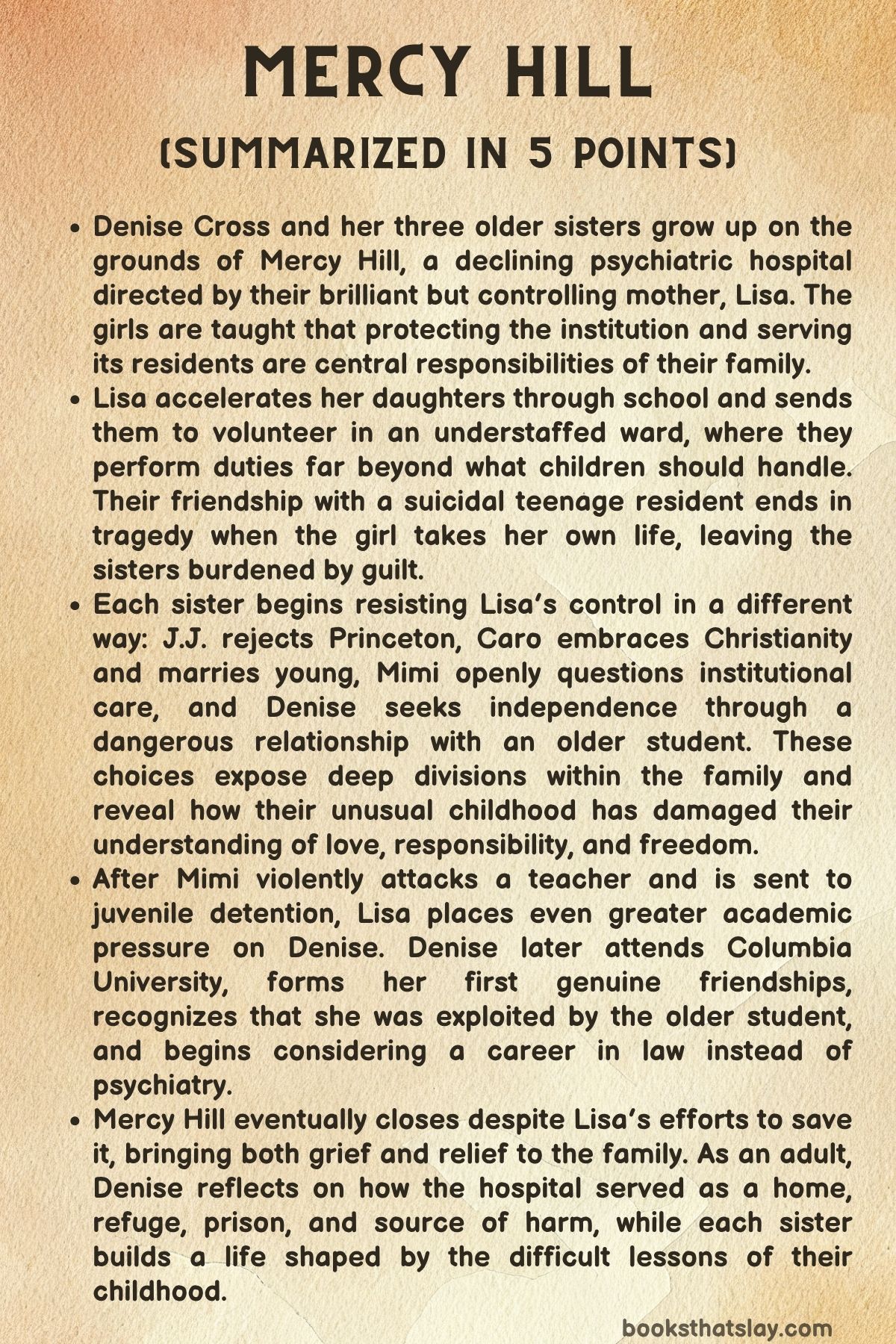
Adult Denise Cross remembers growing up beneath the shadow of Mercy Hill, an old psychiatric hospital whose remaining buildings stand above the cottage where she lives with her parents and three older sisters. Her mother, Lisa Cross, is the hospital’s first female director of psychiatry and treats its survival as both a professional obligation and a family cause.
Lisa is brilliant, persuasive, and deeply committed to psychiatric care, but she is also controlling and emotionally harsh. Denise, J.J., Caro, and Mimi grow up believing that their intelligence makes them responsible for protecting the institution and the vulnerable people housed within it.
The danger surrounding the family becomes clear when the sisters climb a magnolia tree extending over the fence of Ward C, the hospital’s highest-security unit. Mimi falls into the recreation yard and is approached by Alexander White, a resident the girls call the Scarecrow because he drowned three boys.
Alexander frightens Mimi but follows J.J.’s request to get help, only to be tackled by staff members when he enters the building. Lisa rescues Mimi and then punishes J.J. by smashing her cherished porcelain dolls, demonstrating that her fear often expresses itself through cruelty and control.
The accident gives state officials another reason to question the hospital’s future. Lisa responds by making her daughters reaffirm their loyalty, presenting them as soldiers in a battle to preserve a place that she believes society has abandoned.
Lisa transfers all four girls to Lincoln, an academically demanding magnet school, and makes each daughter skip two grades. Although she describes the move as an opportunity, the sisters are placed among students much older than they are and are expected to pursue the medical careers she has chosen for them.
Denise is mocked because of her age and her home on the hospital grounds. Her classmates call the institution a jail for mentally ill people, leaving her caught between her desire to defend the residents and her wish to escape the identity her mother has created for her.
At a city council meeting, Lisa uses Denise to argue against plans to redevelop hospital property. Denise explains that failed community services have left mentally ill people homeless or imprisoned, but she also discovers that knowledge and preparation cannot easily overcome political power.
When Lisa learns that an occupied ward may be protected from redevelopment, she sends the sisters into Ward B as volunteers. The ward is severely understaffed, and the girls are quickly assigned responsibilities that should belong to trained adults.
They dress residents, deliver meals, collect trays, distribute supplies, and report problems to Lisa. Although they feel important and useful, their labor allows the adults to continue operating an unsafe ward without confronting the full consequences of its deterioration.
The girls become close to Ashley, a teenage resident they call the Girl. Ashley is intelligent, abrasive, funny, and openly preoccupied with death, but she is also the closest friend the isolated sisters have ever possessed.
Mimi begins questioning whether long-term confinement actually helps people whose conditions never improve. The others interpret her doubts as disloyalty because they have been taught that criticizing the hospital is equivalent to abandoning its residents.
Denise secretly watches Lisa calm David Johnson, a frightened and paranoid resident who believes new needles are contaminated. Lisa listens respectfully, allows him to test an empty syringe on her, and gives him his medication without humiliation.
This encounter shows Denise that her mother is capable of patience and compassion with patients, even though she rarely offers the same emotional safety to her daughters. Lisa’s professional gifts therefore make her failures at home more difficult for Denise to understand.
Religious conflict soon divides the family. Nurse Jenny invites the girls to her home and introduces them to Christianity, while Caro begins attending her church in secret.
When Caro announces that she has become a Christian, Lisa reacts with contempt. Her hostility comes partly from her childhood, when her religious father refused psychiatric treatment for her mentally ill mother and relied on prayer instead.
Caro argues that Lisa values independent thought only when her daughters agree with her. Her conversion becomes the first sustained attempt by one of the sisters to construct an identity outside their mother’s authority.
Lisa takes Mimi and Denise to Washington to seek financial support from a senator with whom she shares a suspiciously intimate history. He possesses a diamond brooch that once belonged to Lisa’s mother, suggesting private connections that Lisa never explains.
Lisa secures enough funding to preserve the hospital temporarily. During the journey home, however, Mimi reveals that she stole the brooch and forces Denise to share the secret by pressing its pin into her skin.
Conditions in Ward B continue to worsen until the sisters are performing food preparation, cleaning, and other essential duties. During a chaotic meal, Ashley steals a serrated knife, locks herself in a bathroom, cuts an artery in her neck, and dies.
The death ends the volunteer program and brings investigators into the hospital. Questions arise about medication, inadequate supervision, missing staff members, poor management, and the decision to use children as unpaid workers.
The sisters understand that the adults created the unsafe conditions, yet they still blame themselves. Their upbringing has taught them to view every institutional failure as evidence that they did not work hard enough.
J.J., who has been accepted at Princeton, announces that she will attend a local community college instead. She claims that she wants to remain at home, but her decision also reflects guilt, exhaustion, fear of abandoning her sisters, and resentment toward Lisa.
Lisa sees the choice as a personal attack and the destruction of everything the family has sacrificed to achieve. J.J. finally admits that she no longer wants to make her mother happy, openly rejecting the role of obedient successor.
The family’s pressures increase when Lisa’s estranged father, Pete Cross, moves into their cottage while awaiting dangerous heart surgery. Pete is cruel, religiously rigid, and dismissive of Lisa’s career, marriage, and daughters.
Lisa insists on caring for him because she wants to prove that the education he opposed has given her the power to save him. Instead of escaping their old conflict, she recreates it inside her own home and forces the entire family to participate.
Pete intimidates the girls and tells Denise that Lisa cares more about power and victory than about saving lives. Denise rejects the accusation at first, but it begins influencing how she interprets her mother’s actions.
Lisa pressures doctors to perform the operation, after which Pete’s health deteriorates. She manages his morphine herself, and he dies after receiving a dose that is medically permissible but larger than the amount his nurse would normally administer.
Denise cannot determine whether Lisa merely relieved Pete’s suffering or also released herself from him. Lisa immediately returns to work, refusing to remain with the body or openly acknowledge her grief.
Ward B is permanently closed, and its remaining residents are transferred to group homes and other facilities. Caro’s baptism occurs at roughly the same time, linking the death of the family’s shared institutional mission with the growth of her separate spiritual identity.
Lisa then pushes Denise ahead another set of grades. Denise enters high school at twelve, where she is no longer openly bullied but remains isolated because her classmates have established friendships and view her as a child.
For a time, Lisa treats Denise as her new chosen daughter. She shares personal stories, praises Denise’s abilities, and begins transferring to her the ambitions that J.J. rejected.
Caro develops a relationship with Laketon, an older teenager from her church. Lisa refuses to approve the courtship, but Tucker secretly grants his permission, beginning a quiet rebellion against his wife’s dominance.
Tucker has spent years maintaining peace while Lisa leads the family. As his resentment grows, he retreats emotionally, exercises obsessively, and begins helping the daughters evade Lisa rather than challenging her directly.
During a summer mathematics course, Denise meets Jeremy Morgans, a nineteen-year-old student known as Skate. He presents himself as an intelligent outsider and makes the lonely, not-yet-thirteen-year-old Denise feel mature, desirable, and understood.
Their sexual relationship develops in an abandoned staff cottage. Denise imagines that her love can rescue him from sadness, repeating the family belief that care requires sacrificing oneself for another person.
J.J. discovers them and recognizes that Skate is exploiting a child. She forces him to leave and threatens to tell Lisa, but Denise attacks her because she experiences the intervention as another form of control.
Skate promises to wait until Denise is sixteen, creating a countdown toward their supposed reunion. Denise remains emotionally attached to him and directs her anger toward J.J., while the distracted adults fail to notice the seriousness of the conflict.
Caro is accepted at several prestigious universities but chooses nearby Duke to remain close to Laketon. When the couple becomes engaged, Lisa refuses permission, but Tucker’s legal approval allows sixteen-year-old Caro to marry.
The marriage further divides the parents. Tucker eventually accuses Lisa of using a sexual relationship with the senator to secure funding, and Lisa does not clearly deny the allegation.
Denise’s need for acceptance leads her to participate in the bullying of Mimi during an advanced English class. She entertains classmates by exposing Mimi’s vulnerabilities and encourages increasingly sexual and humiliating jokes.
When the sisters encounter Bethy, a former resident now living near a bus station, Mimi asks Denise not to involve Lisa. Mimi believes Bethy has the right to reject a crowded group home, but Denise reports the situation because she cannot imagine care without intervention.
The following day, Mimi breaks a metal spike from a desk and drives it through her teacher’s hand. Denise knows that the classroom abuse and family pressure contributed to the attack, yet she tells Lisa that Mimi simply went crazy.
Mimi is sent to juvenile detention, where she refuses to let Lisa control her treatment. Lisa responds by investing even more intensely in Denise, who is promoted into the final year of high school and prepared for elite universities.
On a tour of northeastern colleges, Denise experiences an unusual period of closeness with her mother. She chooses Columbia University in New York, attracted by its academic reputation and the possibility of a life beyond Raleigh.
Before leaving, Denise discovers that Ward C has only sixteen residents and that new admissions have stopped. Lisa reveals a secret plan to transfer patients from other closing institutions, reopen the empty wards, and rebuild Mercy Hill as a larger hospital.
Denise and Lisa move into a small New York studio because Denise is too young to live in university housing. While Lisa works on the proposal, Denise begins exploring the city and forming friendships independent of her family.
She becomes especially close to Marion Hobson, a Black student who understands social isolation without treating Denise as either a prodigy or a child. Marion provides Denise with her first relationship based on honest mutual recognition rather than duty.
College exposes Denise to classmates as intelligent as she is and teaches her that academic difficulty does not equal failure. A visit to a maximum-security prison also causes her to recognize uncomfortable similarities between psychiatric confinement and incarceration.
The proposal to reopen the hospital is eventually rejected, and the state decides to close Ward C. Lisa admits that she may have made life more dangerous for her daughters while trying to protect vulnerable patients.
Denise is devastated but also relieved because the mission governing her life is finally ending. Her relief does not mean that she wanted patients abandoned; it means that she is beginning to recognize the difference between caring for people and surrendering her identity to an institution.
Professor Julia invites Denise and Marion to apply for an internship with the Innocence Project. Denise begins questioning whether she wants to become a psychiatrist or has merely confused her talent for science with an obligation to fulfill Lisa’s plans.
When Skate contacts her on her fifteenth birthday, Denise finally sees their relationship from an older perspective. Surrounded by college students who recognize that she is too young for them, she understands that his supposed love depended on her isolation and inexperience.
Denise returns home for Christmas as the hospital approaches closure. Mimi, temporarily released from juvenile detention, appears calmer and acknowledges that confinement sometimes provides necessary stability, even though better forms of treatment should exist.
J.J. is building a career, Caro is becoming more comfortable in her independent life, and Denise begins repairing her relationship with J.J. All four sisters admit that they feel guilty relief about the hospital’s end.
Years later, J.J. is married to Kate and cares for their autistic daughter, while Caro has left both Laketon and her church and become a writer. Mimi runs operations for a foster-care organization and finds purpose in helping young people without repeating Lisa’s methods.
Denise abandons medicine for law and becomes a professor in New York. Lisa works in several psychiatric positions and eventually treats prisoners, many of whom are former state-hospital residents.
The old hospital buildings remain empty while people debate preservation and redevelopment. Denise concludes that Mercy Hill was home, prison, mission, refuge, and source of injury, and that no single account can decide whether the family’s sacrifices saved people or merely created different forms of harm.
Characters
Denise Cross
Denise is the narrator and emotional center of Mercy Hill, looking back on her childhood with the insight of an adult who has spent years questioning the stories she once accepted as truth. Her perspective combines memory, self-criticism, affection, anger, guilt, and an awareness that childhood experiences do not fit into simple moral categories.
As the youngest Cross sister, Denise inherits the family mission after her older sisters begin rejecting it. Lisa interprets Denise’s intelligence as proof that she can become the successful daughter who attends an elite university, studies medicine, and eventually returns to continue her work.
Denise initially welcomes this role because being chosen gives her access to rare moments of maternal warmth. Her academic ambition therefore comes from genuine ability but is also tied to her longing for Lisa’s approval.
Her childhood isolation makes her highly vulnerable to anyone who offers recognition. Skate exploits this need by treating her as mature and desirable, while Denise interprets his attention as evidence that she has finally made a choice independent of her family.
Denise is not presented only as a victim. She participates in Mimi’s humiliation, lies to protect herself, reports Bethy against Mimi’s wishes, and describes Mimi’s violent breakdown as madness even though she understands the pressures that caused it.
These failures make her adult honesty important. She does not construct herself as the reasonable sister who escaped unharmed but acknowledges how fear, privilege, ambition, and the desire for acceptance shaped her behavior.
Her development at Columbia allows her to separate intelligence from obligation. Friendship with Marion, exposure to law, and recognition of Skate’s abuse help her understand that maturity involves setting boundaries, admitting harm, and choosing a life that does not reproduce her mother’s mission.
Lisa Cross
Within Mercy Hill, Lisa is simultaneously a gifted psychiatrist, a determined political advocate, a traumatized daughter, and a controlling mother. She possesses genuine compassion for psychiatric patients and an extraordinary ability to take their fears seriously without surrendering medical judgment.
Her treatment of David Johnson demonstrates the best part of her professional identity. She listens, negotiates, accepts personal discomfort, and protects his dignity rather than forcing compliance through humiliation.
Lisa’s understanding of institutions is shaped by the death of her mentally ill mother. Because her religious father prevented effective treatment, Lisa comes to see scientific medicine as the only reliable defense against suffering, neglect, and superstition.
Her devotion gradually becomes rigid. She cannot accept that an institution created to protect people may also confine, neglect, or endanger them, because acknowledging those failures would threaten the meaning she has constructed from her childhood.
Lisa treats her daughters as extensions of her mission. She accelerates their education, chooses their expected careers, sends them into an unsafe ward, uses Denise at political meetings, and interprets disagreement as disloyalty rather than independent thought.
Her love is often conditional on usefulness. J.J. receives approval while pursuing Princeton, Caro becomes unacceptable when she embraces religion, Mimi is treated as a problem when her anger becomes disruptive, and Denise becomes favored after agreeing to study psychiatry.
Lisa’s relationship with Pete reveals the wounded child beneath her authority. She wants to save the father who harmed her because his survival and gratitude might prove that she has defeated both his beliefs and his judgment of her.
His death leaves unresolved questions about compassion, exhaustion, revenge, and release. Lisa’s immediate return to work suggests that action is her primary defense against emotional pain.
By the end, she briefly recognizes that preserving the hospital may have endangered her children. This admission does not erase the harm she caused, but it shows that she is capable of seeing the conflict between her public ideals and private behavior.
Tucker Palmer
Tucker begins as the quieter parent who attempts to soften Lisa’s severity. He objects when she destroys J.J.’s dolls, questions the racial structure of the magnet school, and tries to mediate confrontations without directly challenging her authority.
His passivity, however, becomes a serious failure. He understands that the girls are under extreme pressure but rarely acts decisively enough to protect them from it.
Tucker gradually retreats into the basement, physical exercise, dietary control, and emotional silence. His transformed body functions like armor, allowing him to feel powerful while avoiding the vulnerability required for honest conflict.
He eventually resists Lisa through secrecy rather than open responsibility. He permits Caro’s courtship and marriage without Lisa’s knowledge and advises Denise not to let her mother determine her future, but he does not create a safer family structure.
His accusation about Lisa and the senator exposes years of jealousy and humiliation. Instead of addressing the marriage’s problems earlier, he allows resentment to build until it erupts in front of the daughters.
Tucker loves his children, yet his desire to avoid confrontation often leaves them without an active parent. His character illustrates how apparent gentleness can become neglect when it refuses to oppose domination.
J.J. Cross
J.J. is the eldest sister and the first daughter assigned the role of family successor. She responds to pressure by becoming useful, responsible, academically successful, and closely attached to authority figures.
Her childhood responsibilities turn her into a substitute parent. She protects Mimi after the fall, manages her sisters inside the ward, and later intervenes when she discovers Denise with Skate.
J.J.’s rejection of Princeton is both an act of rebellion and a sign that she has been emotionally exhausted. She cannot simply leave because she feels responsible for the sisters she has helped raise and guilty about Ashley’s death.
Her decision disappoints Lisa but does not immediately liberate her. She remains near home, uncertain about her career and trapped by the belief that she has wasted a future others expected her to fulfill.
Her confrontation with Skate demonstrates moral clarity. Although Denise experiences her intervention as betrayal, J.J. is the only family member who immediately recognizes the relationship as exploitation.
J.J.’s later life suggests that she eventually creates a more nurturing form of family responsibility. Her care for her daughter differs from Lisa’s model because it is based on presence rather than achievement or institutional ambition.
Caro Cross
Caro develops independence through religion, the very system Lisa most strongly rejects. Her conversion gives her language, community, and authority outside the family, allowing her to challenge the idea that intellectual freedom must always produce Lisa’s conclusions.
Her faith is not presented as simple wisdom. New Life church offers belonging but also encourages early marriage and restrictive expectations that may limit her education.
Caro’s relationship with Laketon becomes both an expression of choice and another structure capable of controlling her. She believes that marrying him proves her independence, yet she remains influenced by a religious culture that values marriage over personal development.
Unlike Mimi’s explosive rebellion, Caro resists through calm argument, secrecy, and withdrawal. She continues loving her sisters and later helps Denise understand that J.J.’s intervention against Skate was protective.
Her eventual departure from Laketon and New Life shows that her youthful decisions were stages rather than permanent definitions. As a writer examining Christianity and feminism, she transforms personal conflict into intellectual inquiry.
Mimi Cross
Mimi is the sister who most openly questions the family’s assumptions. She challenges Nurse Jenny’s religion, doubts whether confinement helps every resident, resists Lisa’s interventions, and recognizes that removing people from institutions does not automatically provide humane alternatives.
Her defiance often appears as anger because the family has little space for disagreement. While J.J. becomes obedient and Caro finds an outside community, Mimi absorbs contradictions until she can no longer express them safely.
She understands that Bethy’s refusal of a group home may represent a legitimate desire for privacy and control. Her position does not romanticize homelessness but questions whether forcing someone into another institution always qualifies as rescue.
Denise’s classroom betrayal contributes to Mimi’s emotional collapse. Because Denise knows her sister’s insecurities, her jokes carry the power of intimate knowledge turned into a public weapon.
Mimi’s attack on Mr. Scott is shocking and unjustifiable, yet it does not emerge without context. Years of responsibility, grief, humiliation, isolation, and suppressed anger precede the moment in which she drives the desk spike through his hand.
Juvenile detention unexpectedly gives her distance from the family’s expectations. She becomes calmer there and later admits that some people may temporarily need walls, showing that her thinking has grown more complex rather than simply reversing itself.
As an adult, Mimi directs her organizational skills toward foster care. She appears to preserve Lisa’s desire to help vulnerable people while rejecting the belief that helpers must dominate those they serve.
Ashley, the Girl
Ashley is a teenage resident whose wit and defiance attract the Cross sisters. Because the girls have almost no friends outside their family, her companionship carries an importance that the adults overseeing the ward fail to understand.
She speaks casually about suicide, challenges J.J.’s confidence, and tests the sisters’ loyalty. Her behavior can be manipulative, but it also reflects a young person attempting to exercise control inside a setting where most choices have been removed.
Her death exposes the combined failures of staffing, supervision, medication management, institutional policy, and adult judgment. The sisters’ presence cannot compensate for the absence of a properly supported clinical environment.
Ashley continues shaping the family long after her death. J.J. abandons Princeton, Mimi’s rage deepens, Denise dreams about her, and Lisa becomes increasingly desperate to prevent the investigation from destroying the hospital.
Jeremy Morgans, or Skate
Skate presents himself as an intelligent, misunderstood outsider who has rejected ordinary social expectations. His poetry, charm, academic failure, and claims of emotional suffering make him attractive to Denise because they seem to offer an alternative to Lisa’s world of controlled achievement.
The relationship is fundamentally exploitative. Skate is nineteen, while Denise is not yet thirteen, and he uses her loneliness and desire to appear mature to create sexual access.
His refusal to have intercourse allows him to portray himself as responsible while continuing other sexual acts. This selective boundary protects his self-image rather than Denise.
The promise to wait until she is sixteen extends his influence even when they are separated. By turning the relationship into a countdown, he encourages Denise to interpret grooming as patience and devotion.
Denise’s eventual understanding occurs when she enters a community where older students maintain appropriate boundaries. Their behavior shows her that Skate’s attraction was not proof of her exceptional maturity but evidence of his willingness to exploit a child.
Nurse Jenny
Nurse Jenny works inside an understaffed system while attempting to preserve kindness toward residents and the Cross sisters. She recognizes the girls as children more clearly than many other adults, although she still allows them to perform duties they should never have been given.
Her Christianity provides her with meaning after the suicides of her brothers. This history complicates Lisa’s assumption that religious belief belongs only to frightened or unintelligent people.
Jenny’s invitation to church opens a path for Caro to build an independent identity. At the same time, her effort to convert the girls crosses professional and personal boundaries.
She remains devoted to former residents and participates in mental-health advocacy after Ward B closes. Her character represents imperfect care carried out by someone who is both constrained by institutional failure and personally motivated to respond to suffering.
Dr. Aaron Holt
Dr. Holt directs Ward B and immediately understands that Lisa has placed her daughters there partly to observe him. His anger is justified because their presence undermines his authority and exposes the ward’s failures without providing the staff or funding needed to correct them.
He nevertheless participates in the system that uses the girls as labor. His resistance to Lisa does not translate into a successful effort to remove them from danger.
After the ward closes, Nurse Jenny reveals that he has continued asking about the sisters. This concern suggests that his earlier hostility arose partly from recognizing that children had been placed in an unstable clinical environment.
Francis
Francis is an administrator caught between Lisa’s determination and the ward’s practical collapse. He knows that no functional volunteer program exists, yet he permits the sisters to enter because Lisa’s authority is difficult to oppose.
Following Ashley’s death, Francis argues that Ward B should close before the investigation threatens the rest of the institution. His position appears disloyal to Lisa, but it reflects a more realistic assessment of the ward’s danger.
Francis represents the compromises of institutional administration. He sees the problems clearly but acts decisively only after tragedy makes continuation impossible.
Pete Cross
Pete is Lisa’s estranged father and the source of much of her unresolved trauma. His religious rigidity contributed to his wife’s lack of psychiatric treatment, while his treatment of Lisa taught her to associate faith with cruelty, ignorance, and power.
Even when physically dependent on his daughter, Pete continues insulting her family and questioning her motives. His ability to provoke her shows that professional success has not freed Lisa from the desire for his approval.
His accusation that Lisa values victory more than human life becomes important to Denise. Although Pete speaks with malice, his judgment contains enough truth to disturb her understanding of her mother.
Pete’s final illness recreates the family’s central question: whether care means preserving life at all costs, respecting suffering, controlling another person, or proving one’s own worth. His death offers no simple answer.
Imogene Palmer
Imogene Palmer, known as Grannie Palmer, represents social respectability, inherited wealth, and the pressure to preserve appearances. She wants the girls to attend cotillion and believes polished manners and elite connections can restore the future Tucker abandoned.
Her worldview has been shaped by scandal. After Tucker’s father left the family for another man and later died violently, Imogene devoted herself to protecting the Palmer name and controlling how the past would be remembered.
She often appears rigid and class-conscious, yet she is less dismissive of Caro’s engagement than Lisa. Her practical acceptance of the wedding reveals that her traditionalism can sometimes accommodate realities that Lisa’s supposedly progressive household cannot.
Laketon
Laketon gives Caro a relationship and community separate from her mother. His formal request to court her appears respectful within the customs of their church, but the age difference and expectation of early marriage raise concerns about how much freedom Caro truly possesses.
He is not portrayed with Skate’s predatory manipulation. Nevertheless, his relationship with Caro belongs to a religious environment that encourages her to place marriage ahead of education.
Their eventual separation suggests that the marriage could not support Caro’s changing identity. Laketon is therefore part of her search for independence rather than the final answer to it.
Marion Hobson
Marion becomes Denise’s first genuine friend outside her family. She recognizes Denise’s loneliness without idealizing her intelligence and responds to her age by acknowledging how difficult her accelerated education must have been.
As a Black scholarship student, Marion understands exclusion from a different social position. Her experiences challenge Denise to examine how the magnet-school system benefited academically advanced students while marginalizing children from the surrounding neighborhood.
Marion refuses to provide Denise with easy absolution when she discusses privilege or guilt. She offers friendship without pretending that self-awareness alone repairs structural harm.
Her desire to become a criminal-defense lawyer influences Denise’s changing ambitions. Through Marion, Denise discovers that intellectual ability can support justice rather than merely continue a family profession.
Alexander White, the Scarecrow
Alexander is introduced through the sisters’ fearful nickname and the knowledge that he killed three children. He appears to embody the danger Lisa uses to justify the hospital’s fences and continued existence.
His encounter with Mimi complicates that image. Although he touches the blood on her face in a frightening manner, he listens to J.J. and goes for help.
When Denise sees him years later, he mistakes her for Lisa and then notices their resemblance. She no longer views him only as a monster but as a confined human being facing another uncertain transfer.
Alexander does not become innocent because he is vulnerable. His character instead demonstrates that someone can be dangerous, damaged, responsive, frightening, and deserving of humane treatment at the same time.
Bethy
Bethy first appears as a resident whom the sisters help dress after finding her sitting in dirty shower water. Her condition exposes how severely understaffing has reduced the dignity of people living in Ward B.
After the closure, she is found homeless near a bus terminal because she left a noisy, overcrowded group home. Her situation shows that institutional removal without adequate community support simply relocates neglect.
Bethy becomes the focus of a moral disagreement between Denise and Mimi. Denise believes immediate intervention is necessary, while Mimi argues that Bethy’s choices deserve consideration even when those choices appear unsafe.
Jared
Jared is a Ward B resident whose speech is difficult for outsiders to understand. The sisters can interpret him because they have spent enough time around the residents to recognize the logic inside his confusion.
His decision to wait in extreme heat rather than return to the guardhouse suggests that apparently irrational actions may arise from experiences other people cannot see. He also remembers the girls after they are removed from the ward and asks whether the “geniuses” have returned.
Jared’s continued recognition gives Denise a painful reminder that the girls formed real relationships with residents despite the irresponsibility of their volunteer roles.
The Senator
The senator represents the political system Lisa must navigate to preserve the hospital. His familiarity with her, possession of her mother’s brooch, and flirtatious behavior suggest a personal history that extends beyond professional advocacy.
He helps secure funding, but his support demonstrates that political outcomes often depend on private access rather than the strength of public arguments. Lisa’s success is therefore shadowed by questions about compromise and secrecy.
The stolen brooch carries these questions back into the family. It connects Lisa’s mother, Mimi’s rebellion, Denise’s silence, and Tucker’s later accusation without ever producing a fully confirmed explanation.
Professor Julia
Professor Julia recognizes Denise’s abilities outside the medical future planned for her. Her invitation to apply for the Innocence Project encourages Denise to consider law as a serious path rather than a temporary distraction.
She offers opportunity without demanding personal loyalty. This difference matters because Denise has been taught to interpret mentorship as part of a larger obligation.
Julia’s influence helps Denise discover that being talented in science does not require becoming a doctor. Her character represents an adult authority capable of expanding a young person’s choices rather than narrowing them.
Themes
Care, Confinement, and Institutional Failure
In Mercy Hill, care and confinement are never treated as exact opposites. The hospital provides shelter, medication, trained professionals, and stability for people who may be unable to live safely without support, yet its locked wards also remove privacy, freedom, and control.
The decline of Ward B shows how an institution can become dangerous even when its stated purpose remains humane. Understaffing forces children to perform adult duties, medication schedules collapse, residents lose basic dignity, and Ashley gains access to the knife she uses to end her life.
Closing the ward does not solve the underlying problem. Bethy becomes homeless after leaving an intolerable group home, and many former residents eventually enter prison, demonstrating that community care and criminal institutions can reproduce the abandonment once associated with state hospitals.
Mimi’s experience adds further complexity. Juvenile detention is punitive and restrictive, but the distance and structure it provides appear to help her regain stability after years of pressure.
The novel therefore avoids claiming that every wall is oppressive or that every form of intervention is compassionate. It asks whether people are being confined for their own safety, for society’s convenience, or because governments refuse to fund better options.
Humane care requires more than preserving or closing a building. It depends on adequate resources, accountability, personal dignity, meaningful choice, and recognition that vulnerable people cannot be protected through neglect disguised as freedom.
Parental Control and Inherited Trauma
Lisa’s parenting is shaped by injuries she believes she has already overcome. Her mother’s untreated mental illness and her father’s religious cruelty convince her that ignorance, superstition, and passivity must be defeated through knowledge and decisive action.
Instead of leaving her childhood power struggle behind, Lisa reproduces its structure. Pete demanded obedience through religion, while Lisa demands obedience through science, achievement, and institutional loyalty.
She encourages her daughters to think critically but reacts with anger when Caro reaches a religious conclusion, Mimi questions psychiatric confinement, J.J. rejects Princeton, or Denise considers a future beyond medicine. Independence is praised only when it confirms Lisa’s worldview.
Her control is especially powerful because it is mixed with real love and genuine competence. The daughters know that she can calm frightened patients, persuade politicians, understand complex illnesses, and work tirelessly for neglected people.
These qualities make resistance emotionally difficult. Rejecting Lisa’s plans feels not merely like choosing a different life but like betraying a brilliant woman whose mission arose from personal loss.
Each sister develops a different response. J.J. sacrifices opportunity, Caro enters a religious community, Mimi erupts through anger, and Denise initially becomes the successful daughter Lisa wants.
The cycle begins to weaken only when the sisters reinterpret their mother’s pain without accepting it as a command. Understanding why Lisa became controlling does not require them to surrender their futures to her unfinished struggle.
Intelligence, Achievement, and the Search for Identity
The Cross sisters are taught that intelligence creates responsibility. Their accelerated education is presented as a privilege, but it removes them from age-appropriate friendships and turns academic success into evidence of loyalty.
At Lincoln, being younger and more advanced does not make Denise feel exceptional in a positive sense. It makes her visible, isolated, and vulnerable to ridicule.
J.J. builds her identity around usefulness until Princeton becomes another demand rather than an opportunity. Her refusal to attend is destructive partly because she has never been allowed to imagine success outside Lisa’s expectations.
Caro possesses the same academic ability but chooses religion and marriage as ways of asserting that her worth does not depend entirely on intellectual accomplishment. Mimi rejects the family’s assumptions more directly, yet her resistance is interpreted as instability rather than thought.
Denise begins separating talent from duty only after arriving at Columbia. Mediocre grades teach her that difficulty is normal, while friendship shows her that relationships do not have to depend on being the smartest person in the room.
Marion’s question about whether Denise enjoys chemistry or is merely good at it becomes central to this transformation. Ability can create possibilities, but it does not determine moral obligation or personal desire.
Denise’s movement from medicine to law represents more than a career change. It marks her decision to use her intelligence without allowing her mother, her childhood, or an institution to define the only acceptable form that usefulness can take.
Guilt, Memory, and Competing Versions of Truth
Denise’s adult narration is shaped by the knowledge that memory is selective and family stories are contested. Lisa’s interpretation of the past is powerful because she speaks with certainty, but certainty does not make her account complete.
Ashley’s death produces several possible explanations. Medication, understaffing, inadequate observation, administrative neglect, Lisa’s ambitions, and the girls’ inappropriate responsibilities all contribute, yet no single cause can absorb the entire tragedy.
The sisters nevertheless convert collective failure into personal guilt. J.J. abandons Princeton, Mimi’s anger intensifies, and Denise carries nightmares while continuing to believe she should have done more.
Guilt also influences Denise’s treatment of Mimi. By claiming that Mimi simply went crazy, Denise avoids acknowledging the classroom cruelty that helped create the crisis.
Her later self-examination does not provide easy forgiveness. Marion remains her friend without erasing questions about racial privilege, and Denise’s recognition of Skate’s abuse does not instantly remove her grief or repair her relationship with J.J.
The abandoned hospital eventually becomes a physical version of disputed memory. Some people see historic buildings worth preserving, others see valuable land, and the Cross family sees a home that was also a workplace, prison, refuge, and source of suffering.
No official monument records what the sisters endured or what the residents lost. Their conflicting accounts become the only memorial, preserving the idea that moral truth may require several incomplete perspectives rather than one final verdict.