Mortedant’s Peril Summary, Characters and Themes
Mortedant’s Peril by R.J. Barker is a dark fantasy mystery set in Elbay, a rigidly divided city powered by strange machinery, spiritforms and the stolen energy of the dead.
The story follows Irody Hasp, a gifted but disgraced Mortedant who can perceive fragments of a corpse’s final thoughts. When the murder of his young assistant draws him into a conspiracy involving religious extremists, influential families and corrupt institutions, Hasp must investigate the city he has spent years criticizing from a distance. His search for justice gradually becomes a struggle to prevent mass murder while confronting his own pride, prejudices and past failures. It’s the 1st book of The Trials of Irody Hasp series.
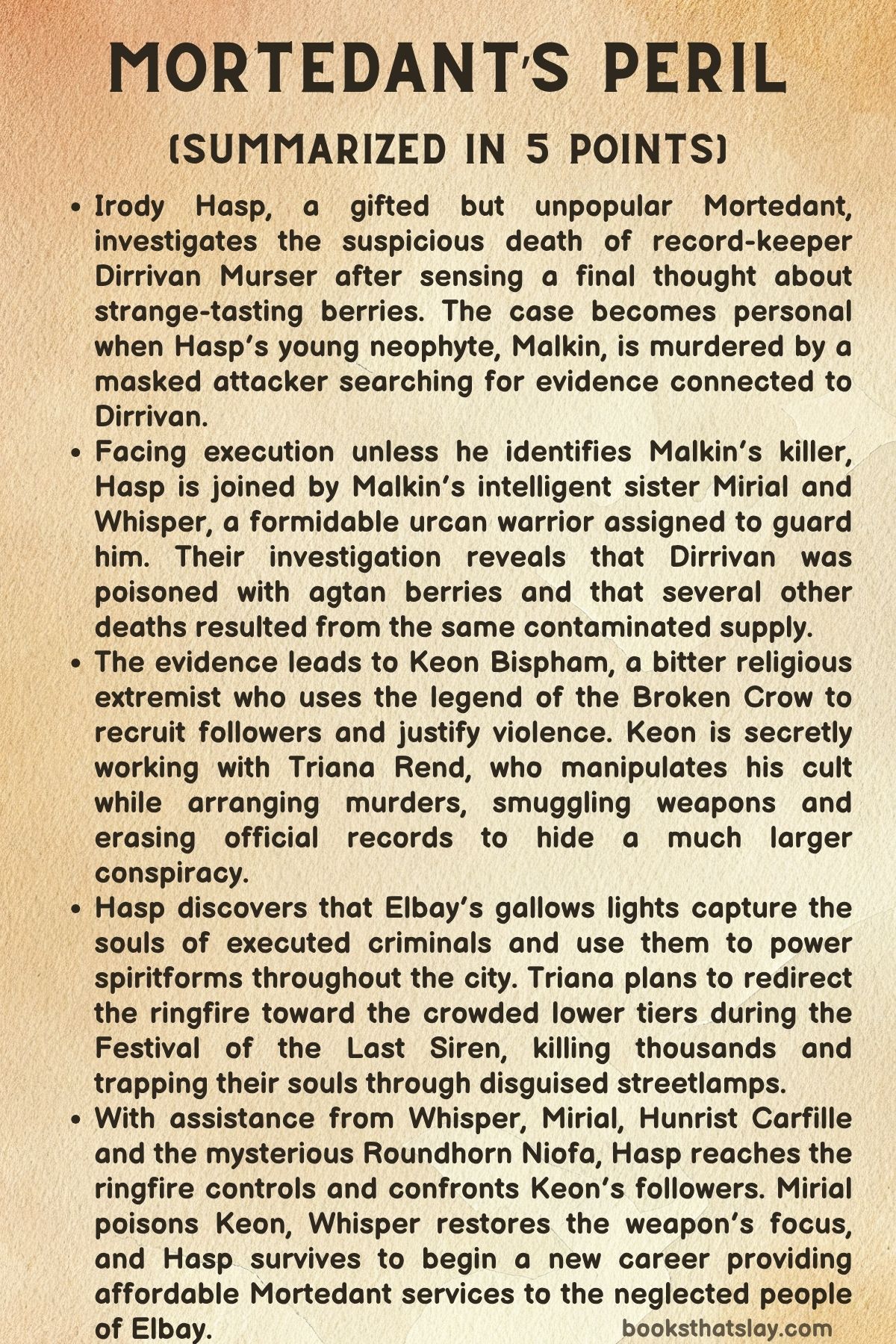
Summary
Dirrivan Murser is a poorly paid record-keeper living with his family in the lower levels of Elbay. An intruder who knows Dirrivan’s home, habits and secret fondness for expensive grinberries enters the house and mixes deadly agtan berries with his private supply.
The poisoner regards Dirrivan’s death as a necessary sacrifice rather than murder. He believes Dirrivan has learned something dangerous and must die before he can reveal it.
After Dirrivan’s death, his widow, Sivver Murser, hires Irody Hasp to read the corpse’s final thoughts. Hasp is a talented Mortedant, but he is impoverished, unpopular and willing to take unsanctioned work because he desperately needs money.
Hasp is accompanied by Malkin, his loyal young neophyte. When Hasp touches Dirrivan’s body, he senses only uncertainty about whether the berries tasted right and a vague connection to the approaching Festival of the Last Siren.
Unable to locate the fortune Dirrivan supposedly expected, Hasp invents a comforting message about a red ribbon. Sivver recognizes the deception, becomes violent and forces Hasp and Malkin to flee.
Hasp later reports to the Mortedants’ Priory, where Farrah Bispham questions him about the case. She shows unusual interest in Dirrivan’s mention of berries, although Hasp fails to recognize its importance.
When Hasp returns home, he finds Malkin strangled beneath the table used for his illegal experiments. An attacker then attempts to kill Hasp with a rope, but Hasp throws a volatile chemical over his shoulder and burns the murderer, who escapes.
Hasp reads Malkin’s final emotions and discovers that the boy died believing he had failed to protect his master. Overcome by grief, Hasp assures the dead Malkin that he never failed him.
Because Hasp possesses forbidden spurrying equipment, he destroys his laboratory before reporting the murder. The secant guard immediately suspects him because he cannot provide a clear image of Malkin’s killer.
Grand High Mortedant Affinar Tusp Bendant rereads the corpse and confirms that Malkin did not believe Hasp was responsible. Hasp is given until Shadowday evening to identify the real murderer or surrender for execution.
Farrah assigns an urcan mercenary called Whisper to guard and supervise him. Hasp initially regards her as an uncivilized outsider, while Whisper considers Elbay’s practice of sacrificing lives to create spiritforms barbaric.
Hasp first assumes Malkin’s murder is connected to the criminal communities of the lower tiers. His search brings him into contact with Mirial, Malkin’s younger sister, who believes the priory allowed her brother to be killed.
Mirial takes Hasp before the liars’ circle, the secret court governing Elbay’s gangs. The leaders reveal that the gangs contributed money to secure Malkin’s education because they hoped his success would prove that poor children could enter respected professions.
Ashamed of his assumptions, Hasp promises to accept Mirial as his new neophyte. Whisper then fights an urcan warrior who challenges Hasp’s honour, revealing both her extraordinary skill and the hostility surrounding her unexplained exile.
Mirial and Whisper persuade Hasp to reconsider the Murser case. The timing suggests that Malkin was killed because he had become involved in something connected to Dirrivan’s death.
Hasp discovers that someone searched his rooms and removed Dirrivan’s will. He, Mirial and Whisper obtain another copy from the records office, but Mirial later collapses after touching the document and eating beside it.
Whisper identifies agtan poison on the paper and saves Mirial with an agonizing antidote. Hasp realizes that agtan berries closely resemble grinberries, proving that Dirrivan was murdered and that the poisoned will was intended to kill anyone investigating his affairs.
Sivver explains that Dirrivan’s will was prepared by a contracteer named Gryunt Bardif. A huge black-haired man delivered it, supplied Dirrivan’s grinberries and spoke in the language of the Broken Crow, a dead revolutionary once known as Kuridan Satury.
Sivver also reveals that Dirrivan had become terrified by information discovered through his work. He believed an enormous payment would allow his family to leave Elbay before the festival.
The remaining berries were sold to a trader named Veron and later consumed by several people found dead in a chapel. What initially appeared to be disease is therefore another consequence of the original assassination.
Dirrivan’s notebooks contain records of streetlamps, guard movements, traffic and ringfire schedules. The information appears ordinary, but Hasp suspects it conceals a map of something much more important.
Hasp attempts to question Gryunt Bardif but discovers that the elderly contracteer has already been convicted and executed. Bardif’s face has been burned to resemble the attacker injured by Hasp, yet his frail body could never have overpowered Malkin or escaped from Hasp’s rooms.
Someone has framed Bardif and arranged his execution beneath the gallows light. Because this form of execution erases the spiritual traces normally read by Mortedants, Bardif has been silenced more completely than an ordinary murder victim.
Mirial identifies the real attacker as Keon, a bearded man working from the Chapel of the Eternal Hum. Keon distributes money and weapons, gathers followers and spreads claims that the Broken Crow has returned.
Official records connected to Bardif’s supposed crime have been erased. Hasp enters Castle Elbay and consults its ancient master spirit board, which shows that Bardif was accused of entering a property belonging to the powerful Rend family.
At the property, Hasp finds an observation scope aimed at the ringfire pylons above the castle. The supposed burglary was connected to surveillance of Elbay’s defensive weapon rather than theft.
Mirodel Rend admits that Keon once served as his son’s chief guard and supplied the household with grinberries. Mirodel appears frightened and secretly warns Hasp to abandon the investigation and flee.
An anonymous message directs Hasp and Whisper to Keon’s camp beyond Elbay’s walls. They approach by an indirect route, where Whisper uses an urcan ritual to read impressions retained by the forest.
The camp contains cultivated grinberries and agtan, tents for a large force and crates from a weapons manufacturer. Hasp also finds evidence that alcohol deliveries are being used to conceal firelances smuggled into the city before the festival.
On their return, someone deliberately activates the ringfire days ahead of schedule. Hasp and Whisper race across the protected road while people outside it are burned alive.
Whisper carries Hasp through the caustic remains of the discharge, sacrificing the flesh below her knees to bring him safely inside Elbay. She is captured while Hasp escapes into the city.
At home, Hasp is betrayed by the woman claiming to be Bardif’s widow. She is actually Ariant Belseer, an agent who entered his household to manipulate the investigation and guide him into traps.
Belseer has kidnapped Mirial and brings Hasp before Keon. Keon demands that Hasp confess to murdering Malkin and accept execution in exchange for Mirial’s life.
Hasp agrees and is imprisoned, tortured and publicly condemned. He is placed beneath the gallows light, prepared to lose both his life and every remaining trace of his consciousness.
Before the execution can be completed, the bronze ventran of Castle Elbay remove him from the scaffold. Hasp is taken before Niofa, the Roundhorn who secretly rules the city.
Niofa reveals that Mirial has been rescued and Whisper is receiving treatment. The Roundhorn also identifies Whisper as a sea princess and gives Hasp a mysterious mark granting him limited authority throughout Elbay.
Niofa needs Hasp to continue the investigation because the ancient ruler’s crow observers cannot understand every human conspiracy. Hasp unwillingly becomes an agent of the city.
Mother Worshipful Saskia Beria Havet explains that the Howling Lord worshipped by extremists is a real sleeping entity beneath Elbay. She distinguishes ordinary Worshipful belief from the violent interpretations promoted by the Cult of Ascension.
Once reunited, Mirial reports that the early ringfire discharge was described as a test. Hasp realizes the conspirators are preparing a larger attack during the Festival of the Last Siren.
Within Elbay’s citycore, Hasp sees the enormous structure believed to contain the Howling Lord. He also recognizes symbols corresponding to Dirrivan’s notes and concludes that the murdered record-keeper had mapped the ringfire’s hidden control system.
Keon is eventually identified as Farrah Bispham’s cousin. He possessed neither the talent to become a Mortedant nor the mathematical ability to become a Spurrier, and his repeated failures drove him toward fanaticism.
Further investigation reveals that 150 firelances were purchased using false credentials. Large quantities of specialist spurrying materials were also collected through orders managed by the Rend family.
Hasp and Mirial break into the Rend estate and overhear Mirodel arguing with his wife, Triana. Mirodel insists that his theories were academic, but Triana intends to turn them into reality.
Triana admits ordering the deaths of Dirrivan and Bardif. Hasp also discovers that Triana is Ariant Belseer, the false housekeeper who infiltrated his home and kidnapped Mirial.
Triana plans to manipulate the Cult of Ascension into committing an atrocity that will be blamed on the Worshipful. The resulting political crisis would enrich the Spurriers and restore the Rend family’s lost status.
A dream about Kuridan leads Hasp to connect the gallows lights, new streetlamps, ironstones and ringfire pylons. He concludes that the lamps are not ordinary sources of illumination but devices designed to capture spiritual energy.
Hasp confronts Grand Dame Heluist Sarinter with the truth behind executions. The gallows light does not merely erase the condemned; it captures their souls and stores them as energy for spiritforms.
The new lamps are much larger versions of the same spiritual nets. However, they cannot kill anyone by themselves, meaning another weapon must cause thousands of deaths at the same moment.
Hasp realizes that the conspirators intend to change the focus of the ringfire pylons so that the weapon strikes Elbay’s lowest tiers. Portable ironstones will protect Keon’s followers while the souls of the dead are collected through the lamps.
Triana believes the stored energy can power an army of permanent demihuman servants based on Mirodel’s theories. Keon believes the mass sacrifice will awaken the Howling Lord, although he is actually being used to serve Triana’s ambitions.
Niofa refuses to evacuate the lower tiers because panic could kill enormous numbers of people. When the ventran suddenly collapse, Hasp suspects that the Roundhorn has deliberately created a test for him.
Niofa equips Hasp with ancient repeating handlances and gives Mirial a promise blade coated with lethal poison. Whisper accepts ceremonial armour from Oknusoka, acknowledging both her lost royal identity and her loyalty to her new companions.
Hasp and Whisper reach the castle roof, where Keon has released the ringfire’s focusing mechanism. As Whisper struggles to return it to its proper position, Hasp attempts to persuade Keon that Triana has deceived him.
Keon refuses to abandon his beliefs and defeats Hasp. Hunrist Carfille arrives with guards, revealing that he is another secret agent working for Niofa, but the defenders remain in danger.
Mirial disobeys Hasp’s order to remain behind and attacks Keon with the promise blade. Although his armour stops the weapon, he grabs the poisoned edge and collapses.
Whisper succeeds in locking the focusing mechanism into its normal position. The ringfire discharges outward rather than into the city, saving the lower tiers and the thousands gathered there.
Triana escapes Elbay, while the official explanation blames defective streetlamps. The authorities conceal both the attempted massacre and the truth that the Spurriers power their creations with human souls.
Hasp later confronts Farrah with evidence that she secretly assisted Keon. He forces her to allow him to remain a Mortedant, although she becomes a lasting enemy.
Returning home, Hasp finds that Mirial has advertised his services among the poor. With Whisper, Mirial and the crow Harpsimast beside him, he begins a new career serving people normally ignored by the city’s institutions.
Characters
Irody Hasp
Irody Hasp is the central figure in Mortedant’s Peril, combining exceptional supernatural talent with arrogance, poverty and a reputation for causing trouble. His ability to read the final thoughts of the dead makes him valuable, yet his refusal to respect rules or cultivate allies leaves him isolated within his own profession.
At first, Hasp protects himself through mockery, pride and intellectual superiority. He assumes criminals must be responsible for Malkin’s death, dismisses Whisper’s culture and treats religious faith as evidence of ignorance.
Malkin’s murder breaks through this emotional distance. Hasp’s grief forces him to admit that the boy mattered deeply to him and that his responsibilities cannot be limited to payment, professional reputation or personal survival.
His investigation gradually reveals a strong moral centre beneath his abrasive behaviour. He refuses to name Bardif as the murderer even when doing so would save his life, and he accepts execution to protect Mirial.
Hasp’s greatest development comes from learning to value people whose experiences differ from his own. Mirial teaches him about downtier intelligence and resilience, Whisper challenges his cultural prejudice, and Saskia proves that sincere faith can exist without fanaticism.
By the conclusion, Hasp has not become polite, obedient or universally admired. He has instead become more responsible, self-aware and willing to use his abilities in service of people who lack power.
Malkin
Malkin is Hasp’s first neophyte and the emotional force behind the entire investigation. Although he dies early, his loyalty, hopes and relationships shape nearly every decision Hasp makes afterward.
The lower-tier gangs invested in Malkin’s education because they regarded him as proof that poverty did not determine ability. His admission to the Mortedants’ Priory therefore represented a communal achievement rather than an individual advancement.
Malkin’s final thoughts reveal his devotion to Hasp. Even while being murdered, he fears that he has failed to protect his master, showing a sense of responsibility far greater than his age should require.
His death also exposes Hasp’s emotional dishonesty. Hasp often treated him impatiently, yet the loss reveals that Malkin had become the closest person in his life.
Through Mirial’s memories, Malkin is shown as a caring brother who secretly shared his education. His efforts allowed her to read, write and calculate even though the city denied her formal recognition.
Malkin therefore represents both personal loss and wasted social potential. His murder is not merely the death of one child but the destruction of a future that many downtier people had worked together to create.
Mirial
Mirial enters the story through anger, suspicion and grief. She believes Hasp failed Malkin and initially approaches him as someone who must answer for her brother’s death.
Her intelligence quickly proves that she is more than a replacement neophyte. Malkin taught her everything he learned, and she combines this informal education with practical knowledge of theft, criminal networks, hidden routes and lower-tier society.
Mirial often notices dangers that Hasp overlooks. She questions the false housekeeper’s stories, recognizes tactical problems during pursuit and helps connect Keon’s cult to the ironstones protecting the Radial Road.
Her guilt over telling Malkin about the Murser job reveals the emotional burden she carries. Hasp’s insistence that she is not responsible becomes one of the clearest signs of his growing compassion.
Mirial also gives the book an important downtier perspective. She understands that faith, humour and community are not signs of foolishness but methods through which poor people survive lives filled with hardship.
Her decision to join the final battle demonstrates both courage and independence. By poisoning Keon, she directly prevents the massacre and proves that Hasp’s attempts to exclude her from danger cannot erase her agency.
Whisper
Whisper begins Mortedant’s Peril as an unwanted guard hired to supervise Hasp, but she gradually becomes his protector, moral equal and closest companion. Her great physical power is balanced by patience, discipline and a strict understanding of personal promises.
Hasp initially judges her through Elbay’s prejudice against urcans. Whisper responds without insecurity, allowing her actions to demonstrate that her culture possesses its own honour, knowledge and supernatural practices.
Her loyalty exceeds the terms of employment. She continues protecting Hasp after her paid contract is cancelled because she personally promised to keep him safe.
Whisper’s sacrifice during the premature ringfire discharge defines her courage. She carries Hasp through burning residue even as the flesh beneath her knees is destroyed.
Her concealed identity as an Oknusokan princess explains the formality of her behaviour and the hostility shown by other urcans. Accepting her royal armour becomes an emotional confrontation with the life, title and homeland she abandoned.
Whisper also guides Hasp toward a broader moral understanding. She challenges Elbay’s use of sacrificed lives, defends Mirial’s place in their household and teaches Hasp that responsibility can be chosen rather than imposed.
Keon Bispham
Keon Bispham is the visible leader of the conspiracy and the murderer responsible for Malkin’s death. He presents himself as a prophet and revolutionary, but his actions reveal a man driven by resentment, pride and the need to prove that his failures were caused by an unjust world.
Born into a respected Mortedant family, Keon lacked the ability to read the dead. He later attempted to become a Spurrier but lacked the mathematical skill required for that profession as well.
Instead of accepting his limitations, Keon transformed humiliation into fanaticism. The Cult of Ascension gave him followers who treated his personal interpretations as divine revelation.
Keon uses the image of the Broken Crow because it provides political authority among the poor. He has no genuine loyalty to Kuridan’s ideals and admits that the revolutionary identity is useful propaganda.
His treatment of Dirrivan, Bardif, Malkin, Mirial and the sick child demonstrates his contempt for individual life. Although he speaks about sacrifice and justice, he consistently forces others to suffer while protecting his own position.
Even after Hasp explains Triana’s manipulation, Keon refuses to reconsider his actions. His faith has become inseparable from his ego, making doubt feel like personal annihilation.
Triana Rend and Ariant Belseer
Triana Rend is the hidden architect of the festival conspiracy. Under the false identity Ariant Belseer, she enters Hasp’s household, poses as Bardif’s widow and manipulates the investigation from within.
Unlike Keon, Triana is not motivated by sincere religious belief. She regards the Cult of Ascension as a convenient force that can commit violence while allowing the Spurriers to avoid responsibility.
Her objective is political and economic restoration. The Rend family lost wealth and influence after the destruction of its weapons business, and Triana believes a single calculated atrocity can restore both.
Triana’s greatest strength is her ability to identify and exploit weakness. She uses Keon’s resentment, Mirodel’s guilt, the cult’s fanaticism and the city’s prejudice to conceal her own intentions.
Her control over Mirodel through their children also reveals the private cruelty behind her public ambition. Family members, servants, believers and victims are all resources to be managed.
Triana’s escape prevents complete justice. Her survival also demonstrates that powerful organizers often avoid the punishment suffered by the followers and victims they manipulate.
Farrah Bispham
Farrah Bispham represents the defensive self-interest of the Mortedants’ Priory. She is intelligent enough to recognize danger but repeatedly prioritizes reputation, family loyalty and institutional convenience over justice.
Her treatment of Hasp combines contempt with reluctant respect. She understands his extraordinary ability, yet his independence and refusal to follow procedure threaten the controlled image she wants the priory to maintain.
Farrah’s connection to Keon adds a personal dimension to her choices. Although she claims that the family rejected him, evidence suggests that she provided assistance and interfered with Hasp’s protection.
She may not have expected Keon’s plans to reach the point of mass murder. However, her willingness to support him while ignoring the likely consequences makes her morally responsible for the danger he creates.
Farrah also participates in the exclusion of people such as Mirial. Her insistence on formal certificates protects professional standards in theory but reinforces barriers against talented children who were denied education.
Hasp’s final confrontation with her does not reform the institution. It merely forces Farrah to tolerate him, leaving their relationship defined by mutual knowledge and permanent hostility.
Niofa
Niofa is the Roundhorn who secretly rules Elbay from the castle. The ancient being appears eccentric and playful, but this behaviour conceals a mind that measures events across centuries rather than individual lifetimes.
Niofa rescues Hasp from execution, protects Mirial and Whisper, and gives Hasp authority to continue the investigation. These actions make the Roundhorn an essential ally, though never a fully trustworthy one.
The ruler’s crows, ventran and hidden agents reveal the enormous reach of this power. However, Niofa still requires human investigators because observation alone cannot explain motives, loyalties and moral choices.
Niofa’s refusal to evacuate the lower tiers shows the limitations of long-term thinking. The possibility of thousands of deaths becomes an administrative calculation rather than a human catastrophe.
The sudden collapse of the ventran strongly suggests that Niofa deliberately creates a test for Hasp, Mirial and Whisper. Providing precisely the weapons and armour they require strengthens the suspicion that their danger is being observed as an experiment.
Niofa protects Elbay, but ownership matters more to the Roundhorn than justice. The character therefore remains both guardian and manipulator.
Hunrist Carfille
Hunrist Carfille initially appears to be an arrogant, wealthy Mortedant who enjoys mocking Hasp’s clothes, poverty and disgraced history. His privileged confidence makes him seem like a representative of everything Hasp dislikes about the priory.
His later actions reveal a more complicated personality. Hunrist arranges protection for Hasp and Mirial, appears during the battle at the ringfire focus and is eventually identified as one of Niofa’s hidden agents.
Hunrist’s humour often conceals genuine concern. He avoids openly declaring friendship, possibly because secrecy is essential to his work and because mockery allows him to maintain emotional distance.
His loyalty is directed more toward Elbay than toward the formal leadership of the Mortedants. This places him in quiet opposition to Farrah whenever institutional reputation conflicts with the city’s survival.
Hunrist is not transformed into a humble or openly generous man. His importance comes from demonstrating that unpleasant behaviour and moral corruption are not always the same thing.
Mirodel Rend
Mirodel Rend is a gifted theorist whose intellectual work makes the conspiracy possible. He developed ideas about ringfire, spirit energy and permanent demihuman servants without initially intending that they should be used.
His claim that the work was merely academic does not remove his responsibility. Dangerous knowledge becomes more dangerous when its creator ignores the political and moral conditions surrounding it.
Mirodel’s guilt leads him to contact Dirrivan, setting the record-keeper’s mapping work in motion. When Dirrivan realizes the significance of the project and attempts blackmail, Triana orders his death.
Mirodel is frightened, controlled and watched within his own household. His secret warning to Hasp shows that he wants to prevent disaster but lacks the courage to confront his wife directly.
His weakness allows Triana to convert theory into mass violence. He is therefore neither an innocent scholar nor a deliberate murderer, but a compromised man whose passivity enables atrocity.
Grand Dame Heluist Sarinter
Grand Dame Heluist Sarinter leads the Spurriers’ Priory and protects its deepest secret. She understands that the institution’s spiritforms are powered by souls captured during executions.
Heluist first attempts to persuade Hasp to abandon the investigation by offering future employment. Her approach reveals that she prefers influence, bribery and professional temptation to direct confrontation.
Her concern about Kuridan’s history is linked to the danger that the public may learn how execution and spurrying are connected. Such knowledge would expose the priory’s prosperity as dependent on systematic spiritual exploitation.
Heluist does not appear to support Triana’s massacre, and she confirms that the new lamps were installed without her authority. However, her defence of the existing system creates the conditions that make Triana’s plan possible.
She represents an institution that considers secrecy necessary for social order. Her fear of unrest is understandable, but it also protects practices that would probably be rejected if citizens knew the truth.
Mother Worshipful Saskia Beria Havet
Saskia is the leader of the Worshipful Priory and an important challenge to Hasp’s prejudice against religion. She is intelligent, practical and fully aware that sacred texts can be interpreted in destructive or compassionate ways.
She explains that the Cult of Ascension treats references to blood and sacrifice literally, while many believers understand them as spiritual metaphors. This distinction prevents Keon’s fanaticism from defining the entire Worshipful community.
Saskia also knows that the Howling Lord is physically real. Her desire to keep it asleep gives her religious authority a practical responsibility toward the safety of the city.
Like Hasp, she bears Niofa’s mark and serves as one of the Roundhorn’s human agents. Their shared role suggests that Niofa deliberately recruits people capable of challenging the institutions from which they come.
Her medical treatment of Hasp, Whisper and Mirial demonstrates a faith expressed through care rather than domination. Saskia becomes evidence that belief and reason can coexist.
Kuridan Satury
Kuridan Satury, once known as the Broken Crow, is dead before the central action begins, yet his memory shapes Hasp, Keon and Elbay’s political imagination. He was once Hasp’s friend and partner in forbidden experiments.
Kuridan recognized the city’s inequality and wanted to challenge systems that treated the poor as disposable. His early ideals contained genuine demands for dignity and reform.
Over time, rejection and frustration turned those ideals toward violence. Kuridan began sacrificing the same people he claimed to liberate, believing that future justice excused present suffering.
Hasp’s guilt comes from understanding both Kuridan’s original purpose and his later cruelty. He fears that opposing his friend made him a coward, even though allowing Kuridan to continue would have caused further deaths.
Keon’s use of the Broken Crow’s identity further corrupts the legacy. Kuridan becomes a symbol detached from the complicated person who created it.
The dream before the festival allows Hasp to confront this history. It also helps him recognize that noble language cannot excuse methods that treat human beings as fuel for a cause.
Dirrivan Murser
Dirrivan Murser is the first victim whose death exposes the wider conspiracy. He appears socially insignificant, which allows his killers to assume that no powerful person will investigate his fate.
His work mapping lamps, traffic, guards and ringfire controls places dangerous knowledge in the hands of a poorly protected record-keeper. Once he understands the purpose of the information, fear and greed lead him to demand payment.
Dirrivan’s attempted blackmail is morally questionable, but it does not justify his murder. His desire to move his family away before the festival suggests that he understood the scale of the coming danger.
His hidden grinberries reveal both selfishness and ordinary human weakness. The killer exploits this private greed to ensure that Dirrivan consumes the poison alone.
Dirrivan’s final thought about the taste of the berries becomes the small clue that eventually prevents mass murder. His overlooked death proves that the final experience of an unimportant person can expose crimes committed by the powerful.
Sivver Murser
Sivver Murser is introduced as an angry widow convinced that Dirrivan concealed money from her. Her hostility toward Hasp reflects grief, poverty and the fear that her husband’s promised payment has disappeared.
She recognizes Hasp’s invented message immediately. This moment establishes that she is perceptive and unwilling to accept sentimental comfort when practical survival is at stake.
Once Hasp waives her debt and treats her concerns seriously, Sivver provides essential information. She identifies Bardif, describes Keon and explains how the poisoned berries entered the market.
Her decision to sell the remaining fruit causes further deaths, but she has no knowledge of the poison. The event shows how a single concealed crime can spread through ordinary economic exchanges.
Sivver’s family remains vulnerable because the institutions of Elbay offer little protection to poor citizens. Hasp’s warning that she should flee is one of his earliest attempts to place another family’s safety above his own immediate needs.
Gryunt Bardif
Gryunt Bardif is a contracteer used as a substitute culprit. His profession connects him to Dirrivan’s will, making him a convenient person for the conspirators to accuse.
He is arrested, injured and executed before Hasp can question him. The burn on his face is deliberately created to resemble the injury Hasp inflicted on Malkin’s attacker.
Bardif’s frailty makes the deception obvious to anyone willing to look beyond the official account. He could not have committed the physical acts attributed to him.
His execution beneath the gallows light prevents a Mortedant from recovering his final memories. The legal system is therefore used not only to kill him but to destroy evidence.
Bardif represents the ease with which powerful groups can manufacture guilt. Once the authorities present an executed suspect, they expect society to accept the case as solved.
Harpsimast
Harpsimast is one of Niofa’s crow observers and becomes an unusual member of Hasp’s household. The bird provides communication, surveillance and practical assistance while connecting Hasp directly to the Roundhorn.
Although Harpsimast cannot interpret human motives as deeply as a person can, he and the other crows observe movement across much of Elbay. Their limitations explain why Niofa requires agents such as Hasp.
Harpsimast also protects Hasp and Mirial by summoning other crows to attack their pursuers. His intervention gives them enough time to escape into the citycore.
By the ending, his presence among Hasp’s companions reinforces the household’s unconventional nature. Mortedant, neophyte, urcan princess and ancient ruler’s crow form a community based on shared danger rather than social expectation.
Siren Halend
Siren Halend is a blind Worshipful who runs a street chapel and distributes food to anyone in need. His generosity offers a direct contrast to the cruelty of Keon’s Cult of Ascension.
Halend once belonged to the extremist sect but left when he recognized that its desire for vengeance produced no joy or spiritual growth. His experience gives him insight into how bitterness can disguise itself as religious purity.
He identifies Keon’s family history and explains how repeated professional failure shaped his resentment. Halend understands that Keon’s need for superiority matters more than the doctrines he publicly teaches.
His kindness toward Hasp is especially significant because he knows Malkin criticized Hasp’s attitude toward faith. Rather than answering contempt with hostility, Halend responds through service and honesty.
Vela
Vela operates a specialist shop supplying chemicals and equipment to Spurriers. She is one of the few people who knows about Hasp’s illegal experiments and continues helping him despite the danger to herself.
Her friendship with Hasp is practical rather than sentimental. She provides materials, information and discreet cooperation without demanding that he become easier to tolerate.
Vela’s records reveal that the Spurriers’ Priory ordered unusual quantities of complex materials. This information helps connect the Rend family’s influence to the technical side of the festival conspiracy.
Her role also shows that Hasp was never completely isolated. Even before forming his new household, he possessed quiet relationships built on trust, shared curiosity and mutual risk.
Themes
Institutional Power and Social Inequality
Elbay’s seven tiers transform social class into physical geography. Wealth, clean water, political influence and professional opportunity increase as citizens move upward, while the lower levels endure disease, pollution, overcrowding and constant suspicion.
Mortedant’s Peril shows that inequality is preserved through institutions that present themselves as necessary guardians of order. The Mortedants restrict entry through certificates unavailable to poor children, the Spurriers hide the source of their power, and the guards prefer convenient suspects to difficult investigations.
Malkin’s education reveals how much collective effort is required for one downtier child to gain access to a respected profession. His success depends on money gathered by criminal organizations because legitimate structures offer no comparable path.
The same system makes Dirrivan, Bardif and the sick child easy to eliminate. Their poverty ensures that authorities expect little public resistance when they die.
Hasp’s development requires him to recognize that personal talent does not free him from institutional privilege. Despite his poverty and disgrace, his status as a Mortedant still grants access that Mirial, Sivver and Malkin do not possess.
The ending offers reform at a small scale rather than a complete transformation. Hasp serves downtier clients and accepts barter, creating an alternative practice within a city whose larger inequalities remain intact.
Faith, Fanaticism and the Manipulation of Belief
Religious belief takes several distinct forms throughout the story. Mirial and Siren Halend understand worship as a source of endurance, joy and community, while Saskia treats faith as a responsibility to protect people from destructive interpretations.
Keon turns belief into a declaration of personal authority. His inability to succeed as a Mortedant or Spurrier leaves him desperate for a system in which his words cannot be questioned.
The Cult of Ascension gives him that system. By presenting his desires as divine commands, Keon converts resentment into sacrifice and murder.
Triana’s involvement reveals how easily fanaticism can be exploited by people who do not share it. She allows Keon to believe he is awakening the Howling Lord while using his followers to advance the Spurriers and the Rend family.
Hasp’s early contempt for all Worshipful practices prevents him from understanding these differences. His encounters with Mirial, Halend and Saskia teach him that dismissing every believer as foolish only strengthens extremists who claim to speak for the entire faith.
The physical reality of the Howling Lord further complicates the question. Something immense exists beneath Elbay, but its existence does not prove that Keon understands it or that his violence is justified.
The theme therefore separates spiritual possibility from human certainty. Belief becomes dangerous when one person claims exclusive knowledge and treats disagreement as permission to destroy others.
Death, Memory and the Exploitation of the Soul
Mortedancy begins as an apparently respectful relationship between the living and the dead. A Mortedant touches a corpse and receives fragments of final thought, preserving a small part of a person’s final experience.
The limitations of this ability are important. Corpses rarely provide complete answers, meaning the living must still interpret evidence, question assumptions and accept uncertainty.
Elbay’s execution system turns death into something far more sinister. The gallows light removes the spiritual echo from condemned people because their souls are being captured and converted into energy.
This secret changes the meaning of every spiritform in the city. Machines, vehicles and conveniences are not simply products of technical brilliance but creations powered by human consciousness taken without consent.
The conspiracy expands this exploitation to an unimaginable scale. Triana intends to kill thousands and trap their souls through disguised streetlamps, reducing entire communities to fuel for an army.
Hasp’s profession places him in direct opposition to this process. Mortedancy depends on recognizing that something of a person remains after death, while the Spurriers treat that remainder as a resource.
Malkin’s final emotions, Dirrivan’s uncertain thought and the sick child’s question about his mother each preserve individuality. These moments insist that even brief spiritual traces belong to people whose lives cannot be reduced to numbers, weapons or political advantages.
Responsibility, Loyalty and Chosen Family
Hasp begins the story determined to avoid emotional obligations. He hides behind professional arrogance and treats companionship as inconvenience, even though Malkin’s devotion has already made them more than master and apprentice.
Malkin’s death forces Hasp to confront the cost of emotional distance. His promise to find the murderer becomes both an act of justice and an attempt to honour affection he failed to express while Malkin lived.
Mirial and Whisper gradually form a new household around him. Neither relationship begins through comfort: Mirial demands a promise after accusing him, while Whisper arrives as a guard and jailer.
Their loyalty becomes meaningful because it is repeatedly chosen. Whisper remains after her contract ends, Mirial refuses to abandon Elbay, and Hasp accepts death rather than allow Keon to harm her.
Responsibility also requires accepting another person’s independence. Hasp tries to keep Mirial away from the final battle because he fears repeating his failure with Malkin, but her intervention is what defeats Keon.
The household does not depend on blood, status or cultural similarity. It includes an abrasive Mortedant, a downtier girl, an exiled urcan princess and a watchful crow.
By serving poor clients at the end, they convert private loyalty into public responsibility. Their family becomes the foundation of a different kind of professional life, one based on accessibility, mutual protection and respect rather than prestige.