The Stolen Heir Summary, Characters and Themes
The Stolen Heir by Holly Black is the first installment of a duology set in the same enchanting yet dangerous world introduced in The Folk of the Air series. The novel follows Wren, once known as Suren, the child queen of the Court of Teeth.
Having endured betrayal, enchantment, and exile, she hides in the mortal world, haunted by memories of the family that cast her aside. When Prince Oak, heir to Elfhame, appears with a dangerous quest, Wren is drawn back into Faerie’s tangled politics and ruthless power struggles. Their journey together blurs the lines between trust and betrayal, setting the stage for old wounds and new dangers.
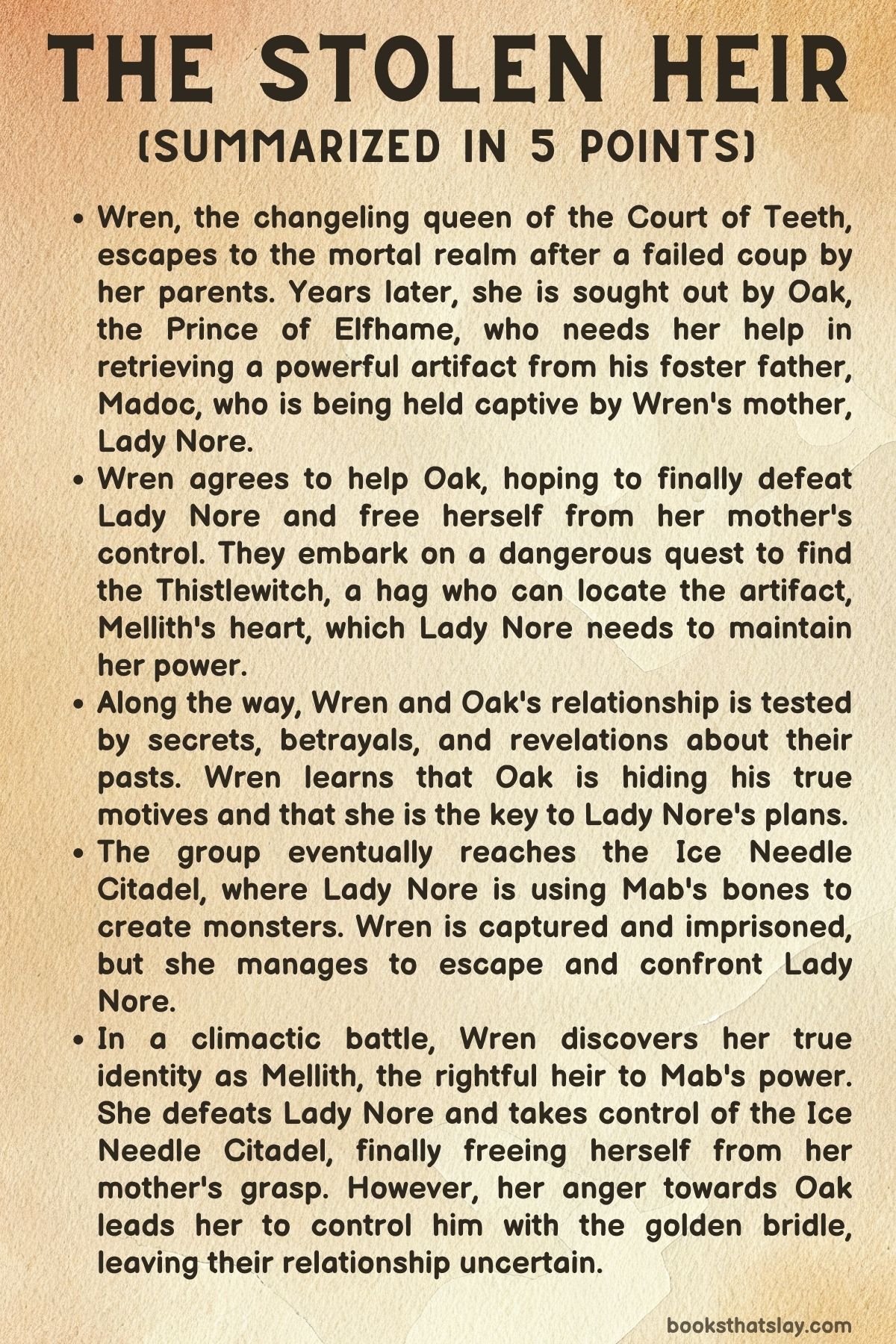
Summary
The story opens with Wren, a strange child abandoned in an alley and raised by mortal foster parents alongside her sister, Rebecca. Though fragile in appearance, she shows unusual strength and an unsettling resistance to the cold.
At nine, her life unravels when three faeries—Lord Jarel, Lady Nore, and Bogdana—reveal she is not human but their changeling daughter, Suren. Her reflection exposes a monstrous form, and under enchantment, her mortal family recoils from her.
Heartbroken and rejected, she is taken into Faerie. Years later, she returns scarred and feral, but vanishes once more, severing ties to her former life.
Now grown, Wren lives on the outskirts of the mortal world. She secretly watches her “unfamily” from the shadows, calling them unmother, unfather, and unsister to remind herself she no longer belongs.
At night, she lurks near the Devil’s Tree, where mortals bargain with faeries, secretly breaking curses laid on them as vengeance against Faerie. Despite her monstrous appearance, she clings to remnants of her mortal ties, sneaking into her old home even at great risk.
Her quiet existence ends when Bogdana tracks her down. To protect her family, Wren flees, drawing the hag away.
During the chase, she is intercepted by Prince Oak of Elfhame and his knight Tiernan. Oak, her childhood companion and betrothed, insists she join him.
Lady Nore has risen in power, and Wren’s knowledge of the Citadel makes her vital. Though bound and mistrustful, she recalls Oak’s past kindness when he tried to ease her captivity years ago, stirring conflicted feelings.
Despite Tiernan’s wariness, Oak’s gallantry unsettles her as they begin their reluctant alliance.
Together with Tiernan and Hyacinthe, a bridled soldier, they travel through mortal and faerie lands. Wren, inexperienced and mistrustful, struggles to fit into their company.
Along the way, they face dangers: ambushes by grotesque constructs, poisoned arrows, and reminders of Bogdana’s relentless pursuit. At a seaside town, Wren is bound out of mistrust, but small moments with Oak rekindle echoes of their childhood bond.
Their journey continues with Oak’s charm, Tiernan’s loyalty, and Hyacinthe’s warnings about Oak’s gancanagh heritage—an inherited power to ensnare hearts.
They arrive at the Court of Moths and meet Queen Annet, who offers passage to the Thistlewitch, though her generosity hints at hidden bargains. During revels, Oak reveals his true mission: to rescue Madoc, his foster father, from Lady Nore’s grasp.
Wren feels betrayed but continues, drawn deeper into Oak’s shifting motives. Their relationship blurs further when a kiss leaves her questioning his sincerity and her own guardedness.
In the swamp, the Thistlewitch tells them of Mab, Mellith, and the cursed heart that binds creation and annihilation. Mellith’s heart holds immense destructive power, and Lady Nore seeks it to solidify her reign.
Oak strikes a bargain with the Thistlewitch, but afterward declares Wren too great a risk. Distrust grows, worsened by Bogdana’s claim that Wren was made from snow, blood, and breath rather than born, and that Oak intends to betray her.
Caught between lies and half-truths, Wren briefly flees but is drawn back into the group, uneasy yet unwilling to abandon the path forward.
The group reaches Undry Market, where Oak acquires supplies, weapons, and enchantments for the dangerous journey to Lady Nore’s Ice Citadel. Despite Wren’s suspicion, moments of shared vulnerability with Oak deepen their connection.
They prepare for the final confrontation, bound together by necessity but divided by secrets.
At the Ice Citadel, Oak and Wren infiltrate as servants, moving through chilling corridors of ice and grotesque displays. When caught, Oak boldly negotiates with Lady Nore, offering Mellith’s heart in exchange for Madoc.
Wren is imprisoned but escapes briefly, discovering fragments of Mab’s bone and unleashing dangerous power that frightens even herself. Recaptured, she invokes Lady Nore’s sworn vow, seizing control of her authority.
With Oak’s support, she orchestrates a dangerous plan for the exchange.
At the snowy rendezvous, chaos erupts. The supposed heart Oak presents is revealed as a ruse, poisoned to strike Hurclaw, King of Trolls.
In the fray, Wren realizes the truth: Mellith’s heart beats within her. Drawing on its destructive power, she unravels Lady Nore’s constructs and annihilates her with a thought, ending her reign in an instant.
With Hurclaw poisoned, Wren asserts her authority, demanding fealty in exchange for breaking the trolls’ curse. She releases Tiernan, Madoc, and others who wish to go free, but not Oak.
In a shocking reversal, Wren uses the bridle to bind Oak himself, imprisoning him at the Citadel. Though he pleads for trust and admits his past deceptions were meant to protect her, she cannot risk surrendering to his charm or lies.
The freed soldiers hail her as queen, but her isolation deepens. Bogdana urges her to establish a court, while Oak remains caged, calling her name as she flees his presence, torn between power, mistrust, and the remnants of a bond that refuses to die.
Characters
Wren (Suren)
Wren is the heart of The Stolen Heir, a character torn between her human upbringing and her faerie origins. Abandoned as a baby and raised by mortal foster parents, she experiences early love and belonging before that identity is brutally stripped away when her faerie lineage is revealed.
Her transformation from cherished daughter to rejected changeling scars her deeply, and this rejection fuels both her mistrust of others and her compulsion to protect mortals from faerie cruelty. Wren’s existence is marked by duality: fragile yet powerful, human yet fae, monstrous yet empathetic.
Her struggles with her physical monstrosity and her emotional wounds create a complex heroine who oscillates between vulnerability and ferocity. As the story progresses, her discovery of Mellith’s heart within herself elevates her from outcast to a figure of immense destructive power, yet she remains haunted by questions of identity, loyalty, and whether she is capable of love without destroying those closest to her.
Prince Oak
Prince Oak is a fascinating blend of charm, secrecy, and political cunning. As heir to Elfhame, he bears the burden of power but masks it with a disarming gallantry that often leaves others unsure whether his actions are sincere or manipulative.
Oak is deeply shaped by his lineage: the son of a gancanagh, he carries the gift—or curse—of irresistible allure, which makes others question his motives. His relationship with Wren is fraught with tension, rooted in their childhood bond and complicated by betrayal, secrecy, and his hidden agenda to rescue Madoc.
Oak’s character thrives in contradiction: he is kind yet deceptive, loyal yet strategic, affectionate yet bound by ambition. His willingness to be bridled by Wren in the end, despite knowing the danger, shows a mix of resignation, sacrifice, and perhaps a deeper attachment to her than he admits.
Tiernan
Tiernan serves as Oak’s loyal knight and moral counterbalance, embodying steadfast duty and unyielding suspicion of Wren. Unlike Oak, who oscillates between trust and manipulation, Tiernan is consistently wary, often acting as the voice of caution within the group.
His mistrust of Wren is sharpened by his devotion to Hyacinthe, and his fear that Wren’s presence endangers their mission and those he loves. Tiernan’s loyalty is rooted in pragmatism, but moments of tenderness—particularly his feelings for Hyacinthe—reveal a softer, more vulnerable layer beneath his stern exterior.
His warnings about Jude’s wrath and his disapproval of Oak’s choices highlight his role as a stabilizing presence, though his inability to fully see beyond Wren’s past mistakes limits his growth.
Hyacinthe
Hyacinthe is a character caught between servitude and rebellion, shaped by the curse of the bridle that binds him. Despite his shackled existence, he demonstrates agency through loyalty, small acts of resistance, and his willingness to aid Wren at critical moments.
His relationship with Tiernan adds emotional depth, softening his role from mere soldier to someone capable of love and longing. Hyacinthe embodies resilience in the face of control, mirroring Wren’s own struggles against enchantments and power structures that seek to define her.
His presence in the story underscores themes of freedom and bondage, while his debt to Wren and quiet bravery make him a subtle but significant force in her survival.
Lady Nore
Lady Nore stands as the embodiment of ruthless ambition and cruelty. A master manipulator, she uses both enchantment and terror to bend others to her will, seeing Wren as nothing more than a tool for her political and magical designs.
Her obsession with Mab’s bones and Mellith’s heart reveals her hunger for ultimate power, and her cold indifference toward life—whether mortal or fae—marks her as a tyrant. Yet her ignorance of Wren’s true nature ultimately leads to her downfall, underscoring her fatal flaw: the arrogance of control.
Lady Nore’s role highlights the oppressive structures Wren must overthrow, making her both an external enemy and a reflection of the manipulations Wren fears she may replicate.
Bogdana the Storm Hag
Bogdana is a sinister yet oddly maternal figure in Wren’s life, claiming responsibility for her creation from snow, blood, and breath. This revelation blurs the line between captor and progenitor, making Bogdana a figure of unsettling complexity.
Her pursuit of Wren is relentless, but it is tinged with a demand for loyalty, as if she believes herself owed filial devotion. Unlike Lady Nore’s calculated cruelty, Bogdana operates through chaotic power and elemental fury, embodying raw faerie menace.
Her taunts about Wren’s mortal family reveal a keen understanding of Wren’s deepest vulnerabilities, making her both a physical and psychological adversary.
Madoc
Though not a central figure throughout the story, Madoc’s presence looms large as the object of Oak’s secret quest. Once a powerful war general, his capture by Lady Nore drives much of Oak’s deception and strategy.
Madoc’s counsel to Oak—urging ruthless pragmatism—reminds readers of his legacy of violence and manipulation. He represents both paternal authority and the temptation of power through brutality, serving as a foil to Oak’s more measured, if deceptive, approach.
His strained relationship with Oak illustrates the generational conflict between ambition rooted in fear and ambition tempered by charm and diplomacy.
Themes
Identity and Transformation
In The Stolen Heir, the exploration of identity is not simply about self-recognition but also about the fluid boundaries between what is imposed upon a person and what they claim for themselves. Wren’s life begins in confusion when she is taken from her human family and forced to accept a monstrous reflection that strips away her sense of belonging.
This fractured identity shapes her existence, as she is caught between two worlds—never fully human, never fully fae. Her transformation is not just physical but psychological, as she must reconcile the cruel labels and betrayals she has endured with her own choices and actions.
The revelations that she was created rather than born, and that Mellith’s heart beats within her, deepen this theme by raising questions about whether origin determines destiny or if self-determination can override it. The theme of transformation is reflected not only in Wren but also in Oak, who wrestles with the charm inherited from his mother and the role he must play as heir.
Both characters embody the instability of identity, constantly adapting to the deceptions and revelations around them, and their growth lies in embracing the contradictions within themselves rather than erasing them.
Family, Belonging, and Rejection
The novel underscores the ache of belonging through Wren’s relationships, first with her mortal family and later with her companions. Her parents’ rejection under enchantment leaves her scarred, and Rebecca’s recoil cements the idea that family bonds can be as fragile as enchantments.
Yet, even after years of estrangement, Wren’s compulsion to linger near her old home shows how belonging is both a comfort and a torment. The motif of “unfamily”—unmother, unfather, unsister—symbolizes her attempt to protect herself from longing, yet her actions prove she still craves connection.
Alongside this, the dynamic with Oak, Tiernan, and Hyacinthe illustrates the precarious bonds formed out of necessity. Trust is fragile, betrayal looms, and yet these ties reveal the paradox of chosen family: it may be less secure than blood, but often more genuine.
Wren’s final choice to release Tiernan and Madoc while binding Oak reflects her complex understanding of belonging—desiring connection but on her own terms, refusing once again to be cast aside.
Power, Control, and Manipulation
Power in The Stolen Heir is rarely straightforward; it is layered with coercion, bargains, and manipulation. From Wren’s childhood, where enchantments strip away her family’s love, to Lady Nore’s use of grotesque creations animated by blood and bone, power is depicted as invasive and corrupting.
The cursed bridle symbolizes the most explicit form of control, transforming individuals into tools and stripping them of will. Wren’s struggle with the bridle—first fearing it, later stealing it, and ultimately using it on Oak—captures the cycle of power and victimhood.
The theme is also visible in Oak, whose inherited gancanagh charm constantly raises suspicion about whether his kindness is genuine or manipulation. Even moments of intimacy between him and Wren are clouded by doubt, showing how difficult it is to separate real emotion from strategic influence.
By the end, Wren’s command over Lady Nore and her own acceptance of Mellith’s heart shift her role from pawn to wielder of immense authority. Yet this victory is tinged with unease, for the same tools of control that harmed her become the ones she now wields, forcing readers to question whether true freedom is ever possible in a world built on dominance and submission.
Love, Trust, and Betrayal
Romantic tension between Wren and Oak serves as a central thread, but it is always shadowed by mistrust. Their shared childhood memories suggest a bond built on kindness and small acts of rebellion, yet their present interactions are marked by suspicion and half-truths.
Oak’s concealment of his true mission and his effortless charm blur the line between sincerity and deceit, leaving Wren constantly uncertain of his motives. The kiss they share is less a moment of clarity than one of confusion, as Wren herself questions whether she is being manipulated or if real feeling exists beneath the layers of strategy.
Betrayal is not limited to their relationship; Bogdana’s revelations about Wren’s origins and her manipulation of truth also complicate Wren’s understanding of loyalty. Even Lady Nore’s treatment of Wren demonstrates the theme on a familial level, with betrayal becoming an inheritance of sorts.
Trust, therefore, becomes an act of defiance rather than naivety. Wren’s final act of binding Oak is both a betrayal of intimacy and a twisted attempt at securing fidelity, encapsulating the paradox that love in this world cannot exist without the shadow of betrayal.
Survival and Resilience
Wren’s journey is as much about survival as it is about destiny. From her childhood abduction to her years of isolation, she endures hunger, fear, and constant pursuit.
Her secret acts of breaking faerie curses, done at risk to herself, reveal her resilience not only as self-preservation but as resistance. She refuses to be defined solely as a victim, even though her life is shaped by cruelty and manipulation.
This resilience is most evident when she reclaims her agency in the Ice Citadel, resisting Lady Nore’s enchantments and eventually commanding power for herself. Her survival is not passive; it transforms into active defiance, rewriting the terms of her existence.
Yet the theme is layered with ambiguity—her survival often comes at the cost of others, whether through binding Oak or claiming dominion over the falcons. This complexity underlines that survival in The Stolen Heir is never clean or heroic but a constant negotiation between sacrifice, compromise, and endurance.