The House in the Pines Summary, Characters and Themes
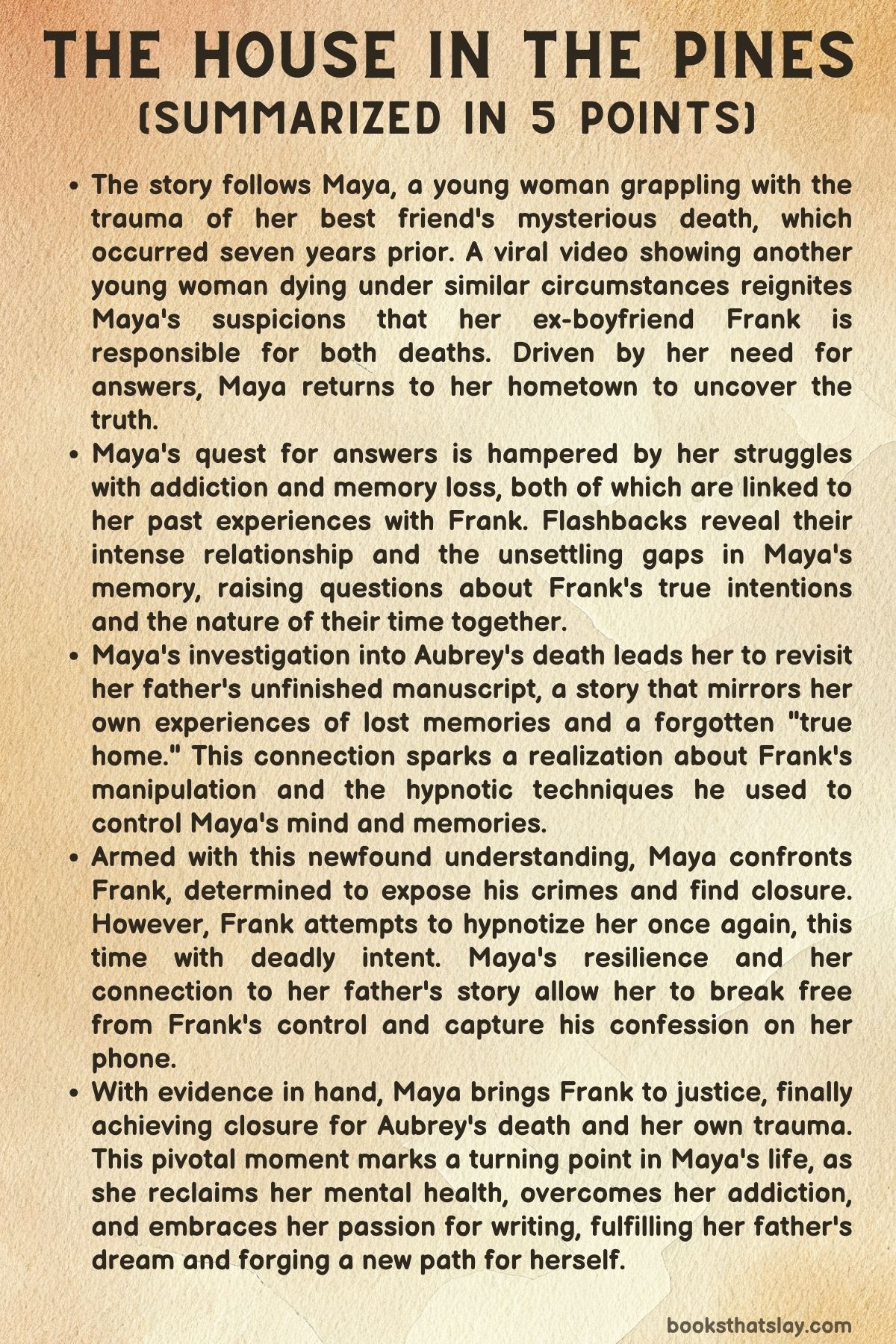
The House in the Pines by Ana Reyes is a psychological thriller that explores the fragile boundaries between memory, trauma, and truth. The novel follows Maya, a young woman burdened by addiction, insomnia, and haunting memories of her past.
When she stumbles across a viral video of a woman dying mysteriously in the presence of her ex-boyfriend Frank—who hasn’t aged a day in years—Maya’s long-buried suspicions resurface. Convinced that Frank is linked to the unexplained deaths of women, including her best friend Aubrey, Maya embarks on a perilous journey to uncover the truth. What unfolds is a chilling story about manipulation, hidden dangers, and reclaiming control.
Summary
The story begins with a dreamlike prologue: an abandoned house in the woods that feels alive in memory but disappears with the morning. This imagery reflects Maya’s fragile state of mind as she struggles with insomnia and withdrawal from Klonopin, a medication she secretly depended on for years.
Her boyfriend Dan remains unaware of her addiction, and her supplier Wendy has cut off contact, leaving Maya to endure physical and mental symptoms that intensify her fear and confusion.
One night, Maya sees a viral video that shocks her: a woman collapses and dies suddenly in a diner while sitting with Frank Bellamy, Maya’s ex-boyfriend from high school. Frank looks unchanged from seven years ago, and the dead woman bears an uncanny resemblance to Maya.
The video ends with Frank staring into the camera, a gesture that Maya interprets as a warning. The scene revives her unresolved trauma—her best friend Aubrey died in Frank’s presence in the same inexplicable way years earlier.
Though authorities dismissed Aubrey’s death as “Sudden Unexplained Death,” Maya has always believed Frank was responsible. Her fears at the time led to a diagnosis of psychosis and years of medication, but her certainty about Frank never disappeared.
Maya tries to convince Dan of Frank’s guilt by showing him the video. Although disturbed, he suggests coincidence and questions her assumptions, which leaves Maya feeling isolated.
Despite attempts to maintain normalcy, such as baking a cake for Dan’s mother’s birthday, her mental and physical state unravels. At a dinner with Dan’s family, she drinks too much, falls ill, and feels ashamed of her downward spiral.
Recognizing that she cannot ignore Frank, Maya decides to leave for her mother Brenda’s home in Pittsfield under the pretense of needing rest, but secretly with the goal of investigating Cristina’s death—the woman from the video.
On her journey, Maya learns about Cristina, who was an artist known for desert landscapes. She contacts Cristina’s boyfriend Steven, hoping to gather clues.
Alongside her investigation, Maya recalls moments with Aubrey, including carefree summers that highlight the depth of their friendship and the sharp loss Maya still feels.
Back home, Maya grapples with memories of her family’s past. Brenda, who once worked as an EMT, struggles to reconcile her daughter’s fragile mental health with the family’s history of trauma, including her sister Lisa’s mental illness and death.
Maya’s connection to her late father also emerges when she attends her grandmother’s funeral in Guatemala. There she learns more about her father’s idealism and receives his unfinished manuscript, which later provides symbolic insight into her battle with Frank.
Maya visits the diner where Cristina died and hears from a waitress that Cristina seemed to be looking beyond Frank, almost as if at something invisible. This deepens Maya’s unease and sense of being caught between rational explanations and supernatural ones.
Meanwhile, she experiences visions and episodes of lost time, which echo her past encounters with Frank. Flashbacks reveal her initial attraction to him in high school—his charm, interest in her father’s heritage, and the hypnotic quality of their conversations.
Gradually, Maya realizes that time often slipped away when she was with him, a sign of his manipulative control.
Her suspicion intensifies when she discovers another of Frank’s acquaintances, Ruby Garza, died in a fire. Tensions rise between Maya and Aubrey as Frank’s presence strains their friendship.
When Aubrey unexpectedly meets Frank, Maya grows fearful that he is targeting her friend. Soon after, Aubrey dies in front of Maya, leaving her convinced that Frank used a hidden method to cause it.
Determined to uncover the truth, Maya revisits Frank’s cabin in the woods, a place he once lured her to. There she experiences disorientation, fragmented memory, and a growing sense that Frank drugged or hypnotized her.
Later, Steven confirms Cristina had also been drawn to the cabin and shared Maya’s fascination with it. The place becomes a symbol of Frank’s manipulative hold over his victims.
Through further confrontation and research, Maya discovers that Frank’s father, Oren, conducted experiments with hypnosis and developed a method called the “Bellamy Induction.” It involved conditioning subjects to fall into a trance through cues associated with a specific object—in Frank’s case, a key. This revelation helps Maya understand how Frank exerted control over her and others, erasing memories and inducing collapses that appeared like natural deaths.
Maya arranges to meet Frank at a bar and secretly records their conversation. Frank boasts about his control techniques and admits his father’s influence.
Under his cues, Maya slips into a trance and hallucinates vividly until her mother Brenda intervenes, snapping her out of it. At the police station, Maya shares her recording with Detective Diaz, who takes it seriously despite initial skepticism from others.
Though much of the audio is obscured, key phrases revealing Frank’s hypnotic control are clear enough to warrant further investigation.
In the aftermath, Maya begins the slow process of healing. She is prescribed a new medication to manage her withdrawal and reconciles with Dan, who now understands more of her struggle.
Together they uncover evidence of Frank’s father’s unethical experiments, linking them to past deaths. Maya also secures a restraining order against Frank, while Detective Diaz pursues further leads into his operations.
Despite lingering fears of hidden suggestions implanted by Frank, Maya grounds herself by adopting a dog, reconnecting with her family, and returning to her father’s unfinished manuscript. The story closes with her finding strength through writing and planning a trip to Guatemala, reclaiming both her past and her future.
Characters
Maya
Maya is the central figure in The House in the Pines, a character caught between her fragile present and a haunting past. She struggles with withdrawal from Klonopin, a drug she has relied upon for years to keep her fears and suspicions at bay.
Her insomnia, hallucinations, and psychological unraveling shape her every action. At her core, Maya is a woman who desperately seeks clarity—about herself, about her past, and especially about the enigmatic Frank, whom she believes to be responsible for multiple deaths.
Her identity is marked by contradiction: she is deeply vulnerable, yet she clings to resilience, returning repeatedly to the painful memories of Aubrey’s death in order to make sense of them. Her Guatemalan heritage and the tragic death of her father deepen her sense of dislocation, while her relationship with Dan represents both stability and the ever-present fear that she cannot hold onto it.
Maya’s journey is one of survival, rediscovery, and confrontation with forces—both external and internal—that threaten to consume her.
Aubrey
Aubrey, Maya’s best friend from high school, is remembered as vibrant, fearless, and magnetic. Their friendship is deeply intimate, bound by poetry, experimentation, and shared feelings of otherness.
Aubrey represents everything Maya both admires and feels she lacks: courage, spontaneity, and a willingness to leap into the unknown. Yet her life is tragically cut short in Frank’s presence, leaving Maya consumed by guilt and suspicion.
Even in death, Aubrey continues to shape Maya’s choices—her absence a wound that never heals. Through flashbacks, Aubrey’s loyalty and occasional skepticism toward Maya’s choices, especially her fascination with Frank, highlight the tension between the grounding force of friendship and the lure of destructive romance.
Aubrey becomes not only a memory but also a moral compass, her death serving as the catalyst for Maya’s unrelenting search for truth.
Frank Bellamy
Frank is the novel’s most sinister and mysterious character, embodying both charm and menace. When Maya first encounters him, his allure is undeniable: charismatic, attentive, and seemingly wise beyond his years.
Yet beneath this surface lies an insidious manipulator who uses hypnosis—learned from his father—to bend others to his will. His ability to remain unchanged by time, his association with unexplained deaths, and his recurring use of keys as hypnotic triggers transform him into a figure of dread.
Frank thrives on control, preying upon those who are susceptible, leaving them disoriented and vulnerable. To Maya, he is both the shadow of her adolescence and a present danger, an adversary she must face to reclaim agency over her own life.
Frank’s sinister presence is heightened by the ambiguity he creates—his crimes leave no physical trace, only shattered psyches and inexplicable deaths.
Brenda
Brenda, Maya’s mother, is a complex character shaped by her own family’s struggles with mental illness and tragedy. A former EMT who later finds solace in baking, she embodies both stern pragmatism and deep maternal concern.
Her strictness about Maya’s mental health stems from her experiences with her sister Lisa, whose untreated paranoia ultimately destroyed her. Brenda often seems controlling to Maya, but her actions are rooted in fear of watching her daughter spiral in the same way.
She represents a blend of love and suffocation, offering care while reminding Maya of her fragility. Their relationship is marked by cycles of conflict and reconciliation, but ultimately Brenda proves to be a saving force, stepping in at critical moments to protect Maya from Frank’s manipulations.
Her resilience and grounded nature make her an anchor in a story fraught with disorientation and deceit.
Dan
Dan, Maya’s boyfriend, functions as a foil to her instability. A law student immersed in rationality and order, he initially dismisses Maya’s fears as coincidence or delusion.
His skepticism, though frustrating to Maya, is rooted in his desire to protect her from spiraling further into paranoia. Despite his doubts, Dan’s care for Maya is genuine; he nurtures her through withdrawal, listens even when he struggles to understand, and remains a constant presence when others fall away.
He represents stability and the possibility of a normal life—a life Maya both longs for and fears she cannot sustain. In contrast to Frank’s chaos, Dan embodies steadiness, even if it comes with limits to his empathy for Maya’s worldview.
Oren Bellamy
Though deceased before much of the novel’s present action, Oren Bellamy, Frank’s father, exerts a long shadow over the story. A psychologist whose experiments with hypnosis pushed ethical boundaries, he developed the “Bellamy Induction,” a dangerous method of planting posthypnotic suggestions triggered by objects.
His influence on Frank is profound, shaping him into both a practitioner and victim of this psychological weapon. Oren represents the legacy of manipulation and control, a generational curse passed down to his son.
His presence in the story underscores themes of inherited trauma, misuse of science, and the blurred line between care and coercion.
Cristina
Cristina, the woman who collapses and dies in the diner video, is both a mirror and a warning for Maya. An artist with a haunting style, she becomes the second woman linked to Frank’s lethal presence.
Through her paintings—especially the one depicting Frank’s glowing cabin—Cristina leaves behind traces of her entanglement, as if her art holds the truths she could not speak. Her death reignites Maya’s quest for answers and intensifies her conviction that Frank’s power is real.
Cristina’s brief but powerful presence in the novel highlights how Frank ensnares women who, like Maya, are searching for connection and meaning, only to leave destruction in his wake.
Aunt Lisa
Lisa, Brenda’s sister and Maya’s aunt, is a tragic figure whose untreated paranoia eventually consumed her. Though not physically present in much of the story, her shadow looms large over Maya’s life.
Lisa’s decline serves as the backdrop for Brenda’s vigilance and sternness, instilling in Maya both fear of her own fragility and resentment at being treated as fragile. Lisa’s story intertwines with the themes of inheritance—of trauma, illness, and vulnerability—offering a parallel to the destructive legacy passed down from Oren to Frank.
She serves as a reminder of what neglect and denial can cost within a family.
Themes
Addiction and Dependency
Maya’s struggle with Klonopin dependency forms one of the central conflicts in The House in the Pines. The drug functions both as a literal substance that numbs her anxiety and as a symbol of the ways people attempt to silence their pain.
Her withdrawal exposes the fragility of her carefully built life, stripping away layers of denial and leaving her vulnerable to paranoia, hallucinations, and spiraling fear. Yet the narrative makes it clear that her reliance on the drug was not merely about insomnia; it was about survival.
From adolescence, Maya was conditioned to see her fears and suspicions as symptoms rather than truths. The pills became a tool to suppress her instincts, even as those instincts pointed to real dangers.
This duality—the chemical relief versus the silenced self—mirrors the broader theme of control, both internal and external. Just as Frank uses psychological manipulation to dominate others, the drug represents a quieter, systemic form of domination that disconnects Maya from her own voice.
Her battle with dependency thus becomes a journey of reclaiming her agency. The moments of raw withdrawal—panic, sleepless nights, bodily collapse—are not just physical struggles but metaphors for what it means to confront pain without false shields.
Through this arc, the book raises questions about whether healing lies in numbing trauma or confronting it directly, and how easily attempts at escape can become another prison. Maya’s decision to taper off and seek alternative forms of support, like writing and building connections, reflects her transformation from dependence toward self-possession.
Memory, Trauma, and the Unreliable Mind
The narrative constantly blurs the line between memory, hallucination, and reality, making Maya’s mind both her greatest threat and her only tool for uncovering the truth. Her flashbacks to Aubrey’s death and her disjointed recollections of time spent with Frank illustrate the fragility of memory, especially when filtered through trauma.
These lapses are not just gaps but distortions—whole hours lost, conversations replayed with shifting details, sensations that cannot be trusted. The tension lies in how others interpret these experiences: doctors label her psychotic, her mother sees echoes of Aunt Lisa’s paranoia, and Dan views them with rational skepticism.
This external doubt compounds her internal uncertainty, leaving her trapped in the space between knowing and doubting. The novel’s structure reflects this instability, interspersing present-day investigations with fragmented recollections that force readers to question alongside Maya.
Trauma operates as both a personal affliction and a narrative device, shaping not only her perception of events but the progression of the story itself. Frank’s ability to manipulate through hypnotic suggestion literalizes the idea of an unreliable mind, turning Maya’s mental landscape into contested territory.
Her recovery is not just about proving Frank’s guilt but about reclaiming trust in her own perception. By the conclusion, her willingness to write again and interpret her father’s manuscript signals a shift: instead of fearing her mind’s instability, she learns to engage with memory as a source of strength, even if fractured.
The novel suggests that healing does not erase trauma but reframes it, turning vulnerability into resilience.
Manipulation, Control, and Power
Frank embodies the theme of control, not only in the physical sense of hypnosis but also in the psychological allure he exerts over others. His charisma, his fabricated stories, and his uncanny ability to make people lose time illustrate how power operates through suggestion rather than force.
The key object, central to his manipulative practice, becomes a chilling representation of authority—something ordinary transformed into an instrument of domination. His methods, inherited from his father’s experiments, also tie the theme of control to systems of knowledge and institutional abuse.
What begins as academic study evolves into weaponized manipulation, showing how intellectual curiosity without ethics can warp into danger. For Maya, being under Frank’s influence exposes how easily personal autonomy can be eroded, not by violence but by subtle coercion that rewrites one’s sense of reality.
Her lost hours are more terrifying than physical harm because they strip her of authorship over her own life. Beyond Frank, the theme resonates with her family history: her mother’s strict vigilance, born from fears of addiction, can feel smothering; the medical system pathologizes her suspicions and silences her voice.
Control operates on multiple levels—personal, familial, systemic—suggesting that manipulation is not confined to villains but exists in everyday power dynamics. The climax, where Maya resists Frank’s influence and records his confession, marks a pivotal reversal of control.
By seizing back narrative and evidence, she demonstrates that power lies not only in domination but in the ability to resist, to witness, and to redefine one’s reality.
Family, Inheritance, and Identity
Family history deeply shapes Maya’s struggles, anchoring her experiences of addiction, trauma, and resilience. Her mother Brenda’s vigilance reflects the shadow of Aunt Lisa’s untreated paranoia and death, creating a generational echo of fear and responsibility.
Brenda’s attempts to protect Maya are loving yet suffocating, shaped by a belief that mental illness can swallow lives if left unchecked. This tension creates both comfort and conflict, as Maya seeks independence while simultaneously relying on Brenda’s grounding presence.
Beyond her immediate family, Maya’s Guatemalan heritage plays a critical role in her search for identity. The visit to her grandfather and the discovery of her father’s unfinished manuscript reveal a lineage of creativity, activism, and loss.
Her father’s murder during the civil war adds a political dimension to her inheritance, showing how personal identity cannot be separated from historical violence. The rare flower blooming during the funeral and the manuscript’s themes of forgetting and remembering symbolize continuity across generations, reminding Maya that her struggles exist within a broader narrative of survival and resistance.
Frank, in contrast, represents a dark inheritance: the legacy of his father’s unethical experiments passed down in the form of hypnotic control. The juxtaposition of these two lineages—one rooted in resilience, the other in domination—frames the novel’s exploration of identity.
By the end, Maya’s decision to continue her father’s writing and reconnect with her heritage shows her reclaiming identity not as something imposed by trauma or manipulation but as something actively chosen and created.
Friendship, Betrayal, and Loss
The relationship between Maya and Aubrey underscores the fragile beauty of friendship and the devastating impact of betrayal and grief. Their bond, built on poetry, shared misfit status, and youthful daring, represents an ideal of trust and mutual understanding.
Yet Frank’s intrusion destabilizes this foundation, exploiting insecurities and sowing suspicion between them. The scenes where Aubrey shows skepticism of Frank or where Maya suspects Aubrey of being drawn into his orbit reveal how external forces can fracture even the closest ties.
Aubrey’s sudden death intensifies this theme, transforming friendship into haunting absence. For Maya, the loss is not only emotional but existential: Aubrey becomes the embodiment of the truth others refuse to see, the proof she cannot fully provide, and the wound that never heals.
The lingering presence of Aubrey—through memories, hallucinations, and symbols like the red dress—shows how grief becomes inseparable from identity. Betrayal also plays out in subtle forms: Maya’s guilt for choosing Frank over Aubrey at times, her fear that she abandoned their bond, and her suspicion that Aubrey saw something she could not.
The interplay of loyalty and betrayal complicates the narrative, showing that friendship is not only about shared love but also about the vulnerabilities it exposes. By revisiting her memories and confronting Frank, Maya honors Aubrey’s memory, transforming loss into a motivating force.
The novel ultimately portrays friendship as both fragile and enduring, suggesting that even in betrayal and death, the bonds of trust shape who we become and what we fight for.