Attack Of The Black Rectangles Summary, Characters and Themes
Attack Of The Black Rectangles by A.S. King is a middle-grade novel about censorship, truth, growing up, and learning how to speak when adults would rather stay quiet. The book follows Mac Delaney, an eleven-year-old sixth grader in a rule-heavy Pennsylvania town where many adults try to hide uncomfortable realities behind politeness, tradition, and control.
When Mac and his friends discover that words have been blacked out in their school copies of a Holocaust novel, they begin a fight that becomes about much more than a few censored sentences. It is a story about intellectual freedom, family pain, friendship, activism, and emotional honesty.
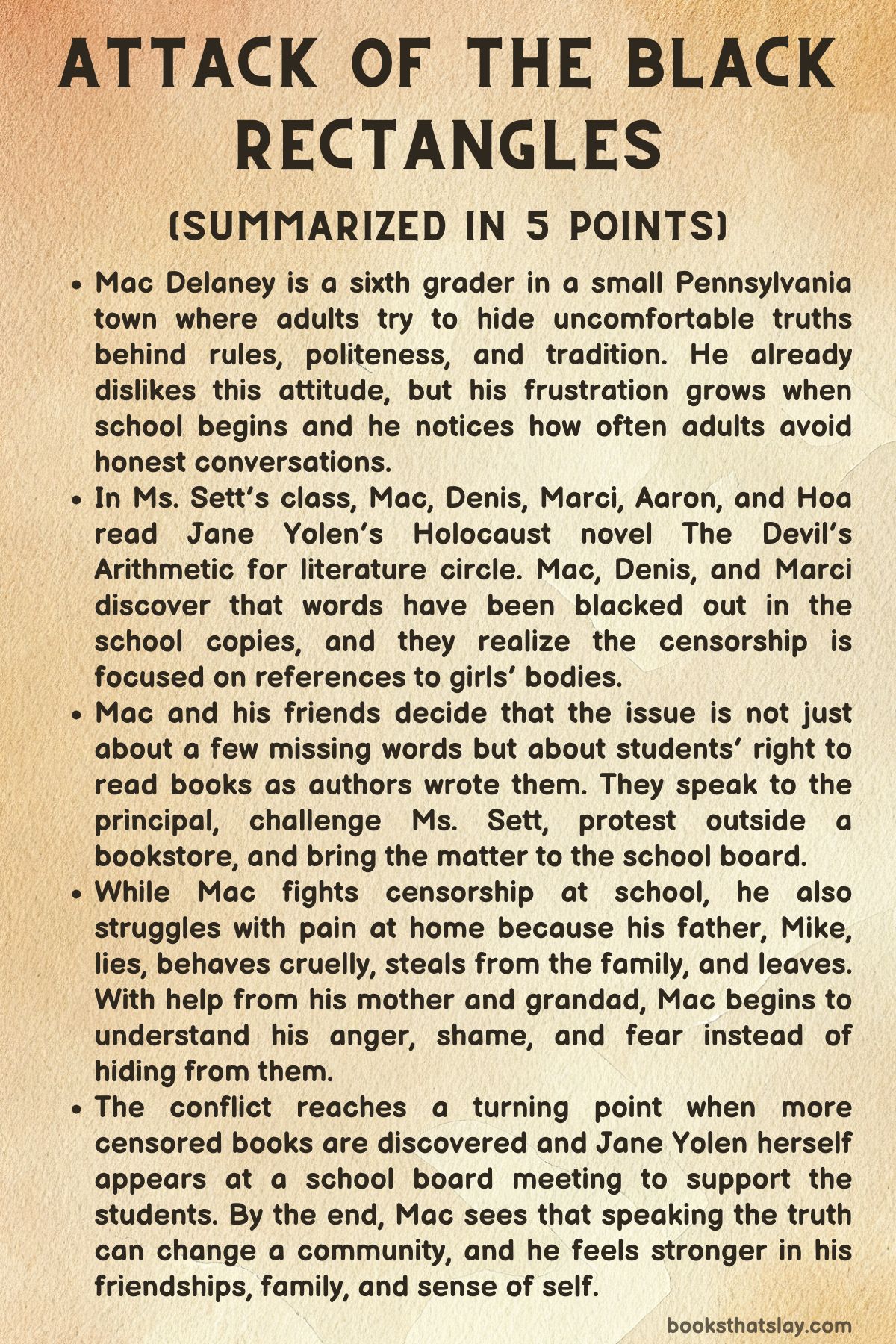
Summary
Mac Delaney lives in a small Pennsylvania town where adults seem obsessed with rules, appearances, and avoiding difficult truths. The town has expectations about church, the Pledge of Allegiance, junk food, curfews, house colors, and even Halloween.
Many adults claim these rules keep everyone safe and decent, but Mac sees something false underneath them. He believes adults are too quick to divide everything into “good” and “bad,” when real life is far more complicated.
Mac wants the truth, even when it is uncomfortable.
Before sixth grade begins, Mac already knows that one teacher, Ms. Laura Samuel Sett, is strict and judgmental. On a previous field trip to Philadelphia, she disapproved when Mac questioned the Founding Fathers because many of them enslaved people.
His classmate Marci also challenged the absence of women in the history they were being taught. Ms. Sett did not seem to like students asking questions that complicated the official version of history.
At home, Mac’s life is shaped by three important adults. His mother works in hospice care, helping people near death, and Mac admires her patience and grace.
His grandad lives in the basement and is politically active, emotionally honest, and deeply committed to justice. Mac’s father, Mike, lives apart from the family and visits on Saturdays.
Mike tells Mac that he is not really from Earth but is an alien anthropologist studying humans. He works on Grandad’s old car, which he calls a spaceship, and takes Mac along in this strange fantasy.
Mac is not sure what to believe about his father, but he wants a connection with him.
When sixth grade starts, Mac, Denis, and Marci end up in Ms. Sett’s class. Mac expects a miserable year, but Ms. Sett surprises him by saying the students will have freedom to study subjects that interest them.
Mac is hopeful, though Marci remains suspicious because she knows Ms. Sett’s public views are controlling and narrow. Soon the class begins a literature circle unit.
Mac, Denis, Marci, Aaron, and Hannah are placed in a group reading Jane Yolen’s The Devil’s Arithmetic, a Holocaust novel. Mac chooses it because he wants to understand the truth about painful history instead of pretending it did not happen.
The central conflict begins when Marci calls Mac and tells him to look at certain pages in the school copy of the book. Mac discovers that words have been covered by black rectangles of marker.
Marci and another group member have the same marks in their copies. The next day, Mac, Marci, and Denis go to the library and then to Tad’s Books to find an uncensored copy.
They learn that the blacked-out words are references to “breasts” in a scene where girls in a concentration camp are being humiliated and abused by Nazi soldiers. The children are furious.
They are old enough to read about the Holocaust, but some adult has decided they are not mature enough to read a normal word for part of the body.
Mac tells his mother and grandad, and they take the issue seriously. They talk about book banning, censorship, and how some adults fear ideas that challenge their view of the world.
Grandad buys Mac an uncensored copy of the novel. Mac writes to Jane Yolen, explaining what happened and asking for support.
At the same time, Mac’s home life becomes more painful. His father admits that he deliberately smashed Mac’s mother’s beloved blue mug, which had belonged to her mother.
Mike is angry and unapologetic, and Mac begins to see how much harm his father causes.
Mac, Marci, and Denis take their complaint to Dr. McKenny, the principal. She reacts as if the censorship is a minor problem and offers to replace Marci’s copy, not understanding that all the school copies have been altered.
The children insist that the issue is about intellectual freedom. Dr. McKenny later reveals that a female teacher marked out the words because boys had supposedly giggled at them in the past.
Mac and his friends understand that Ms. Sett is responsible. Marci explains that the censorship is sexist because it treats female anatomy as shameful and assumes boys cannot handle a word without becoming immature.
The conflict with Ms. Sett grows. Mac challenges her lesson about Christopher Columbus, objecting to the false heroic version of history that ignores violence against Indigenous people.
Ms. Sett gives him detention and tells him not to bring uncomfortable truths from home into the classroom. Mac becomes even more convinced that adults are hiding reality from children.
He and his friends confront Ms. Sett about the black rectangles, but she defends her actions by claiming adults sometimes know what is best for children.
While the school conflict grows, Mac struggles with his feelings for Marci and his confusion about his father. Denis notices that Mac likes Marci and encourages him to ask her to the dance.
Grandad advises Mac in his warm, unusual way and supports his activism. Mac and Marci join Grandad in protesting outside Tad’s Books against censorship.
The protest gives Mac a sense of purpose, but his home life becomes worse when Mike takes Grandad’s car, tools, clothes, Mac’s baseball things, and other household items and leaves town. Mac’s mother calls Grandad, and the police become involved.
After Mike disappears, Mac finally tells his mother and Grandad about Mike’s alien story and the nighttime rides in the “spaceship.” His family does not mock him, but they help him understand that Mike’s behavior is not magical or harmless. Grandad bluntly says Mike is not an alien but a jerk.
Mac begins to face the emotional damage caused by his father’s lies, anger, and selfishness. He feels ashamed and worries he will become like Mike.
The censorship fight expands. Mac, Marci, and Denis go to a school board meeting and argue that the marked books should be replaced and that a policy should be created to prevent future censorship.
Marci gives a strong presentation, and Mac explains that censoring a Holocaust story because adults think boys cannot handle a body-related word is insulting and sexist. The board members do not immediately act, which frustrates the children.
Mac feels especially bad because his private shame about his father makes him imagine that everyone sees him as broken.
Mac eventually tells Denis about his father leaving, and Denis tells Marci. Mac is angry at first, but later he accepts that his friends care about him.
Grandad takes Mac to a large protest in the city about teaching honest history. There, Mac breaks down and admits his shame and fear.
Grandad shows him that speaking painful truths can release some of their power. Mac says he does not like himself, fears being like his father, and feels overwhelmed by the need to fight ignorance.
Grandad reassures him that adults are messy too and that pretending otherwise is one of the biggest lies adults tell children.
After this emotional release, Mac feels lighter. He apologizes to Denis and finally asks Marci to the dance.
She says yes. Their friendship and young crush are sweet but careful; both are still figuring out what they want and what they are ready for.
Denis, meanwhile, realizes that he does not experience crushes the way others do. When Hoa likes him romantically and he cannot return the feeling, Mac and Marci comfort him and affirm that he may be ace.
The school situation reaches a turning point when Hoa discovers other books in Ms. Sett’s closet that have also been censored. During literature circle, Aaron, who had once been ignorant and dismissive, recognizes the power of the censored passage and becomes angry about the black rectangles.
When Ms. Sett punishes him, Mac, Marci, and Denis support him. They stage a silent hallway protest with signs, and other students join.
The issue can no longer be treated as a private complaint from three students.
At the next school board meeting, many more people attend. Marci’s father, Aaron’s father, Mac’s mother, and others speak against censorship.
Then Jane Yolen herself appears. She tells the adults that children deserve the truth and that censoring books harms their ability to learn.
Hoa and Aaron read from the censored books, and when they reach blacked-out lines, the crowd calls out “BLACK RECTANGLE!” The protest becomes a public reckoning.
Afterward, the town begins to change. More residents attend school board meetings, question local rules, and challenge the culture of silence.
Mac and Marci decide to remain friends for now because they are still young. Denis remains Mac’s best friend.
Mac’s mother is no longer in contact with Mike, while Grandad occasionally updates him about Mac. Mike begins therapy.
Mac ends the book more secure in himself, more honest about his emotions, and more confident that truth matters. He knows his mother and Grandad are there for him, and he looks toward the future with his friends beside him.
Characters
Mac Delaney
Mac Delaney is the central character of the book and the emotional lens through which the story is told. He is eleven years old, curious, blunt, and deeply troubled by the way adults hide difficult truths from children.
His fight against censorship begins when he discovers blacked-out words in a school copy of The Devil’s Arithmetic, but the issue matters to him because it confirms something he already suspects: that many adults would rather control what children know than trust them to think. Mac’s anger is not simple rebellion.
It comes from a moral need for honesty. He questions Columbus, the Founding Fathers, local rules, book censorship, and sexist attitudes because he sees falsehood in all of them.
At the same time, Mac is not only a young activist. He is also a child dealing with shame, confusion, and family pain.
His father’s lies and abandonment make him fear that he may inherit the same emotional coldness. His growth comes through learning that anger can become action, shame can be spoken aloud, and truth is not only something to demand from others but something he must practice in his own relationships.
Marci
Marci is one of the most intellectually confident and morally clear characters in the novel. She notices patterns of injustice quickly and has the language to explain them, especially when it comes to sexism and patriarchy.
Her response to the censored word “breasts” shows how sharply she understands the social meaning behind censorship. For Marci, the issue is not only that a word has been hidden but that female bodies are being treated as shameful while boys are assumed to be immature.
She often helps Mac and Denis understand ideas they have not yet fully considered, and she does this with patience rather than superiority. Marci is also vulnerable.
She cries after the dress code incident and after the school board dismisses their concerns, showing that strength and emotional openness can exist together. Her crush on Mac adds tenderness to her character, but it does not reduce her to a romantic role.
She is a thinker, organizer, speaker, and activist who pushes the group to think beyond replacing one book and toward changing policy.
Denis
Denis is Mac’s best friend, and his character brings anxiety, loyalty, humor, and emotional honesty into the story. He worries often, whether about class assignments, posture, homework, or imagined medical problems, but his nervousness does not make him weak.
In many ways, Denis is one of the most dependable characters in the book. He supports Mac and Marci in the censorship fight, helps research and plan, and encourages Mac when Mac is unsure about his feelings for Marci.
Denis also has his own important moment of self-understanding when he realizes he does not experience crushes or romantic attraction in the same way others do. His possible asexuality is treated with respect by his friends, which allows the story to present identity as something children can discuss with kindness and acceptance.
Denis’s decision to tell Marci about Mac’s father comes from concern, even though it hurts Mac at first. He is not perfect, but he is caring, loyal, and willing to stand beside his friends.
Grandad
Grandad is one of the strongest moral anchors in the story. He lives with Mac’s family, supports activism, meditates, protests, listens carefully, and gives Mac the kind of guidance his father cannot provide.
Grandad represents a version of adulthood that does not depend on control or false certainty. He admits fear, shame, regret, and imperfection.
His past as a Vietnam War veteran gives him moral weight because he has lived through violence and carries guilt, yet he does not hide from it. Instead, he teaches Mac that shame becomes less destructive when spoken aloud.
His public confession at the city protest is one of the book’s clearest lessons about emotional truth. Grandad also encourages Mac’s activism without taking it over.
He buys him an uncensored book, protests beside him, gives advice about Marci, and provides comfort after Mike leaves. By the end, Mac recognizes Grandad as the person who has truly acted like a father.
Mac’s Mother
Mac’s mother is defined by grace, endurance, and quiet strength. Her job in hospice care requires her to face pain, death, regret, and fear every day, and Mac understands that her ability to come home with patience is extraordinary.
She is not loud in the same way Grandad is, but her moral clarity is firm. When Mac tells her about the censored book, she does not dismiss him as dramatic.
She understands that censorship is serious and helps him research book banning. Her own pain becomes visible through Mike’s cruelty, especially when he smashes her treasured blue mug and later steals from the family.
Yet she does not collapse into bitterness. At the school board meeting, her speech about people regretting what they never learned connects her hospice work to the wider argument against censorship.
She believes children deserve knowledge because life is short and ignorance has a cost. Her character shows that gentleness can be powerful.
Mike Delaney
Mike, Mac’s father, is one of the most troubling figures in the book. His claim that he is an alien anthropologist gives him an odd charm at first, and Mac partly wants to believe in the fantasy because it makes his father seem special rather than emotionally unreliable.
Over time, however, Mike’s behavior becomes more clearly harmful. He breaks Mac’s mother’s mug deliberately, refuses to apologize, steals from the family, lies to Mac, and treats emotional damage as if it is someone else’s problem.
His alien story becomes a way of avoiding responsibility for ordinary human duties such as love, honesty, accountability, and care. When he says he wanted to learn about love but could not love Mac’s mother properly, he reveals the selfishness beneath his performance.
Mac’s fear that he might become like Mike is one of his deepest conflicts. Mike is not shown as purely monstrous, since the ending notes that he begins therapy, but the story is clear that his behavior causes real harm.
Ms. Laura Samuel Sett
Ms. Sett is the main adult opponent in the school censorship conflict, but she is more complex than a simple villain. She believes in rules, order, tradition, and adult authority.
Her letters to the newspaper show her desire to regulate many parts of town life, from junk food to curfews to school content. In the classroom, she initially surprises Mac by allowing independent study, but her deeper instincts are controlling.
Her decision to black out words in school books reveals her belief that children must be protected from language she considers inappropriate, even in a serious historical context. She also enforces the dress code against Marci and avoids teaching the full truth about Columbus.
Yet there are moments when she is unexpectedly kind, such as when she removes Aaron from Mac’s group after Aaron mocks Mac about his father. This does not excuse her censorship, but it shows that she is not without human feeling.
Her flaw is that she confuses protection with control and comfort with truth.
Dr. McKenny
Dr. McKenny, the principal, represents institutional avoidance. When Mac, Marci, and Denis bring the censored books to her, she treats the matter as small and manageable rather than recognizing its moral seriousness.
Her first instinct is not to investigate the larger problem but to calm the students and minimize disruption. She speaks to the children, and later to Mac’s mother, in a condescending way that mirrors the very issue at the center of the story: adults refusing to take children’s thinking seriously.
Dr. McKenny is not the person who marks the books, but her reluctance to act allows censorship to continue. Her character shows how institutions can protect wrongdoing by calling it minor, procedural, or not worth conflict.
She is important because the students are not only fighting one teacher’s choice; they are fighting a system that would rather avoid embarrassment than admit harm.
Aaron
Aaron begins as an irritating and ignorant classmate. He believes the earth is flat, throws footballs carelessly, mocks people, and uses childish insults.
At first, Mac sees him as someone who represents the kind of ignorance that adults fail to challenge. Aaron also makes fun of Mac and Denis, and later hurts Marci accidentally with a football.
Yet Aaron changes when he realizes that his own school copy of the novel has been censored. Because he cares about personal freedom, the black rectangles anger him once he understands what they mean.
His later statement about the censored concentration camp passage being powerful shows real growth. Aaron’s development matters because the book does not treat him as hopeless.
He is capable of learning when the issue connects to something he values. His apology to Mac also suggests that even careless children can become more thoughtful when held accountable.
Hoa
Hoa is first introduced by the English name Hannah, but she later tells her literature group that she wants to use her given name. Her decision is a quiet but important act of self-assertion.
She explains that her parents chose “Hannah” to make English-speaking people more comfortable, which reveals the pressure placed on immigrants and children of immigrants to adjust themselves for others. The group’s support of her name marks one of the story’s gentler moments of justice.
Hoa also plays an important role in the censorship fight when she reveals that her father is a lawyer and later discovers more censored books in Ms. Sett’s closet. At the school board meeting, she helps expose the wider pattern of blacked-out language.
Hoa’s character connects personal identity to the larger theme of truth. Just as books should not be altered to make adults comfortable, a child should not have to alter her name to make others comfortable.
Jane Yolen
Jane Yolen appears first as the author whose work has been censored, then later as a direct participant in the students’ fight. For Mac, her book makes the Holocaust feel real in a way that sanitized lessons cannot.
When he writes to her, he is reaching toward an adult who might understand why truth in literature matters. Her email response validates him at a crucial moment, especially because she recognizes both the censorship and the pain in his family life.
Her surprise appearance at the school board meeting gives the children’s cause public force. She speaks as someone whose books have been challenged, banned, damaged, and misunderstood, but she also speaks as someone who trusts children with truth.
Her presence confirms that Mac and his friends were never overreacting. In Attack Of The Black Rectangles, she functions as both a real literary figure and a moral witness.
Mac’s Grandmother
Mac’s grandmother is not alive during the events of the story, but her presence is felt through the blue mug that belonged to her. That mug matters because it connects Mac’s mother to memory, family, and grief.
When Mike deliberately smashes it, he is not merely breaking an object; he is attacking something emotionally precious. The grandmother’s role is therefore symbolic but still important.
She represents the personal histories that objects can carry and the pain caused when someone treats those histories carelessly. Through the mug, the book shows how harm can be intimate and quiet, not only public and political.
Marci’s Parents
Marci’s parents are not as developed as Mac’s mother and Grandad, but they are important because they help explain Marci’s confidence and policy-minded activism. Marci mentions that they know how to write policy, and this helps her think beyond emotional protest toward practical change.
Their influence appears in her ability to speak clearly, organize arguments, and push the school board toward a lasting rule against censorship. Marci’s father also attends the later school board meeting and speaks, showing that Marci’s activism is supported at home.
The contrast between Marci’s family support and Mac’s embarrassment about Mike deepens Mac’s shame, but it also shows that children’s public courage is often strengthened when adults take them seriously.
Aaron’s Father
Aaron’s father becomes important after Aaron realizes the school books have been censored. Mac hopes Aaron will tell his father because Aaron’s family may respond strongly to the issue of personal freedom.
Aaron’s father later appears at the protest and school board meeting, showing that the controversy has moved beyond Mac, Marci, and Denis. His role is not deeply personal, but it matters socially.
He represents adults who may not begin on the same side as the young activists but can still be drawn into the fight once they see censorship as an attack on rights. His involvement helps widen the movement.
Dr. McKenny’s Secretary
The school secretary has a small role, but she is part of the official structure the children must approach when they decide to speak to the principal. Her presence marks the beginning of their attempt to handle the problem through proper channels.
Though she is not personally responsible for the censorship, she belongs to the adult-controlled space where children must ask permission to be heard. In that sense, she helps establish the formal school environment that Mac, Marci, and Denis must challenge.
The School Board Members
The school board members represent public authority that is slow to respond even when children make a clear case. At the first meeting, they listen but delay action, which shows how bureaucracy can drain urgency from moral problems.
Their hesitation frustrates Marci and makes Mac feel personally inadequate, even though the failure is not his. At the later meeting, the board can no longer keep the issue contained because more parents, students, and community members are present, and Jane Yolen’s arrival changes the atmosphere.
The board members are important not because of individual personalities but because they show how public pressure can force institutions to confront what they would rather postpone.
The Nurse
The nurse appears when Mac is overwhelmed after learning that Denis told Marci about his father. Mac goes to the nurse’s office and says he needs to go home.
Her role is brief, but the moment matters because it shows Mac’s emotional overload becoming physical and school-based. He cannot simply continue with ordinary class life while carrying shame, anger, and confusion.
The nurse is part of the system, but unlike Dr. McKenny or Ms. Sett, she is not shown dismissing his distress. Her function is to provide a small exit from a day Mac cannot manage.
The Police Officer
The police officer who stops Mac, Marci, and Denis after the dance represents the town’s excessive rule enforcement. The children are simply walking, but because of the curfew, they are treated as if they are doing something wrong.
This encounter connects to the larger pattern of adult control in the town. The officer is not portrayed as cruel, but his enforcement of the curfew shows how rules can become unreasonable when they are applied without context.
Grandad’s later protest sign about letting people walk around turns this small incident into another example of citizens questioning unnecessary restrictions.
The Philadelphia Tour Guide
The field trip tour guide appears briefly when Mac asks about the Founding Fathers and slavery. This character is minor, but the scene is important because it shows Mac’s questioning nature before the central censorship conflict begins.
The guide becomes part of a public history setting where Mac refuses to accept a cleaned-up version of the past. Through this moment, the book introduces Mac as a child who notices what adults leave out.
The Bible Club President
The Bible club president appears through a letter to the town newspaper responding to Ms. Sett’s comments about LGBTQ+ students. This character is significant because they complicate Ms. Sett’s assumption that religion should be used to redirect or judge LGBTQ+ students.
The president says the Bible club is affirming and includes LGBTQ+ members, rejecting the narrow moral framework Ms. Sett tries to impose. Though this character does not enter the main action directly, their voice shows that the town contains more compassion and openness than its loudest rule-makers suggest.
The Newcomer to Town
The newcomer who writes to the newspaper about junk food rules serves as an outside observer of the town’s strange culture of control. By questioning why residents are restricted from buying certain foods while candy stores exist for tourists, this person exposes the contradiction in the town’s logic.
The newcomer’s role is small, but useful: they show that the rules Mac has grown up around are not normal or inevitable. Sometimes it takes an outsider to notice how unreasonable a community has become.
The Letter Writers and Townspeople
The many letter writers and townspeople form a kind of public background to the story. Some defend rules, censorship, curfews, and adult authority, while others question them.
Their letters show that the town is not united; it is full of disagreement, fear, judgment, frustration, and gradual change. At first, Ms. Sett’s voice seems powerful because she repeatedly writes in defense of restrictions.
Over time, however, more citizens begin challenging the rules. The townspeople matter because Mac’s fight does not remain private.
His protest helps awaken a wider civic conversation about freedom, honesty, and control.
Tad
Tad, the owner or namesake of Tad’s Books, is not strongly developed, but the bookstore associated with him is central to the children’s resistance. Tad’s Books offers access to the uncensored copy of Jane Yolen’s novel, making it a place where truth can be checked against institutional alteration.
It is also where Mac and his grandad protest. Tad’s role is therefore connected to independent thought, reading culture, and community space.
Even as a minor figure, he is linked to the idea that bookstores can become sites of civic courage.
The Classmates
Mac’s classmates serve as the school community that gradually witnesses and responds to the censorship conflict. Some are passive at first, some join the hallway protest, and some absorb lessons from the actions of Mac, Marci, Denis, Hoa, and Aaron.
They show that activism can spread when others see courage modeled in front of them. The classmates also help reveal the social risks of speaking up.
Children who challenge adults may be mocked, punished, or isolated, but they may also inspire others to act.
The Hospice Patients
The hospice patients are mostly unnamed, but they shape Mac’s understanding of his mother and later influence her school board speech. Because Mac’s mother works with people near death, she knows that regret often comes from what people failed to learn, say, or face.
The patients therefore contribute to one of the book’s deepest arguments: truth matters because life is limited. Their presence gives moral seriousness to the anti-censorship argument.
Learning is not a luxury; it is part of living fully.
Themes
Censorship and the Right to Know
Censorship in Attack Of The Black Rectangles is not presented as a distant political issue but as something immediate, physical, and insulting. The blacked-out words in the school copies of Jane Yolen’s novel show how censorship can begin with a marker and a single adult deciding what children should not see.
The censored word is not obscene in context; it appears in a scene about the humiliation and terror of girls in a Nazi concentration camp. That contrast exposes the moral absurdity of the act.
The students are trusted to read about genocide but not trusted to read a normal word connected to the human body. The censorship also changes the relationship between student and text.
Instead of allowing readers to encounter the author’s words fully, it places adult fear between the child and the truth. Mac, Marci, and Denis understand that the missing words are not the only issue.
The real danger is the assumption that children’s minds belong under adult control. Their demand for new books and a future policy turns a classroom problem into a civic argument about intellectual freedom.
Truth Versus Comfort
The story repeatedly places truth in conflict with comfort. Many adults in Mac’s town prefer clean stories, safe rules, and simplified history.
They want Columbus taught as a hero, local problems kept quiet, bodies treated as shameful, and difficult ideas pushed away. Mac sees this as a form of lying, even when adults call it protection.
His hunger for truth is not abstract; it affects how he understands history, school, family, and himself. The same conflict appears at home through Mike’s alien story.
Mac wants to believe his father because the fantasy is easier than accepting that Mike is selfish, angry, and harmful. Yet the truth becomes necessary for healing.
Mac has to admit that his father has hurt him, that he feels shame, and that he fears becoming like him. Grandad teaches him that truth can be painful but also freeing.
The book argues that comfort built on denial is fragile. Real strength comes from facing what happened, naming what is wrong, and refusing to pretend that silence is the same as peace.
Growing Up Through Emotional Honesty
Mac’s growth is not only political but emotional. At the beginning, he is angry at adults for lying, but he has not yet learned how to handle his own pain honestly.
He hides his father’s behavior from his friends, tries to file away his feelings like an “office guy,” and worries that crying or needing help makes him weak. His father’s emotional coldness becomes a warning image for him.
Mac fears that if he cannot understand his anger, he may become someone who hurts others and refuses responsibility. Grandad offers a different model of adulthood.
He cries, admits shame, talks about fear, and still remains strong. The city protest becomes a turning point because Mac finally says aloud that he does not like himself and is scared other people will reject him.
This confession does not solve everything, but it changes how he carries his pain. Emotional honesty allows him to apologize to Denis, trust Marci, accept comfort, and separate himself from his father’s failures.
Growing up, in this story, means becoming more truthful, not less vulnerable.
Young People as Moral Leaders
The adults in the town often assume that children should listen, obey, and wait until they are older to understand serious matters. The children prove the opposite.
Mac, Marci, Denis, Hoa, and eventually Aaron understand the censorship issue more clearly than the principal, Ms. Sett, and the school board do at first. They see the insult, the sexism, the historical disrespect, and the danger of allowing one adult to alter books.
Their activism also changes the adults around them. Parents attend meetings, townspeople write letters, school board discussions become more crowded, and other rules in the town come under scrutiny.
The children do not act perfectly or without fear. Mac feels ashamed, Denis worries, Marci cries, Hoa has to claim her own name, and Aaron has to learn from ignorance.
Their power comes from acting despite those limits. The story treats young people not as symbols of innocence but as citizens with minds, rights, and moral insight.
They are capable of recognizing injustice and demanding better from the institutions meant to educate them.