The Amazing Adventures of Kavalier and Clay Summary, Characters and Themes
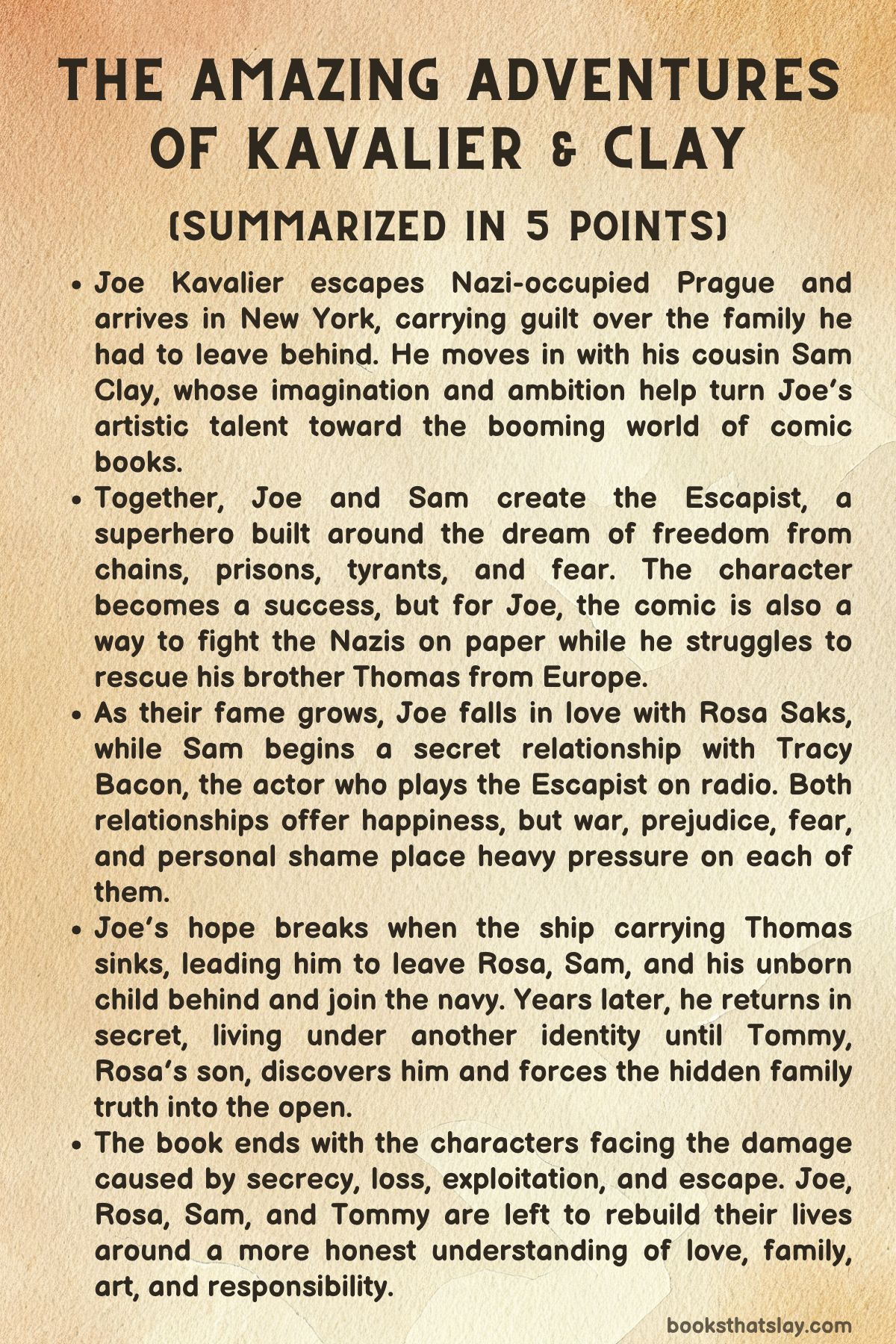
The Amazing Adventures of Kavalier and Clay is Michael Chabon’s novel about art, escape, friendship, exile, and the birth of superhero comics in America. Set mainly before, during, and after World War II, it follows two Jewish cousins: Joe Kavalier, a refugee from Nazi-occupied Prague, and Sam Clay, a New Yorker with a restless imagination and private wounds.
Together they create the Escapist, a comic-book hero who becomes both a commercial success and an emotional outlet. The book blends family drama, wartime loss, romance, creative ambition, and the painful cost of secrets.
Summary
Joe Kavalier arrives in New York in 1939 after escaping Nazi-occupied Prague through a dangerous and strange route arranged by his old teacher, Bernard Kornblum. Before reaching America, Joe had been trained as an escape artist, fascinated by Houdini, locks, chains, and the promise that a person could free himself from almost anything.
His escape from Europe is tied to the smuggling of the legendary Golem of Prague, which Jewish leaders hope to protect from the Nazis. Joe survives the journey through Lithuania, Japan, and San Francisco, but he leaves behind his parents and younger brother, Thomas.
That abandonment, though forced by history, becomes the wound that shapes much of his life.
In New York, Joe stays with his cousin Sam Clay, originally Samuel Klayman. Sam is small, sharp, ambitious, and physically marked by childhood polio.
He dreams of becoming a successful writer and artist, but he knows his own drawing talent is limited. When he sees Joe’s skill, he realizes that Joe might be the partner he has been waiting for.
Sam works for Sheldon Anapol at Empire Novelties, a company that sells cheap novelty products, but the success of Superman has opened a new business opportunity: comic books. Sam convinces Anapol and his associates to let him and Joe create a superhero.
The cousins gather a group of young artists and begin building a comic-book universe. Their greatest creation is the Escapist, a hero based on escape artists, magicians, and freedom fighters.
The character’s mission is to free the oppressed and fight tyranny, making him a powerful fantasy for Joe, who cannot save his family in Prague. Sam gives the character his purpose, mythology, and dramatic shape, while Joe gives him movement, power, and visual beauty.
Their first cover shows the Escapist punching Hitler, a bold image that reflects Joe’s fury and grief. Though the publishers are nervous, the comic becomes a major success.
As Empire Comics grows, Joe becomes more desperate to rescue his family. He saves money, writes letters, visits government offices, and fights against the slow cruelty of immigration rules.
News from Europe worsens. Joe learns that his father has died, and his anger begins spilling into real life.
He attacks or provokes German speakers in New York and breaks into the office of Carl Ebling, a disturbed Nazi sympathizer who has become obsessed with the Escapist. Joe discovers that even a hateful man can admire his art, and this leaves him ashamed of the violent fantasies he has been drawing in the name of freedom.
Joe meets Rosa Saks at a party thrown by her father, the eccentric art patron Longman Harkoo. Rosa is an artist, intelligent and bold, with her own imaginative world.
She and Joe fall in love, and through her he finds a temporary home beyond rage and work. Rosa also helps Joe connect with efforts to rescue Jewish children from Europe.
Joe arranges passage for his brother Thomas on a ship called the Ark of Miriam. For a time, hope returns.
He buys an apartment, imagines Thomas living with him, and plans a future with Rosa.
Sam’s private life also changes. He meets Tracy Bacon, the handsome actor who plays the Escapist on the radio.
Sam falls in love with him, but his feelings frighten him. The world around him treats same-sex desire as shameful and dangerous, and Sam struggles to accept himself.
His relationship with Tracy gives him a brief sense of being loved openly, but it is shadowed by fear. During a gathering of gay men at a private house, police raid the place.
Tracy is beaten, and Sam is assaulted by officers. The experience leaves Sam terrified and convinced that he cannot live honestly in such a world.
Joe’s hope collapses when he learns that the Ark of Miriam has sunk and that Thomas is dead. At a bar mitzvah performance, Joe attempts an escape after hearing the news, and the act nearly kills him.
He survives, but the emotional damage is severe. Rosa, newly pregnant with Joe’s child, finds him broken.
Joe leaves to join the navy without knowing about the pregnancy. Sam, shattered by his own trauma and by his breakup with Tracy, marries Rosa.
Their marriage is partly an act of protection, partly a compromise, and partly a mutual shelter. Rosa’s son, Tommy, is raised as Sam’s child.
During the war, Joe is stationed in Antarctica as a radioman. The post is isolated and bitterly disappointing because he had wanted to fight the Nazis directly.
A carbon monoxide accident kills most of the men at the station, leaving Joe and the pilot Shannenhouse alive. As months pass, Joe repairs the radio, listens to war transmissions, and becomes obsessed with a lone German geologist at another Antarctic base.
Joe’s grief and anger turn into a desire to kill someone, even someone who personally did him no harm. He and Shannenhouse try to fly to the German base, but the mission ends in disaster.
Shannenhouse dies, and Joe crash-lands. The German, Klaus Mecklenburg, shoots Joe in fear; during their struggle, Klaus dies.
Joe survives, wounded and half-mad, and is later rescued. Instead of returning to Rosa and Sam, he disappears again.
Years pass. Sam and Rosa live in suburban Bloomtown with Tommy.
Sam works in comics again, but he is unhappy and tired. Rosa contributes artwork under a pen name, but her own ambitions have been reduced by family life and circumstance.
Tommy grows into a bright, imaginative boy interested in comics, magic, and secret identities. He senses that something is hidden in his family.
He knows Sam is not his biological father, though no one has told him clearly. By chance, he meets Joe at a magic shop and soon begins visiting him secretly in New York.
Joe has been living under cover in the Empire State Building, making new work filled with Jewish memory, Prague, and the Golem.
Tommy realizes Joe is lonely and trapped in his own secrecy. To force the truth into the open, Tommy writes a fake letter claiming that the Escapist will jump from the Empire State Building in protest against the comic industry’s exploitation of artists.
The stunt attracts police, reporters, Sam, Rosa’s father, and finally Sam himself. Joe does appear, wearing the Escapist costume, not to die but to perform a dangerous rubber-band jump.
The act brings him back into contact with Sam, Tommy, and Rosa. His return is awkward, emotional, and unfinished, but it ends his long disappearance.
Joe comes home with them, and the family begins confronting the truth. Rosa and Joe still love each other.
Tommy learns that Joe is his biological father, though Sam remains the man he calls Dad. Sam faces public humiliation during the Senate hearings on comic books, where his sexuality is indirectly exposed.
Instead of feeling only shame, he feels an unexpected release. George Deasey tells him that a secret can be a heavy chain and that the hearing may have given him a kind of key.
Joe buys Empire Comics, recovering the world that he and Sam helped create but never truly controlled. Sam considers leaving for Los Angeles, both to escape and to begin again.
At the end, he leaves the house quietly, placing his old family card on the linens. Where it once said “The Clays,” he writes “Kavalier & Clay.” The gesture suggests not a clean ending, but a new arrangement of love, family, art, and identity.
The novel closes with escape no longer meaning disappearance. It becomes the painful, necessary act of moving toward truth.
Characters
Joe Kavalier
Joe Kavalier is the emotional center of The Amazing Adventures of Kavalier & Clay, a man whose life is shaped by escape, guilt, and unfinished rescue. His early training under Bernard Kornblum makes escape seem like a discipline of control, patience, and technique, but history turns it into something far more painful.
Joe escapes Prague, but his family does not, and that fact becomes the source of his deepest shame. In America, his artistic brilliance turns grief into motion: the Escapist fights the battles Joe cannot fight in real life.
His drawings are not only commercial work; they are private acts of rage, mourning, and wishful correction. Joe’s love for Rosa reveals his capacity for tenderness, but even that love cannot save him from the burden of Thomas’s death.
After the Ark of Miriam sinks, Joe’s disappearance is both cowardice and survival. He cannot bear to remain among people who still hope for him.
His later return through Tommy shows that love, rather than skill, is the one lock he cannot pick alone.
Sam Clay
Sam Clay is one of the most complex figures in The Amazing Adventures of Kavalier & Clay because his genius is rooted in invention, performance, and concealment. He is not the great visual artist Joe is, but he has a powerful instinct for story, myth, timing, and emotional need.
Sam understands what a hero must mean before he knows what the hero must do. The Escapist is born from his grasp of motive: freedom matters because people are trapped by poverty, fear, politics, family, and shame.
Sam’s own life is filled with such traps. His father abandons him, his body carries the memory of polio, and his sexuality must be hidden in a society that punishes him for wanting love.
His relationship with Tracy Bacon gives him a vision of happiness, but violence and humiliation drive him back into secrecy. His marriage to Rosa is a shelter built from love, fear, and compromise.
As Tommy’s father, Sam is genuine, not fraudulent. His final departure is not a rejection of Tommy but a painful attempt to stop living inside a lie.
Rosa Saks
Rosa Saks brings intelligence, artistic force, and emotional clarity to The Amazing Adventures of Kavalier & Clay. When she first enters Joe’s life, she is not merely a romantic figure; she is an artist with her own strange, vivid imagination and a confidence that challenges Joe’s isolation.
Rosa sees art as a living practice rather than a lesser form because of its medium, and her belief helps Joe and Sam take comics more seriously. Her relationship with Joe is passionate, but it is also marked by practical devotion: she helps him try to save Thomas, supports his work, and imagines a future with him.
After Joe leaves, Rosa’s marriage to Sam becomes one of the book’s most complicated arrangements. She protects her child, cares for Sam, suppresses parts of herself, and continues to work, though not with the freedom she once had.
Rosa is often the person who must live with the consequences of men’s departures. Her strength lies not in perfect certainty, but in her ability to keep a household, a career, and a wounded family functioning while carrying truths no one wants to name.
Tommy Clay
Tommy Clay is the child of secrets, comics, magic, and partial truths. Raised by Sam and Rosa, he grows up loved but surrounded by silence.
His fascination with superheroes and magic is not childish decoration; it is his way of understanding identity. Like the heroes he admires, he senses that names, costumes, and origin stories matter.
Tommy knows enough to suspect that his family story is incomplete, and his curiosity becomes a moral force. When he meets Joe, he does not simply discover a missing relative; he finds a living secret.
Their meetings give Tommy excitement and purpose, but they also burden him with responsibility. His fake letter to the newspaper is reckless, yet it comes from care.
He sees that Joe is trapped and that the adults are too afraid, guilty, or tired to force a reckoning. Tommy’s role in the book is crucial because he becomes the bridge between disappearance and return.
By the end, his question about Sam shows his emotional maturity. He can absorb the truth about Joe, but he understands that fatherhood is also made through years of presence.
Bernard Kornblum
Bernard Kornblum is Joe’s teacher, rescuer, and spiritual counterweight. He trains Joe in escape artistry, but his lessons are never only technical.
He teaches discipline, composure, and the importance of thinking about what one is escaping toward. Kornblum understands that Joe is drawn to escape for dangerous emotional reasons, not simply for showmanship.
This makes him both proud and wary of his student. His role in smuggling Joe and the Golem out of Prague links stage magic to historical survival.
He is practical, unsentimental, and deeply brave, even while he often presents himself through dry wit and stern instruction. Later, whether as memory, vision, or imagined guide, Kornblum continues to shape Joe’s choices.
His command to go home near the end cuts through Joe’s years of avoidance. Kornblum represents a kind of hard wisdom: escape is not complete if it only removes the body from danger.
True escape requires returning to life.
Thomas Kavalier
Thomas Kavalier, Joe’s younger brother, is physically absent for much of the story but emotionally present almost everywhere. In Prague, he is lively, curious, and imaginative, sharing Joe’s fascination with Houdini and helping him dream up impossible feats.
His injury during Joe’s youthful water escape foreshadows the way Joe’s ambitions can harm the people he loves, even when he does not mean to. After Joe reaches America, Thomas becomes the person Joe most desperately wants to save.
The plan to bring him across the ocean gives Joe hope, structure, and purpose. When the Ark of Miriam sinks, Thomas’s death destroys Joe’s fragile belief that art, money, influence, and willpower can repair history.
Later, Rosa names her son Tommy, keeping Thomas’s memory alive while also creating a new generation shaped by the dead. Thomas is not only a lost brother; he is the measure of Joe’s guilt and the symbol of every rescue that came too late.
Tracy Bacon
Tracy Bacon is charming, lonely, beautiful, and deeply important to Sam’s emotional awakening. As the radio actor who plays the Escapist, Tracy occupies a strange space between fantasy and reality.
He looks like the hero Sam helped create, but his own life is far more vulnerable than the character he performs. His romance with Sam gives Sam a rare experience of being desired and understood.
Tracy is more comfortable with his sexuality than Sam, though he is still living in a world where that comfort is dangerous. His confidence and ease make him attractive, but his loneliness makes him human.
The police raid and his beating reveal the cruelty faced by gay men in the period and become a turning point for Sam. Tracy’s later death in war closes off the future Sam might have had with him.
In the book, Tracy represents a possible life that Sam cannot bring himself to choose, and then can never recover.
Rosa’s Father, Longman Harkoo
Longman Harkoo, born Siegfried Saks, is eccentric, generous, theatrical, and deeply influential. He gives the story access to the art world, where Joe and Rosa encounter Surrealism, performance, and the belief that art can transform ordinary life.
Harkoo’s wealth and social reach allow him to help in practical ways, including efforts connected to Thomas’s rescue. He also welcomes Joe into his family circle, though Joe’s response reveals how tightly Joe remains bound to the family he lost in Europe.
Harkoo’s warmth is not shallow. He often understands more than others realize, and his affection for Rosa, Joe, and Tommy gives him a stabilizing role.
He is one of the few older figures who does not respond to unconventionality with fear. His home, parties, and connections create spaces where the younger characters briefly imagine broader lives.
Sheldon Anapol
Sheldon Anapol is a businessman first and last. He recognizes the commercial value of comics, but he does not understand or respect the full emotional and artistic labor behind them.
His willingness to publish Sam and Joe’s work helps launch their careers, yet his contracts and decisions also trap them. Anapol benefits enormously from the Escapist while the creators receive only a fraction of what their work earns.
He is not portrayed as a grand villain; he is more ordinary and therefore more believable. He is cautious, self-interested, nervous about politics, and eager to protect profit.
Through him, the book examines how creative industries often reward ownership more than imagination. Anapol’s later sale of Empire Comics to Joe carries a sense of delayed correction, though it cannot undo the years of exploitation.
George Deasey
George Deasey begins as a cynical editor who dismisses comics as trash, but he becomes one of the book’s sharpest observers. His bitterness comes from experience: he knows what it means to be cheated by the entertainment business and to watch one’s work become someone else’s property.
Though he mocks the medium, he also understands writing, structure, and professional survival. Deasey often gives Sam and Joe hard truths they do not want to hear.
His later conversation with Sam after the Senate hearings is especially important because he recognizes secrecy as a form of imprisonment. Deasey’s compassion is dry and guarded, but real.
He helps Sam see that exposure, however humiliating, may also loosen a chain he has carried for years.
Carl Ebling
Carl Ebling is a disturbed Nazi sympathizer whose obsession with the Escapist turns admiration into violence. He is both ridiculous and dangerous, a man whose fantasies of political importance mask loneliness, resentment, and mental instability.
His reading of Sam and Joe’s comics unsettles Joe because it shows that art cannot fully control its audience. A hero created to fight fascism can still fascinate a fascist.
Carl’s bomb attempt at the bar mitzvah turns the symbolic war of comic books into real danger. He is a dark mirror of Joe in one specific sense: both men are consumed by imagined battles.
The difference is moral purpose, but the book refuses to let Joe feel completely clean about his own violent fantasies.
Ethel Klayman
Ethel Klayman, Sam’s mother, is difficult, sharp, and often dismissive, but she is not without tenderness. She sees comic books as trash and often fails to understand Sam’s ambitions, yet she has endured abandonment and responsibility in her own life.
Her relationship with Sam’s father leaves her hardened, and her love for Sam often comes out as criticism rather than encouragement. Still, she provides shelter at key moments.
When Joe returns after the sinking of the Ark of Miriam, Ethel receives him, feeds him, and gives him space to break down. Her regret at not embracing him shows the emotional restraint that defines much of her life.
Ethel belongs to a generation that survives by endurance more than open comfort, and that makes her both frustrating and moving.
Themes
Escape, Imprisonment, and the Limits of Freedom
Escape in The Amazing Adventures of Kavalier & Clay is never only a physical act. Joe escapes Prague, chains, coffins, locked rooms, and even military accountability, but each escape leaves another confinement behind.
He reaches New York, yet remains trapped by guilt over his family. He survives Antarctica, yet cannot return home.
Sam is not locked in a box, but he is trapped by his body, his fear, his sexuality, and the demands of public respectability. Rosa is trapped by love, motherhood, and the compromises made after Joe leaves.
Even Tommy, the child, lives inside a family story full of closed doors. The Escapist becomes powerful because he gives visible form to invisible prisons.
He can break chains that real people cannot. Yet the book steadily questions whether escape is meaningful when it avoids responsibility.
Joe’s final movement home suggests that freedom is not disappearance. Freedom requires facing the people one has hurt, accepting love, and allowing the truth to change the shape of one’s life.
Art as Rescue, Revenge, and Self-Expression
Art in the story begins as ambition and becomes survival. Sam wants success, money, and recognition, but he also wants to turn his restless imagination into a life larger than the one offered to him.
Joe draws because drawing gives him temporary power over history. On the page, he can defeat Hitler, free prisoners, punish enemies, and save families.
Comics become a place where rage can be organized into panels and where helplessness can be answered with action. Yet the book does not treat art as pure healing.
Joe’s anti-Nazi violence on the page feeds his real-world anger, and Carl Ebling’s admiration proves that art can be misread or claimed by the wrong people. Rosa’s art is equally important because it shows a more private, symbolic mode of expression.
Her portrait of Joe bound in chains, with herself holding a key, understands him more honestly than many words could. Art rescues no one completely, but it preserves longing, memory, and identity when ordinary life cannot.
Family, Fatherhood, and Chosen Bonds
Family in the novel is unstable, improvised, and often built after loss. Joe loses his parents and brother, then later abandons Rosa and his unborn child.
Sam is abandoned by his father and spends much of his life trying to understand what male care should look like. Tommy is biologically Joe’s son but emotionally Sam’s child, and the book refuses to reduce fatherhood to blood alone.
Sam’s love for Tommy is real because it is daily, anxious, imperfect, and sustained. Joe’s return does not erase Sam’s place; it complicates it.
Rosa, too, builds family through hard choices rather than simple romance. Her marriage to Sam is not conventional passion, but it is a structure of loyalty and protection.
The final family arrangement is uncertain, but that uncertainty is part of its honesty. The book suggests that family is not a fixed legal or biological pattern.
It is a set of responsibilities, secrets, sacrifices, and acts of care that may wound people even as they hold them together.
Secrecy, Shame, and the Search for an Honest Life
Secrets shape nearly every major life in the story. Joe hides from grief by vanishing.
Sam hides his sexuality, even from himself for a long time. Rosa hides Tommy’s parentage.
Tommy hides his meetings with Joe. The comic-book industry hides exploitation behind contracts and cheerful fantasy.
These secrets are not all equal, but they all carry weight. Sam’s secret is especially painful because it is enforced by a society that treats his love as criminal or diseased.
His public questioning during the Senate hearings is humiliating, yet it also produces an unexpected release. Once a secret is exposed, it can no longer demand the same daily performance.
Joe’s secrecy, by contrast, is tied to guilt and avoidance. He believes absence protects others, but it mainly freezes everyone in unfinished grief.
The book’s ending does not offer a neat cure for shame, but it moves toward honesty. The characters begin to speak, or at least to stop pretending quite so hard, and that becomes its own form of escape.