The Amalfi Curse Summary, Characters and Themes
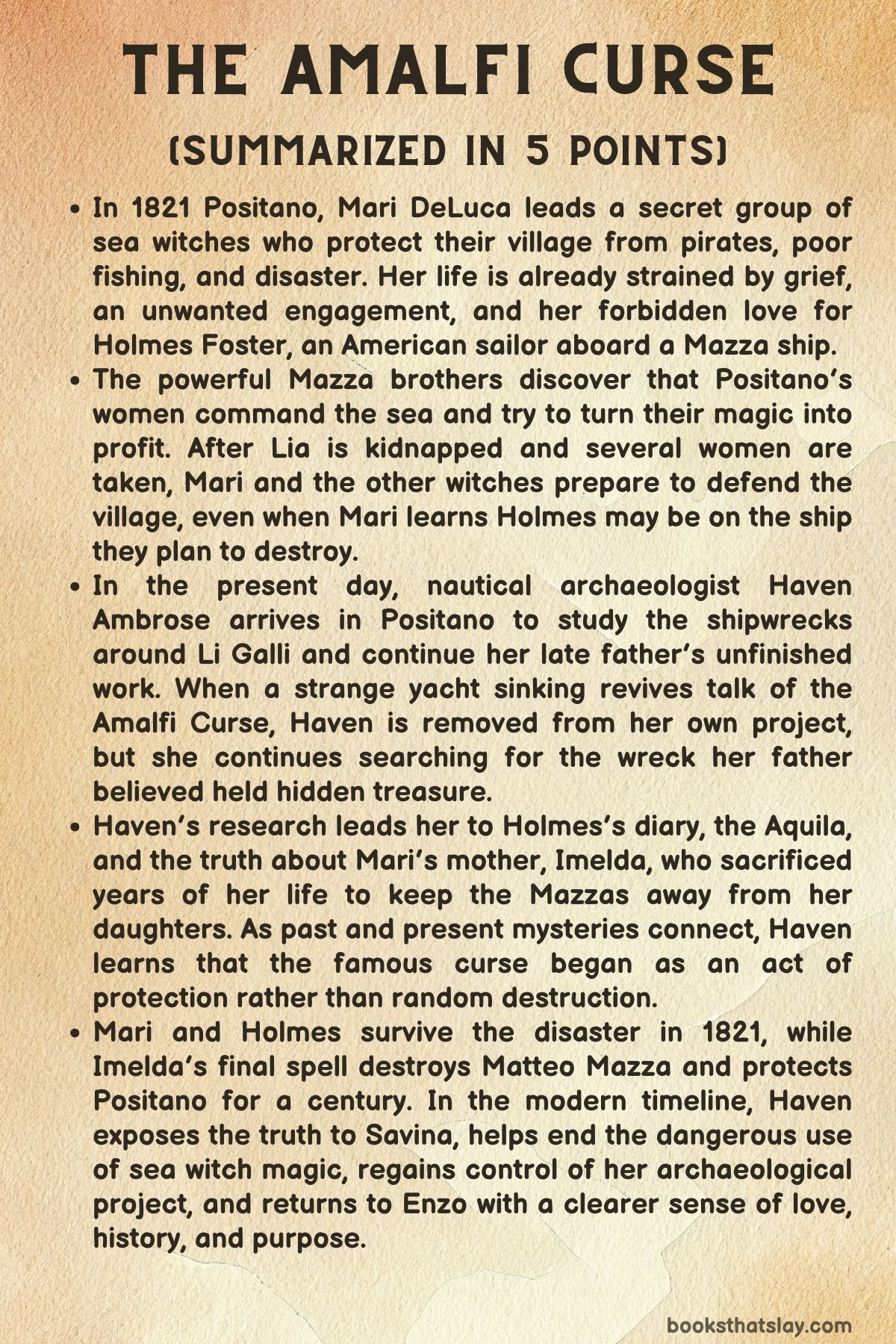
The Amalfi Curse by Sarah Penner is a dual-timeline historical fantasy mystery set around Positano and the Li Galli islets. The book follows Mari DeLuca, a powerful sea witch in 1821, and Haven Ambrose, a modern nautical archaeologist investigating shipwrecks tied to a legendary curse.
Through danger, betrayal, family secrets, and lost love, the story connects ancient siren magic with modern ambition. It is both an adventure about hidden treasure and a story about women carrying inherited power, grief, and responsibility across generations.
Summary
The Amalfi Curse begins in 1821 with a warning about Positano, a fishing village on the Amalfi Coast that appears mysteriously protected from pirates, poor fishing, and coastal disaster. An unnamed informant writes to Matteo Mazza, a ruthless shipping magnate in Naples, claiming that the village’s safety is not luck but the work of powerful women who control the sea.
The letter invites Matteo to buy the secret, suggesting that this knowledge could make him wealthy beyond imagination.
The story then moves to Mari DeLuca, a twenty-year-old sea witch in Positano. Mari belongs to a line of women descended from the sirens of Li Galli.
These women, known as streghe del mare, use their powers to protect their village. Mari is their leader because her magic is especially strong, passed down through an unbroken maternal line.
Yet she hates the sea. As a child, she watched her mother, Imelda, disappear, and years later her younger sister Sofia drowned.
Though everyone believes Imelda died, Mari knows there is more pain in that memory than she has admitted.
Mari feels trapped by her duties and by an arranged marriage to Corso, a wealthy but selfish cousin from Rome. Her real love is Holmes Foster, an American sailor working aboard the Aquila, one of the Mazza brothers’ ships.
Holmes and Mari plan to run away together. He writes to her from sea, warning that the Mazzas are involved in smuggling and violence.
He suspects their ship carries something of great value, though he does not yet understand what it is.
In the present day, Haven Ambrose arrives in Positano from the Florida Keys. She is a thirty-five-year-old nautical archaeologist leading an all-women team on Project Relic, a major underwater investigation around Li Galli.
The project is urgent because Mount Vesuvius may erupt and damage archaeological sites along the coast. Haven also has a private reason for coming: her late father, a respected diver and archaeologist, once found traces of pink and red gemstones near Li Galli and urged her not to let the discovery be forgotten.
Haven hopes that finishing his work will help her make peace with his death.
Soon after Haven arrives, a modern yacht sinks near Li Galli under strange conditions. There is no storm and no clear scientific explanation.
People whisper about the Amalfi Curse, a legend tied to the many ships that sank around the islets in the nineteenth century. Haven dismisses the idea of magic, but the wreck changes everything.
Gage Whitlock, head of the foundation funding her work, removes her from the project, saying he cannot risk a group of women diving after the accident. He gives control to Conrad, Haven’s wealthy family friend and her father’s former colleague.
Haven is furious, especially when she suspects Conrad may know about her father’s hidden treasure find.
Back in 1821, Mari trains two young witches, Pippa and Lia, teaching them how to read the water and care for the sea without relying only on magic. During this lesson, Lia is kidnapped by Massimo Mazza.
Mari uses her power to drown Massimo, but Matteo witnesses the killing and escapes with Lia. This act exposes the sea witches’ existence to a dangerous man.
Matteo later returns with armed men, killing and abducting villagers. He takes several women and girls, believing they may have magic he can exploit.
Mari blames herself for the danger now facing Positano and promises to save Lia.
In the present, Haven refuses to give up. She rents equipment from Enzo Rossi, the charming owner of a local dive business.
Enzo is warm, playful, and unlike the rigid academic divers Haven usually knows. Their attraction grows quickly.
He introduces Haven to his mother, Savina, who lives in an old villa overlooking Li Galli. Savina is kind but intense, and she warns Enzo that diving near the islets is dangerous.
Haven senses that Savina knows more than she is saying.
Haven and Enzo dive together and find evidence of shipwrecks. Haven notices letters on a wreck that lead her to suspect she has found the Aquila, the same ship connected to Holmes Foster.
She travels to the maritime archive in Naples and discovers Holmes’s journal, along with records showing that the Aquila sank near Li Galli in 1821. The records mention the Mazza brothers’ criminal activities and suggest there were rumors of witchcraft surrounding the wreck.
Haven becomes convinced that the ship, Mari, Holmes, and the legendary curse are connected to the treasure her father found.
Meanwhile, Holmes learns the full danger aboard the Aquila. He overhears that Matteo plans to seize red-haired women from Positano because one killed Massimo with magic.
Holmes realizes they mean Mari. Desperate to slow the ship, he sabotages the rigging and ruins repair supplies.
His act delays the vessel, but it also causes an accident that fatally injures his friend Nico. Holmes is discovered and locked in the cargo hold.
There, he meets a mysterious imprisoned woman held in the cabin above him. She turns out to be Imelda, Mari’s mother.
Imelda reveals that she did not die. Years earlier, Matteo and Massimo saw her perform magic, and she left Positano to protect Mari and Sofia.
She convinced the Mazzas that she was the only sea witch and spent years using her power to guide them to sunken treasure so they would not harm her daughters. Holmes tells her that Mari is alive and that she killed Massimo.
Imelda understands that Matteo’s threat has reached her daughter despite all her sacrifices.
Mari and the other witches prepare to sink Matteo’s ship when it passes Li Galli. But Mari receives Holmes’s warning and realizes he is aboard the Aquila.
She faces an impossible choice: save her lover or protect her village. Before she can fully decide, her stepsister Paola exposes Mari’s secrets, including her love for Holmes and the truth that Imelda left rather than drowned.
Mari is devastated but still believes Holmes would want her to defend Positano.
The witches create a maelstrom that destroys the Aquila. Holmes escapes with Imelda’s help, but he is shot while swimming away.
Imelda gives him a flask for Mari containing shells, a note, and her talisman. As the ship sinks, Holmes believes he has lost Mari forever.
Mari, believing Holmes has died, returns home in grief. There she overhears Corso and her father discussing their betrayal.
Corso was the informant who exposed the witches to the Mazzas, hoping fear would force Mari to leave with him. Mari also learns that Matteo was not aboard the Aquila.
He is approaching Positano on another ship, La Dea, armed with cannons.
Knowing there is no time to gather the witches again, Mari decides to cast the vortice centuriaria, a spell that will protect Positano for one hundred years but requires the witch’s death. She ties herself to an anchor near Li Galli and prepares to sacrifice herself.
Before she can die, Holmes finds her. He tells her Imelda was aboard the Aquila and gives her the flask.
Mari reads her mother’s note and realizes Imelda sacrificed herself by casting the same century-long curse. The vortex will destroy Matteo’s second ship and protect Positano.
Mari and Holmes survive and later help rescue some of the abducted women. To escape suspicion and painful memories, the witches eventually leave Positano, settling elsewhere.
Holmes’s diary is later sent to the archive, allowing the truth to survive.
In the present, Haven discovers the same truth through Holmes’s journal and genealogical research. She learns that Mari survived, had children, and left descendants across the world.
This matters because Savina and her friend Renata are modern sea witches who believe they are the last of their line. They have rejected their power for years, but after personal losses, including the death of Savina’s daughter Bria, they began using magic dangerously.
They caused the yacht sinking and the false signs of volcanic activity in an attempt to protect Enzo and control the coast. Savina believes her lineage is cursed and tries to persuade Haven to stay with Enzo and continue the bloodline.
Haven shows Savina evidence that Mari lived a full life and that many descendants remain. This changes Savina’s understanding of her inheritance.
The magic is not only a burden; it can be a gift. Savina stops using her power destructively and begins learning better ways to use it, including fighting pollution.
Conrad eventually leaves the project after finding fake gems, proving that greed rather than archaeology drove him. Gage asks Haven to return, and she renegotiates stronger terms for herself and her team.
Months later, Haven comes back to Positano to continue Project Relic. Enzo’s business is recovering, tourism has returned, and Haven has new clues from her father’s coded notes pointing to treasures hidden in the bows of Mazza ships.
She also reunites with Enzo, confident that their love is real and not merely the result of magic.
Characters
Mari DeLuca
Mari DeLuca is the emotional and magical center of the 1821 storyline. As the strongest sea witch in Positano, she carries a responsibility that she never fully chose.
Her power comes from her lineage, but her relationship with the sea is filled with grief. She associates it with her mother’s disappearance and Sofia’s drowning, so the very element that strengthens her also reminds her of abandonment and loss.
This contradiction makes her one of the most layered figures in the book. Mari wants freedom, love, and a life beyond Positano, but she also cannot ignore the needs of her village.
Her plan to run away with Holmes shows her longing for selfhood, while her later willingness to die for Positano shows how deeply she accepts responsibility when danger reaches the people she loves. Mari’s journey is not about becoming powerful; she already is.
It is about understanding what power costs, whom it protects, and how easily sacrifice can be mistaken for destiny.
Haven Ambrose
Haven Ambrose is a modern archaeologist shaped by ambition, grief, and the need to prove herself in a field where men repeatedly underestimate her. Her work at Li Galli begins as both a professional mission and a private act of loyalty to her father.
She wants to complete what he started, yet she also struggles with the burden of living under his unfinished dream. Haven’s conflict with Conrad and Gage shows the gendered barriers she faces: her expertise is dismissed, her safety is used as an excuse to remove her, and her discoveries are treated as prizes others can claim.
In The Amalfi Curse, Haven’s search for the Aquila becomes a search for truth, not only about treasure but about women whose histories were hidden, distorted, or dismissed as superstition. Her growth comes from learning to separate her own desires from her father’s expectations.
By the end, she is not simply continuing his work; she is claiming the project on her own terms.
Holmes Foster
Holmes Foster is Mari’s lover and one of the book’s most sincere moral figures. As an American sailor aboard the Aquila, he begins with limited power over the violent world around him, yet he repeatedly chooses courage when silence would be safer.
His love for Mari is passionate, but the novel does not reduce him to a romantic figure. He is observant, compassionate, and willing to act when he realizes the Mazzas intend to harm Positano’s women.
His sabotage of the ship shows both bravery and tragic consequence, since his attempt to save Mari indirectly leads to Nico’s fatal injury. That guilt gives Holmes depth, reminding the reader that good intentions do not erase harm.
His survival and reunion with Mari offer a rare moment of mercy in a story marked by sacrifice. His diary also becomes a bridge between centuries, preserving truths that later help Haven uncover what really happened.
Imelda DeLuca
Imelda DeLuca is one of the most tragic and powerful presences in the story. For much of the book, she exists in Mari’s memory as a vanished mother, someone believed to have drowned.
The truth is more painful: Imelda left to protect her daughters after the Mazza brothers discovered her magic. Her choice is morally complex because it saves Mari and Sofia from immediate danger but leaves Mari with lifelong wounds.
Imelda spends years trapped by the Mazzas, using her power to lead them to treasure while preventing them from discovering the wider community of sea witches. Her final sacrifice reveals the full scale of her love.
She casts the century-long curse not for glory, revenge, or legend, but to protect her daughter and Positano from Matteo. Imelda’s life shows how women in the story often make impossible choices under male violence, and how sacrifice can be both an act of love and a source of lasting pain.
Enzo Rossi
Enzo Rossi brings warmth and emotional openness into Haven’s tense modern investigation. As the owner of Positano Underwater Adventures, he is tied to the sea through work, family, and local identity.
He is charming, playful, and grounded, offering Haven a connection that is not based on competition or academic pressure. Yet Enzo is not merely a romantic interest.
His life has been shaped by hardship: his father’s death left the family struggling, and his twin sister Bria’s sudden death left his mother consumed by fear. Enzo’s devotion to his business reflects both pride and survival.
He wants stability, but he also longs for joy, which Haven helps restore. His ignorance of his mother’s magic makes him vulnerable to Savina’s attempts to control his future.
By the end, his relationship with Haven stands apart from manipulation because it is based on choice, trust, and mutual attraction rather than inherited fear.
Savina Rossi
Savina Rossi is a complicated figure whose grief turns into dangerous control. She is a modern sea witch who spent much of her life rejecting her inheritance, only to return to magic after devastating losses.
Her husband’s death, financial hardship, and Bria’s death convince her that denying her power has brought suffering upon her family. This belief makes her desperate to protect Enzo at any cost.
In the book, Savina’s fear becomes destructive because she uses magic to create accidents and panic around Li Galli, believing that harm to strangers is acceptable if it keeps her son safe. Her actions are wrong, but the story gives her understandable motives: loneliness, regret, and terror of losing her last child.
Haven’s discovery that Mari survived gives Savina a new way to see her lineage. Instead of treating magic as a curse that demands fear, she begins to understand it as a responsibility that can be used with care.
Conrad
Conrad represents entitlement disguised as concern. He was close to Haven’s father and once saved Haven’s life, but he uses that history to justify control over her choices.
When he takes over Project Relic, he frames the decision as protection, yet his actions reveal ambition and greed. He knows about the gemstones from Haven’s father’s files and wants the treasure for himself.
Conrad’s betrayal is especially painful because he occupies a trusted, almost familial position in Haven’s life. He is not openly cruel in the way Matteo is, but his manipulation is still damaging.
He undermines Haven professionally, pressures her emotionally, and tries to force her out of Positano through threats. His eventual failure with the fake gems gives the story a satisfying reversal.
Conrad’s role highlights how exploitation can appear in polished, modern forms, especially when powerful men treat women’s labor and knowledge as resources to seize.
Matteo Mazza
Matteo Mazza is the main human threat in the historical storyline. He is wealthy, calculating, and ruthless, treating people, secrets, and magic as things to possess.
His interest in Positano begins with greed, but once he learns that women control the sea, his greed turns into a campaign of violence. He kidnaps women and girls, uses armed force against civilians, and plans to exploit the sea witches for profit.
Matteo is frightening because he understands power only through ownership. He cannot accept that the women’s magic belongs to them or that Positano’s safety is not a commodity.
His downfall through Imelda’s curse is fitting because the sea, which he hoped to control, becomes the force that destroys him. Matteo also exposes one of the novel’s central conflicts: women’s hidden knowledge survives because men like him would corrupt it if they could claim it.
Massimo Mazza
Massimo Mazza is Matteo’s brother and partner in exploitation. Though he appears for a shorter time, his actions have major consequences.
His kidnapping of Lia forces Mari into open violence and exposes the sea witches’ power to Matteo. Massimo’s death at Mari’s hands is a turning point because it changes the conflict from secrecy to war.
He embodies the same predatory entitlement as his brother, assuming that a child can be taken and used as leverage in a larger scheme. His death also places Mari in a moral crisis.
She kills him to save Lia, but the act leads to greater danger for the village. Massimo’s role shows how one act of male violence can set off waves of suffering, especially when the men responsible have wealth, ships, and armed crews behind them.
Corso
Corso is a smaller but deeply important villain because his betrayal comes from inside Mari’s own social world. He is supposed to be her future husband, yet he treats marriage as possession rather than partnership.
His arrogance and laziness already make him unworthy of Mari, but his decision to inform the Mazzas about the witches makes him far worse than a bad suitor. Corso exposes the women of Positano for money and because he wants to frighten Mari into depending on him.
His betrayal is intimate, selfish, and cowardly. Unlike Matteo, who attacks from outside, Corso damages the village from within.
His eventual miserable marriage to Paola suggests that a life built on envy and control offers no real victory. He helps show that the threat to women’s autonomy can come not only from obvious enemies but also from men who claim social rights over them.
Paola
Paola is Mari’s stepsister, and her role is shaped by jealousy, insecurity, and resentment. She envies Mari’s position, beauty, power, and connection to Corso, even though Mari does not want him.
Paola’s bitterness leads her to expose Mari’s secrets at a moment of crisis, increasing Mari’s emotional pain when the village is already in danger. Still, Paola is not a simple villain.
She is a young woman living in a household defined by secrecy, unequal affection, and social pressure. Her jealousy grows in an environment where marriage and male approval appear to determine a woman’s future.
Her later marriage to Corso seems less like a reward than a continuation of the same narrow values that shaped her resentment. Paola’s character shows how women can be turned against one another when society gives them too little power and too few choices.
Ami
Ami is Mari’s best friend and one of the emotional anchors of the 1821 storyline. As Lia’s mother, she suffers directly from the Mazza brothers’ violence, yet she remains brave and loyal.
Her friendship with Mari is marked by trust, shared danger, and the practical support needed in a community of women guarding a powerful secret. Ami’s grief after Lia’s abduction is intense, but she does not become passive.
She stays involved in the effort to protect Positano and later helps rescue the captives. Her presence shows the communal side of witchcraft in the story.
Magic is not only an individual gift; it is sustained through relationships, shared rituals, and women who depend on one another. Ami also helps balance Mari’s isolation, reminding readers that leadership is heavy but never entirely solitary.
Lia
Lia is a young witch whose abduction drives much of the historical conflict. She represents the next generation of sea witches, still learning what her inheritance means.
Because she is a child when Matteo’s men take her, her suffering exposes the brutality of the Mazza brothers’ ambitions. They are not only hunting powerful adult women; they are willing to endanger girls to secure control over magic.
Lia’s later life is important because she survives, becomes a mother, and helps preserve Holmes’s diary by sending it to the archive. Through that act, she ensures that Mari and Holmes’s story does not disappear.
Lia’s character connects survival with memory. She begins as someone others must rescue, but she becomes one of the people responsible for carrying the truth into the future.
Mal
Mal is Haven’s friend and dive marshal, bringing practical caution and emotional honesty to the modern storyline. She understands the risks of diving better than anyone and repeatedly reminds Haven of the danger involved in continuing without full support.
Yet she also respects Haven’s need to finish what she came to do. Mal is important because she does not romanticize risk.
Her friendship gives Haven a grounded counterweight to obsession, grief, and professional pressure. When Mal returns to help, it is an act of loyalty rather than recklessness.
She also helps Haven recognize that she does not have to live only according to her father’s unfinished wishes. Mal’s presence strengthens the book’s focus on women supporting women through both danger and doubt.
Gage Whitlock
Gage Whitlock is the CEO of HPI, the foundation funding Project Relic. He appears as a polished institutional figure, but his choices reveal the sexism and image management behind many professional barriers.
When the yacht sinks, he removes Haven and her women-led team from the project under the excuse of safety and optics. His decision suggests that women are treated as liabilities even when they are qualified experts.
Later, when Conrad abandons the project, Gage wants Haven back because he needs her competence. Haven’s renegotiation of the contract becomes an important victory because she forces the institution to value her work on better terms.
Gage’s role shows how discrimination is often hidden inside professional language about risk, funding, and reputation.
Renata
Renata is Savina’s fellow modern sea witch and partner in the renewed use of magic around Li Galli. Though less developed than Savina, she is important because she shows that Savina’s fear is not isolated.
Both women were warned by older generations about the danger of rejecting their heritage, and both returned to witchcraft after loss and regret. Renata helps create the strange events that make people fear the Amalfi Curse again.
Her presence shows how inherited power can become dangerous when guided by fear instead of wisdom. She also helps connect the modern storyline to the older tradition of women practicing magic together, though in her case that community has become distorted by grief.
Themes
Inherited Power and the Burden of Legacy
Power in The Amalfi Curse is never simple freedom. For the sea witches, magic is an inheritance that brings strength, identity, and protection, but it also brings danger.
Mari is powerful because she descends from an unbroken line of witches, yet that same lineage traps her in expectations she did not choose. She must protect Positano, guide younger witches, and carry the memory of women who came before her.
In the modern timeline, Savina treats the same inheritance as a curse because her life has been marked by loss. Her fear shows how legacy can become distorted when it is remembered only through pain.
Haven’s discoveries change that understanding by proving that Mari survived and that the magical bloodline continued far beyond Positano. The theme becomes richer because inheritance is shown as neither purely blessing nor punishment.
It depends on how it is understood, taught, and used. When power is hidden, feared, or exploited, it harms people.
When it is accepted with responsibility, it can heal, protect, and preserve history.
Women’s Knowledge Against Male Control
The conflict between the sea witches and the Mazza brothers is built on the struggle over women’s knowledge. The witches know the sea intimately.
They protect fish populations, sense danger in water, and shield Positano from pirates and disaster. Their knowledge is practical, spiritual, ecological, and communal.
Matteo, Massimo, Corso, Conrad, and even Gage each try in different ways to take control of women’s labor, secrets, or expertise. Matteo wants to turn magic into profit.
Corso exposes the witches for money and personal control over Mari. Conrad tries to steal Haven’s discovery while pretending to protect her.
Gage removes a qualified woman from her own project because of appearance and liability. Across both timelines, women’s knowledge is treated as valuable only when men can claim it.
The story pushes back by allowing women to recover, protect, and reinterpret that knowledge. Haven’s research does not simply uncover treasure; it restores the truth of women who were reduced to rumor.
The book argues that history often hides women’s power because acknowledging it would challenge the systems built to control them.
Love, Sacrifice, and the Cost of Protection
Love in the story is repeatedly tested by danger, secrecy, and sacrifice. Mari loves Holmes and dreams of leaving Positano with him, but when the village is threatened, she believes she must choose duty over happiness.
Holmes loves Mari enough to risk his life sabotaging the Aquila, though his action causes unintended harm. Imelda’s love is the most painful form of protection: she abandons her daughters to keep the Mazzas away from them, then spends years imprisoned by the consequences of that choice.
Savina’s love for Enzo becomes dangerous because fear turns protection into control. These different forms of love raise difficult questions.
Protecting someone does not always mean making the right choice for them. Sacrifice can be noble, but it can also leave wounds that last for generations.
The story is most powerful when it refuses to treat love as simple purity. Love saves lives, but it can also conceal truth, justify harm, and place unbearable burdens on the beloved.
The healthiest love appears when characters choose honesty and freedom rather than control.
History, Memory, and the Recovery of Hidden Truth
The modern investigation shows that history is not fixed; it depends on what survives, who records it, and who is believed. For two centuries, the wrecks around Li Galli are explained through rumors of currents, curses, and superstition.
Holmes’s diary, old shipping records, family trees, and local stories gradually reveal a fuller truth. Haven’s archaeological work becomes an act of recovery, not only of objects beneath the sea but of lives that official records failed to understand.
Mari, Imelda, Holmes, Lia, and the sea witches could have remained legends or footnotes, but the preserved diary allows their choices to speak across time. This theme also challenges the idea that treasure is always material.
Conrad searches for gems because he values wealth and ownership. Haven searches for evidence because she values meaning, context, and truth.
By the end, the greatest recovery is not the hidden gemstones but the correction of a false story. Memory becomes a form of justice, giving the past the dignity it was denied and helping the living make better choices.