The Alloy of Law Summary, Characters and Themes
The Alloy of Law is a fantasy crime novel by Brandon Sanderson, set in a later era of the Mistborn world, where magic, guns, railways, and modern city politics exist side by side. The book follows Waxillium Ladrian, a former lawman from the Roughs who returns to noble society after a personal tragedy.
Instead of escaping violence and duty, he is pulled into a case involving kidnappings, train robberies, corrupt nobles, and a hidden criminal organization. It is both a detective story and an action-driven fantasy about grief, responsibility, class, and the uneasy line between law and justice.
Summary
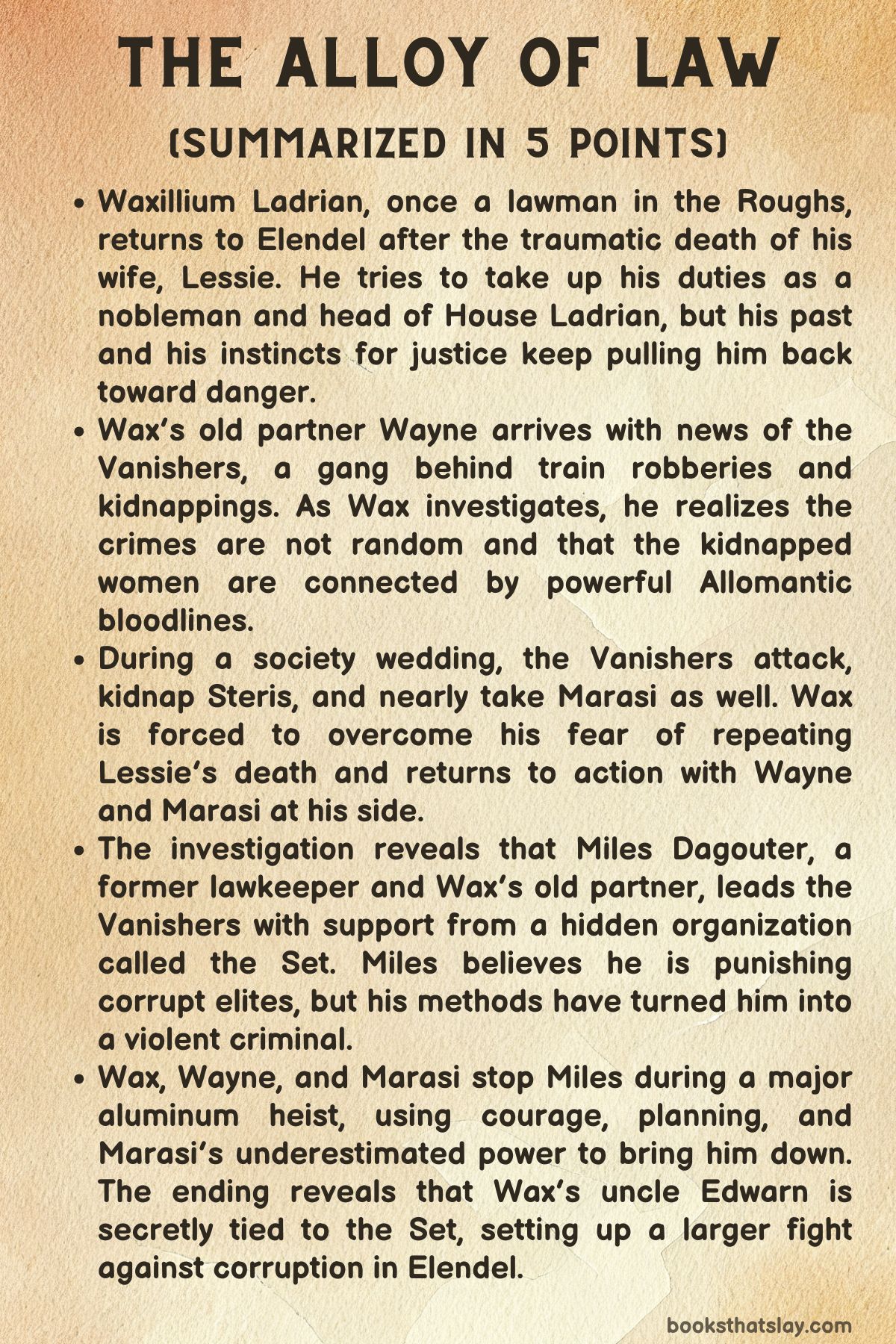
The Alloy of Law begins with Waxillium Ladrian during his years as a lawman in the Roughs, a dangerous frontier region where he has built a reputation for skill, courage, and relentlessness. He is hunting Bloody Tan, a murderer known for cruel theatrical displays.
Wax is accompanied by Lessie, his wife and fellow lawkeeper, whose competence and courage match his own. Their pursuit leads them through Feltrel and into a hidden cellar filled with corpses arranged in disturbing scenes.
Wax follows the trail to a ruined chapel, where Bloody Tan holds Lessie hostage. Wax attempts the impossible shot, trying to kill Tan without harming her, but Tan shifts her body at the last instant.
Wax’s bullet kills Lessie. Broken by the accident, Wax kills Tan, but the damage is done.
The event becomes the central wound of Wax’s life.
Months later, Wax has returned to Elendel, the great city of civilization and noble power. His uncle’s death has forced him to take control of House Ladrian, which is drowning in debt.
Instead of chasing criminals, Wax must now attend parties, manage finances, and consider marriage as a way to save his house. He is deeply uncomfortable in this role.
At a society gathering, he feels trapped by expectations and memories. He escapes by using his Allomantic ability to Push on metal and move across the city rooftops.
From above, he sees a fight between criminals and constables, but when a woman’s cry reminds him of Lessie’s death, he freezes. He returns home and tries to put away his guns and his old identity.
Six months later, Wax prepares for a meeting with Lord Harms and his daughter Steris, a practical noblewoman being considered as his future wife. Steris arrives with her cousin Marasi Colms, a quieter and more observant young woman.
Wax’s old partner Wayne appears unexpectedly, disguised as someone else, bringing news of a criminal gang called the Vanishers. The gang has been robbing trains and kidnapping women from noble families.
Wayne gives Wax an aluminum bullet recovered from one of their crimes. Aluminum cannot be affected by Allomancy, which makes it especially dangerous to people like Wax.
Steris approaches marriage like a contract, presenting Wax with conditions that are blunt, organized, and socially strategic. Wax agrees to publicly court her because House Ladrian needs financial stability.
Yet his mind keeps returning to the Vanishers. He studies reports of robberies and begins seeing patterns.
The gang is not merely stealing goods. They appear to be using thefts as cover for something more specific: kidnapping women connected to powerful Allomantic bloodlines.
Wax realizes that aluminum has been stolen to make bullets and weapons that Allomancers cannot control. Though he tells himself he is no longer a lawman, his instincts remain active.
At a major wedding attended by Elendel’s elite, Wayne warns Wax that the Vanishers may strike. Soon after, armed bandits invade the ballroom.
Wax hesitates at first, afraid of repeating the mistake that killed Lessie. The gang robs the guests, but their leader also selects specific women as hostages.
Steris is taken, and Marasi is seized as well. When a retired constable tries to resist and is killed, Wax’s reluctance breaks.
Wayne uses a speed bubble, creating a pocket where time moves faster, giving them a brief chance to prepare. Wax retrieves his weapons and fights back.
The battle is brutal. Wax discovers the bandits carry some aluminum bullets, and one of them, Tarson, even has an aluminum gun.
Wax again struggles when Marasi is held hostage, but she fights for herself, giving him the opening to act. Wayne is shot, but his Feruchemical healing saves him.
Wax chooses to help Wayne rather than immediately chase Steris, showing the strength of their bond. Marasi later saves Wax and Wayne by shooting two attackers, proving she is far more capable than others assume.
Afterward, Steris remains captive, Lord Harms begs Wax to rescue her, and Wax is drawn fully back into the work he tried to leave behind.
Marasi visits Ladrian Mansion the next morning and finds Wax investigating the unusual aluminum alloy used by the Vanishers. Together, they discuss the kidnappings and reach a disturbing conclusion.
The women are not being taken for ransom alone. Their noble bloodlines make them valuable for breeding Allomancers.
Marasi also reveals her intelligence and interest in law, especially crime prevention through social structure and public order. Wax begins to respect her mind, though he remains cautious about involving her in danger.
Wayne, meanwhile, infiltrates a constabulary precinct in disguise and manipulates captured Vanishers into revealing the location of the gang’s hideout. His gift for accents, impersonation, and fast thinking makes him an unusual but highly effective investigator.
When he returns, Wax, Wayne, and Marasi prepare to investigate together. Before they can leave, Wax deduces that Marasi is not simply Steris’s cousin but her half-sister, the daughter of Lord Harms through an affair.
Soon after, Wayne drinks tea meant for Wax and collapses from poison. Tillaume, Wax’s butler, draws an aluminum pistol and tries to kill him.
Wax survives by using a metal button as a weapon, but Tillaume triggers a bomb. Wayne’s speed bubble slows the explosion just enough for Wax to protect Marasi and escape through the floor.
Wayne shields them and suffers severe burns, then heals. Wax rescues the household staff from the burning mansion and realizes the enemy has been watching him closely.
The group travels to the Vanishers’ abandoned foundry hideout. There they find signs of aluminum forging, explosives, machinery, and a canal-based system for transporting heavy equipment.
Wayne tells Marasi about his own dark past: he once killed a man during a robbery and was spared from hanging by Wax. This guilt explains why Wayne refuses to use guns.
Wax finds clues linking the hideout to Miles Dagouter, also called Miles Hundredlives, a former lawkeeper from the Roughs and once Wax’s partner.
Miles is revealed as the leader of the Vanishers. He sees himself not as a common criminal but as someone enforcing a higher justice against the corrupt elite.
His healing powers make him nearly impossible to kill. As a Double Gold Twinborn, he can use Allomancy and Feruchemy together to heal from terrible wounds.
He is backed by a mysterious figure called Mister Suit, who represents an organization known as the Set. Mister Suit criticizes Miles’s failures but still orders one final major robbery: the theft of a valuable aluminum shipment.
Wax, Wayne, and Marasi investigate earlier robberies and discover how the Vanishers remove entire train cars using canal barges and heavy machinery. On a train journey, Miles ambushes Wax.
The two fight across the moving cars. Wax shoots Miles, but Miles heals instantly.
During the fight, Miles argues that Elendel’s nobles are corrupt and that Wax knows it. Wax recognizes that Miles still uses the language of justice, but his methods have become monstrous.
Wax manages to throw him from the train, but Miles survives.
The group seeks help from Ranette, a brilliant gunsmith from the Roughs who has a tense history with Wayne. She provides Wax with special ammunition and a revolver named Vindication.
Marasi finds a hidden message in an aluminum revolver, and Wax forms a plan to stop the final robbery. Wayne gathers information at the station through disguise and misdirection.
Wax and Wayne stage a fake attack that allows Wax to be locked inside the armored train car carrying the aluminum. When the Vanishers steal the car and move it to their underground workshop, Wax is waiting inside with dynamite.
The explosion begins the final confrontation. Wax fights through Vanishers, but Miles, Tarson, and other Allomantic enemies press him hard.
Marasi and Wayne intervene from above. Wax is badly injured and nearly defeated, but he hears Harmony’s voice and finds his old mistcoat and weapons.
Reclaiming them is more than practical; it is a symbolic return to the role he was meant to fill. He rescues Steris and the missing gunsmith Nouxil, then faces another hostage crisis when Tarson takes Marasi.
This moment mirrors Lessie’s death. This time, with Wayne’s help, Wax uses the altered timing of a speed bubble to make a near-impossible shot, ricocheting one bullet off another and killing Tarson without harming Marasi.
Wax then confronts Miles. Marasi uses her own cadmium ability, which slows time inside a bubble, to trap Miles and Wax long enough for the outside world to move ahead by hours.
Miles beats Wax almost to death, unaware that time outside is racing forward. Marasi finally reveals herself and tells Miles that his downfall will come through her.
When she drops the bubble, Wayne arrives with more than one hundred constables. Miles is overwhelmed and captured.
After the battle, Wax receives official authority to act as a lawman in Elendel. Marasi admits romantic interest in him, but he gently refuses.
Steris, practical as ever, still wants to continue their marriage agreement, and Wax accepts. At Miles’s execution, he gives a final warning about Trell and mysterious forces connected to gold and red.
Marasi notices a strange robed figure, later revealed as Ironeyes, who gives her a book from Harmony for Wax. In another revelation, Wax confronts his supposedly dead uncle, Lord Edwarn Ladrian, and recognizes him as Mister Suit.
Edwarn admits that the robberies were part of a larger scheme and reveals that Wax’s sister Telsin is alive. Wax is thrown from the train, but he survives.
With Edwarn’s appointment book in hand, Wax and Wayne prepare to continue the fight against the Set and the corruption hidden beneath Elendel’s polished surface.
Characters
Waxillium Ladrian
Waxillium Ladrian is the emotional and moral center of the book. He begins as a man divided between two lives: the lawman of the Roughs and the noble lord of Elendel.
His return to House Ladrian is not a triumph but a retreat after trauma. The accidental killing of Lessie leaves him afraid of his own competence, because the very skill that made him legendary also caused the worst moment of his life.
His struggle is not about whether he can fight, investigate, or survive; it is about whether he can trust himself to act when innocent lives depend on him. This makes him a strong action hero without making him emotionally simple.
In The Alloy of Law, Wax’s Allomantic and Feruchemical abilities support his role as a protector, but they do not solve his deepest conflict. He must accept that responsibility includes risk, pain, and imperfect choices.
His return to the mistcoat and revolvers near the end shows his acceptance of identity, not nostalgia. He is not merely going back to who he was in the Roughs.
He is becoming someone who can bring that sense of justice into a city that hides its violence behind wealth, manners, and politics.
Wayne
Wayne is Wax’s partner, comic contrast, moral mirror, and one of the most layered characters in the story. His humor, disguises, accents, and casual thefts often make him seem unserious, but that surface hides an old and lasting guilt.
His refusal to use guns is rooted in the fact that he once killed a man during a robbery. That past shapes nearly everything about him.
He fights with dueling canes, heals through Feruchemy, and uses speed bubbles with tactical brilliance, but he also carries a strict personal code that he rarely explains directly. Wayne understands people through habits, speech, clothing, and tone, which makes his disguises more than costumes.
He enters other identities by observing how people move through the world. His friendship with Wax is built on loyalty and debt, but it is not one-sided.
Wayne pushes Wax back toward action when Wax wants to hide behind noble duty. In the book, Wayne represents the idea that guilt does not have to end a person’s usefulness.
It can become discipline, restraint, and a strange but sincere form of compassion.
Marasi Colms
Marasi Colms is one of the most underestimated figures in the book, and much of her character arc comes from proving that her value is not defined by how others rank her. She begins as the quiet companion beside Steris, treated as timid, secondary, and socially inconvenient because of her illegitimate birth.
Yet she quickly shows intelligence, courage, and strong powers of observation. Her interest in law is not romantic fantasy; she thinks deeply about crime, systems, prevention, and the structure of public safety.
Her cadmium ability initially seems useless to her because it slows time rather than helping directly in a fight. The ending overturns that assumption.
By trapping Miles in a slowed-time bubble long enough for the constables to arrive, Marasi becomes essential to his defeat. Her power matches her mind: it changes the conditions of a situation rather than overpowering it.
In The Alloy of Law, Marasi stands for overlooked forms of strength. She does not become important by copying Wax or Wayne.
She becomes important by recognizing the value of her own gifts.
Steris Harms
Steris Harms is introduced through structure, caution, and social calculation. Her marriage contract with Wax could make her seem cold at first, but it also reveals her honesty.
Steris does not pretend romance exists where it does not, and she does not hide the practical stakes of noble marriage. She understands society as a system of obligations, reputations, alliances, and risks.
Her approach to courtship is controlled because control is how she survives in a world that measures women by usefulness, bloodlines, and appearance. Steris’s kidnapping also shows that she is valuable to others in ways she cannot fully control.
The Vanishers see her as part of a breeding scheme because of her noble ancestry, turning social status into physical danger. By the end, her decision to continue the engagement is not simply obedience to family pressure.
It shows her ability to assess Wax honestly and still choose the arrangement. Steris is not emotionally expressive in the same way as Marasi, but the book gives her a clear identity: practical, guarded, intelligent, and more self-aware than many around her realize.
Miles Dagouter
Miles Dagouter is the main antagonist, but he is not written as a simple villain. He was once a lawkeeper and Wax’s partner, which makes his fall especially important.
Miles believes that the official law protects corrupt elites and punishes the powerless. His anger has roots in real injustice, but he twists that anger into cruelty, kidnapping, murder, and terror.
His healing power shapes his psychology. Because he can survive wounds that would kill others, he becomes detached from ordinary limits and consequences.
Pain loses meaning for him, and over time, so does the suffering of others. His title, Hundredlives, suggests durability, but also a loss of ordinary human vulnerability.
Miles’s speeches to Wax are dangerous because they contain partial truths. Elendel does have corruption.
Nobles do exploit systems. Law can serve power.
Yet Miles uses those truths to excuse becoming what he claims to oppose. In The Alloy of Law, he serves as a warning about justice without humility.
His desire to punish corruption becomes another form of corruption.
Lessie
Lessie’s presence in the book is brief but powerful. She is central to Wax’s emotional life and to the fear that shapes his decisions after returning to Elendel.
Lessie is not simply a lost wife used to motivate the hero; she is shown as a capable lawkeeper who works beside Wax in the Roughs. She understands danger, takes action, and has her own courage.
Her death is devastating because it occurs through Wax’s own attempt to save her. That accident turns Wax’s greatest skill into a source of terror.
Every later hostage situation carries the weight of Lessie’s final moment. When Wax hesitates with Marasi in danger, the reader understands that he is not merely afraid of missing.
He is afraid of repeating the exact pattern that destroyed him. Lessie therefore functions as both memory and moral test.
Wax cannot bring her back, but he must learn to act without letting grief decide every future choice.
Bloody Tan
Bloody Tan is a small but important figure because he creates the wound that drives Wax’s inner conflict. He is cruel, theatrical, and psychologically manipulative.
His habit of arranging corpses in staged scenes shows a desire not only to kill but to control the meaning of death for those who find his victims. In the chapel, he forces Wax into an impossible choice and then moves Lessie at the last instant, turning Wax’s skill into tragedy.
Bloody Tan’s power over the larger story comes from that manipulation. Even after he dies, his influence remains inside Wax’s memory.
He represents the kind of evil that does not need to survive physically in order to keep harming people. His role is also structurally important because later hostage scenes echo his final act.
The difference is that Wax must learn not to let Bloody Tan’s cruelty define his future.
Lord Edwarn Ladrian, Mister Suit
Lord Edwarn Ladrian is one of the book’s most important hidden threats because he connects family betrayal, noble corruption, and organized crime. As Wax’s uncle, he should represent inheritance, family duty, and continuity.
Instead, he becomes a symbol of rot inside the very social structure Wax is trying to preserve. His identity as Mister Suit reveals that the danger facing Elendel is not limited to street criminals or rogue lawmen.
It reaches into wealth, bloodlines, business schemes, and private networks of power. Edwarn’s confession about insurance fraud shows his cold practicality.
He treats violence and robbery as tools in a financial game. His revelation that Telsin is alive also gives him emotional leverage over Wax, proving that he understands how to manipulate family bonds.
Unlike Miles, Edwarn does not need to justify himself through moral outrage. His evil is cleaner, calmer, and more strategic.
That makes him especially dangerous.
Tillaume
Tillaume begins as the image of household loyalty and order, which makes his betrayal unsettling. As Wax’s butler, he belongs to the private world of Ladrian Mansion, the one place Wax should be able to treat as safe.
His poisoning of Wayne and attack on Wax show that the enemy has entered Wax’s home long before Wax fully understands the scale of the conspiracy. Tillaume’s use of an aluminum pistol is also significant because it connects domestic betrayal with the larger Vanisher plot.
He is not simply a servant who turns traitor for dramatic effect; he demonstrates how deeply Wax has been watched and prepared for. His attack destroys the illusion that noble life can protect Wax from the violence of the Roughs.
The battlefield has moved indoors, into parlors, studies, tea service, and family property.
Tarson
Tarson is a physical threat whose importance comes from the danger he poses in close, immediate situations. As a koloss-blooded Pewterarm, he combines size, strength, endurance, and brutality.
He is not the intellectual center of the Vanishers, but he gives their violence a body. His seizure of Marasi during the wedding attack and later during the final confrontation makes him part of Wax’s repeated hostage trauma.
Tarson’s strength forces Wax into situations where ordinary marksmanship is not enough. The final ricochet shot that kills him is important because Tarson becomes the obstacle through which Wax proves he can face the memory of Lessie without being ruled by it.
Tarson also shows how Miles’s cause depends on people willing to enact raw violence. Whatever political language Miles uses, men like Tarson reveal the ugly reality beneath it.
Ranette
Ranette is independent, sharp, inventive, and unwilling to be charmed into cooperation. As a gunsmith from the Roughs, she represents practical brilliance.
She understands the technical side of combat in a world where firearms and metal-based magic exist together, and her weapons give Wax options he would not otherwise have. Her tense history with Wayne adds humor, but it also establishes that she is not easily manipulated by familiar relationships.
Ranette sets boundaries clearly and enforces them with confidence. Her workshop is a place of knowledge, not comfort.
Through her, the book shows that survival in this world depends not only on magical ability but on engineering, craftsmanship, and preparation. She also expands the sense of Wax and Wayne’s past life in the Roughs by showing another capable person from that world.
Lord Harms
Lord Harms represents the social world Wax has returned to: formal, reputation-conscious, and deeply invested in marriage as alliance. His role as Steris’s father and Marasi’s secret father gives him moral complexity, though not necessarily moral strength.
He has managed his family’s public image while keeping Marasi’s status hidden, which places her in a socially painful position. His desperation after Steris is kidnapped shows real concern, but his earlier choices reveal the limits of that concern when reputation is at stake.
Lord Harms is not a villain like Edwarn, yet he benefits from the same noble system that makes women’s bloodlines, marriages, and legitimacy into tools of power. Through him, the story shows quieter forms of harm inside polite society.
Constable-General Brettin
Constable-General Brettin represents official law in Elendel, with all its limits. He is often frustrated by Wax’s methods, especially the level of violence that follows him, but he also cannot deny the results.
Brettin’s role matters because the city’s formal institutions are not entirely useless or corrupt, yet they are not prepared for the scale and strangeness of the threats they face. His eventual decision to give Wax authority recognizes that Elendel needs someone who can operate between frontier lawkeeping and urban policing.
Brettin is cautious, bureaucratic, and concerned with procedure, but he is also practical enough to adapt. Through him, the book avoids making official law look wholly foolish.
It is limited, pressured, and sometimes slow, but still necessary.
Ironeyes
Ironeyes appears briefly, but his presence expands the story beyond the immediate crime plot. He is tied to religion, death, and older powers within the world.
Marasi’s sighting of him at Miles’s execution gives the scene a sense of mystery and consequence. His delivery of a book from Harmony to Wax suggests that Wax’s actions matter not only politically but spiritually.
Ironeyes also contrasts sharply with the public spectacle of execution. While the crowd watches violence as punishment, he stands apart as a figure connected to deeper judgment and older history.
His role is restrained, but it signals that the conflict with the Set and Trell is part of something larger than robberies and noble schemes.
Harmony
Harmony is not present as an ordinary character, yet his influence is important. Wax’s faith, prayer earring, and moment of hearing Harmony’s voice show that divine presence in the book is subtle rather than constantly visible.
Harmony does not simply solve Wax’s problems. Instead, he offers guidance at a moment when Wax is close to defeat, helping him find what he needs to continue.
This keeps Wax’s agency intact while also suggesting that his path has spiritual importance. Harmony’s connection to the book given through Ironeyes also points toward unfinished questions.
His role raises a difficult issue: if a god exists and sees suffering, why does he allow people like Wax to endure so much pain? The book does not answer that fully, but it uses Wax’s faith to frame duty as something chosen even when certainty is impossible.
Themes
Justice, Law, and Moral Corruption
Justice in this story is never treated as a simple matter of catching criminals. Wax, Miles, Brettin, and Marasi each represent a different relationship to law.
Wax believes in direct protection of the innocent, shaped by years in the Roughs where hesitation could mean death. Brettin represents official structures, paperwork, jurisdiction, and public accountability.
Marasi approaches law intellectually, thinking about prevention, social conditions, and institutions. Miles is the dangerous distortion of justice: he sees real corruption among the elite, but he uses that truth to excuse kidnapping, murder, and terror.
This conflict gives the book much of its moral force. The reader can understand why Miles hates noble hypocrisy, but understanding his anger does not make his actions defensible.
The Alloy of Law asks whether justice can survive contact with power, wealth, and personal pain. Its answer is cautious but firm: justice requires restraint.
Without restraint, it becomes revenge. Without compassion, it becomes cruelty.
Without structure, it becomes personal rule by whoever has the strength to impose it.
Trauma, Guilt, and the Fear of Repeating the Past
Wax’s grief over Lessie’s death shapes nearly every major decision he makes. His trauma is not shown only through sadness; it appears as hesitation, avoidance, and fear of his own abilities.
He does not stop being skilled after Lessie dies. In fact, his competence is part of the problem.
He knows exactly how capable he is, and that makes the fatal accident harder to accept. The same hands that saved many people also killed the person he loved most.
This gives the later hostage scenes emotional weight because Wax is not facing a new problem each time. He is facing the same memory in different forms.
Wayne also carries guilt, though he handles it differently. His refusal to use guns comes from a killing he committed before Wax saved him.
Both men are shaped by deaths they cannot undo. The story treats guilt as something that can either paralyze a person or become a form of moral discipline.
Healing does not mean forgetting or becoming untouched by pain. It means acting responsibly even when memory hurts.
Social Class, Bloodlines, and the Violence Beneath Polite Society
Elendel’s noble society presents itself through parties, weddings, contracts, family names, and controlled manners, but beneath that surface lies exploitation. Marriage is treated as financial rescue, women’s ancestry becomes a criminal target, and family reputation decides how people like Marasi are treated.
The Vanishers’ kidnappings expose the ugly logic already present in noble culture: bloodlines are valuable, and women can be reduced to their usefulness in preserving or producing power. Steris is wanted because of her ancestry.
Marasi is dismissed socially because of her birth, yet targeted for the same hidden reason. Wax’s return to noble life forces him to see that civilization is not necessarily less violent than the Roughs.
It simply hides violence behind contracts, inheritance, and business schemes. Edwarn’s role makes this especially clear.
The criminal conspiracy is not outside high society; it grows from within it. The polished world of Elendel depends on systems that can turn people into assets, embarrassments, or obstacles.
The book uses crime to reveal what polite conversation tries to conceal.
Identity, Duty, and Choosing a Place in a Changing World
Wax’s central struggle is a question of identity. Is he Lord Ladrian, responsible for debts, marriage, and noble survival, or is he Wax the lawman, responsible for protecting people when others cannot?
At first, he treats these lives as incompatible. The Roughs represent action and danger; Elendel represents duty and restraint.
Over time, he learns that this division is false. The city needs the lawman precisely because noble society is full of hidden violence.
His role is not to abandon one identity for the other, but to carry the best parts of both. The setting reinforces this conflict through technological change.
Guns, trains, aluminum, skyscrapers, and modern policing exist beside Allomancy and Feruchemy. The world is changing, and older forms of heroism must change with it.
Wayne and Marasi also face questions of usefulness. Wayne turns guilt into service, while Marasi discovers that a power she considered weak can decide the outcome of a major battle.
Duty, in this story, is not assigned once and obeyed blindly. It is chosen again and again under pressure.