The All-Girl Filling Station’s Last Reunion Summary, Characters and Themes
The All-Girl Filling Station’s Last Reunion is a warm, comic, and moving novel by Fannie Flagg about identity, family history, and the hidden lives of women whose achievements were overlooked. The story follows Sookie Poole, a gentle Alabama woman whose settled life is shaken when she learns that she was adopted and that her biological family has a remarkable connection to World War II aviation.
Through Sookie’s present-day search and the past story of the Jurdabralinski sisters, the book connects personal self-discovery with a broader history of women pilots who served their country with courage and little recognition.
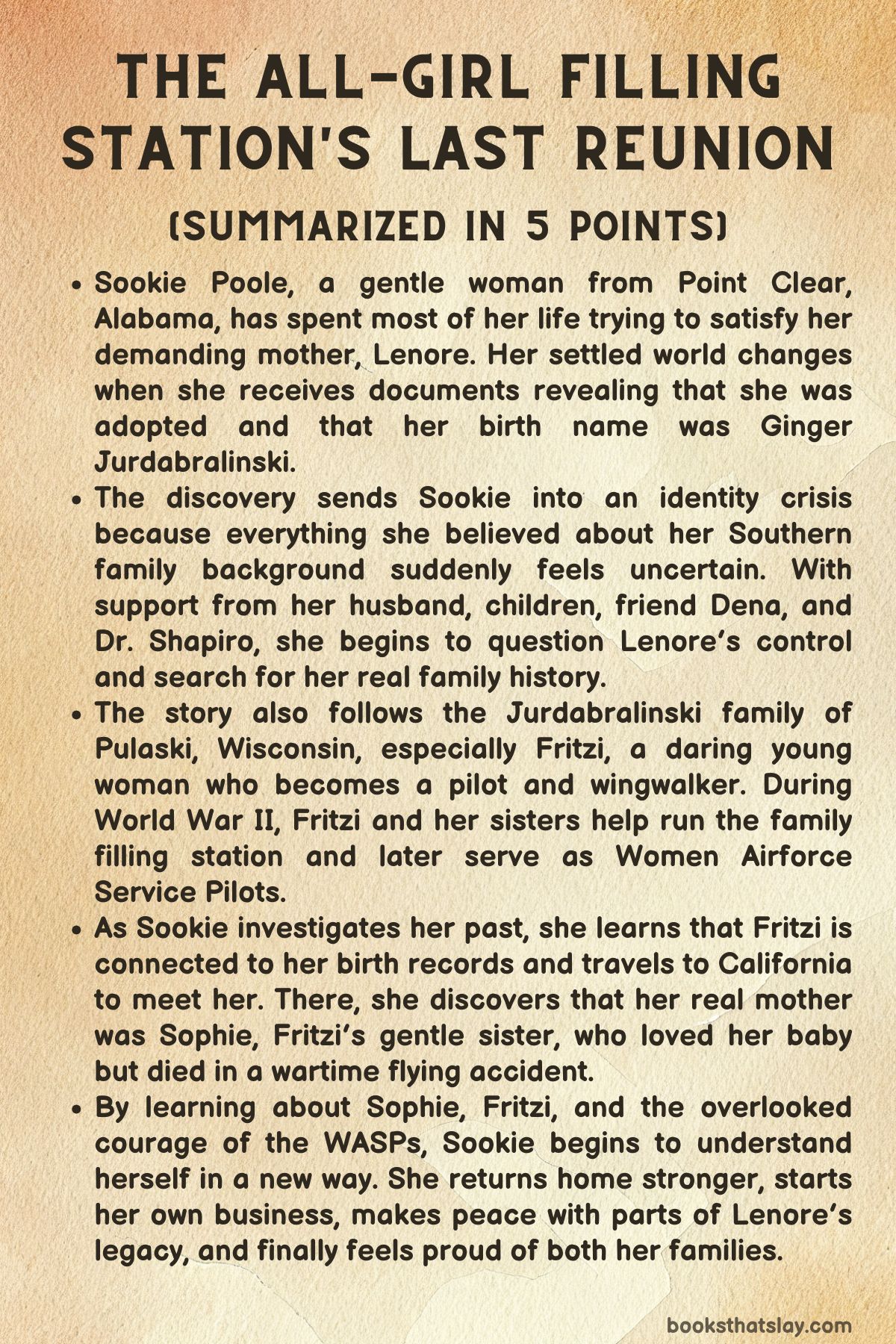
Summary
Sookie Poole lives in Point Clear, Alabama, where she has spent much of her adult life trying to be a good wife, mother, daughter, friend, and Southern lady. Her children are grown, her last daughter’s wedding has just taken place, and she hopes that life will finally slow down.
She is married to Earle, a steady and loving man who has long understood her anxieties better than almost anyone. Yet Sookie’s life is still dominated by her mother, Lenore Simmons Krackenberry, a dramatic, demanding, status-conscious woman who believes deeply in family names, old customs, and the importance of being a Simmons.
Lenore is elderly but still energetic enough to control the lives of those around her. She calls Sookie often, criticizes her appearance, gives orders, and turns even family occasions into performances centered on herself.
Sookie handles Lenore’s bills, worries about her nurses, runs errands for her, and tries to keep peace. She has always believed she belongs to a proud old Southern family, even though she has never felt quite equal to Lenore’s expectations.
Sookie fears that she lacks drive, glamour, courage, and personality. She also worries about the supposed emotional instability in the Simmons family, wondering whether she and her children may have inherited it.
Her ordinary world changes when she receives a mysterious registered letter. At first she refuses to accept it, afraid that it contains bad news about Lenore.
When she finally opens it with Earle beside her, she discovers documents showing that she was adopted from a Texas children’s home in 1945. Her birth name was Ginger Jurdabralinski, her listed mother was Fritzi Willinka Jurdabralinski, and her father was unknown.
The birthday she has celebrated all her life is not her real birthday. The truth is so shocking that she faints.
This revelation shakes Sookie’s sense of self. She feels as if her whole identity has been built on a lie.
She is not biologically a Simmons or a Krackenberry. She is not the Southern daughter Lenore always claimed she was.
She is Polish American by birth, possibly connected to people and places she has never known. She begins questioning everything: her childhood, her sorority membership, her place in society, her relationship with Lenore, and even her personality.
If she is not who she thought she was, she wonders who she might really be.
The story then moves into the history of the Jurdabralinski family. Stanislaw Ludic Jurdabralinski leaves Poland in the early twentieth century and comes to America with faith in hard work and opportunity.
He settles in Wisconsin, marries Linka Marie, and raises a family. Their eldest daughter, Fritzi, is spirited, adventurous, and restless from childhood.
Stanislaw eventually opens a Phillips 66 station called Wink’s Phillips 66, named after his son, and the filling station becomes the center of family life.
Fritzi’s life changes when Billy Bevins, a skywriter and stunt pilot, arrives to advertise Phillips 66 from the air. Fritzi is fascinated by him and by flying.
At first she imagines romance, but Billy is more interested in her daring nature and her potential as a performer. He teaches her to fly, and she becomes a wingwalker in his flying circus.
She performs stunts, travels, earns money, and discovers that flight gives her the freedom she has always wanted. Though her relationship with Billy is irregular and uncertain, her love of aviation becomes the most powerful direction in her life.
Back in the present, Sookie struggles to process the adoption news. She avoids Lenore and confides in her old college friend Dena, who reminds her that Lenore’s huge personality has always overshadowed her.
Sookie starts therapy with Dr. Shapiro, meeting him secretly because she fears gossip and Lenore’s judgment. Dr. Shapiro helps her see that her anger, confusion, and anxiety are understandable.
He recognizes that Lenore is narcissistic and that Sookie has spent her life defining herself through her mother’s needs.
Meanwhile, the Jurdabralinski family faces World War II. Stanislaw becomes ill with tuberculosis and must go to a sanitarium.
Wink enlists, leaving the filling station without its usual male worker. Rather than sell it, Fritzi convinces her mother and sisters to run it themselves.
The women turn Wink’s Phillips 66 into an all-girl filling station, fixing cars, pumping gas, cleaning windshields, wearing roller skates, and drawing attention from customers and newspapers. What begins as necessity becomes a bold family enterprise.
The sisters prove that women can do practical, technical work and enjoy doing it.
Fritzi still misses flying. When the government begins recruiting licensed female pilots for the war effort, she is thrilled.
She reports to Texas and joins the program that becomes known as the Women Airforce Service Pilots, or WASPs. Her sisters Gertrude and Sophie also join.
These women fly military aircraft within the United States, deliver planes, tow targets, test aircraft, and take on dangerous assignments so male pilots can be sent to combat. They face sexism, mockery, harassment, and disbelief from men who do not think women belong in military planes.
Still, they keep flying.
Fritzi proves herself as a skilled and daring pilot. She delivers heavy planes, handles difficult weather, and earns respect from many who see her work.
She writes letters to Billy, Wink, and her family, sharing the excitement, strain, humor, and sadness of wartime flying. She enjoys the freedom and glamour of California, meets famous people, and sees how the war has opened unexpected doors for women.
Yet danger is always present. Fellow women pilots die in crashes, and the program is never treated with the same respect or security as men’s military service.
Sookie gradually tells her children about her adoption. Their responses surprise her.
Dee Dee is shaken because she has invested deeply in the Simmons family story, but Sookie’s other children accept the truth with warmth. Her son Carter is even relieved that they may not have inherited the Simmons family troubles.
Sookie begins to understand that her children love her for who she is, not for her ancestry. This helps her separate herself from Lenore’s version of family pride.
As Sookie researches the Jurdabralinskis, she learns that Fritzi and her sisters were famous as the Flying Jurdabralinski Girls of Pulaski. She receives photographs and newspaper clippings that show Fritzi as glamorous, bold, and confident.
Sookie is amazed by the connection and eventually contacts Fritzi, who is alive and living in Solvang, California. Fritzi answers calmly, as if she has long expected the call, and invites Sookie to visit.
Before that meeting, the past reveals more of the wartime story. Sophie, Fritzi’s quiet and gentle sister, falls in love with Jimmy, a Royal Air Force pilot.
She believes he wants to marry her, but his letters stop. When she investigates, she discovers that he already has a wife.
Sophie is pregnant. Fritzi helps protect her secret and arranges for her to give birth quietly.
Sophie loves her baby and does not want to give her up, but the situation is difficult and dangerous for a young unmarried woman in wartime. Soon afterward, Sophie is killed in a midair collision caused by Bud Harris, a man who had harassed her and then flown recklessly close to her plane.
When Sookie reaches California, she expects to meet her biological mother, Fritzi. Fritzi welcomes her and shows her family photographs, but then tells her the truth: Fritzi is not her mother.
Sophie was Sookie’s mother. Fritzi had put her own name on the birth certificate to protect Sophie and the family.
After Sophie’s death, Fritzi took the baby to an orphanage, believing it was the best chance for the child to have a stable life. She named the baby Ginger after Ginger Rogers, her favorite actress, though Sookie later learns that her real family name connects her to Fritzi as well.
This truth gives Sookie a new understanding of herself. She sees a photograph of Sophie and recognizes something familiar: shyness, softness, gentleness.
Fritzi tells her that Sophie loved her. Sookie also learns more about the WASPs, their service, their losses, and the fact that their records were sealed for years.
The country used their skill during the war and then ignored them when their work was no longer politically convenient. Even later, when women were accepted into military aviation, the earlier women were often left out of official memory.
Sookie stays in Solvang for a week and feels unexpectedly happy. Away from Lenore, Point Clear, and old expectations, she begins to feel free.
Fritzi gives her Sophie’s rosary, a deeply personal link to the mother she never knew. Sookie returns to Alabama changed.
She has not rejected Lenore, but she sees her differently. Lenore adopted and loved her, even if she also controlled and pressured her.
Sookie begins to understand that Lenore’s own life was shaped by loss, disappointment, social rules, and hidden family pain.
Sookie’s confidence grows. Her old problem with blue jays eating all the birdseed leads her to invent a feeder that allows smaller birds to eat while keeping the blue jays away.
With a handyman named Walter, she turns the idea into a business called Blue Jay Away. The business succeeds, and Sookie is delighted when the newspaper calls her an inventor.
For the first time, she sees herself as capable of creating something useful and independent.
Lenore eventually has a stroke and dies after telling Sookie that she is the best daughter in the world. Sookie grieves deeply, even with all the difficulty Lenore caused.
She honors parts of Lenore’s legacy while releasing herself from others, including the burden of the Simmons silver. Later, Sookie learns that through a distant connection she may still have Simmons ancestry after all, but by then the revelation no longer defines her.
In later years, Sookie attends a reunion honoring the WASPs and meets more of her biological family. She visits Pulaski, sees the old filling station site, hears stories from Fritzi and the surviving relatives, and stands before Sophie’s grave.
She also becomes more vocal about women’s erased history, especially when she sees museum exhibits that credit only men for flying aircraft that women like Sophie and Fritzi also flew.
By the end, Sookie has become more comfortable with herself. She remains a wife, mother, daughter, and grandmother, but she no longer sees those roles as proof that she failed to become someone important.
She understands that survival, kindness, patience, and love have value. She takes pride in Sophie’s courage, Fritzi’s daring, Lenore’s love, and her own quiet strength.
In old age, Sookie feels that she has finally become the person she was meant to be, carrying both families within her and honoring the women whose stories helped her find herself.
Characters
Sookie Poole
Sookie Poole is the central figure of The All-Girl Filling Station’s Last Reunion, and her journey is built around the collapse and rebuilding of identity. At the start of the book, she is a kind, anxious, people-pleasing woman who has spent most of her life trying to meet other people’s expectations.
Her mother’s standards, her Southern social world, and her own desire to be agreeable have shaped her into someone who often doubts her worth. Sookie’s discovery that she was adopted does more than surprise her; it removes the foundation on which she has explained her personality, her fears, and her family role.
Her crisis is comic at times, but it is also deeply human because she has to ask whether blood, upbringing, memory, or choice defines a person. As the book develops, Sookie becomes braver in small but meaningful ways.
She goes to therapy, questions Lenore’s hold over her, tells her children the truth, travels to meet Fritzi, and begins to claim a history that had been hidden from her. Her growth is not sudden or theatrical.
It appears through practical acts: speaking honestly, inventing a bird feeder, accepting love from her children, and learning that a quiet life can still be a strong life. By the end, Sookie is not transformed into a completely different person; she becomes more fully herself.
Lenore Simmons Krackenberry
Lenore is one of the most vivid and difficult characters in the book. She is dramatic, proud, controlling, and deeply attached to social position, especially the prestige of the Simmons name.
She often treats Sookie as an extension of herself rather than as an independent adult, using criticism, guilt, tradition, and family history to keep her daughter close. Yet Lenore is not written as a simple villain.
Her behavior is shaped by her own wounds, including the loss and confusion surrounding her mother, her frustrated dreams of acting, and the limits placed on women of her generation. She lies about Sookie’s birth and has a fake birth certificate made, but her motives are not purely selfish.
She wants Sookie to have legitimacy, status, and protection in a society that can be cruel about parentage. Lenore’s love is possessive and often damaging, but it is still love.
Her final words to Sookie reveal the feeling that has always existed beneath the vanity and pressure. She leaves behind irritation, grief, loyalty, and tenderness all at once.
Her character shows how love can be real and still be burdened by control, fear, and pride.
Fritzi Jurdabralinski
Fritzi is bold, energetic, and hungry for a life larger than the one expected of her. From childhood, she resists stillness and ordinary limits.
When Billy Bevins introduces her to flying, she discovers the thing that matches her spirit. Aviation gives her freedom, skill, confidence, and purpose.
Her years as a stunt performer and later as a WASP show her courage, but also her discipline and competence. Fritzi is not fearless in a shallow way; she understands danger, loss, and unfairness, yet she keeps going because flight is where she feels most alive.
She also carries guilt. She encouraged her sisters’ flying, helped hide Sophie’s pregnancy, and made the painful choice to leave Sophie’s baby at an orphanage.
Her decision to put her own name on the birth certificate is both protective and deceptive, and it shapes Sookie’s life for decades. In The All-Girl Filling Station’s Last Reunion, Fritzi represents the women whose work during wartime was essential but later minimized.
She refuses to be sentimental about the past, yet she knows its weight. Her relationship with Sookie is marked by honesty, restraint, regret, and unexpected connection.
Sophie Jurdabralinski
Sophie is the gentle center of the hidden family story. Unlike Fritzi, she is quiet, soft, religiously inclined, and more emotionally vulnerable.
Her decision to join the WASPs shows that gentleness does not mean weakness. She wants to contribute, to belong with her sisters, and to prove that she can handle the same difficult world they inhabit.
Her romance with Jimmy exposes her innocence and trust. She believes in his promise, and when she learns he is already married, the betrayal leaves her facing pregnancy, shame, and uncertainty in a period that offers unmarried mothers few compassionate choices.
Sophie’s love for her baby is one of the most important emotional truths in the book. She does not reject her child; circumstances, secrecy, and her sudden death separate them.
Her death in the crash caused by Bud Harris adds injustice to tragedy, because it is tied to male entitlement and reckless cruelty. For Sookie, learning that Sophie was her mother gives her a new mirror.
Sophie’s softness, shyness, and goodness help Sookie understand herself not as weak, but as connected to a woman whose quiet nature coexisted with real courage.
Earle Poole
Earle is Sookie’s emotional anchor. He is patient, loyal, warm, and steady in moments when Sookie feels overwhelmed.
His importance lies not in dramatic speeches but in the calm consistency with which he supports her. When Sookie learns she was adopted, Earle does not treat the news as a threat to their marriage or family.
He reassures her, helps her research, encourages her to consider meeting Fritzi, and gives her space to change. He also understands Lenore’s difficult personality without forcing Sookie to reject her mother.
Earle’s love is practical and secure. He represents the kind of family bond that is chosen and sustained over time.
Through him, the book shows that identity is not only inherited; it is also built through the people who stay, listen, and love without demanding performance. His presence helps Sookie discover that she has not failed at life simply because she did not become glamorous or famous.
She created a loving home, and Earle is central to that home.
Dena Nordstrom
Dena is Sookie’s old college roommate and one of the people who sees Sookie more clearly than Sookie sees herself. She functions as a voice of perspective outside the pressure of Point Clear and Lenore’s influence.
When Sookie spirals after learning about her adoption, Dena does not dismiss her confusion, but she also refuses to let Sookie define herself only through family background. She recognizes that Sookie has always viewed herself through Lenore’s judgment and wishes her friend could see her own goodness.
Dena’s role is important because she offers emotional honesty without drama. She tells Sookie that change is possible and reminds her that being agreeable is not the same as having no personality.
Through Dena, the book gives Sookie a friendship that is not based on status, blood, or obligation. It is based on long memory, affection, and the ability to speak truth gently.
Dr. Shapiro
Dr. Shapiro helps Sookie name the emotional patterns she has lived with for decades. He is not a magical fixer, but his conversations with her give her permission to see her pain as valid.
He identifies Lenore’s narcissistic behavior and helps Sookie understand that anger at her mother does not make her a bad daughter. His sessions also allow Sookie to separate inherited fear from learned anxiety.
Sookie’s secrecy about meeting him, and the gossip that follows, show how trapped she feels by her town’s opinions and Lenore’s social control. Dr. Shapiro’s role is partly therapeutic and partly symbolic: he marks the first time Sookie seriously invests in her own inner life.
By continuing to meet him despite embarrassment and pressure, she practices independence. His departure later in the story also shows that Sookie has grown enough to continue without leaning on him as heavily.
Stanislaw Jurdabralinski
Stanislaw is the immigrant patriarch whose belief in America shapes the Jurdabralinski family’s possibilities. He arrives from Poland with a conviction that work, courage, and freedom can build a new life.
His filling station is more than a business; it is a symbol of belonging, ambition, and family cooperation. Stanislaw’s love for Fritzi is especially important because he gives her room to be unconventional.
He does not always stop her from taking risks, and his approval matters when she pursues aviation. His illness during the war creates the situation that allows the women of the family to take over the station, but his values have already prepared them for that responsibility.
Stanislaw represents a version of fatherhood that is proud, encouraging, and rooted in trust. His immigrant story also broadens Sookie’s understanding of inheritance, giving her a family history based not on Southern status but on resilience, labor, and hope.
Linka Jurdabralinski
Linka is practical, protective, and often worried about the risks her daughters take. She values order, respectability, cleanliness, and family stability.
Her insistence that the filling station restrooms be spotless may seem comic, but it also shows her standards and her understanding that women customers deserve decent treatment. Linka is anxious about Fritzi’s adventures, skeptical of women running the station, and frightened when her daughters fly.
Yet she is not weak or passive. When circumstances demand it, she adapts.
She allows her daughters to work, serve, and step outside ordinary expectations, even when it hurts her. Her character captures the tension many mothers feel between wanting their children safe and knowing they must live their own lives.
Linka’s love is protective, sometimes restrictive, but ultimately loyal.
Wink Jurdabralinski
Wink is the son whose name is attached to the family filling station, but his role is not simply that of the expected male heir. He is affectionate, responsible, and eager to serve during the war.
His enlistment leaves space for his sisters to prove what they can do, and his letters help maintain the family’s emotional bond across distance. Wink’s marriage to Angie and his concern for his family give the wartime story a domestic counterpoint.
He represents the many young men whose lives were redirected by war, but he also helps highlight the women’s contributions. While he serves overseas, his sisters keep the business alive, learn mechanical skills, and later join aviation service themselves.
Wink’s return and reopening of the station suggest continuity, but the family has changed permanently by then.
Gertrude Jurdabralinski
Gertrude is one of the Jurdabralinski sisters who steps into both the filling station work and the WASP program. She has a lively, adaptable presence and shares in the family’s willingness to take on jobs that society does not expect women to do.
Her later life as a nun adds another layer to her character, suggesting a movement from wartime daring to spiritual commitment. Gertrude’s romantic storyline, in which her fiancé falls for Tula and she is relieved rather than devastated, gives her a comic practicality.
She is not defined by jealousy or convention. Like her sisters, she has a strong sense of self, but hers is expressed in a more understated way than Fritzi’s.
In The All-Girl Filling Station’s Last Reunion, she helps show that courage takes many forms: mechanical work, flying, faith, humor, and emotional flexibility.
Tula Jurdabralinski
Tula brings comedy, energy, and charm to the Jurdabralinski family story. Her mishap with the oil before an important date is funny, but it also shows the pressures young women face while trying to be both capable workers and socially desirable girls.
She participates in the all-girl filling station with enthusiasm, helping make it a local attraction and a symbol of women’s competence during wartime. Tula’s eventual romance with Nard, who was first connected to Gertrude, is handled with surprising ease within the family, showing the sisters’ practical and affectionate bonds.
Tula’s presence keeps the wartime sections from becoming only about sacrifice and loss. She reminds the reader that even during national crisis, young people still want dates, laughter, beauty, and ordinary happiness.
Billy Bevins
Billy Bevins is charming, talented, restless, and emotionally elusive. He changes Fritzi’s life by introducing her to flying, yet he is not a simple romantic hero.
He encourages her talent and gives her access to aviation, but he also avoids commitment for much of their relationship. His flying circus offers Fritzi freedom, work, and self-discovery, even as his personal life remains unstable.
During the war, his letters reveal more tenderness, and he eventually admits his love. Billy’s character reflects both the thrill and uncertainty of the aviation world Fritzi enters.
He is connected to risk, performance, mobility, and reinvention. His relationship with Fritzi works because neither of them is conventional, though Fritzi’s strength often feels more grounded than his.
He helps open the door to her future, but she becomes remarkable through her own courage and skill.
Dee Dee Poole
Dee Dee is one of Sookie’s daughters and one of the characters most affected by the revelation about the Simmons family line. She has absorbed much of Lenore’s pride in ancestry, so the news of Sookie’s adoption unsettles her at first.
Yet Dee Dee’s love for her mother proves stronger than her attachment to family mythology. As the story continues, she becomes one of Sookie’s most important supporters.
She reminds Sookie that motherhood, loyalty, patience, and emotional labor are real achievements. Dee Dee also helps research Sookie’s biological connections and accompanies her in moments of discovery.
Her relationship with Sookie matures as she begins to see her mother not only as a parent but as a person with wounds, questions, and desires of her own.
Carter Poole
Carter, Sookie’s son, responds to the family revelation with humor and acceptance. His reaction helps loosen the fear surrounding ancestry and identity.
Rather than mourning the loss of Simmons blood, he sees possible relief from the family’s history of instability. Later, his announcement that he is marrying David gives Sookie another chance to respond with love instead of inherited social scripts.
Her initial surprise is real, but she chooses her son’s happiness. Carter’s role near the end shows how Sookie’s growth affects her parenting.
She does not need Lenore’s rules to guide her. She has learned that family is made through love, honesty, and acceptance, even when life does not match older expectations.
Marvaleen
Marvaleen is comic, talkative, and full of self-help advice. She introduces Sookie to journaling exercises, ideas about sacred space, and later yoga.
While some of her suggestions are funny or impractical, her presence matters because she represents one of the ways Sookie tries to understand herself outside Lenore’s framework. Marvaleen also reflects the social world of Point Clear, where gossip travels quickly and appearances matter.
When she mentions the rumor about Sookie and Dr. Shapiro, the moment is embarrassing, but it also gives Sookie useful information about how others see her. Marvaleen is not always wise, but she is energetic, affectionate, and part of the everyday community that surrounds Sookie.
Bud Harris
Bud Harris is one of the book’s clearest examples of male entitlement and cruelty. He pursues Sophie despite her lack of interest, treats her as a challenge to be won, and makes a bet about seducing her.
His harassment becomes physical, and though he does not intend to kill her, his reckless attempt to frighten her in the air leads to her death. Bud’s behavior exposes the danger faced by women who entered male-dominated spaces during the war.
They were expected to prove their skill while also protecting themselves from men who resented, desired, or dismissed them. His later humiliation by Willy does not undo the harm he caused, but it gives a measure of rough justice within the story.
Bud’s character is disturbing because he is not a grand villain; he is an ordinary man whose arrogance and lack of accountability have fatal consequences.
Themes
Identity Beyond Inheritance
Sookie’s story challenges the belief that identity is fixed by bloodline, family name, birthplace, or social class. She has spent her life thinking of herself as a Simmons and a Krackenberry, and much of her insecurity comes from feeling that she has failed to live up to those names.
When she learns that she was adopted, the discovery first feels like erasure. The family stories, the ancestral pride, the Southern traditions, and even her birthday seem unstable.
Yet the book gradually shows that identity is not destroyed by hidden truth; it can be expanded by it. Sookie is still the woman Earle loves, still the mother her children depend on, and still the daughter Lenore raised.
At the same time, she is also connected to Sophie, Fritzi, Poland, Wisconsin, aviation, and the history of the WASPs. Her selfhood becomes richer when she stops searching for one pure explanation of who she is.
By the end, she does not need to choose between adopted family and birth family. She can carry both, while also recognizing that her choices, kindness, endurance, and creativity define her just as powerfully as ancestry.
Women’s Work and Forgotten History
The wartime story gives serious attention to the labor women performed when the country needed them, and the speed with which that labor was dismissed afterward. The Jurdabralinski sisters run a filling station, repair cars, serve customers, and keep a family business alive when men are absent.
Later, Fritzi, Sophie, and Gertrude fly military aircraft through the WASP program, taking on dangerous and necessary work. They are skilled, disciplined, and brave, yet they are treated as temporary helpers rather than full participants in military history.
Their records are sealed, their dead are not honored equally, and later exhibits still center men while ignoring women who flew the same planes. The All-Girl Filling Station’s Last Reunion uses Sookie’s personal search to recover this overlooked history.
Her pride in Sophie and Fritzi becomes more than family pride; it becomes anger at public forgetting. The book shows that recognition matters because history shapes what future generations believe is possible.
When women’s achievements are left out, their courage has to be rediscovered by daughters, nieces, granddaughters, and strangers willing to speak their names again.
Motherhood, Control, and Love
Motherhood in the story is complicated, imperfect, and often painful. Lenore loves Sookie, but her love is mixed with control, vanity, fear, and a need to shape her daughter into proof of Simmons importance.
Sophie loves her baby but is denied the chance to raise her. Fritzi protects Sophie’s secret and makes a life-changing decision for the child, but that decision also creates decades of confusion.
Linka loves her daughters by worrying over them, resisting their risks, and eventually letting them go. Sookie loves her own children with steadiness, but she initially undervalues that achievement because it does not look heroic to her.
These different versions of motherhood resist easy judgment. The book does not suggest that love always heals or that mothers always know best.
Instead, it shows that love can be protective, selfish, sacrificial, anxious, proud, or silent. Sookie’s growth depends on seeing mothers as human beings rather than symbols.
Lenore becomes more understandable without being excused. Sophie becomes real, not just a missing name.
Fritzi becomes both rescuer and keeper of secrets. Through them, Sookie learns that being a good mother is not about perfection or performance, but about presence, care, and the courage to let children become themselves.
Courage in Ordinary and Extraordinary Lives
The book places different kinds of courage beside one another. Fritzi’s courage is visible and dramatic: she walks on airplane wings, teaches pilots, delivers military aircraft, and faces danger in the sky.
Sophie’s courage is quieter: she leaves home, joins the WASPs despite her gentle nature, carries a painful secret, and loves her child in frightening circumstances. Lenore’s courage is harder to recognize, but it appears in her determination to adopt Sookie and claim her in a society obsessed with legitimacy.
Sookie’s courage may seem ordinary at first, yet it becomes one of the most important forms in the story. She confronts a hidden past, enters therapy, tells her children the truth, travels alone to meet Fritzi, changes her relationship with Lenore, starts a business, and speaks up when women’s history is ignored.
The contrast between flying planes and feeding birds is intentional. Courage is not only found in public danger or historical achievement.
It is also found in emotional honesty, self-acceptance, loyalty, and the willingness to begin again late in life. The story honors spectacular bravery while insisting that private resilience also deserves respect.