At the Back of the North Wind Summary, Characters and Themes
At the Back of the North Wind is a Victorian fantasy novel by George MacDonald about a gentle boy named Diamond, whose encounters with the mysterious North Wind teach him courage, compassion, faith, and acceptance of suffering. The book moves between London poverty, family struggle, dreamlike journeys, fairy-tale episodes, and spiritual reflection.
Diamond is not presented as an ordinary hero who conquers danger by strength; instead, his goodness changes the people around him. Through his strange friendship with the North Wind, the story explores death, innocence, moral growth, and the hope that pain may lead toward a deeper and kinder reality.
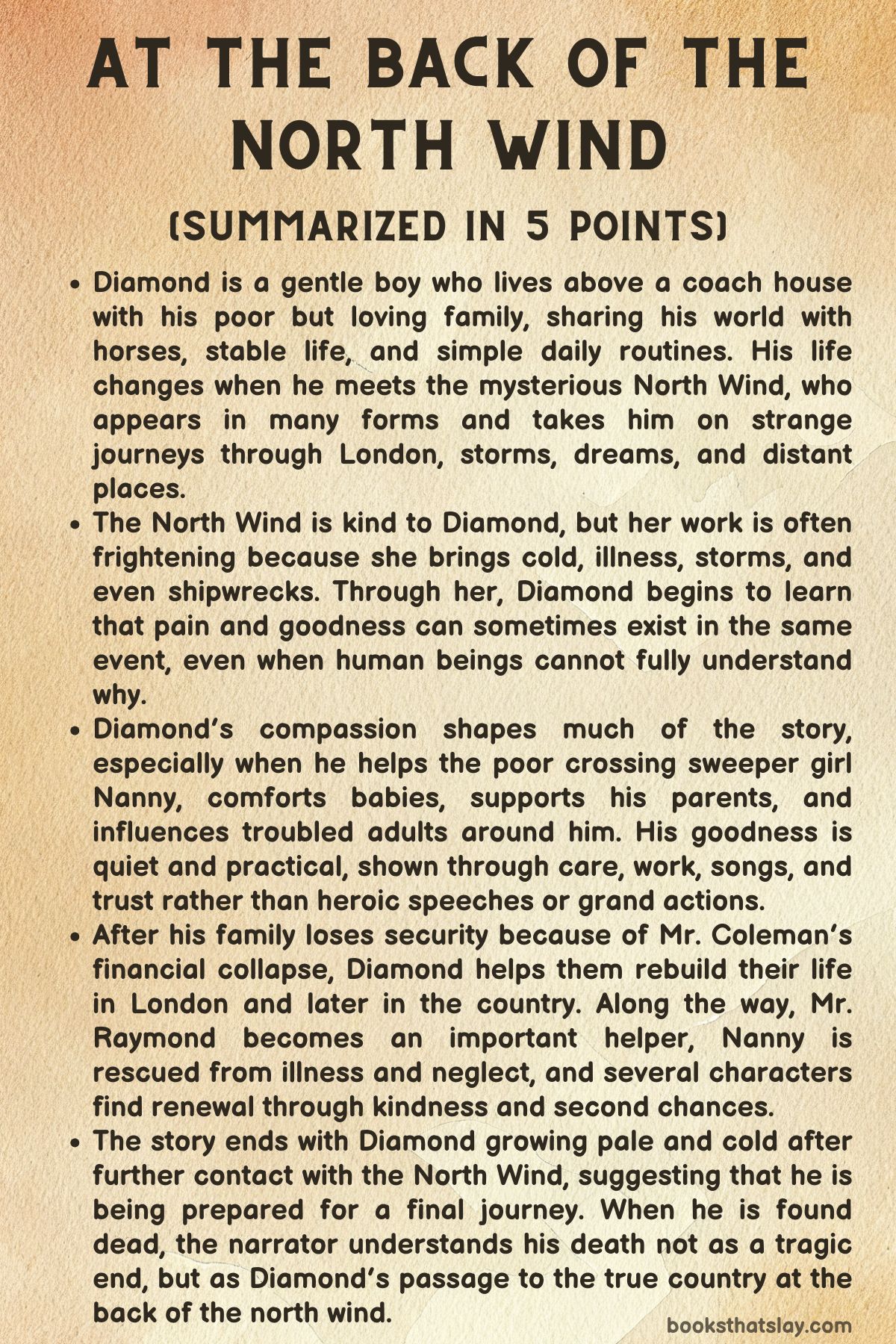
Summary
Diamond is a little boy who lives with his parents above a coach house on the outskirts of London. His father is a coachman, and Diamond is named after his father’s favorite horse, Old Diamond.
The family is poor but loving, and Diamond’s life is simple, shaped by the stable, the hayloft where he sleeps, and the horses below him. One cold night, while trying to warm himself after testing how much cold he can bear, Diamond notices a small hole in the wall of his loft.
His mother covers it, but a mysterious voice later complains that he has closed its window. When Diamond opens the hole again, he meets the North Wind, who appears as a beautiful woman and invites him to come with her.
Diamond’s first meetings with the North Wind are full of uncertainty. She is beautiful, kind to him, and protective, yet she also warns him that beauty is not always the same as goodness and that he must learn to recognize her in different forms.
Diamond follows her outside but loses sight of her and ends up in the garden of the Colemans, the family that employs his father. Lonely and frightened, he is discovered by Mrs. Crump, who thinks he is sleepwalking.
He mistakes Miss Coleman for the North Wind and is embarrassed, but the women treat him kindly and send him home.
Diamond begins to question whether his experience was real or only a dream. Soon, however, the North Wind returns.
She appears in different shapes and takes him into London, where he witnesses her strange work. She frightens a drunken nurse who has been mistreating a child, causing the household to discover the nurse’s bad behavior.
Diamond learns that the North Wind may do frightening things for merciful reasons. He struggles to understand how someone he loves can also be connected with pain, danger, and fear.
On another night, the North Wind carries Diamond over London while she sweeps the streets with her powerful wind. Diamond sees a poor little girl trying to sweep a crossing and asks the North Wind to help her.
The North Wind says she is helping in a larger way, but Diamond cannot ignore the child’s suffering. He leaves the North Wind’s protection and goes to help the girl himself.
He and the girl are driven about by the cold wind, locked out of her home by Old Sal, and forced to wander the streets. They finally shelter in a barrel before the wind drives them toward Diamond’s old neighborhood.
The girl remains doubtful of Diamond’s talk about the North Wind, but Diamond’s impulse to help her becomes important later.
As the story continues, Diamond grows close to Miss Coleman, who allows him to play in the garden. The North Wind returns in miniature form and tells Diamond that she must sink a ship.
Diamond is troubled by this and cannot understand how sinking a ship can be part of goodness. Later, during a storm, she carries him away and explains that she has work to do at sea.
Diamond insists that she is kind, even when he cannot understand her actions. She leaves him in a cathedral so he will not have to witness the shipwreck.
There, he must face loneliness and fear by himself. He falls asleep beneath the stained-glass windows and later imagines or hears the saints in the windows talking in a petty, unworthy way, which makes him doubt that they are truly holy figures.
Diamond becomes fascinated by the idea of reaching the place at the back of the north wind. He is sent to Sandwich to stay with his aunt while he is unwell, and there the North Wind speaks to him again.
He asks to go to the country at her back, and she agrees, though the journey is difficult. She carries him northward by ship and through ice, fading as she fights against the South Wind.
Diamond eventually reaches a cold boundary where the North Wind is frozen outside the land at her back. To enter, he must pass through her.
He does so and finds himself in a peaceful country filled with music, beauty, warmth, and people who seem to be waiting for a greater gladness.
Diamond stays in that mysterious country for what feels like a long time, though only seven days pass in the ordinary world. He misses his mother and eventually senses her grief.
He finds the North Wind again, frozen and still, and his touch helps her revive. She carries him back south.
When he wakes in Sandwich, his mother tells him he has been very ill. During this time, the Coleman family has suffered ruin.
Mr. Coleman’s financial dishonesty has collapsed, his property has been seized by creditors, and Diamond’s father has lost his position. The ship the North Wind sank belonged to Mr. Coleman, and Miss Coleman’s former lover, Mr. Evans, was aboard it.
After Diamond recovers, his family faces hardship. Diamond’s father eventually finds Old Diamond again and buys him along with a cab, allowing the family to begin a new life in London.
Their new home in the mews is poorer and less pleasant than their old home, but Diamond tries to keep everyone cheerful. His mother has a baby, and Diamond helps care for the child.
His songs, which he says come from the river and swallows of the country at the back of the north wind, comfort the household.
Diamond’s goodness begins to affect the people around him. He helps the men in the mews become less crude in speech and behavior.
He learns to handle horses and to drive. He again encounters the crossing sweeper girl, now known as Nanny.
When boys bully her, Diamond defends her and is injured. Later, he meets a gentleman named Mr. Raymond, who notices Diamond’s unusual innocence and intelligence.
Mr. Raymond encourages him to learn to read and promises him books and money when he does.
Diamond learns to read from the book found earlier on the beach at Sandwich. When Nanny disappears from her crossing, Diamond goes to find her and discovers that she is terribly ill in Old Sal’s cellar.
With Mr. Raymond’s help, Nanny is taken to a children’s hospital. There, she begins to recover.
Mr. Raymond tells the children a fairy tale called “Little Daylight,” about a princess cursed to wake only at night and change with the moon, and a prince whose compassion breaks the spell when he kisses her without knowing who she is.
Diamond’s father falls ill, and the family struggles for money. Diamond wakes early, harnesses Old Diamond himself, and drives the cab to earn money for his mother.
Though he is only a child, he handles the work with surprising skill. He also solves Mr. Raymond’s riddle with help from a passenger.
Later, Diamond drives a fare who turns out to be Mr. Evans, Miss Coleman’s lost lover. Mr. Evans survived the shipwreck and came to understand that he should not have abandoned Miss Coleman because of poverty.
Diamond brings him to her, and the two are reunited.
Nanny eventually comes to live with Diamond’s family. She learns to care for the baby and to read, while the family continues to struggle.
Mr. Raymond lends them his horse Ruby, but Ruby becomes lame and does not work as expected. Diamond later overhears Old Diamond and Ruby speaking in the stable.
Old Diamond accuses Ruby of laziness and dishonesty, while Ruby claims to be an angel horse. Diamond, with his usual trust, believes Ruby’s strange claim.
When Mr. Raymond returns, he offers Diamond’s father a better position in the country as his driver, using both Old Diamond and Ruby.
The family moves to the country, and Diamond arranges for Nanny’s friend Jim to come too by asking Mr. Raymond to employ him. Diamond eventually becomes a page in the Raymond household.
The narrator, who has been telling the story, finally appears as a character and meets Diamond. He becomes interested in the boy’s strange wisdom, songs, and stories of the North Wind.
Diamond confides much of his history to him.
In the country, Diamond continues to wonder whether his experiences with the North Wind are dreams or reality. Nanny is skeptical, but Diamond longs for them to be true because they carry such deep joy.
The North Wind returns and explains that she appears differently to different people, but her heart remains the same. She tells Diamond that the country he once visited was only a picture of the real country at her back, which he will someday reach.
Diamond has one more journey with the North Wind. She carries him over the countryside and back to his old home, where he sees that the place has changed and feels empty without the people who once made it beloved.
Later, Diamond becomes pale and cold after seeing the North Wind frozen again. The narrator grows worried.
Soon afterward, Diamond is found lying in the attic room. To others, he seems dead, but the narrator understands his death as his true journey to the real country at the back of the north wind.
Characters
Diamond
Diamond is the central figure of the book and the moral center of At the Back of the North Wind. He is a child whose innocence is not ignorance but a rare openness to goodness.
He trusts deeply, loves easily, and responds to suffering with action rather than complaint. His compassion appears early when he leaves the safety of the North Wind to help the crossing sweeper girl, and it continues through his care for babies, horses, Nanny, his parents, and even troubled adults.
Diamond’s imagination is central to his identity, but the book never treats imagination as mere childish fantasy. Through him, dreams, songs, visions, and spiritual truths become ways of understanding reality.
He is often called strange or not quite right by others, but the story presents his difference as a kind of wisdom. His death at the end is not described as defeat.
It is the completion of the longing that has shaped his life.
The North Wind
The North Wind is one of the most mysterious figures in the story. She is motherly, frightening, playful, severe, beautiful, and sometimes almost impossible to understand.
To Diamond, she appears as a woman, a girl, a tiny creature, a wolf, and many animals, showing that her nature cannot be reduced to one form. She is associated with cold, storms, illness, shipwreck, and death, yet she also protects children, corrects injustice, carries Diamond safely, and leads him toward spiritual understanding.
Her role is not simple comfort. She teaches Diamond that goodness may include pain, and that human beings often cannot see the whole meaning of events.
She becomes a figure of divine mystery, fate, death, and mercy at once. Her affection for Diamond is real, but she never lets him remain morally passive.
She tests his courage, asks for trust, and prepares him for the country beyond ordinary life.
Diamond’s Father
Diamond’s father is a hardworking coachman whose love for his family is quiet but steady. He is practical, honest, and emotionally attached to Old Diamond, the horse that once belonged to Mr. Coleman.
His reunion with the horse shows his tenderness and loyalty. When he loses his employment after Mr. Coleman’s ruin, he does not collapse into bitterness, though he is deeply shaken.
He accepts difficult work as a cabman and later allows Diamond to help in ways that many parents might refuse. His trust in Diamond grows because he sees the boy’s unusual skill and goodness.
At times, he worries that Diamond’s beliefs are strange, especially when Diamond speaks of Ruby as an angel horse, but his concern comes from care rather than cruelty. He represents humble dignity under economic pressure.
Diamond’s Mother
Diamond’s mother is loving, anxious, and practical. She worries about her son’s health, the family’s money, her husband’s illness, and the care of her babies.
Her life is marked by domestic labor and emotional strain, yet she provides warmth and stability. She does not always understand Diamond’s visions or songs, and she fears that his talk of other worlds may signal illness.
Still, she listens, cares, and allows him space to be himself. Her tenderness toward Diamond is especially clear when he is sick and when she worries over his early cab-driving.
She also shows moral generosity when she agrees to take in Nanny despite the family’s poverty. Her character grounds the spiritual and fantastic elements of the novel in ordinary family love.
Old Diamond
Old Diamond, the horse, is more than an animal companion. He represents loyalty, memory, work, and continuity through hardship.
At first, he shares a name and sleeping space with Diamond, linking the boy to the stable world and to his father’s labor. Later, when the family loses its position, Old Diamond’s return gives them a way to survive.
He is old, worn, and less strong than before, but he remains valuable because of his history and faithfulness. In the strange stable conversation with Ruby, Old Diamond becomes almost moral in his stern honesty.
He condemns laziness and deceit, showing the old working horse as a figure of plain duty. His bond with Diamond and Diamond’s father gives emotional weight to the family’s struggle.
Mrs. Crump
Mrs. Crump is the Coleman household’s old nurse, and she appears as a practical, kindly woman. When she finds Diamond crying outside at night, she assumes he is sleepwalking and brings him inside rather than reacting harshly.
Her treatment of him is gentle, and she helps return him safely to his mother. She belongs to the domestic world of care, routine, and watchfulness.
Although she is not central to the later action, her early kindness matters because it contrasts with the cruel or neglectful caregivers elsewhere in the story, such as the drunken nurse and Old Sal.
Miss Coleman
Miss Coleman is a young woman whose life is shaped by illness, disappointment, and emotional stagnation before her reunion with Mr. Evans. She is kind to Diamond and allows him to enjoy the garden, giving him a space of beauty and friendship.
Her poor health is not only physical; the narrator suggests that sorrow and lack of meaningful purpose have weakened her. Her abandoned relationship with Mr. Evans leaves her wounded, and her family’s financial collapse worsens her situation.
Yet she is not bitter. When Diamond brings Mr. Evans back to her, her joy shows how much love has remained alive beneath her suffering.
In At the Back of the North Wind, she reflects the human need for hope, vocation, and faithful affection.
Mrs. Coleman
Mrs. Coleman is part of the respectable household that first surrounds Diamond’s family. She is not presented in as much emotional depth as her daughter, but she represents the social world above Diamond’s family in class and comfort.
Her interaction with the sweeper girl, whom she does not pay, shows the limits of conventional respectability. She is not cruel in a dramatic way, but she can fail to see the poverty directly in front of her.
Later, when the Coleman family falls, she becomes part of the story’s wider movement from security to vulnerability. Her character helps show how social position can change quickly and how moral vision matters more than wealth.
Mr. Coleman
Mr. Coleman is an important though often distant force in the story. He begins as Diamond’s father’s employer, but his dishonesty and financial decline eventually destroy the Coleman household’s stability.
He conceals poverty through deception, and the shipwreck connected with the North Wind becomes part of the moral correction directed at him. His failure affects many others: his wife, his daughter, Diamond’s father, and Diamond’s family.
He is not explored as a villain in a simple sense, but as a man whose fear, pride, and dishonesty cause suffering. Through him, the book criticizes the moral decay that can hide beneath social respectability.
Mr. Coleman’s Clergyman Brother
Mrs. Coleman’s brother, the clergyman, appears briefly after the storm damages the garden. His comment about the north wind and the hyperborean regions helps Diamond connect ordinary adult speech with his own secret longing to reach the country at the back of the north wind.
The clergyman is not developed as a major spiritual guide, but his presence adds a note of learned, religious language to the story. Ironically, Diamond’s spiritual experience is much deeper than the adult’s casual reference.
The character helps show how children may grasp truths that adults mention without fully understanding.
Nanny
Nanny begins as the poor crossing sweeper girl whom Diamond helps in the storm. Her life is harsh, shaped by hunger, cold, street labor, and Old Sal’s neglect.
At first, she is skeptical, rough, and suspicious, which is understandable given her conditions. Diamond’s friendship becomes a turning point for her.
When she falls ill, he seeks help, and Mr. Raymond arranges her care at the children’s hospital. Her recovery softens her manners and opens a new future.
Once she comes to live with Diamond’s family, she learns reading, childcare, and gentler habits. Nanny’s growth is not presented as instant perfection.
She still argues with Diamond and doubts his dreams, but she becomes capable of love, loyalty, and work. Her transformation shows the healing power of care, safety, and moral friendship.
Old Sal
Old Sal is Nanny’s grandmother or guardian figure, and she represents neglect, poverty, and moral damage. She locks Nanny out if the girl returns late, even though Nanny is a child exposed to cold and danger.
She spends money on liquor and fails to protect the girl in her care. Old Sal is not given a rich inner life, but her role is important because she embodies the conditions from which Nanny must be rescued.
She also reflects one of the book’s recurring concerns: children suffer deeply when adults surrender to selfishness, addiction, or despair.
Mr. Raymond
Mr. Raymond is a gentleman, storyteller, benefactor, and moral ally to Diamond. He recognizes Diamond’s unusual intelligence and goodness when others dismiss him as strange.
Rather than laughing at the boy, he encourages his reading, gives him books, pays him fairly, and helps him care for Nanny. His story of “Little Daylight” mirrors the larger book’s interest in hidden beauty, enchantment, suffering, and transformation.
Mr. Raymond uses his social position generously. He arranges medical help for Nanny, lends Ruby to Diamond’s family, and eventually offers Diamond’s father a better position in the country.
He is not merely charitable; he listens to children seriously, which makes him one of the adults most aligned with the book’s moral vision.
John
John, Mr. Raymond’s servant, appears in a small but revealing role. When Diamond first comes to Mr. Raymond’s house seeking help for Nanny, John refuses him entry and lies about Mr. Raymond’s whereabouts.
His behavior reflects gatekeeping, class prejudice, and the tendency of servants in respectable houses to protect order at the expense of mercy. John is not a major figure, but his action matters because it delays help for a sick child.
His presence contrasts with Mr. Raymond’s openness and Diamond’s urgency.
The Police Officer
The police officer who helps Diamond near Nanny’s home is a figure of practical protection. He sees that Diamond is vulnerable in a dangerous part of London and follows at a distance even when Diamond insists he can manage alone.
When women threaten to steal Diamond’s clothes, the officer intervenes and escorts him away. He represents public order at its best: not cold authority, but watchful assistance.
His role also shows Diamond’s innocence in contrast with the harsh realities of the city.
The Drunken Cabman
The drunken cabman next door is one of the book’s clearest examples of moral recovery. At first, he is frightening: he shouts, drinks heavily, terrifies his wife, and harms the peace of his home.
Diamond does not condemn him from a distance. Instead, he enters the room, comforts the baby, and speaks with gentle honesty.
The cabman hears Diamond’s song and words, and shame awakens in him. His decision not to drink for a week marks the beginning of change.
The character shows that goodness can work quietly, not by argument or punishment alone, but by making a person see himself clearly.
The Drunken Cabman’s Wife
The cabman’s wife is a suffering domestic figure trapped in poverty and fear. Her crying beside her child shows the damage caused by her husband’s drinking.
She has little power in the scene, but her distress gives urgency to Diamond’s intervention. She also represents the hidden victims of addiction: family members who bear the emotional and physical consequences.
Though the book does not give her a large independent arc, her presence makes the cabman’s reform more meaningful.
The Drunken Cabman’s Child
The cabman’s child is important because Diamond’s care for the baby becomes the means through which the father begins to change. The child is helpless, frightened, and dependent, yet his response to Diamond’s tenderness softens the room.
Babies in the book often bring out Diamond’s best qualities. This child, like Diamond’s siblings, becomes a sign of innocence that adults are morally responsible to protect.
Diamond’s Baby Brother
Diamond’s baby brother gives Diamond a daily outlet for care, music, and service. Diamond nurses him, entertains him, and sings to him, helping lift his parents’ spirits during hardship.
The baby is not developed as an individual personality, but his presence reveals Diamond’s patience and usefulness at home. Through him, the story shows that goodness is not only found in magical journeys but also in ordinary acts such as soothing a crying child.
Dulcimer
Dulcimer, Diamond’s baby sister, is named by Diamond before her christening. Her presence comes during a period of financial strain, yet Diamond greets her with love and song rather than resentment.
Like the baby brother, she shows Diamond’s gift for turning domestic care into joy. Dulcimer also strengthens the sense of Diamond as a child who behaves almost like a guardian spirit within his own family.
Mr. Stonecrop
Mr. Stonecrop, the stable owner, notices Diamond’s ability with horses and gives him an opportunity to drive. His role is small but useful because he helps confirm that Diamond’s gifts are real, not merely imagined by his family.
By trusting him with a ride, Mr. Stonecrop becomes part of Diamond’s movement into useful work. He represents the working world’s recognition of skill, even in an unlikely child.
Mr. Evans
Mr. Evans is Miss Coleman’s former suitor, and his story centers on pride, poverty, survival, and repentance. He once refused to marry Miss Coleman because he was ashamed of being poor.
This decision caused pain and separation. After surviving the shipwreck connected with Mr. Coleman’s affairs, he realizes that his earlier choice was wrong.
His return is an act of humility. Diamond’s decision to take him to Miss Coleman becomes one of the boy’s important services to others.
Mr. Evans shows that suffering can lead to moral clarity when a person is willing to admit failure.
Ruby
Ruby is Mr. Raymond’s horse, and his character becomes comic, strange, and morally suggestive through Diamond’s overheard stable conversation. Ruby is accused by Old Diamond of laziness and of allowing himself to become fat rather than work properly.
His claim that he is an angel horse may be an excuse, a fantasy, or one of the story’s playful mysteries. Diamond believes him, as Diamond often believes in hidden goodness.
Ruby contrasts with Old Diamond’s stern work ethic. He introduces humor but also raises questions about self-deception, dignity, and the possibility that even laziness may hide some unknown purpose.
Jim
Jim is Nanny’s young friend, and his importance lies in Nanny’s attachment to him. When the family prepares to move to the country, Nanny is reluctant because she does not want to leave Jim behind.
Diamond responds by asking Mr. Raymond to hire Jim, showing Diamond’s sensitivity to others’ emotional ties. Jim’s presence helps Nanny enter the new country life without losing someone she loves.
He also becomes part of the small community of rescued and cared-for children around Diamond.
Mrs. Raymond
Mrs. Raymond is the woman who lends Nanny the ruby ring and later becomes Mr. Raymond’s wife. She is associated with beauty, kindness, and the dream that Nanny describes.
Her presence helps connect the realistic world of charity and household care with the dream world that shapes the children’s imaginations. As Mrs. Raymond, she becomes part of the benevolent country household where Diamond later serves.
She is not described in great psychological depth, but she contributes to the atmosphere of healing and generosity around Mr. Raymond.
The Narrator
The narrator begins as a storytelling voice and later enters the book as a character who meets Diamond in the country. His role is important because he mediates between the reader and Diamond’s strange experiences.
He admits uncertainty, reflects on the meaning of Diamond’s visions, and treats the boy with seriousness. Unlike many adults, he does not dismiss Diamond as foolish.
His final interpretation of Diamond’s death gives the book its closing spiritual meaning. To him, Diamond has not simply died; he has gone to the true country at the back of the North Wind.
Diamond’s Aunt
Diamond’s aunt provides shelter in Sandwich while Diamond is unwell. She is not deeply characterized, but her invitation creates the circumstances for Diamond’s journey toward the country at the back of the north wind.
Her home becomes the ordinary setting from which one of the book’s most extraordinary journeys begins. She represents family support beyond the immediate household.
The Old Woman at the Toy Shop
The old woman who owns the toy shop in Sandwich befriends Diamond during his stay there. Her shop, with the toy windmill moved by the North Wind, becomes a quiet meeting point between ordinary life and wonder.
She is a minor but warm figure, adding to the gentle atmosphere of Sandwich and giving Diamond a small human connection while he is away from home.
Diamond’s Father’s Old Friend
Diamond’s father’s old friend helps him find Old Diamond and acquire a cab after the Coleman household collapses. His practical kindness is crucial because it allows the family to rebuild.
When he sees the emotional reunion between Diamond’s father and the horse, he responds generously. He shows that friendship among working people can be life-changing, especially when formal security has failed.
The Blacksmith
The blacksmith appears briefly when Diamond and his father take Old Diamond for new shoes. His role is part of the working world surrounding horses, cabmen, and stable life.
He helps establish the practical environment in which Diamond grows up. Though minor, he belongs to the network of labor that grounds the story’s fantasy in everyday reality.
The Cruel Nurse
The drunken nurse whom the North Wind frightens is a disturbing figure because she abuses a child under her care. The North Wind’s intervention exposes her misconduct, leading others in the house to discover the truth.
The nurse shows how vulnerable children are when adults entrusted with their care become selfish or careless. Her punishment also helps Diamond begin to understand that the North Wind’s frightening actions may serve justice.
The Mistreated Child
The child cared for by the cruel nurse is mostly unseen, but the child’s vulnerability matters. The North Wind acts to protect this child without terrifying the child directly.
This small episode reveals the story’s moral structure: children may suffer silently, and unseen forces of justice may act on their behalf.
The Man in the Boat
The man in the boat appears when the North Wind blows mist to wake him and guide him toward shore. This brief incident shows that her work is not only destructive.
Even while she is connected with storms and shipwrecks, she also saves. The man’s role helps Diamond and the reader see that the North Wind’s actions cannot be judged from only one event.
The Older Gentleman Passenger
The older gentleman who helps Diamond solve Mr. Raymond’s riddle is a small but generous figure. He treats Diamond with patience rather than mockery and pays him well.
His answer, a tree, helps Diamond move forward in his relationship with Mr. Raymond. The character shows how casual kindness from strangers can support a child’s growth.
The Boys Who Bully Nanny
The boys who bully Nanny represent street cruelty and the way children can imitate the harshness of the world around them. Their attack on Nanny and Diamond shows that poverty does not automatically create solidarity.
Diamond’s willingness to defend Nanny, even when he is hurt, stands in clear contrast to their cowardice and aggression.
The Men at the Wharf
The men who try to rob Diamond when he carries a fare to the wharf represent the dangers of the city’s rougher public spaces. Diamond’s innocence makes him vulnerable, but he is protected by the intervention of Mr. Evans.
Their role increases the sense that Diamond’s goodness exists in a world where exploitation is common.
Herodotus
Herodotus appears only through the narrator’s opening reference to people at the back of the north wind. His mention gives the story an old, legendary frame.
He connects Diamond’s private spiritual journey to ancient tales of distant blessed lands. Though not a character in the action, the reference helps establish the book’s interest in myth, report, and mystery.
Durante
Durante is mentioned by the narrator as someone who described the country at the back of the north wind. He functions as a literary witness to the mysterious land.
His description supports the idea that Diamond’s experience is part of a larger spiritual tradition rather than an isolated dream.
Kilmeny
Kilmeny is another figure used by the narrator to compare accounts of the country at the back of the north wind. As a peasant girl who described the place poetically, she broadens the story’s sense of who may receive visions.
Her presence suggests that children, humble people, and poets may understand truths that others miss.
St. Paul, St. Matthew, St. Luke, and St. John in the Cathedral Vision
The voices Diamond hears from the stained-glass windows sound like saints, but their petty complaints make him doubt their holiness. These figures are important less as true apostles than as part of Diamond’s test in the cathedral.
They reveal his instinct for spiritual authenticity. Diamond knows that holiness should not sound vain, irritable, or narrow.
The scene also shows that religious images alone do not guarantee spiritual truth.
Little Boy Blue
Little Boy Blue is the central figure in the poem Diamond learns to read. He loses his way, is misled by a snake, and receives help from forest creatures before overcoming the snake.
As a story within the story, he mirrors Diamond’s own movement through confusion, danger, guidance, and moral learning. He also gives Diamond practice in interpretation, showing how reading becomes a way of thinking about life.
Princess Daylight
Princess Daylight is the heroine of Mr. Raymond’s fairy tale. Cursed to wake only at night and to change with the moon, she embodies beauty hidden under suffering and change.
Her condition makes identity unstable: she is radiant under the full moon and withered under the dark moon, yet she remains the same person. Her release depends on love that responds compassionately without full knowledge.
She reflects the larger story’s belief that true vision sees beyond outward appearance.
The Old Witch
The old witch in “Little Daylight” represents malice, envy, and the desire to limit joy. Her curse distorts the princess’s life and separates her from ordinary daylight.
She is a fairy-tale form of destructive will. Yet her power is not final, because another fairy modifies the curse and the prince’s compassion eventually breaks it.
Her role shows that evil may wound life deeply but cannot fully control its ending.
The Good Fairy
The good fairy who softens the witch’s curse represents mercy acting within limitation. She cannot erase the curse entirely at once, but she changes its ending and makes redemption possible.
This resembles the way the North Wind’s actions may not remove suffering immediately but may guide it toward a hidden good. The fairy’s role is quiet but decisive.
The Prince
The prince in “Little Daylight” learns love through exile, loss, and wandering. He first loves the princess in beauty, but the curse is broken when he shows tenderness to her in a form he does not recognize.
His kiss is not based on glamour or reward; it is an act of compassion toward someone helpless. This makes him a model of love that sees dignity before certainty.
The Fairy Disguised as an Old Woman
The fairy disguised as an old woman helps the prince when he is displaced by violence in his kingdom. She gives him food and care, guiding him without revealing everything.
Her disguise continues the book’s interest in hidden helpers. Like the North Wind, she shows that aid may come in forms that are easy to overlook.
Princess Daylight’s Attendants
The attendants care for Princess Daylight during her strange life in the woods. They protect her routine and help sustain the hidden world created around her curse.
Their role is practical and loyal. They are not the source of rescue, but they preserve the conditions in which rescue can eventually occur.
The Angel Boys in Diamond’s Dream
The angel boys in Diamond’s dream are playful, affectionate, and mysterious. They dig for stars underground and show Diamond holes through which he can see people and places he knows.
They represent childlike joy joined with cosmic work. Their world suggests that play and spiritual labor are not opposites.
The dream also prepares Diamond for thinking of heaven not as stillness alone, but as activity, discovery, and song.
The Girl Angels Mentioned in the Dream
The girl angels are not directly seen, but they are imagined as coming after the boys sleep to clean the stars. Their unseen work suggests hidden care that keeps beauty alive.
They also balance the angel boys’ playful digging with restoration and order. Though briefly mentioned, they fit the book’s wider pattern of invisible helpers.
Themes
Innocence as Spiritual Wisdom
Diamond’s innocence is not presented as weakness or lack of understanding. It is a form of perception that allows him to notice suffering and respond with trust.
He does not understand poverty, death, illness, or adult failure in the way grown people do, but he often understands the moral demand of a situation better than they do. When Nanny is cold, he helps her.
When the cabman’s child cries, he comforts the baby. When his father is ill, he works.
His innocence is active, not passive. The book repeatedly contrasts Diamond’s simplicity with adult fear, pride, dishonesty, and resignation.
Others call him strange or suggest that he may not be right in the head, but the story steadily shows that his difference is a gift. His openness to dreams, songs, and the North Wind allows him to live with hope in circumstances that might otherwise crush him.
Innocence here does not mean avoiding pain. Diamond suffers loneliness, fear, illness, and grief, but he continues to trust that goodness is real even when he cannot explain it.
Suffering, Death, and Hidden Mercy
Pain in At the Back of the North Wind is never treated lightly, yet it is often shown as part of a reality larger than human understanding. The North Wind sinks a ship, worsens illness, frightens wrongdoers, and carries Diamond toward death, but she also protects children, saves a man in a boat, exposes cruelty, and guides Diamond toward peace.
This creates a difficult moral vision: events that appear cruel may have meanings that people cannot see from their limited position. The story does not ask the reader to enjoy suffering or pretend that grief is easy.
Diamond’s mother weeps, Miss Coleman suffers, Nanny becomes seriously ill, and Diamond himself dies young. Yet death is presented not as emptiness, but as passage.
The country at the back of the north wind becomes a symbol of the hope that beyond coldness, fear, and loss there is a warmer and truer home. The theme is deeply spiritual, but it is also emotionally demanding because it asks for trust without full explanation.
Poverty, Work, and Human Dignity
The story pays close attention to poverty, especially in London. Diamond’s family lives close to financial danger, and one lost position changes everything.
Nanny sweeps crossings, sleeps in a cellar, and depends on adults who fail her. The drunken cabman’s family suffers because addiction and poverty feed each other.
Work is shown as necessary, tiring, and sometimes unstable, but it is also a source of dignity when done honestly. Diamond’s father works as a coachman and cabman; Diamond learns to drive, care for horses, and help earn money; Nanny learns skills that may give her a future.
The book does not romanticize poverty, because hunger, illness, and fear are real throughout the story. At the same time, it refuses to measure worth by wealth.
Mr. Coleman’s respectable status hides dishonesty, while Diamond’s poor family shows generosity by taking in Nanny. Mr. Raymond’s charity is valuable because it creates practical opportunity rather than offering only sentiment.
The theme insists that dignity belongs to the poor as fully as to the comfortable.
Transformation Through Love and Care
Characters change when they are seen, helped, and loved in practical ways. Nanny’s transformation begins not with punishment but with rescue, medical care, teaching, and belonging.
The drunken cabman begins to reform after Diamond treats his crying child with tenderness and speaks truth without hatred. Miss Coleman’s life brightens when Mr. Evans returns in humility.
Even Diamond’s family, burdened by poverty, finds strength through mutual service. Love in the story is rarely abstract.
It appears as feeding a child, teaching someone to read, caring for a baby, finding work for Jim, lending a horse, or guiding someone safely home. The fairy tale of Princess Daylight repeats the same idea in symbolic form: the prince breaks the curse not when he admires beauty, but when he shows compassion to someone who appears weak and unattractive.
Real love recognizes value before it receives proof. This theme gives the book much of its moral force.
People are not changed by lectures alone. They are changed when goodness reaches them through patient, embodied care.