The Lies of Lena Summary, Characters and Themes
The Lies of Lena by Kylie Snow is a fantasy romance built around a girl who has spent her whole life hiding what she is. Lena is a Mage in a kingdom that hunts Mages, and her survival depends on silence, restraint, and constant vigilance.
When a chance encounter pulls her into combat training, court politics, and forbidden bonds, the careful life she and her mother built in the Outer Ring starts to crack. What begins as a story about passing unnoticed turns into one about power, identity, and choosing who you’ll risk everything for—even when the world insists you shouldn’t exist.
Summary
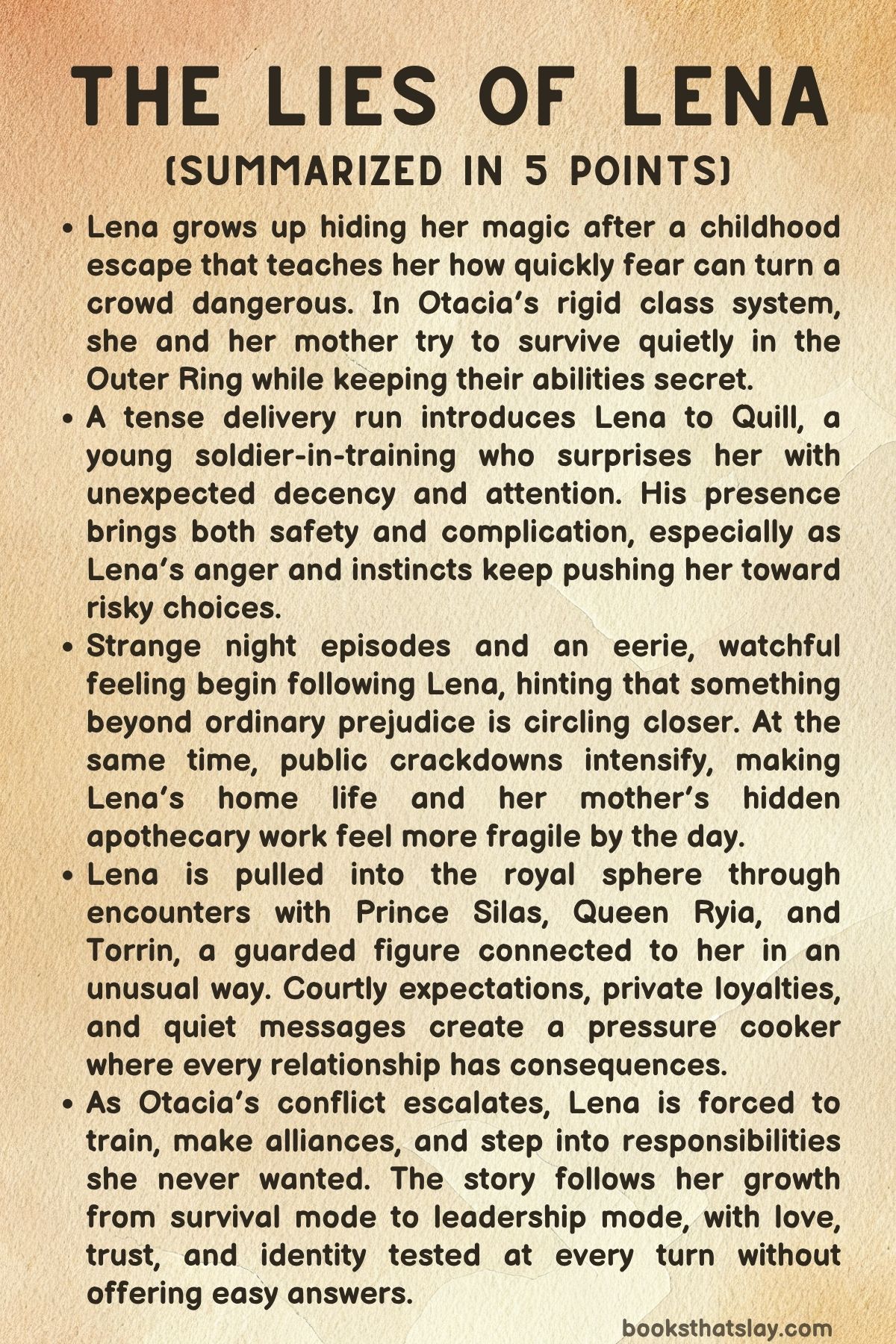
Lena’s first memory is of running. At four years old she flees through snow with her mother, who warns her again and again that Mages are hated and must never be revealed.
When Lena stumbles in a village and her instinctive magic flashes into a protective barrier, the reaction is immediate: villagers notice, panic, and chase them. They escape into a frozen forest, and instead of anger, Lena’s mother breaks down, apologizing for the life Lena has been forced to live.
From that day, Lena learns fear as discipline—she clamps down on her magic, believing one mistake could get them killed.
Years later, when Lena is twelve, they settle in Otacia, a large kingdom structured by class and controlled by harsh anti-Mage beliefs. Otacia is split into the wealthy Center, the Inner Ring of merchants and tradespeople, and the struggling Outer Ring.
Lena and her mother live in a small cottage in the Outer Ring, trying to stay ordinary. The kingdom is ruled by King Ulric La’Rune, known for brutality, and Queen Ryia, admired for public kindness and occasional visits to the Outer Ring.
The royal family carries old grief: their infant daughter was kidnapped years earlier and later found dead, and their son Prince Silas has since been kept protected within the castle.
At sixteen, Lena lives with constant tension. Her mother runs a combined bakery and apothecary, selling pastries and healing elixirs that are subtly enhanced with magic.
Lena hates any risk, but her mother wants her to learn at least the basics. Their disagreement turns raw—Lena admits she’s terrified that practicing magic will cost them their home and safety.
Her mother backs off, but reminds Lena that hiding is not the same as living. Lena also learns more about her father, Waylon, a fisherman her mother left behind while pregnant to avoid bringing danger to him.
One morning, Lena goes to the Inner Ring to deliver orders. There she is humiliated by wealthy girls who call her a peasant, knock her down, and steal her delivery bag.
Lena’s anger snaps her control; she pulls an obsidian dagger and threatens one of them. A tall teenage boy with black hair and striking golden eyes intervenes—not to protect the rich girls, but to stop them.
He introduces himself as Quill Callon, insists they return the stolen goods, and offers help when an elixir bottle breaks in the scuffle. Lena is trapped by time restrictions for Outer Ring residents, so she reluctantly gives Quill her list and map, trusting him to finish deliveries while she races home.
Lena’s mother is furious when she hears a stranger took the bag, and Lena spirals into shame—until Quill arrives at their cottage with everything returned and the money collected. Her mother apologizes and, when she needs rare herbs gathered beyond the walls, Quill offers to escort Lena.
In the Western Forest they both sense a cold, watchful presence that appears and vanishes without explanation. The moment leaves Lena uneasy, especially because it echoes the fear she carries from childhood.
As Lena and Quill continue delivering, they learn the limits of what healing can do. A customer’s father has died, and Lena is shaken by the reminder that effort does not guarantee rescue.
Quill comforts her, telling her she can’t save everyone, and makes it clear he doesn’t look down on her for being from the Outer Ring. Lena gets home just before curfew, thrown off balance by his warmth and attention.
Soon after, Lena experiences a terrifying episode at night: she wakes unable to move, sensing the same cold presence whispering her name. Her mother calls it sleep paralysis, but Lena’s fear grows when Queen Ryia visits the Outer Ring and seems to single Lena out twice.
At the market, the Queen buys everything from their stand, pays far more than necessary, and tells them to keep the excess. The money is life-changing, yet Lena can’t shake the feeling that the Queen’s interest has a reason.
Quill returns and begins training Lena in combat each Thursday. Lena is embarrassed by how unprepared she is, but she forces herself through exhaustion and learns discipline.
Over weeks she grows stronger, learns footwork, blocking, and control under pressure. She also learns how quickly Otacia turns cruel: soldiers drag neighbors from their home and banish them as suspected Mages while the crowd jeers.
Lena is sickened by how easily people participate in someone else’s ruin.
One day Quill takes Lena to Amethyst Pond near Serpent’s Cove, a criminal-controlled area. Their flirtation turns dangerous when men from the Cove stalk them and make threats.
Quill fights, killing attackers to protect Lena, but the aftermath leaves him shaken. Lena brings him home despite the risk, and she and her mother treat his wound with elixirs, hiding the true scale of what happened.
After seeing violence up close, Lena decides hiding is no longer enough. She asks her mother to teach her magic, starting with healing and enchantment.
Lena discovers she can channel warmth through her hands to close a wound, and the success is both empowering and frightening. The night terrors continue, as if something is calling to her from beyond her understanding.
When Quill misses a training day, Lena’s anxiety spirals into reckless action. She storms into Serpent’s Cove looking for him and is attacked and beaten.
Quill arrives in time to stop it, killing the man who is strangling her. Soldiers come, arrest criminals, and treat Lena as a victim, but the incident exposes how fragile her safety is.
At home, Lena’s mother forces a confrontation about what Lena has been doing and who she has been risking herself for.
Lena’s life then collides with the castle. She attends a royal ball with her mother, wearing a gown chosen by Prince Silas.
Silas approaches her openly, dances with her, and shares a brief space where both can imagine something better—while knowing the cost of their positions. Lena also has a strange connection with Torrin Brighthell, a guard with whom she communicates mind-to-mind.
Their telepathy creates closeness and confusion, and Lena’s stray thoughts expose feelings she didn’t mean to reveal.
Queen Ryia draws Lena aside to view art, and Lena is pulled toward a painting called “Rebirth,” which Ryia says is also Silas’s favorite. The night ends with Lena unsettled, caught between attraction, loyalty, and fear.
Later she hears a voice—Kayin—warning that a terrible change is coming, instructing her to find Torrin and go to Ames to save Magekind.
By morning, the kingdom is shattered: Queen Ryia has been assassinated. Lena rushes to the castle and confronts Torrin, suspecting he and Kayin knew something.
Torrin insists he did not know the Queen would be killed, and explains Kayin claimed to be a seer who used Torrin’s gift to reach Lena. Torrin reveals another shock: Kayin predicted Silas would find his Soul-Tie at sixteen—a red-haired Mage girl from the Outer Ring—and that girl is Lena.
Lena insists on seeing Silas. She finds him devastated, furious, and drowning in grief.
He tells her the accused assassin is Amatta, his mother’s aide, and that the King claims Amatta used magic. Lena stays with Silas through the night, offering comfort he can’t show anyone else.
Before she leaves, Silas gives her Queen Ryia’s sapphire necklace and begs her to be careful.
The “change” arrives in public. Amatta is executed, the crowd turns violent, and King Ulric declares a kill order for all witches, using fear to justify open slaughter.
He forces Silas to ignite the execution fire, tying the prince to his agenda. Lena realizes this is the future Otacia is choosing: a kingdom that will hunt her, her mother, and anyone like them without restraint.
Lena’s mother acts fast. They decide to fake their deaths by burning their cottage and using magic to leave false bodies behind.
Lena cannot leave without saying goodbye to Silas one last time, so she sneaks back and asks him to promise he won’t give up, whatever happens. She doesn’t tell him the truth of her departure.
Returning home, Lena’s grief triggers a new, uncontrolled power: ice blooms from her, freezing her arms to the floor. Torrin, revealed as a fire Mage, melts the ice—confirming Lena’s magic runs deeper than she knew.
They burn the cottage, drink invisibility elixirs, and flee the kingdom into the forest.
Five years pass. Lena lives in Ames among Mages, training her ice and fire and becoming a capable fighter.
Torrin has been gone for over a year, leaving without explanation. The leader, Igon, summons Lena, speaks of old realms, and points her toward Mount Rozavar and an enchanter family there.
Lena demands answers about Torrin and learns Igon pushed Torrin away because Torrin’s feelings for Lena were growing while Lena’s Soul-Tie is Silas. Lena is also hit with news that Silas has married.
Her anger flares literally, and she storms away, torn between old love, betrayal, and the cost of destiny.
Events later tighten into a dangerous escape. Lena and allies—Merrick, Viola, and Elowen—are imprisoned, and Silas, now acting from inside the enemy structure, comes to Lena with a plan.
He begs her to promise that if everything fails, she will run. Lena agrees only as a last resort.
The plan hinges on distraction: Lena will climb the fortress exterior to ignite a catapult and set fires in empty rooms to draw soldiers west while Silas and Hendry free prisoners from cells under the eastern wing. Lena slips her mother a map and instructions to lead survivors toward Mount Rozavar.
Lena executes the climb, nearly falling, then sparks chaos with carefully controlled fire. As she moves through corridors with Roland—an opportunistic presence she doesn’t fully trust—she adds to the distraction.
The prisoners are released, and Lena throws up barriers of fire and then ice to stall pursuit. The group escapes on limited horses, merges with freed Mages, and Lena forces everyone to stop fighting long enough to understand the impossible truth: the prince betrayed his kingdom’s orders to free them.
On the road, they face exhaustion, suspicion, and attacks by cursed beasts. Silas repeatedly protects Lena, and their bond remains undeniable even as politics and survival complicate every decision.
They finally reach Mount Rozavar and find an enchanted marker only Mages can see. A voice named Immeron challenges them, then admits them when Lena explains Ames has fallen and Igon is dead.
They are teleported to a hidden mountaintop settlement, warm and alive.
Immeron reveals he is Igon’s brother. Lena asks for enchanted replacements for Edmund’s lost limbs, and the community agrees to help—especially once Lena privately admits Silas is her Soul-Tie.
Over the next week, they forge enchanted weapons and armor, and Edmund receives a working enchanted arm and leg, regaining movement and hope. Immeron also hints at a larger search: “Find Oquerene,” connected to rumors of Nereida, a hidden southern land with dangerous borders and darker forces.
As they prepare to leave again, Lena and Silas speak quietly. He returns Igon’s compass, and Lena acknowledges the changes he made to improve the Outer Ring.
Silas reacts sharply, as if kindness is harder for him than hatred. After he leaves, Lena senses the same chilling presence that has followed her for years—and hears Kayin in her head again, reminding her their work is not finished.
Characters
Lena
Lena is the emotional and moral center of The Lies of Lena—a girl shaped by fear, scarcity, and the constant discipline of hiding who she is. Her earliest flight through snow with her mother hardwires a survival instinct that later shows up as hypervigilance, quick anger when cornered, and an almost compulsive need to control outcomes.
What makes Lena compelling is the tension between her deep compassion and her learned ruthlessness: she delivers healing goods to strangers yet holds an obsidian dagger to a rich girl’s throat when humiliation and injustice boil over. As the story progresses, her arc becomes less about discovering power and more about accepting responsibility for it; she moves from suppressing magic to choosing it deliberately, first through healing, then through enchantment, and finally through full-spectrum combat magic that includes ice and fire.
Her relationships reveal her central conflict—she wants love, belonging, and safety, but she keeps reaching for them through secrecy, half-truths, and self-sacrifice, which repeatedly turns intimacy into danger. Lena’s “lies” are not only spoken deceptions; they are the identities she wears to survive class hatred, mage persecution, and royal politics, until the pressure forces her to decide what kind of leader she will be when hiding is no longer possible.
Lena’s Mother
Lena’s mother functions as both shield and forge: she protects her daughter fiercely while also quietly preparing her to become someone who can endure what the world will demand. Her love is practical—she builds a life in the Outer Ring, runs a bakery and apothecary, and risks subtle enchantment to keep people alive, even while knowing discovery could mean death.
She carries grief and guilt that seep into everything: the breakdown after Lena’s childhood magic flare shows a parent who hates the cost her child must pay for being born a Mage, and her insistence that Lena learn basic magic reads as desperation, not ambition. She is also morally complex; she sells enchanted healing to a kingdom that would burn her, and later chooses an extreme survival tactic—faking deaths by fire—to save her community.
As Lena grows, her mother becomes a mirror Lena can’t fully escape: where Lena’s fear turns into impulsive action, her mother’s fear turns into long-term planning and controlled risk. Their relationship is the story’s most intimate battleground, with love expressed through arguments about safety, autonomy, and the right to live as more than a hidden thing.
Silas “Quill” La’Rune
Silas “Quill” La’Rune is a prince forged in isolation and royal cruelty. Hidden in the castle since his sister’s murder, he chafes under his father’s brutality and the weight of expectation. As Quill, he becomes the golden-eyed, black-haired swordsman who defies class lines, protects Lena, and teaches her to fight—offering her the freedom and connection he himself craves.
His dual life creates constant tension: the disciplined, conscience-driven prince versus the passionate, reckless young man in love. Silas/Quill’s arc is defined by moral fracture—he learns violence, betrayal, and sacrifice while clinging to genuine desire for Lena. The lies he tells (and lives) mirror Lena’s own concealment, turning their romance into a mirror of mutual recognition and doomed longing.
Compassionate yet capable of ruthless choices, he embodies the story’s core conflict: how power, destiny, and love force a sheltered boy to become both savior and traitor.
King Ulric La’Rune
Ulric is the kingdom’s blunt instrument of fear, and he is written less as a distant tyrant than as a man who actively uses spectacle and policy to manufacture hatred. His brutality is not incidental; it is strategic, turning public punishment into social glue that binds citizens through shared cruelty.
The execution of Amatta—and his forcing Silas to ignite her—shows Ulric’s core method: he doesn’t merely kill enemies, he corrupts witnesses, recruits complicity, and makes violence a ritual that transforms grief into permission to hunt. Ulric’s reign intensifies after Ryia’s assassination, suggesting that compassion in the royal image had been a restraint, and once removed, his worst instincts become law.
He functions as the story’s primary human antagonist because he embodies institutional persecution; even when Lena wins fights in alleys or escapes fortresses, Ulric’s ideology follows like a shadow, turning entire populations into informants, mobs, and executioners.
Queen Ryia
Ryia is the story’s symbol of visible compassion within a corrupt structure, and her presence reveals how power can be used to dignify people even when it cannot fully protect them. Her visits to the Outer Ring, her enthusiastic support of local vendors, and her lavish overpayment are acts that look like generosity but also feel like recognition—she sees Lena, and that gaze carries meaning long before it becomes explicit.
Ryia’s repeated eye contact with Lena suggests awareness of prophecy, identity, or bloodline threads running beneath the surface, and her quiet encouragement of Torrin dancing with Lena shows her ability to guide without commanding. Her assassination is not only a political turning point; it is the narrative’s moral rupture, removing the one royal figure who made coexistence imaginable and leaving a vacuum that Ulric fills with sanctioned slaughter.
Ryia’s legacy persists through the sapphire necklace and through the emotional imprint she leaves on Silas, Lena, and even Torrin—proof that tenderness can matter, but also proof that tenderness can be targeted precisely because it threatens fear-based rule.
Torrin Brighthell
Torrin is the story’s quiet tension—disciplined, watchful, and restrained—yet his gift of mental communication makes him intimately connected to Lena in a way that bypasses consent unless carefully managed. Their telepathic link creates a relationship that feels like companionship, surveillance, and vulnerability all at once; the moment Lena accidentally thinks he is handsome is not just comedic embarrassment, it exposes how thin the boundary is between private self and shared space.
Torrin’s defining trait is controlled devotion: he follows duty, but he repeatedly chooses Lena’s safety, escorts her, protects her, and ultimately joins her flight from Otacia, even when it costs him emotionally. He is also caught in a moral web through Kayin, who uses Torrin’s ability as a conduit, making Torrin both an ally and an unwitting tool.
The revelation that Igon pushed Torrin away because his feelings grew too strong frames Torrin as a man who loved responsibly—stepping back because destiny and politics demanded it—yet that sacrifice leaves a wound that lingers for years. Torrin embodies the theme of loyalty under strain: he is a guard trained to obey, but his bond with Lena forces him to redefine what duty even means.
Kayin
Kayin functions like a voice at the edge of the world—part prophet, part manipulator, part warning system—and the story deliberately keeps his nature ambiguous to maintain dread. His messages arrive during paralysis and in disembodied speech, linking him to the chilling presence that stalks Lena’s sleep and the forests, which makes every “helpful” instruction feel like a threat wrapped in necessity.
Kayin’s insistence that Lena meet Torrin and go to Ames “to save Magekind” positions him as someone working on a larger timeline than any one character can see, and that scale raises suspicion: saving often demands sacrifice, and Kayin never fully explains the price. His earlier prophecy about Silas’s Soul-Tie suggests real foresight, but the way he routes communication through Torrin implies calculation and a willingness to invade boundaries.
Kayin is less a character of warmth and more a narrative force that turns personal drama into destiny, pulling Lena into movements and migrations that feel chosen and coerced at the same time.
Iliera
Iliera appears briefly, but she embodies the everyday terror of being a Mage in Otacia and the randomness of who gets caught. Her kindness to Lena and her mother shows how community can exist under persecution, but her banishment exposes how fragile that community is when the crowd’s fear is ignited.
The rumors about her ice magic being tied to deep grief add a thematic echo to Lena’s later awakening of ice power: magic is not just a tool, it is an emotional language, and pain can shape its form. Iliera’s removal is one of the story’s early moral shocks—proof that exile, humiliation, and dehumanization are not future threats but current policies lived in real time by decent people.
Xaro
Xaro, Iliera’s partner, amplifies the cruelty of persecution by showing its collateral damage: it is not only the accused who suffer but the family unit, the neighbors who watch, and the social fabric that learns to cheer at dispossession. The way the crowd spits and throws slurs as Xaro is dragged away demonstrates how persecution trains ordinary citizens to perform hatred as belonging.
Xaro’s presence is a reminder that “witch hunts” are not abstract—they are a mechanism that destroys households in minutes and teaches survivors to either hide better or become the mob.
Guinevere
Guinevere is a small but emotionally significant character because she shows the true impact of Lena’s mother’s work and the limits of what healing can do. When she tells Lena her father Gerald has died, she offers gratitude instead of blame, giving Lena a rare moment of being seen as someone who tried.
This encounter punctures Lena’s youthful fantasy that effort guarantees salvation and becomes part of her maturation: compassion matters, but it cannot rewrite mortality or injustice. Guinevere’s kindness also contrasts with the Inner Ring’s cruelty, underlining that class does not strictly determine character, even if it often determines behavior in crowds.
Gerald
Gerald appears through absence, yet his death provides a hard, quiet lesson that anchors the story’s stakes in ordinary suffering, not only grand prophecy. He represents the people Lena’s family serves—those who cannot access palace doctors or Inner Ring privileges—and the fact that enchanted elixirs can ease pain without preventing death reinforces the realism inside the fantasy.
Gerald’s role is to remind both Lena and the reader that magic is not omnipotence; it is a means of mercy in a world that still breaks bodies.
Amatta
Amatta is positioned as the alleged assassin and as the kingdom’s chosen scapegoat, and the narrative uses her trial and execution to show how “justice” becomes theater under Ulric. Whether she used magic is almost beside the point to the crowd; she becomes a symbol onto which the kingdom projects fear, grief, and hunger for punishment after Ryia’s death.
Her execution also functions as psychological warfare: it is designed to terrify hidden Mages into mistakes or surrender, and it succeeds by forcing Lena and her mother into irreversible flight. Amatta’s greatest narrative significance is how her death reshapes law into extermination—one body turned into a policy that makes every Mage a target.
Igon
Igon, Supreme of Ames, represents the political and spiritual leadership of Mage society, but his leadership carries the flaws of gatekeeping and control. He summons Lena with maps and ancient references, framing her as a piece in a broader plan involving Mount Rozavar and enchanter bloodlines, which suggests he thinks in strategies rather than purely in people.
His most consequential act is deeply personal: pushing Torrin away because of Torrin’s growing feelings and because Lena’s Soul-Tie is Silas. That decision reveals Igon’s belief in destiny and social order—he prioritizes the “correct” bond over the messy reality of love and choice—and it also shows how even Mage leaders can replicate coercive structures under the banner of protecting the greater good.
Lena’s explosive anger in response, literally igniting his desk, highlights that Igon’s authority cannot contain her grief, and that leadership which treats hearts like chess pieces creates rebellion as surely as oppression does.
Merrick
Merrick is the blunt conscience of the Mage fighters—protective, suspicious of Otacians, and emotionally honest even when it turns into harshness. His conflict with Elowen over Edmund exposes his central flaw: prejudice can exist even among the persecuted, especially when trauma turns caution into contempt.
Yet Merrick’s growth is visible in his eventual softening, his willingness to hug Elowen, and his participation in the group’s survival without making everything about his anger. As a training partner for Lena in later years, he also represents chosen family—someone who may not be gentle, but who shows up, fights, and holds the line when it matters.
Elowen
Elowen is defined by healing and steadfast loyalty, but her strength is not passive; it is the kind that endures captivity, keeps mending others, and refuses to apologize for love that crosses enemy lines. Her bond with Edmund—implied to be a Soul-Tie—challenges the group’s assumptions about purity and allegiance, forcing everyone to confront whether they want freedom or merely a reversal of power.
Elowen’s insistence that Edmund must escape with them reveals her values: she prioritizes individual humanity over factional hatred, and she is willing to be judged for it. Her presence also broadens the portrayal of magic beyond combat; healing becomes a political act, because keeping people alive is a form of resistance.
Viola
Viola brings volatility and versatility—both through her implied ability to shift shape and through her role as a fighter who can operate outside standard rules. By becoming a stallion to run without a mount, she embodies the story’s theme of adaptation under pursuit: survival belongs to those who can transform, literally or figuratively, when conditions change.
Viola is also socially sharp, often acting as an equalizing force in a group full of clashing loyalties; she is difficult to intimidate, which makes her useful around figures like Silas and Roland. Her combat presence signals that Magekind is not monolithic; their resistance includes many kinds of power and many kinds of personalities.
Hendry
Hendry is a practical bridge between sides: he works within Silas’s plan, manages logistics, and makes harsh decisions with a soldier’s urgency rather than a romantic’s hesitation. His care for Edmund—agreeing to ride with him, ensuring he is moved safely—shows an ethic rooted in competence and responsibility.
Hendry’s function in the narrative is often to keep the escape grounded in realism: someone has to handle horses, routes, timing, and the ugly compromises of getting bodies out alive. Where other characters burn hot with love or ideology, Hendry burns steady with execution.
Edmund
Edmund embodies the cost of conflict written onto the body: injured, impaired, and still insisting on agency even when he believes he is a burden. His willingness to stay behind to avoid endangering the others highlights his integrity, while Silas’s refusal to abandon him reveals a crucial moral line in Silas’s evolution.
Edmund’s relationship with Elowen carries emotional weight because it demonstrates that enemy labels collapse in the face of sustained care; love grows where propaganda says it should not. His enchanted prosthetics later become a symbol of restoration and future-building—proof that survival is not only escape, but the rebuilding of a life with dignity and function.
Roland
Roland is a destabilizer—charismatic, intrusive, and strategically useful in ways that make him hard to fully reject. His decision to insert himself into Silas’s escape plan suggests opportunism or hidden loyalty, and the fact that Silas threatens him yet still allows him in shows how dangerous necessity can be.
Roland’s flirting with Lena is not just romantic noise; it is pressure, temptation, and a test of boundaries, especially when he uses a kiss as camouflage during the fire distraction. That moment captures his essence: he can be clever and helpful, but he also treats intimacy as a tool, which makes him both effective and ethically slippery.
Roland’s presence constantly asks whether someone is ally, threat, or both—an ambiguity that mirrors Lena’s broader world where trust is a luxury.
Erabella
Erabella represents the possibility of change inside a person shaped by privilege and propaganda. Traveling with the freed Mages forces her to witness what her kingdom has done, and her apology to Lena signals genuine moral awakening rather than performative sympathy.
Her confession that she has never been asked what she thinks reveals how patriarchy and monarchy silence even those who benefit from the system, creating victims and participants in the same body. When she describes Silas improving the Outer Ring—warm water, business growth—she offers Lena something Lena rarely receives: evidence that compassion can be built into policy, not only into individual acts.
Erabella’s value in the story lies in her transition from ornament of power to witness and, potentially, advocate.
Immeron
Immeron is the gatekeeper of sanctuary and the embodiment of ancient Mage continuity. His booming interrogation at Mount Rozavar’s entrance frames him as someone who has learned caution through history, and his connection to Igon as a brother gives him inherited grief and inherited responsibility.
When he grants entry after hearing Ames has fallen, he signals that mercy and pragmatism can coexist: he tests newcomers, then commits resources decisively once convinced. Immeron’s readiness to help hinges not only on politics but on truth—Lena’s admission about her Soul-Tie becomes a lever of trust—showing how even sanctuary has conditions.
He is a builder figure, focused on weapons, armor, and the infrastructure of survival, which makes him crucial to the shift from fleeing to resisting.
Ayla
Ayla personifies the future the characters are fighting for: skilled craft, embodied resilience, and a life where magic serves creation as much as destruction. Her working enchanted arm is a powerful counterimage to trauma; it says loss does not have to be permanent diminishment, and ingenuity can restore agency.
Ayla’s calm competence balances Immeron’s gatekeeping intensity, creating a sanctuary that feels lived-in rather than purely militarized. By measuring clothes, guiding recovery, and demonstrating what enchanted craft can do, Ayla frames Mage power as civilization-building, not just warfare.
Waylon
Waylon exists mostly as absence—Lena’s never-met father whose name lives on through the bakery and apothecary. Yet that absence shapes Lena’s identity: it leaves her with unanswered questions about belonging and lineage, and it intensifies her bond with her mother as the sole architect of her world.
Waylon’s role also emphasizes the cost of persecution: love and family are interrupted not by personal failure but by systemic hatred that forces flight and secrecy. Even without appearing directly, Waylon is part of the emotional backdrop that makes Lena both hungry for connection and terrified of what connection can destroy.
Themes
Identity under persecution and the cost of concealment
Lena grows up learning that her very nature is punishable, so “being safe” becomes a daily performance rather than a state of peace. The early flight through snow isn’t just a dramatic origin story; it establishes a childhood where instinct is dangerous and honesty is a liability.
When her magic erupts to protect her from injury and the villagers immediately hunt her, the lesson is simple and brutal: self-preservation requires self-erasure. That pressure follows her into Otacia, where the city’s ringed structure makes hiding both possible and exhausting.
The Outer Ring gives her anonymity, but it also reinforces her position as someone who must remain small—economically, socially, and magically. Her fear of practicing magic is not laziness or stubbornness; it’s a rational response to a world that turns suspicion into violence with almost no evidence.
Even their business model—an apothecary that quietly relies on enchantment—shows how persecution forces talent into the shadows and turns everyday work into risk management.
What makes Lena’s identity struggle especially sharp is that concealment doesn’t only come from the outside; it becomes internalized until it shapes her relationships and her sense of self-worth. She lies reflexively: about her father, about what happened at the pond, about what she feels, and eventually about what she is willing to sacrifice.
These lies aren’t portrayed as simple deception—they are survival habits that create distance between Lena and anyone who might care about her. When she finally asks her mother to teach her enchantment, it reads like a turning point not because she suddenly becomes brave, but because her life has made it impossible to keep shrinking.
Threats escalate from social humiliation to physical danger to state-sanctioned killing, and the old strategy—stay unnoticed, stay quiet—stops working. Even her body rebels against suppression: tension, discomfort, sleep paralysis-like episodes, and a recurring cold presence suggest that burying power and fear doesn’t eliminate them; it forces them to surface in distorted ways.
This theme also complicates the meaning of freedom. When Lena reaches Ames and later Mount Rozavar, she gains community and training, yet she carries the reflex to hide and the expectation that safety can be revoked at any moment.
That lingering instinct shows how persecution outlasts geography. Identity, in The Lies of Lena, isn’t only about claiming “I am a Mage.” It’s about unlearning the belief that being known is the same as being doomed, and about deciding whether a life built on constant concealment can ever feel like a life that belongs to you.
Class division, social cruelty, and how power justifies itself
Otacia’s physical design teaches its politics: stairs, guards, and curfews make inequality tangible. The Center, Inner Ring, and Outer Ring aren’t simply neighborhoods; they are a system that trains people to see suffering as normal and privilege as deserved.
Lena’s delivery route becomes a guided tour of how a kingdom manufactures social distance. In the Outer Ring, people live near criminal zones, rely on precarious work, and carry the daily stress of being one accusation away from ruin.
In the Inner Ring, wealth is protected not only by money but by confidence that the rules will bend in your favor. The dress-shop incident is important because it shows class cruelty as casual entertainment.
The girls don’t need a reason to degrade Lena; the social order supplies one. Their insults and theft aren’t a misunderstanding—they are an assertion of rank, performed publicly because they assume no consequences will reach them.
The monarchy’s relationship to the poor is portrayed with sharp ambiguity. Queen Ryia’s market visit and her extravagant overpayment create a moment of hope, but it also raises unsettling questions: when charity arrives as spectacle, it can feel like salvation while still leaving the structure intact.
Lena’s discomfort about the Queen staring at her suggests that royal attention is never neutral. Being noticed by power can mean protection, but it can also mean selection, scrutiny, or ownership.
After Ryia’s assassination, the kingdom’s response exposes how quickly public emotion becomes a tool. A trial and execution turn into a mass performance where the crowd participates in cruelty, and the King forces even his own son into symbolic violence.
The point is not only that Ulric is brutal, but that brutality is staged as “justice,” allowing ordinary people to feel righteous while doing harm.
Class and persecution reinforce each other in the way accusations land. A poor couple can be dragged from their home and banished with little resistance; the crowd’s reaction is immediate and eager, because scapegoating stabilizes the hierarchy.
When the kill order begins, the state doesn’t need to invent hatred from scratch—it only needs to give it permission. Later, when Silas improves the Outer Ring—warm water access, support for businesses—the narrative doesn’t treat it as a magical fix.
Instead, it highlights how rare it is for someone with power to use it in ways that cost them something. Even that improvement becomes complicated, because it’s tied to Silas’s political aims and his need for allies.
The poor are always at risk of being used: by criminals in Serpent’s Cove, by wealthy bullies, by monarchs seeking legitimacy, and even by would-be reformers who might genuinely care but still benefit from the system.
Class is not background flavor here; it is a machine that shapes what kinds of violence are possible and which lives are considered expendable. The theme’s sting comes from how ordinary the cruelty feels: not exceptional villains, but everyday people choosing contempt because it is rewarded, and institutions maintaining order by teaching everyone where they belong.
Desire, intimacy, and the conflict between agency and destiny
Lena’s romantic and sexual life is written as more than escapism; it functions as a battlefield where she tests what she is allowed to want. Her attraction to Quill starts with safety—someone unexpectedly defends her in the Inner Ring—and quickly becomes a mix of thrill, curiosity, and hunger for experiences she’s been denied.
The training sessions deepen this because they bring Lena into contact with her body as something strong rather than something that must stay invisible. Physical exertion, soreness, improved stamina, and Quill’s attention all counter the message her upbringing taught: that being noticeable is dangerous.
Her sexual fantasies after training aren’t random scenes; they signal a mind trying to claim pleasure and control in a life where so much is controlled by fear. Even her defensiveness about food and charity reveals how intimacy can feel like exposure.
Accepting care risks feeling owned, pitied, or trapped.
But desire is repeatedly interrupted by violence and the reality of power. The pond scene turns from playful sexuality to terror, showing how quickly a woman’s vulnerability can be exploited.
Quill’s killing of the attackers leaves him shaken, and that shock lingers like a stain over their connection. Lena’s later decision to learn enchantment is partly about protection, but it also reads as a response to how fragile intimacy becomes when you cannot guarantee safety.
Her relationship dynamics shift again at the royal ball, where desire is filtered through surveillance, politics, and reputation. Dancing with Silas isn’t only about attraction; it’s about what it would mean for someone from the Outer Ring to be publicly claimed by royalty, and what that would cost both of them.
The presence of the Queen, the forced propriety, and the expectations around Silas’s matches turn romance into a negotiation with a whole kingdom watching.
The Soul-Tie element adds a second layer: the story questions whether the deepest bonds are chosen or assigned. When Lena learns that a prophecy framed her as Silas’s destined connection, her feelings become harder to interpret.
If she loves him, is that desire or fate? If she is pulled toward Torrin through telepathic closeness, is that genuine intimacy or simply proximity intensified by magic?
The embarrassment of accidentally thinking he’s handsome while he can hear her thoughts is telling: her private self is no longer private, and that makes consent and boundaries more complicated. Torrin’s request for closeness and Lena’s insistence on space show an attempt to reclaim agency in a connection that bypasses ordinary filters.
Later, when Silas risks everything to free prisoners and ally with Mages, their bond becomes entangled with strategy and revolution. Lena’s insistence that he trust her without telling him their destination reverses the usual power dynamic, but it also exposes a relationship built on withheld information—another form of “lies,” even if meant to protect.
The narrative keeps pressing the same question through different pairings: how do you keep desire honest when survival demands secrets, and when destiny tries to label what you should want? The story treats intimacy as both refuge and risk, insisting that love is meaningful not because it feels inevitable, but because it requires choices made under pressure.
Fear, violence, and the transformation of morality during crisis
Violence in the story isn’t only action; it is a force that reshapes what characters believe is acceptable. Early on, Lena’s mother teaches her that the world will punish them for existing, so caution becomes a moral stance—avoid attention, avoid conflict, avoid magic.
Yet the plot steadily removes the option of staying clean. Lena’s first major threat with the obsidian dagger shows how humiliation and powerlessness can trigger aggression, and how quickly a line can be crossed when someone has been trained to swallow everything.
What follows is a pattern: each escalation in external danger pushes Lena toward actions that once would have horrified her. The killings at the pond are framed as self-defense, but the aftermath matters more than the act itself.
Quill’s shaking horror shows that violence, even when justified, leaves residue. It changes how someone sees themselves and what they think they are capable of.
The kingdom’s public execution sequence makes violence communal and instructional. By staging punishment as entertainment and compelling Silas to ignite the fire, the King isn’t only killing one person—he’s teaching the population that cruelty is loyalty and hesitation is betrayal.
That lesson spreads fast: a kill order turns neighbors into hunters and law into permission. Lena’s mother’s plan to fake their deaths—burning their own home and creating false bodies through magic—marks another moral shift.
Home, which once represented safety earned through careful living, becomes something they must destroy to survive. The emotional impact is severe because it shows how persecution can force people to violate their own sense of what is sacred.
This theme also tracks Lena’s internal battle with power as a response to fear. Her ice magic emerges through grief and distress, suggesting that trauma doesn’t only break people; it can also arm them.
Later, in captivity and escape planning, Lena uses fire as distraction and ice as defense, treating her gifts as tools in a tactical sequence. That shift can look like empowerment, but the narrative keeps reminding the reader what it costs: constant vigilance, readiness to injure, and a shrinking space for innocence.
Even the cursed bear attack reinforces that crisis trains groups to think in terms of immediate threat elimination. People become valuable for what they can do in a fight, and moral debate gets postponed because survival has a deadline.
Yet the story doesn’t allow morality to disappear; it relocates it. Lena remains outraged at injustice, protective of others, and unwilling to abandon her people even when escape is offered as an individual solution.
Silas’s arc complicates the theme further: he is forced into violence by his father, participates in brutal systems, and later betrays his kingdom to free Mages. His motives—wanting the throne, seeking allies—aren’t purely altruistic, but his actions still save lives.
That ambiguity matters because it shows how crisis creates moral hybrids: people do the right thing for mixed reasons, or do harmful things while believing they have no choice.
Fear doesn’t simply produce violence; it produces a new ethics shaped by urgency. Characters must decide what they will burn—homes, reputations, relationships, even parts of themselves—to keep moving.
The theme’s power lies in how it refuses to treat survival decisions as simple heroism or villainy, instead showing how repeated danger trains a person to accept extremes while still yearning to remain human.