The Lust Crusade Summary, Characters and Themes
The Lust Crusade by Jo Segura is an adventure-romance set in Greece that begins with a woman finally choosing herself. Dani Guiterrez, a 35-year-old librarian from Michigan, takes a last-minute singles tour to Crete after years of putting her parents first.
The trip becomes something else entirely when she spots signs that Dr. Theo Galanis—her brother’s best friend, her long-time secret love, and a man everyone believes is dead—may be alive. What starts as a shaky attempt at freedom turns into a high-stakes chase through museums, ruins, and hidden chambers, pushing Dani to decide what she wants, what she fears, and who she’s willing to fight for. It’s the 3rd book in the Raiders of the Lost Heart series.
Summary
Dani Guiterrez arrives in Crete alone, unsure whether she’s brave for coming or ridiculous for trying. For sixteen years she has centered her life on caring for her parents after her father’s accident, while her brother Eddie moved forward elsewhere.
Now her parents are selling the family home and relocating to Florida, leaving Dani with the bitter sense that she sacrificed her adulthood for a life that’s changing without her input. The timing makes it worse: just days earlier, she attended a memorial for Dr. Theo Galanis, Eddie’s best friend.
Theo disappeared in Greece after chasing what turned out to be a false archaeological lead. A wrecked boat eventually turned up, and Theo was presumed dead.
Dani never admitted how much she loved him, not even to herself, but the loss sits inside her like unfinished business.
On a tour bus headed to the Palace of Knossos, Dani feels surrounded by reminders of Theo—food he used to describe, landscapes he adored, a culture he studied and celebrated. She tries to stay anonymous within the cheerful group, but an older traveler named Harold strikes up friendly conversation and gently nudges her to enjoy being here, not just endure it.
At Knossos, their guide Cosmo delivers a dramatic presentation about the Minotaur and the labyrinth, then tries to sell the group an extra excursion to a supposed “Minotaur cave.” While the group debates whether to pay, Dani wanders, needing air and space.
That’s when she sees something that flips her world: a bearded man wearing a Detroit Tigers cap climbing into a restricted excavation zone. Two men in black follow with shovels.
Dani’s first instinct is to dismiss it as grief playing tricks on her, but the cap feels too specific. Theo had a lucky Tigers hat.
The thought hits her hard enough that she moves before she can talk herself out of it.
She climbs over the barrier and slips into the restricted area. A stairway leads into underground corridors, and she uses her phone light to navigate deeper into the site.
She finds work lights, empty tables, and a sense that the space is actively used, just not officially. Voices echo through a stone wall.
Through a narrow crack, she sees the man in the Tigers cap being forced to dig while the two men argue over tools and timing. When the cap-wearing man mentions he’s allergic to apples—an oddly personal detail Dani knows about Theo—her doubt collapses.
It’s him.
Her shocked gasp gives her away. The men whirl, and Dani runs, sprinting through tunnels with footsteps thundering behind her.
She scrambles back over the embankment and races to the bus. As the tour departs, the three men chase alongside.
The man in the cap lifts his head, removes the hat, and looks straight at Dani. Even from a distance, she recognizes Theo’s distinctive cerulean eyes behind dark-framed glasses.
Theo Galanis is alive.
Dani demands the bus stop, but Cosmo refuses, insisting on keeping the schedule. He claims he’ll contact authorities.
At dinner that night, Dani tells Harold what she saw. Harold listens without mocking her, but Cosmo returns with an update that feels like a slap: police found nothing suspicious at Knossos and no sign of Theo.
Cosmo implies Dani is imagining things. Dani, furious at being dismissed, decides she can’t rely on anyone else.
If she wants the truth, she’ll have to find it herself.
The next day, while the tour goes on the paid cave excursion, Dani heads to Heraklion alone. In the archaeological museum, she studies exhibits tied to the Minotaur myth.
One object catches her attention: a clay vessel dated later than the Minoan era, showing the Minotaur’s severed head and a symbol like the Greek letter μ over an eye. Dani searches online for references to Minotaur worship caves and feels a prickling sense of being watched.
When she looks up, Theo is standing across a glass case, staring at her like he can’t decide whether to run or reach for her.
He greets her with an old nickname—“Juicy”—and Dani faints on the spot.
Theo catches her and hustles her out, clearly terrified of being seen. Once Dani comes to, she unleashes a wave of anger and disbelief: his family held a memorial, there’s a grave, her whole town believes he’s gone.
Theo insists he had no way to contact anyone. He’s been held captive and forced to work.
Before he can fully explain, two men arrive—Maurice and Louis, the same threatening figures from Knossos. They seize Theo’s letter to Dani and take her phone, deciding Dani is now part of the problem.
Theo tries to pretend he doesn’t know her, but the men don’t buy it. With weapons and intimidation, they force Theo and Dani toward the docks and onto a speedboat.
As they tear across the Mediterranean, Dani realizes she’s not just caught in a mystery—she’s been kidnapped. Theo tries to communicate with small looks and careful movements.
In a moment of defiance, he snatches a letter from Maurice and rips it in half, throwing the pieces into the sea. The act triggers panic in the men, and one name—Pierre—lands like a threat Theo has been bracing for.
They reach a private island with a glass-walled mansion. Dani and Theo are marched uphill through lush landscaping to a terrace overlooking an infinity pool.
There, the person pulling the strings appears: a Frenchman in white linen who introduces himself as Jean-Luc Monfils, also known as Pierre Vautour. Dani quickly learns Pierre is a notorious antiquities smuggler with a history of scandal and a talent for escaping consequences.
He plays host with expensive champagne and fancy food, acting relaxed while making it clear he controls every door and every outcome.
Pierre’s goal is blunt: he wants Theo to find the “Eye of the Minotaur,” a legendary ruby said to come from the creature’s head. Theo insists it’s myth, not scholarship, and Pierre grows irritated.
When Pierre cites something Theo wrote years earlier, Theo admits it was a playful piece for a kids’ magazine inspired by his grandfather’s stories, not a factual claim. Pierre doesn’t care.
Theo is useful because Pierre believes Theo can make the legend real.
Pierre turns to Dani, probing who she is and why she matters. When Maurice blurts that Dani is Theo’s fiancée, Dani reels, briefly wondering if she never truly knew Theo at all.
Theo quickly claims she is his fiancée to protect her, and Pierre watches the reaction with interest. He admits he wasn’t necessarily going to kill her immediately—he wanted to see if she could be leverage.
Now that Dani has seen Theo alive and witnessed Pierre’s operation, Pierre refuses to let her walk away. He makes a deal: six days.
If Theo finds the Eye, Dani goes free and her tour group will be told she returned home early. If they fail, Pierre offers no promises.
That night, Theo and Dani are given a room like “guests,” which only underlines how trapped they are. Theo checks for listening devices and insists they talk where surveillance is hardest.
They meet in the pool, leaning into the appearance of being a couple. Theo finally explains how he vanished: he received an email from an old classmate, Ford Matthews, asking him to verify artifacts on the Peloponnese.
The email was fake. When Theo traced it, chartered a boat, and followed the lead, he was attacked and later woke on a remote farm on Crete with missing time and memory gaps.
Maurice and Louis told him he would help them search for the Minotaur’s treasure or suffer the consequences. He tried escaping multiple times, but each attempt failed.
Even the police couldn’t be trusted.
Dani confronts him about the “fiancée” story, and Theo admits he invented it early in captivity to make himself seem human, the kind of person someone might look for. Now that Dani has appeared, the lie has become a shield for them both.
Dani refuses to leave Theo behind, even when he argues that getting her out first would improve their chances. Their old feelings surface in fragments—half-said things, misread signals, and the ache of years of silence.
Through a chain of allies—Andreas Demetrious, an archaeologist with connections, and Christos, Andreas’s cousin—they manage a dangerous escape attempt, with gunfire and frantic driving carrying them away from Pierre’s men. They end up hidden outside Athens at Christos’s house, where the lack of internet and cell service is both protection and frustration.
Theo wants to call home immediately, desperate to tell his family he’s alive, but Andreas warns that Pierre’s influence is wide and that contact could expose them. Theo, shaped by captivity, distrusts Andreas at first.
Dani mediates, understanding Theo’s fear and choosing cooperation over pride.
In close quarters, tension shifts into intimacy. Their bond becomes harder to deny, especially when friends tease them into playing along as an engaged couple.
A forced public kiss turns real enough to shake Dani, because it stirs up a memory: once, years ago, she confessed feelings to Theo and he stopped her, saying he couldn’t kiss her. Now, with danger pressing in, the old restraint feels cruel and pointless.
Dani later clarifies a misunderstanding that has haunted Theo—“Beau” isn’t her boyfriend, just a gay coworker—removing one barrier between them. Theo drops his own bombshell: he wants to stay in Greece long enough to stop Pierre for good and figure out the Eye’s location with Andreas.
Dani refuses to be left behind again. For once, she chooses her own life in a way that isn’t just escape, but commitment.
Their search turns scholarly and obsessive. At the Acropolis Museum, Andreas shows them pages from Papantonis’s journal, a disputed document tied to rumors of a secret group called the Minotaur’s Children.
The journal hints that the Eye was moved and buried “below where Helios rises,” meant to blend into the dirt and strengthen the land. Theo and Andreas debate likely locations, but Dani reads differently.
Using her librarian instincts, she focuses on the language, the symbols, and the possibility that everyone is looking in the wrong place. Dani’s earlier museum observation—the μ-over-eye symbol and the later-era vessel—keeps echoing in her mind.
They are later brought into contact with Lysander and the Minotaur’s Children, a secretive society that claims to protect ancient truths. Theo and Dani press to return home, while Andreas and Christos refuse to join the society.
Lysander offers safety but forbids phones, promising controlled reentry into public life. The arrangement is uneasy, but it gives Dani and Theo a chance to breathe.
In a grand library, among shelves that feel like Dani’s dream, the two finally stop circling the truth. Dani translates Theo’s tattoo—“It’s always been you”—and demands honesty.
Theo admits he didn’t kiss her years ago because she was drunk and he didn’t want to take advantage, and because he was still with someone else. He also admits he panicked afterward and ran from what he felt.
Dani admits she came to Greece because she missed him and couldn’t accept the finality of his death. They agree to stop wasting time.
Dani’s insight sharpens into a new theory: the Eye may be connected to the Acropolis itself. She connects Helios rising in the east, references to Poseidon, and the imagery of a cave beneath a temple-like structure.
She remembers the reddish soil of the Acropolis and the way the legend describes the Eye blending into the earth. With flights arranged for their return home, Dani and Theo ask only for a ride back to Athens, claiming they want to sightsee.
In reality, they’re chasing the last thread.
At the Acropolis, they run into Cosmo again leading a tour, and Harold is there too. Harold senses something is off and offers to help by acting as a lookout.
He jokes about an eye-shaped rock, and the joke turns into a clue. Dani and Theo locate a carved eye high above a path, marked faintly with the μ symbol.
They can’t reach it safely with crowds around, so they wait until after closing.
That night, armed with simple tools and nerve, they sneak back in and climb toward the carving. Dani slips into a hidden opening and falls into a cavern.
Theo anchors a rope and climbs down after her. They find a stone door and push into a chamber that feels sealed off from time: an altar and a Minoan larnax.
Before they can open it on their own terms, Pierre appears with Maurice and Louis. Theo realizes the medallion he’s been wearing has been swapped for a tracker.
Pierre orders them to open the larnax at gunpoint.
Inside is not bone or dust, but a massive blood-red ruby: the Eye of the Minotaur.
Theo creates a split-second distraction by throwing the ruby toward Maurice. Dani hurls dirt, the lantern breaks, a gun fires, and chaos tears through the chamber.
Dani and Theo race back through the tunnel, scramble up the rope, and burst into the open as shots follow them. Greek police arrive—called by Harold, who reported suspicious activity.
Theo identifies himself, explains the kidnapping, and insists the site be secured and the artifact handled properly. Pierre and his men are arrested.
A week later, Theo and Dani are free. The ruby is secured in a police vault awaiting transfer to appropriate authorities, and investigations continue.
The Minotaur’s Children vanish from their compound with almost no trace, and Theo and Dani keep their side of the bargain by not exposing Lysander. They retreat to Santorini, staying at a luxury resort that seems mysteriously funded—likely another quiet intervention from Lysander.
Their families arrive, the shock of Theo’s survival turning into relief, tears, and furious love. Theo and Dani try to decide how to announce they’re together, but the truth escapes them anyway when relatives spot them kissing from nearby balconies.
Their secret becomes public in the most chaotic, joyful way possible, and Dani finally steps into a life that belongs to her.
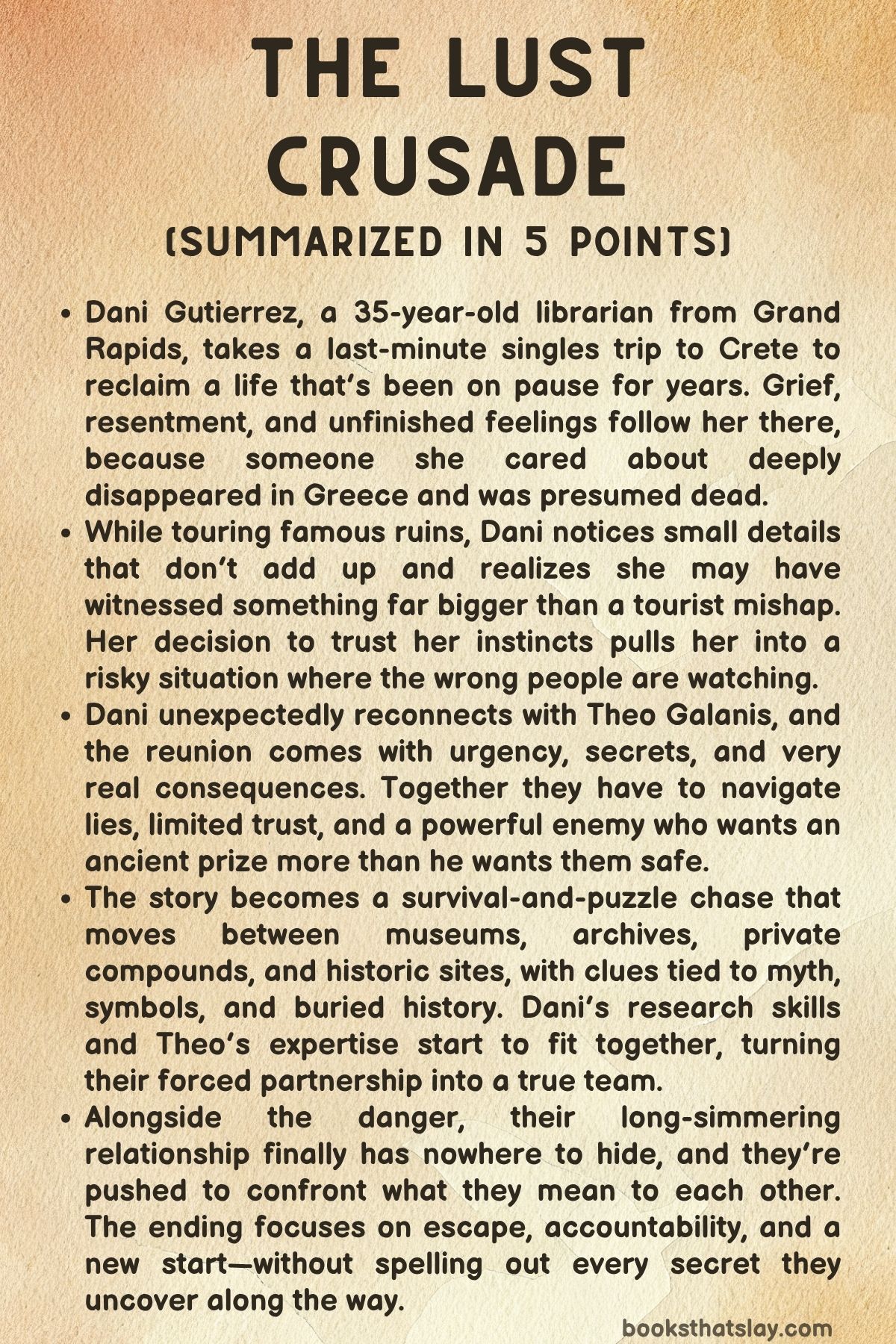
Characters
Dani Gutierrez
In The Lust Crusade, Dani Gutierrez is introduced as someone who has spent most of her adult life living for other people, and the trip to Crete becomes the first real act of choosing herself. Her identity is built around duty—sixteen years of caretaking after her father’s accident has trained her to measure her worth by how useful and responsible she is—so being “cut loose” by her parents’ move to Florida doesn’t feel like freedom at first; it feels like abandonment and erasure.
That emotional displacement fuels her restlessness on the singles tour, and it’s why Theo’s “death” hits her with a unique cruelty: she’s mourned him silently for years, and the memorial service forces her to confront how much of her life has been shaped by postponement and unspoken longing. Dani’s defining trait is that she refuses to accept the comfortable lie when truth is available, even if truth is dangerous.
She could have dismissed the Detroit Tigers cap as grief and coincidence, yet she follows the evidence into the restricted tunnels because she needs reality more than reassurance. That same stubborn clarity becomes her survival skill: she adapts quickly under pressure, invents believable cover stories to keep herself alive, and reads people well enough to understand when Theo is lying from trauma rather than malice.
Dani’s librarian instincts are not just a cute detail; they’re the way she thinks—pattern-based, text-sensitive, patient with ambiguity—and that mindset turns her into an equal partner in the hunt for the Eye, because she approaches clues like a cataloging problem rather than an adrenaline problem. Emotionally, Dani’s arc is about reclaiming desire without surrendering self-respect: she wants Theo, but she also demands honesty from him, refuses to be treated as a pawn, and insists that love cannot be another form of self-sacrifice.
By the end, she isn’t merely rescued or proven right—she becomes the person who can hold fear, love, anger, and agency all at once, and still make a choice that’s hers.
Dr. Theo Galanis
Theo functions as both the story’s mystery and its emotional center: the missing man everyone has mourned, and the living proof that Dani’s instincts were right all along. His personality is defined by competence under strain and a deep, quiet tenderness that keeps leaking through even when he tries to bury it for safety.
Captivity has trained him into hypervigilance—he checks rooms for surveillance, avoids direct conversations in spaces that might carry sound, and keeps trying to manage Dani’s risk by controlling information, even when that frustrates her. That impulse to protect is genuine, but it also reveals a flaw: Theo’s first reaction to danger is to shoulder it alone, because he’s learned the cost of trusting the wrong person.
His trauma is not presented as abstract; it shapes his decisions in real time, especially his suspicion of authorities and his instinct to stall, deny, and deflect in front of Maurice, Louis, and Pierre. Yet Theo is not only a victim—he is also a strategist, and even small acts like tearing the letter and tossing it into the sea show how he tries to seize control in increments when he can’t seize it outright.
The romantic tension with Dani is sharpened by his history of restraint: the tattoo translation (“It’s always been you”) reframes him as someone who has carried a long, private certainty but avoided acting on it, partly out of ethics and partly out of fear. That combination makes him compelling: he is brave in the physical sense, but emotionally cautious to the point of self-sabotage.
His professional identity also matters—he’s an archaeologist who understands myth, narrative, and how stories become leverage—so when Pierre weaponizes Theo’s own playful writing, Theo’s humiliation is also intellectual, like being trapped inside a caricature of his work. By the end, Theo’s growth is less about becoming fearless and more about becoming present: allowing Dani to share the burden, admitting the truth he’s carried, and choosing partnership over isolation as they step back into public life.
Eddie Gutierrez
Eddie’s role is mostly offstage, but his presence is felt as a pressure line in Dani’s life, representing the path she did not take. He embodies the “elsewhere” Dani has watched from the inside of her family home: he built an adult life while she stayed behind, and that contrast complicates Dani’s resentment because it isn’t only about him leaving—it’s about how her caretaking became expected, normalized, and ultimately taken for granted.
Eddie’s closeness to Theo also gives him narrative weight: Theo isn’t just Dani’s secret love; he is Eddie’s best friend, which makes Dani’s longing feel even more forbidden and lonely. Eddie functions as a mirror for Dani’s suppressed needs—proof that leaving was possible, that independence can happen, and that her sacrifice wasn’t inevitable.
Even without direct scenes, Eddie’s existence intensifies Dani’s sense of time lost, and it helps explain why she clings to the truth about Theo: if she can recover Theo from “death,” maybe she can also recover the parts of herself that went missing while she was being responsible.
Harold
Harold begins as a gentle, almost incidental companionship on the tour, but he evolves into something more meaningful: a reminder that decency exists even in a plot full of manipulation. He is the rare character who sees Dani as a person rather than a problem to manage or a tool to use.
His conversations with her on the bus establish him as emotionally perceptive, the kind of traveler who understands that people don’t book “singles tours” only for fun—they do it to survive a transition. Harold’s significance grows when the story returns to him at the Acropolis: instead of acting like a bystander, he chooses to help, offering lookout support and then alerting the police when he senses danger.
That choice redefines him as quietly brave, not through physical dominance but through civic courage—the willingness to intervene when it would be easier to shrug and walk away. He also adds texture to the story’s theme of seeing: Harold notices what matters, believes urgency when it appears, and helps translate Dani’s private crisis into public action at exactly the moment it’s needed.
Cosmo
Cosmo is the face of institutional indifference, presented as a tour guide whose priorities are schedule, spectacle, and profit rather than safety or truth. His theatrical Minotaur story and upsell tactics establish him as someone who commodifies myth for tourists, which becomes an ironic counterpoint to the very real myth-driven criminal operation happening beneath the surface.
When Dani begs him to stop the bus, his refusal feels less like simple stubbornness and more like a worldview: problems are inconvenient, and inconvenient things get minimized. His later report that police found nothing at Knossos—and his implication that Dani imagined it—positions him as a gaslighting force, whether intentional or reflexive.
Even if he believes what he’s saying, Cosmo becomes part of the machine that keeps Dani isolated: he validates the group’s desire for normalcy over Dani’s need for action. His reappearance at the Acropolis later adds a layer of tension, because he symbolizes how close Dani has been to danger while surrounded by people who treat everything like entertainment.
Maurice
Maurice is the story’s most openly violent enforcer, the character who makes the threat tangible rather than theoretical. He operates through intimidation, quick escalation, and ownership—he isn’t interested in persuasion so much as compliance.
He treats Theo as property, reacts to resistance with threats of bodily harm, and approaches Dani as leverage first and person last. Maurice also functions as a “middle power” in the villain hierarchy: he is not the mastermind, but he is the one who makes the mastermind’s will physically real, and that’s why he’s so frightening.
His attention to the torn letter and the name “Pierre” suggests he understands enough to be dangerous, but not enough to be secure—he is paranoid, reactive, and eager to prove usefulness. Maurice’s behavior reveals the moral structure of the criminal enterprise: violence is not only permitted, it’s expected, and the people doing it can still imagine themselves as professionals just doing a job.
That casual brutality is what forces Theo into constant calculation, and it’s what pushes Dani to rely on wit and performance as much as courage.
Louis
Louis is positioned as “less cruel” than Maurice, but the story makes it clear that being softer around the edges does not equal innocence. He participates in the kidnapping, helps maintain Theo’s captivity, and enables Pierre’s leverage games even when he shows moments of hesitation.
What makes Louis interesting is that he represents complicity without sadism: a person who may dislike what he’s doing but continues anyway, either out of fear, loyalty, greed, or the deadening logic of having gone too far to stop. His presence sharpens the story’s tension because he is unpredictable in a different way than Maurice—Maurice is a storm you can see coming, while Louis is the kind of person who might waver, then still pull the trigger when ordered.
In a narrative sense, Louis underscores the theme that danger isn’t always loud; sometimes it’s the quiet person in the room who helps the harm happen.
Jean-Luc Monfils / Pierre Vautour
Pierre is the novel’s central antagonist, a man who weaponizes charm, culture, and luxury as effectively as violence. In The Lust Crusade, his menace is in his ease: he offers champagne, speaks politely, tests the food to prove it’s safe, and frames captivity as hospitality, all while controlling every variable of Dani and Theo’s survival.
He is not impulsive like Maurice; he is strategic, theatrical, and psychologically skilled. Pierre’s obsession with the Eye of the Minotaur reveals a particular kind of villainy—one that treats history as a private marketplace and myth as a branding opportunity.
He flatters Theo’s expertise, then punishes him for the difference between scholarly rigor and storytelling, demonstrating Pierre’s contempt for nuance: he wants certainty, treasure, and ownership, not inquiry. His interrogation of Dani—probing who she is, what she means to Theo, what she can be used for—shows that he understands relationships as instruments, and the “fiancée” gambit becomes a case study in how quickly he turns intimacy into leverage.
Even when he claims he wasn’t going to kill Dani, the threat is part of the method: Pierre creates a reality where gratitude feels like safety and safety feels like a favor he can revoke. His eventual capture doesn’t erase his impact; the fact that he had reach into police systems and contingency plans reinforces that he is not a lone predator but a node in a wider network of exploitation.
Ford Matthews
Ford’s significance comes from absence and implication: he is the name used to bait Theo into Greece, and that makes him the story’s first hinge. Ford functions as a symbol of how professional trust can be exploited—Theo believes in the legitimacy of an academic request because it fits the logic of his world, and the forged email turns that logic into a trap.
Whether Ford is merely an identity stolen for credibility or someone unknowingly entangled, his role highlights the vulnerability of expertise: the more reputable Theo is, the easier it is to lure him with something that flatters his specialization. Ford also represents the unsettling reality that danger can begin with something as banal as a message in an inbox, and that the line between scholarly opportunity and criminal bait can be thinner than it should be.
Christos
Christos injects momentum and grounded warmth into the escape and hiding portion of the story. He is defined by action-first loyalty: he drives like someone who has already decided that saving Dani and Theo matters more than safety, social approval, or legal comfort.
His flashy car chase energy contrasts with Theo’s trauma-driven caution, but it complements Dani’s need for forward movement when fear threatens to freeze her. Christos also provides a social ecosystem—trusted relatives and friends at dinner—that temporarily restores normal human life to Dani and Theo, reminding them what it feels like to be around people who laugh, tease, and share food without ulterior motive.
That domesticity isn’t just a tonal break; it’s part of their healing, because it gives Theo a glimpse of safety that isn’t controlled by Pierre. Christos’s practical limitations—no phone battery, no service at the house—also keep the tension alive, making him a helper who can’t magically solve everything, only shelter them long enough for the next move.
Dr. Andreas Demetrious
Andreas operates in the liminal space between ally and unknown, which makes him compelling and occasionally threatening. He presents as competent, connected, and calm under pressure, offering the kind of strategic caution Theo is too traumatized to accept easily.
His warning about Pierre’s influence—spies, compromised police, unreliable systems—positions Andreas as someone who understands the broader chessboard rather than just the immediate danger. At the same time, his interactions with Dani carry an edge of personal interest, and the way he asserts the engagement narrative during the dinner scene shows he can manipulate social situations when needed.
Andreas is not framed as cruel, but he is framed as willing to shape reality to protect the group, which mirrors Pierre’s tactics in a safer register and invites Theo’s suspicion. His scholarly investment in Papantonis’s journal and the Minotaur’s Children adds another layer: Andreas isn’t only rescuing Theo; he’s also pursuing meaning, proof, and legacy, and those motivations could potentially compete with Theo’s urgent desire to go home.
Ultimately, Andreas embodies a key theme of the story: trust is necessary, but it is never simple, especially when knowledge, myth, and power overlap.
Lydia Demetrious
Lydia functions as the connective tissue between modern characters and older stories, the person whose recognition helps validate Theo’s identity and mobilize help. She represents inherited memory—someone who remembers faces, patterns, histories, and does not dismiss intuition as mere sentiment.
Her role reinforces the idea that myth and truth often travel through families before they ever show up in archives, and that older generations can be guardians of crucial knowledge rather than obstacles. Even without extensive page time, Lydia’s impact is structural: she is the reason Andreas can move from “rumor” to “confirmation,” and she quietly legitimizes the idea that the past is not dead—it’s living inside people.
Lysander
Lysander is the most morally ambiguous figure in the story, a character who complicates any simple division between savior and captor. He leads the Labyrinth compound and the Minotaur’s Children with an authority that feels both protective and controlling: he offers safety, resources, expedited passports, and a pathway back to public life, yet he forbids phones and enforces secrecy.
That combination makes him unsettling, because the same structure that keeps Pierre away can also keep Theo and Dani contained. Lysander’s recruitment offer to Andreas and Christos reveals an ideological agenda—this isn’t merely a safe house, it’s a society with a mission and rules, and membership comes with obligations.
His promise to help with press or embassy access sounds benevolent, but it also reinforces dependence: he remains the gatekeeper to the outside world until he chooses otherwise. The likely “unknown benefactor” funding the Santorini respite suggests Lysander’s influence extends beyond the compound and continues after the danger has passed, implying a patron who gives gifts that also purchase silence.
Lysander ultimately represents the seductive side of control: the version that feels like refuge, asks for loyalty instead of fear, and still shapes what truths get told.
Giorgina
Giorgina appears primarily through Theo’s past, but her narrative function is important: she anchors the reason Theo initially held back from Dani. Theo’s explanation that he was dating Giorgina at the time reframes his earlier refusal as ethical restraint rather than rejection, and it adds realism to the romance by acknowledging that timing and entanglement can matter as much as feelings.
Giorgina is not treated as a villain; she’s a signpost of Theo’s former life and former self, the version of him that still believed he could manage love cleanly by choosing the “appropriate” option. Her presence in the backstory also intensifies the tragedy of the years lost: while Theo was making ordinary decisions and then panicking into flight, Dani was staying put, and both were quietly building a misunderstanding that only captivity and crisis finally force them to confront.
Beau
Beau’s role is brief but pivotal as a misunderstanding that reveals how badly Theo and Dani have misread each other for years. The “beau” comment from Dani’s father becomes a perfect example of how tiny assumptions can calcify into life-altering distance.
Beau’s existence also does something gentle for the story: it suggests that Dani did have companionship and a world beyond caretaking, even if it wasn’t romantic in the way Theo feared, and it gives Dani a moment of clarifying truth that releases tension without diminishing her feelings. Functionally, Beau is the hinge that turns Theo’s jealousy into vulnerability, because once the misunderstanding is corrected, Theo can no longer hide behind the idea that Dani belonged to someone else.
Papantonis
Papantonis exists through the disputed journal, making him more artifact than person, but he still operates like a character because his words drive choices. The journal’s contested authenticity mirrors the story’s larger tension between myth and evidence: is this a true witness account, a cult fabrication, or a later invention meant to mislead?
Papantonis’s voice—obsessed with burial, directionality, and the language of the land—becomes a puzzle box for Theo, Andreas, and Dani, and the fact that his text can be interpreted in multiple ways forces them to reveal their thinking styles. Papantonis, as a “character,” represents the power of narrative to outlive the narrator: whether or not he intended it, his phrasing becomes a map for modern greed and modern love, pulling everyone toward the same hidden chamber.
Dr. Demetrios
Demetrios is more legend than confirmed historical figure within the story’s present, but he functions as a gravitational mythic presence. The search for proof of Demetrios ties into the Minotaur’s Children and their sense of purpose, suggesting that “truth” here is not only about objects like the Eye but also about identities and lineages that groups may protect—or exploit.
Demetrios stands for the way history can be used to justify secrecy: if the past is sacred enough, then controlling access to it can be framed as duty rather than dominance. Even as a shadowy reference point, Demetrios helps explain why some characters want the Eye for money, some want it for scholarship, and some want it to preserve a story they believe the world is not worthy to hold.
Dani’s Parents
Dani’s parents aren’t villains, but they are a central force shaping her emotional landscape. Their decision to move to Florida and sell the family home detonates Dani’s sense of identity because it reveals how conditional her role has been: she organized her life around them, and then they made a life decision without treating her as a full stakeholder.
The timing—so soon after Theo’s memorial—adds a feeling of cruelty even if none was intended, and it catalyzes Dani’s travel decision as both escape and protest. Their presence matters because it explains Dani’s fear of being “unneeded,” and that fear echoes in her refusal to abandon Theo once she finds him.
Dani’s growth is partly about learning to love without making herself indispensable, and her parents are the original context where indispensability became her currency.
Themes
Autonomy after long-term caregiving
Dani’s decision to book a last-minute singles tour is less about romance and more about forcing her own life back into motion after years of living as an extension of her parents’ needs. Sixteen years of caretaking has trained her to treat desire as something postponed, and even her grief has been structured around other people’s narratives—Theo’s memorial, her parents’ announcement, her brother’s separate adulthood.
When her parents decide they are moving and selling the home, it doesn’t simply change her address; it removes the role that has defined her, leaving behind a raw question: if she is no longer needed in that way, who is she supposed to be? That emotional displacement follows her to Crete, where every familiar reference to Theo becomes a trigger, not only for longing but for anger at time stolen from her.
Her choice to climb into the restricted excavation area shows how autonomy begins for her: not as calm self-care, but as a risky refusal to keep being the person who waits for permission. Even when authority figures try to minimize her—Cosmo’s insistence on schedule, the police report that claims nothing is wrong—she keeps acting.
The theme gains complexity because Dani’s independence is not clean or solitary. Her choices repeatedly pull others in, especially Theo, and she has to confront the difference between taking charge of her own story and controlling outcomes she can’t actually control.
By the time she insists on staying in Greece rather than leaving once Theo is safe, it signals growth: she is no longer making decisions only from obligation or guilt. She is making them from commitment, curiosity, and the recognition that her skills and instincts matter.
Autonomy here is not framed as rejecting family or responsibility; it is framed as ending the idea that responsibility means self-erasure, and learning that choosing herself can coexist with caring for others.
Truth, doubt, and the politics of being believed
The plot constantly tests how reality is negotiated through credibility. Dani sees evidence that Theo is alive—his Tigers cap, the apple allergy, his eyes—and yet institutional responses immediately push her toward self-doubt.
Cosmo’s refusal to stop the bus isn’t only logistical; it signals how systems prioritize smooth operation over a single person’s alarm, especially when that person is emotional, grieving, and alone. The police finding “nothing suspicious” becomes a blunt weapon that implies her perception is unreliable, as if the absence of proof is proof of absence.
This dynamic matters because it forces Dani into a second burden: not just fear, but the labor of translating what she knows into something others will accept. The theme also shows how doubt can be manufactured strategically.
Theo’s captors use confusion, surveillance, and isolation to keep him compliant, and Pierre uses social performance—lavish hospitality, calm speech, selective honesty—to make brutality look like reason. When Pierre tests whether Dani can be used as leverage, he is also testing whether her identity will be defined by what she knows or by what he can force her to say.
The “fiancée” lie becomes a sharp example of truth’s instability under pressure: a false claim protects Dani in the moment, yet it also hurts her because it echoes a deeper fear that she has always been an afterthought in Theo’s life. Later, Theo’s withheld information about his tattoo repeats the same pattern on a more intimate scale—he hides truth to manage consequences, and Dani experiences that concealment as betrayal.
The story suggests that being believed is never just about facts; it is about power, context, and who controls the narrative channels. Dani ultimately becomes credible not because she becomes calmer, but because the confrontation produces undeniable stakes and witnesses.
Even then, the theme refuses a neat victory: the Minotaur’s Children vanish, influence and secrecy persist, and the characters learn that public proof can stop one threat while leaving the larger machinery intact.
Captivity, coercion, and the hidden cost of survival strategies
Theo’s abduction is not presented as a single dramatic event but as a long pressure system designed to shrink his choices until compliance feels like the only rational option. He is forced to dig under Knossos, kept under watch, and taught through repeated failed escapes that resistance brings punishment.
That kind of captivity reshapes the self: it trains the body to anticipate harm and trains the mind to calculate risk constantly. This is why Theo’s reactions often look like coldness or secrecy—he scans rooms for bugs, avoids speaking openly, and tries to move Dani toward the consulate while hiding the full story.
These aren’t personality quirks; they are survival habits. The theme deepens because the story shows how survival tactics create secondary damage.
Theo’s early lie about a fiancée was meant to spark sympathy, yet it becomes a trap once Dani appears and the captors decide she must be that person. A strategy that once helped him endure suddenly becomes the mechanism that endangers someone he cares about.
Similarly, Dani’s insistence that she will not leave without him is brave, but it also exposes how captivity spreads: once she enters Pierre’s orbit, her freedom becomes a bargaining chip, and her tour group becomes an easy cover story for her disappearance. Pierre’s coercion is sophisticated: he alternates threat with comfort, gives deadlines and “deals,” and frames imprisonment as a fair exchange.
That manipulation matters because it tempts victims into thinking they are negotiating as equals when they are not. Even after escape, the theme continues through trauma residue.
Theo distrusts Andreas at first not because Andreas is suspicious on the surface, but because captivity has taught Theo that “help” can be a setup. Dani’s panic when Theo briefly disappears inside the Labyrinth compound shows how fear persists even in safety; the mind keeps replaying the worst pattern because repetition has made it feel probable.
Survival, then, is not only escaping the island or getting Pierre arrested; it is rebuilding the ability to trust perceptions, people, and the future without needing constant control.
Desire, intimacy, and commitment under extreme pressure
The relationship between Dani and Theo is built on years of unspoken feeling, interrupted opportunities, and timing that always seems wrong. In The Lust Crusade, intimacy is repeatedly forced into the open by crisis rather than by calm choice: Dani sees Theo alive in a hidden chamber before she ever gets a private conversation; Theo claims she is his fiancée before either of them has agreed on what they are; a public dinner turns their first significant kiss into a performance demanded by a crowd.
That public pressure matters because it mirrors how both characters have avoided vulnerability. Dani has spent years prioritizing family stability over personal longing, while Theo has a pattern of retreating when emotions become direct, like the earlier moment when he refused to kiss her because she was drunk and he was entangled elsewhere.
Their desire is real, but it has been contained by ethics, fear, and misread signals—like Dani’s “boyfriend” misunderstanding that is actually a coworker named Beau. The theme explores how attraction can be both refuge and risk.
When Dani clings to Theo in the pool to appear convincing under surveillance, physical closeness becomes camouflage, yet it also stirs genuine longing that neither can fully dismiss afterward. Their jealousy and arguments—Theo reacting to Andreas’s attention, Dani accusing Theo of dragging her into danger—are not petty side drama; they show how stress compresses emotion until it bursts out sideways.
The story also treats commitment as something tested by action rather than declarations. Dani refuses to abandon Theo even when leaving would be rational; Theo shields Dani when Pierre threatens her; both of them keep choosing alignment despite fear and confusion.
When they finally admit love, it is not romanticized as a magical fix. It arrives with practical consequences: secrecy is dangerous, exposure is inevitable, and their families’ perceptions will shift overnight.
Even the final reveal—relatives spotting them kissing—shows that private commitment can become public truth without permission. Desire here is not written as escapism; it is a catalyst that pushes them toward honesty, toward taking responsibility for what they want, and toward building a future that is not defined by loss, duty, or control.