The Other March Sisters Summary, Characters and Themes
The Other March Sisters is a fresh, contemporary take on the classic Little Women by Louisa May Alcott. Written by Linda Epstein, Ally Malinenko, and Liz Parker, this novel shifts the focus from the original March sisters to their modern-day counterparts, exploring their evolving relationships, personal growth, and the timeless struggles of balancing family expectations with individual dreams.
Through a blend of art, romance, and societal pressures, the novel paints a vivid picture of the struggles women face in finding their own path while honoring their past and familial bonds. The story is a rich, thought-provoking exploration of identity, autonomy, and love in the modern world.
Summary
The Other March Sisters begins with Amy March in Europe, where she is traveling under the watchful care of Aunt Mary, Uncle Edward, and Cousin Florence. Their journey starts in London, where Amy tries to present herself as elegant, disciplined, and socially capable.
She wants to be seen as a refined young woman, but she also carries a serious ambition to become an artist. Her days are shaped by social expectations as much as by museums and sketchbooks.
In London, Amy spends time with Fred and Frank Vaughn. Fred is clearly interested in her, and Amy understands that his attention could become something more formal.
He is rich, respectable, and approved by the sort of people who matter in polite society. At first, Amy tries to enjoy his courtship and the position it gives her.
During a walk on the Mall, however, a small accident with soot and Fred’s awkward attempt to help her leave Amy embarrassed rather than charmed. At Hampton Court, Fred loses his way in the hedge maze, though Amy already knows how to escape because Laurie once explained it to her.
She lets Fred think he has saved the situation, but the moment quietly shows her the limits of his confidence and her own habit of making men feel clever.
Fred’s interest becomes harder to ignore. At Lady Willoughby’s ball, Amy worries about etiquette, reputation, and the idea that she is expected to marry well.
Lady Willoughby treats her kindly because of her connection to Aunt March and invites her to return for tea and sketching. Amy is pleased by the recognition, yet she also feels trapped by what everyone seems to want from her.
Fred continues to behave as if an engagement is close. During a game of whist, he hints at it openly.
Amy knows a marriage to him could help her family financially, but she cannot make herself feel excited by him. He is decent and fond of her, yet he is also dull, limited, and unable to understand the person she is becoming.
Laurie’s presence enters Amy’s life first through a telegram saying he is coming to Europe. His later letter reveals that he has left home after a painful misunderstanding with Jo.
Amy gathers that Jo may have tried to discuss a practical marriage arrangement with him, not from love, but from the pressure placed on the March daughters to improve the family’s circumstances. This realization unsettles Amy because she recognizes the same pressure in her own situation.
Marriage is not simply romance for the March sisters. It is duty, survival, and family strategy.
In Paris, Amy’s conflict deepens. She continues to see Fred, who offers to buy her a cameo and hints that he may offer something greater.
Amy avoids naming what is coming because she does not yet know how to refuse the life he represents. At the same time, her commitment to painting grows stronger.
A visit to Rosa Bonheur at Fontainebleau inspires her deeply. Bonheur’s independence, discipline, and success show Amy that a woman’s artistic life can be real and serious.
Amy then becomes a copyist at the Louvre, where she works among great paintings and begins to imagine herself as part of that world. Fred visits her there, but instead of encouraging her, he makes careless comments about women artists, race, marriage, and motherhood.
His remarks reveal how little he understands her work or her ambitions. Amy begins to see that marrying Fred would mean shrinking parts of herself to fit his expectations.
Laurie surprises Amy at the Louvre, and their old connection returns with ease. They spend time together in Paris, talking, walking, and sharing a private picnic at Bois de Vincennes.
Laurie treats Amy’s art not as a charming hobby but as something central to her. He tells her that if she marries, it should be to someone who truly sees her as an artist.
His words affect her because they give shape to something she has barely allowed herself to want.
Amy also meets Mary Cassatt, who challenges her to take her art seriously and to think honestly about the demands marriage and motherhood place on women. Cassatt’s questions do not give Amy easy answers, but they sharpen her understanding of the choice before her.
When Amy and Laurie meet again at the Louvre before she leaves Paris, Laurie asks about the rumors of Fred’s proposal. Amy admits that she is expected to marry well for her family’s sake.
Laurie kisses her, then leaves abruptly for Greece, unable or unwilling to remain in the uncertainty between them.
The novel then shifts to Meg Brooke in Concord. Meg is married to John and raising children, but she is unhappy and exhausted.
Motherhood has swallowed much of her old sense of self. Her friend Sallie gives her a beautiful green dress and a copy of Culpeper’s herbal, encouraging her to claim something that belongs only to her.
When John mistakes the dress for a foolish purchase, they argue, and Meg leaves for Orchard House in anger.
At Orchard House, Meg sees that Marmee’s guidance, though loving, has often pulled her back into dependence instead of helping her build a satisfying life of her own. This realization marks a turning point.
Meg returns home and begins working in her neglected garden. Rather than clearing out the plants others call weeds, she studies their uses.
Nettles, vervain, linden, and other plants become sources of knowledge and practical power.
John apologizes, and although their marriage is not suddenly fixed, something between them softens. Meg begins preparing remedies from the garden.
She discovers that linden may help strengthen the heart and decides to use it for Beth, asking Hannah not to tell Marmee. With Sallie’s help, and later with guidance from Rebekah Mayer, Meg learns more about women’s healing traditions, including forms of knowledge considered dangerous or improper.
Her garden becomes a place of purpose. Through it, Meg finds a way to help Beth, support other women, and recover a sense of usefulness that is not limited to obedience or domestic duty.
Beth’s story unfolds at Orchard House while Meg is married, Jo is away in New York, and Amy is abroad. The house feels emptier than ever, and Beth feels like a fading presence inside it.
She is still weakened by the fever she caught years earlier while caring for the Hummels. She reads Amy’s letter about Paris and Laurie, then plays an unfinished piano piece she privately calls “Little Women.” The music is built from memories of her sisters and their childhood, and it holds the life of the family she misses.
Beth visits Mr. Laurence and plays for him. She also speaks more honestly than usual about the dead Hummel baby, whose memory still troubles her.
Her illness is not only physical. She carries grief, fear, and the burden of being seen as too gentle to want anything for herself.
When the Marches host the Ronsons, a Black family visiting Concord for suffrage work, Beth meets their daughter, Florida. Florida is lively, direct, and the same age as Beth.
Beth is nervous at first, but Florida is drawn to her music. After Beth plays Mozart, Florida insists she should teach piano.
Mr. March describes Beth as the family’s “House Angel,” but Florida objects to that image. She sees Beth as a young woman, not a symbol.
Beth is overwhelmed by being seen so clearly and runs upstairs in tears.
Later, Beth meets Florida in town. Florida asks Beth to tell a story about herself rather than about her sisters.
Beth remembers how, as a baby, her sisters once buried her inside a tower of books and forgot her there. Florida understands the sadness beneath the memory.
She asks Beth for piano lessons, and though Beth is frightened by Florida’s intensity, she is also excited. Under the stars, Florida calls Beth “the Northern Lights,” rare and unforgettable.
Beth decides the lessons will be her own choice.
Their weekly piano lessons become the center of a close and tender friendship. Beth tells Florida about her illness, and Florida accepts the truth without reducing Beth to it.
When Beth suffers a serious relapse, Florida sees how fragile her health is, but she returns anyway. She cares for Beth and encourages her to live as fully as she can, resting when she must but still choosing what she wants.
Beth even stands up to Marmee when her mother tries to send Florida away, insisting that Florida stay.
Florida eventually learns that her father has accepted a lecturing tour that will take the family across the country and later to Europe. Beth is devastated.
On their last night together, they play piano one final time. Florida gives Beth a ribbon from her hair and kisses her.
Beth gives Florida the sheet music for “Little Women,” asking her to play it every Sunday wherever she is, while Beth will do the same at home. Their farewell gives Beth both sorrow and a lasting proof that she has been loved as herself.
The final movement returns to Amy in Europe. In Germany and Italy, she studies art, visits galleries and monuments, and thinks seriously about talent, money, marriage, and independence.
She asks herself whether women can make honest art while also securing their futures in a world built to limit them. Fred resumes his courtship in Nice, but a conversation makes the truth plain: he does not understand her values, her art, or her loyalty to Laurie.
When Fred proposes, Amy refuses him. Her family is shocked, but Uncle Edward quietly understands.
After the refusal, Amy paints Orchard House from memory. The act releases something in her.
She is no longer painting only to please, imitate, or prove herself acceptable. She is painting from memory, love, and personal truth.
Laurie sends a brief note telling Amy to expect him. When he arrives, they speak openly about Fred, love, and Laurie’s attraction to men.
Amy realizes that this truth does not erase her love for him or his love for her. Laurie urges her to choose art, and Amy begins to understand that choosing herself does not necessarily mean giving up love.
In the closing scene, she sketches Laurie with new confidence. She feels changed, freer, and more certain that she is not merely someone’s daughter, sister, wife, or duty.
She is an artist, and she is ready to live as one.
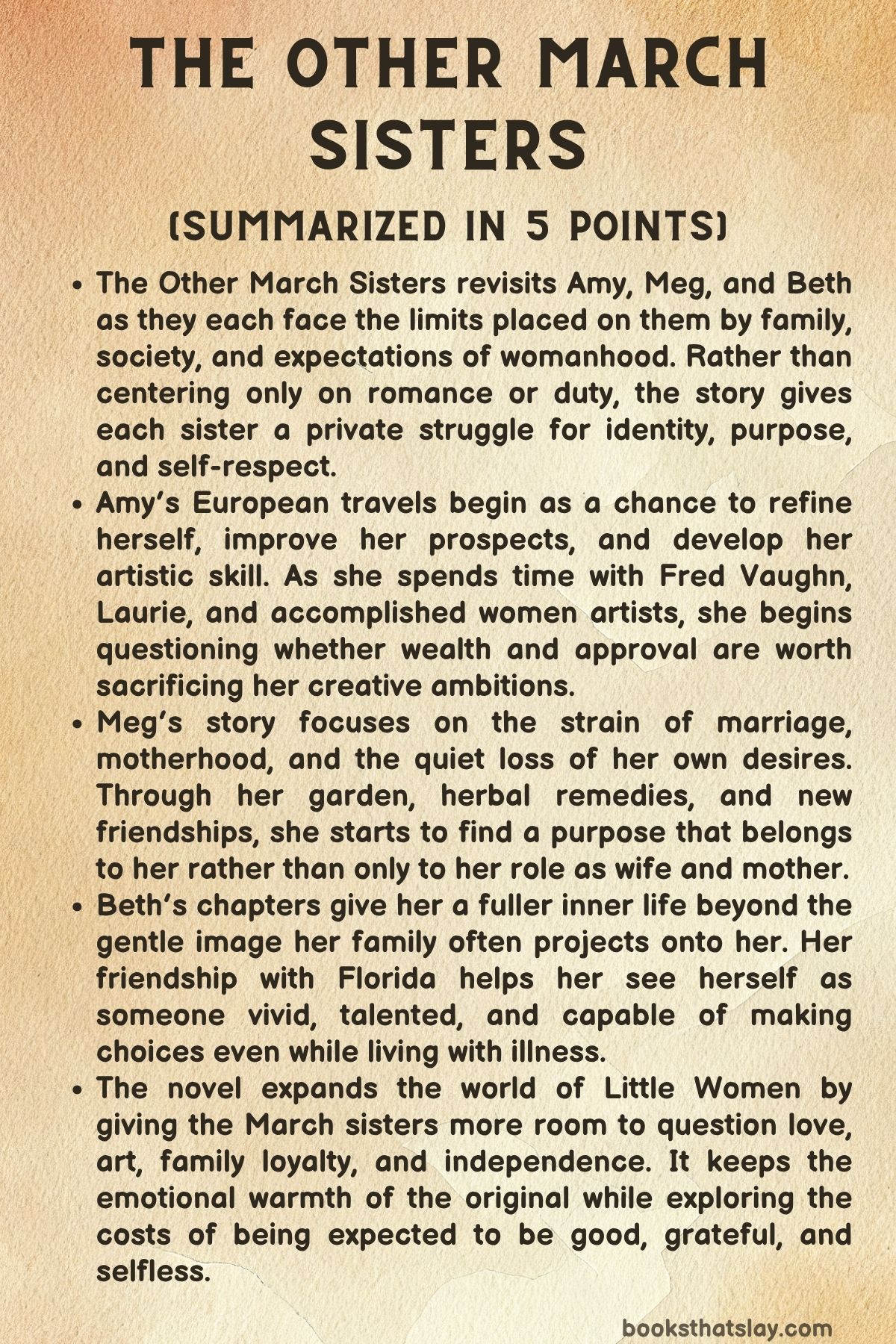
Characters
In The Other March Sisters, the characters are shaped by questions of ambition, duty, love, illness, marriage, art, and selfhood. Each figure contributes to the book’s larger concern with how the March sisters and the people around them struggle against the roles expected of them.
Amy March
Amy March is one of the central figures in the book, and her character is presented with far more emotional and artistic seriousness than a simple portrait of a fashionable young woman abroad. At the beginning, Amy is trying to perform the role of a polished, marriageable young lady in Europe.
She is conscious of manners, clothing, social approval, and the expectations placed on her by her family. Her interactions with Fred Vaughn show that she understands the practical value of marrying well, especially because the March family’s financial position creates pressure on the daughters.
Yet Amy is never merely shallow or calculating. Beneath her careful social behavior is a young woman trying to decide whether security is worth the cost of being misunderstood.
Amy’s deepest conflict is between marriage as duty and art as identity. Her time in Paris, her work as a copyist at the Louvre, and her encounters with women artists force her to take her talent seriously.
Rosa Bonheur and Mary Cassatt become important because they show Amy that a woman’s ambition does not have to be decorative or secondary. Amy’s rejection of Fred is therefore not only a romantic decision but also a declaration that she refuses to build her life around someone who diminishes her art, her intelligence, or her independence.
By the end, Amy’s confidence has grown. Her choice to sketch Laurie as a model shows that she has begun to see herself not as a girl waiting to be chosen, but as an artist who chooses how to look, love, and live.
Meg Brooke
Meg Brooke is portrayed as a woman trapped between the domestic ideal she was taught to desire and the emotional reality of married life. Her marriage to John has not given her the peace or fulfillment she expected.
Instead, she is overwhelmed by motherhood, household labor, disappointment, and the feeling that she has lost herself. The green dress Sallie gives her becomes more than a garment; it represents beauty, self-possession, and the possibility that Meg might still have desires separate from being a wife and mother.
Meg’s development centers on reclaiming agency through her garden and healing work. At first, the garden appears neglected, but Meg learns to see value in what others might dismiss as weeds.
This mirrors her own situation: she has been underestimated, reduced, and pushed into dependence, yet she contains hidden knowledge and strength. Her use of plants such as nettles, vervain, and linden connects her to women’s practical wisdom and gives her a purpose beyond domestic obedience.
Her relationship with John softens when he apologizes, but the more important change is internal. Meg begins to understand that happiness will not come from being guided back into the role of the obedient daughter or perfect wife.
She must cultivate her own life, just as she cultivates her garden.
Beth March
Beth March is one of the most delicate and emotionally powerful characters in the book. She is physically weakened by illness, but the story gives her a rich inner life that is not defined only by fragility.
Beth feels like a ghost in Orchard House, partly because her sisters have moved into fuller, more visible lives and partly because her own sickness has made others treat her as something almost sacred rather than fully human. Mr. March’s description of her as the family’s “House Angel” captures the problem: Beth is loved, but she is also confined by that love.
Beth’s friendship with Florida Ronson becomes a turning point because Florida sees her not as a symbol, but as a young woman. Through Florida, Beth begins to tell stories about herself, make choices for herself, teach piano, and experience emotional intimacy that belongs to her alone.
Music is central to Beth’s character because it allows her to express what she cannot always say directly. Her composition “Little Women” preserves memory, love, grief, and longing, but giving the music to Florida also shows Beth’s willingness to send part of herself into the wider world.
Beth remains vulnerable, but she is not passive. Her decision to stand up to Marmee and insist that Florida stay reveals a quiet courage that has been present all along.
Laurie Laurence
Laurie is portrayed as emotionally restless, tender, and searching. His arrival in Europe follows a painful misunderstanding with Jo, and that pain shapes his connection with Amy.
He is not simply a romantic figure; he is someone trying to understand what kind of love is possible for him and what kind of life he wants. With Amy, Laurie is unusually perceptive.
He recognizes her artistic seriousness and encourages her to marry only someone who truly sees that part of her. This makes him a contrast to Fred, whose affection is conventional but shallow.
Laurie’s openness about his attraction to men adds complexity to his character and changes the meaning of his bond with Amy. Rather than making him distant from her, it allows their relationship to rest on honesty instead of performance.
Laurie’s love is not presented as simple possession or social arrangement. He wants Amy to choose art, freedom, and herself.
His final role as Amy’s model is significant because he becomes part of her artistic awakening rather than an obstacle to it. In The Other March Sisters, Laurie helps Amy imagine love as something that does not require the death of ambition.
Fred Vaughn
Fred Vaughn represents the respectable marriage Amy is expected to want. He is wealthy, socially appropriate, attentive, and clearly interested in her, but his courtship reveals the limits of a life built only on comfort and status.
Fred is not shown as cruel, but he is careless in ways that matter deeply. His awkwardness in London and the hedge maze initially make him seem harmlessly comic, but later his comments at the Louvre expose a more serious problem: he does not understand Amy’s ambitions or the seriousness of women’s art.
Fred’s proposal becomes a test of Amy’s values. He offers security, but not recognition.
He likes Amy, but he does not truly see her. His assumptions about women, marriage, motherhood, race, and art reveal that life with him would likely shrink Amy’s world rather than expand it.
Fred therefore functions as a mirror for Amy. By rejecting him, she rejects the version of herself that would have accepted wealth in exchange for silence, misunderstanding, and artistic compromise.
Jo March
Jo March appears mostly through the consequences of her actions rather than through direct presence, but her influence is still important. Her misunderstanding with Laurie sends him to Europe and affects Amy’s emotional life.
Jo’s attempt to discuss a practical marriage arrangement suggests that she too is under pressure from the family’s financial needs. This complicates Jo’s character because it shows that even the most independent March sister is not free from social and economic expectations.
Jo also serves as a point of comparison for Amy. Amy realizes that Jo may have been acting from the same burden Amy feels: the idea that one of the daughters should marry well for the family’s sake.
This makes Jo less of a rival and more of a sister caught in a similar system. Though she is not the center of this portion of the book, Jo’s presence deepens the story’s examination of duty, love, and female choice.
Marmee
Marmee is a complicated maternal figure because her love for her daughters is real, but her guidance can also be limiting. In Meg’s story especially, Marmee’s comments reveal how easily care can become control.
Instead of helping Meg become happier and more independent, Marmee seems to guide her back toward dependence and endurance. This makes Meg question whether the ideals she inherited from her mother have truly served her.
With Beth, Marmee’s protectiveness also becomes restrictive. She wants to shield Beth, but in doing so she risks denying Beth the right to choose her own relationships and experiences.
When Beth insists that Florida stay, she is not rejecting her mother’s love; she is resisting the version of love that treats her as too fragile to live fully. Marmee’s character therefore represents the tension between maternal devotion and the inherited social rules that mothers sometimes pass down to daughters.
John Brooke
John Brooke is presented as a husband who is not malicious but often fails to understand Meg’s emotional needs. His mistaken assumption about the green dress exposes the strain in their marriage.
He sees the dress through the lens of household responsibility and financial anxiety, while Meg experiences it as a rare symbol of beauty and selfhood. Their argument reveals how unseen Meg feels in her own home.
John’s apology matters because it shows that he is capable of tenderness and growth, but the book does not make his change the sole solution to Meg’s unhappiness. His softening helps, yet Meg’s real transformation comes from discovering her own work and purpose.
John’s character therefore shows the limits of a decent but conventional husband. He can love Meg, but he must learn that love requires seeing her as more than a mother, housekeeper, or dependent wife.
Sallie
Sallie serves as a catalyst for Meg’s awakening. By giving Meg the green dress and Culpeper’s herbal, she offers her friend both beauty and knowledge.
Sallie understands that Meg needs more than advice about patience or domestic duty. She needs permission to want something for herself.
Her gifts help Meg reconnect with pleasure, curiosity, and practical power.
Sallie’s role is important because she represents female friendship as a force of renewal. She does not rescue Meg, but she places tools in her hands.
Through Sallie, the book suggests that women often help one another survive by noticing needs that family members overlook. Sallie sees Meg’s buried dissatisfaction and responds with generosity rather than judgment.
Florida Ronson
Florida Ronson is one of the most vital characters in Beth’s part of the book. She is lively, confident, observant, and unafraid to challenge the way others define Beth.
When Mr. March calls Beth the “House Angel,” Florida objects because she recognizes the harm in turning a living girl into a symbol. This moment reveals Florida’s clarity and courage.
She sees Beth as a person with talent, desire, and a future, not as a delicate figure meant only to remain at home.
Florida’s relationship with Beth is tender, intimate, and transformative. She encourages Beth to teach, speak, choose, and live.
She accepts Beth’s illness without reducing her to it, which is exactly what Beth needs. The kiss, the ribbon, and the shared music all show that Florida gives Beth a love that is both romantic and liberating.
Even when Florida must leave, she does not vanish from Beth’s life emotionally. Their promise to play the same music every Sunday turns separation into a form of continued connection.
Mr. March
Mr. March represents the sentimental idealization of Beth that the book questions. His description of her as the family’s “House Angel” may sound affectionate, but it confines Beth to a role of purity, service, and stillness.
He does not appear cruel, yet his language reveals how deeply he participates in a worldview that praises women for self-erasure.
His character is important because he shows that even loving fathers can misunderstand their daughters by turning them into ideals. Beth does not need to be worshipped as an angel; she needs to be allowed to be a young woman.
Mr. March’s treatment of Beth helps explain why Florida’s recognition of her feels so powerful.
Mr. Laurence
Mr. Laurence is connected to Beth through music, memory, and grief. Beth visits him and plays for him, and their bond allows her to speak more honestly than she usually does.
Her conversation with him about the dead Hummel baby reveals the trauma she still carries from the illness that changed her life. Around Mr. Laurence, Beth’s quietness becomes less like emptiness and more like a container for feeling.
Mr. Laurence’s importance lies in the emotional space he gives Beth. He does not transform her life in the way Florida does, but he belongs to the part of Beth’s world where music can hold sorrow.
His presence reminds the reader that Beth’s gentleness is not simplicity. She has seen death, carries memory, and understands pain more deeply than many around her realize.
Lady Willoughby
Lady Willoughby represents the social world Amy is trying to enter. Her warmth toward Amy gives Amy access, approval, and a sense of possibility within elite society.
The invitation to return for tea and sketching is important because Lady Willoughby does not only receive Amy as a potential bride; she also acknowledges her artistic interest.
At the same time, Lady Willoughby’s world is tied to etiquette, marriage prospects, and social performance. Amy’s nervousness at the ball shows how much pressure such spaces place on young women.
Lady Willoughby is not an antagonist, but her presence helps define the environment in which Amy must decide whether she wants admiration, security, and status badly enough to sacrifice other parts of herself.
Rosa Bonheur
Rosa Bonheur functions as an artistic model for Amy. Her seriousness, independence, and success show Amy that women can pursue art with discipline and authority.
Meeting her at Fontainebleau expands Amy’s understanding of what an artist’s life might look like. Bonheur’s importance is not only professional but psychological: she helps Amy imagine a future that does not depend entirely on marriage.
For Amy, Rosa Bonheur represents proof. She proves that female talent can be more than a pastime, more than refinement, and more than a way to become attractive in society.
After encountering Bonheur, Amy becomes more committed to painting and more aware of the gap between people who admire art as decoration and people who understand art as vocation.
Mary Cassatt
Mary Cassatt plays a direct role in challenging Amy to take her own artistic ambition seriously. She questions whether marriage and motherhood can coexist with art, not to discourage Amy, but to force her to think honestly about the costs of conventional choices.
Cassatt’s presence sharpens Amy’s conflict because she refuses to romanticize the sacrifices demanded of women.
Cassatt matters because she gives Amy intellectual pressure rather than simple encouragement. She helps Amy see that talent requires commitment and that the world will not automatically make room for a woman artist.
Through Cassatt, The Other March Sisters connects Amy’s private romantic decisions to larger questions about women’s labor, creative freedom, and the price of independence.
Aunt Mary
Aunt Mary is part of the adult structure surrounding Amy during her travels. She represents supervision, respectability, and the social expectations attached to Amy’s European experience.
Amy is not wandering freely through Europe; she is being watched, guided, and placed within a network of relatives and acquaintances who expect her to behave properly.
Aunt Mary’s role helps emphasize the pressure on Amy to become a polished young lady. Even when Amy is pursuing art, she is doing so under the gaze of family expectations.
Aunt Mary therefore contributes to the book’s atmosphere of social discipline, where a young woman’s movements, manners, and romantic prospects are constantly being interpreted.
Uncle Edward
Uncle Edward is one of the quieter but more sympathetic adult figures. He accompanies Amy in Europe and is part of the family world that expects her to make a suitable match.
However, when Amy refuses Fred, Uncle Edward quietly understands. This response distinguishes him from characters who are shocked or disappointed by Amy’s decision.
His understanding matters because it gives Amy a small but meaningful form of adult recognition. He does not force her back into the expected path, and his quiet support suggests that not every member of the older generation is blind to Amy’s need for freedom.
Uncle Edward’s role is understated, but he helps soften the emotional cost of Amy’s refusal.
Cousin Florence
Cousin Florence belongs to Amy’s European social circle and helps frame the world of travel, manners, and family supervision. Although she is not developed as deeply as Amy, Meg, or Beth, her presence reinforces the fact that Amy’s life abroad is communal and observed.
Amy’s actions are not private; they unfold among relatives who represent family reputation and social expectation.
Florence’s character also helps establish the contrast between ordinary social touring and Amy’s deeper inward journey. While the group moves through London, Paris, Germany, and Italy, Amy is not merely sightseeing.
She is changing. Florence remains part of the surface world of travel against which Amy’s artistic and emotional awakening becomes clearer.
Frank Vaughn
Frank Vaughn appears in connection with Fred and the early European scenes. His role is smaller, but he helps establish the social environment in which Amy is being courted.
The promenades, public outings, and polite interactions all belong to a world where young people are watched and evaluated.
Frank’s presence also emphasizes that Fred is not isolated as a romantic prospect; he comes from a larger social group marked by wealth, ease, and expectation. Through characters like Frank, the book builds the atmosphere of respectable society that Amy must learn to navigate without surrendering herself to it.
Hannah
Hannah is a practical household figure who becomes important in Meg’s effort to help Beth. When Meg prepares linden for Beth and asks Hannah to keep it from Marmee, Hannah is drawn into a quieter network of care that operates outside the family’s usual authority.
Her role suggests trust, discretion, and domestic knowledge.
Hannah’s presence also connects Meg’s healing work to the household world women have long managed. She is not at the center of the emotional conflict, but she supports the practical actions through which Meg begins to claim purpose.
Hannah represents the kind of everyday female labor that often sustains families without receiving much attention.
Rebekah Mayer
Rebekah Mayer expands Meg’s understanding of healing beyond gentle domestic remedies. She teaches Meg more dangerous women’s healing work, which suggests knowledge that is powerful, risky, and perhaps socially suspect.
Through Rebekah, Meg’s garden becomes more than a comforting hobby. It becomes an entrance into a tradition of female expertise that exists outside polite approval.
Rebekah’s importance lies in the way she complicates Meg’s awakening. Healing is not presented as merely soft or sentimental.
It involves judgment, courage, and knowledge that can be dangerous if mishandled. Rebekah helps Meg move from instinctive care toward serious practice, giving her a new sense of capability and responsibility.
Aunt March
Aunt March appears indirectly through her connection to Amy and Lady Willoughby. Even when she is not physically central, her influence matters because she represents wealth, social position, and family expectation.
Amy’s reception in elite circles is partly shaped by her association with Aunt March, which shows how family connections affect a young woman’s prospects.
Aunt March also belongs to the pressure surrounding marriage and status. Her presence in the background reminds the reader that Amy’s choices are not made in a vacuum.
They are shaped by class, inheritance, reputation, and the hope that a March daughter might improve the family’s fortunes.
Themes
Women’s Selfhood Beyond Family Expectations
In The Other March Sisters, each sister faces pressure to become useful, pleasing, or respectable in ways that reduce her private desires. Amy is expected to marry well and improve the family’s position, Meg is expected to find complete satisfaction in wifehood and motherhood, and Beth is treated as a gentle household spirit rather than a young woman with wishes of her own.
These expectations are not always cruel, but they are limiting because they ask the sisters to arrange their lives around other people’s comfort. Amy’s refusal of Fred becomes more than a romantic decision; it is her rejection of a future built on social approval rather than inner truth.
Meg’s garden gives her a life outside domestic frustration, allowing her to become useful in a way she chooses. Beth’s music lessons with Florida help her claim a self separate from her sisters and parents.
The theme shows that love for family should not require the erasure of personal identity.
Art as Freedom and Self-Recognition
Art becomes a path through which Amy and Beth understand who they are beyond the roles assigned to them. Amy begins with a desire to appear refined, but her encounters with serious women artists push her to treat painting as discipline, vocation, and self-expression.
Fred’s careless opinions expose how little he values her artistic ambition, while Laurie’s encouragement helps her see that love should support, not shrink, her creative life. Painting Orchard House from memory becomes a breakthrough because Amy is no longer simply copying beauty or seeking approval; she is creating from feeling, history, and personal vision.
Beth’s music serves a similar purpose. Her composition carries the emotional weight of childhood, absence, illness, and love.
Through teaching Florida, Beth’s talent becomes active rather than hidden. In The Other March Sisters, art is not decoration or accomplishment for marriageability.
It is a language of independence, grief, memory, and becoming fully visible.
Marriage, Love, and the Cost of Respectability
Romantic and marital relationships are shown as complicated spaces where affection, security, duty, and self-sacrifice collide. Amy’s courtship with Fred seems sensible because he is wealthy, attentive, and socially acceptable, yet his lack of imagination makes the match feel emotionally empty.
He represents the kind of marriage that would solve practical problems while quietly denying Amy’s deeper self. Laurie, by contrast, does not offer a simple conventional romance.
His honesty about desire, his pain over Jo, and his understanding of Amy’s artistic life create a more truthful connection. Meg’s marriage reveals another side of this theme.
Her life with John is not presented as a fairy-tale ending but as a strained partnership shaped by money worries, childcare, resentment, and misunderstanding. The green dress argument reveals how easily a woman’s wish for beauty or pleasure can be judged as selfish.
The theme questions whether respectability is worth the loss of joy, honesty, and personal growth.
Illness, Mortality, and the Desire to Be Seen
Beth’s story gives illness emotional depth without reducing her only to suffering. She lives with weakness, memory, fear, and the knowledge that others often define her by fragility.
Her family’s image of her as pure and angelic may seem loving, but it traps her in a role that denies anger, desire, talent, and choice. Florida’s arrival changes this because she sees Beth as vivid, gifted, and present, not as a symbol.
Their friendship allows Beth to speak about pain without being pitied and to feel affection without being treated as untouchable. The piano lessons become acts of life, proof that Beth can still teach, choose, love, and be remembered for more than sickness.
The farewell between Beth and Florida is powerful because it accepts separation while resisting disappearance. Through Beth, the narrative suggests that mortality does not cancel personhood.
A brief life still contains longing, artistry, courage, and the right to be fully known.