The Sirens by Emilia Hart Summary, Characters and Themes
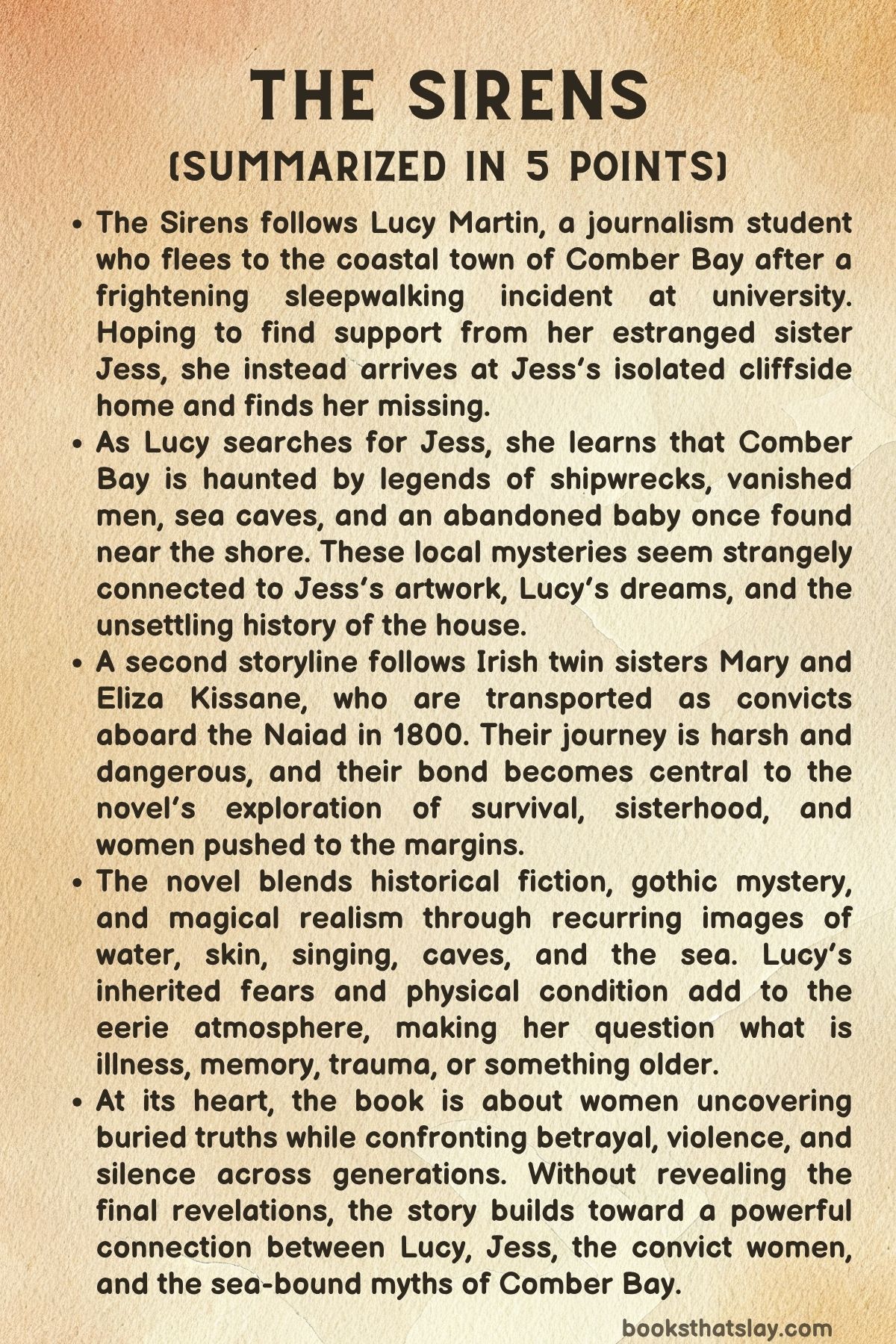
The Sirens by Emilia Hart is a historical mystery about women, inheritance, violence, and the stories hidden inside families. Moving between 1788, 1800, 1982, 1999, and 2019, the novel follows Lucy Martin as she runs from a frightening act she cannot remember and arrives at her missing sister Jess’s home in Comber Bay.
There, Lucy begins to uncover links between Jess, a lost convict ship, vanished men, strange dreams, and a secret birth. The Sirens blends gothic suspense with feminist historical fiction, using the sea as both threat and refuge.
Summary
Lucy Martin is a journalism student at Hamilton Hume University in 2019 when her life breaks open in one terrible morning. She wakes to find herself in the room of Ben, a fellow student she once trusted, with her hands around his throat.
She has no memory of going there. The shock is worse because Ben has already harmed her in another way.
After sleeping with Lucy and encouraging her feelings, he shared an intimate photo she sent him. The image was turned into a cruel TikTok that mocked her skin condition, leaving her exposed and humiliated.
When Lucy tried to seek help, the university seemed more interested in protecting Ben’s future than supporting her. Now, terrified that Ben and his roommate Nick will report her, she flees.
Lucy drives to Comber Bay, where her older sister Jess has recently moved into Cliff House, a decaying home above Devil’s Lookout. The sisters have been distant for years, but Lucy believes Jess may understand what is happening to her because Jess has also sleepwalked.
On the journey, Lucy listens to a true-crime podcast about Comber Bay. The town is known for strange local legends: the wreck of the convict ship Naiad, dangerous sea caves, the 1982 discovery of an abandoned baby known as Baby Hope, and eight men who disappeared between 1960 and 1997.
When Lucy arrives at Cliff House, Jess is gone. Her car, keys, and phone are still there, which makes the disappearance feel wrong.
Inside the house, Lucy finds unsettling paintings: two pale women, a convict ship, and a mermaid figurehead. The images seem familiar because they match dreams Lucy has been having.
She also notices signs that a man may have been in the house recently.
The next morning, Lucy meets Melody, Jess’s neighbour, who has been feeding Jess’s cat, Dora Maar. Melody says Jess asked her to look after the cat because she needed to get away before her art exhibition, called The Sirens.
Lucy uses Jess’s phone and unlocks it with her own birthday. Searching through messages and belongings, she finds emails about the exhibition and an old school diary hidden in a rotting backpack.
The diary reveals that teenage Jess had aquagenic urticaria, the same condition that makes Lucy’s skin react painfully to water. Jess felt isolated from her parents and suspected they were hiding things from her.
She also dreamed of two women, Mary and Eliza Kissane, aboard the Naiad. Jess’s diary shows her growing closeness to her art teacher, Cameron Hennessey, whose attention became inappropriate and dangerous.
As the entries continue, Jess becomes frightened that she might sleepwalk into the dam and drown with the women from her dreams.
Running alongside Lucy’s search is the story of Mary and Eliza Kissane, Irish twin sisters transported as convicts in 1800. Eliza is blind, and Mary describes the world for her.
They are chained at the Cove of Cork and forced onto the Naiad, a ship with a mermaid figurehead. The sisters were convicted after an attack involving a man named Byrne, who had threatened them.
Their father had always warned them away from water because it affected their skin and because their mother had been drawn to the sea and drowned.
On the Naiad, Mary, Eliza, and the other women endure brutal conditions below deck. As the journey continues, their bodies begin to change.
Their skin burns, flesh thickens between fingers and toes, and strange pain develops under their jaws. At Rio, they briefly glimpse land and taste oranges, but once the ship leaves again, food and water become scarce, storms strike, and the sailors’ cruelty grows.
After the crew kills a shark, one of the women, Aoife, fears they have brought a curse on themselves. The ship seems to be carrying not only convicts but also a secret tied to women, water, and transformation.
Back in Comber Bay, Lucy’s sleepwalking worsens. She wakes near the cliff edge and fears she may harm herself without knowing it.
She is also suspended from university while Ben’s assault is investigated. Determined to understand Jess’s paintings and dreams, Lucy travels to Sydney and confirms that Mary and Eliza Kissane were real passengers on the Naiad.
Yet she cannot find later birth or death records for them, which suggests they may have survived under other names, disappeared, or become part of a hidden family history.
Lucy then asks Melody more about Comber Bay. Melody explains how the town has always carried stories about the wreck, drowned women, Baby Hope, and men who vanished over the years.
She shows Lucy old newspaper clippings, including one about Judith Wilson, the woman who adopted Baby Hope. Lucy is shocked when she sees Judith’s photograph and recognizes her own mother.
This discovery changes everything. Lucy realizes Jess was Baby Hope.
Jess was not born into their family but was adopted after being found in a cave at Comber Bay. Lucy still feels tied to Jess as her sister, but the family story she grew up with has been built on silence and lies.
Lucy calls Max Murphy, an old friend of Jess’s, but he avoids giving her clear answers.
Jess’s 1999 diary confirms the truth. At sixteen, Jess found her adoption papers and learned that her parents had once been Robert and Judith Wilson.
She was Baby Hope, the child discovered in the cave. Feeling abandoned, betrayed, and desperate for answers, Jess leaned on Cameron Hennessey.
The diary shows that he exploited her confusion and began a sexual relationship with her when she was still a teenager.
Police arrive at Cliff House looking for Jess and ask Lucy about Cameron. They explain that his car has been found nearby and that he and Jess once had an intimate relationship.
Lucy lies and says she does not know him. After they leave, she sees that her own body is changing.
The skin between her toes has begun to web, and beneath her peeling rash is bluish, shining flesh.
Melody later reveals her own connection to Comber Bay’s legends. In 1981, when she was a teenager, she went with Daniel Smith to the cave at Devil’s Lookout.
When Daniel tried to assault her, women’s voices began singing. Daniel seemed entranced and moved toward the cave mouth before falling or jumping into the sea.
Melody hid the evidence and never told anyone. She believes the bay protects women from violent men.
Lucy calls her mother and says she knows Jess is Baby Hope and that Jess is missing. Her mother warns her not to read more of the diary and says she and Lucy’s father are coming, but Lucy keeps reading.
She finds an ultrasound dated April 1999 under Jess’s name and realizes Jess was pregnant at sixteen.
Jess’s own account finally reveals the central secret. In September 1999, heavily pregnant, she ran away to Comber Bay, pulled by dreams of the cave, the sea, and women singing.
She reached the abandoned Cliff House, went into labour, and followed the voices down to the cave. There she gave birth to Lucy.
Jess wanted to leave with the women of the sea, but rescue workers arrived after her father found her. In hospital, officials said Jess had endangered the baby and planned to place Lucy in emergency care.
To keep Lucy from strangers, Jess agreed that Robert and Judith could raise Lucy as their own child.
Lucy is not Jess’s sister by birth. She is Jess’s daughter.
This truth explains the shared skin condition, the dreams, the pull of water, and the bond between them. It also links Lucy and Jess to the older line of women connected to Mary and Eliza, the Naiad, and the sea caves of Comber Bay.
As Lucy uncovers the truth, she begins to understand that the strange voices, missing men, and inherited transformations are part of a long history of women surviving male harm, protecting one another, and reclaiming power through the sea.
Characters
Lucy Martin
Lucy Martin is the central figure through whom much of the modern story unfolds. In The Sirens, she begins as a frightened and isolated journalism student who has already been publicly humiliated, institutionally dismissed, and emotionally betrayed before the deeper mysteries of her life begin to surface.
Her sleepwalking attack on Ben is shocking not because Lucy seems naturally violent, but because it reveals how much fear, anger, and inherited trauma are moving through her without her conscious control. Lucy’s condition, aquagenic urticaria, makes her feel marked and physically different, yet the story gradually turns that difference into a sign of belonging to a hidden female lineage rather than a mere medical affliction.
Her journey to Comber Bay is therefore not only a search for Jess but also a search for truth, identity, and bodily meaning.
Lucy is also defined by her refusal to accept easy answers. Even when frightened by Jess’s disappearance, the unsettling paintings, the locked family secrets, and the changes in her own body, she keeps investigating.
Her journalism background matters because she instinctively follows records, dates, testimonies, and contradictions, but her discoveries become deeply personal rather than professionally detached. She learns that the people she trusted have hidden the truth of her birth, and that the sister she came looking for is actually her mother.
This revelation reshapes Lucy’s sense of family, but it does not destroy her connection to Jess. Instead, it proves that love, secrecy, protection, and harm can exist together inside the same family structure.
Lucy’s character becomes a bridge between past and present, showing how silenced women’s histories can return through dreams, bodies, memory, and the sea.
Jess Martin
Jess Martin is one of the most tragic and emotionally complex characters in the book. At first, she appears as the missing older sister whose absence pulls Lucy into Comber Bay’s mysteries, but her diaries and later account reveal that she has carried abandonment, shame, exploitation, and motherhood in silence for most of her life.
Jess’s discovery that she was Baby Hope devastates her because it confirms what she has long suspected: that her family history is built on omissions. Her skin condition and dreams connect her to Mary and Eliza, making her feel different long before she understands why.
Art becomes her language for expressing what no one around her can explain, and her exhibition, The Sirens, suggests that she has been trying to transform inherited pain into images of power, memory, and warning.
Jess’s vulnerability as a teenager makes Cameron Hennessey’s manipulation especially disturbing. He exploits her loneliness, her artistic longing, and her hunger to be understood, turning himself into the adult who seems to recognize her when her parents do not.
Her pregnancy at sixteen deepens the tragedy because Jess is both a victim of abuse and a young mother stripped of agency. When she gives birth to Lucy in the cave, she is drawn toward the sea and the women’s voices, suggesting a desire for escape, belonging, or surrender.
Yet her agreement to let her parents raise Lucy also shows a desperate form of protection. Jess is not simply absent from Lucy’s life; she is hidden inside it.
Her character represents how women can be erased even while their sacrifices shape everyone around them.
Mary Kissane
Mary Kissane is a fierce, protective, and deeply loyal character whose story gives the book its historical foundation. As Eliza’s twin sister, Mary often acts as her sister’s eyes, describing the world around them and shielding her from danger.
Her love for Eliza is one of her defining traits, and it is this love that places her in conflict with male violence and colonial punishment. Mary’s transportation aboard the Naiad is not presented as a simple criminal sentence but as part of a broader system that punishes poor women, vulnerable women, and women who resist abuse.
Her attack on Byrne comes from a protective instinct, and the punishment that follows reveals the injustice of a world more willing to condemn women than defend them.
Mary’s physical transformation aboard the ship makes her character both human and mythic. Her burning skin, changing hands and feet, and strange bodily pain connect her to Lucy and Jess across generations.
Yet Mary never becomes only a symbol; she remains a sister, a survivor, and a young woman forced into terror by empire, confinement, hunger, and cruelty. Her fear, anger, and endurance give emotional weight to the historical storyline.
Through Mary, the story links the violence of transportation, the sea’s dangerous beauty, and the hidden power of women who are treated as disposable but refuse to disappear completely.
Eliza Kissane
Eliza Kissane is Mary’s blind twin sister and one of the most haunting figures in the story. Her blindness makes her dependent on Mary’s descriptions, but it does not make her weak.
In fact, Eliza’s presence often deepens the emotional and sensory world of the book because she experiences danger, memory, and the sea differently from those around her. She is vulnerable to men like Byrne, but she is also capable of resistance, as shown through the events that lead to the sisters’ arrest.
Eliza’s bond with Mary is central to her character: the two sisters function almost as two halves of one shared life, connected by love, fear, memory, and a mysterious inheritance tied to water.
Eliza also represents the unseen dimensions of the story. Because she cannot see the world in the ordinary way, her character draws attention to voices, textures, sensations, dreams, and instincts.
This matters in a book where truth is often hidden beneath official records and family stories. Eliza’s connection to the sea and to the strange changes affecting the transported women makes her part of the novel’s larger pattern of women whose bodies reveal histories that society refuses to name.
She is not merely a helpless figure; she is part of the ancestral force that continues to echo into Jess’s and Lucy’s lives.
Melody
Melody is Jess’s neighbour and one of the most important keepers of Comber Bay’s local memory. At first, she appears helpful and practical, feeding Jess’s cat and reassuring Lucy that Jess may simply have gone away before her exhibition.
Gradually, however, Melody becomes a guide into the darker legends of the town: the wreck of the Naiad, Baby Hope, the drowned women, and the long history of missing men. Her role is crucial because she understands Comber Bay not just as a place of danger but as a place shaped by stories of female suffering and female protection.
Melody’s own past with Daniel Smith gives her character emotional depth. Her account of his attempted assault and his death near the cave shows that she is not merely repeating town folklore; she has personally experienced the mysterious power associated with the caves and the women’s voices.
Her decision to hide the evidence reveals both fear and survival. She carries guilt, secrecy, and perhaps relief, because Daniel’s death saved her from violence.
Melody believes the place protects women from dangerous men, and this belief makes her a morally ambiguous but sympathetic figure. She is not presented as innocent in a simple sense, but as someone who has lived long enough with trauma to interpret the supernatural as justice.
Ben
Ben is a modern example of betrayal, entitlement, and social cruelty. He first appears through Lucy’s horror after she wakes with her hands around his throat, but the context of his earlier actions changes the reader’s understanding of that scene.
Ben slept with Lucy, encouraged her affection, received an intimate image from her, and then violated her trust by sharing it. The TikTok made from the image turns private vulnerability into public entertainment, exposing Lucy not only to humiliation but also to a wider culture that treats women’s bodies as material for ridicule.
Ben’s importance lies less in psychological complexity and more in what he represents. He is part of the pattern of men who harm women and are then protected by institutions, friends, or social privilege.
The university’s concern for his future rather than Lucy’s safety reinforces this imbalance. Lucy’s sleepwalking attack on him becomes disturbing because it blurs victimhood and violence, but the book does not ask the reader to forget what Ben did.
His character exposes how digital abuse can become another form of sexual and emotional violence.
Nick
Nick is a smaller but significant character because he is connected to the immediate aftermath of Lucy’s sleepwalking attack on Ben. As Ben’s roommate, his presence intensifies Lucy’s fear that the incident will be reported and that she will be treated as dangerous without anyone understanding the larger history of Ben’s betrayal.
Nick’s role is mostly functional, but he helps create the atmosphere of panic that drives Lucy away from campus and toward Comber Bay.
Nick also represents the social environment surrounding Ben. Even when he is not developed in depth, his position as witness or potential witness matters because Lucy already feels that the world will not believe her or protect her.
Through Nick, the story shows how a woman’s fear is not limited to the person who directly harmed her. It extends to the friends, roommates, institutions, and bystanders who may help shape the public version of events.
Cameron Hennessey
Cameron Hennessey is one of the most predatory characters in the story. As Jess’s art teacher, he occupies a position of authority, trust, and influence, which makes his relationship with teenage Jess deeply exploitative.
He recognizes Jess’s loneliness and artistic talent, but instead of protecting or mentoring her responsibly, he turns her vulnerability into an opportunity for control. His attention appears emotionally validating to Jess because she feels alienated from her parents and confused by her identity, but the imbalance between them makes the relationship abusive.
Cameron’s role is important because he connects personal trauma to a larger pattern of male harm. Like Byrne, Daniel, and Ben, he represents a man who crosses boundaries and benefits from a world that often fails to protect young women.
Jess’s pregnancy becomes one of the most devastating consequences of his exploitation. Even when he is not physically present for much of the story, his influence haunts Jess’s diaries, Lucy’s investigation, and the police’s questions.
He is a reminder that danger in the book does not come only from the sea, caves, or supernatural forces; it also comes from ordinary men who abuse trust.
Judith Wilson
Judith Wilson is Lucy’s mother figure and Jess’s adoptive mother, making her a central figure in the family’s web of secrecy. Her adoption of Baby Hope initially suggests compassion, but the later revelations complicate her role.
She and Robert raise Jess without giving her the full truth about her origins, and later they become Lucy’s carers while hiding the fact that Jess is Lucy’s biological mother. Judith’s actions may come from a desire to protect, but they also deny Jess and Lucy the truth of their own identities.
Judith is not a simple villain. Her choices are shaped by fear, social pressure, and the belief that secrecy might preserve stability.
Yet her warning to Lucy not to read more of Jess’s diary shows how invested she remains in controlling the family narrative. She represents a form of maternal authority that is protective and harmful at the same time.
By hiding painful truths, Judith preserves the appearance of family while allowing confusion, alienation, and inherited trauma to grow underneath.
Robert Wilson
Robert Wilson is Jess’s adoptive father and Lucy’s father figure. His role is less prominent than Judith’s, but he remains important in the structure of concealment surrounding Jess and Lucy.
He is part of the parental unit that raises Jess after she is found as Baby Hope and later takes responsibility for Lucy after Jess gives birth. His discovery of Jess after she runs away to Comber Bay suggests concern and urgency, yet his participation in the later family arrangement also means he helps maintain the secrecy that shapes both daughters’ lives.
Robert’s character reflects the limits of conventional protection. He may help rescue Jess and ensure Lucy is not placed with strangers, but the solution he participates in requires Jess to lose her place as Lucy’s mother.
In this sense, Robert represents the adult world’s tendency to manage crisis by imposing order, even when that order silences the young woman most affected. His presence adds to the book’s exploration of how families can be built on care, fear, and denial at once.
Max Murphy
Max Murphy is Jess’s old friend and one of the characters who seems to know more than he is willing to say. When Lucy reaches out to him using Jess’s phone, his evasiveness increases the sense that Jess’s disappearance is surrounded by withheld information.
Max’s importance comes from his connection to Jess’s past and from the possibility that he understands parts of her life that Lucy has only begun to uncover.
Max functions as a guarded witness. He is not presented with the same moral clarity as Ben or Cameron, but his reluctance to answer Lucy’s questions makes him suspicious and frustrating.
He helps maintain the atmosphere of uncertainty around Jess, suggesting that silence is not limited to family members or institutions. In a story where hidden knowledge has damaged generations of women, Max’s evasiveness becomes another obstacle Lucy must push against in her search for truth.
Daniel Smith
Daniel Smith is a disturbing figure from Melody’s past and one of the missing men associated with Comber Bay. His attempted assault of Melody places him within the story’s repeated pattern of male violence against women.
His death near the cave, apparently after hearing women’s voices and moving toward the sea, gives the local legend a personal and frightening reality. Daniel is not explored as a rounded character, but his actions and fate are crucial to understanding Melody and the town’s mythology.
Daniel’s disappearance also complicates the idea of justice. On one hand, his death prevents further harm to Melody.
On the other hand, Melody’s decision to hide evidence leaves a secret buried for decades. Through Daniel, the book suggests that the supernatural force connected to Comber Bay may act against predatory men, but it also asks what happens to the women who survive such encounters and must live with the aftermath.
Daniel is therefore less important as an individual than as a sign of the dangerous masculine behavior the story repeatedly confronts.
Byrne
Byrne is the man whose attack leads to Mary and Eliza’s arrest and transportation. He represents the brutal gendered violence of the historical storyline, as well as the injustice of a society that punishes women for defending themselves.
His assault by the stream becomes the event that changes the sisters’ lives, sending them into the machinery of criminal punishment and imperial transportation.
Byrne’s character is significant because he shows that Mary and Eliza are not criminals in the moral sense the law claims. The legal system treats their resistance as a punishable offense while ignoring the danger he poses.
Like several men in The Sirens, Byrne embodies a world in which women’s safety is secondary to male power and reputation. His presence may be brief, but the consequences of his violence echo across the entire historical plot.
Aoife
Aoife is one of the transported women aboard the Naiad, and her fear after the crew kills a shark adds to the atmosphere of dread surrounding the voyage. She appears to understand the sea as something powerful, watchful, and capable of vengeance.
Her terror suggests that the women aboard the ship are not only enduring human cruelty but also sensing that the natural or supernatural order has been disturbed.
Aoife’s role is small but meaningful because she helps express the collective fear of the imprisoned women. Her reaction to the shark’s death deepens the sense that the voyage is cursed, or at least that the sea is not passive.
She belongs to the wider community of women whose suffering aboard the Naiad becomes part of the hidden history that later returns through dreams, legends, and bodily transformation.
Baby Hope
Baby Hope is less a separate developed character than an identity placed upon Jess before her true history is known. The name itself shows how the public turns an abandoned infant into a symbol, reducing a real person to a mystery, a headline, and a sentimental idea.
When Lucy discovers that Jess was Baby Hope, the revelation changes the meaning of Jess’s entire life. What once seemed like a local legend becomes a family truth.
As an identity, Baby Hope represents the violence of being named by strangers and separated from origin. Jess grows up without knowing where she came from, and that absence shapes her alienation, her dreams, and her search for belonging.
The Baby Hope story also connects the caves, the sea, Judith, and the family’s lies. It shows how public mysteries can hide private wounds, and how a child supposedly rescued can still grow up surrounded by silence.
Dora Maar
Dora Maar, Jess’s cat, is a minor but memorable presence in the modern storyline. The cat helps reveal Jess’s absence because Melody comes to feed her, suggesting that Jess expected to be away or wanted others to believe she had left voluntarily.
Dora Maar also gives Cliff House a lived-in quality, making Jess’s disappearance feel more intimate and unsettling. The abandoned house is not simply empty; it contains traces of daily life interrupted.
The cat’s name also reflects Jess’s artistic identity, since Dora Maar evokes the world of art, portraiture, and female image-making. Even this small detail reinforces Jess’s connection to visual expression and to women whose lives are often interpreted through the eyes of others.
Dora Maar’s role is quiet, but she helps ground the mystery in domestic reality.
Themes
Women’s Bodies as Sites of Inheritance and Resistance
In The Sirens, the female body carries history, trauma, memory, and power. Lucy’s skin condition first appears to isolate her, making her feel exposed and ashamed after Ben uses her vulnerability against her.
Yet the same body that has been mocked begins to reveal a deeper ancestry through webbing, blue flesh, and strange connections to water. Jess’s body also becomes a place where family secrets are hidden: her pregnancy is treated as a problem to be managed, and her motherhood is erased so that Lucy can be raised under a false identity.
Mary and Eliza’s physical changes aboard the Naiad suggest that the body remembers what society tries to suppress. Their transformation is not simply frightening; it becomes a sign that they belong to something older and stronger than the systems trying to punish them.
Across generations, women’s bodies are controlled, shamed, recorded, hidden, and violated, but they also become sources of survival and truth.
Sisterhood, Motherhood, and Chosen Bonds
The relationships between women are shaped by protection, secrecy, sacrifice, and longing. Mary protects Eliza with fierce devotion, becoming her guide in a brutal world that offers neither safety nor dignity.
Jess and Lucy’s bond is more complicated because it is built on a lie: Lucy believes Jess is her sister, only to learn that Jess is actually her mother. This discovery does not weaken their connection; instead, it explains the emotional pull between them.
Jess’s absence drives Lucy’s search, but the search becomes more than an attempt to find a missing person. It becomes a recovery of the truth about who raised her, who bore her, and who was forced into silence.
Motherhood here is not presented as simple comfort. It is marked by fear, control, social judgment, and loss.
Yet the novel also shows that female bonds can survive distorted family structures, because care and kinship are not limited to official names or legal roles.
Male Violence and Institutional Betrayal
The novel presents male violence not as isolated acts, but as part of a wider pattern protected by social institutions. Ben’s betrayal of Lucy is not only personal cruelty; it becomes public humiliation when her intimate image is used to mock her.
The university’s response deepens the harm by treating Ben’s future as more important than Lucy’s suffering. In the past, Mary and Eliza are punished within a legal system that ignores the violence committed against them and focuses instead on their resistance.
Jess’s exploitation by Hennessey follows a similar pattern, as an older man uses his authority and her loneliness to gain control over her. Melody’s story adds another layer, showing how women learn to hide their pain because they do not expect justice.
The repeated disappearances of men in Comber Bay suggest a dark reversal of power: when formal systems fail women, the sea, the caves, and the voices become a form of judgment.
Memory, Dreams, and the Return of Suppressed Truth
Memory in The Sirens does not stay neatly in diaries, records, or official accounts. It returns through dreams, sleepwalking, paintings, voices, and bodily change.
Lucy’s dreams of Mary and Eliza seem impossible at first, but they gradually become a way of accessing a history that has been buried. Jess’s art performs a similar function, preserving images of the ship, the pale women, and the mermaid figurehead before Lucy understands their meaning.
Written records both reveal and conceal truth: the convict database confirms Mary and Eliza’s existence, while adoption papers, diaries, and medical documents expose the lies surrounding Jess and Lucy’s family. Sleepwalking is especially important because it shows the mind moving toward truths that waking life avoids.
Lucy’s body knows before she does. Jess knew before she could explain it.
The past keeps pressing into the present until secrecy becomes impossible. The novel suggests that buried stories do not disappear; they wait for someone willing to read the signs.