We All Live Here Summary, Characters and Themes
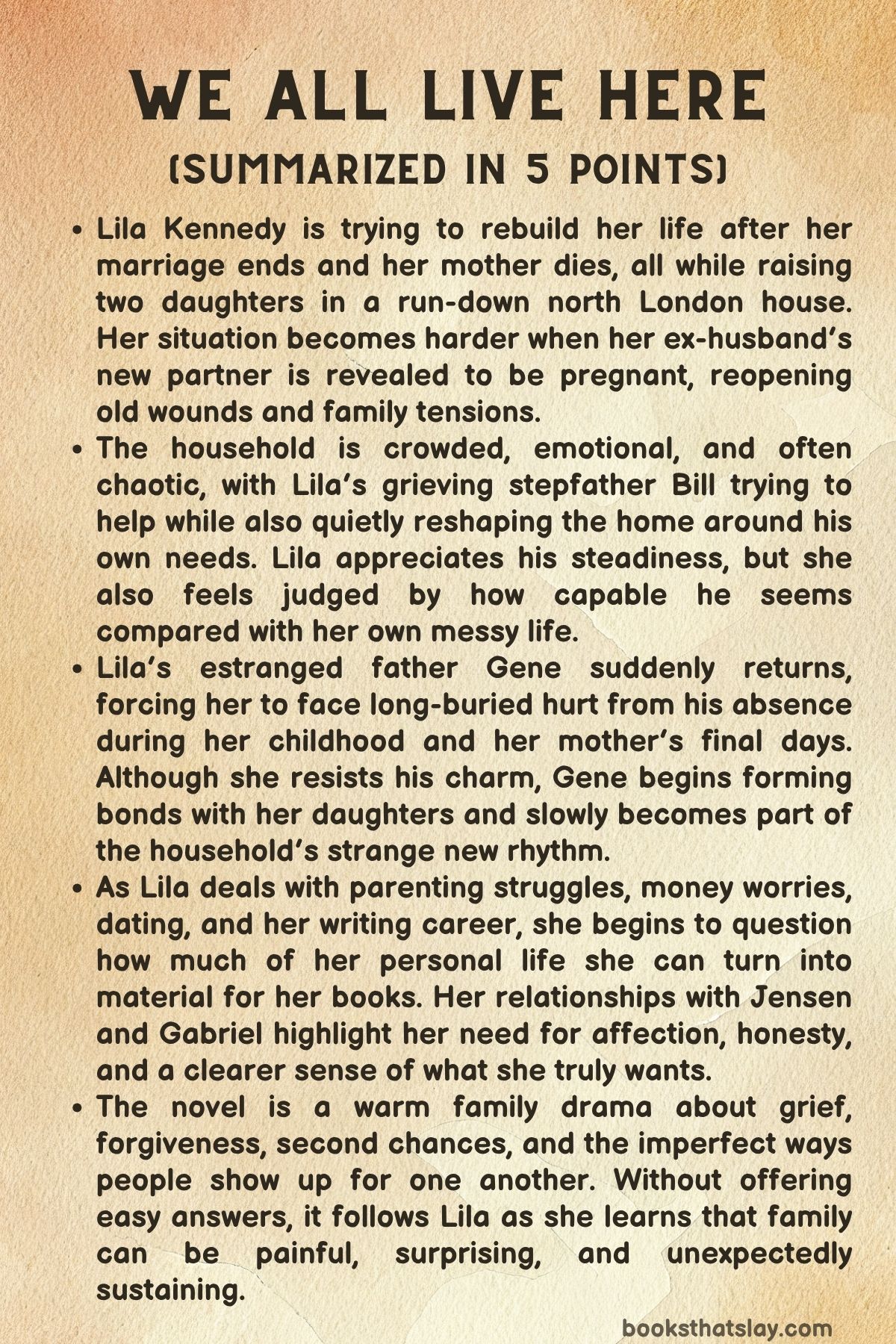
We All Live Here by Jojo Moyes is a contemporary family novel about a woman trying to rebuild her life while everything around her seems to be breaking down. Lila Kennedy is newly separated, grieving her mother, raising two daughters, managing money worries, and sharing her home with a stepfather who may never leave.
Then her absent biological father returns, bringing old hurt back into the house. The novel looks at divorce, parenting, grief, second chances, and the messy shape of modern family life with warmth, humour, and emotional honesty.
Summary
Lila Kennedy is living in a large, worn-down house in north London, trying to keep her family, finances, and emotions from falling apart. Her marriage to Dan has ended badly after he left her for Marja, a younger woman connected to their daughters’ school community.
The betrayal is made worse by the timing: Lila had recently published a book about repairing marriages, called The Rebuild, only for her own marriage to collapse soon afterward. Now she is expected by her agent, Anoushka, to write a new book about the joys of single life, even though Lila feels anything but joyful.
Her household is full and tense. She lives with her teenage daughter Celie, her younger daughter Violet, their nervous dog Truant, and Bill, her elderly stepfather.
Bill moved in after the sudden death of Lila’s mother, Francesca. He is kind, dependable, and helpful, but his calm competence often makes Lila feel judged.
He cooks healthy meals the girls do not want, keeps the house in better order than Lila can, and quietly makes himself more settled there. He also begins planning a memorial garden for Francesca, which suggests he may see the house as his long-term home.
Lila’s daily life is shaped by practical problems and emotional strain. The plumbing is blocked, money is tight, her house needs repairs, and she has to keep meeting Marja at school.
One day at pickup, Lila discovers that Marja is pregnant. The news hurts deeply because Dan had refused to have more children with Lila.
Dan later calls and asks Lila to tell their daughters about the baby, partly because Marja is upset that Lila found out in public. During the argument, Celie overhears the truth.
Lila tries to soften the news, but Celie already suspected it after noticing clues online and in Marja’s belongings.
Celie’s anger and unhappiness begin to show more openly. She skips school, smokes weed, and pushes back against Lila’s attempts to control her.
When Lila tracks her down using Find My Phone, their confrontation becomes bitter. Celie calls Lila a hypocrite because Lila also sometimes smokes weed at night to sleep.
Lila is left feeling that she is failing as a parent while also trying to process her own grief and humiliation.
Into this disorder comes Jensen, a landscape gardener. Lila first mistakes him for a suspicious stranger watching her tree and shouts at him.
He later returns because Bill wants him to help with the memorial garden. Jensen is practical, observant, and calm, and his presence slowly becomes important in the household, though Lila is too distracted at first to understand what he might mean to her.
Dan adds to Lila’s stress when he says he may need to reduce child support because he and Marja must find a bigger house for their new family, which includes Marja’s son Hugo and the baby on the way. Lila feels that Dan is building a new life at the expense of the old one he left behind.
Then, during a garden discussion, Celie announces she is going out to drink and get high. At that same moment, an older American man named Gene enters through the back gate, and Truant bites him.
Gene is Lila’s biological father, an actor once known for playing Captain Troy Strang in an old science-fiction show. He has been absent for most of her life and did not come to Francesca’s funeral.
His sudden arrival shocks the girls, who barely know about him, and infuriates Bill, who sees him as selfish and unreliable. Gene is charming and theatrical, and Violet is quickly drawn to him, but Lila remains guarded and angry.
A tense dinner follows, filled with old resentment. Gene claims his hotel booking has gone wrong and asks to stay.
Lila allows him to sleep in her study for one night, though she does so reluctantly.
Gene’s arrival forces Lila to remember her childhood. He left when she was young, while Bill slowly became the steady father in her life.
Bill built her a beautiful doll’s house and gave her the reliability Gene never offered. In the present, Lila tries to talk through her confusion with her friend Eleanor, who urges her to find some happiness again.
Around this time Lila also meets Gabriel Mallory, an attractive new father at school. She later discovers he is an award-winning architect, and his attention gives her a sense of possibility.
Meanwhile, Gene begins to take small acting jobs, including a toothpaste advert and a minor role in a period drama. He is delighted by these chances and rehearses his few lines with great seriousness.
Lila wants to be pleased for him, but his past still stands between them. She cannot forget that he abandoned her and Francesca, and that he stayed away even when Francesca died.
Bill, too, begins to change. He prepares nervously for a dinner date with Penelope Stockbridge, worrying over the menu and atmosphere.
While Bill hosts Penelope, Lila takes Gene and the girls out for pizza. During the meal, Anoushka calls with excellent news: a publisher has offered Lila £170,000 for two books.
The offer eases her immediate financial fears, but it also makes her uncomfortable because the new book draws heavily from her own life and the people around her. When the family returns home, Bill and Penelope are clearly enjoying each other’s company.
Gene later encourages Bill to go back and kiss her properly, and Gene’s advice turns out to be right.
Dan then asks Lila if he can take old baby items from the garage for his child with Marja. Lila is furious.
The cot, car seat, and toys feel like pieces of the family Dan left, and reminders of the child he refused to have with her. She lies and says she has thrown them away, then loads them into her Mercedes to take them to the dump.
When the car will not start, Jensen helps by driving her. At the dump, he asks whether he has upset her, since she has been distant.
Their honest conversation eases some of the awkwardness between them.
Gene becomes more involved with the family and, at the school gates, is recognized by parents as Captain Troy Strang from Star Squadron Zero. When he realizes Marja is Dan’s pregnant partner, he publicly challenges her for never apologizing to Lila.
Others try to defend Marja, but Gene points out that everyone is protecting Marja’s unborn baby while ignoring the pain caused to Celie and Violet. Marja finally apologizes.
Lila is embarrassed and overwhelmed, but the moment also gives voice to feelings she has been forced to carry quietly.
As Bill grows closer to Penelope, he becomes happier and more alive. Jensen completes the memorial garden, creating a peaceful space with Bill’s carved bench and plants chosen partly for Francesca.
He also fixes Lila’s Mercedes battery and takes her for a drive with the roof down. Lila feels a sudden rush of pleasure and begins to wonder whether Jensen is part of that happiness.
Gene’s toothpaste advert airs, and the household gathers to watch it while eating Bill’s fried chicken. They cheer when he appears on screen.
Lila sees that this strange, noisy, damaged group has somehow become a family.
Lila then goes to dinner at Gabriel’s house. He delays the meeting, has not cooked, orders food, and they drink and sleep together on his sofa.
Afterward, Lila expects closeness, but Gabriel asks her to leave before his daughter wakes up and tells her not to mention anything at school. She leaves hurt and uncertain.
Celie starts improving after encouragement from Gene. She joins Animation Club, makes gentler friends, and creates a storyboard inspired by Gene and Bill as two foolish old men fighting.
Celie also pushes Gene to face what he did to Lila. He begins to understand that charm is not enough and that he owes his daughter a real apology.
Lila becomes increasingly uneasy about Gabriel, whose attention is affectionate but inconsistent. Eleanor suggests that he may be giving her just enough hope to keep her interested without offering anything real.
Then Jensen finds a draft chapter of Lila’s book that describes their private night in detail. He is horrified that she has turned him into material for her work.
His anger forces Lila to confront a painful truth: in trying to make sense of her life through writing, she has failed to think about how exposed and used the people around her might feel.
Characters
Lila Kennedy
Lila Kennedy is the emotional centre of We All Live Here, and her character is shaped by grief, humiliation, exhaustion, and the constant pressure to appear more capable than she feels. She is trying to manage a life that has come apart in several directions at once: her marriage has ended, her mother has died, her finances are uncertain, her house is falling apart, and her daughters need more emotional steadiness than she can always provide.
What makes Lila compelling is that she is not presented as a perfect victim. She is hurt, funny, defensive, loving, chaotic, sometimes selfish, and often overwhelmed.
Her pain over Dan’s betrayal is intensified by public embarrassment, especially because she had recently written a book about rebuilding marriage. This makes her feel exposed, almost as if her private failure has become public evidence against her.
Lila’s relationship with motherhood is one of the most important parts of her character. She deeply loves Celie and Violet, but she is not always able to meet their needs calmly.
Celie’s anger and rebellion frighten her because they reflect the damage the family breakdown has caused, but also because Celie can see through Lila’s own contradictions. Lila wants to correct her daughter’s behaviour, yet she is also guilty of using weed to cope with sleeplessness and stress.
This makes her a very human parent rather than a simplified one. Her parenting is marked by guilt: guilt that Dan has disrupted the girls’ lives, guilt that she cannot protect them from Marja’s pregnancy, and guilt that her own sadness sometimes fills the house.
Lila’s emotional journey is also tied to her identity as a writer. Her professional life depends on turning personal experience into material, but the situation with Jensen forces her to confront the ethical cost of doing that.
When he finds that she has written about him intimately, Lila realizes that her habit of shaping real life into publishable narrative can hurt people who never agreed to become part of her work. This is an important moment because it pushes her beyond self-pity.
She begins to understand that her suffering does not automatically excuse carelessness toward others.
Her romantic confusion also reveals her vulnerability. Gabriel attracts her because he represents elegance, desirability, and a possible escape from the mess of her life.
However, his vagueness and secrecy leave her feeling small and uncertain. Jensen, by contrast, sees her in the middle of her chaos and responds with practical kindness.
Lila’s gradual recognition of this difference suggests that she is learning to value steadiness over surface charm. By the end of the story, Lila has not become fully healed, but she is beginning to see that family, love, and renewal may not look like the polished life she once tried to write about.
Celie Kennedy
Celie Kennedy is one of the most emotionally wounded characters in the book. At sixteen, she is old enough to understand the betrayal and disruption caused by Dan’s new life, but still young enough to need security from the adults around her.
Her skipping school, smoking weed, and open hostility are not simply teenage rebellion; they are expressions of grief, anger, and powerlessness. Celie has watched her father leave, seen her mother humiliated, and then learned that Marja is pregnant with the child Dan once refused to have with Lila.
This makes the new baby feel not just like a sibling, but like evidence that Dan has chosen another family over hers.
Celie’s sharpness often makes her seem difficult, but much of her anger comes from clear perception. She notices adult hypocrisy and refuses to pretend that everything is fine.
When she challenges Lila over weed, she exposes one of the central tensions in their relationship: Lila wants authority, but Celie sees that her mother is also barely coping. Celie’s pain is therefore mixed with a demand for honesty.
She does not want comforting lies or polite explanations. She wants the adults around her to admit the damage they have caused.
Her relationship with Gene becomes unexpectedly important. Gene’s flamboyance and lack of conventional discipline could easily make him seem like a bad influence, yet he reaches Celie in a way other adults struggle to do.
He treats her imagination seriously, encourages her creativity, and helps her move toward Animation Club and kinder friendships. Through Celie’s storyboard about Gene and Bill as ridiculous old men, she begins to transform family chaos into art.
This mirrors Lila’s role as a writer, but in Celie’s case the creative act feels more playful and healing.
Celie also becomes morally significant because she pushes Gene toward accountability. When she challenges him, he begins to understand that charm is not enough to repair abandonment.
In this sense, Celie is not only a damaged teenager but also a truth-teller. Her anger may be messy, but it often points directly to what the adults are avoiding.
Violet Kennedy
Violet Kennedy is younger than Celie, and her role in the book brings out the softer and more vulnerable side of the family breakdown. She does not carry the same openly rebellious energy as her older sister, but she is still affected by the instability around her.
Violet’s position as the younger daughter means she often absorbs tension without fully controlling or articulating it. She lives in a house where adults argue, money is uncertain, her father has left, and a new baby is coming in another household.
Her innocence makes these changes feel especially painful.
Violet is also important because she responds warmly to Gene. While Lila is guarded and Celie is suspicious in her own way, Violet is more open to his theatrical charm.
Through her, the reader sees why Gene can be appealing despite his failures. He brings excitement, stories, and colour into a house that has been weighed down by grief and resentment.
Violet’s reaction to him does not erase his past, but it shows that children can be drawn to warmth and attention even when the adult offering it has been unreliable.
Her presence also deepens Lila’s sense of responsibility. Lila has to consider not only Celie’s anger but Violet’s need for reassurance and ordinary happiness.
The cinnamon bun moment with Gabriel’s daughter shows how Violet is part of Lila’s daily world of school gates, snacks, routines, and small maternal gestures. Violet represents the everyday tenderness that continues even when the larger family structure has broken.
Bill
Bill is one of the steadiest and most quietly moving characters in We All Live Here. As Lila’s elderly stepfather, he represents reliability, domestic care, and the kind of love that is proven through repeated action rather than dramatic speeches.
After Francesca’s death, he moves into Lila’s house and becomes both a help and a complication. He cooks, organizes, plans, worries, and tries to hold the household together, but his competence sometimes makes Lila feel judged.
This tension is central to his character: he is genuinely helpful, yet his presence also reminds Lila of everything she cannot manage on her own.
Bill’s grief for Francesca is understated but powerful. His desire to create a memorial garden shows that he is not simply trying to tidy the house or control the family; he is trying to give his loss a shape.
The garden becomes an outward expression of mourning, memory, and continuity. Unlike Gene, who returns with performance and charm, Bill has already earned his place through years of loyalty.
His love for Lila is paternal in the deepest sense because he chose consistency when her biological father did not.
His relationship with Gene reveals Bill’s protective anger. Bill resents Gene not only because Gene abandoned Francesca and Lila, but because Gene can arrive late and still attract attention.
Bill’s bitterness is understandable: he did the hard work of fatherhood while Gene kept the glamour of being the exciting absent parent. Yet Bill is not frozen in resentment.
His romance with Penelope brings out a livelier, more hopeful side of him. Through Penelope, Bill becomes more than a grieving widower or responsible elder; he becomes a man still capable of embarrassment, desire, and renewal.
Bill’s transformation is gentle but important. As the household becomes stranger and more crowded, he begins to loosen.
The fried chicken evening, the garden, and his growing happiness with Penelope show that steadiness does not have to mean emotional dryness. Bill’s character proves that ordinary devotion can be heroic, even when it is expressed through meals, benches, repairs, and quiet presence.
Gene
Gene is one of the most dramatic and morally complicated figures in the story. He arrives as Lila’s estranged father, an aging actor associated with an old science-fiction show, and his entrance immediately disrupts the fragile order of the household.
He is charming, theatrical, self-absorbed, funny, and emotionally evasive. His personality is built around performance, which makes him entertaining but also difficult to trust.
He knows how to win a room, but he has not always known how to stay for the people who needed him.
Gene’s greatest failure is his abandonment of Lila and Francesca. His absence during Lila’s childhood, and especially his failure to attend Francesca’s funeral, cannot be excused by charm.
Lila’s coldness toward him is therefore not cruelty; it is self-protection. Gene wants access to the family without fully facing the damage he caused.
At first, he seems to believe that warmth, humour, and helplessness can get him forgiven. His request to stay after his hotel problem may be comic, but it also shows his habit of imposing himself on others.
Yet Gene is not written as a simple villain. He has emotional intelligence in unexpected moments.
He understands that Bill should return and kiss Penelope. He recognizes the cruelty in the school-gate community’s protection of Marja while Celie and Violet’s pain is ignored.
His public confrontation with Marja is inappropriate in its theatricality, but it also gives voice to something Lila has been forced to swallow. Gene’s instinct for drama can be destructive, but it can also expose hidden truths.
His bond with Celie is especially important because it helps him grow. Celie’s challenge forces him to see that he owes Lila more than charm; he owes her an apology.
This suggests that Gene may still be capable of moral development. He remains chaotic and unreliable in some ways, but his return creates movement in the family.
He is both a wound and a catalyst, a reminder of old abandonment and a possible source of unexpected repair.
Dan
Dan is Lila’s ex-husband and one of the main causes of the emotional disorder surrounding the Kennedy family. He has left Lila for Marja, a younger woman connected to the school community, which makes the betrayal feel especially public and humiliating.
His actions suggest a man who wants the benefits of his new life without fully accepting the emotional cost to his old one. He may not be deliberately cruel in every moment, but he is often selfish, evasive, and insensitive.
His request that Lila tell the girls about Marja’s pregnancy reveals his weakness. Rather than taking responsibility for the consequences of his choices, he shifts emotional labour onto Lila.
This is particularly painful because the pregnancy touches one of Lila’s deepest wounds: Dan had once refused to have more children with her. The new baby therefore becomes a symbol of rejection.
It tells Lila and the girls that Dan is willing to build elsewhere what he denied at home.
Dan’s financial behaviour also exposes his priorities. When he says he may reduce child-support payments because he and Marja need a bigger house, he treats Lila’s household as adjustable and secondary.
His desire to take old baby items from the garage is another example of emotional blindness. To him, the cot and toys may be practical objects, but to Lila they belong to the history of their family and to the future she did not get.
Dan’s failure is not only that he left; it is that he keeps expecting Lila to make his leaving easier for him.
Marja
Marja is a painful presence in the story because she represents Dan’s new life and Lila’s public humiliation. As the younger pregnant partner, she could easily be reduced to the role of the other woman, but her character is more effective because she exists within a social community that seems to protect her while leaving Lila exposed.
Her pregnancy intensifies the emotional imbalance between the two households. For Marja, the baby is part of a new beginning; for Lila, Celie, and Violet, it is a reminder of abandonment and replacement.
Marja’s failure to apologize is important. Whether from guilt, awkwardness, defensiveness, or self-preservation, she appears to benefit from silence.
The school-gate environment makes this worse because everyone seems aware of the situation, yet Lila is expected to remain polite. Gene’s confrontation is embarrassing, but it forces Marja to acknowledge Lila’s pain directly.
Her apology matters because it breaks the social performance in which Lila has had to carry humiliation alone.
Marja is not shown as purely malicious, but she is part of a moral injury. Her presence reveals how betrayal does not happen only between two adults; it spreads through children, friendships, routines, finances, and public spaces.
She is significant less because of what she says and more because of what her position does to everyone around her.
Jensen
Jensen is one of the most grounded characters in the book. He first appears through misunderstanding, when Lila mistakes him for a suspicious stranger, but he gradually becomes associated with repair, patience, and practical care.
As a landscape gardener, his work is symbolically important. He helps create the memorial garden for Francesca, but he also brings order and beauty into a household marked by decay, grief, and emotional disorder.
His kindness is quiet rather than showy. He helps Lila with the baby items, drives her to the dump, fixes her car battery, and encourages her to enjoy the Mercedes rather than see it only as an impractical burden.
These actions show that he pays attention to what people need. Unlike Gabriel, who offers glamour and uncertainty, Jensen offers presence.
He does not seem interested in making Lila feel dazzled; he makes her feel accompanied.
However, Jensen is not merely a convenient romantic alternative. His anger after finding Lila’s draft is justified and important.
He refuses to be turned into material without consent, especially when the writing exposes intimate details. This moment gives him dignity and prevents him from being treated only as a gentle helper in Lila’s story.
Jensen’s hurt forces Lila to confront the real-world consequences of her writing. His character therefore represents not only emotional possibility but also ethical boundaries.
Gabriel Mallory
Gabriel Mallory represents the seductive appeal of a polished new beginning. He is handsome, accomplished, and socially impressive, especially once Lila discovers that he is an award-winning architect.
To Lila, who feels messy, rejected, and financially anxious, Gabriel appears to offer validation. His attention suggests that she might still be desirable and that life after Dan might contain romance, elegance, and excitement.
Yet Gabriel’s behaviour gradually reveals emotional evasiveness. He texts affectionately but avoids firm commitment.
When Lila goes to his house for dinner, the evening lacks the care she may have imagined: he delays, has not cooked, orders food, drinks with her, sleeps with her, and then asks her to leave before his daughter wakes. His request that she not mention anything at school makes the encounter feel hidden and unequal.
He gives Lila enough warmth to keep her hoping, but not enough respect to make her secure.
Gabriel is important because he exposes Lila’s hunger for reassurance. She wants to believe that being chosen by him will repair some of the damage Dan caused.
Instead, he risks repeating a familiar pattern in which Lila’s needs are secondary to a man’s convenience. His role is not simply romantic; he tests whether Lila can learn to recognize the difference between attention and care.
Francesca
Francesca, Lila’s mother, is absent through death but emotionally present throughout the story. Her death is one of the major losses Lila is trying to survive, and it also explains Bill’s grief and his need to create the memorial garden.
Francesca represents the family history that came before the current chaos. Through memories of her, the reader understands the long contrast between Gene’s absence and Bill’s reliability.
Her importance lies partly in the way other characters respond to her absence. Lila is grieving not only the loss of her mother but also the loss of a stabilizing figure.
Bill mourns her through domestic rituals, order, and the garden. Gene’s failure to attend her funeral becomes one of the clearest signs of his selfishness.
Francesca’s death therefore reveals the truth of the living characters. It shows who stayed, who fled, who remembers, and who tries to make amends too late.
Although she is not active in the present action, Francesca shapes the emotional architecture of the novel. Her memory binds Lila and Bill together, stands as an accusation against Gene, and gives the garden its deeper meaning.
Anoushka
Anoushka, Lila’s agent, represents the professional pressure in Lila’s life. She pushes Lila for a manuscript about happy single life, even though Lila’s actual experience of single life is chaotic, painful, and unresolved.
This contrast creates much of Lila’s tension as a writer. She is expected to turn personal collapse into marketable confidence before she has truly recovered.
Anoushka is not necessarily cruel; she is functioning within the logic of publishing, where pain can become a proposal and reinvention can become a brand. Her news about the two-book offer is life-changing because it relieves Lila’s immediate financial panic.
However, it also deepens the central conflict around Lila’s writing. The better the professional opportunity becomes, the more tempting it is for Lila to use the people around her as material.
Her character helps show that Lila’s crisis is not only domestic but also creative and ethical. Anoushka gives Lila hope, but the opportunity she brings also forces Lila to ask what kind of writer she wants to be.
Eleanor
Eleanor is Lila’s friend and a source of emotional perspective. She encourages Lila to move forward and seek joy, which matters because Lila often feels trapped by humiliation and responsibility.
Eleanor’s role is that of the clear-eyed confidante who can say what Lila may not be ready to admit. When she suggests that Gabriel may be breadcrumbing Lila, she gives language to the uncertainty Lila has been feeling.
Eleanor’s importance lies in her ability to stand slightly outside the family chaos. She is not caught in the same house, the same grief, or the same school-gate tensions, so she can see patterns Lila struggles to recognize.
Her friendship offers Lila a form of adult support that is not based on obligation. In a story full of complicated family bonds, Eleanor represents chosen loyalty and practical honesty.
Penelope Stockbridge
Penelope Stockbridge brings warmth, romance, and renewal into Bill’s life. Her presence allows Bill to become more than the grieving widower and responsible stepfather.
Around her, he becomes nervous, hopeful, and endearingly uncertain. His repeated menu changes before their dinner show how much he cares about making the evening right, and this vulnerability reveals a softer side of him.
Penelope’s relationship with Bill also changes the atmosphere of the household. Her regular presence suggests that life after loss can still contain companionship and pleasure.
This is important not only for Bill but also for Lila, because it shows that grief does not have to be the final emotional state of the family. Penelope helps Bill re-enter life, and through that, she becomes part of the wider healing process within We All Live Here.
Truant
Truant, the anxious family dog, adds both comedy and emotional texture to the household. His anxiety mirrors the instability of the people around him.
In a home full of grief, arguments, blocked plumbing, unexpected visitors, and shifting loyalties, Truant’s nervousness feels almost like an animal version of the family’s collective stress.
His biting of Gene is comic, but it also works symbolically. Gene arrives as an intruder from the past, and Truant responds as if the household’s boundaries have been violated.
The bite captures the family’s instinctive suspicion before anyone has fully explained who Gene is or what he wants. Truant may be a minor character, but he contributes to the chaotic domestic realism of the story.
Hugo
Hugo, Marja’s son, is mostly important because he is part of Dan’s new family structure. His existence reminds Lila, Celie, and Violet that Dan’s life has expanded beyond them.
Along with Marja’s pregnancy, Hugo contributes to the sense that Dan is building a replacement household while his first family is still dealing with the damage.
Hugo is not presented as blameworthy. He is a child caught within adult decisions, just as Celie and Violet are.
His role is therefore structural and emotional rather than antagonistic. He helps show that blended families can contain innocent children while still being formed through painful choices.
Lennie
Lennie, Gabriel’s daughter, is important because she reveals the limits of Gabriel’s openness with Lila. His insistence that Lila leave before Lennie wakes up makes Lila feel hidden and temporary.
Lennie herself is not responsible for this, but her presence shapes the emotional meaning of Lila’s night with Gabriel.
Through Lennie, the story also draws a quiet parallel between Lila and Gabriel as single parents. However, Gabriel appears much more careful about protecting the boundaries of his own household than he is about respecting Lila’s feelings.
Lennie’s role therefore helps expose the imbalance in Gabriel and Lila’s connection.
Philippa Graham
Philippa Graham represents the social world that surrounds and judges Lila. At the school gates, she tries to defend Marja when Gene confronts her, and this makes Philippa part of the community’s uncomfortable moral imbalance.
Her reaction suggests that people are often quicker to protect the person who appears vulnerable in the present, such as pregnant Marja, than to acknowledge the quieter pain of those who have already been hurt.
Philippa’s role is small but revealing. She shows how public spaces can become emotionally hostile after private betrayal.
Lila is not only dealing with Dan and Marja; she is also dealing with the opinions, silences, and alliances of other parents. Philippa helps make the school community feel like a stage on which Lila’s humiliation is constantly being replayed.
Themes
Family as a Shifting, Imperfect Shelter
Family in We All Live Here is not shown as a neat or peaceful unit, but as a crowded, difficult, emotionally messy space where people keep hurting and helping one another at the same time. Lila’s household is full of strain: her daughters are angry and unsettled, Bill is grieving while trying to impose order, Gene arrives with years of absence behind him, and Dan’s new family keeps reminding Lila of what she has lost.
Yet the novel suggests that family is not only formed through biological loyalty or perfect behaviour. Bill, though not Lila’s real father, has given her steadiness and care.
Gene, though unreliable, slowly begins to offer warmth and recognition. Even Penelope and Jensen widen the emotional world of the house.
The family becomes meaningful because people continue showing up, even awkwardly and imperfectly. The crumbling house reflects this idea: damaged, crowded, and hard to manage, yet still capable of holding love, grief, anger, forgiveness, and renewal under one roof.
Grief, Abandonment, and the Need for Recognition
Lila’s grief over Francesca’s death is made heavier by older wounds that were never fully healed. Gene’s absence from her childhood and from her mother’s funeral is not a small personal failure; it represents a lifelong pattern of emotional neglect.
His return forces Lila to face pain she has learned to manage by dismissing him as selfish and unserious. Bill’s grief is quieter but equally important.
His cooking, orderliness, possessions, and memorial garden are ways of trying to keep Francesca present. The novel shows that grief is not only sadness over death; it is also anger over who was missing, who failed to help, and who now claims space in the aftermath.
Lila needs more than apologies. She needs Gene to understand the scale of what his absence cost her.
When Celie challenges him and he begins to recognize this, the story presents healing as a slow process based on accountability, not charm.
Reinvention After Public Failure
Lila’s life has collapsed in a particularly humiliating way because her marriage ended just after she published a book about repairing relationships. Her private failure has become tied to her public identity, leaving her trapped between embarrassment and the pressure to perform confidence.
Anoushka’s demand for a manuscript about happy single life exposes the gap between the life Lila is expected to sell and the life she is actually living. She is not happily independent; she is anxious about money, parenting, repairs, desire, and loneliness.
Yet We All Live Here does not treat reinvention as a sudden transformation into strength. Lila’s movement forward is uneven.
She makes poor romantic choices, avoids difficult conversations, lies about the baby things, and hurts Jensen through her writing. Still, these mistakes become part of her rebuilding.
Her reinvention begins when she stops pretending to have mastered life and starts accepting that survival can be confused, funny, painful, and unfinished.
The Ethics of Using Life as Material
Lila’s work as a writer raises a serious question about what happens when private experience becomes public material. Her new book is meant to draw from her life as a single woman, but the people around her are not simply characters; they are family members, lovers, children, and friends with their own feelings.
This becomes most painful when Jensen finds a draft describing their night together in intimate detail. His anger reveals that Lila has treated a shared emotional moment as something she alone owns.
The theme is not presented as a rejection of writing from life, but as a warning about care, consent, and responsibility. Lila’s need to turn pain into a book is understandable because writing may help her regain money, control, and identity.
However, the story makes clear that personal truth can still injure others when it ignores their dignity. Art may come from life, but it cannot excuse emotional carelessness.