The Midnight Carousel Summary, Characters and Themes
The Midnight Carousel by Fiza Saeed McLynn is a historical mystery that travels from turn-of-the-century Paris to wartime America and beyond, following a spectacular carousel with a shadowed past. It begins with a grieving craftsman who pours love and loss into a single carved horse, then jumps forward to a detective chasing disappearances tied to fairgrounds and a charming suspect who refuses to explain anything.
Years later, an orphaned girl named Maisie finds safety, ambition, and danger wrapped up in the same machine. The carousel becomes both refuge and threat, testing what people will sacrifice to survive.
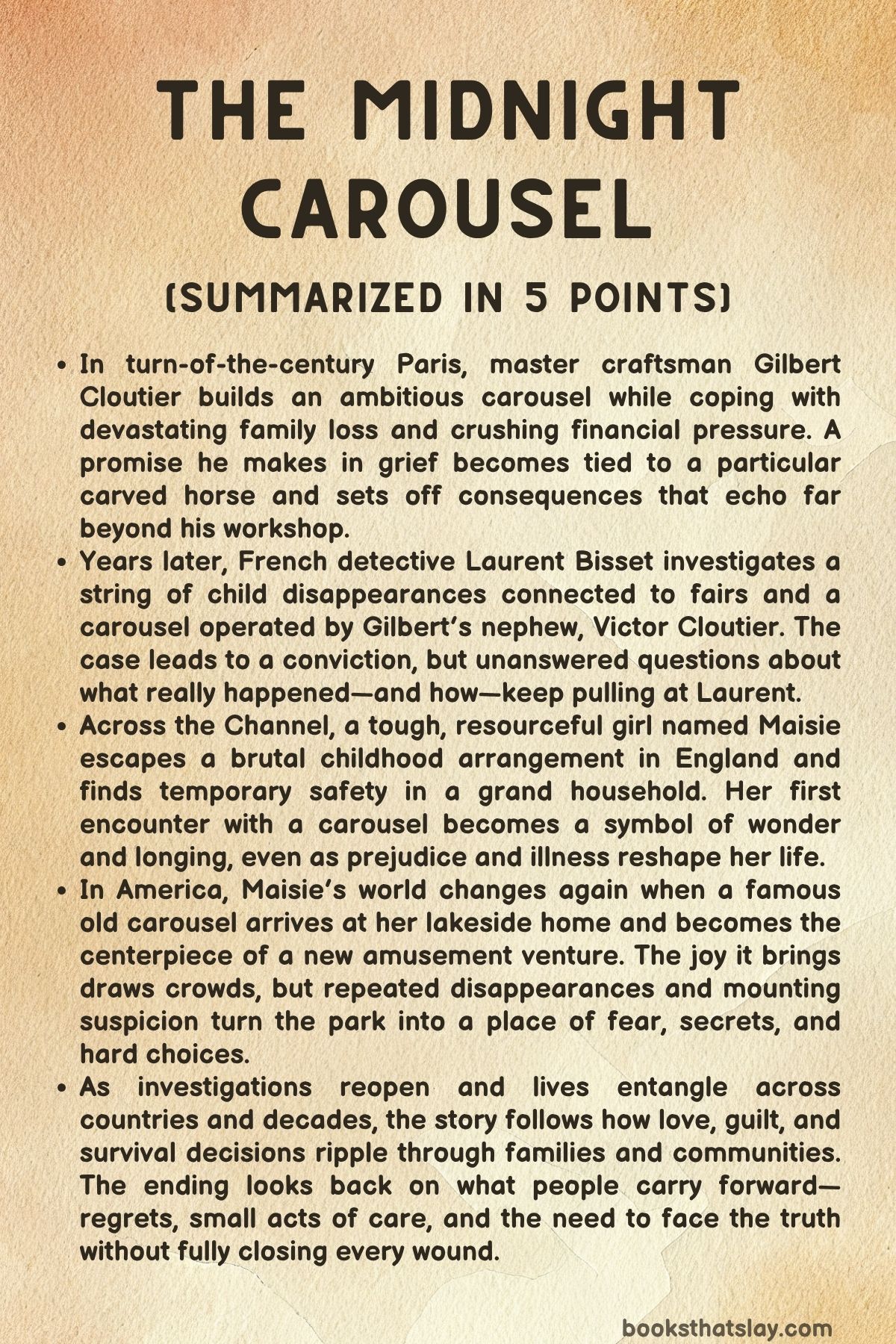
Summary
In 1900, on the gritty edges of Paris, Gilbert Cloutier works through the night building a grand carousel meant to impress the city and humiliate an English competitor at the Exposition. His workshop should be filled with pride, but grief has taken over his life.
His wife has died of influenza, and their small son, Théo, is fading in the next room. Before Théo dies, he makes one request: that his father name a carousel horse after him.
Gilbert promises, clinging to the simple certainty of keeping his word when everything else is breaking.
The Exposition’s schedule suddenly shifts, and Gilbert’s foreman pushes the exhausted workers into longer hours. Money is tight; Gilbert has borrowed heavily, gambling that the finished carousel will bring him prestige and profit.
After Théo’s death, Gilbert’s mind unravels. For a moment he considers ending his own life, but a priest’s warning—that suicide would deny him reunion with his family—turns despair into anger.
Gilbert erupts in public, is restrained, and spends a night in jail. When he returns, he does something he hasn’t done in years: he takes up his tools and carves a horse himself.
He works with feverish focus, shaping the wood by hand, adding a raised blue diamond to the forehead, and painting his son’s name with the proper accent. The horse becomes a vow made solid, but it also seems to anchor a darker resolve forming inside him.
Fourteen years pass. In 1914, Detective Laurent Bisset stands at the center of a major case in Paris.
Victor Gabriel Cloutier—Gilbert’s nephew—has been convicted for multiple disappearances connected to traveling fairs and a carousel he operated while collecting money. The investigation began when an eleven-year-old girl vanished from a Paris market in 1913, then widened to include two other children taken in earlier years in different towns.
The pattern is consistent: festive spaces, brief moments of distraction, and Victor always nearby. Yet there are no bodies, no confession, and no clear method.
Victor has endured brutal interrogation and refuses to say where the missing children are.
Laurent’s interest in the case goes beyond the recent crimes. Years ago, in 1900, Gilbert Cloutier disappeared from his workshop and was presumed drowned.
Many believed it was suicide, but Laurent has never been convinced. Now, as he studies Victor’s sudden inheritance of the famous carousel, he sees another layer: a suspicious windfall for a man already known for theft and deception.
At sentencing, Victor is condemned to death by guillotine. In a final outburst, Victor lunges toward a small boy in the courtroom gallery—Henri—calling out love before guards drag him away.
The moment unsettles Laurent, hinting at bonds that complicate the simple image of Victor as monster.
Before the execution, Laurent visits the evidence warehouse where the carousel has been assembled for demonstrations. Alone with the machine, he examines its structure more carefully than anyone has before.
He sees how the central cylinder, the moving panels, and the noise could hide a person for crucial seconds. He pulls a lever and rides it himself, surprised by how quickly the spinning ride pulls him into childhood memories of happiness with his mother.
Soon after, he witnesses Victor’s execution. When it is over, Laurent thinks again of Henri, who will be left with nothing and no status, and he decides to help the boy quietly.
In July 1914, Laurent’s powerful father belittles his achievements and urges him toward a more “proper” career aligned with political influence. Laurent, tired of being managed, keeps his own counsel.
In Le Havre, he oversees the carousel as seized state property and arranges for it to be shipped on an ocean liner. He writes a discreet instruction to an auctioneer: skim part of the sale proceeds to him so he can funnel money to Henri without public attention.
The carousel, unmoored from France, crosses the Atlantic carrying both beauty and unanswered questions.
Years earlier, in 1910, twelve-year-old Maisie lives a brutal life on Canvey Island in England, taken in by cruel caretakers who profit from unwanted children. She survives by foraging with a younger boy, Tommy, the one person she feels responsible for and the one person who makes her believe she still has a future.
The children find a torn, colorful image of a magnificent carousel, and they keep it like contraband hope. When a letter arrives claiming an aunt wants Maisie, a refined woman named Mabel appears and takes her away across the tidal flats.
Maisie runs with her, leaving Tommy behind, a choice that will haunt her for decades.
Mabel brings Maisie to Jesserton, a grand estate where Mabel serves as head housekeeper. Maisie learns cleanliness, regular meals, and the fragile safety of rules.
She befriends Catherine, the estate owner’s daughter, and glimpses what it might mean to be a child instead of a survivor. On a visit to a seaside funfair, Maisie rides a carousel for the first time, stunned by its brightness and motion.
Boys mock her darker complexion, and Catherine defends her, but the joy is brief. Scarlet fever sweeps through the household.
When the quarantine ends, Maisie learns that both Catherine and Mabel have died and been buried. The estate’s owner, Sir Malcolm Randolph, shattered by loss, decides to leave for America and offers to take Maisie because he promised Mabel he would look after her.
Before she can escape England, Catherine’s cousin James corners her, forces a kiss, and vows he will claim her someday. Maisie gets away, but the threat lingers like a stain.
By 1914, Maisie is living in Chicago under Sir Malcolm’s guardianship at Fairweather House on Lake Michigan. She is safer and educated, but still feels one misstep could return her to abandonment.
At a railway station, a crate breaks open and reveals a carved carousel horse—yellow beneath wrapping—with a raised blue diamond on its forehead and letters that echo the name Théo. Sir Malcolm, struck by the craftsmanship, buys the carousel at auction through the same auctioneer connected to Laurent.
Headlines announce war in Europe, and Maisie worries for Tommy back in England, sensing the carousel’s arrival marks another turning point.
The carousel is delivered to Fairweather House, and Maisie—practical and decisive—chooses where it will stand, a clearing facing the lake. As workers assemble the platform, canopy, and horses, Maisie feels a strange recognition.
When the top flag is fixed, it matches the old picture she once treasured in England. In the instruction folder, she finds a poster advertising the carousel at the Paris Exposition dated April 14, 1900.
The dates and details hit her like a shock: this is not just any ride, but a traveling monument with a long history.
Sir Malcolm and Maisie ride the carousel together, and it runs beautifully. A dazzling light display appears under the canopy, as if the machine is hiding tricks beyond gears and paint.
Maisie’s excitement turns into a plan: invite local children to ride, turning Fairweather House into a place of laughter instead of quiet grief. Sir Malcolm reluctantly allows a small gathering.
On the day of the party, the carousel is the star. Children cheer as it spins and the lights bloom again.
Maisie notices a shy boy, Billy Wadham, who is nervous but finally climbs aboard. He circles once smiling, then comes around again sobbing, clinging to the pole as if trying to escape.
When the ride stops and children scatter, Billy is gone.
The search is frantic and humiliating. Police question Maisie, and the grounds are combed, but Billy is never found.
Time passes, then war and influenza deepen the household’s isolation. Sir Malcolm’s finances collapse, and Maisie begins bartering and budgeting to keep the house functioning.
She sees the abandoned carousel, weathered and overgrown, and decides it must become income, not a monument to fear. She persuades Sir Malcolm and his brother Hugo to create a public amusement park around it.
They name it Silver Kingdom. The opening is slow until advertising brings crowds.
Maisie finally earns wages of her own and starts saving, proud to be more than a dependent.
Silver Kingdom gains attention, even drawing interest from Mary Pickford’s circle. On the day the actress visits, the park is packed and polished, but the celebration curdles when Pickford’s niece, Clementine, disappears.
The nightmare repeats, and this time the investigation turns on Maisie. She cannot account for a short window of time and is treated as a prime suspect.
She is jailed, beaten, and interrogated by federal agents who want a tidy story that explains two vanished children.
A French detective arrives: Laurent Bisset. He recognizes the carousel as the one tied to Victor Cloutier and asks Maisie about her life and whether she recognizes anyone in an old photograph from Paris.
She recognizes the machine but not the faces. Laurent’s presence shifts the case, and Maisie is released, though the missing children remain missing.
Maisie grows convinced the carousel is the common thread, something that invites harm while pretending to offer joy. She begins guarding it in her mind, watching every horse, every panel, every shadow.
As Laurent investigates, he and Maisie open up to each other in ways neither expected. Laurent admits his childhood was controlled by a harsh father and marked by his mother’s self-destruction.
Maisie shares the hunger and loneliness of her early years and the ache of leaving Tommy behind. Their shared damage draws them close, and they kiss, finding comfort in someone who understands fear without explanation.
Soon, Laurent believes he has resolution: an industrialist named Beau Armitage confesses to being Victor’s accomplice. But the confession is incomplete and slippery—no bodies, no method, no reason why one particular horse seems important.
Laurent leaves Maisie with mixed relief and deeper dread.
Maisie’s life fractures again when she learns the ugly truth about her parents: an English mother and an Indian father who turned to crime, fled across borders, and were reported in Paris. Maisie’s sense of self, already fragile, collapses under shame and rage.
Laurent admits he is married, then retreats, leaving Maisie feeling used and discarded. In the void, James re-enters her life, charming and persistent, offering music, attention, and the promise of not being alone.
Maisie, exhausted by uncertainty, accepts his proposal and marries him in early 1920.
On the night of the wedding, something is wrong at the carousel. Sir Malcolm vanishes, and Maisie panics, certain suspicion will fall on her given the park’s history.
She stages evidence to suggest Sir Malcolm walked into the lake, typing suicide notes in his name to protect herself and keep the household from collapsing. Soon after, violence finds James as well.
He is dragged into a field by men tied to his debts and shot while Maisie watches, helpless and horrified.
A body arrives at the police precinct, and Laurent—now back in the United States amid new trouble—learns Maisie is connected to the dead man. He meets her again, steadier and gentler than before, and tells her the authorities believe Nancy Randolph burned down Silver Kingdom and the carousel.
Maisie identifies James’s body and is left hollow. Laurent brings her to his hotel, and in quiet conversation they admit what still remains between them.
Laurent says he loves her, that he is separated, and asks her to come to Paris with him. Maisie agrees, but insists on protecting her son Milo and helping the workers displaced by the park’s ruin.
Laurent promises he will wait.
The story moves forward to Paris in 1926. Laurent has quietly supported Henri over the years, the boy left behind after Victor’s execution.
Laurent lives with Maisie and Milo, and Maisie is pregnant again. Laurent is hopeful about a new lead that might connect Maisie to her mother at last.
Then, without warning, he collapses and dies, his final thoughts fixed on Maisie.
Decades later, in 1981 in New York City, Maisie is old and carries her memories like weight and proof. She visits the offices of Silver Kingdom Inc., then travels to Greenwich Village and encounters a small funfair by the water.
There, in the most ordinary setting, she reunites with Tommy, the boy she left behind on Canvey Island. They speak about what happened after she ran: the abusive home was shut down after a complaint linked to a titled gentleman’s circle, and Tommy was sent to a Barnardo’s home where he eventually built a stable life.
Maisie admits she never found her parents, though she keeps a locket with a lock of blonde hair—evidence her mother remembered her. She then shares the secret she has carried alone: she set the fire that destroyed the famous carousel, believing she had reasons and wanting to stop its reach.
She also tells Tommy she ensured the displaced workers were helped and compensated afterward. Tommy listens without condemnation.
Together, they climb onto the nearby carousel and ride, older bodies circling in a world that keeps turning. As the music plays, Maisie feels herself lifted into a vivid vision, moving through stars toward Laurent, as if the ride has become a final bridge between the life she survived and the love she never stopped carrying.
Characters
Gilbert Cloutier
Gilbert Cloutier begins as a craftsman-visionary whose pride and identity are fused to his work, but the opening tragedy strips him down to raw nerve. In The Midnight Carousel, his grief is not gentle; it turns feral, turning a man who once delegated carving into someone who drags timber into his own office and works as if he can sand pain into meaning.
His promise to name a horse after Théo becomes a vow that replaces faith, sleep, and sanity, and the raised blue diamond and carefully painted accent in his son’s name show how intensely he tries to preserve what illness stole. Yet Gilbert is also defined by pressure beyond grief: the Exposition deadline, debt, and rivalry push him into an all-or-nothing gamble where “glory” and survival blur.
The “other plan” forming in his mind signals that love and desperation are beginning to mix into something dangerous, making him the story’s origin point for a legacy of beauty shadowed by harm.
Liliane Cloutier
Liliane is physically absent for most of the narrative, but emotionally she anchors the book’s first catastrophe. Her death from influenza is rendered as both private loss and historical reality, the kind of ordinary epidemic tragedy that can wreck an entire family in a night.
Her presence lingers as the life that used to exist in the room next door—domestic warmth and stability—and her absence intensifies Gilbert’s isolation, leaving him with no witness to his pain except the workshop and the machinery. She functions as the first “vanishing” that teaches the book’s world its rules: love can disappear without explanation, and what remains is a person forced to invent meaning to survive.
Théo Cloutier
Théo’s role is brief in time but immense in consequence, because his final request reshapes the carousel from mere spectacle into a memorial object. His desire to be remembered through a carved horse is childlike and piercing, and that simplicity becomes the story’s most haunting idea: a child asks for immortality in paint and wood, and the adults’ attempt to grant it creates an artifact that outlives everyone.
Théo’s name, painted with painstaking accuracy, becomes a symbol of tenderness embedded inside an engine of distraction and crowds, and the later reappearance of a horse marked by that blue diamond suggests that Théo’s memory is carried forward like a secret signature—beautiful, vulnerable, and repeatedly pulled into other people’s fates.
Antoine
Antoine is the hard edge of industrial reality: the foreman who translates managerial panic into human strain. His pressure on the workers is not portrayed as cartoon cruelty so much as the logic of deadlines and hierarchy—someone has to force the pace when the Director tightens the schedule, and Antoine becomes that instrument.
His presence highlights how Gilbert’s dream depends on bodies that can be driven past endurance, which complicates Gilbert’s grief by placing it inside a system that does not pause for funerals. Antoine’s character is important because he shows the carousel’s creation as both art and exploitation, making the wonder later experienced by children inseparable from the exhausting labor that built it.
Detective Laurent Bisset
Laurent is a man split between duty, longing, and inherited cruelty, and his arc is one of the book’s most emotionally layered. Publicly, he is the celebrated detective who secures a conviction and stands before reporters, but privately he is haunted by childhood tenderness and trauma, capable of being undone by a single ride on the carousel.
His relationship to the carousel is complex: it is evidence, a machine of concealment, and also a portal into the one kind of happiness he was allowed to feel with his mother before her death. Laurent’s confession about his mother’s suicide and his father’s violence explains why he both distrusts joy and craves it, and why his connection with Maisie becomes so intense so quickly—she offers understanding without demanding performance.
He is also morally ambiguous in quieter ways: he manipulates money from the sale to help Henri, continues investigating despite political pressure, and carries secrets that he believes will protect Maisie but which also wound her. By the end, Laurent becomes the story’s tragic counterweight to the carousel’s endurance: the machine keeps turning through decades, but the man who finally tries to choose love collapses mid-gesture, leaving tenderness behind like an unfinished promise.
Charles Augustin Bisset
Charles is the architecture of Laurent’s damage: a politically powerful father who measures worth by status, connections, and obedience. He embodies a particular kind of respectable brutality—one that does not need fists in adulthood because it has already trained fear and compliance into the child.
His dismissal of Laurent’s achievements and insistence on elite networking shows how he tries to own his son’s identity, turning Laurent’s work into something that only matters if it feeds the family’s influence. Charles also functions as a reminder that violence in this story is not only physical; it can be social, emotional, and lifelong, shaping what a person believes they deserve.
Victor Gabriel Cloutier
Victor is presented as a figure of predation wrapped in performance, a man whose proximity to fairs and carousels allows him to hide in plain sight. His alleged crimes are chilling partly because they leave no bodies, creating an absence that keeps the victims suspended between grief and doubt.
His inheritance of the carousel after Gilbert’s disappearance reads like the neatest kind of criminal luck, and the suggestion he was near the workshop the night Gilbert vanished adds the ugliness of betrayal to the case: the family line itself may be contaminated. Yet Victor is not drawn as a pure monster; his lunge toward Henri and his declaration of love crack open the possibility of attachment, which makes him more unsettling, not less.
The story uses him to explore how someone can be capable of tenderness toward one person while treating others as disposable, and how charisma and spectacle can be used as camouflage for cruelty.
Henri
Henri is the human cost that survives the courtroom, a child marked by adult sin and adult systems that do not protect illegitimate sons. He functions as both innocence and consequence: Victor’s public “love” for him becomes a spectacle inside a spectacle, while Henri himself is left facing poverty and stigma.
Laurent’s decision to quietly support him shows Laurent’s capacity for moral action outside official recognition, and Henri’s later reappearance as a young shop assistant in Paris gives the story a long echo—proof that some acts of care persist even when the carousel’s darker history tries to swallow everything. Henri is also a mirror for Maisie and Tommy: a child left behind, shaped by forces he did not choose, yet still capable of building a life.
Chloé Fourtou
Chloé is the first named disappearance that sets Laurent’s adult case in motion, and her role is to establish pattern, dread, and the book’s obsession with vanishing. She represents the moment when ordinary public life—a market, a fair—turns predatory, teaching the reader that crowds and music can be cover for terror.
Because her body is never found, Chloé becomes an absence that keeps the case alive in a uniquely tormenting way, forcing everyone to imagine what might have happened without ever receiving the mercy of certainty.
Nathalie Moulland
Nathalie’s disappearance extends the horror beyond Paris, showing that the threat travels and repeats. Her case enlarges the sense of a roaming mechanism—fairs moving from town to town like a circuit, carrying danger with them.
Nathalie functions as evidence that what is happening is not a single tragedy but a system, and that the carousel, as an attraction built to draw children in, sits uncomfortably close to the heart of that system.
Gérard le Blanc
Gérard’s disappearance reinforces that the victims are not restricted by gender and that the predator’s appetite is indiscriminate. He helps deepen the dread by showing that any child can be targeted, and that the public spaces meant for joy are vulnerable.
His presence as part of Laurent’s triad of linked cases sharpens the investigative logic of the story while also broadening the emotional reach: every missing child creates a different family-shaped crater.
Maisie
Maisie is the novel’s beating heart: a survivor whose hunger is for safety, belonging, and beauty, and who keeps discovering how fragile those things are. In The Midnight Carousel, her childhood under the Sixpences teaches her to read the world as threat first and comfort second, which is why a torn picture of a carousel becomes sacred—proof that splendor exists and might someday be hers.
Her rescue by Mabel and her bond with Catherine briefly give her the life she dreams of, only for scarlet fever to rip it away and teach her the book’s recurring lesson: happiness can be confiscated overnight. As she grows into responsibility at Fairweather House, Maisie’s talent is practical leadership—she organizes, budgets, negotiates, and builds Silver Kingdom out of scarcity and will, becoming the kind of person who holds a whole household together while still feeling internally exiled.
Her relationship with the carousel is both enchantment and terror; it gives her wonder, income, and purpose, and then becomes the stage for disappearances that trigger guilt, obsession, and protective ritual. Maisie’s moral complexity deepens as the story progresses: she stages Sir Malcolm’s disappearance to protect herself from suspicion, she spirals into alcohol and risk, and decades later she confesses she set the fire that destroyed the carousel—an act she frames as prevention, yet one that also shows how far fear can push her into decisive violence.
Even at the end, reunited with Tommy, Maisie remains someone who carries secrets and longing simultaneously, seeking absolution not through innocence but through endurance.
Tommy
Tommy is Maisie’s unfinished sentence: the little boy she leaves behind, the proof that survival sometimes requires a betrayal that never stops aching. He functions as both guilt and hope—guilt because Maisie escapes without him, hope because the story allows the possibility that a left-behind child can still be saved by intervention and time.
His later reunion with Maisie is emotionally powerful because it resolves a wound the book has kept open for decades, and his acceptance of her confession shows him as someone who has matured beyond resentment into understanding. Tommy becomes a quiet argument for mercy: that people can forgive what they might not have survived, and that love can persist across long separations.
The “Sixpences”
The Sixpences are not individualized as people so much as a system of cruelty, representing the monetization of unwanted children and the everyday violence of neglect. They are the anti-family: a place where care is transactional and hunger is normal, shaping Maisie into someone who treats security as temporary.
Their presence explains Maisie’s later fear of abandonment and why she clings so fiercely to any structure that resembles home. They also highlight the class and power dynamics the book repeatedly returns to—those with money can reshape children’s fates, while those without become inventory.
Aunty Mabel
Mabel is a figure of rescue and mystery, offering Maisie a doorway out of brutality and into order, cleanliness, and possibility. She also embodies the bittersweet truth that salvation can be real and still be temporary; her death from scarlet fever is one of the book’s cruelest turns because it destroys not only a person but the explanation Maisie craves about her origins.
Mabel’s legacy persists through promises—Sir Malcolm’s vow to care for Maisie—and through Maisie’s continuing hunger to understand who she is. Even in absence, Mabel represents the kind of adult care Maisie rarely receives: purposeful, protective, and quietly loving.
Catherine Randolph
Catherine is Maisie’s first experience of peer-level affection that is not conditional, and her friendship is written as a brief, bright pocket of safety. Catherine’s defense of Maisie against mockery shows her instinct for justice, and the shared carousel outing becomes a moment where wonder is uncomplicated—right before illness poisons everything.
Catherine’s death hardens Maisie’s belief that joy draws punishment, reinforcing her fear that any happiness can be stolen on the very night it arrives. Catherine’s memory continues to echo through Sir Malcolm’s grief and through the way Maisie keeps trying to rebuild “Jesserton moments” in new places, even when she doesn’t name them that way.
Sir Malcolm Randolph
Sir Malcolm is a complicated guardian: capable of generosity and genuine care, yet also self-indulgent, fragile, and prone to letting others carry what he will not. He rescues Maisie from abandonment again by taking her to America, educates her, and provides protection, but he also drinks heavily and retreats when responsibility becomes uncomfortable, forcing Maisie into adult roles too early.
His purchase of the carousel is impulsive and emotionally driven, suggesting he is seduced by beauty as an antidote to loss, yet he cannot fully manage what he brings home. When finances collapse, Sir Malcolm’s failures become concrete: unpaid wages, poor investments, and a dependence on Maisie’s savings.
His eventual disappearance, staged as suicide by Maisie, turns him into a strange victim of the carousel’s gravity—whether he vanishes through accident, coercion, or something darker, his absence becomes one more missing-body silence the book specializes in. Sir Malcolm’s tenderness is real, but it is unreliable, and the story uses him to show how even “good” guardianship can still be a form of instability for a child who has already had too much taken.
Mr Fraser
Mr Fraser is a hinge character: an auctioneer who turns history into merchandise and moves the carousel across borders through paperwork and sale. He represents the way objects accumulate stories while owners change, and how profit can quietly carry moral consequences—especially when Laurent instructs him to skim proceeds for Henri.
Mr Fraser’s function is subtle but important: he shows that the carousel’s fate is shaped not only by criminals and dreamers, but by ordinary intermediaries whose decisions allow the machine to keep traveling.
Hugo Randolph
Hugo is pragmatic privilege, the investor relative who can inject money and momentum when others are stuck. He enables Silver Kingdom’s growth through advertising funds and later becomes entangled in the park’s crises, including his own disappearance after the fire.
He often feels like the embodiment of capital’s double edge: his involvement professionalizes the park and increases its reach, but also raises the stakes, the scrutiny, and the power struggles that follow. Hugo’s role highlights how the carousel stops being merely personal to Maisie and becomes an enterprise that attracts opportunists, predators, and institutional attention.
Nancy Randolph
Nancy is glamour turned volatile, a woman whose charm reads as performance and whose instability grows more dangerous the longer it is ignored. She arrives with champagne and detachment, floating above the household’s labor while quietly corroding the atmosphere.
Her public closeness with celebrity and her heavy drinking suggest she survives through appearances, and her eventual implication in the fire that destroys Silver Kingdom positions her as both scapegoat and possible perpetrator—someone the narrative treats with a mix of suspicion and pity. Nancy embodies a particular kind of breakdown: when wealth and image can no longer contain inner chaos, the spillover harms everyone nearby.
Mr Corbett
Corbett is the practical engineer-labor figure who makes the carousel real in America by assembling it, explaining controls, and leaving behind instructions Maisie cannot read. He represents how technology and wonder depend on knowledge that is unevenly distributed; Maisie becomes the person responsible for a machine whose language is literally not hers.
Corbett’s professionalism also underscores the irony of the carousel: it is built to appear effortless and magical, but its reality is fuel, levers, maintenance, and risk.
Mr and Mrs Papadopoulos
The Papadopoulos family offers Maisie something she has rarely had: uncomplicated warmth without interrogation. Mrs Papadopoulos’s assumption that Maisie is Greek and her gift of food become meaningful precisely because they are ordinary kindnesses that make belonging feel possible.
Later, when Maisie admits her mixed heritage, Mrs Papadopoulos reframes identity as affection and community rather than bloodline, giving Maisie a kind of acceptance she has chased all her life. The family also grounds the story in immigrant practicality—barter, work, mutual support—and serves as a counterpoint to the Randolph world of money, reputation, and hidden rot.
Arnold
Arnold is showmanship made human, the operator who understands that delight is partly choreography and presentation. He brings theatrical energy to Silver Kingdom, turning the carousel into a centerpiece event rather than just a ride.
His presence also matters because he becomes a kind of guardian of the machine’s ritual and operation, which is why his absence later feels risky—without him, the carousel’s control passes to less trustworthy hands. Arnold embodies the park’s promise: joy can be produced intentionally, with flair, and made communal—until something underneath turns that joy into a trap.
Eric
Eric is the resistant domestic voice, the one who complains, points to inconvenience, and signals that not everyone shares Maisie’s faith in the carousel as salvation. He functions as a pressure gauge for the household: when things are stable, he grumbles; when things collapse, his reactions help reveal how fragile their system actually is.
Eric’s skepticism is important because it keeps the narrative from romanticizing Maisie’s plans; it reminds the reader that wonder can be irresponsible when it ignores risk, labor, and consequence.
Billy Wadham
Billy is the first American disappearance and the event that turns the carousel from marvel into nightmare for Maisie. His shift from shy delight to sobbing terror suggests the ride is not simply a location but an experience that can trigger recognition, fear, or something unseen.
His vanishing leaves a long psychological bruise: Maisie’s prayers, rituals, and obsessive vigilance all radiate from the helplessness of losing him on a day meant to be safe. Billy’s role is also structural—he creates the template that Clementine later repeats, pushing the story from private guilt into public accusation.
Beau Armitage
Armitage is wealth weaponized: an industrialist who believes money can erase obligations and silence complaint. His conflict with Mr Wadham shows how quickly power turns petty disputes into threats, and his suspicious links to France pull him into the larger web around the carousel’s history.
His confession and later retraction make him a symbol of corrupt systems—either he lies to protect himself, or authorities coerce narratives to close cases. Armitage’s role is to show that predation is not confined to the fairground; it also lives in boardrooms, legal intimidation, and the ability to buy outcomes.
Agent O’Connell
O’Connell represents the American investigative apparatus—bureaucratic, forceful, and sometimes more invested in closure than truth. The Bureau’s harsh questioning of Maisie and their eagerness to anchor guilt to pattern make them feel less like protectors and more like an institution that punishes whoever is nearest when fear rises.
O’Connell’s involvement highlights the story’s critique of authority: missing children become political problems, and solving the problem can become more important than finding the child.
Clementine
Clementine’s disappearance escalates the stakes by attaching the horror to celebrity attention and national scrutiny. Her vanishing at the height of Silver Kingdom’s success shows the book’s cruel timing: just as Maisie begins to feel she has built something lasting, the carousel repeats its darkest trick.
Clementine’s absence also tightens the narrative’s moral vise around Maisie, because it provides the “pattern” authorities use to suspect her, turning her into a symbol they can prosecute even without bodies.
Mary Pickford
Mary Pickford functions less as a fully explored person and more as a force multiplier—the famous visitor whose presence makes Silver Kingdom visible and therefore vulnerable. Her arrival represents legitimacy, publicity, and the dream of success, but it also brings pressure, crowds, and the kind of attention that makes disappearance intolerable at a public level.
She embodies how fame can magnify tragedy: one missing child becomes an event that demands a culprit, and Maisie becomes that convenient target.
Madame Rose
Madame Rose is the story’s intuitive warning system, a fortune-teller who reads danger through atmosphere rather than evidence. She repeatedly tells Maisie that knowledge and truth can be dangerous, framing insight as something that carries cost.
Whether one reads her as mystical or simply perceptive, her role is to externalize the dread Maisie already feels and to push Maisie toward trusting instincts when institutions fail. She also adds a thematic layer: the carousel is not only mechanical but mythic, and Madame Rose speaks in the language of fate that the rest of the story tries to deny.
Lucky Nate
Lucky Nate is the fixer-technician whose small adjustments can change everything, making him one of the most unsettling minor characters because his impact is disproportionate to his visibility. He repairs the carousel’s music mechanism with a tiny repositioning, which emphasizes how delicate the machine’s “normal” is—and how easy it might be to tamper with it.
Later, his alignment with Freddie’s violence reveals a mercenary nature: he is loyal to whoever pays and calm in the presence of harm. Lucky Nate represents the quiet enablers who keep dangerous systems running, not by masterminding evil but by making sure the machine works.
James
James is entitlement dressed as charm, a man who moves through Maisie’s life like a persistent claim rather than a partner. His early assaultive kiss and vow of possession establish him as someone who confuses desire with right, and that threat never truly leaves even when he later appears as a suitor.
His courtship succeeds not because he becomes good, but because Maisie becomes lonely, traumatized, and hungry for the illusion of stability, which makes their marriage feel like a survival choice rather than romance. James’s later death—executed in front of Maisie—casts him as both perpetrator and victim of the violent networks around the park, and his connection to Milo adds emotional complexity: even harmful men can be fathers, and their removal still leaves children shaped by absence.
James ultimately functions as a trapdoor character: when Maisie steps onto him seeking safety, the floor collapses into further danger.
Freddie Fortescue
Freddie is violence with a ledger, the kind of man who treats intimidation and murder as business. His decision to force Maisie to witness James’s execution is about control and humiliation, turning punishment into theater in a way that mirrors the carousel’s own spectacle.
Freddie’s presence suggests that the story’s threats do not come only from hidden compartments and mysterious rides; they also come from plain criminal power operating openly when it believes itself protected.
Sabrina
Sabrina appears briefly but meaningfully as a catalyst in the jazz-club episode, where desire, danger, and chaos blur together. Her role is to show how close Maisie comes to self-destruction after betrayal and grief, and how the world she enters is unstable in ways that echo the carousel’s unstable promise.
Sabrina’s presence underscores the theme that when people lose their anchors, they chase sensation as a substitute for safety, and that substitute can turn hazardous fast.
Eliza Marlowe
Eliza is Maisie’s mother as mystery and wound, a woman whose choices and circumstances are filtered through reports, aliases, and rumor rather than direct relationship. The revelation that she may be living as “Belle” and moving through criminal spaces shatters Maisie’s cherished narrative of being rescued into a better life by a noble family tie.
Eliza is also rendered with a trace of tragic tenderness: the later locket containing blonde hair suggests remembrance and love that survived separation, complicating any simple condemnation. Her character embodies the book’s recurring ambiguity—people can be desperate, criminalized, and still loving—and she is the core of Maisie’s identity conflict, the unresolved question of whether her origin story is shame, survival, or both.
Yousuf Choudary
Yousuf is the father figure who arrives through secondhand knowledge and fear, described as an Indian man with violent temper and tied to criminal life. He represents the danger Maisie believes she narrowly escaped, and the idea that her childhood abandonment may have been an act of protection rather than rejection.
His presence complicates Maisie’s relationship to heritage, because he becomes linked not only to cultural identity but to threat and volatility. He functions as the novel’s reminder that family history can feel like a verdict even when it is incomplete, and that people shaped by poverty and crime can leave children carrying consequences long after they are gone.
Odette
Odette is Laurent’s wife, and her significance lies in what she reveals about Laurent’s divided life rather than in extensive direct action. She is part of the respectable structure Laurent returns to—home, marriage, fatherhood—and his guilt about Maisie intersects with his attempts to be “better” within that structure.
Odette becomes a symbol of the life Laurent inhabits by obligation and history, a life he does not describe with passion, which makes the later claim that he is separated feel like a final admission that his emotional truth has been elsewhere for years.
Amélie
Amélie is Laurent’s daughter and a thread of warmth in his otherwise fraught domestic world. She grounds him in tenderness that is not romantic or obsessive, and her presence gives weight to his choices, because any pursuit of Maisie is also a risk to the stability Amélie depends on.
The image of Laurent buying her a miniature carousel music box near the end links innocence, memory, and the recurring carousel motif: even in miniature, the carousel symbolizes joy, repetition, and the way children inherit the emotional weather of adults.
Milo
Milo represents Maisie’s future made real: a child whose existence forces Maisie to make decisions not only for her own survival but for someone else’s safety and belonging. He is a quiet but powerful anchor; when Maisie negotiates separation, loss, and the possibility of Paris, she does so with Milo as the non-negotiable center.
His presence also reinforces the book’s generational theme: missing children haunt the story, and Milo stands as a child who remains—still vulnerable, but held, named, and protected as fiercely as Maisie can manage.
Mr Wadham
Mr Wadham, as the tailor, embodies the precarious dignity of ordinary work in a world where powerful men can simply refuse fairness. His willingness to file a complaint against Armitage shows moral courage and desperation, and it also indirectly pulls the machinery of investigation toward the park’s larger conspiracy.
He represents families like Billy’s—people who have little leverage but still try to demand justice—and his storyline highlights how class power can ripple outward into tragedies that seem, on the surface, unrelated to fabric and unpaid bills.
Themes
Grief as a force that reshapes identity and behavior
In The Midnight Carousel, grief does not sit quietly inside people as a private feeling; it changes their choices, their ethics, and even their sense of who they are allowed to become. Gilbert’s loss is not portrayed as a single moment of mourning that passes.
It becomes a pressure that pushes him into extremes—first a collapse toward self-destruction, then a fierce turn toward creation. His promise to name a horse after Théo is not a sentimental gesture; it becomes a binding contract with his own conscience, something he clings to because everything else in his life has been taken.
The careful attention to the accent in Théo’s name and the blue diamond on the horse’s forehead shows how grief can demand precision, as if perfect craftsmanship might reverse what sickness has already decided. But grief also makes Gilbert vulnerable to obsession, because a mind that cannot accept death looks for another kind of control.
That same emotional distortion echoes later in Maisie’s life, though her losses are different: abandonment, instability, and the repeated experience of having safety taken away just as it begins to feel real. When Billy disappears, her reaction is not only fear and sorrow for a missing child; it is the return of an old lesson that happiness can be removed without warning.
Her later decisions—taking on financial burdens, pushing herself into leadership, even the secrecy and staging around Sir Malcolm’s disappearance—carry the stamp of someone trained by grief to anticipate punishment and to manage blame before it arrives. The story suggests that grief does not simply hurt; it teaches.
Sometimes it teaches endurance and responsibility, but it can also teach secrecy, hypervigilance, and a willingness to cross moral lines if that seems like the only way to survive what comes next.
The ethics of power, class, and institutions that decide whose lives matter
The social world of the book is filled with systems that present themselves as orderly and moral—police, courts, wealthy households, business networks, even religious authority—yet again and again those systems reveal that their compassion is selective. The factory’s tightened schedule and the pressure Antoine applies to workers show an early form of institutional cruelty: people become tools for an exhibition deadline, and private tragedy receives no pause because profit and prestige are treated as the larger priority.
Later, Laurent’s career appears to represent justice, but the narrative keeps testing what “justice” actually means when power and politics get involved. Victor is convicted and executed, yet the absence of bodies and the unanswered details create an unease that the legal process may have delivered closure for the public without delivering truth for the victims.
The press wants a clean story; the state wants an ending; the accused gives nothing. That gap exposes how institutions often value finality over understanding.
In Chicago, the pattern intensifies. When Clementine disappears, suspicion locks onto Maisie quickly, not because evidence is strong, but because she is socially convenient to doubt: a young woman with a confusing background, tied to the park, and lacking the kind of family shield that wealth provides.
Her beating in jail and the harsh interrogation underline that law enforcement can treat a person as disposable when the case demands a target. Even in quieter spaces, class and power keep shaping outcomes.
Maisie’s early life under the Sixpences shows the market logic of poverty—children treated as paid burdens—while Jesserton shows the polished side of hierarchy, where safety exists but only by permission. Sir Malcolm’s guardianship is generous, but it still carries the truth that Maisie’s place depends on adult decisions made above her.
Laurent’s father embodies the same idea in a political register: achievements are dismissed unless they translate into the “right” connections. Across continents, the message is consistent: institutions rarely function as neutral protectors.
They reward those who fit, punish those who don’t, and frequently confuse authority with moral correctness.
Beauty and entertainment as both refuge and cover for harm
The carousel is not only a setting or a symbol; it is an argument about how beauty works in human life. For Maisie as a child, the torn picture of a magnificent carousel becomes proof that the world contains more than hunger and humiliation.
That small image matters because it offers a language for hope when she has none. Later, her first ride at the funfair is a direct experience of joy—movement, music, light, sensation—and it arrives during a period when she is trying to believe she deserves ordinary pleasures like cleanliness, friendship, and safety.
In America, the carousel becomes central to her attempt to build a stable life and even a community space: inviting local children to ride is not business strategy at first; it is her instinct to share the kind of happiness she once had to imagine from a scrap of paper. But the same qualities that make the carousel a refuge—noise, crowds, distraction, speed—also make it capable of hiding wrongdoing.
Laurent’s realization in the evidence warehouse is chilling because it frames the machine’s design as a practical advantage for concealment. A ride built to overwhelm the senses can overwhelm attention as well.
The story keeps returning to that duality: the more dazzling the spectacle, the easier it is for danger to move unnoticed. That is why the missing children cases feel especially cruel.
Disappearances are not happening in dark alleys alone; they occur amid celebration, where adults are relaxed and children are encouraged to wander toward delight. The theme becomes even sharper when Silver Kingdom succeeds.
Advertising, crowds, celebrity interest, and the promise of wholesome fun create an aura of legitimacy that can smother doubts. Maisie’s obsession after Billy’s disappearance is partly her recognition that the carousel’s beauty is not proof of safety.
It can be a mask that invites trust. By the end, when she admits she set the fire that destroyed the carousel, the act reads as an extreme attempt to break that mask—destroying the object that carried both her hope and her terror, because she could no longer tolerate how easily wonder could be used to harm.
Secrets, silence, and the cost of self-protection
A defining emotional pattern in the story is how often characters keep the truth locked away, and how that secrecy becomes both a survival tool and a slow poison. Gilbert’s “other plan” forming during his obsessive carving suggests an internal decision he cannot share, perhaps because speaking it would make it real or because he suspects he will be judged.
Victor’s refusal to confess becomes another kind of silence—one that controls the narrative even while the state controls his body. Laurent, who prides himself on investigation, still lives with a private wound: his mother’s death and the cruel command that trained him to obey silence.
That childhood experience shapes his adult self, making intimacy difficult and honesty costly. His relationship with Maisie repeats that pattern.
He allows closeness, then retreats behind duty and marriage, leaving her with letters and fragments rather than the full truth. Maisie, meanwhile, learns silence early.
She lets people assume she is Greek because correction feels risky; identity becomes something she edits to avoid rejection. She carries the secret of Tommy for decades, and even when she gains stability, she remains ready to be expelled from it.
Her secrecy reaches its most morally complicated point when Sir Malcolm disappears and she stages evidence to direct suspicion away from herself. The action is self-protection, but it also shows how fear can make a person reshape reality, not only in memory but in the physical record of events.
Later, her confession to Tommy in 1981 about the fire shows the long-term weight of hidden acts. She built a successful life, compensated workers, maintained relationships, yet still carried an untold truth like a private sentence.
The theme suggests that silence is not simply cowardice or deception; it is often a strategy learned in environments where telling the truth brings punishment. But the story also insists that secrecy leaves residue.
It isolates, distorts relationships, and can cause harm even when used to prevent harm. The final reunion with Tommy offers a rare alternative: a moment where truth is met with acceptance rather than consequences, implying that healing is not only about what happened, but about finally having someone safe enough to hear it.