Acceleration by Graham McNamee Summary, Characters and Themes
Acceleration by Graham McNamee is a young adult thriller that follows a teenage boy who stumbles upon the disturbing diary of a potential serial killer. Set in Toronto, the story focuses on Duncan, a seventeen-year-old working a summer job at the city’s subway lost-and-found office.
Already struggling with guilt over a girl who drowned the previous year, Duncan becomes obsessed with the notebook he discovers among the unclaimed items. As he reads the journal, he begins to believe its author is planning attacks on young women. Determined to stop the crimes before they happen, Duncan investigates on his own, risking his safety while confronting his past and his sense of responsibility.
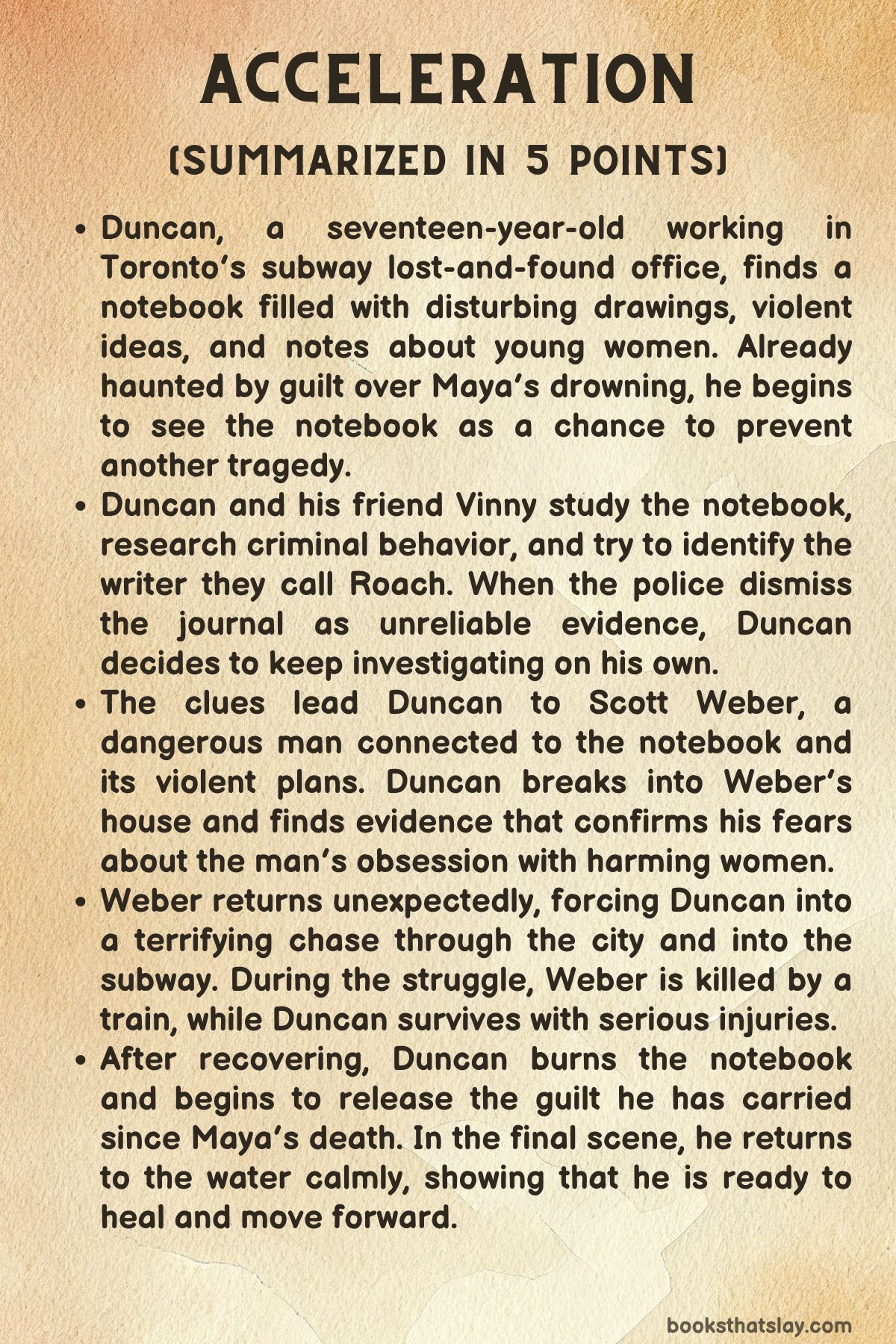
Summary
Duncan works during the summer before his senior year at the Toronto Transit Commission’s Lost and Found office, a cluttered underground storage area nicknamed the “morgue.” The job was arranged by his strict father, and Duncan dislikes spending long hours sorting through unclaimed belongings beneath the rumbling subway lines. One day he discovers a strange notebook among the items.
Inside are unsettling drawings, calculations about drowning in different liquids, and disturbing clippings about mutilated animals. The contents immediately unsettle him.
That night Duncan has a recurring dream about the drowning of a girl at Kayuga Beach. The dream reflects a real event from the previous summer.
A girl named Maya drowned while Duncan was nearby, and he has blamed himself ever since for not saving her. The memory has left him anxious around water and has strained his relationship with his girlfriend Kim, who eventually broke up with him after the tragedy.
Meanwhile, the notebook reveals the thoughts of its anonymous author. The writer imagines how the public will one day talk about him and debates what kind of name the media might give him.
His entries suggest a growing obsession with violence and notoriety. Duncan begins to suspect that the notebook belongs to someone dangerous.
Outside of work, Duncan spends time with his friend Vinny, who lives in the same rough neighborhood known as the Jungle. Vinny has a withered arm caused by a birth defect but hides it in his pocket and often jokes about it with exaggerated stories.
The two friends spend their days wandering the city, visiting places like the Dairy Barn where their friend Wayne works. Wayne used to involve Duncan in petty crimes, but Duncan stopped after they were caught trying to steal toilets to sell.
As Duncan continues reading the notebook, he discovers references to fires and violent acts described with disturbing excitement. The writer also records his habit of watching women on the subway, studying their routines and movements.
Duncan begins to believe that the author is preparing to harm women and that the notebook might document his plans.
At home Duncan struggles with lingering guilt about Maya’s death and the collapse of his relationship with Kim. His mother studies for a community college course while his father works late repairing machinery.
Duncan often feels distant from both of them, trapped in his own thoughts about the past.
The notebook grows more alarming. The writer lists three young women he calls Cherry, Bones, and Clown.
He notes their physical descriptions and daily schedules as if tracking prey. Duncan becomes convinced that these women are future victims.
Although he briefly considers taking the notebook to the police, he decides that stopping the killer himself might be the only way to prevent the attacks. He begins calling the unknown author “Roach.”
Duncan shares the situation with Vinny after studying criminal behavior at the public library. They learn about patterns common among violent offenders, including cruelty to animals and fascination with fire.
These signs match what the journal describes. Vinny believes they should give the evidence to the police, and Duncan reluctantly agrees.
When Duncan brings the notebook to a police station, however, the officers dismiss him. They assume the journal is just the writing of an unstable person and show little interest in investigating it.
Frustrated and afraid the warning will be ignored, Duncan takes the notebook back and leaves. This convinces him that he must continue the investigation himself.
Duncan and Vinny begin analyzing the locations mentioned in the notebook. They mark the places of animal killings, fires, and sightings of women on a map of the city.
Gradually they narrow the possible area where Roach might live or work. Their research suggests that the killer is likely in his early twenties and operates near a shopping mall connected to several subway stops.
One entry in the notebook provides an important clue. Duncan finds a receipt from a hardware store attached to one page.
After carefully removing it, he notices that the purchase included items like a padlock and screws and that the receipt shows an employee discount. This leads Duncan and Vinny to suspect that Roach works at the mall where the hardware store is located.
They visit the mall and observe the security guards, guessing that someone in that job would have the freedom to watch people without raising suspicion. One guard with red hair catches their attention, but further observation shows that he has a normal family life.
The search continues as Duncan becomes increasingly obsessed with catching Roach before any attack happens.
Duncan’s stress worsens when news reports describe a woman being pushed in front of a subway train. The incident reminds him how vulnerable people are in crowded stations and increases his fear that the killer may already be acting.
Eventually a man arrives at the Lost and Found office asking about a missing notebook that matches the one Duncan discovered. Duncan realizes this visitor must be Roach.
Jacob, Duncan’s supervisor, asks him to retrieve the book but then unexpectedly tells Duncan to leave. Suspicious, Duncan secretly follows the man through the subway system.
The man watches women closely in the station before boarding a bus. Duncan follows him off the bus and trails him to a house on Cedar Street.
Determined to learn the truth, Duncan calls Wayne for help breaking into the house while the suspect is away.
Inside the house they find signs confirming their fears. The place smells strongly of chemicals.
A locked door leads to a basement filled with jars containing preserved animal remains and body parts. The walls are covered with disturbing images and photographs of thin young women, including the same targets mentioned in the notebook.
Duncan also discovers more pages written in the same handwriting.
Another locked room contains little more than an empty bucket, suggesting that someone may have been held there. As Duncan searches the basement, the suspect returns unexpectedly.
Duncan hides in a closet while the man moves through the room with a knife.
When the opportunity comes, Duncan attacks and escapes upstairs, running into the rain outside. The man chases him through the streets and into a subway station.
Duncan falls onto the tracks during the struggle. As a train approaches, the attacker attempts to keep him from climbing back up.
Duncan hides beneath the platform to avoid the train.
Later a newspaper article reports that a man was killed by a subway train after a fight. The attacker, identified as Scott Weber, dies in the incident.
Duncan survives but suffers injuries including a concussion, a broken arm, and several cuts.
While recovering in the hospital, Duncan pretends to be confused about what happened, partly because of his concussion and partly to avoid explaining everything. Witnesses confirm that Weber chased him, and the police uncover Weber’s violent past, including a previous assault accusation.
Duncan’s family and friends visit him during his recovery. Kim also appears briefly, and Duncan admits that he still misses her.
The encounter suggests that some of their distance may heal.
Two weeks later Duncan returns to work at the Lost and Found office. The police stop questioning him, and life slowly begins returning to normal.
During a family barbecue at home, Duncan burns the killer’s notebook in the grill, symbolically destroying the evidence of the disturbing events.
Later Duncan and Vinny sneak into a public pool at night. Duncan dives underwater and waits in the silence.
This time he hears nothing frightening and feels calm. He speaks aloud to Maya in his thoughts, apologizing and finally letting go of the guilt he has carried since her death.
Emerging from the water, he realizes that he no longer feels haunted by the past and that Maya is no longer trapped in his memories.
Characters
Duncan
Duncan is the central character and narrator of Acceleration, and the story unfolds largely through his thoughts, fears, and choices. He is a seventeen-year-old boy working a summer job at the Toronto Transit Commission’s Lost and Found office, a place that mirrors his emotional state: cluttered, hidden away, and full of forgotten things.
Duncan carries deep guilt over the drowning of a girl named Maya the previous summer. Although he was only a witness and not directly responsible, he believes he failed to save her.
This guilt shapes many of his actions and creates a constant sense of responsibility that pushes him toward risky decisions. When he discovers the killer’s notebook, he immediately interprets it through the lens of redemption.
Stopping the killer becomes a way for him to make up for what he believes he failed to do before.
Duncan is intelligent and observant, but he is also impulsive and emotionally driven. Instead of trusting authorities or fully listening to his friends, he takes matters into his own hands because he feels morally obligated to act.
His obsession with the journal slowly consumes his thoughts, affecting his relationships and daily life. At the same time, Duncan demonstrates courage and determination.
He carefully studies clues, researches criminal behavior, and works with Vinny to narrow down suspects. His journey is not only about catching a dangerous man but also about confronting his own trauma.
By the end of the story he learns to accept that he cannot control everything and that letting go of guilt is necessary to move forward. His final act of returning to the water symbolizes his emotional healing and personal growth.
Vinny
Vinny is Duncan’s closest friend and an important emotional anchor throughout the story. He lives in the same rough neighborhood known as the Jungle and shares Duncan’s experiences of growing up in a difficult environment.
Vinny has a withered arm caused by a birth defect, which he usually hides in his pocket. Instead of showing vulnerability about his condition, he often invents dramatic stories explaining the injury.
This behavior reflects his sense of humor and his determination not to let others pity him. Vinny’s personality contrasts with Duncan’s intensity.
While Duncan often becomes consumed by his guilt and his investigation, Vinny maintains a more practical and grounded perspective.
Despite his jokes and casual attitude, Vinny proves to be deeply loyal and supportive. When Duncan reveals the disturbing journal and his suspicions about a killer, Vinny does not dismiss him.
Instead, he helps investigate the clues, research criminal patterns, and track possible suspects. At the same time, Vinny frequently urges Duncan to involve the police, showing that he understands the risks they are taking.
His presence prevents Duncan from becoming completely isolated in his obsession. Vinny also understands Duncan’s emotional pain regarding Maya and recognizes that the investigation partly represents a chance for Duncan to make peace with the past.
Through patience and friendship, Vinny helps Duncan face his fears while keeping him connected to reality.
Wayne
Wayne is another friend of Duncan’s who represents a different path Duncan might have taken in life. In the past, Wayne encouraged Duncan to participate in petty crimes, including breaking into places to steal items they could sell.
One memorable incident involved their attempt to steal toilets for resale, which ended with them being caught. After that experience, Duncan stepped away from criminal activity, partly because he did not want to disappoint his mother again.
Wayne, however, continues to carry the reputation of someone who could easily end up in trouble.
Although Wayne initially seems like a troublemaker, his character contains more complexity than Duncan first assumes. By the time the main events unfold, Wayne is trying to improve his life and avoid further criminal behavior.
He works at the Dairy Barn and appears to be making an effort to stay on a better path. His loyalty to Duncan remains strong despite the fact that Duncan and Vinny initially exclude him from their investigation.
When Duncan finally asks for help breaking into the killer’s house, Wayne agrees without hesitation. This willingness demonstrates that he values his friendship with Duncan more than his pride or his fear of getting involved in something dangerous.
Wayne’s presence also reminds Duncan of his earlier mistakes and the choices that shaped who he has become.
Kim
Kim is Duncan’s former girlfriend and represents a part of his life that changed after Maya’s death. Before the tragedy, their relationship had been stable and affectionate.
However, Duncan’s emotional instability and his inability to process the event created tension between them. Kim began volunteering at a center for homeless children, a decision that worried Duncan.
His concern gradually turned into controlling behavior, and he repeatedly expressed fears about her safety. Eventually Kim admitted that she felt afraid of his intensity, which led to their breakup.
Kim’s role in the story highlights how trauma can affect relationships. She cares about Duncan but cannot continue being close to someone who is overwhelmed by guilt and anxiety.
Her decision to step away shows emotional maturity and self-protection. Even though she is not present for much of the narrative, her absence influences Duncan’s thoughts and memories.
He frequently reflects on their past and struggles with the sense that she has become like a phantom in his life. Near the end of the story, Kim visits him in the hospital after his injuries.
This moment suggests that while their relationship may not fully return to what it once was, the emotional connection between them still exists. Her presence also signals Duncan’s gradual recovery and reconnection with the world around him.
Jacob
Jacob is Duncan’s supervisor at the Lost and Found office, and he initially appears to be a quiet and somewhat distant authority figure. The workplace itself is isolated and underground, making Jacob seem like part of an environment that Duncan resents.
However, as the story progresses, Jacob reveals more depth. He lost his wife after she suffered a stroke and remained in a coma before being removed from life support.
This tragedy has left him emotionally withdrawn and focused on maintaining a predictable routine in his life.
Jacob’s personality reflects a mixture of fatigue, grief, and cautious observation. He values stability and prefers the quiet nature of his job because it allows him to avoid emotional upheaval.
Despite his stern attitude, he eventually demonstrates awareness of the danger surrounding Duncan. When the man searching for the notebook appears, Jacob seems to recognize the threat and deliberately sends Duncan away before following the suspect himself.
This decision suggests that Jacob understands more about the situation than he openly admits. His actions imply a protective instinct toward Duncan, even though he rarely expresses it directly.
Jacob represents an adult perspective shaped by loss, emphasizing the theme that tragedy affects people in different ways.
Scott Weber (Roach)
Scott Weber, whom Duncan calls Roach, is the antagonist and the author of the disturbing notebook. His writings reveal a deeply disturbed personality driven by fantasies of control and violence.
Throughout the journal he describes watching women, studying their routines, and imagining ways to harm them. The entries also describe acts of cruelty toward animals and fascination with destructive fires.
These behaviors demonstrate a pattern often associated with individuals who seek power through harming others.
Weber’s background suggests a childhood filled with instability and resentment. He writes about a grandmother who kept him locked in his room and treated him with hostility.
His relationship with his mother is also strained, marked by accusations and anger. These experiences appear to have contributed to his sense of isolation and hatred toward others.
However, the story does not excuse his actions. Instead, it presents him as someone who has allowed his anger and desire for recognition to grow into violent intentions.
What makes Weber especially dangerous is his patience and planning. He carefully observes potential victims, records their habits, and prepares for possible attacks.
His fascination with being known by the public indicates that he wants notoriety as much as he wants power. When Duncan finally confronts him, Weber’s behavior becomes openly violent, confirming that the threat Duncan sensed was real.
His death during the confrontation prevents future crimes but leaves Duncan to confront the psychological aftermath of the encounter.
Maya
Maya is the girl who drowned a year before the events of the story begin, and although she does not appear directly in the narrative, her presence shapes much of Duncan’s emotional journey. She represents the moment that changed his life and triggered the guilt that dominates his thoughts.
Duncan was the last person to see her before she went underwater, and he believes he failed in a crucial moment when he might have saved her.
In Duncan’s dreams and memories, Maya becomes a symbol of unfinished responsibility. His subconscious repeatedly returns to the image of water and the fear of not reaching someone in time.
This emotional burden pushes him toward the investigation of the killer because he believes saving someone else might balance the loss he feels responsible for. Maya therefore functions as a powerful psychological presence.
By the end of the story, when Duncan returns to the pool and speaks to her in his thoughts, he finally acknowledges that the tragedy was not entirely within his control. Letting go of the guilt connected to Maya allows him to begin healing and to step into the future with a clearer sense of himself.
Themes
Guilt and the Search for Redemption
Guilt shapes Duncan’s identity and decisions throughout Acceleration, influencing the way he sees himself and the world around him. The memory of Maya’s drowning becomes a defining emotional burden that Duncan carries constantly.
Even though he was only present at the scene and not responsible for the accident, he convinces himself that he failed in a moment when someone needed him. This belief grows into a persistent feeling that he must someday make up for that failure.
His dreams repeatedly return to water and drowning, showing that the trauma has settled deep within his mind. These dreams blur the line between memory and imagination, making it difficult for him to move on.
The discovery of the killer’s journal immediately connects with Duncan’s desire for redemption. Instead of simply viewing the notebook as evidence of a dangerous person, Duncan interprets it as an opportunity to prevent another tragedy.
The possibility that three women could become victims gives him a purpose that feels deeply personal. In his mind, stopping the killer might compensate for the life he believes he could not save before.
This motivation explains why he continues the investigation even after the police dismiss his concerns and why he willingly risks his safety by confronting the suspect directly.
At the same time, Duncan’s guilt isolates him from others. His relationship with Kim collapses because he cannot release the past and becomes overly protective and anxious.
His emotional distance from his parents also grows, as he struggles to explain what he feels. The investigation therefore becomes both a mission and a coping mechanism, allowing him to channel his emotional turmoil into action.
The resolution of this theme arrives when Duncan finally confronts both the killer and his own feelings. Surviving the violent encounter forces him to acknowledge that he cannot control every outcome in life.
When he later returns to the water and apologizes to Maya in his thoughts, he symbolically releases the weight of his guilt. This moment marks a shift from self-blame toward acceptance, suggesting that redemption is not always about correcting the past but about learning to live with it.
The Psychology of Violence
The narrative explores how violent behavior can develop through patterns of obsession, control, and emotional damage. The killer’s journal reveals a mind that views other people as objects rather than individuals.
His writings describe women as targets to be studied and categorized, reducing them to physical details and routines. This perspective shows a complete absence of empathy, which is one of the most troubling characteristics of his personality.
Violence becomes appealing to him not only as an act but as a source of power and recognition.
The notebook also contains references to cruelty toward animals and fascination with destructive acts such as fires. These details reflect behavioral patterns often discussed in studies of violent offenders.
By including these elements, the story presents violence as something that can grow gradually through repeated acts of domination and experimentation. The killer’s early actions suggest a progression in which harming animals or causing destruction becomes a way to feel control over the environment.
Over time, that desire for control escalates toward the possibility of harming people.
Another important aspect of the theme is the contrast between curiosity and responsibility. Duncan and Vinny study books about criminal behavior in order to understand the journal.
Their research shows how society attempts to analyze and predict violence through psychology and profiling. However, the story also shows the limits of this knowledge.
Even with clues and patterns, identifying a dangerous individual within a large city remains extremely difficult. The complexity of human behavior means that warning signs may exist without immediately revealing the full danger.
The presence of Scott Weber illustrates how personal resentment and isolation can feed destructive thoughts. His memories of family conflict and humiliation contribute to his hatred and desire for recognition.
He imagines becoming famous through violence, which reveals a disturbing need to be acknowledged by the world. This mindset transforms cruelty into a performance meant to attract attention.
Through these elements, the story shows that violence rarely appears suddenly. Instead, it develops through a combination of psychological damage, obsession with power, and the gradual loss of empathy for others.
The Struggle Between Adolescence and Adulthood
Growing up often involves confronting responsibilities that feel larger than a person is prepared to handle. Duncan stands at a transitional point in life where he is no longer a child but not fully an adult.
His summer job, his complicated family relationships, and his uncertain future all reflect this stage of development. The lost and found office where he works symbolizes this transitional state.
The underground environment filled with forgotten objects mirrors the confusion and emotional clutter that often accompany the process of growing up.
Duncan’s interactions with his father highlight the tension between youthful idealism and adult realism. His father speaks about the belief many young men carry that one day they will have the chance to become heroes.
At the same time, he warns Duncan about the danger of letting the past control one’s life. This conversation suggests that adulthood often involves accepting limitations and learning that not every problem can be solved through dramatic action.
Duncan struggles to understand this perspective because he still feels driven by the need to prove himself.
Friendships also play a role in shaping this transition. Vinny represents loyalty and practical thinking, offering support while encouraging Duncan to involve the authorities.
Wayne represents a past version of Duncan’s life that involved reckless behavior and small crimes. Observing Wayne’s attempt to improve his life reminds Duncan that people can change direction as they mature.
These friendships illustrate the different paths that adolescence can lead toward.
The investigation itself becomes a symbolic test of Duncan’s maturity. His decision to pursue the killer without fully trusting adults reflects a mixture of courage and immaturity.
On one hand, he shows initiative and moral determination. On the other hand, he places himself in serious danger because he feels responsible for solving the problem alone.
This tension reflects the uncertainty that many young people experience when trying to define their role in the world.
By the end of the story, Duncan’s experiences push him closer to adulthood. Surviving the confrontation with the killer and accepting the limits of his control allow him to develop a more balanced understanding of responsibility.
Instead of chasing heroism, he begins to recognize that growth involves accepting vulnerability and learning from mistakes.
Fear, Trauma, and Healing
Fear in Acceleration is closely connected to memory and psychological trauma. Duncan’s fear of water is not simply a physical reaction but a reminder of the moment when Maya drowned.
Each time he approaches water, the memory resurfaces, making him feel trapped in the same moment of helplessness. This connection shows how trauma can transform ordinary experiences into sources of anxiety.
Even activities that once felt normal become difficult because they trigger painful memories.
Dreams play a significant role in expressing this emotional state. Duncan repeatedly dreams about drowning and about trying to reach someone who is slipping away beneath the water.
These dreams blur the boundary between the past and the present, making it difficult for him to separate what happened from what he imagines might have happened. The dreams also show how the mind continues processing traumatic experiences long after the event itself has passed.
Fear also appears in the investigation of the killer. Duncan often finds himself in situations where he is uncertain whether he is protecting potential victims or imitating the behavior of the person he is trying to stop.
For example, when he follows one of the women mentioned in the journal, he realizes that his actions resemble stalking. This realization reveals how easily fear and obsession can distort judgment.
Duncan begins to question whether his determination is helping others or simply satisfying his need to fix the past.
The turning point occurs when Duncan survives the confrontation with the killer. The physical injuries he suffers force him to slow down and reflect on what has happened.
Instead of continuing to chase danger, he begins to recognize that healing requires acknowledging vulnerability and seeking connection with others. The presence of his friends, family, and Kim during his recovery reminds him that he does not have to face his struggles alone.
The final scene in the pool represents the completion of this emotional process. By entering the water voluntarily and staying there without panic, Duncan proves to himself that the memory no longer controls him.
Speaking to Maya in his thoughts allows him to express the apology he has carried inside for so long. The moment suggests that healing does not erase trauma but transforms the way a person lives with it.