Accidental Death Of An Anarchist Summary, Characters and Themes
Accidental Death Of An Anarchist is a satirical political play written by Dario Fo. First performed in 1970, it is inspired by the real-life death of Italian anarchist Giuseppe Pinelli, who died after falling from a police station window during an interrogation.
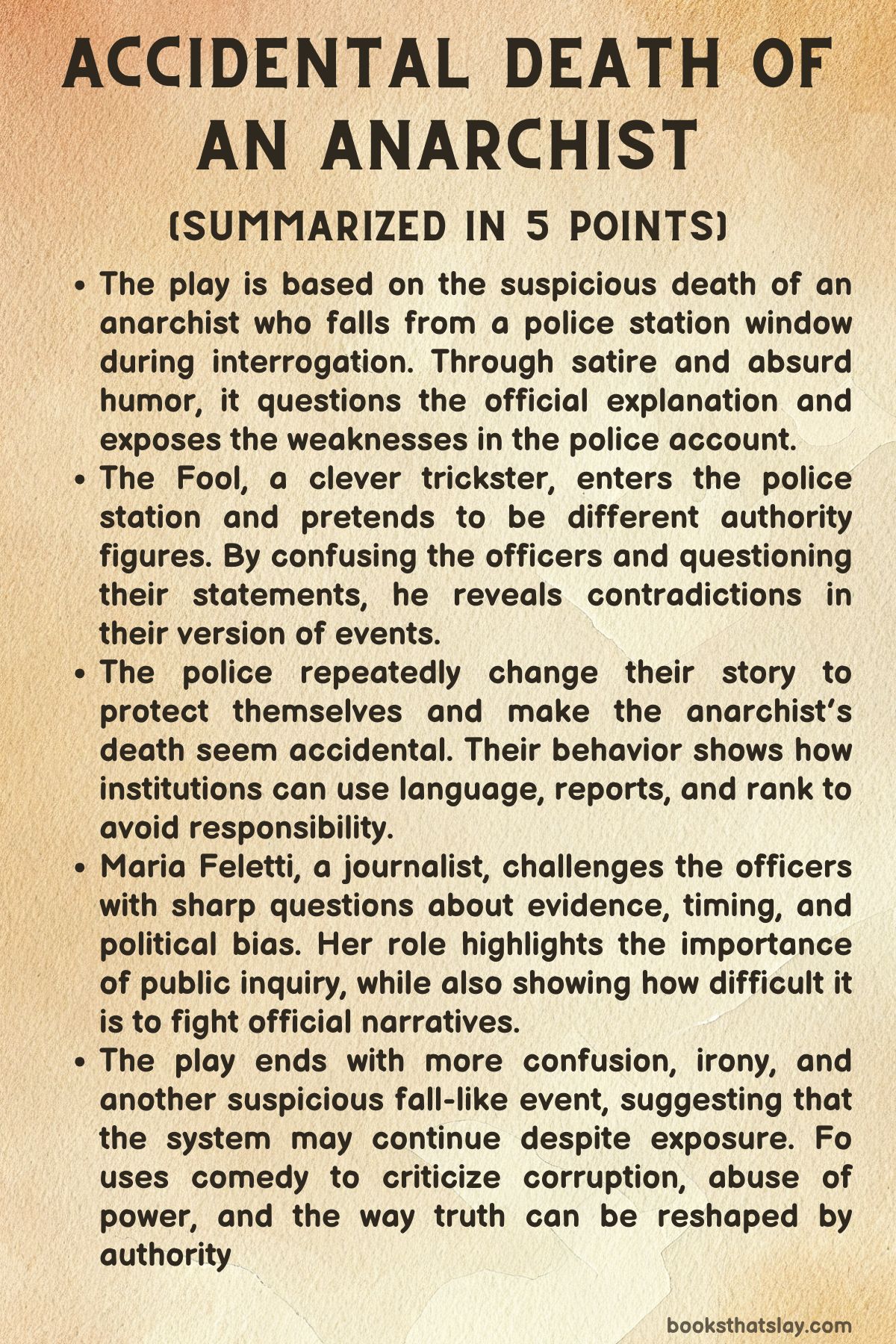
Through fast-paced dialogue, absurd humor, and shifting disguises, the play exposes contradictions in official accounts of the incident. The central character, known as the Fool, manipulates the police into revealing inconsistencies in their story. By blending comedy with political criticism, the play questions authority, media narratives, and the relationship between power and truth in modern society.
Summary
The play opens with a short prologue that explains the background of a real political controversy. An anarchist named Giuseppe Pinelli died after falling from a window during a police interrogation in Milan.
The official explanation suggested that he jumped. However, many people believed that the police were responsible for his death.
The narrator presents the story with heavy irony, joking that anarchists seem to have a strange habit of flying out of police station windows. By framing the situation this way, the prologue introduces the central theme of the play: the absurd explanations that authorities sometimes use to cover up suspicious events.
The main action begins in a police office in Milan. A Sergeant is watching a crowd of protesters gathered outside the building.
The protesters are angry about the death of the anarchist who fell from the fourth-floor window only a week earlier. While the Sergeant tries to explain that the protesters are simply being stirred up by unions, the tension outside suggests that many people suspect wrongdoing by the police.
Inside the office is a strange man known as the Fool. He has been arrested for impersonating various professionals, including doctors and officials.
Inspector Bertozzo arrives and examines the Fool’s record. The file shows that the Fool has been arrested many times for pretending to be different authorities, but he has never been convicted.
He explains that he suffers from a condition that compels him to act out roles in real life. Because of this diagnosis, he claims that the law cannot punish him in the usual way.
During the conversation, the Fool constantly challenges Bertozzo’s authority. He quotes legal codes, debates grammar, and mocks the seriousness of the police.
His behavior confuses and frustrates Bertozzo, who eventually decides to throw him out of the office. However, after the police leave, the Fool sneaks back inside.
While alone, he looks through police documents and accidentally discovers files related to the investigation of the anarchist’s death.
At that moment the phone rings. Pretending to be a secretary, the Fool answers the call and learns that a judge from Rome will soon arrive to examine the case.
The Fool quickly realizes that he has an opportunity to interfere in the investigation. He decides to impersonate the judge and question the officers involved in the interrogation.
Disguised as a high-ranking judicial official named Antonio A. Antonio, the Fool enters another police office on the fourth floor. Captain Pissani and the Chief believe he is a real investigator from Rome.
Using his authority, the Fool orders them to reenact the interrogation that took place before the anarchist fell from the window.
As the officers describe the events, the Fool begins questioning the details of their official report. According to the police version, the anarchist suddenly experienced a moment of panic during questioning and jumped out of the window.
The Fool presses them to explain exactly how this happened. His questions expose contradictions in their story.
The officers admit that they used psychological pressure and interrogation tricks, including suggesting that the anarchist’s friend had confessed to the bombings.
The Fool argues that such pressure could have driven the anarchist into emotional distress. The officers insist that their methods were legitimate and that the suicide had nothing to do with their actions.
The Fool then pretends to sympathize with them and offers to help revise their report so that it appears more convincing.
He begins directing them like actors in a performance. He instructs them to add friendly gestures to the story, such as offering the anarchist gum or joking with him during the interrogation.
He even suggests that they portray the scene as warm and cheerful, claiming that the officers and the anarchist sang together. By exaggerating these details, the Fool highlights how easily an official narrative can be manipulated.
The scene becomes increasingly ridiculous as the officers reluctantly follow the Fool’s instructions. They rewrite their testimony to present themselves as kind and sympathetic.
Through this process, the Fool demonstrates how truth can be altered through language and documentation.
Later, a journalist named Maria Feletti arrives to interview the police about the case. The Fool immediately adopts another disguise, pretending to be a captain from the scientific division.
With a fake mustache, eye patch, and wooden hand, he introduces himself as an expert assisting with the investigation.
The reporter begins asking difficult questions about the anarchist’s death. She points out several inconsistencies in the police account, including the trajectory of the fall, the time when an ambulance was called, and unexplained marks on the anarchist’s body.
Each question forces the officers to invent new explanations. The Fool frequently interrupts, either supporting the police with absurd arguments or exposing the weaknesses in their story.
During the discussion, the topic shifts to the bombings that originally led to the anarchist’s arrest. The reporter suggests that right-wing extremists might have been responsible rather than anarchists.
She cites statistics showing that many similar attacks were carried out by fascist groups. The police attempt to defend their focus on anarchists, but their arguments become increasingly unconvincing.
Inspector Bertozzo enters the room and recognizes the Fool from earlier. He becomes suspicious and tries to reveal the disguise.
However, the other officers are so desperate to maintain the illusion that they silence Bertozzo instead of listening to him.
The Fool then changes identities again, this time claiming to be a bishop sent by the Vatican to support the police. The officers quickly accept this new role as well, showing how easily authority can be established through appearance and confidence.
Throughout the interview, the Fool reflects on the relationship between scandal and political power. He argues that exposing corruption does not necessarily change the system.
Instead, scandals often serve as a way to release public anger while leaving the structure of authority intact. Citizens feel satisfied when wrongdoing is revealed, but real reforms rarely follow.
Eventually the situation escalates when Bertozzo manages to free himself and confront the Fool with a gun. The Fool reveals that he has secretly recorded the entire conversation.
The tape contains the officers’ contradictory statements and admissions. He threatens to send copies of the recording to newspapers and political organizations unless they admit the truth about the anarchist’s death.
At the same time, the Fool takes control of a bomb that had previously been defused as evidence from the bank explosion. He claims that he has reactivated it and will detonate it if anyone tries to stop him.
The officers realize that they are trapped between exposing their own lies and risking an explosion.
The Fool argues that revealing the recording could force society to confront corruption within the system. Even if people feel shocked or ashamed, he believes the exposure might push the country toward greater honesty and accountability.
In the alternate ending, the tension continues as the characters remain locked together in the room. Suddenly the lights go out.
In the darkness there is an explosion outside the window. When the lights return, the Fool has disappeared.
The reporter looks out and concludes that he must have jumped or fallen from the window after throwing the bomb outside.
The police quickly claim that they have no responsibility for what happened because they were tied up at the time. They suggest that the Fool experienced a sudden burst of panic that caused him to jump, using the same explanation they previously used for the anarchist’s death.
The reporter initially questions the explanation but eventually accepts it as the official story. After she leaves, a bearded man enters the room.
The officers think the Fool has returned in another disguise, but they soon discover that he is actually the real judge sent to investigate the anarchist’s death.
Exhausted and confused, the officers prepare to begin the official inquiry once again. The ending leaves the audience with an ironic image: despite all the chaos and revelations, the system continues as if nothing has changed.
Characters
The Fool
The Fool is the engine of the play’s action and the sharpest mind on stage. Though the police dismiss him as unstable, he repeatedly proves himself to be the most observant, adaptable, and intelligent person in the room.
His supposed madness gives him unusual freedom: he can say outrageous things, switch identities, and test the limits of authority without being easily pinned down. He uses performance as both shield and weapon.
Every disguise he adopts allows him to expose how much public institutions depend on costume, title, and confidence rather than truth or merit. In that sense, he is not only a comic figure but also a political one, because he reveals that power often rests on appearance.
He is also the play’s chief satirist. He does not simply mock individuals; he mocks entire systems of policing, bureaucracy, and official storytelling.
By forcing the officers to reenact their own statements and revise their own reports, he turns the police station into a stage where lies become visible through repetition. He behaves like a director, a judge, an actor, and an interrogator all at once.
His humor is chaotic, but it is never random. He always knows where pressure should be applied and when absurdity will uncover something hidden.
The more ridiculous his inventions become, the more clearly the officers reveal their guilt, fear, and incompetence.
At the same time, the Fool is more complicated than a simple hero. He is not a calm reformer or a moral lecturer.
He enjoys confusion, manipulation, and theatrical excess. He often pushes scenes to extremes, and his delight in performance sometimes makes him unsettling.
This matters because Dario Fo does not present truth as something delivered through dignity and order. Instead, truth must be dragged out through disruption.
The Fool’s instability becomes a method for confronting a world in which respectable language has already been corrupted. His disorder is set against the polished falsehoods of officials, and the play repeatedly suggests that his kind of madness may be more honest than their official sanity.
He also carries the play’s deepest ideas about scandal, public outrage, and political control. His reflections on how scandals can actually help preserve the system give him unusual depth.
He understands that exposing corruption does not automatically destroy it. People may denounce injustice, discuss it loudly, and then return to normal life with the structure of power intact.
This makes him more than a prankster. He is someone who sees that institutions survive not only through force, but also through spectacle, outrage, and public exhaustion.
Even when he gains evidence against the police, the ending leaves open the possibility that exposure alone may not be enough. That uncertainty makes him one of the most intellectually rich figures in Accidental Death Of An Anarchist.
Inspector Bertozzo
Inspector Bertozzo represents bureaucratic authority at its most rigid and easily rattled. At first, he appears to be a figure of order, someone who wants proper procedure, written reports, and official discipline.
Yet almost immediately he is overwhelmed by the Fool, who defeats him not through violence or rank but through speed, wit, and verbal agility. Bertozzo’s weakness is that he believes authority should naturally command obedience.
He cannot handle someone who knows the law, challenges language, and refuses to be intimidated. His frustration grows because every effort to control the situation makes him look more foolish.
He is, in many ways, a comic victim of the larger corruption around him. Unlike some of the other police figures, Bertozzo does not seem fully in command of the lies being constructed.
He is vain, hot-tempered, and not especially perceptive, but he is also trapped inside an institution where truth is already unstable. His attempts to expose the Fool’s disguises should make him the voice of reason, yet the absurdity of the situation turns him into a laughingstock.
Nobody wants to hear him, because the others are too invested in maintaining the convenient fiction. This gives his character an ironic quality: the man most desperate to restore official seriousness becomes one of the least respected people in the room.
Bertozzo also shows how institutions can absorb even those who are technically correct. He recognizes the deception long before others fully acknowledge it, but being right does not give him power.
The hierarchy around him is too compromised, too panicked, and too self-protective for truth to matter. His colleagues silence him because exposing the Fool would expose their own willingness to cooperate in the false performance.
In this way, Bertozzo becomes an example of how systems do not merely suppress truth from outsiders; they also neutralize it from within.
His final actions, especially when he turns to force, reveal how thin the line is between procedure and panic. Once language fails him, he reaches for a gun.
This shift shows that beneath bureaucratic formality lies coercion. He is not a noble defender of justice, but he is useful as a figure who exposes the instability of official power.
He begins as a man who trusts paper, rank, and regulations; he ends as someone reduced to shouting, threats, and desperation. That collapse gives his character both comic energy and political meaning.
The Chief
The Chief is a central embodiment of institutional self-protection. He is a senior officer whose first instinct is not to seek truth but to preserve the reputation of the police.
He speaks with the confidence of office, yet that confidence repeatedly breaks under pressure. Once the Fool begins questioning him, it becomes clear that his authority depends on controlling the narrative.
He is less concerned with what happened to the anarchist than with how the event can be explained, softened, and made acceptable. This makes him a powerful symbol of official culture, where language becomes a tool for managing blame.
He is particularly revealing in the way he handles contradiction. When flaws appear in the report, he does not reject the falsehood outright; he adjusts it.
He is willing to reshape the timeline, reinterpret behavior, and add sentimental details if they help the police look humane. That flexibility shows not intelligence in the moral sense, but survival instinct.
He belongs to a world in which reports are not neutral records. They are strategic documents built to withstand scrutiny.
The Chief understands this well, which is why he moves so quickly from denial to revision whenever the Fool corners him.
At the same time, he is not portrayed as masterfully in control. He is vain, nervous, and often frightened.
When the Fool predicts that the government may sacrifice him to calm public anger, the Chief reacts with real fear. This reaction is important because it suggests that corruption does not create secure rulers; it creates anxious ones.
He knows that in a scandal, loyalty flows upward only until someone higher up needs protection. He may help maintain the system, but he is also vulnerable to it.
That vulnerability makes him pathetic as well as culpable.
His exchanges with the reporter also deepen his character. Faced with outside questioning, he relies on authority, evasion, and intimidation.
Yet he never appears fully persuasive. The more he tries to sound official, the more his explanations reveal strain.
He is a man trained to speak from power, but the play places him in a setting where power itself starts to look theatrical and fragile. He is not simply one corrupt official among many.
He is a portrait of how institutions speak when they are trying to survive exposure.
Captain Pissani
Captain Pissani is one of the most revealing portraits of everyday cruelty mixed with insecurity. He carries himself like an active field officer, someone closer to direct action than desk work, and this makes him especially important in the play’s examination of police violence.
He is repeatedly linked to intimidation, bullying, and rough behavior, including the suggestion that he has a habit of using windows as instruments of terror. Whether boasting, deflecting, or losing control, he gives the impression of a man for whom aggression comes easily.
This makes him one of the clearest personal links between state power and physical menace.
Yet Pissani is not strong in a stable way. He is highly suggestible and eager to please anyone who seems more powerful than he is.
Once the Fool appears in judicial disguise, Pissani quickly begins cooperating, adjusting his statements and accepting absurd rewrites. He resists at first, but not on principle.
He resists because he is afraid of saying the wrong thing. As soon as he believes the Fool can protect him, he becomes compliant.
This reveals a great deal about his character. He is not guided by truth, law, or duty, but by fear, self-interest, and hierarchy.
He is also one of the play’s richest comic targets because his seriousness keeps collapsing into foolishness. He tries to defend police procedure, but his explanations often sound childish or absurd.
When the Fool coaxes him into nostalgic or sentimental additions to the report, Pissani ends up sounding ridiculous without fully noticing it. This is crucial to the satire.
He is not exposed by a solemn accusation; he is exposed by participating in his own embarrassment. The play shows that people who carry out violence are not always imposing masterminds.
Sometimes they are vain, clumsy men who rely on uniforms and collective protection.
Even so, Pissani should not be reduced to comic incompetence alone. The laughter around him does not erase the danger he represents.
His nervousness and bluster sit beside real implications of brutality. He helps maintain the false story about the anarchist’s death, and he appears willing to distort facts whenever necessary.
This combination of menace and absurdity is central to the play’s method. Pissani is funny because he is exposed, but the reason he must be exposed is serious.
Maria Feletti
Maria Feletti, the reporter, is the strongest representative of public inquiry in the play. She enters as an outsider to the police world and immediately changes the atmosphere.
Unlike the officers, she asks direct questions and follows inconsistencies instead of smoothing them over. She is prepared, sharp, and persistent.
Her attention to evidence, timing, physical details, and prior statements makes her one of the few characters who genuinely pressures authority through reason rather than performance. In a play crowded with evasions and disguises, her insistence on facts gives her particular force.
She also represents the complicated role of journalism in political life. On one level, she is clearly admirable.
She refuses to be intimidated easily, notices contradictions others want ignored, and keeps returning to the central problem of responsibility. She is not dazzled by titles or uniforms, and she recognizes that official accounts are often designed to protect power.
Her questions about the bombing investigations, right-wing violence, and manipulated blame broaden the play beyond one suspicious death and place it inside a larger political pattern.
At the same time, the play does not treat journalism as a simple cure. Through the Fool’s speeches, Maria is drawn into a troubling discussion about scandal itself.
He suggests that exposing corruption can become part of the system’s maintenance, giving the public outrage and release without real structural change. This does not make Maria naive, but it does place her in a difficult position.
She wants truth to matter in a transforming way. The play pushes her to confront the possibility that truth may also be consumed as spectacle.
Her uncertainty near the end reflects that tension.
Her role in the ending is especially important because it tests the limits of critical inquiry. Faced with another suspicious event, she is vulnerable to accepting the same kind of explanation she had been challenging.
This does not destroy her integrity, but it shows how hard it is to resist official framing when confusion, urgency, and institutional language close in. She remains one of the most intelligent and morally serious figures in Accidental Death Of An Anarchist, yet the play makes clear that even serious journalism can be trapped inside the machinery it tries to expose.
The Anarchist
The anarchist at the center of the plot never appears as a fully active stage presence in the same way the others do, yet his absence gives the play its moral center. He exists through reports, reenactments, official explanations, and political argument.
Because he is dead before the main action unfolds, he becomes a figure over whom others struggle for control. The police try to turn him into a guilty suspect driven to suicide.
The protesters and critics see him as a victim of state violence. This contested identity is essential, because the play is not only about a death but also about who gets to define the dead.
He is repeatedly referred to in terms that stress his ordinariness, particularly his work as a railroad employee. This detail matters.
He is not framed as a glamorous revolutionary mastermind, but as a worker with a job, a routine, and a social place. The Fool emphasizes this point to undermine the police fantasy that they were dealing with some great conspiratorial force.
The anarchist’s ordinary life makes the official account more suspicious. The gap between who he seems to have been and the dramatic role assigned to him by police language exposes the political usefulness of scapegoating.
His character also becomes a mirror for class prejudice. The authorities find it convenient to treat him as dangerous because his political identity makes him available for blame.
At the same time, evidence around him is handled carelessly, and his rights appear to vanish once he enters the police station. In this sense, he stands for more than one man.
He becomes a symbol of how working-class dissidents can be turned into convenient enemies, especially in moments of public panic.
The fact that he never gets to speak for himself is one of the play’s most powerful choices. Others interpret his fear, motives, and final moments.
They decide whether he was calm, guilty, desperate, or irrational. That silence is not a weakness in the writing; it is the point.
The play shows how institutions can erase a person first physically and then narratively. The entire comic machinery surrounding the case ultimately circles a dead man whose truth has been buried under procedure and performance.
The Sergeant
The Sergeant is a smaller figure, but he helps establish the everyday mentality of the police environment. Early on, his conversation about the protesters and the recent death shows how normalized official explanations have become inside the station.
He speaks as someone who has absorbed the institution’s logic and repeats it almost automatically. He does not seem to be one of the main architects of deceit, yet he functions as a carrier of its language.
Through him, the audience sees how a system spreads not only through commands from above but also through routine repetition from below.
He is cautious, obedient, and somewhat nervous, particularly when stronger personalities dominate the room. That nervousness makes him human, but it also shows how low-level functionaries participate in structures they may not fully control.
He follows orders, reacts to immediate pressure, and tries not to attract danger to himself. This is politically significant because it broadens responsibility beyond the top officials.
The culture of evasion survives because ordinary officers accept it as normal procedure.
The Sergeant also contributes to the atmosphere of comic instability. He is often pulled between contradictory instructions and unsure how to respond to the Fool’s unpredictable behavior.
This uncertainty gives him a practical stage function: he shows how absurd the police station has become. Yet the humor around him should not hide his role in a wider apparatus.
He may not be central, but he is part of the machinery that allows official falsehood to move smoothly from office to office.
In character terms, he is best understood as a portrait of minor complicity. He is not grandly evil and not notably brave.
He is an example of the many people inside institutions who keep things running by adapting, obeying, and avoiding risk. That kind of character is easy to overlook, but the play understands that systems depend on him.
The Officer
The Officer is another supporting figure who becomes important because of how readily he adjusts his version of events. During the reconstruction of the interrogation, he provides details that are often weak, invented, or absurd, yet he offers them with enough willingness to show how official testimony can be assembled from convenience rather than memory.
His statements do not carry moral weight because they are stable or reliable; they matter because they reveal how easily subordinate figures can be folded into collective fabrication.
He often appears eager to satisfy whatever authority is currently strongest in the room. This makes him highly malleable.
Under pressure from the Fool, he accepts revised details and confirms sentimental additions to the police narrative. He is not presented as especially thoughtful or ideological.
Instead, he is pliable. That pliability is his main significance.
He shows how institutions create false coherence by drawing on the compliance of people who are willing to say what is needed in the moment.
Comically, the Officer helps ground the escalating absurdity in practical stage business. He responds to commands, enters at tense moments, and often acts as a witness whose testimony can be bent.
His uncertainty and dependence on stronger personalities make him an effective comic instrument, but they also underscore a serious point: many official stories are sustained not by one brilliant liar, but by a chain of people each making small, useful adjustments.
His character therefore adds another layer to the play’s view of responsibility. He is not a mastermind and not a major decision-maker, yet he participates in the production of a lie.
The system does not require everyone to be equally powerful; it only requires enough people to cooperate.
The Investigator
The Investigator appears less fully than some of the others, but he is important as a sign of the violence surrounding the case. He is the officer associated with the interrogation that ended in death, and even when he is not center stage, his presence carries threat.
The Fool’s mocking phone conversation with him establishes that he is feared, resented, and politically vulnerable. He is already entangled in a scandal large enough to attract national attention, which gives his offstage presence considerable weight.
What matters most about him is what he represents. He stands for the branch of police work where interrogation, intimidation, and political suspicion meet.
The fact that he can be joked about as if he were the kind of man who would run a camp or throw someone from a window tells the audience how he is perceived. Even before he is fully seen, the image attached to him is one of abuse hidden behind official duty.
His brief, explosive energy also fits the play’s pattern of authority figures who rely on force when words no longer hold. He is less psychologically developed than the Chief or Pissani, but he sharpens the broader portrait of the police as an institution capable of brutality while still trying to manage appearances.
He belongs to the shadow cast over the entire action.
Because the play is interested in systems as much as individuals, the Investigator functions almost like a concentrated emblem of police suspicion. He does not need long speeches to matter.
His importance lies in the fear, anger, and implication attached to his role in the dead man’s final hours.
The Real Judge
The real judge appears at the end, and that late arrival gives him strong symbolic force. After the long chain of impersonations, inventions, and improvised inquiries, his entrance introduces the possibility of formal justice.
Yet the timing is deeply ironic. By the moment he arrives, the audience has already watched how thoroughly truth can be distorted before any official process even begins.
His presence does not feel triumphant. It feels belated.
He matters because he stands for the idea of lawful investigation in a world where law has already been made theatrical. The police first mistake him for yet another disguise, which says a great deal about the damage already done.
Authority has been so emptied into costume that genuine office is no longer easily recognizable. This is one of the play’s sharpest final jokes, but it is also one of its bleakest.
The arrival of the real judge does not erase what has happened; it only confirms how unstable the ground beneath justice has become.
At the same time, his entrance prevents the ending from closing into complete chaos. He suggests that the demand for truth has not vanished entirely.
There is still a mechanism, however flawed or delayed, that can reopen the case. But the exhaustion of the officers and the audience’s awareness of everything already manipulated make this prospect ambiguous.
The judge may investigate, but the play has already shown how difficult it is for institutions to confront themselves honestly.
As a result, the real judge is less a fully developed personality than a final political gesture. He marks the distance between official justice as an ideal and justice as a lived reality.
His appearance closes the play not with certainty, but with a question about whether truth can still emerge after so much staging, lying, and damage.
Themes
Abuse of Power and Institutional Corruption
Authority in Accidental Death Of An Anarchist is presented as something that can easily be manipulated to protect those who hold it. The police officers in the play demonstrate how institutions often prioritize their own survival over truth or justice.
From the moment the anarchist’s death is discussed, the focus of the officers is not on understanding what happened but on constructing a narrative that shields them from responsibility. Their language becomes a tool for protecting the institution.
Words like “accident” or “raptus” are repeated not because they accurately describe events but because they provide a convenient explanation that removes blame from the authorities.
The interrogation of the officers by the Fool exposes how fragile the official version of events actually is. As he forces them to reenact their testimony, contradictions emerge.
Details about the timing of the interrogation, the open window, and the anarchist’s actions shift repeatedly. Each change demonstrates how easily an official report can be altered to match the needs of those writing it.
The police officers do not treat truth as something fixed. Instead, they treat it as a narrative that can be adjusted until it appears believable enough to survive public scrutiny.
The theme also examines how power relies on hierarchy and obedience. Lower-ranking officers quickly adapt their stories to match what their superiors want to hear.
This dynamic shows that corruption within institutions is rarely the result of a single individual acting alone. It spreads through cooperation, silence, and the pressure to protect colleagues.
People inside the system learn that loyalty to the institution is valued more highly than honesty.
At the same time, the play suggests that corruption is maintained through fear. The Chief and Captain Pissani react nervously whenever the possibility of an official investigation appears.
They worry that higher authorities may sacrifice them to calm public anger. Their anxiety reveals a system that protects itself by constantly shifting blame downward.
Those with less power are left to defend themselves while the institution remains intact.
Through humor and exaggeration, the play shows how authority can become detached from accountability. Uniforms, titles, and official language create the appearance of legitimacy, yet these symbols often hide manipulation and deceit.
By turning the interrogation into a performance, the play reveals that institutional power sometimes operates less like a system of justice and more like a carefully managed spectacle.
Truth, Performance, and the Construction of Reality
Reality in the play becomes unstable because every character treats truth as something that can be shaped through storytelling. The Fool’s disguises reveal how much authority depends on performance.
Each time he changes identities, the people around him accept his role almost immediately. The officers do not verify his credentials or question his authority for long.
They respond instead to his costume, confidence, and language. This reaction suggests that social institutions often rely on appearances rather than genuine legitimacy.
The interrogation scenes show how narratives are constructed collectively. When the Fool asks the officers to reenact the events of the anarchist’s death, they gradually rewrite their story.
New details are added that make the police appear sympathetic and humane. The officers describe friendly gestures, jokes, and casual conversation that supposedly occurred during the interrogation.
These details are clearly exaggerated, yet they become part of the official account simply because the officers repeat them with enough confidence.
Language itself becomes a tool of manipulation. Technical terms and bureaucratic phrases give the impression that the police are providing objective explanations.
In reality, these words function as shields that obscure uncomfortable facts. By focusing on terminology rather than evidence, the officers attempt to transform a suspicious death into a routine administrative matter.
The play shows that official language can distance people from the human consequences of their actions.
The Fool understands this process and deliberately exaggerates it. His performances expose the theatrical nature of institutional authority.
When he directs the officers like actors in a rehearsal, he reveals that their official report is already a scripted performance. They are not describing reality as it occurred; they are constructing a story that must appear credible to outsiders.
The theme also reflects on how society accepts these performances. The reporter initially challenges the police narrative with careful questions and evidence.
However, even she begins to struggle with the overwhelming confusion created by conflicting explanations. When institutions control the language used to describe events, they gain the ability to shape how those events are understood.
The play suggests that truth becomes difficult to recognize when powerful groups control the stories through which reality is interpreted.
Scandal and the Maintenance of Political Systems
Public scandals in Accidental Death Of An Anarchist are not portrayed simply as moments of moral outrage. Instead, the play suggests that scandals can actually help maintain the political system they appear to threaten.
The Fool explains this idea directly when he argues that exposing corruption often serves as a release valve for public anger. People become outraged, newspapers report the controversy, and debates fill public discussion.
However, once the outrage fades, the underlying structures of power frequently remain unchanged.
This idea challenges the common belief that exposing wrongdoing automatically leads to reform. The play shows that institutions can survive scandals by redirecting blame or creating the impression that justice is being pursued.
Investigations, official statements, and public hearings provide the appearance of accountability without necessarily addressing deeper problems. By allowing limited criticism, the system reassures citizens that it is capable of correcting itself.
The police officers’ fear of investigation demonstrates how scandals are managed. They worry less about whether the truth will emerge and more about whether they will personally be blamed.
Their greatest concern is that higher authorities might sacrifice them in order to protect the institution’s reputation. In this way, scandals become opportunities to remove a few individuals while leaving the broader system intact.
The reporter’s role highlights the complicated relationship between journalism and political power. Her investigation has the potential to expose serious wrongdoing, yet the play questions whether public exposure alone is enough to create change.
Even when evidence appears strong, official narratives can still reshape public perception. The constant revisions of the police report illustrate how easily institutions adapt their stories to neutralize criticism.
The Fool’s reflections on scandal suggest that modern political systems sometimes depend on periodic outrage to maintain legitimacy. Public exposure of corruption allows citizens to feel that wrongdoing has been acknowledged, even if meaningful reform never follows.
In this way, scandal becomes part of the system’s stability rather than its downfall. By presenting this idea through comedy and irony, the play encourages audiences to think critically about the relationship between outrage, accountability, and real political change.
Social Class and Political Manipulation
The conflict surrounding the anarchist’s death reflects deeper tensions related to social class and political identity. The anarchist himself represents a working-class figure whose political beliefs make him vulnerable to suspicion.
When the police accuse him of involvement in terrorist attacks, they rely heavily on stereotypes about anarchists as dangerous radicals. These assumptions allow the authorities to treat him as a convenient suspect even when evidence remains uncertain.
Throughout the investigation, the play highlights how class influences credibility. The anarchist’s alibi depends partly on the testimony of retired workers, yet the police dismiss these witnesses as unreliable because of their social position and age.
Their statements are considered less trustworthy than the official explanations provided by the authorities. This imbalance demonstrates how institutions often privilege certain voices while ignoring others.
The Fool’s commentary on class exposes these prejudices. He argues that people in positions of power often distance themselves from the working class in order to maintain social hierarchy.
Occupations like policing become symbols of authority that separate individuals from the communities they once belonged to. By adopting uniforms and titles, individuals gain status that reinforces existing social divisions.
The discussion of political violence further reveals how class interests shape investigations. The reporter points out that many bombings have been linked to right-wing extremist groups rather than anarchists.
Despite this evidence, the police continue focusing on left-wing suspects. This pattern suggests that investigations may be guided not only by evidence but also by political convenience.
Blaming marginalized groups helps maintain existing power structures by diverting attention away from other possible sources of violence.
At the same time, the play shows how political narratives can transform ordinary individuals into symbols. The anarchist is no longer treated as a worker with a personal history.
Instead, he becomes a representation of a political threat. This transformation allows authorities to justify harsh treatment and questionable interrogation methods.
When a person is reduced to a political label, their individual humanity becomes easier to ignore.
Through these interactions, the play examines how social class influences both justice and public perception. Political accusations, media narratives, and institutional authority all interact to shape how certain groups are viewed.
The result is a system in which individuals from marginalized backgrounds can be blamed for larger social anxieties, while those in positions of power retain the ability to control the story.