Time Will Tell Summary, Characters and Themes
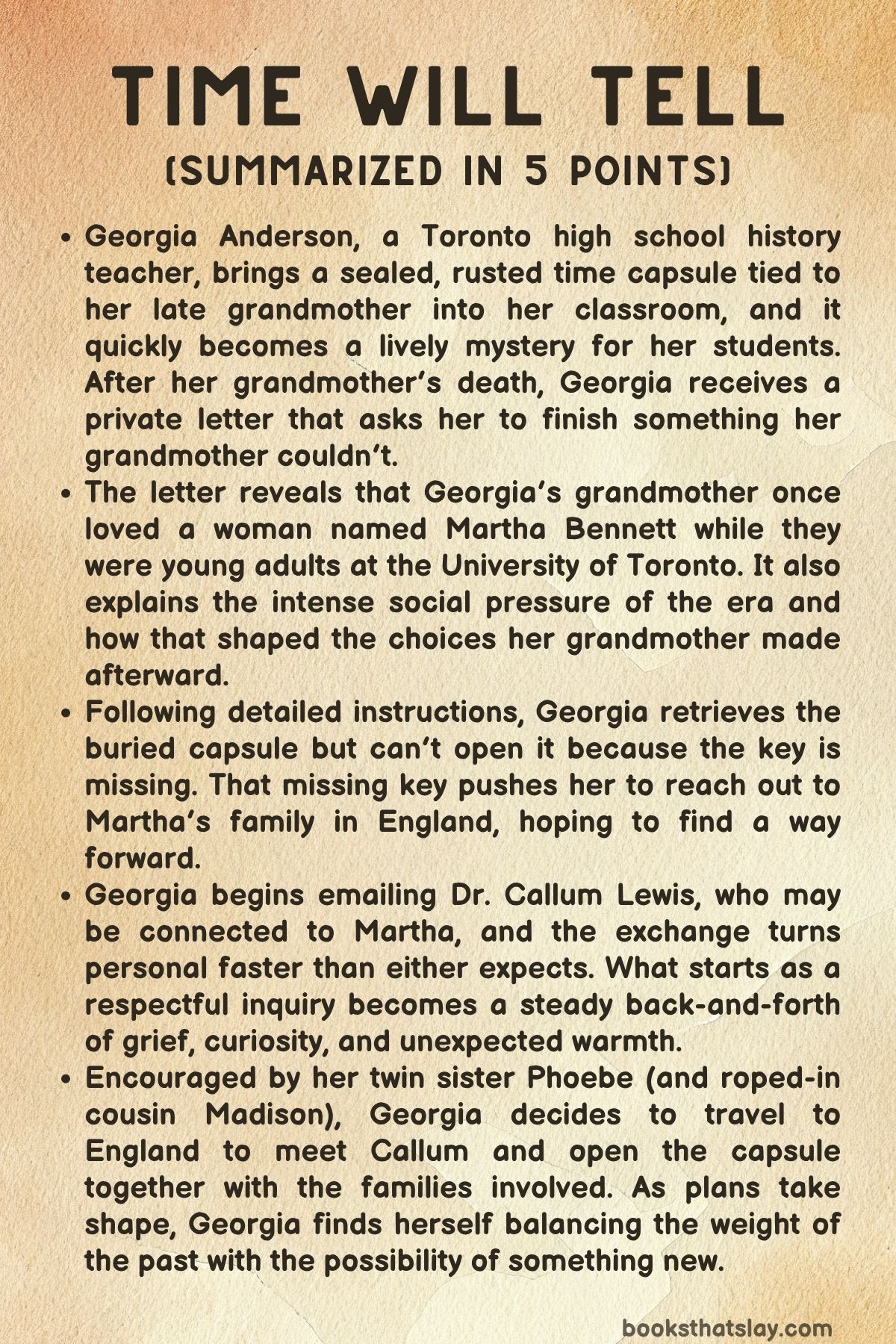
Time Will Tell by Hannah Bonam-Young is a contemporary romance with a strong family-history thread, told through the discovery of a long-hidden love story. Georgia Anderson, a Toronto high school teacher, inherits more than grief when her grandmother dies: she inherits a secret, a buried time capsule, and a set of instructions that pull the past into the present.
What begins as a classroom curiosity turns into a cross-ocean connection with a stranger in England—Dr. Callum Lewis—whose family is tied to the same secret. As Georgia tries to honor her grandmother’s truth, she also finds herself opening up to the possibility of a new one.
Summary
Georgia Anderson is a high school history teacher in Toronto, and on Valentine’s Day she’s standing in front of her senior elective class doing something that feels both ordinary and strangely intimate: composing an email. Her students are unusually alert, not because of romance or candy hearts, but because Georgia has brought a rusted metal time capsule into the classroom.
It’s locked, battered, and mysterious—exactly the kind of object that makes teenagers lean forward. The capsule belonged to Georgia’s late grandmother, a woman Georgia knew as “Bonnie,” steady and quiet in a way that made her seem almost unshakable.
Georgia’s grandfather Henry was the opposite: outgoing, full of stories, especially about the war. Henry died when Georgia was eighteen, and afterward Bonnie sold their lake house, moved closer to family, and eventually grew ill.
Georgia carries a sharp ache of regret about those years. During college, she didn’t visit as much as she should have.
Later, when Bonnie’s health declined, Georgia tried to make up for it in small, consistent ways—Sunday visits, walks when Bonnie could manage them, reading aloud when she couldn’t, bakery treats, and conversation that sometimes turned into Georgia talking while Bonnie drifted in and out of sleep. When Bonnie dies on January 24, Georgia is left with the familiar weight of loss, but also with the unsettling sense that she never fully knew the woman she loved.
Not long after the funeral, Georgia receives a call from the estate lawyer. He insists on delivering a special envelope specifically meant for her, and the urgency in his voice makes Georgia’s stomach tighten.
In a parking lot, with winter air biting at her hands, Georgia opens the envelope and finds a letter written in Bonnie’s handwriting, dated April 19, 2017. Bonnie’s message is direct: when she was young, she lived a “double life.” Georgia reads, stunned, as her grandmother reaches back through time with the kind of honesty Georgia never expected to hear so plainly.
Bonnie tells Georgia that in 1949, at the University of Toronto, she fell in love with another woman: Martha Bennett. Martha studied physiology and chemistry; Bonnie studied English literature.
Their relationship lasted seven years, kept hidden because the world around them did not offer safety for the life they wanted. They rented a two-bedroom flat, building a private version of normal while Martha pushed forward in medicine and Bonnie worked as a church secretary.
In Bonnie’s description, Martha is bold—fearless in a way that made Bonnie feel brave simply by standing near her. Reading the letter, Georgia realizes that the gentleness she associated with her grandmother once lived alongside a hunger for risk and possibility.
Then Bonnie describes the turn that changed everything. Henry walked into the church office, bright and charming, and he proposed quickly.
Bonnie admits she felt pressure from the era’s suspicion and from her own longing for what she had been taught to want: marriage, children, a home, and stability. She chose the conventional future, even though it meant breaking her own heart and Martha’s.
Bonnie writes that Henry eventually learned the truth. Instead of reacting with cruelty, he remained kind and loyal.
Their long marriage, she explains, was loving—just not shaped like the love story people assume when they hear the word “husband.”
Before Martha left for England to complete her residency, Bonnie and Martha buried a box of mementos near St Peter’s cemetery, hoping that one day their love might be found by “kinder eyes.” Bonnie gives Georgia precise instructions: where to dig, what landmarks to use, how to find the exact spot outside the cemetery entrance between a maple tree and iron fencing. The problem is simple and maddening: Martha took the key when she left.
Georgia doesn’t keep the letter to herself. She tells her parents, fulfilling Bonnie’s request that the truth be shared with family.
Her mother supports her, encouraging Georgia to do what she needs to do to honor Bonnie’s wishes. That permission feels like a door opening.
Georgia decides she will retrieve the buried time capsule, even if it means doing something that looks completely unhinged if anyone sees her.
One week earlier, around two in the morning, Georgia drives to the cemetery area with a shovel, the kind of plan that sounds daring in daylight and terrifying at night. Her twin sister, Phoebe, is on the phone from Montreal, panicking about bylaws and the optics of someone digging near a graveyard.
Georgia insists she’s not digging among graves—she’s outside the fence, where Bonnie said it would be. Still, the cold and darkness make every sound feel amplified.
Georgia finds the maple tree and squeezes into the narrow space described in the letter. Her hands ache as she digs, trying to keep quiet, flinching at rustles and distant noises.
A sick thought keeps circling: what if someone already found it? What if the box is gone?
Then her shovel hits metal. Relief rushes through her so fast it almost makes her dizzy.
Georgia uncovers the rusted capsule, clumsily refills the hole, and hurries back to her car with the box held close. She feels exhilarated, but the lock is a hard stop.
The capsule is real, heavy with history, but still sealed. It is a message from the past that refuses to speak until the right person arrives.
On February 14, 2025, Georgia decides to find Martha’s family. She emails Dr. Callum Lewis in England, believing he is Martha Bennett’s grandson.
She explains, as calmly as she can, that her grandmother instructed her to dig up a time capsule buried with Martha in 1956, and she asks if he is willing to learn what it contains. The next day Callum replies with condolences.
He confirms that his grandmother Martha attended the University of Toronto in the 1950s and tells Georgia that Martha died on June 11, 2015. He adds that both he and his mother, Suzette, want to hear more.
Georgia admits how she found him—an online search that led her to an article about a clinic passed down through three generations. She also confesses that she used the project in her classroom, and she asks if she can share updates with her students.
She explains she hasn’t opened the capsule because Bonnie said Martha took the key. Then Georgia says the part that could end the conversation: Bonnie and Martha were romantic partners.
She offers to stop contacting him if it makes him uncomfortable.
Callum responds with humor and clarity. He tells Georgia he is not “an intolerant toad.” He explains that in 2014, when same-sex marriage became legal in the UK, Martha gathered the family, showed them the news, and told them she was a lifelong lesbian.
Instead of shock, Callum’s tone suggests familiarity—like the truth was a long-held fact, just newly spoken aloud. He says his family is searching Martha’s inherited cottage for the key.
He also tells Georgia she can use a locksmith if she wants. Then he raises another possibility: his brother Graham is a journalist, and he’d like to draft a story about the discovery, with the promise that nothing will be published without review.
Alongside the practical details, Callum sends photos of himself and his family. Georgia replies warmly and agrees to let Graham draft an article.
She shares that she has a twin sister, Phoebe, and the email exchange starts to shift from logistics to something more personal. Callum reassures Georgia that Bonnie trusted her for a reason.
He admits he checked Georgia’s online presence. Then he ends with a question that lands like a thumb on a bruise: is she still “Miss Anderson,” or is she now “Mrs Anderson”?
Back in Toronto, Georgia video-calls Phoebe while grading quizzes and confesses the truth she’s been dodging: Callum’s emails are giving her butterflies. Phoebe teases her mercilessly, demanding to see the photos.
When Georgia sends them, Phoebe’s shock is immediate, and Phoebe’s husband Rhett wanders into frame and reacts too. Georgia tries to brush it off—Callum lives across the ocean; it can’t mean anything.
Rhett counters that distance doesn’t have to be a full stop. He reminds Georgia that she once dreamed of moving to England and suggests she use the inheritance money to visit, bring the capsule to Lambley, and open it with Martha’s family.
Phoebe jumps on the idea, already recruiting their cousin Madison. Within minutes, the trip becomes real: flights are booked, and Georgia agrees to go.
Georgia continues emailing Callum, their tone increasingly playful. She jokes about being called a “good egg,” teases him for stalking her TikTok, and shares personal details about past relationships and the strange social scripts that come with being a twin.
She invites Callum to meet her, Phoebe, and Madison when they arrive in England, suggesting all the grandchildren open the time capsule together. She confirms she’s still “Miss Anderson,” and she notes he was the only man who wished her a happy Valentine’s Day—then asks, pointedly, about his status.
Callum answers early in the morning. He admits he made a TikTok account just to see her videos.
He asks if she’s still sharing their emails with her students, jokes about his own awkward flirting, and insists she’s required to come to Lambley. He immediately starts planning—arrival times, rides, whether a child is coming.
He offers his spare room but recommends an inn with a family discount. He tells her he’s thrilled to be her only Valentine, and he confirms he’s single.
Georgia switches to her personal email so they can flirt without the classroom hovering in the background. She shares travel details—landing at Heathrow March 8 and leaving March 16—and asks for advice on London, Bath, and Chatsworth House, plus restaurant suggestions near Lambley.
Callum replies after a brutal clinic day, mentioning he unexpectedly helped deliver a baby and that he kept thinking he couldn’t wait to tell Georgia. He sends a detailed spreadsheet packed with itineraries and recommendations, revealing both competence and eagerness.
Georgia picks a plan with a small change because she’s afraid of heights. She worries about the restaurants being too fancy for her budget and asks why Callum’s sister calls him “Lucky.” She admits she thinks about him too.
Callum immediately says he’ll pay for dinner and asks if it’s a date. Georgia says yes.
Callum explains the nickname: as a child he found a coin from 1066 that turned out to be valuable, and he still carries it. He asks about Georgia’s childhood nicknames and gives her his phone number.
From Callum’s perspective, Georgia calls from Canada. Their flirting is both awkward and sweet, shaped by time zones and the strange intimacy of talking from separate rooms.
They trade details that shouldn’t matter but do—Georgia’s cramped apartment, a broken dryer, the small messes of real life. The call runs late, and neither wants to end it.
When they finally hang up, Callum saves her contact as “Georgia the Good Egg” and lies awake thinking about what it would mean if this connection is real—because he’s rooted in Lambley and the clinic his family runs.
Three weeks later, Callum waits at Nottingham station holding flowers, nerves tight in his chest. His siblings Lena and Graham hype him up on a video call, and then he forces himself to focus as the train arrives.
Georgia steps off with Phoebe and Madison, hauling heavy luggage. Georgia runs to him, hugs him, and accepts the flowers.
They exchange jokes, and then—without hesitation—they kiss on the platform, testing whether the chemistry survives distance and screens. It does.
Callum walks Georgia back to her companions, relieved and buzzing, while Georgia admits she likes being there with him, right now, in the same place—finally close enough for the past and present to meet face to face.
Characters
Georgia Anderson
Georgia is the emotional and moral center of Time Will Tell—a woman who lives in the present but is constantly pulled into the past, both by grief and by curiosity. As a high school history teacher, she’s trained to treat artifacts as evidence and stories as something you interrogate, but the time capsule forces her to do something messier: treat history as intimate, unfinished, and personal.
Her guilt about not visiting her grandmother often during college shows how she carries responsibility in a quiet, heavy way, yet her later Sunday routines with Bonnie reveal her capacity for devotion once she chooses to show up. Georgia’s bravery is not loud; it’s the kind that happens while she’s cold, anxious, and imagining worst-case scenarios—like when she digs up the capsule anyway, even while fearing she might be caught or that someone has already stolen it.
What’s especially revealing is how quickly she moves from discovery to action: she tells her parents the truth, follows the instructions, contacts Callum, and keeps going even when the story turns personal. That same forward motion shows up in her romance arc—she tries to downplay the possibility because of distance, but she can’t fully resist the way Callum draws her into a version of herself that’s more hopeful and more daring than her default.
Georgia’s tenderness is practical and real, and her growth comes from realizing that honoring the past doesn’t have to mean living inside grief—it can also mean choosing connection, risk, and joy.
Martha “Bonnie” Bennett
Bonnie is the book’s quiet force: outwardly steady, inwardly complicated, and ultimately courageous in the way she chooses truth at the end of her life. For most of Georgia’s memories, Bonnie appears as consistency—someone calm, present, and reliable—yet her letter redefines her not as a simple figure of comfort, but as a person who built a life under the constraints of her time and carried a private heartbreak for decades.
The “double life” she describes isn’t framed like sensationalism; it reads as survival, shaped by a world that made her love risky and her future feel conditional. Her love for Martha is portrayed as awakening—Martha makes her feel brave—yet the tragedy is that Bonnie cannot sustain that bravery when the pressure of suspicion and social expectation closes in.
Even so, Bonnie isn’t written as someone who merely surrendered; she later insists on meaning, choosing to preserve the truth in a capsule and trusting that the future might be kinder than her past. Her final act—leaving Georgia precise directions and the story itself—turns inheritance into responsibility, but also into liberation: she gives Georgia permission to see her fully, and in doing so, she transforms from “grandmother” into a whole human being whose life contained love, loss, compromise, and enduring loyalty.
Martha Bennett
Martha is the catalytic figure in Bonnie’s past and the symbolic promise that love can outlast secrecy, even when it can’t outlast circumstance. Through Bonnie’s description, Martha comes across as bold, fearless, and intellectually driven—someone pursuing demanding sciences and medicine at a time when that path already required defiance, especially for a woman.
That ambition mirrors her emotional boldness: she doesn’t simply exist as a hidden romance; she actively expands Bonnie’s sense of who she can be, making her feel alive and brave. Yet Martha is also marked by the particular loneliness of being ahead of her era—her love has to be hidden, her future has to be negotiated, and even the mementos of their relationship must be buried like contraband.
The key detail that she took the key when she left adds a poignant complexity: it suggests both separation and hope, as if the story could only be opened when the right hands—and the right time—arrived. Martha’s later-life decision to tell her family she was a lifelong lesbian, prompted by changing laws and cultural shifts, reinforces her lifelong relationship with truth: she may have lived through decades that demanded silence, but she still claimed her identity openly when the world finally offered a safer moment.
Even in absence, Martha shapes the present-day plot by pulling new people together, proving that the past isn’t dead—it’s waiting to be understood.
Henry Bennett
Henry represents a different kind of love story—one built less on romantic ideal and more on companionship, decency, and chosen loyalty. Georgia remembers him as outgoing, full of stories, and defined by the social ease that Bonnie often seemed to lack, which makes their pairing feel like a balance of temperaments.
What’s most significant is not that Henry enters Bonnie’s life quickly, but that once he learns the truth about her past, he stays kind and loyal rather than turning that knowledge into a weapon. In the context of his era, that loyalty becomes quietly radical: he participates in a marriage that Bonnie describes as loving but not typically romantic, which implies a partnership shaped by mutual care rather than the narrative society expected.
Henry’s character complicates easy judgments about Bonnie’s choice; he is not a villain who forced her hand, but a person who became part of the life she chose, and who honored her even when he understood there were parts of her heart that began elsewhere. His presence makes the story richer because it refuses to flatten marriage into either fairy tale or tragedy—Henry embodies the possibility that someone can be deeply loved and still not be the first, secret, foundational love.
Phoebe Anderson
Phoebe functions as Georgia’s emotional counterweight and comic pressure-release valve, but she’s also an engine of momentum. As Georgia’s twin, she has an intimacy with Georgia that allows her to tease mercilessly while still being protective, which shows up when she panics about cemetery bylaws yet stays on the phone through the digging anyway.
Phoebe’s reactions—both anxious and delighted—highlight Georgia’s tendency to internalize everything; Phoebe externalizes it, says the embarrassing part out loud, and insists the feelings be acknowledged rather than minimized. She’s also socially bold in a way Georgia isn’t, pushing possibilities forward: once the idea of England becomes real, Phoebe immediately turns it into logistics, recruits Madison, and helps transform a strange mystery into a shared adventure.
Her marriage and motherhood add another layer to her role—she can be playful and impulsive, but she’s not careless; she simply believes that life should be seized when it offers something rare. Phoebe’s presence keeps Georgia from retreating into caution, and her enthusiasm becomes a form of sisterly care: she wants Georgia to be brave, not only for the sake of the time capsule, but for the sake of her own happiness.
Rhett
Rhett appears briefly but leaves a clear impression as the kind of partner who expands rather than restricts the people around him. His humor blends with practical support—he reacts to Callum’s photos with disbelief, yes, but he also takes Georgia seriously enough to argue that distance shouldn’t be the deciding factor.
What makes Rhett notable is that he doesn’t treat the trip as a fantasy; he treats it as something doable, even offering to solo parent their baby for the week so Phoebe can go. That detail frames him as grounded and generous, someone whose masculinity is expressed through caretaking and encouragement rather than control.
In narrative terms, Rhett helps convert the romantic thread from “impossible” to “possible” by normalizing the idea that Georgia can pursue something across an ocean without it being reckless. He’s a small-role character with a big function: he helps make the leap feel supported, and that support matters because Georgia’s default mode is to talk herself out of wanting things.
Madison
Madison plays the role of the blunt truth-teller and the practical amplifier of group energy. Even before she arrives on the page in person, she’s characterized through how quickly she says yes and how immediately she’s asking about dates and feasibility, which suggests a person who’s decisive and unafraid of committing to a plan.
Her influence becomes sharper through her astrology comments, which aren’t presented as mystical authority so much as a comedic, candid way to voice what everyone is thinking—especially about Callum. That bluntness provides contrast to Georgia’s carefulness; where Georgia worries about budget, propriety, and imposing, Madison’s presence implies someone who would rather name the obvious and deal with the consequences later.
As part of the travel trio, she helps shift the England trip from a private romantic risk into a shared expedition, lowering the emotional stakes for Georgia while still keeping the excitement high. Madison’s character matters because she embodies a kind of confidence that Georgia is still learning to practice: not the confidence of certainty, but the confidence of showing up and seeing what happens.
Callum Lewis
Callum is written as both stable and surprisingly vulnerable: a rooted man with deep family ties who nevertheless becomes emotionally unmoored—in a good way—by a stranger’s email. His first responses establish his values quickly: he’s respectful about Bonnie’s death, open-minded about the romance revelation, and emotionally mature enough to reassure Georgia rather than judge her.
The humor he uses—calling himself not “an intolerant toad,” joking about flirting, admitting to making a TikTok to see her account—signals warmth and a willingness to be embarrassed, which is one of the clearest markers of sincerity in romantic characterization. Professionally, he’s competent and intense, living the reality of long clinic days and sudden emergencies, but what’s revealing is how he shares that intensity with Georgia, like when he tells her he kept thinking about telling her about delivering a baby.
That detail shows he’s not performing a smooth persona; he’s inviting her into his day-to-day self, which is why their connection feels earned rather than purely dreamy. Callum’s planning spreadsheet and multi-itinerary approach shows a personality that manages anxiety through preparation, yet his emotional arc is about stepping into uncertainty anyway—wondering how a relationship could work when he’s tied to Lambley and a multigenerational clinic.
His nickname “Lucky,” tied to a childhood coin discovery, also works symbolically: he’s a man who believes in unexpected finds, which aligns perfectly with a love story born from a buried capsule and a chance email.
Suzette
Suzette, Callum’s mother, is present more as influence than as direct scene, but her role carries emotional weight because she stands at the intersection of Martha’s truth and the family’s response to it. Her interest in hearing more about the capsule signals openness and care, suggesting a family culture that can hold complicated histories without panic or denial.
Because she and Callum want to hear Georgia’s story rather than reject it, Suzette implicitly represents the “kinder eyes” Bonnie hoped for—someone from the next generations willing to treat queer love as real history rather than shameful secret. Even without extensive page time, Suzette’s willingness to engage establishes that this is not a story where the past is punished again; it’s one where the past is finally welcomed.
Graham Lewis
Graham serves as the bridge between private history and public narrative. As a journalist, he sees the capsule not only as an emotional inheritance but also as a story with broader resonance, which introduces a tension: the difference between honoring real people and packaging their lives for consumption.
The key to his characterization is consent and restraint—he wants to draft a story, but the promise that nothing will be published without review frames him as ethical rather than exploitative. He also functions as part of Callum’s support system, participating in the sibling dynamic that steadies Callum when he’s nervous and emotionally invested.
Graham’s presence underscores one of the recurring ideas in Time Will Tell: history becomes safer when it can be witnessed, but it becomes complicated when witnessing turns into broadcasting.
Lena Lewis
Lena’s role highlights the warmth and normalcy of Callum’s family ecosystem, and she contributes to the romantic plot by making Georgia feel already half-included. Her playful “assessment” of compatibility via star signs mirrors Madison’s astrology energy, creating a parallel between the two families: both sides have people who express care through teasing, humor, and light-hearted frameworks that make vulnerability easier.
Lena’s influence also shows in how she hypes Callum up before he meets Georgia, positioning her as an emotionally attentive sibling who understands that big feelings can make even competent adults act like teenagers. She helps soften the stakes of the meeting by surrounding it with familial affection, which allows Callum’s nervousness to read as endearing rather than fragile.
Themes
Inherited silence and the cost of belonging
Georgia’s relationship with her grandmother is shaped as much by what was never said as by what was lovingly done. Bonnie is remembered as steady and present, yet her life contains a sealed chamber of truth that only becomes visible after death, when the letter forces the family to reinterpret decades of ordinary memories.
What makes the silence powerful is that it was not simply personal hesitation; it was a survival strategy built for a world that punished women like Bonnie and Martha. Choosing Henry was not framed as cruelty but as compliance with a narrow definition of safety: marriage, children, social acceptance, and a predictable future.
The theme sits inside the everyday texture of family life—Sunday walks, reading aloud, bakery treats, drifting conversations as illness advances—showing how tenderness can coexist with an absence of full honesty. Georgia’s regret about not visiting enough during college adds another layer: silence and distance are not always dramatic betrayals; sometimes they are the quiet byproducts of growing up, being busy, and assuming there will always be more time.
When Bonnie’s truth finally arrives, it does not simply reveal a hidden romance; it reveals how an era can press a person into a role until the role feels like the only available way to live. The family’s reaction matters too: Georgia immediately tells her parents, and her mother gives permission to honor Bonnie’s wishes, suggesting that the next generation can offer what the previous one could not—space to acknowledge complexity without turning it into scandal.
The envelope delivered with insistence by the estate lawyer underscores how intentional Bonnie is about timing. She controls the conditions of disclosure, ensuring Georgia receives the story when she is old enough to carry it, and when “kinder eyes” are more plausible than they were in 1956.
The emotional weight of the theme comes from that delayed release: love was real, loss was real, and the decades in between were real too, built on compromise, loyalty, and the private ache of choosing belonging over truth.
Objects as evidence and the ethics of uncovering the past
The time capsule functions less as a cute mystery and more as a physical argument that the past is not abstract. It can be held, dug up, hidden, lost, and locked.
Georgia’s students’ sudden engagement shows how objects give history friction; they turn interpretation into investigation. In Time Will Tell, the capsule is also an ethical test.
Georgia is not simply curious—she is entrusted. Bonnie’s letter turns Georgia into a caretaker of other people’s memories, with instructions precise enough to remove ambiguity but with one built-in restraint: the missing key.
That missing key matters because it forces collaboration and consent across families. Georgia could take the capsule to a locksmith immediately, but she pauses because the story does not belong to her alone.
Reaching out to Callum is an acknowledgement that discovery can become theft if it ignores the living. Callum’s response reframes the capsule again: it is not just Bonnie’s secret but Martha’s, and Martha has her own timeline of truth, having come out to her family late in life.
The capsule’s locked state becomes a metaphor for how narratives are accessed—through permission, readiness, and shared context, not just force. Even the act of digging raises ethical questions that the book does not dodge.
Phoebe worries about bylaws and appearances; Georgia is anxious about being seen with a shovel near a cemetery at night. That anxiety is not just comic tension; it highlights how easily the search for truth can be misunderstood, criminalized, or sensationalized.
Georgia’s care in digging outside the fence, refilling the hole, and treating the moment with reverence suggests she understands that history is not entertainment even if it begins as a classroom hook. The capsule also blurs lines between public and private history.
Georgia shares parts of the process with her students, then asks Callum for permission to continue doing so, which raises a modern dilemma: when does a personal story become a teachable story, and who gets to decide? Graham’s interest in drafting an article intensifies this.
The promise of review before publication is a safeguard, but it also shows how quickly a private past becomes content in the present. Through the capsule, the book argues that evidence is powerful, but power requires restraint: to uncover is not automatically to own.
Love shaped by constraints and the forms commitment can take
Bonnie’s romantic life resists neat labels, and that resistance is the point. Her first great love with Martha is passionate and affirming, marked by the feeling of becoming braver in someone else’s presence.
Yet it is carried out in secrecy, in a rented flat that has to look like something else to the outside world. The secrecy does not make the love less genuine; it makes it more precarious.
When Bonnie chooses Henry, the decision lands as heartbreak rather than villainy, because the narrative makes clear what she is choosing: not a man over a woman, but stability over exposure, social legitimacy over suspicion, a life she was taught to want over a love she was taught to fear. Then the story complicates things further by refusing to paint Henry as merely a symbol of repression.
Henry learns the truth and remains kind and loyal; their long marriage is loving but not “typical romantic.” This opens a nuanced theme about commitment: devotion can exist in forms that do not match conventional romantic ideals, and people can build meaningful partnerships inside imperfect circumstances. The book also shows how constraint distorts time.
Bonnie and Martha have seven years together, then a forced ending, then decades where the relationship survives only through memory and the buried capsule. That long delay is not just a plot device; it mirrors how many queer lives were stretched across waiting—waiting to be safe, waiting to be believed, waiting for laws and communities to change, waiting for family to be ready.
The theme extends into the present through Georgia and Callum, whose connection forms through emails, jokes, spreadsheets, late-night calls, and a growing sense of emotional reliance before they meet. Their romance is constrained too, but by geography and practical life commitments rather than law and stigma.
Callum is rooted in a family clinic; Georgia has a teaching life and an apartment that feels too small for big change. The parallel suggests that love always negotiates limits, but the nature of the limits matters.
Bonnie and Martha’s limits were enforced by danger and social punishment; Georgia and Callum’s are logistical and emotional risks. By placing these side by side, the story argues that love is not only about desire; it is also about what people are willing or able to build, what they sacrifice, and how they stay loyal—sometimes to a partner, sometimes to a family, sometimes to a version of safety they cannot yet outgrow.
Time, timing, and the courage to act before life closes the window
The narrative is obsessed with timing, not as an abstract concept but as a force that shapes choices and regrets. Bonnie times her confession carefully, writing the letter years earlier but arranging for it to be delivered after her death, when she can no longer be judged directly and when Georgia can carry the truth without it destabilizing Bonnie’s daily care in old age.
That timing reveals a late-life form of courage: Bonnie cannot undo what happened, but she can prevent the story from disappearing. Georgia’s own sense of time is marked by regret—she did not visit enough during college, then tried to compensate in Bonnie’s last years with steady Sunday rituals.
Those rituals are tender, but they also show how people often respond to time by trying to make ordinary moments count once they sense scarcity. The book places specific dates like anchors—Bonnie’s death in late January, the Valentine’s Day email, the March break trip—making time feel like a series of gates that open and close.
Georgia’s midnight dig illustrates this theme in action: she could delay, rationalize, and wait for better conditions, but she chooses to act while she still has the letter, the instructions, and the nerve. The cold, the darkness, and the fear of being caught emphasize that acting in time is rarely comfortable.
It is simply necessary. The capsule’s lock introduces another dimension: sometimes acting in time still means accepting that you cannot resolve everything immediately.
Georgia can retrieve the object, but she cannot access its contents without help, which pushes her toward relationship and trust rather than solitary heroics. Callum’s family history adds a different layer of timing through Martha’s late coming-out, triggered by a legal and cultural shift.
That scene suggests that people do not always hide because they lack honesty; sometimes they hide because the world has not yet made honesty survivable. In the present-day romance, timing again becomes decisive.
Weeks of nightly calls build momentum, and when they finally meet at the station, they confirm their chemistry with a kiss that acts like a choice: not to postpone, not to keep it hypothetical, not to stay safe inside screens. Across generations, the theme insists that time is not neutral.
It pressures people into silence, but it also offers chances for repair, recognition, and connection when someone decides to move while the opportunity is still alive.