Twelve Months Summary, Characters and Themes | Jim Butcher
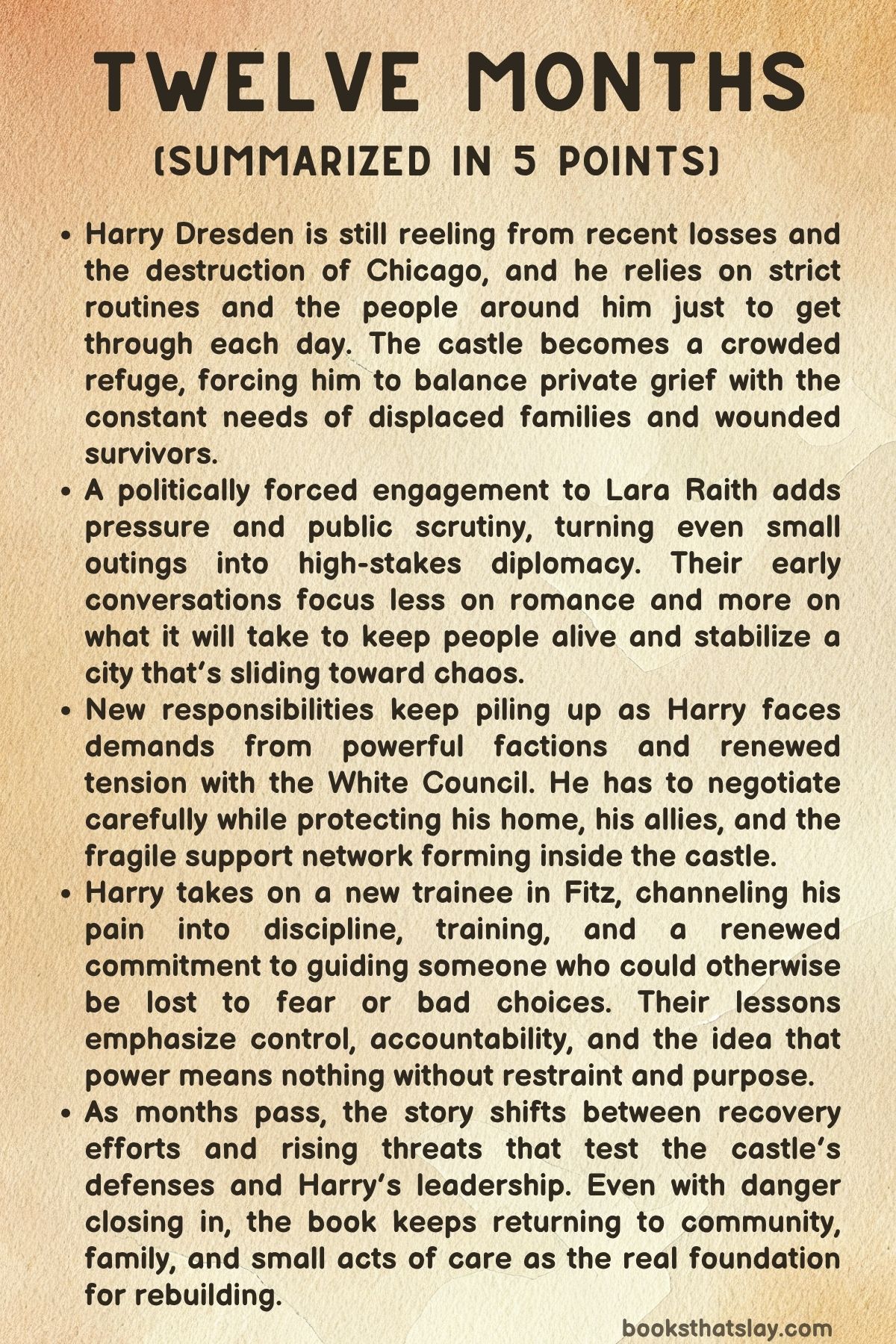
Twelve Months by Jim Butcher is the 18th Dresden Files novel set in the battered aftermath of Chicago’s catastrophic supernatural war. Harry Dresden—wizard, Winter Knight, and reluctant public symbol—tries to keep breathing while grief, trauma, and politics grind him down.
The city’s power grid is wrecked, fear is everywhere, and Harry has been cut loose by the White Council. He’s sheltering refugees inside a newly claimed fortress, raising a young wizard in training, and facing an arranged engagement to Lara Raith of the White Court vampires under Mab’s orders. The story tracks a year of recovery, hard choices, and the next wave of enemies.
Summary
Harry Dresden jolts awake from another nightmare about Karrin Murphy’s death. It’s 3:30 a.m., and the pain is so sharp he can barely move.
Three weeks have passed since the battle that shattered Chicago—tens of thousands dead, neighborhoods ruined, and a magical EMP that left the city limping without reliable power or modern systems. Harry’s arm is still broken, but the worse wounds are inside his head.
He uses the few private minutes before dawn to fall apart in his basement room, then forces himself into a strict routine—wash, stretch, make the bed—because routine is the only thing keeping him functional.
Upstairs in the castle kitchen, Will Borden has become Harry’s organizer and caretaker. The fortress is packed with refugees: families who lost their homes, a few surviving “Knights of the Bean,” and homeless kids sleeping on mats and air mattresses.
Will runs through the day’s schedule and reminds Harry of two big obligations: a practical meeting with Michael Carpenter about improving living quarters, and an evening “date” with Lara Raith. The word still hits like a punch.
Harry is engaged to Lara because Mab, Queen of Winter, demanded a political marriage to lock in an alliance. Harry didn’t choose it, and he can’t refuse it.
Molly—now the Winter Lady—visits and immediately recognizes how close to collapse Harry is. She offers to try delaying the date, but Harry knows Mab won’t allow it.
Molly pushes him to admit what he’s tempted by: White Court feeding. The sensation can feel like peace and would numb grief in seconds.
Harry admits the temptation is real, but he draws a line when he thinks of Maggie, his daughter. Molly warns him that Winter agents will be nearby; if Lara tries to force the issue, Harry only has to call, and help will come.
Harry steels himself and agrees to go through with it.
Outside the castle, Chicago looks like a city shoved backward in time. Curfews and distrust rule the streets.
Dead cars clog lanes. Water, sanitation, and food supplies are strained.
People tell themselves the attack was “terrorism,” because the alternative is believing monsters are real. Harry leaves without heavy weapons, keeping the meeting low-key, and rides a Winter carriage driven by Redcap through tense crowds that recognize him as “the wizard” and glare like he’s a threat as much as a protector.
He meets Lara at McAnally’s Pub, where the supernatural community has formed a market outside for safety and trade. The whole setup makes the political angle obvious: witnesses are watching Lara and Harry together, measuring what this alliance will mean.
Over coffee, Lara bluntly tells Harry he looks wrecked and asks whether he can keep protecting anyone if he’s running on empty. Harry says he has to try, because people still need him.
Lara asks what help he wants, and Harry—careful, suspicious, but practical—lists what the castle needs: real beds, a doctor, antibiotics, insulin for a diabetic child, painkillers for the wounded. Lara listens and says she’ll look into it.
They talk about Thomas. Harry explains he tried tracking Justine, who vanished after being possessed, and all his attempt suggests is distance—possibly Europe.
Lara confirms sightings in Romania. Harry tells her Thomas is in stasis on Demonreach, healing while the island restrains his Hunger.
Lara admits her motives are complicated, but she doesn’t deny she wants Thomas alive, and she doesn’t pretend she never tries to do the right thing.
As they leave, Lara advises Harry to “fill his cup” with something that restores him—anything that keeps him from collapsing. Harry notices her eyes stay blue and learns why: when her Hunger rises, her eyes lighten, and that shift is dangerous for both of them.
He also avoids locking eyes too long, because a soulgaze with Lara would be a mess neither of them can afford.
On the ride home, Mab appears in the carriage and judges Harry’s performance as inadequate. She insists the alliance must hold because a larger war is coming, and she says outright that Harry will eventually “give himself” to Lara.
Then she drops a new task: King Etri of the svartalves knows Harry hid Thomas and wants compensation—Harry’s life. Mab orders Harry to repair relations with Etri so the svartalves will continue supplying Winter with weapons.
Her threat is personal; if Harry fails, she implies she can reach anyone tied to him. When Harry realizes she’s pointing at Maggie, he nearly breaks.
He threatens to unleash the prisoners of Demonreach if Mab harms his child. Mab warns him there’s no time for mourning and vanishes, leaving Harry desperate, furious, and exhausted.
Three days later, Lara delivers on her promise. A shipment arrives at the castle—beds, medical supplies, and a doctor—along with a massive Valkyrie bodyguard named Bear.
Bear presents a Monoc Securities contract: Lara has hired her to protect Harry and his home for five years. Harry verifies the contract through Bob the Skull, who contacts Vadderung, and the confirmation comes back clean.
Bear moves in and insists on staying close to Harry. Doctor Lacalle begins treating the sick and injured children among the refugees, and the castle becomes a little more stable.
Not long after, Mortimer Lindquist arrives with Fitz, a former street kid Harry once knew. Mort explains Fitz’s magical talent has surged since the battle: Fitz burned a monster during the fighting, and now he can reach into multiple elements, growing stronger fast.
Mort can’t train him and is afraid the White Council will either recruit Fitz harshly or kill him if they label him a warlock. Fitz asks Harry to train him so he can learn control and see what he might become.
Harry knows training Fitz could draw the Council’s attention, but he also knows leaving a talented, traumatized teenager untrained is a disaster waiting to happen. He tells Fitz to talk it over with Mort and come back at dawn.
As the months drag on, Chicago’s condition worsens before it improves. Summer heat brings stink and decay.
Violence climbs. Ghouls roam at night, taking advantage of the broken city.
Fitz becomes Harry’s trainee in the castle, and Harry trains him the only way he knows how: discipline first. Fitz runs brutal workouts, reads, practices meditation, and drills the basics of control.
Harry’s grief doesn’t vanish, but he channels it into structure and purpose, pushing Fitz to understand that uncontrolled emotion makes a wizard dangerous.
Then the White Council comes to Harry’s doorstep. Two Wardens arrive: Carlos Ramirez, injured and worn down after the battle, and a younger Warden named Ilyana, openly hostile.
Ilyana demands Harry confess crimes and return to Edinburgh. She tries to frame him as a corrupt influence over the vulnerable magical refugees gathering in Chicago’s ruins.
Harry refuses. He won this fortress by force, he says, and it is his home.
If the Wardens want to visit, they can call ahead and come as guests. Ilyana calls it a threat and reaches for her sword, but Ramirez stops her, pointing out that arresting Harry inside a fortress like this would be suicide.
After Ilyana leaves, Ramirez explains her bitterness: she had a twin sister who became a warlock and framed her, twisting her life into something hard and sharp. Ramirez also shares anger at the Council’s choices, including their refusal to retrieve the bodies of Wild Bill and Yoshimo—friends who were turned into Black Court vampires.
The two men, battered by different kinds of loss, make a quiet agreement: when they’re both ready, they’ll go after the Black Court, bring their people home, and settle things with Drakul.
Life in the castle keeps moving. Molly refurbishes Harry’s salvaged boat, the Water Beetle, and insists he accept small improvements while the city rebuilds.
Harry and Molly prepare to escort Lara to Demonreach so she can confirm Thomas is alive. Molly also admits Mab has ordered her to push Harry toward making things “simpler” by letting Lara seduce him.
Harry doesn’t like the admission, but he files it under “Mab is Mab” and focuses on what matters.
On Demonreach, Harry takes Lara deep into the prison caverns. The place terrifies her, and Harry warns her not to touch the crystal cells; contact can trigger mental connections that can break someone.
They reach Thomas’s crystal and use the island’s power to speak with him. Thomas wakes enough to recognize them and immediately warns that Justine is possessed and cannot be trusted.
He fears for Justine and the baby. He also admits the Hunger is still chewing on him; if he’s released and fed carelessly, he could spiral into addiction and slaughter.
Lara suggests feeding him immediately to restore him, even if it costs human lives. Harry refuses.
He promises to find another way, even if it’s slow and ugly.
Harry meets King Etri at McAnally’s to negotiate Thomas’s fate. Etri lays out the old law: Thomas took a life, and by svartalf standards he must pay with his own.
Harry argues Thomas was coerced—Justine and the unborn child were used as leverage—but Etri says coercion doesn’t erase consequences. If Harry can provide proof, Etri might allow some latitude.
Without proof, Thomas’s life is forfeit. Etri gives Harry a deadline: one year from the day Thomas was taken.
Fix it by then, or Etri becomes Harry’s enemy.
Back at the castle, Fitz continues learning controlled magic, and Harry steers him toward safer evocation—force instead of fire inside the building. Detective Stallings from Special Investigations arrives with grim news: Chicago is sliding toward lawlessness, people are vanishing at night, and Stallings suspects ghouls.
Harry promises to help, even though he’s stretched thin. Michael Carpenter later corners Harry with something gentler and sharper than any threat: he insists Harry come to Sunday dinner and show up for Maggie.
For a little while, the weight on Harry’s chest eases. Community doesn’t cure grief, but it keeps it from eating everything.
In October, Bear arranges a midnight meeting under guest-right with Carter LaChaise, a ghoul lord with influence. Harry lays down a boundary: Chicago is off-limits to ghouls at sunrise.
LaChaise claims he can’t control every ghoul, but Harry makes it simple. Any ghoul found in the city after sunrise forfeits its life.
Bear reinforces the message by calmly pointing a massive gun at LaChaise’s head. The ghoul lord retreats, and Harry prepares to enforce his ultimatum.
Later, Harry tries something risky with Lara. In a hotel room, he sets up a ritual circle shaped like an infinity loop using practical, improvised materials, because he’s nearly broke and sinking money into keeping the castle running.
He explains the plan: test whether he can contain and separate her Hunger without harming the rest of her, like a modified exorcism. Lara agrees, steps into the circle, and follows his instructions.
Harry draws power by focusing on Thomas—his courage, his humor, and the brutal condition he was left in. The room’s lights surge and burst, leaving candlelight and green sparks dancing around the sigils.
With his wizard’s senses, Harry identifies something alien in Lara’s Hunger—Outsider-tainted energy that feels hostile to reality. He commands it with a spellword, and Lara’s body reacts as if something inside her is fighting.
Smoke thickens, then implodes into the other side of the loop, forming a pale, near-featureless figure shaped like Lara: a manifested Hunger, tethered to her by strands of energy. Harry tests the strands and realizes the separation is real.
It’s possible. It might be possible for Thomas, too.
He eases off the spell carefully, the figure dissolves back into smoke, and the Hunger returns to Lara without the ritual tearing her apart. Lara is shaken and stunned, saying she is not Hungry.
Harry, exhausted, confirms the proof of concept worked. For the first time in a long while, a path forward exists.
As winter sets in, Chicago slowly begins to recover. Power returns in patches.
Repairs creep along. On the castle roof, Harry and Fitz talk in the cold about why Harry shelters people and keeps helping even when it costs him.
Harry tells Fitz he does what he can because he has power, and power means responsibility. Fitz shares his own losses and offers to listen if Harry ever wants to talk about Murphy.
Harry can’t—not yet—but he doesn’t shut the door entirely.
After Thomas, Justine, and their newborn son are rescued, Harry is still shaken. Thomas visits Harry on the roof, physically recovered but emotionally hollow.
He has been feeding again under Lara’s supervision to manage his Hunger, but his instincts and dreams have changed. Thomas presses for a timeline on Justine’s return.
Harry admits he can’t promise one; removing possession is unpredictable. When Thomas learns the political cost Harry paid—Lara now bound closer to Winter through the engagement—he panics, realizing the White Court could tear Lara apart if they discover how deep the influence runs.
Overwhelmed, Thomas tells Harry they should not speak for a while. It hurts, but Harry lets him go, accepting that Thomas needs space.
Then a warning arrives. A Knight of the Bean delivers a black envelope.
Inside is a note from Drakul, polite on the surface and threatening underneath, timed with sundown. Harry orders an immediate lockdown.
Maggie and Mouse go to safety. Civilians are moved to the lowest levels.
Harry calls Toot-Toot to send messengers for allies, orders the gargoyle Basil to bar the gates, and has Bob activate the fortress’s defensive systems.
Outside, a huge crowd gathers at the gates—protesters and counterprotesters escalating toward violence. Using his Sight, Harry sees the truth: supernatural manipulators are feeding on fear and pushing mortals toward a riot.
Malvora vampires amplify terror. Renfields stand ready as controlled pawns for the Black Court.
Ghouls wait to spark bloodshed. Lord Raith appears briefly, confirming the unrest has been engineered for months.
Harry refuses to let mortals die as collateral. Drawing on the fortress’s ley-line channels through Bob, he controls a massive surge of power and conjures a sudden storm.
He projects a gigantic image of his head over the street and thunders warnings, calling down lightning between the factions and unleashing freezing rain to shatter the frenzy. Then he stops the storm and threatens worse if they don’t leave.
The ordinary people scatter, leaving the real attackers exposed as night falls.
The Black Court tests the castle’s defenses with sorcery, but the fortress holds. Malvora gunfire forces Harry’s team to take cover.
Toot-Toot reports the enemy’s split: some circle the rear, while Renfields approach the front gate carrying bombs. Harry orders the gargoyles to fall back and tells Bob to contain the explosion’s energy to the gate area.
He intentionally allows the gate to fail so the attackers will enter on his terms, where the fortress can crush them.
The gate explodes. Malvora vault onto the roof and ghouls climb up.
Harry blasts them with wind while Bear takes gunfire meant for him. Fitz throws fire, and a terrified resident named Matias guards the stairs with a shotgun, refusing to hide.
In the middle of the fight, Lara arrives on the roof and cuts down ghouls with twin blades. From the street, holy notes from a shofar ring out, weakening the monsters.
Allies pour in: Butters with Fidelacchius, Daniel Carpenter, Father Forthill, Rabbi Aaronson, Will’s werewolves, and Ramirez—who reveals he’s been nearby. Ramirez disrupts the Renfields’ control so they collapse, destroys a Black Court elder, and Mavra escapes into the mist, laughing.
Inside the castle’s great hall, a few Black Court vampires force entry against the gargoyles. Harry triggers the fortress itself: a rune-etched section of stone ceiling slams down and pulverizes them.
When the fight ends, the residents emerge from the basement. Maggie clings to Harry.
Fitz receives praise for surviving his first real battle. The fortress begins repairing itself as best it can, and the defenders gather for a grim debrief.
They conclude the warning prevented a massacre and suspect the night’s events may have been engineered to remove rivals and elevate Mavra. The only option is vigilance and intelligence gathering, because this was a message, not a finale.
In the weeks that follow, life steadies into repairs, inspections, and small celebrations as Chicago crawls forward. On the anniversary of the battle, Harry feels the pull of relapse and fights it with the tools he’s built over the year: meditation, training, routine, and family.
He teaches Fitz a small “pocket sunshine” trick, something simple that still matters in a battered city. Then Thomas arrives with a restored blue Volkswagen Beetle, meant as a birthday gift.
Harry invites him up for ice cream. Thomas accepts.
The brothers finally close the distance between them, holding on in a long hug, and for a moment the year’s weight lifts—just enough to keep going.
Characters
Harry Dresden
Harry is the emotional and moral center of Twelve Months, and the story follows him less as an unstoppable wizard and more as a man trying to stay functional after catastrophic loss. He begins in raw, private collapse—traumatized by Murphy’s death, the destruction of Chicago, and his exile from the White Council—and clings to routine as a survival tool because it gives him structure when grief has erased his sense of control.
That rigidity isn’t just coping; it becomes a discipline strategy he later passes to Fitz, revealing how Harry turns pain into training because he’s terrified of what an unregulated wizard can become. Politically, he’s boxed in from every direction: Mab’s demands, Lara’s arranged engagement, Etri’s vengeance, and the Council’s surveillance all treat him as an asset or a threat, rarely as a person.
Yet Harry keeps choosing responsibility over relief—most clearly when he refuses the seductive numbness of Lara’s feeding and keeps Maggie as his anchoring “line he will not cross.” His heroism in this book is quieter than battlefield triumph: it’s persistence, boundaries, and refusing to let trauma turn him cruel, even as he grows sharper and more dangerous when forced to defend his home.
Karrin Murphy
Murphy’s presence is felt more through absence than action, but her death is the gravitational force shaping Harry’s inner life. She becomes the symbol of what Harry lost that was personal, intimate, and earned outside of supernatural politics—someone who chose him without compulsion or bargaining.
The nightmare that opens the story and the recurring memories show that Harry’s grief is not abstract sadness; it’s intrusive, bodily, and destabilizing, and it threatens to push him toward self-destruction disguised as duty. Murphy also functions as a moral measuring stick: when Harry weighs surrendering to White Court bliss, his refusal is partly loyalty to Murphy’s memory and the kind of man she believed he could be.
Even in death, she shapes the tone of the book by making every “move on” demand from Mab or others feel brutal, because the reader understands Harry isn’t just resisting politics—he’s resisting the erasure of love and mourning.
Will Borden
Will acts like the story’s pragmatic stabilizer, the person who translates “surviving” into logistics when Harry’s mind is drowning. In the castle, he becomes an organizer, caretaker, and quiet authority figure who keeps the refuge functioning—coffee, schedules, meetings, and reminders that bodies still need food and days still have hours.
What makes Will important is that he doesn’t try to fix Harry’s grief with speeches; he supports Harry by creating a framework where Harry can keep moving without having to invent the will to live from scratch each morning. Will also represents the community Harry has built over years: not an official institution like the Council, but a chosen network that shows up because Harry once showed up for them.
When the city collapses into fear and factionalism, Will’s presence is proof that solidarity can be organized and maintained, even in the rubble.
Molly Carpenter
Molly is both family and weapon now, and the book explores how painful that dual role is for her and for Harry. As the Winter Lady, she sees Harry with a clarity that is partly love and partly Winter’s predatory attention, and she recognizes immediately that he is mentally unwell in a way that makes him vulnerable to self-sabotage.
Her warnings about guilt and reckless choices are not abstract mentorship; they are intimate fear, because she knows Harry’s pattern of turning suffering into sacrifice. At the same time, she is caught inside Mab’s machinery—ordered to advise Harry in ways that would “simplify” matters by pushing him toward Lara—so her loyalty is constantly strained between who she is and what her mantle requires.
Her refurbishing of the Water Beetle reads like a small, stubborn act of care: a refusal to let Harry live only in penance and ashes. Molly’s tragedy here is that she can offer support, but she cannot fully protect Harry from Winter, because she is one of Winter’s sharpest instruments.
Mab
Mab is the cold engine driving the political plot, and she embodies the book’s harshest theme: the world does not pause for grief. She treats Harry’s mourning as an inefficiency and his pain as something to be exploited or redirected, insisting the alliance with Lara is not optional but necessary for an approaching war.
What makes Mab terrifying is not just her power, but her willingness to target what Harry loves in order to ensure compliance, turning Maggie into an implied pressure point and thereby forcing Harry to confront how far he might go in retaliation. Her leadership is purely strategic: she measures lives, alliances, and threats like pieces on a board, and she is frank that Harry will be “given” to Lara because Winter values results over consent as mortals define it.
Yet Mab is not mindlessly cruel; she is purpose-driven, and that purpose creates a twisted form of consistency—Harry always knows that if he fails, the punishment will be precise and personal. She functions as both patron and oppressor, giving Harry resources and authority while simultaneously stripping him of autonomy.
Lara Raith
Lara is written as a blend of predator, politician, and reluctant ally, and Twelve Months makes her complexity impossible to ignore. On the surface, she is the power behind the White Court and the fiancée assigned to Harry by Mab, which turns every interaction into theater with witnesses and political consequences.
But Lara also shows a surprisingly practical compassion when Harry lists the castle’s needs; she responds not with flirting but with logistics, sending beds, medicine, and a doctor, which reveals that her idea of power includes protecting assets and stabilizing communities. Her danger is constant, though, because intimacy with her is never only emotional—it is supernatural hunger, addiction-like bliss, and the risk of being consumed, and both she and Harry know that his grief makes him especially vulnerable.
The Demonreach scene displays her protective love for Thomas but also her ruthless calculus, because she is willing to consider feeding him even at the cost of victims, while Harry refuses to cross that line. The ritual where Harry temporarily externalizes her Hunger reframes her nature in a chilling way: her appetite is not merely personal vice but something alien-adjacent, tied to Outsider-like energy, and Lara’s horror afterward suggests she has lived with the Hunger as identity for so long that seeing it as a separable “thing” destabilizes her self-concept.
Her relationship with Harry becomes a battlefield of consent, strategy, and the possibility—however fragile—that she wants to be better than what she is.
Thomas Raith
Thomas is the emotional mirror to both Harry and Lara, representing what happens when love, addiction, and supernatural compulsion collide. He is physically trapped in Demonreach’s stasis and psychologically trapped in the reality that his Hunger can make him dangerous even when his intentions are good.
His warning about Justine’s possession shows that he is still protective and lucid enough to prioritize others, yet his fear of being released highlights the depth of his self-awareness: he does not trust himself not to spiral into predation if given the chance to feed freely. His relationship with Lara is layered—she is both sister and the person most capable of managing his feeding—so her protectiveness comes with a terrifying edge, while Harry’s protectiveness comes with moral boundaries that sometimes frustrate her.
After Thomas’s rescue and partial recovery, he becomes emotionally hollow, indicating that survival did not undo trauma, and his decision to pull away from Harry for a while is not rejection so much as self-preservation. Thomas’s arc emphasizes that healing is not a switch; it’s a long process that can include distance even from the people you love most.
Maggie Dresden
Maggie functions as Harry’s anchor and his most important boundary line in the book. She is the reason he refuses the tempting relief of Lara’s feeding, the reason Mab’s implied threat lands with such force, and the reason he insists on building a home rather than just a fortress.
Maggie also symbolizes continuity: while Chicago is broken and institutions are failing, her presence forces Harry to think in years, not battles, and Michael Carpenter’s insistence that Harry show up for Sunday dinner underscores that being a father is part of how Harry resists becoming only Winter’s weapon. She is not portrayed as a helpless token; she has her own life, schooling, protections, and community, and her relationship with Harry includes ordinary moments like gymnastics and talk of Bonea, which gives the story emotional oxygen.
When danger comes to the castle, Maggie’s fear and need for Harry reveal what is truly at stake: not politics, not reputation, but a child’s faith that her father will keep coming back.
Redcap
Redcap’s role is small but telling, because he represents Winter’s everyday machinery—the part of the fae court that turns dread into routine service. Driving Harry through hostile crowds, he is a reminder that Harry’s status as Winter Knight is not theoretical; it’s visible, it frightens mortals, and it comes with attendants who embody Winter’s menace.
Redcap’s presence also reinforces the sense that Harry is never truly alone or unobserved, because Winter’s eyes and hands are everywhere around him. Even when the task is as mundane as transportation, Winter wraps it in intimidation and spectacle, turning a coffee date into an implicit demonstration of power.
King Etri
Etri embodies the unforgiving logic of law and consequence, serving as a counterweight to Harry’s personal ethics. He is not interested in Harry’s intentions; he is interested in the fact that Thomas took a life and therefore must pay according to svartalf standards, and his calm insistence makes him more frightening than open rage.
Etri’s negotiation stance is structured and conditional: proof could change the outcome, but sentiment will not, which forces Harry into a problem-solving mode rather than a pleading one. The one-year deadline he sets transforms the conflict into a ticking political time bomb and ensures Harry’s future is shaped by obligation long after the battle’s smoke has cleared.
Etri also highlights how isolated Harry is becoming, because even potential allies treat him as a risk to be managed unless he can produce results.
Bob the Skull
Bob is both a tool and a companion, and the story leans into how valuable that combination is for someone like Harry. He provides verification and intelligence—such as confirming Bear through Vadderung—and later becomes literally integrated into the castle’s systems, which symbolizes Harry’s shift from lone-wizard improvisation to fortress-level preparedness.
Bob’s presence also offers a kind of continuity and dark humor adjacent to the despair, a reminder that Harry’s world has always been strange, but now the weirdness is part of a domestic ecosystem protecting refugees and children. Functionally, Bob acts as Harry’s amplifier and safety mechanism, helping him manage power on a scale that would otherwise risk catastrophe, especially when Harry is emotionally unstable.
The more Bob becomes part of the castle, the more Harry’s home becomes a hybrid of family shelter and war machine.
Vadderung
Vadderung appears briefly but carries enormous thematic weight because he represents the “professional” side of supernatural power—contracts, verification, and pragmatic trust. By confirming Bear’s legitimacy, he prevents Harry from being manipulated through paranoia, and that matters because Harry’s mental state makes him vulnerable to seeing traps everywhere.
Vadderung also reinforces the sense that the supernatural world runs on enforceable agreements, not just raw power, and that Lara is playing that game expertly by binding protection with paperwork. His involvement subtly suggests that Harry’s orbit includes entities who can stabilize chaos, but only within the rules of their own systems.
Bear
Bear is introduced as a massive Valkyrie bodyguard, but her real narrative function is to transform “protection” from an abstract promise into a constant physical presence. She is a living wall between Harry and assassins, but she also becomes part of the castle’s domestic rhythm, insisting on proximity and quarters, which blurs the line between hired security and household member.
Her professionalism contrasts with the emotional volatility around Harry: she doesn’t argue about grief or politics; she simply enforces safety, announces threats, and takes bullets when needed. The five-year contract symbolizes how long Harry’s danger horizon is, and it also shows Lara’s willingness to invest in Harry’s survival in a way that is both strategic and oddly protective.
Bear’s steady competence gives Harry room to function, but it also underlines that he is important enough to require mythic-level security at home.
Doctor Lacalle
Doctor Lacalle grounds the story in human fragility and the practical aftermath of catastrophe. Her arrival marks a shift from magical crisis response to rebuilding: antibiotics, insulin, and treating children become as important as warding spells.
She also makes Harry’s refuge feel real, because a castle full of displaced people is not sustainable without medical care, sanitation, and triage. Lacalle’s presence subtly reframes heroism away from duels and toward care work, showing that survival after disaster is a system of small, relentless interventions.
In narrative terms, she’s a sign that Harry and his allies are trying to build something livable, not just defensible.
Mortimer Lindquist
Mort represents the boundary between the supernatural community and institutional power, and he arrives as a messenger of risk. He brings Fitz to Harry because he knows the White Council’s warlock protocol can be harsh and because Fitz’s talent has escalated beyond what Mort can safely guide.
Mort’s fear is not melodramatic; it is practical knowledge of how the Council responds when young magic gets volatile, and that fear forces Harry into a mentorship role even when he is barely holding himself together. Mort also carries grim news about unrest, shades, and the city’s spiritual deterioration, which expands the disaster’s impact beyond infrastructure to the metaphysical health of Chicago.
His presence underscores that crises create vulnerable kids, and vulnerable kids with power can become either rescued or weaponized.
Fitz
Fitz is the story’s clearest embodiment of “the next generation,” showing how Harry’s grief becomes both hazard and fuel. Fitz’s magic surges out of trauma and battle, making him dangerous not because he is malicious but because he is untrained and emotionally raw, and that mirrors Harry’s own fear of what pain can do to a wizard.
Harry’s training regimen for Fitz—workouts, reading, meditation, discipline—reveals Harry trying to build a firewall against emotional volatility, essentially teaching Fitz the lessons Harry is desperately trying to live. Fitz’s quiet obedience early on suggests he is testing whether adults are reliable, while his later rooftop conversations show a boy trying to understand why anyone helps anyone when the world is cruel.
The moment he offers to listen about Murphy, and shares his own loss, creates a bridge between them that is not magical at all—it’s grief recognition. Fitz’s participation in the castle’s defense, surviving his first real battle, marks him as someone who could become a protector rather than a casualty, and that possibility is part of what keeps Harry choosing life.
Carlos Ramirez
Ramirez is the White Council’s human face, and his complexity lies in the fact that he is both enforcer and wounded friend. He arrives injured and exhausted, and his effort to keep Ilyana from escalating shows that he still values reason over ideological purity, even after everything that has happened.
Ramirez’s insistence on monthly Warden visits reflects institutional paranoia, but his private conversations with Harry reveal personal grief and shared anger, especially about the Council’s failures regarding their fallen friends. The agreement to someday retrieve Wild Bill and Yoshimo and face Drakul is less a plan than a promise that their history still matters, even if the institution is broken.
Ramirez embodies the tragedy of divided loyalties: he believes in the Council enough to serve it, but he believes in Harry enough to try to keep the bridge from burning completely.
Ilyana
Ilyana functions as the sharpened edge of the White Council’s fear, arriving with hostility that feels personal even when it is framed as protocol. Her demand for confession and her contempt for the “substandard magical community” reveal a worldview that ranks lives and worthiness, which directly clashes with Harry’s habit of protecting the overlooked.
When her backstory surfaces—being framed by her twin who became a warlock—her aggression becomes more legible as trauma hardened into ideology, a person who clings to strict categories because ambiguity once destroyed her life. She is not written as a nuanced friend-figure like Ramirez; she is a warning of what the Council can become when fear is allowed to define policy.
Her presence also forces Harry to articulate his boundaries clearly: he will not submit to humiliation or surveillance in his own home, even if that defiance makes future conflict inevitable.
Wild Bill and Yoshimo
Though they do not actively appear in scenes, Wild Bill and Yoshimo matter as symbols of unresolved grief and institutional betrayal. Their transformation into Black Court vampires is not only a horror; it is a violation that demands reclamation, and Ramirez’s anger about the Council’s refusal to recover them highlights a failure of duty to their own.
For Harry and Ramirez, they represent the cost of the war that continues after the war, because their fate makes “closure” impossible until someone risks everything to bring them home. They also deepen the motivation for future conflict with Drakul and the Black Court, giving the story a thread of vengeance that is framed as honor rather than rage.
Detective Stallings
Stallings is the voice of collapsing civic order, bringing the mundane reality that people are disappearing, law enforcement is overwhelmed, and predators exploit chaos. His involvement keeps the story tethered to the human consequences of supernatural events, because he is dealing with missing children and elders rather than vampire courts and faerie queens.
Stallings also reflects a strained but functional bridge between Harry and mortal institutions: even when official narratives call the attack “terrorism,” Stallings is close enough to truth to suspect ghouls. His role reminds the reader that Chicago’s recovery isn’t only about restoring power lines; it’s about restoring safety, trust, and basic predictability.
Michael Carpenter
Michael represents moral steadiness and relational accountability, refusing to let Harry disappear into grief behind the mask of duty. His focus on Sunday dinner and being present for Maggie reframes Harry’s responsibility in a way Mab never will: not as political necessity, but as love and everyday commitment.
Michael’s strength is that he does not compete with Harry’s pain; he makes space for it while still demanding that Harry choose life and community. In a book where many powerful beings treat Harry as a tool, Michael treats him as family, and that difference is lifesaving.
Michael’s presence also quietly challenges Winter’s logic by proving that gentleness and routine can be powerful defenses, not weaknesses.
Mouse
Mouse operates as both protector and symbol of safety, a steady guardian presence around Maggie and, by extension, Harry’s last emotional stronghold. He is tied to the protections around Maggie’s school and the castle’s defensive routines, making him part of the book’s theme that care requires infrastructure.
When danger rises, Mouse’s alarm and protective behavior show that the household’s survival depends on more than Harry’s power—it depends on loyal beings who act fast and without hesitation. Mouse also provides a sense of calm normalcy in moments like rooftop meditation, where his presence suggests that peace is still possible, at least briefly.
Bonea
Bonea adds an unusual emotional texture to the story, embodying the strange mixture of innocence and cosmic knowledge that defines much of Harry’s life. The conversations about her “odd mix” highlight how Harry’s household is not a conventional family, yet it functions like one, built from love, responsibility, and improvisation.
Bonea’s presence also emphasizes that knowledge alone is not maturity, and that caregiving is required even when the “child” can theoretically know everything. She becomes one more reason Harry must keep the world stable, because the vulnerable in his care are not only mortal refugees but also uniquely strange dependents who cannot navigate danger alone.
Toot-Toot
Toot-Toot represents Harry’s ability to mobilize community quickly, turning personal relationships into rapid-response networks. When the Drakul threat arrives, Toot-Toot’s role in dispatching messengers shows how Harry’s influence is not only raw power but also organization through loyalty.
He adds momentum and scale to Harry’s defensive efforts, making it clear that the castle’s survival is the product of coordination, not solo heroics. Toot-Toot also reinforces that Harry’s alliances reach into every corner of the supernatural ecosystem, including the smallest and most underestimated beings.
Basil
Basil, as a gargoyle tied to the castle’s defenses, represents the fortress as a living system rather than a backdrop. Basil’s role in barring gates, managing defenses, and taking tactical retreats shows the castle operating like a trained unit, with Harry as commander rather than lone combatant.
The damage and repair of gargoyles like Cinnamon underline that even magical constructs take casualties, reinforcing the cost of defense. Basil contributes to the theme that Harry’s home is both sanctuary and weapon, and that protecting civilians requires architecture, planning, and sacrifice.
Drakul
Drakul functions as a strategic terror rather than a simple villain, using politeness as a weapon and timing as a blade. The black envelope and courteous card are not restraint; they are psychological warfare, a signal that he can reach Harry whenever he wants and that he is orchestrating events with deliberate intent.
The attack that follows feels engineered not only to harm Harry but to manipulate supernatural politics, possibly pruning rivals and reshaping Black Court power dynamics. Drakul’s menace lies in scale and patience: he doesn’t need to win every fight tonight if tonight advances a longer plan.
He forces Harry into the role of fortress-defender and war-leader at the exact moment Harry is emotionally least equipped, which is itself a form of cruelty.
Mavra
Mavra’s role emphasizes survival, opportunism, and the ugly resilience of the Black Court. While other enemies are destroyed or driven off, she escapes into the mist laughing, which makes her feel like a lingering infection rather than a defeated opponent.
The war council’s suspicion that the night’s events could elevate her suggests she thrives in chaos and power vacuums, and that she may be a beneficiary of Drakul’s strategy even if she is not fully in control of it. Mavra’s continued existence is a promise of future horror: an enemy who learns, adapts, and returns.
Lord Raith
Lord Raith’s brief reveal carries immense implication because it signals long-term manipulation behind the social unrest outside the castle. His appearance connects mortal crowd violence to supernatural predation, suggesting that the fear, division, and anger in Chicago have been cultivated rather than merely spontaneous.
He represents the White Court’s deeper, colder instincts—politics that treat human society as a feeding ground and a lever. Even when Lara is positioned as Harry’s ally, Lord Raith’s shadow reminds the reader that the White Court is not a unified moral actor, and that Lara’s internal enemies may be as dangerous as external ones.
Carter LaChaise
Carter LaChaise embodies the uncomfortable diplomacy Harry must practice with creatures who are irredeemably predatory but politically significant. His meeting under guest-right shows that even in a broken city, formal rules still matter, and Harry uses that structure to deliver an ultimatum rather than a plea.
LaChaise’s claim that he cannot control every ghoul rings as both excuse and warning, because it hints at decentralized violence that diplomacy may not stop. The scene defines Harry’s evolving authority: he is no longer only defending Chicago reactively—he is declaring territory and threatening enforcement like a sovereign power.
Renfields
The Renfields represent coerced human servitude and the ugliest kind of tactical cruelty. Positioned as pawns for the Black Court, they show how enemies weaponize human bodies and wills, creating battlefields where the innocent are literally driven into harm.
Their collapse when Ramirez disrupts control underscores that many of them are not willing participants, which deepens the tragedy and complicates the ethics of defense. They exist in the story to demonstrate that Harry’s enemies will gladly erase personhood if it buys them advantage.
Butters
Butters brings a sharp contrast of courage and conviction, arriving in crisis with Fidelacchius and reinforcing that Harry’s alliance web includes people who fight without needing Winter’s ruthlessness. His presence in the defense of the castle signals that faith-driven power still has a place in this world, and that Harry’s home draws protectors from multiple moral traditions.
Butters also contributes to the practical, tactical side of the war council, showing that survival requires planning and intelligence-gathering, not just heroic displays.
Daniel Carpenter
Daniel’s appearance during the battle ties the Carpenter family more tightly into the ongoing defense of Chicago, emphasizing that Harry’s chosen community includes people willing to step into danger because it’s right, not because it benefits them. Daniel functions as part of the “reinforcements” that turn Harry’s defense from a lone stand into a collective response.
His involvement underlines one of the book’s quiet arguments: family and community are not passive shelters; they can be active participants in rebuilding and protection.
Father Forthill
Father Forthill represents the moral and spiritual infrastructure that persists when cities collapse. His presence during the defense—alongside holy sound that cripples monsters—shows that faith traditions can be operationally relevant in supernatural warfare, but more importantly, it shows him as part of the trusted circle around Harry’s refuge.
He helps frame the castle not merely as a military position but as a sanctuary worth defending because it contains families, children, and the displaced. His calm participation reinforces the theme that courage can be steady and quiet, even at sundown with monsters at the gate.
Rabbi Aaronson
Rabbi Aaronson’s participation broadens the sense of community defense, showing allies arriving from different spiritual and cultural lineages to confront a shared threat. The inclusion of his role during the holy countermeasure underscores that the fight is not only about wizardry and faerie power; it’s also about human traditions that can resist darkness.
He functions as a reminder that Chicago’s recovery and defense are collective, and that moral authority does not belong to one faction.
Matias
Matias is one of the most humanly poignant characters in the story, because he is a terrified father who still refuses to hide. His shotgun, his shaking resolve, and his insistence on helping capture what disaster does to ordinary people: it leaves them scared, angry, and desperate not to be powerless again.
Harry’s decision to give him a role rather than dismiss him is significant, because it treats Matias as a person with agency, not a liability. Matias becomes part of the castle’s defense not because he is special, but because he is determined, and that makes him a symbol of civilian courage—the kind of bravery that doesn’t come from destiny or magic, but from choosing to stand anyway.
Ethniu
Ethniu is not active in the present timeline, but she remains the disaster that defines Chicago’s new world. Her attack is the reason the city has been shoved into a dark-age condition, the reason fear is so easy to weaponize, and the reason Harry’s grief is so immense.
Ethniu also serves as the benchmark threat in Harry’s diplomacy: he reminds LaChaise and others what happened to a titan, using that memory as deterrence. Even absent, she continues to shape behavior because everyone now knows that beings once considered impossible can, in fact, arrive and break everything.
Themes
Grief, recovery, and the daily work of staying functional
Harry’s grief in Twelve Months is not something he simply “gets over.” It lives in nightmares, exhaustion, intrusive memories, and the constant effort required to keep moving after Murphy’s death and Chicago’s devastation. The ruined city mirrors his inner state: damaged, unstable, and still full of people who need help.
Recovery is shown as routine rather than inspiration. Harry washes, stretches, makes the bed, trains, meditates, and keeps showing up because structure gives him something to hold onto.
His responsibilities in the castle are both a burden and a lifeline; refugees, Maggie, Fitz, and his allies keep him from disappearing into pain.
The book also shows the danger of false relief. Lara’s feeding could numb Harry’s suffering, but accepting that escape would risk his autonomy and his ability to remain present for Maggie.
Healing comes through small repeated choices: accepting Michael’s invitation to dinner, mentoring Fitz, maintaining discipline, and reconnecting with Thomas. The pain remains, but Harry learns ways to survive it without surrendering himself.
Power, control, and the ethics of protection when institutions fail
After Chicago’s collapse, official systems are too damaged or dishonest to protect everyone. Harry’s castle becomes a refuge, but also a kind of emergency government: people need beds, medicine, food, security, and leadership.
The novel asks what protection means when ordinary authority fails and supernatural predators move into the vacuum.
Harry’s power makes him both protector and threat. He must negotiate with Lara, defy the White Council, warn off ghouls, and defend civilians from manipulated mob violence.
His choices often involve intimidation, force, and calculated risk, such as conjuring a terrifying storm to scatter the crowd before monsters can use them as shields.
The book does not present this as simple heroism. Harry’s authority is effective, but dangerous.
Every act of protection risks making him more like the powers trying to use him: Mab, the Council, the svartalves, and the White Court. The theme centers on Harry’s struggle to wield power for the vulnerable without becoming a tyrant, a weapon, or a pawn.
Consent, temptation, and the fear of being used by someone who can offer relief
Harry’s engagement to Lara turns politics into an intimate threat. Lara is beautiful, useful, and often genuinely helpful, but her power is rooted in supernatural desire and consumption.
Harry’s grief makes him especially vulnerable because White Court feeding could offer exactly what he wants most: silence, comfort, and escape from pain.
The novel treats this temptation as a question of consent, not romance. Molly warns Harry because someone in crisis can accept relief that later becomes violation.
Mab makes the danger worse by framing Harry’s eventual surrender to Lara as inevitable, using duty and fear for Maggie as leverage. That turns Harry’s body and emotional life into political territory.
Lara’s complexity deepens the theme. She provides medicine, beds, security, and real aid, yet her Hunger remains dangerous.
Harry’s ritual separating her Hunger makes that danger visible as something almost parasitic, raising questions about how much control either Lara or Harry truly has when supernatural appetite, grief, and political coercion collide.
Community as resistance and rebuilding in a city living through disaster
The castle refuge shows that rebuilding Chicago is not only about defeating monsters. It is about beds, medicine, food, safety, routines, and people willing to organize daily survival.
Will’s scheduling, Doctor Lacalle’s care, Bear’s protection, and Lara’s supplies all matter as much as Harry’s magic.
Community becomes the main defense against despair and fear. Fitz’s training shows how mentorship can turn trauma into responsibility instead of danger.
Michael’s Sunday dinners remind Harry that family life is not a distraction from duty; it is part of what keeps him human. Even small gestures, like restoring the Water Beetle or sharing ice cream, become acts of recovery.
The castle battle proves that survival depends on many forms of courage. Toot-Toot, Bob, Butters, Ramirez, religious leaders, werewolves, civilians, and even frightened residents like Matias all contribute.
Harry does not win alone. The book’s answer to engineered fear and social collapse is durable connection: people continuing to show up, protect one another, and rebuild together.