Woman Down Summary, Characters and Themes
Woman Down by Colleen Hoover is a romantic suspense story about Petra Rose, a bestselling author whose career implodes after readers discover she supported a controversial film change that erased a fan-favorite character. Desperate to meet a deadline and rebuild her life, Petra hides out in a remote cabin to write.
What begins as a quiet attempt to restart her creativity turns into something far riskier: a charming “detective” appears at dawn, sparks her imagination, and then pushes past boundaries Petra didn’t realize were fragile. As Petra’s writing returns, so do her appetite for danger, her shame, and the question of how much control she really has over the story she is living.
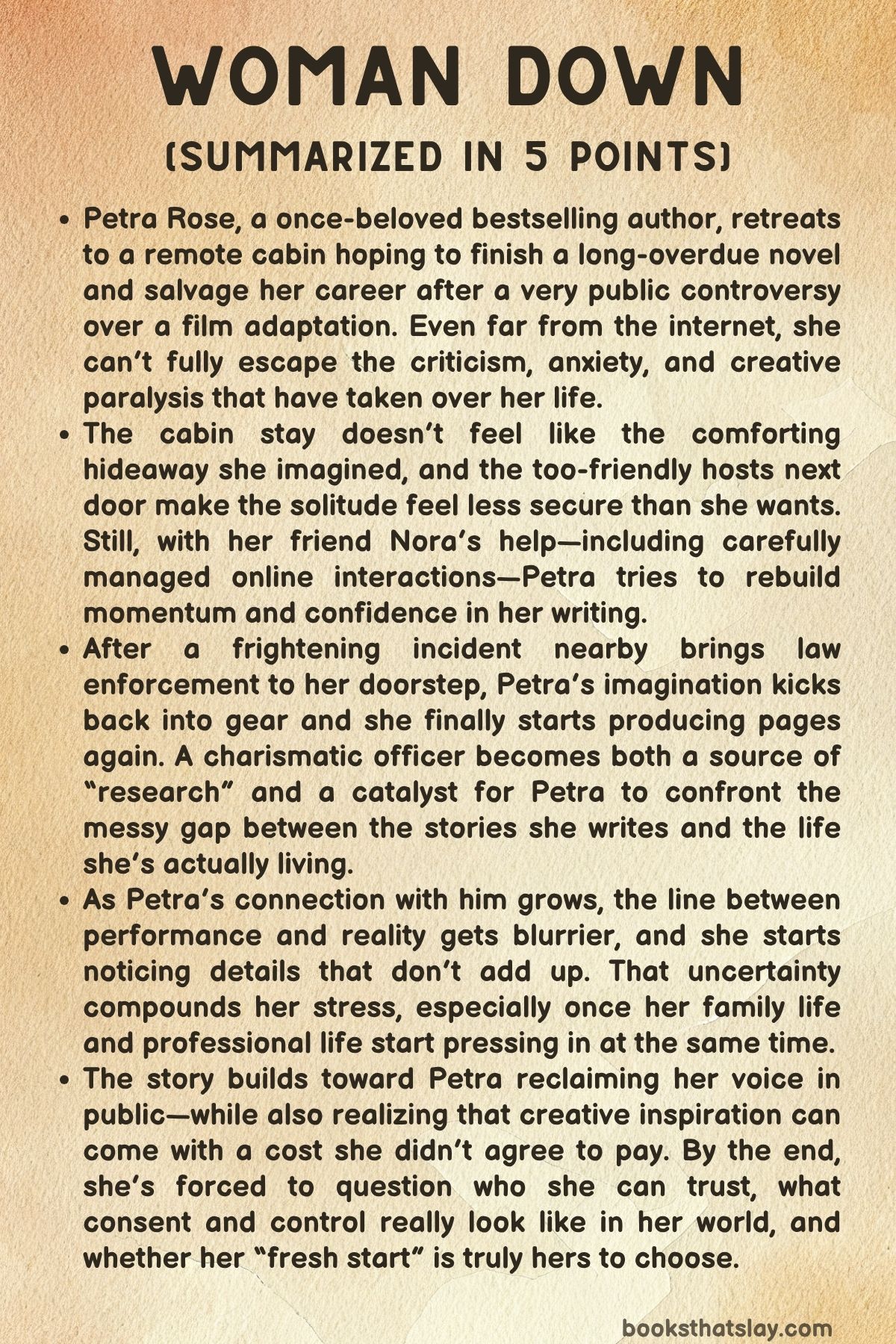
Summary
Petra Rose drives to a secluded rental cabin hoping isolation will fix what she can’t. Her name has become a punchline online after the movie version of her most famous romance removed a major love-triangle character, and a leaked text proves she knew and approved.
The backlash is relentless: readers boycott her, colleagues avoid her, and her confidence collapses. Petra tells herself she’ll recover by doing the only thing she still knows how to do—write—but she arrives with eighteen months of stalled pages and a deadline that feels like a threat.
On the way in, Petra listens to a podcast that mocks her downfall and features the producer who oversaw the adaptation. The sound of his voice makes her pull over, shaking and nauseated, as if her body remembers humiliation more clearly than her mind can explain.
Her best friend Nora calls and scolds her for feeding herself more public cruelty. Nora pushes Petra toward therapy and away from social media, but Petra refuses to apologize publicly.
She insists she’ll answer everything through her next book.
The cabin is not the warm retreat Petra pictured. It’s modern, bright, and sterile, more like a showroom than a refuge.
The host, Louie Longsetter, greets her with too much cheer and too many questions. He recognizes her immediately and brings up the missing character from the movie, then pitches his own life story as if Petra should be grateful for the material.
Petra feels cornered, grips the mace on her keys, and works to get him to leave. Later, his wife Marigold—Mari—arrives with brownies and an avalanche of chatter about her acting gigs and the cabin remodel.
Petra plays polite while craving privacy, but Mari acts as if they are already friends.
Petra can’t write. Every attempt sounds wrong to her.
She begins drafting a scene about a woman named Reya being questioned by a detective after a disappearance, but self-doubt snaps her out of it. At night she sees a figure near the lake and fears an intruder, only to realize it’s Louie fussing with an animal trap.
The setting that was supposed to calm her becomes another place where she feels watched.
Nora suggests an approach Petra used to love: going live inside Petra’s private reader group. Petra hates the idea, convinced someone will leak clips and turn her into content again, but Nora offers to manage the comments and steer the conversation.
During the livestream, Petra admits she has barely written anything in over a year. She explains the real problem isn’t lack of ideas—it’s fear of finishing.
A completed book means publicity, questions, and exposure. Readers ask about love triangles, and Petra can’t ignore what her past taught her: the crowd can turn overnight.
She confesses she worries she can’t convincingly write experiences she hasn’t had. Nora argues that imagination is part of the job, and for a moment Petra feels less trapped.
Then something happens that changes the rhythm of her days. Before dawn, flashing lights hit the cabin windows.
A police officer knocks and introduces himself as Nathaniel Saint. He claims there was a pursuit on the dead-end road and a man killed himself nearby after fleeing.
Petra is shaken by the idea of a death so close to where she sleeps. Saint tells her to be careful, to make it look like she isn’t alone, and even suggests wearing a wedding ring in town.
Before he leaves, he gives her a card with his number and offers extra patrol drive-bys.
When Petra sits at her laptop afterward, her mind finally clicks into motion. Saint becomes a living template for the detective in her book.
She writes for hours, pouring out thousands of words like her hands have been waiting for permission. The next morning she calls Nora, thrilled and buzzing with the rush of productivity, and admits she’s also distracted by how attractive Saint is.
Petra reaches out to Saint under the excuse that police might still need a statement, and he replies fast, offering to stop by. When he arrives, he’s dressed casually and flirts as if he already belongs in her space.
He admits he looked her up online and teases her about her public spiral. Petra explains she writes romantic suspense and is building a plot around a married cop and a witness.
Saint’s questions shift from research to intimacy. He asks if Petra has ever been kissed by a married man.
When his phone buzzes and he says it’s his wife, Petra tells him to answer it. Instead, he tosses the phone aside and kisses her.
Then he abruptly leaves, as if a switch flips, leaving Petra stunned and guilty—and also newly alive on the page.
Mari keeps showing up, prying and joking, and Petra accidentally admits she kissed Saint. Mari reacts with delighted approval and urges Petra not to waste regret.
Petra uses the tension to write more, but she is also caught in a loop: craving Saint’s attention, hating herself for it, and wanting to turn it into material so it feels less like a mistake.
Saint returns again, this time in uniform, and their dynamic becomes a form of roleplay. He calls her Reya, she calls him Cam, and the line between “for the book” and “for real” keeps thinning.
Their encounters escalate. Petra is both attracted and unsettled by how easily Saint shifts between tenderness and control.
After one intense moment goes wrong, Petra breaks down crying in the shower. Saint holds her, apologizes, and agrees to stop assuming what she wants.
Petra insists they drop the characters and be themselves, craving something steady. He behaves carefully for a while, asking permission, slowing down, trying to reassure her.
Petra feels exposed but also relieved by the attention, and she clings to the idea that this experience is giving her access to emotions she can finally write from.
When Saint leaves later, Petra does something that surprises even her: she follows him in her car. He pulls over and confronts her, warning her to stop digging into his life.
Petra admits she wanted to know where he goes, who his wife is, whether he’s happy. Saint tells her she’s crossing a line.
He says he thought they had an agreement—no questions, no consequences. Petra panics at the idea of losing him and says she doesn’t want to stop.
The exchange turns sexual again, right there on the roadside, and Saint warns her that if she keeps searching for answers, she won’t like what she finds.
Petra writes hard for days, feeding off fear and desire. Then her real life collides with the fantasy.
Her husband Shephard arrives unexpectedly with their daughters. Petra is hit by a wave of guilt so sharp it feels like vertigo.
She has been acting as if she isn’t a wife and mother, as if this cabin version of her is separate. She hurriedly texts Saint not to come over.
That evening, Saint shows up anyway in full uniform. Shephard assumes he is a real cop, and Petra, trapped, plays along.
Saint invents a visitor-tag excuse and leaves after telling them to have a lovely night in a tone that makes Petra’s stomach drop. Later, Petra calls him, furious and scared.
Saint throws her hypocrisy back at her: she is married too. He asks if she’s going to sleep with her husband.
Petra refuses to end things, and Saint asks for a disturbing favor—during sex with Shephard, Petra should get on top and imagine Saint instead.
Petra does it. While Shephard is with her, Petra looks up and sees Saint standing outside the bedroom window, watching.
Terror and arousal crash together. Petra forces herself to keep moving so Shephard won’t notice.
Saint signals her to continue. Petra finishes while Saint watches, then collapses, shaken by how far the situation has gone and how little control she seems to have.
Rain and paranoia drive Petra to Mari for answers. In town, Louie acted like the police chase never happened, and nothing appeared in the news.
Petra demands to know if Saint is real. Mari’s fear gives her away.
Under pressure, Mari admits the truth: Saint paid her to lie. The “police” scene was staged with fake lights, and there was no body.
Mari says she confronted Saint that night and threatened to call real police, but he convinced her it was harmless and implied Petra wanted it as creative motivation. Mari took the money and kept quiet, later assuming Petra was fine because Petra continued letting Saint into the cabin.
Petra races back and investigates. Searching the name “Nathaniel Saint” produces nothing credible.
She uses a photo and paid searches until she finds a match: Eric Merrell Kingston, a screenwriter based in Los Angeles. The phone number matches.
The lie is real.
Before Petra can escape, Saint is inside the cabin, already seeing her screen. He corners her, frames everything as consensual “role-play,” and claims he chose the cop identity after hearing Petra talk online about wanting to feel what she writes.
He admits he watched her livestreams from the beginning. He also admits he has no wife.
Petra tries to call for help, and he overpowers her long enough to make the danger unmistakable. When he loosens his grip, Petra grabs her things and bolts into the storm, fleeing before he can stop her.
She calls Shephard and lies that she’s sick and coming home early, desperate to get back to the safety of ordinary life.
Months pass. Petra finishes a new novel titled Woman Down.
Shephard reads it and praises how real it feels. Petra hides the truth in plain sight, even dedicating the book to “Saint” and claiming it’s a harmless reference.
On release day, Petra does a public event with Nora and answers questions about her old adaptation scandal with more honesty than before. Then she sees Saint in the crowd.
He talks as if they share a private joke, as if he belongs to her success.
At the signing, Saint asks for the book to be personalized to “Saint.” Petra writes “Eric” instead and adds a message making clear he is a stranger. Outside, she confronts him and Nora together.
Nora admits Eric is someone she knew online from college. She explains that after Petra’s livestream, she and Eric joked about him showing up in a uniform to jolt Petra out of writer’s block.
Nora claims she meant it as a brief, silly idea and had no clue the deception continued or escalated. Saint minimizes everything, pretending he only stopped by once.
Petra recognizes the pattern: he takes what people hand him and stretches it until it serves him.
Petra tells him to leave her alone forever. He says he would do it again.
She says she wouldn’t. That night, Petra reads reviews and spirals, trying to convince herself the story is finished.
Then an email arrives confirming a cabin booking made in her name for twenty-one days, prepaid. She didn’t reserve it.
Another message follows from an unknown address: it’s time to work on the next book. Petra realizes the danger isn’t only what happened before—it’s that someone still believes he has a role in whatever she writes next.
Characters
Petra Rose
Petra is the emotional and narrative center of Woman Down—a bestselling author whose public humiliation has metastasized into private collapse. The adaptation scandal doesn’t only damage her career; it rewires her sense of safety, making ordinary exposure feel like threat and turning creativity into a trap: finishing a book means returning to interviews, scrutiny, and the internet’s appetite for punishment.
Her writer’s block is not a lack of ideas but a fear response, and the cabin becomes a pressure cooker where shame, isolation, and survival instincts all compete. Petra’s contradictions are the point: she’s defensive and proud enough to refuse an apology, yet deeply insecure and desperate for absolution; she’s perceptive enough to read danger cues, yet lonely enough to override them; she knows she’s crossing lines, yet rationalizes those choices as “research” and “material.” What makes her compelling is how she uses story as both shield and scalpel—rewriting reality to regain control, even while real people manipulate her through the very fantasies she sells.
Nora
Nora functions as Petra’s lifeline, manager, and moral counterweight, but she also embodies the risk of intimacy in a digital world. On the surface she is the grounded friend pushing Petra toward coping skills, therapy, and practical career triage, and she’s the one person who can coax Petra back into public-facing action through the reader-group livestream.
Nora’s humor and assertiveness are protective tools, creating a buffer between Petra and the mob while also giving Petra permission to exist without constant self-censorship. Yet Nora is not simply “the good friend”—her casual online connection to Eric becomes the story’s most painful betrayal, not because she intends harm, but because she underestimates how easily joking “inspiration” becomes real-world violation when mixed with obsession, access, and Petra’s vulnerability.
Nora represents the modern dilemma of blurred boundaries: friendship, audience, and internet acquaintances overlap until accountability becomes slippery, and Petra pays the price for that ambiguity.
Eric Merrell Kingston (Nathaniel Saint)
Eric is the novel’s most destabilizing presence because he weaponizes Petra’s own language—story, roleplay, research, romance tropes—against her. His “Detective Nathaniel Saint” persona is crafted to slip past Petra’s defenses: authoritative, protective, competent, and sexually charged, offering both safety and danger in the exact proportions her genre promises.
What’s chilling is how he frames coercion as collaboration; he repeatedly recasts his deception as something Petra wanted, something she invited through her livestream confession that she wished she could experience what she writes. This is not just catfishing—it’s predation dressed as fandom and creativity.
Eric’s control tactics escalate from staged police lights to engineered intimacy, to surveillance, to intimidation, to rewriting the record in front of other people so Petra sounds unstable if she objects. Even his later public reappearance functions like a claim: he wants authorship over her inspiration and a place inside her narrative.
He is frightening not because he’s chaotic, but because he’s deliberate—someone who understands that a writer’s imagination can be a point of entry.
Shephard
Shephard is written as both an anchor to Petra’s real life and a mirror that reflects how far she has drifted from it. His arrival at the cabin shatters Petra’s compartmentalization, forcing her to see herself not as a solitary, wronged artist but as a spouse and parent actively lying and disappearing into a fantasy.
He carries practical pressures—finances, deadlines, the strain of a stalled career—and those pressures sometimes come out as impatience or frustration, but he is also capable of softness and pride, especially when he reads the finished novel and celebrates her work. The tragedy in Shephard’s role is his unknowing proximity to danger and betrayal: he interprets “Saint” as a cop doing a routine check, he trusts Petra’s explanations, and he is physically present during the most violating boundary-crossing moment of the story without realizing it.
Shephard represents normalcy and the stakes of Petra’s choices—what she risks losing, and what she already endangers through secrecy.
Marigold “Mari” Longsetter
Mari is a performance of friendliness with a volatile underside: flamboyant, intrusive, and hungry for proximity to drama. Her chatter and showbiz anecdotes make her seem harmless comic relief at first, but her need for excitement becomes morally consequential when she accepts money to support Eric’s deception.
Mari rationalizes her complicity as harmless, even helpful—telling herself she’s protecting Petra by “keeping an eye” on things—yet her actions expose Petra to a stranger’s staged authority at her most isolated moment. Mari also serves as a social pressure valve; she normalizes Petra’s transgression with amused approval, encouraging “no regrets” and treating moral boundaries like plot points.
When the truth comes out, Mari’s fear and evasiveness reveal that beneath the theatrics she understands exactly how bad it looks. She is a portrait of complicity that doesn’t come from malice so much as self-interest, thrill-seeking, and the belief that other people’s lives are entertainment.
Louie Longsetter
Louie is initially framed through Petra’s hypervigilant perspective as a potential threat: a too-cheerful stranger in a remote setting, physically handling her belongings, lingering on her porch, and pushing for connection. His pushiness is real—he oversteps, assumes familiarity, and treats Petra like a story vending machine—but his deeper function is to show how Petra’s fear has become indiscriminate.
In a life shaped by online mobs and sudden public hatred, every interaction feels like a trap, and Louie becomes the everyday face of that: the neighbor who won’t stop talking, the man who knows who she is, the reminder that anonymity is gone. Later, when conflict erupts about “the police chase,” Louie’s anger is less about justice than liability and income—he doesn’t want lawsuits, he wants his rental business protected.
Louie’s self-protectiveness contrasts with Petra’s emotional unraveling; where Petra internalizes shame, Louie externalizes risk and tries to manage it through denial and control.
Kellie
As a podcast host dissecting Petra’s downfall, Kellie embodies the cultural machinery that turns personal failure into consumable spectacle. Her tone—gleeful, judgmental, entertained—matters as much as the facts, because Petra experiences Kellie’s voice as a trigger that can induce panic and nausea.
Kellie’s role isn’t to be nuanced; it’s to represent how commentary ecosystems flatten context and reward cruelty with attention. By existing largely through Petra’s reaction, Kellie becomes less a fully realized person and more a symbol of the “public” Petra can’t escape: the person who profits from your worst moment while insisting it’s accountability.
Micah
Micah complements Kellie as part of the same narrative engine: the co-host who helps frame Petra’s scandal as ongoing content rather than a human crisis. Together with Kellie, Micah reflects how “fandom” can become punitive and how hosts can posture as moral referees while feeding audience outrage.
His presence reinforces Petra’s isolation—people she has never met can have loud, confident opinions about her character, her intentions, and what she deserves, and their certainty becomes a force that shapes her mental health and career reality.
Allister Jones
Allister is the industry gatekeeper figure who catalyzes Petra’s collapse and later echoes through her fear response. He represents professional power with a personal edge: a producer who humiliates Petra in meetings, leverages criticism to destabilize her confidence, and then becomes the voice associated with betrayal when the text exchange leaks.
Even when he isn’t physically present, Allister’s influence is structural—he is the proof that Petra’s loss of control wasn’t only artistic but political, and that the entertainment machine can turn an author into a disposable brand. Petra’s panic at hearing him suggests trauma tied not just to public backlash, but to feeling cornered and coerced in spaces where she was supposed to have agency.
Don William Puttman
Puttman is a small but pivotal figure because his “suicide after a pursuit” is the spark that restarts Petra’s writing, demonstrating how strongly she converts fear into fuel. Whether or not he is real in the way Petra is told, the idea of him functions as a narrative catalyst: a death near her cabin transforms the setting from sterile and uninspiring into charged and story-ready.
In that sense, Puttman is less a character than a device that exposes Petra’s creative mechanism—she writes best when adrenaline and threat make her feel something sharp enough to cut through numbness.
Chloe
Chloe’s role is brief but loaded: she is the child’s-eye interruption that collapses Petra’s fantasy of being alone, unobserved, and unaccountable. When Chloe appears at the cabin window, Petra’s guilt spikes because she can no longer pretend her choices exist in a vacuum.
Chloe represents innocence and consequence at the same time—proof that Petra’s secrecy isn’t only self-destructive but potentially destabilizing to the people who depend on her.
Petra and Shephard’s daughters
The daughters intensify the story’s moral pressure without being individualized in detail, serving as living reminders of Petra’s identity outside authorship and scandal. Their presence forces domestic normalcy into a space Petra has turned into an escape hatch, and that collision heightens Petra’s internal split: she can be affectionate and present in small moments, yet still be actively managing lies and fear in the background.
They function as stakes rather than plot actors—what Petra risks fracturing if her double life, trauma, and obsession keep escalating.
Elise, Ash, and Caleb
As the central trio from Petra’s adapted romance, these characters exist in the story as cultural objects: fans fought over them, studios reshaped them, and Petra’s perceived betrayal of Caleb becomes the symbol that fuels online punishment. Caleb, specifically, represents what Petra believes she failed to defend—both an artistic choice and a stand-in for her own self-worth.
The backlash about cutting him becomes a shorthand for larger accusations: that Petra is dishonest, cowardly, or complicit. In that way, Elise, Ash, and Caleb are less about their fictional personalities and more about how fiction can become a public courtroom where authors are tried.
Reya, Cam, and Sarah
These are Petra’s in-progress creations, but they also act like psychological projections. Reya holds Petra’s fear of exposure and judgment; Cam, especially once modeled on “Saint,” becomes a vessel for Petra’s conflicted desires—protection, danger, dominance, tenderness, and the thrill of secrecy.
Sarah’s disappearance sets the suspense frame that mirrors Petra’s own sense of vanishing from her former life, swallowed by scandal and isolation. As Petra’s real experiences intensify, the boundary between invention and confession blurs, and the book she writes becomes both therapy and evidence—an attempt to turn violation into art before it turns her into a victim without a voice.
Themes
Public punishment and the fragility of reputation
Petra’s life is reorganized by a version of justice that happens in comment sections rather than courtrooms. A single leaked text becomes proof of character, and the reaction scales faster than any explanation she could offer.
What makes the backlash feel so suffocating is not only the anger, but the certainty: strangers treat a partial record as a complete biography, and Petra’s motives are rewritten by people who have never met her. The boycott videos, the book burnings, the hashtags, and the opportunistic podcast recaps turn her into a public object that others can use for entertainment, moral signaling, or community bonding.
The story shows how this kind of outrage rarely stays aimed at the original decision; it expands into an all-purpose permission slip to dehumanize someone. Petra’s isolation isn’t just emotional.
It is structural: colleagues keep their distance to protect their own careers, sales collapse, and her livelihood becomes dependent on producing a new success while she is least capable of doing so.
The psychological cost is portrayed as constant exposure without relief. Even the cabin, chosen as a hiding place, can’t protect her because recognition follows her there.
Petra’s panic response to Allister’s voice is telling: her body reacts before her arguments can. She repeats a mantra about having done nothing wrong, yet her inability to believe it reveals the deeper wound—she has absorbed the crowd’s judgment as if it were her own.
The pressure to apologize is complicated by her fear that any statement becomes more fuel for scrutiny, and by a stubborn instinct to reclaim power through writing instead of public contrition. That conflict keeps her trapped between silence and spectacle, neither of which restores dignity.
In Woman Down, reputation isn’t a stable reflection of who Petra is; it’s a volatile commodity traded by strangers, and it can be destroyed even when the person at the center is trying to survive rather than win.
Control, authorship, and the way stories get taken from their makers
Petra’s crisis begins with a story that stops belonging to her. The adaptation doesn’t simply change plot elements; it changes what the public thinks her original work meant, and it collapses the line between the author and the product.
By removing a central character from the triangle and reshaping the narrative around a simpler pairing, the film transforms what readers loved into something else, and Petra is blamed as if she personally rewrote everyone’s memories. The twist is that Petra’s position is not purely victimhood.
She first claims she had no control, then evidence shows she knew and agreed. That contradiction is central to the theme: control in creative industries is rarely absolute.
It is negotiated under pressure, shaped by humiliation, insecurity, and power imbalances that can make surrender feel like the only way to stay in the room. Allister’s tactic of reading negative comments aloud is a form of coercion dressed up as “feedback.” It trains Petra to doubt her own instincts until she can be led into endorsing changes she’ll later hate.
The cabin’s interior reinforces this theme in a quieter, physical way. Petra arrives expecting a space that supports imagination and finds a sterile remodel that feels like someone else’s taste imposed on her refuge.
Even the setting reflects how her creative life has been remodeled by outside priorities: sleek, marketable, and empty of warmth. Against that, Petra clings to writing as the last territory where she can decide what happens.
Her refusal to post an apology and her vow to “get revenge” by writing is not just pride; it’s an attempt to reclaim authorship over her identity. Yet the story also questions whether writing is truly hers alone.
Livestreams turn the drafting process into performance. Reader questions steer her choices.
Fear of backlash shapes what she dares to write. When Petra worries she can’t write convincingly about what she hasn’t lived, that anxiety signals a shift from imagination to credentialing, as if art now requires proof of experience to be legitimate.
Authorship becomes a contested space: producers, audiences, friends, and even predators all try to steer the narrative, and Petra’s struggle is to keep her voice from becoming just another editable component.
Consent, coercion, and the danger of confusing desire with permission
The sexual plotline is built around a steady erosion of clear consent, and the book refuses to treat that erosion as romantic just because Petra sometimes wants what is happening. Saint enters Petra’s life using authority as costume: a badge, patrol language, warnings about safety, and the implied protection of law enforcement.
That performance is not harmless roleplay; it is a tool that pressures Petra into trusting him before he has earned trust. Their relationship begins with him testing boundaries—intimate questions, a kiss that happens while his “wife” calls, exits that leave Petra disoriented—and then escalates into scenarios where Petra feels both pulled in and unsettled.
The dynamic becomes especially complicated because Petra is hungry for anything that restarts her creativity. Saint senses that hunger and offers himself as “research,” framing intimacy as professional necessity while satisfying his own appetite for control.
A key moment occurs when Petra states a boundary: he must only do things she explicitly asks, not assume. That line is simple, but it exposes how much of what came before relied on his assumptions and her confusion.
His apology and careful actions afterward show that he understands the rules; the question is why those rules weren’t respected from the start. The later roadside confrontation makes the manipulation plain.
He uses moral reversal—“you asked me to”—to shift responsibility onto Petra, then pairs the lecture with sexual stimulation to keep her compliant. It’s a pattern: discomfort is followed by intensity, and intensity becomes a shortcut around reflection.
Petra’s fear of losing him becomes leverage. Even when she feels guilt or suspicion, she clings to the arrangement because it gives her momentum and because it offers a private world where she temporarily escapes public contempt.
The most chilling violation is the window scene, when Saint watches Petra have sex with her husband. There is no consent there, only forced performance under threat of discovery.
Petra’s body reacts with terror and arousal at once, and the story treats that mixture as a psychological reality rather than a moral endorsement. Desire does not erase harm; arousal does not equal agreement.
Sex is not simply about pleasure or romance here. It becomes a language of power, a way to rewrite responsibility, and a test of whether Petra can recognize that being an active participant in moments of intimacy does not make her responsible for the deception and surveillance that enabled those moments.
Obsession, surveillance, and the collapse of boundaries in parasocial relationships
Petra’s world is filled with people who feel entitled to her: fans who demand apologies, podcast hosts who profit from her humiliation, neighbors who insert themselves into her solitude, and a man who watches her online until he decides he can step into her life. Saint’s deception is not spontaneous; it is planned, researched, and fed by Petra’s visibility.
He follows her livestreams, learns her fears and fantasies, and uses that information to design a persona that will work on her. The fake police lights, the staged “pursuit,” and Mari’s paid cooperation demonstrate how easily reality can be manufactured when someone is isolated and already anxious.
Petra is not only lied to; her environment is edited so that she will interpret danger and safety exactly the way Saint wants. That is surveillance with a creative director’s mindset, treating Petra as both audience and target.
What makes the theme especially unsettling is how many small boundary violations are normalized before the major ones arrive. Louie waits on the porch, handles her luggage, and fishes for admiration.
Mari barges in, talks over Petra’s discomfort, and later admits she accepted money to keep quiet about a stranger staging an incident near Petra’s cabin. Nora insists on livestreams despite Petra’s fear, filters the audience but still brings the audience into Petra’s most vulnerable workspace.
None of these choices are identical to Saint’s predation, but they share a common assumption: Petra’s privacy is negotiable, and her discomfort is less important than someone else’s curiosity, excitement, or content. Petra becomes a resource.
The later reveal about Nora’s connection to Eric deepens the theme by showing how obsession can travel through trusted relationships. A joke between online friends becomes a real-life intrusion, and Nora’s casual attitude toward the idea highlights how internet culture can blur the seriousness of impersonation and stalking when it is packaged as “inspiration.” Eric’s final messages and the forged cabin reservation confirm that the danger is not only what happened, but what can keep happening.
His confidence—his belief that he can schedule Petra’s life, steer her next book, and insert himself into her future—shows an obsessive mindset that treats another person’s autonomy as an obstacle to manage.
The threat is not limited to one villain. It is a broader ecosystem where attention becomes access, and access becomes entitlement.
The story argues that when private life is repeatedly converted into public material—by fans, friends, strangers, and predators—boundaries don’t just get crossed; they get rewritten until the victim is pressured to doubt whether they ever had the right to set them.