All the Glimmering Stars Summary, Characters and Themes
All the Glimmering Stars by Mark Sullivan is a historical novel based on the long terror of the Lord’s Resistance Army in Uganda and Sudan. At its center are Anthony Opoka and Florence Okori, two children taken from ordinary village lives and forced into a world of fear, violence, obedience, and loss.
The book follows how they survive years inside Joseph Kony’s army, how they protect what remains of their humanity, and how love becomes a force of endurance. It is a story about captivity, guilt, faith, family, forgiveness, and the difficult return to life after war.
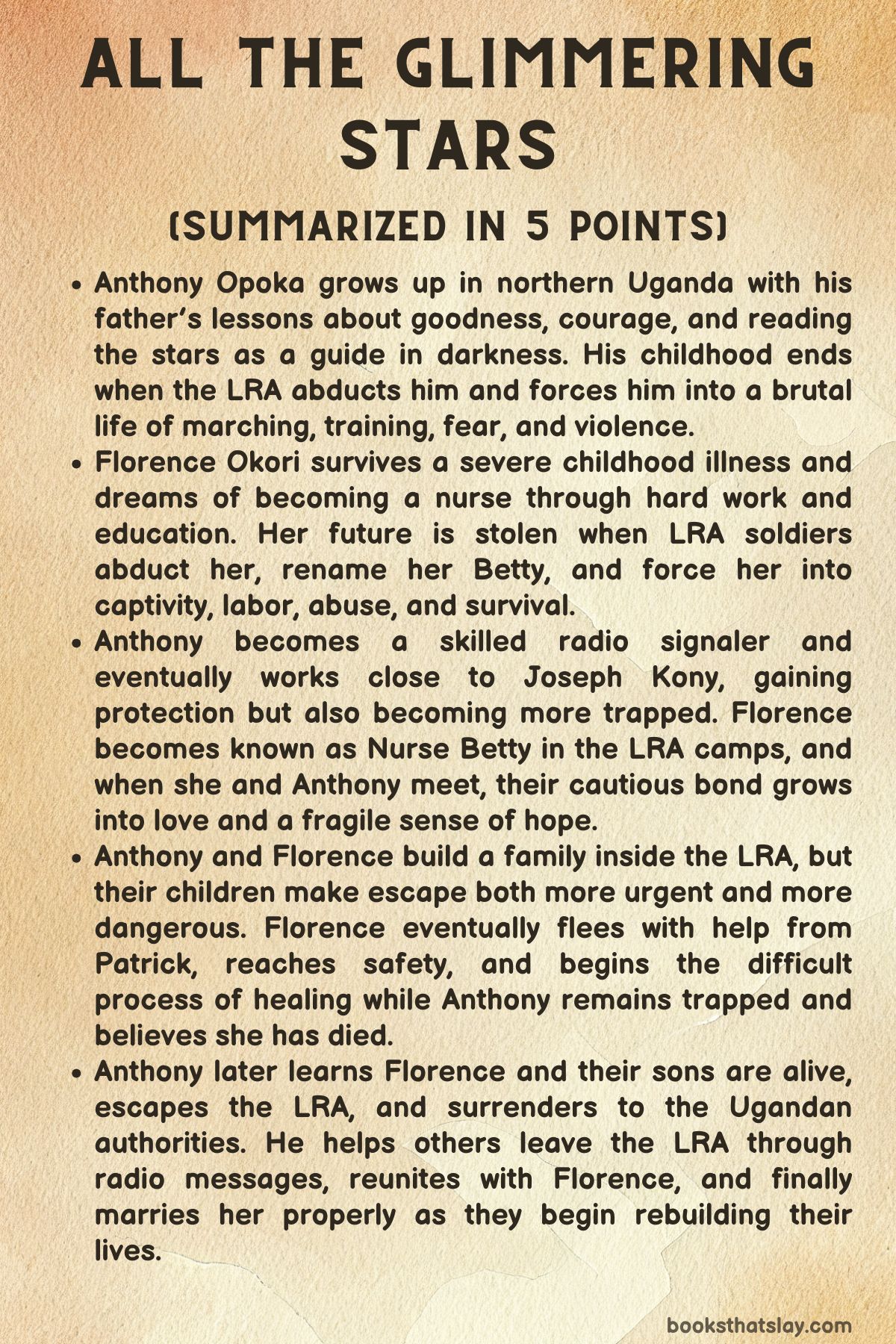
Summary
Anthony Opoka grows up in northern Uganda under the care of his father, George, a man who teaches him to read the stars and to measure every choice by one question: what would a good human do? Anthony’s childhood is shaped by family, school, running races, and the growing fear of the Lord’s Resistance Army.
His father warns him never to become a soldier because soldiers hold power over others, and that power can corrupt the soul. Anthony listens, but the war soon comes for him.
Florence Okori grows up in another Ugandan village. As a young child, she nearly dies of malaria, but her mother, Josca, carries her home from the hospital and keeps faith in her recovery.
Florence survives, returns to school, and becomes a gifted student. She dreams of becoming a nurse, inspired by both her own illness and her father’s knowledge of healing plants.
Her life is full of family, work, hope, and ambition, but the same conflict that surrounds Anthony’s village slowly reaches hers too.
Anthony is abducted by the LRA as a boy after stepping forward to protect his younger brother. He is marched into the bush with other children, starved, beaten, and taught that escape is impossible.
The LRA breaks the children’s will through cruelty, including forcing them to take part in acts that make them believe they can never return home. Anthony carries guilt and terror, but he also clings to his father’s lessons and to his knowledge of the stars.
Inside the LRA, Anthony meets Patrick, a boy from his past who had earlier been abducted. Patrick warns him how to survive.
Anthony is taken to see Joseph Kony, who presents himself as a man guided by spirits and divine authority. Many children are drawn into the belief that Kony can protect them, but Anthony’s belief is unstable.
He wants to live, and survival often requires obedience. After his first battle, he is praised as a soldier, and that praise confuses him.
He knows his father would hate what he has become, yet part of him feels pride because the army has made him important.
Anthony is injured in battle and later trained as a radio signaler. His intelligence and calm make him valuable, and he eventually becomes Kony’s personal radioman.
This role gives him status, protection, and access to the highest levels of the LRA, but it also traps him more deeply. He hears orders, sends messages, and witnesses the system that keeps thousands of abducted children under control.
Along the way, a wounded shopkeeper named Mabior teaches him that suffering often speaks through inner voices of fear, violence, lack, and restless urgency. Anthony uses this lesson to keep himself from being consumed by despair.
Years after Anthony’s abduction, Florence is taken by LRA soldiers. She is forced to march with other captives, suffers severe beatings, and sees death around her.
She lies about her name, calling herself Betty, and gradually becomes known by that name in the camp. Florence is assigned to commanders, forced into sexual slavery, and later works in field hospitals, where her intelligence and care earn her the name Nurse Betty.
Her dream of nursing survives in a brutal form, as she tends to wounded soldiers while still longing for freedom.
Anthony and Florence meet when Anthony is recovering from another battle injury. He sees her working at the hospital and is drawn to her strength and beauty.
Florence is cautious, knowing that choosing a husband inside the LRA is still a choice made under threat. Yet Anthony treats her with respect and promises not to force himself on her.
Slowly, they trust each other. They share memories of home, admit their hatred of Kony, and form a bond that becomes their safest place inside the war.
Their marriage begins under LRA control, but their love becomes real. Florence gives birth to their son Kenneth, and later becomes pregnant again.
Anthony wants to escape with her once they return to Uganda, but Kony refuses to let Florence leave because Anthony is too valuable and knows too much. Florence is eventually separated from him with their children.
During a dangerous river crossing under attack, she gives birth to their second son, Boniface, named after a young boy who helps her and is soon killed.
Florence’s desire to escape grows stronger after she sees how easily children die in the LRA. She tells Anthony that if they stay, their sons will not survive childhood.
Anthony agrees but cannot run immediately without endangering them all. Patrick later helps Florence escape with Kenneth and Boniface during a chaotic confrontation between LRA forces and Ugandan soldiers.
To protect Anthony, Patrick lies and says Florence and the boys were killed. Anthony is shattered, believing his family is dead, but he continues to survive.
Florence reaches safety and receives help from World Vision. She reunites with other women who escaped the LRA, including Palmer, and begins therapy.
Civilian life is difficult, not only because of trauma but because former captives are often viewed with suspicion. Her parents love her, but they struggle with her marriage to Anthony and the children born from that life.
Florence works to free herself from Kony’s psychological hold. In her mind, she chooses to forgive him, not to excuse him, but to remove his power over her.
Anthony eventually learns from Patrick that Florence and the boys are alive. This news renews his will to escape.
He hears Florence speak to him over a radio program, urging him to come home. Still under watch, he plans carefully.
He weakens his guard, joins a raid, and slips away into the forest. Bacia, the brutal soldier connected to his mother’s death, tracks him, but a leopard attacks Bacia before he can capture Anthony.
Anthony continues toward home, guided by the stars and the landmarks his father taught him.
When Anthony surrenders to Ugandan soldiers, he fears punishment for everything he was forced or ordered to do. He tells the truth about his years in the LRA and is offered a choice between prison and working with the Ugandan Army.
He chooses to help translate intercepted LRA messages rather than fight. His radio appeals encourage many other captives to escape.
At last, Anthony reunites with Florence and their sons. Their return is not simple.
Florence’s family is wary, and Anthony must prove his commitment through a proper marriage process. He works, pays the dowry, and in 2008 he and Florence marry in a church before family and friends.
Their wedding becomes not only a celebration of love but also a public act of survival. Florence speaks of how Anthony’s love helped her endure and how forgiveness gave her room to live again.
Patrick appears at the wedding after escaping the LRA himself, and the couple thanks him for saving Florence and the boys.
All the Glimmering Stars ends with Anthony and Florence surrounded by family, friendship, and the possibility of peace after years of captivity. Their story does not erase the horror they endured, but it shows how memory, love, courage, and moral choice can help people rebuild a life from what war tried to destroy.
Characters
Anthony Opoka
Anthony Opoka is the emotional and moral center of All the Glimmering Stars. He begins as a bright, athletic, observant boy whose father teaches him to navigate by the stars and to judge his actions by asking what a good human would do.
That lesson becomes the core of his identity, even after the LRA abducts him and forces him into violence. Anthony’s story is not a simple movement from innocence to corruption; it is a long struggle to hold on to some part of himself while being trained to obey, kill, survive, and fear return.
His guilt over what he is forced to do becomes one of his deepest wounds. Yet he remains capable of tenderness, intelligence, restraint, and love.
His work as a signaler gives him status and relative safety, but it also places him close to Kony’s command structure, making him both useful and trapped. His relationship with Florence restores his belief that life can still contain goodness.
By the end, Anthony’s escape and decision to help others leave the LRA show that he has not become what the army tried to make him. He carries trauma, shame, and memory, but his defining quality remains his desire to be good in a world designed to punish goodness.
Florence Okori
Florence Okori is marked by endurance, intelligence, and a fierce instinct to protect life. As a child, she survives malaria through her mother’s devotion, and that early experience shapes her dream of becoming a nurse.
She is hardworking, ambitious, and deeply aware of the value of care. When the LRA abducts her, she is forced into a system that tries to strip her of her name, body, choices, and future.
Yet Florence never becomes passive. Even when she must obey to survive, she watches, learns, adapts, and preserves her inner judgment.
Her identity as “Betty” is both a survival mask and a sign of how captivity fractures the self. Her time as a nurse inside the LRA lets her use her gifts, but under terrible conditions.
Her marriage to Anthony begins under coercive circumstances, yet it grows into a real partnership built on trust and shared hatred of Kony’s rule. Motherhood strengthens her resolve.
Florence’s escape is one of the clearest acts of courage in the novel because she runs not only for herself but for her children’s right to live outside fear. Her later forgiveness of Kony is not weakness or forgetfulness; it is a deliberate act of emotional release, allowing her to reclaim control over her own life.
Joseph Kony
Joseph Kony is the central force of terror in the story and the figure through whom the novel examines manipulation, belief, and absolute power. He presents himself as more than human, claiming spiritual authority and using ritual, fear, and superstition to control abducted children.
His power depends on performance: the blessed shea butter, the spirit voices, the rules, the punishments, and the promise of invincibility. To children who are starving, frightened, and cut off from home, these performances become a substitute for certainty.
Kony understands how to turn terror into loyalty and guilt into obedience. Yet the narrative also exposes his smallness, vanity, paranoia, and emotional weakness.
He is not shown as a mythical figure but as a man who hides behind myth. His grief after the death of his wives and children reveals that he is capable of human pain, but it does not redeem him.
Instead, it sharpens the horror of his character: he knows suffering and still inflicts it on thousands. In All the Glimmering Stars, Kony represents the corruption of faith, the abuse of charisma, and the way one man’s delusions can destroy entire generations.
Patrick
Patrick is one of the most complex supporting characters because he is both a product of the LRA’s brutality and a protector within it. Before his abduction, he is Anthony’s rival in running, and Anthony saves his life during a flood.
That early act becomes the moral debt that shapes Patrick’s later choices. Inside the LRA, Patrick has learned how to survive by appearing loyal, understanding the rules, and knowing when to stay silent.
At times, he seems fully absorbed into the army’s mindset, especially when he encourages Anthony to believe in Kony’s spiritual power. Yet he repeatedly protects Anthony, saves him after injuries, warns him of danger, and eventually helps Florence and her children escape.
Patrick’s character shows how survival can require compromise without completely erasing loyalty or conscience. He lies about Florence’s death to protect both her and Anthony, a painful deception that gives Anthony grief but also keeps hope alive.
His appearance at Anthony and Florence’s wedding closes his arc with quiet grace. He is not untouched by violence, but he proves that even someone deeply shaped by captivity can still choose sacrifice, friendship, and repair.
George Opoka
George Opoka is Anthony’s moral foundation. He teaches his son how to read the stars, but more importantly, he teaches him how to think about right and wrong.
His question about what a good human would do becomes Anthony’s inner compass throughout captivity. George is gentle but not weak; he values discipline, memory, family, and moral clarity.
His rejection of soldiering is not naïve pacifism but a deep understanding that weapons give people power over others, and that such power often destroys compassion. When Anthony disappears, George’s grief is heavy, but he continues to believe in his son’s essential goodness.
His reunion with Anthony is crucial because it gives Anthony what the LRA denied him: recognition as a son rather than a soldier. George’s love does not erase Anthony’s guilt, but it helps him understand that being forced into violence is not the same as freely choosing evil.
George stands for home, memory, and the possibility of moral return.
Acoko
Acoko, Anthony’s mother, is a more guarded and practical figure than George. Where George teaches Anthony about goodness and guidance, Acoko teaches him that the world also demands fear and survival.
Her view is not cruel; it comes from an understanding of danger. Her separation from George adds emotional strain to Anthony’s childhood, but her later return shows that love in the novel is often imperfect rather than idealized.
She knows George is a good man even when she cannot always love him easily. Her death from injuries caused by an LRA attack becomes one of Anthony’s deepest sources of grief and rage.
Through Acoko, the story shows that parents pass down different kinds of wisdom: George gives Anthony moral direction, while Acoko gives him an awareness of danger. Both become necessary for his survival.
Florence’s Mother, Josca
Josca is one of the strongest images of maternal love in the novel. Her decision to carry Florence home from the hospital, despite the child’s extreme weakness, defines her character.
She believes in love as an active force, not simply a feeling. For Florence, that memory becomes a source of strength years later when she is forced to march in pain and exhaustion.
Josca’s love is physical, practical, and persistent. She carries, feeds, tends, and waits.
After Florence escapes, Josca’s reaction to her daughter’s children is complicated by social stigma and pain, but she still receives them. This complexity makes her believable.
She loves Florence, but she also belongs to a community struggling to understand what LRA captivity did to women and children. Josca represents both the healing power of family and the difficulty of returning to a family changed by war.
Constantine Okori
Constantine, Florence’s father, is steady, traditional, and emotionally restrained. He teaches Florence about medicinal herbs, helping shape her desire to become a nurse.
His knowledge connects healing to land, family, and inherited wisdom. After Florence returns, his response to her and her children is not immediately warm in a simple way.
He carries hesitation and judgment, especially regarding Anthony and the circumstances of Florence’s marriage. Yet he does not reject her.
His demand for a proper dowry from Anthony reflects both cultural expectation and a father’s need to restore dignity to a relationship formed under captivity. Constantine’s character shows the tension between love and social order.
He wants to protect his daughter, but he also needs time to understand the life she was forced to live.
Jasper
Jasper, Florence’s cousin, is a quiet but important figure of shared suffering. Having already lost his parents, he enters Florence’s household as someone marked by grief before the LRA takes him too.
His abduction alongside Florence and Owen ties him to the same world of forced marching, violence, and survival. Later, his disability shows the lasting physical cost of the war.
Jasper’s presence after Florence’s return links her old family life to the trauma of captivity. He understands some of what she endured in a way her parents cannot fully understand.
His character represents the many young people whose lives are permanently altered, even when they survive.
Albert
Albert, Anthony’s younger brother, carries the pain of family separation inside the LRA. When Anthony sees him during captivity, they must hide their relationship to protect each other.
This forced denial of family is one of the LRA’s cruelest tactics, because it turns love into a danger. Albert’s later presence in signaler training briefly gives Anthony comfort, reminding him that some piece of home still exists inside the bush.
His eventual death near the end of the conflict adds another layer to Anthony’s losses. Albert represents the stolen childhoods of countless siblings who were taken, separated, and made to live as strangers in order to survive.
Charles
Charles is Anthony’s younger brother and the child Anthony saves by offering himself to the LRA soldiers. His role is brief but deeply important because Anthony’s abduction begins as an act of protection.
Anthony does not become a captive by accident; he chooses to step forward so Charles might live. Charles also shares George’s grief after Anthony and Albert are taken, and his belief that they must still be alive gives George a small measure of hope.
Charles represents the family Anthony sacrifices himself for, and the innocence he tries to shield from the violence that claims him instead.
Mabior
Mabior is a short-lived but powerful moral teacher in Anthony’s life. Wounded during an attack, he receives kindness from Anthony and responds by giving him a way to understand his inner suffering.
His idea of the four destructive voices gives Anthony language for emotions that might otherwise overwhelm him. Mabior does not offer easy comfort.
Instead, he teaches Anthony to recognize the mental patterns that keep pain alive: fear, violence, lack, and restless pressure. This lesson becomes one of Anthony’s main survival tools.
Mabior’s death makes the encounter feel almost sacred in Anthony’s memory. He appears briefly, but his influence lasts because he gives Anthony a method for preserving his mind when his body and freedom remain controlled by others.
Captain Oyet
Captain Oyet is morally mixed in a way that reflects the warped world of the LRA. He participates in abduction and control, yet he also shows Florence small acts of protection, such as giving her clothing and cutting captives free during attacks.
These moments do not make him good, but they complicate him. He is part of a violent system and benefits from its authority, but he is not without flashes of human recognition.
His death prevents him from developing further, but his presence shows how some LRA figures could be both captors and occasional protectors. The contradiction makes the atmosphere of captivity even more unstable, because victims cannot always predict whether a commander will harm or help them.
Okaya
Okaya represents the sexual exploitation built into the LRA’s command structure. His claim over Florence and Palmer shows how girls are distributed as property under the language of marriage.
He is old, entitled, and protected by rank. His use of wives and forced sex shows how the LRA’s violence extends beyond battle into domestic and intimate spaces.
Okaya’s character is not defined by inner conflict but by the system he embodies. Through him, the novel shows that captivity for girls includes specific forms of bodily control, humiliation, and forced dependency.
His death frees Florence from his direct authority, but it does not immediately free her from the larger structure that allowed him to possess her.
Mariama
Mariama, Okaya’s primary wife, is a painful example of how oppressed people can become enforcers of oppression. She manages Okaya’s household and helps bring Florence and Palmer into his control.
Her actions are harsh, but they are also shaped by her own position within a hierarchy where survival may depend on obedience to a powerful husband. Mariama is not presented as innocent, because she helps harm younger girls.
At the same time, she is not simply powerful either. She has authority only inside a narrow domestic prison created by male command.
Her character shows how systems of abuse reproduce themselves by forcing victims to police other victims.
Palmer
Palmer is Florence’s friend, fellow captive, and witness. Their relationship gives Florence emotional support in a world where trust is dangerous.
Palmer shares Florence’s suffering under Okaya, and their reunion after escape becomes one of the story’s moments of relief. She helps show the importance of community among survivors.
Florence’s recovery is not solitary; it happens through therapy, shared memory, and the presence of women who understand what words often cannot fully express. Palmer represents the bonds formed under pressure and the way survivors help each other reenter life after captivity.
Fatima
Fatima is Kony’s most important wife and a symbol of status within his inner circle. She appears as commanding, intimidating, and deeply tied to Kony’s authority.
Her position gives her power over other women and children, but that power remains dependent on Kony. Her death in the fire has a major effect on him, revealing the emotional attachments beneath his public image.
Fatima’s role is less about personal development and more about what she represents: the domestic side of Kony’s rule, the hierarchy among his wives, and the personal losses that briefly expose his human fragility without softening his crimes.
Tabuley
Brigade General Charles Tabuley is one of the main reasons Anthony survives his early captivity. He spares Anthony from execution and later protects him by assigning him roles that keep him useful.
Anthony feels gratitude toward him, especially when Tabuley provides scraps, shelter, and opportunity. Yet Tabuley remains a commander in a brutal army.
His kindness is conditional and tied to Anthony’s obedience. This makes him a complex figure: he is a savior in specific moments but also part of the machinery that destroys children.
Anthony’s dependence on him shows how captivity can twist gratitude, making a victim thankful to someone who still serves the system imprisoning him.
Bacia
Bacia is one of the novel’s clearest embodiments of cruelty. He kills children, tracks escapees, and becomes associated with the violence that destroys Anthony’s family.
Unlike characters who show contradictions, Bacia functions as a direct threat. His presence creates fear because he represents the LRA’s promise that no one can run and survive.
For Anthony, Bacia is not only a dangerous soldier but also a personal symbol of revenge, grief, and the temptation to kill in cold blood. His death by leopard is significant because Anthony does not have to become his executioner.
Nature removes Bacia, allowing Anthony to escape without surrendering the last part of himself that refuses murder as an act of revenge.
Vincent
Vincent, Kony’s second-in-command, represents the unstable politics inside the LRA leadership. He is powerful enough to influence decisions and practical enough to recognize when Kony is emotionally dangerous, especially after the fire.
His later attempt to negotiate surrender shows that even within the command structure, doubt exists. Yet his death at Kony’s hands reveals the cost of dissent.
Vincent’s character highlights the paranoia at the top of the LRA. No one is truly safe, not even senior commanders, because Kony’s authority depends on eliminating betrayal before it can become public resistance.
Yango
Yango introduces Anthony to the rules and dangers of life around Kony. As head of security, he represents the controlled atmosphere of the inner camp, where every movement and word matters.
His role shows that Kony’s power is not maintained by charisma alone but through constant surveillance, strict rules, and fear of punishment. Yango’s presence helps the reader understand how Anthony’s promotion brings danger as well as status.
Being close to Kony means being watched more closely, expected to perform perfectly, and punished severely for mistakes.
General Bunyi
General Bunyi is part of the later LRA command structure that monitors Anthony when his loyalty is questioned. He is suspicious, pragmatic, and dangerous because he has the authority to decide whether Anthony can move, raid, or be trusted.
His decision to allow Anthony to lead a raiding party unintentionally creates the opening Anthony needs to escape. Bunyi’s character reflects the weakened but still deadly state of the LRA near the end of Anthony’s captivity.
The commanders are alert to betrayal, but their system is strained, fearful, and increasingly vulnerable.
General Hugo Adamo
General Hugo Adamo represents the uneasy transition from captivity to state authority. When Anthony surrenders, Adamo does not immediately treat him only as a victim.
He tests him, questions him, and presents him with harsh options. This reflects the complicated reality of former child soldiers, who are both survivors and people connected to acts of war.
Adamo’s offer allows Anthony to avoid prison by using his skills against the LRA. Though the choice is difficult, it gives Anthony a path toward repair.
Adamo is not sentimental, but he becomes part of Anthony’s return to society by recognizing the value of his knowledge.
Kenneth
Kenneth, Anthony and Florence’s first son, represents life created inside a place of death. His birth brings joy but also fear because a child makes escape harder and raises the stakes of every decision.
For Anthony, Kenneth is a reason to imagine a future beyond war. For Florence, he becomes one of the main reasons she refuses to remain in the LRA.
Kenneth’s innocence exposes the moral urgency of escape: children cannot grow safely inside a system that consumes children. His bond with Anthony after reunion helps heal some of the distance caused by separation.
Boniface
Boniface, Florence and Anthony’s second son, is born during violence, rain, exhaustion, and flight. His birth shows Florence’s extraordinary strength and the persistence of life under impossible conditions.
His name, suggested by a young boy who is soon killed, carries the meaning of doing good. That meaning connects him to the moral questions that run through Anthony and Florence’s lives.
Boniface is not only a child but a sign of continuation. He is proof that the LRA has not succeeded in ending the future for his family.
Young Boniface
The young boy who helps Florence during the river crossing leaves a lasting mark despite appearing briefly. He helps her when she is exhausted and vulnerable, then suggests the name Boniface for her newborn child.
His sudden death captures the terrifying randomness of survival in war. He is only a child, yet he performs an act of kindness in a moment when adults and armies are destroying everything around him.
His name living on through Florence’s son turns a brief life into a moral inheritance.
Phillip Bol
Phillip Bol appears at the opening as a Sudanese People’s Liberation Army sergeant facing an LRA attack. His perspective places readers outside Anthony and Florence’s experience and shows how terrifying the LRA’s use of children appears to its enemies.
Bol sees children singing and clapping in front of armed child soldiers, a sight that captures the moral horror of the conflict. His role frames the story’s central tragedy: children are turned into weapons, shields, believers, victims, and attackers all at once.
Miss Catherine
Miss Catherine, Florence’s nurse during her childhood illness, represents professional care and patience. She is part of the world Florence wants to join: a world of healing, responsibility, and medical knowledge.
Her presence during Florence’s malaria treatment helps shape Florence’s admiration for nursing. Though Florence’s later medical work occurs inside the LRA under terrible conditions, Miss Catherine remains connected to the original dream of healing people in a humane setting.
Mr. Alonsius
Mr. Alonsius, Florence’s teacher, recognizes her intelligence and gives her notebooks, including one meant for her dreams. His gesture is small but meaningful because it validates Florence’s future.
He sees her not as a poor village girl recovering from illness but as a student with promise. The notebook becomes a symbol of aspiration before captivity interrupts her education.
Mr. Alonsius represents the life Florence might have had and the social value of adults who encourage children to imagine more for themselves.
Paul
Paul, Anthony’s uncle, becomes important at the moment of Anthony’s return. When Anthony reaches the area near home, Paul helps reconnect him to family and to the authorities.
His embrace gives Anthony one of his first signs that he may be received as a human being rather than hunted only as an LRA soldier. Paul’s role is practical and emotional.
He helps Anthony cross the dangerous boundary between the bush and society.
Themes
Moral Survival Under Coercion
Anthony and Florence are repeatedly placed in situations where ordinary moral choice has been almost completely destroyed. The LRA’s control works by making children believe that survival requires obedience and that guilt makes return impossible.
Anthony’s forced participation in violence is designed to convince him that he is already condemned. Florence’s forced marriage and abuse are designed to make her accept powerlessness as normal.
Yet both characters continue to make small moral choices within captivity. Anthony helps Mabior, protects his brothers when he can, refuses to murder Leonard in cold blood, and later uses his radio skills to bring others home.
Florence cares for the wounded, protects her children, and chooses escape despite fear. The theme is powerful because the novel does not pretend that goodness remains pure under extreme conditions.
Instead, goodness becomes damaged, pressured, compromised, and still worth defending. Moral survival means retaining the ability to recognize wrong, even when one is forced to take part in it.
All the Glimmering Stars suggests that a person’s humanity is not measured only by what happens to them or what they are forced to do, but by the struggle to return to conscience when freedom becomes possible.
Love as Protection, Memory, and Resistance
Love in the story is rarely comfortable or easy. It often appears as labor, risk, waiting, or sacrifice.
Josca carries Florence home from the hospital and gives her daughter a memory of love strong enough to sustain her years later. George teaches Anthony to read the stars and gives him a moral question that becomes a form of protection after abduction.
Anthony steps forward to save Charles and later holds on to the hope of Florence and his children when despair nearly breaks him. Florence’s love for Kenneth and Boniface becomes the force that turns fear into action.
Her escape is not only a flight from danger; it is a refusal to let her sons be absorbed by the same system that stole her childhood. Romantic love also matters, but the novel treats it with seriousness rather than fantasy.
Anthony and Florence’s bond begins in captivity, under conditions that make trust almost impossible. Their marriage becomes meaningful because they choose gentleness, honesty, and mutual protection inside a world built on command and violation.
Love does not remove trauma, but it gives the characters reasons to endure, remember who they were, and imagine who they might become.
The Manipulation of Faith and Fear
Kony’s authority depends on his ability to turn faith into obedience and fear into loyalty. He uses spiritual language, ritual, and claims of possession to convince abducted children that he is protected by forces beyond ordinary human power.
The shea butter, commandments, spirit voices, and promises of invincibility create a closed belief system where doubt becomes dangerous. Children who have been cut off from their families and subjected to violence are especially vulnerable to this control because belief offers order amid terror.
The novel shows that Kony’s power is theatrical as much as military. He stages himself as prophet, commander, father, and judge.
Yet the story also strips away that image by showing his vanity, grief, paranoia, and physical weakness. Florence’s disappointment when she first sees him is important because it begins the collapse of the myth.
Anthony’s closeness to Kony also reveals the gap between the legend and the man. The theme is not an attack on faith itself; rather, it examines how spiritual language can be corrupted when joined to violence and unchecked authority.
Kony’s tragedy is not that people believe, but that belief is captured and turned into a weapon.
Trauma, Forgiveness, and the Return to Life
Escape from the LRA does not end the suffering for Anthony and Florence. Both must face memory, guilt, family judgment, social suspicion, and the question of how to live after years of fear.
Florence’s return is especially difficult because her parents struggle to accept the full reality of her captivity, her marriage, and her children. Anthony’s surrender brings a different crisis: he fears punishment, prison, and the possibility that he no longer deserves a future.
The novel treats trauma as something that continues after physical safety is restored. Healing requires food, shelter, therapy, family, work, truth-telling, and time.
Forgiveness is presented with care. Florence’s forgiveness of Kony does not excuse his crimes or erase the dead.
It is an inward act that frees her from his continuing control over her mind. Anthony’s path is more tied to service and repair.
By helping decode messages and speaking to LRA soldiers over the radio, he turns the skills captivity gave him into tools of rescue. Return to life, then, is not a clean break from the past.
It is a long effort to carry memory without letting it rule every future choice.