Alone Together Summary and Analysis
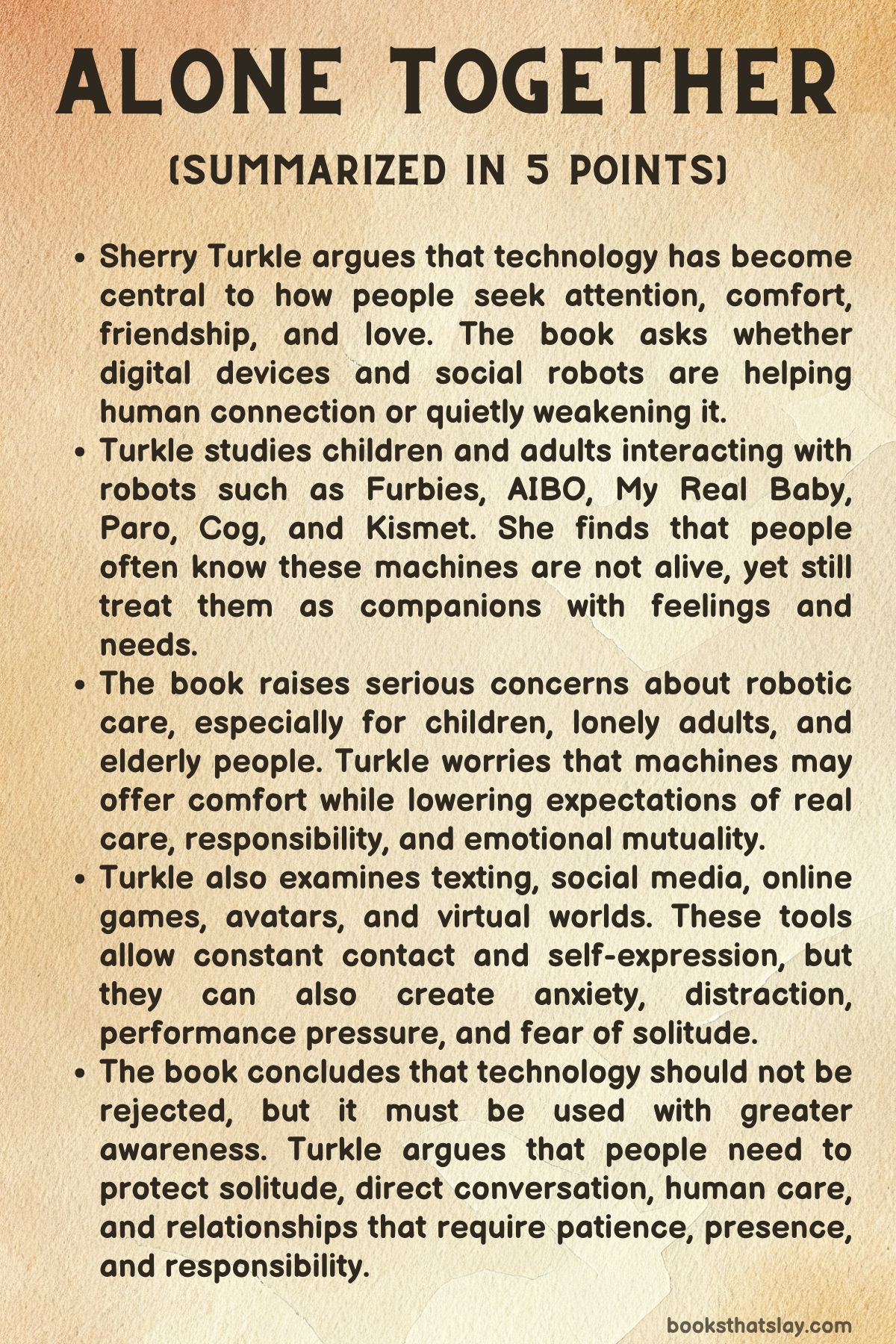
Alone Together: Why We Expect More from Technology and Less from Each Other by Sherry Turkle is a nonfiction study of how digital technology and social robots are changing human relationships. Turkle argues that devices, online identities, texting, social media, and robotic companions do more than help us communicate; they reshape what we expect from friendship, care, attention, and love.
Drawing on interviews with children, teenagers, adults, engineers, and elderly people, she examines why machines can feel comforting and why constant connection can still leave people lonely. The book is not anti-technology. Its concern is whether convenience, control, and simulation are quietly replacing the harder, richer demands of human presence.
Summary
Alone Together begins with Sherry Turkle’s claim that technology has become a powerful force in shaping intimacy. She sees people turning to machines not only for work, play, and information, but also for comfort, companionship, and emotional management.
The book asks how society reached a point where a person might text someone in the same house, prefer a robot pet to a living one, or feel more at ease confessing to strangers online than speaking honestly to people nearby. Turkle is interested in the appeal of these technologies, but she is equally concerned about what they cost us.
The first major part of the book focuses on sociable robots. Turkle traces this concern back to her early experience with ELIZA, a simple computer program that imitated a therapist by responding to users’ words.
Even though users knew the program had no real understanding, many still wanted to share private feelings with it. Turkle sees this as an early sign that people are often willing to help machines seem more alive than they are.
The illusion works because users participate in it.
Children’s relationships with toys such as Furbies, Tamagotchis, AIBO robot dogs, and My Real Baby dolls deepen Turkle’s concerns. Children often understand that these objects are machines, yet they still treat them as needing care, attention, and affection.
They feed them, worry about them, mourn them, and describe them as friends. Turkle does not claim that children are simply fooled.
Instead, she argues that these robots occupy a new emotional category: not alive in a biological sense, but alive enough to draw out care.
This “alive enough” quality matters because it changes expectations about relationships. A robot pet can be turned off, ignored, reset, or controlled.
It may seem responsive without making real demands. Turkle sees this as a form of attachment without full responsibility.
For some children, that is part of the appeal. A robot can provide companionship without the unpredictability of a living animal or another person.
But Turkle worries that such relationships may train people to prefer connection on easier terms.
As Turkle studies children interacting with robots such as Cog and Kismet, she finds that they often work hard to make the robots seem more capable than they are. When a robot fails to respond properly, children invent explanations.
When a robot appears to reject them, some children feel hurt. Vulnerable children, including those dealing with neglect, loneliness, illness, or family instability, may be especially drawn to robots because robots appear safe.
They seem to offer love without the risk of rejection. But this safety is troubling because the machine does not understand, care, or reciprocate in any human sense.
The book also examines the use of robots with elderly people. Therapeutic robots such as Paro, a robot seal, and interactive baby dolls can soothe residents in nursing homes.
Some older adults talk to them, name them, and feel less anxious in their presence. Turkle does not dismiss these effects.
She recognizes that the robots may bring comfort. Still, she asks whether comfort is enough.
If a robot appears to care but cannot care, society may begin to accept emotional substitutes where human attention is needed. This is especially troubling in eldercare, where technology can become a way for families or institutions to reduce the burden of real human contact.
Turkle’s concern is not that robots are useless, but that people may begin to lower their expectations of companionship. When machines simulate empathy, people may come to accept the performance of feeling in place of feeling itself.
Robots can be dependable, patient, and easy to manage. Yet they are also indifferent.
Turkle argues that the human difficulty of relationships, including mistakes, needs, misunderstandings, and effort, is part of what gives them moral and emotional value.
The second major part of Alone Together turns from robots to digital connection. Turkle argues that phones, social media, online games, avatars, instant messaging, and texting create a world in which people are always available but not always present.
She describes the shift from being alone with one’s thoughts to being constantly tethered to others. For many young people, the phone becomes a source of safety, identity, and emotional regulation.
Feelings are often processed by sending them out to friends rather than sitting with them privately.
Teenagers in the book prefer texting because it gives them control. They can edit their words, avoid awkward silences, and manage how available they are.
Phone calls begin to feel intrusive because they demand full attention and real-time response. Texting is efficient, but it also changes the meaning of conversation.
Difficult moments, including breakups, grief, and conflict, can be handled at a distance. Turkle worries that people are trading the discomfort of direct conversation for the easier control of mediated exchange.
Social media intensifies this pressure. Young people describe the burden of creating profiles that represent who they are, or who they want to appear to be.
Facebook and similar platforms ask users to simplify themselves for an audience. The result is anxiety: people monitor how they are seen, worry about what to post, and fear being left out.
Online identity becomes a performance that can feel both empowering and exhausting. Instead of discovering the self in private reflection, users may shape themselves through constant feedback.
Virtual worlds such as Second Life and online games offer another form of escape and self-construction. Turkle describes people who use avatars to explore talents, desires, and identities that feel unavailable in ordinary life.
In some cases, this can be useful. A person may use virtual experience to work through real problems or practice new forms of confidence.
But virtual life can also become a substitute for real action. It offers achievement, intimacy, and control without the same obligations or consequences.
Online confession sites show another side of mediated intimacy. People post secrets and receive responses from strangers.
Such confession can bring relief, but Turkle questions whether it leads to repair, responsibility, or deeper connection. Confessing to an online audience may feel easier than apologizing to someone directly.
It can soothe the confessor without addressing the damaged relationship. Online communities may provide comfort, but they can also be cruel, shallow, or easy to abandon when the exchange becomes uncomfortable.
Anxiety runs throughout the connected life Turkle describes. People fear missing messages, disappointing others, being excluded, being watched, or being recorded.
The phone is both a lifeline and a source of pressure. After traumatic events, constant contact can feel necessary for safety.
Yet the same constant contact can weaken solitude. Turkle argues that solitude is not loneliness; it is the space in which people learn to reflect, imagine, and know themselves.
Without solitude, relationships suffer because people turn to others for reassurance before they have formed their own thoughts.
By the end of Alone Together, Turkle argues for a more thoughtful relationship with technology. She does not call for rejection of devices, online life, or robots.
Instead, she asks readers to notice what kinds of human needs these tools claim to satisfy and what they may replace. Technology often promises control: control over attention, connection, identity, companionship, and emotional risk.
But love and friendship require more than control. They require presence, patience, vulnerability, and responsibility.
The book closes with a warning and a hope. The warning is that society may redefine care downward until simulated attention seems good enough.
The hope is that people can still choose differently. Turkle sees signs that younger generations, though deeply shaped by technology, also long for fuller conversation, letters, phone calls, and undistracted attention.
Alone Together ultimately asks readers to protect the human spaces that technology cannot truly reproduce: solitude, conversation, empathy, and the demanding work of being present for one another.
Key People
Sherry Turkle
Sherry Turkle is the central observing consciousness of Alone Together, though she is not a character in a fictional sense. She appears as researcher, mother, psychologist, cultural critic, and participant in the technological world she studies.
Her importance lies in the tension between curiosity and concern. She is not hostile to technology, and her career has been built around studying computers, artificial intelligence, online identity, and human-machine interaction.
Yet she becomes increasingly troubled by the emotional bargains people make with machines and digital platforms. Turkle’s role is to notice what others often accept too quickly: that a robot that seems to care may change what people expect care to be, and that constant communication may weaken real conversation.
Her character is marked by intellectual caution. She does not reject innovation, but she keeps asking what kind of person technology encourages us to become.
Her perspective is also shaped by motherhood, especially when she compares older forms of separation and letter-writing with texting, Skype, and constant contact.
Rebecca
Rebecca, Turkle’s daughter, represents the younger generation growing up inside a world of digital communication. Her early comment about replacing the Galápagos turtles in a museum with robots becomes one of the book’s first unsettling moments.
To Rebecca, a robot turtle could spare a living animal from captivity, and this reaction shows a child’s moral imagination adapting to a technological age. She is not presented as cold or insensitive; rather, she is compassionate in a way that assumes machines can solve the ethical discomfort of using animals for display.
Later, Rebecca’s gap year in Dublin gives Turkle a personal reason to reflect on the difference between letters and instant communication. Their relationship shows both the gift and the loss of digital contact.
They can reach each other easily, but the emotional depth of older written correspondence feels harder to reproduce. Rebecca therefore becomes a figure through whom Turkle measures generational change, intimacy, distance, and memory.
David Levy
David Levy is important because he gives intellectual seriousness to the idea of romantic relationships with robots. His work on human-machine intimacy forces Turkle to confront a future that many people might dismiss as strange or impossible.
Levy’s position suggests that if machines become convincing enough, humans may accept them as partners, companions, or even spouses. In Turkle’s analysis, this is not simply a prediction about robotics but a sign of cultural desire.
Levy’s ideas reveal a society increasingly willing to define relationship by satisfaction, predictability, and responsiveness rather than mutual feeling. He stands for the optimistic side of technological futurism, where emotional needs can be met through design.
Turkle’s discomfort with his argument helps frame the book’s larger question: if a machine performs affection well enough, will people stop caring whether affection is actually present?
Wilson
Wilson is one of the children who helps Turkle understand how young people relate to robotic toys. His response to the Furby is especially revealing because he can treat it as a friend while still recognizing the machine inside it.
He does not need to decide whether it is fully alive or fully artificial. Instead, he accepts both realities at once.
Wilson’s attitude shows the practical flexibility Turkle sees in many children. They are not necessarily deceived by robots; they cooperate with them emotionally.
Wilson’s character suggests a new kind of psychological comfort with ambiguity. For him, a machine can be mechanical and companionable at the same time.
Turkle sees this as culturally significant because it shows how children may grow up expecting relationships with objects that simulate need, affection, and response without possessing inner life.
Freedom Baird
Freedom Baird contributes one of the book’s most memorable experiments: the “upside-down test.” By asking adults to hold a Barbie, a gerbil, and a Furby upside down, Baird exposes the discomfort people feel when a machine protests in a lifelike way. The Furby’s words of fear create an emotional response even when the person knows it is only a programmed toy.
Baird’s role is significant because the experiment dramatizes the gap between knowledge and feeling. People may know that a robot has no pain, fear, or consciousness, but their bodies and emotions react as if something vulnerable is present.
Through this test, Baird helps reveal the human tendency to respond socially and morally to machines that display signs of distress. The experiment supports Turkle’s larger argument that sociable robots do not need to fool us completely in order to affect us deeply.
Howard
Howard represents a later generational attitude toward robots and human imperfection. Unlike Bruce, who values human mistakes as part of what makes people special, Howard imagines robots as better advisers because they could be loaded with endless information and avoid human error.
His view is important because it shows how fallibility changes meaning across time. For Bruce, imperfection is tied to humanity, warmth, and uniqueness.
For Howard, it is a weakness to be solved. Howard’s confidence in robotic advice points to a cultural shift toward efficiency, accuracy, and optimization.
Turkle finds this troubling because relationships are not only about correct answers. They are also about shared vulnerability, patience, and the understanding that comes from human limitation.
Howard’s character helps show how easily people may begin to prefer machine competence over human presence.
Bruce
Bruce provides an important contrast to Howard. Speaking from an earlier technological moment, he understands that a robot might make fewer mistakes than a person, but he does not see this as proof of superiority.
For him, human error is not merely a defect; it is part of the texture of personhood. Bruce’s view gives emotional and ethical weight to imperfection.
He sees value in the fact that humans are unpredictable, limited, and sometimes wrong. In Turkle’s analysis, Bruce belongs to a time when machines were admired for ability but not imagined as replacements for human judgment or companionship.
His perspective reminds readers that the desire for flawless performance can come at a cost. If society treats mistakes only as failures, it may lose sight of the human qualities that make relationships meaningful.
Henry
Henry’s interaction with AIBO shows that robotic pets can produce confusion, frustration, and aggression rather than simple affection. He plays with the robot in a rough way, and Turkle uses his behavior to suggest that children may experience inner conflict when they are asked to treat a machine as both object and companion.
Henry’s aggression is not just misbehavior; it reflects the uncertainty created by a thing that seems alive but can also be controlled. A real pet would resist, suffer, or respond in ways that carry moral weight.
AIBO invites care but can also be handled as property. Henry’s response reveals how this mixed status can disturb emotional development.
Through him, Turkle asks whether children are being given relationships that imitate responsibility while allowing domination.
Tamara
Tamara, like Henry, demonstrates the darker emotional possibilities of robotic companionship. Her rough treatment of AIBO suggests that children do not always respond to sociable machines with tenderness.
A robot pet can become a screen for anger, control, and testing boundaries. Tamara’s importance lies in the way her behavior complicates the claim that robotic animals are harmless substitutes for living pets.
If a child can act aggressively toward a robot that behaves like a creature, what habits are being formed? Turkle does not argue that Tamara becomes cruel because of AIBO, but she does suggest that such interactions deserve careful thought.
Tamara shows how robots can become emotional objects through which children act out confusion about care, power, and responsibility.
John Lester
John Lester offers a more accepting view of robotic life. As a computer scientist, he can see AIBO as both an inanimate computer and a creature-like companion.
His perspective is less anxious than Turkle’s because he is comfortable with mixed categories. John does not require the robot to be alive in the traditional sense in order to find value in interacting with it.
He represents a technologically fluent way of thinking, one that treats emotional response to machines as part of contemporary life rather than as a moral crisis. His position is useful because it prevents the book from becoming one-sided.
Through John, readers see why intelligent people might embrace relational machines without feeling deceived. Still, Turkle uses his view to sharpen her concern that comfort with ambiguity can slide into acceptance of emotional substitution.
Wesley
Wesley, a sixty-four-year-old man who has been divorced three times, represents the appeal of uncomplicated companionship. His attraction to a robot companion comes from the desire for a relationship without the pain, demands, and disappointments of human intimacy.
Wesley is significant because he makes explicit one of the book’s central worries: people may not turn to robots because robots are truly rich companions, but because they are easier than people. His history of failed relationships makes him vulnerable to the promise of connection without conflict.
Turkle treats this vulnerability seriously. Wesley is not mocked or dismissed; he is shown as someone whose loneliness makes the offer of robotic companionship tempting.
His case raises the question of whether technology heals loneliness or simply offers a safer-looking form of withdrawal.
Kevin
Kevin, the twelve-year-old who asks how robots can comfort people if they do not feel pain, provides one of the sharpest moral insights in the book. His question cuts through the behaviorist view that comfort is only about producing the right response.
For Kevin, real comfort requires some capacity for suffering or shared emotional knowledge. He understands that empathy is not just performance.
A robot may say the right thing or act soothingly, but it has no experience of pain and therefore cannot truly understand another’s distress. Kevin’s importance comes from his resistance to easy technological optimism.
While many children accept robots as future caretakers, Kevin sees a missing depth. His question supports Turkle’s argument that simulated empathy may not be enough, especially when people are vulnerable.
Callie
Callie is a ten-year-old girl whose relationship with My Real Baby reveals the emotional power of caregiving. Her father works a great deal, and the robotic baby gives her a chance to feel needed and loving.
She treats the doll as if it were real and feels like its mother. Turkle’s analysis suggests that loving the robot helps Callie feel more loved herself.
Callie’s case is tender but also troubling. The robot allows her to practice care, but it also responds in ways designed to reward her emotionally.
It becomes a controlled relationship where the child can experience attachment without the full uncertainty of another living being. Callie shows why robotic companions are so attractive: they can meet emotional needs in the moment.
Yet her case also raises the question of whether such comfort addresses loneliness or quietly adapts children to substitutes.
Tucker
Tucker, a seriously ill seven-year-old, is one of the most vulnerable figures in Alone Together. He uses AIBO to express fears about his body, illness, and death.
The robot becomes a way for him to speak about feelings that may be too frightening to state directly. He compares AIBO to his real dog and is frustrated by the robot’s apparent superiority, especially its ability to resist death through technology.
Tucker’s relationship with AIBO is emotionally complex. On one hand, the robot gives him a symbolic language for fear.
On the other, it may intensify his awareness of his own fragile body. Turkle does not treat his attachment as foolish.
Instead, she shows how powerful such machines can become when they meet children at points of deep vulnerability. Tucker’s case shows both the therapeutic promise and the emotional risk of robotic companions.
Neela
Neela, an eleven-year-old from India, is drawn to Cog because the robot seems dependable. She has experienced social rejection from girls who pretend to be friendly and then mock her accent.
Cog appears to offer a relationship protected from betrayal. Neela’s attraction to the robot reveals how painful human social life can be, especially for children who feel excluded.
Her desire for “safe” love is understandable. Yet Turkle sees danger in the very safety that attracts her.
If a child learns to prefer a machine because it cannot reject her, she may be pulled away from the difficult but necessary work of human friendship. Neela’s character shows that robots do not prey on abstract curiosity alone; they appeal to real wounds.
Her loneliness gives the robot emotional power.
Estelle
Estelle enters the robot study with excitement and expectation, but the robot’s limited responsiveness causes her to blame herself. Her reaction is one of the book’s clearest examples of the ethical problem involved in exposing vulnerable children to sociable machines.
The robot does not intend to reject her, but Estelle experiences its failure as personal. Her disappointment leads to visible distress, including binge-eating the snacks provided during the study.
Estelle’s case shows that people do not respond only to what machines are; they respond to what machines appear to offer. When a robot is presented as social, its silence or malfunction can feel like emotional failure.
Turkle uses Estelle to question the assumption that robot interactions are harmless. If a machine can invite attachment, it can also produce hurt.
Hiroshi Ishiguro
Hiroshi Ishiguro, the Japanese roboticist who builds a robot version of himself, represents the ambition to reproduce human presence mechanically. His robot clone raises questions about identity, family, and substitution.
The most disturbing part of his example is not simply that the robot resembles him, but that his daughter begins to treat it in ways similar to how she treats her father. Ishiguro’s project pushes the book’s concerns to a personal extreme.
If a child can adapt to a robotic copy of a parent, what does that mean for presence, absence, and emotional authenticity? Ishiguro stands for the technological desire to preserve or duplicate the self.
Turkle sees both fascination and danger in this desire. The robot clone is not just a machine; it is a challenge to the uniqueness of embodied human relationship.
Tim
Tim is a middle-aged man who believes that Paro improves his mother’s life. He sees that she seems more animated and happier when interacting with the robot seal.
Tim’s position is practical and sympathetic. He wants his mother to feel better, and the robot appears to help.
Turkle does not deny what he observes, but she questions whether liveliness is the same as less loneliness. Tim represents family members who may accept robotic care because it produces visible comfort and because eldercare is emotionally and practically difficult.
His character reveals the moral pressure behind technological solutions. When human care is hard to provide consistently, a machine that calms an elderly parent can seem like a blessing.
Turkle asks readers to consider whether such relief may also make it easier to withdraw human attention.
Andy
Andy, an elderly man with few friends, becomes attached to My Real Baby and gives it a name. He knows the doll is not real, yet he talks to it and finds comfort in its presence.
Over time, his relationship with the doll shifts, and it becomes a stand-in for his ex-wife. Andy uses the robot to say things he cannot say directly to the person from his past.
His case is emotionally rich because the doll becomes a container for memory, regret, and loneliness. Turkle presents him with compassion but also concern.
The robot helps Andy feel safer and less anxious, yet it also creates a one-sided space where unresolved human feelings are directed toward a machine. Andy shows how robotic companions can become emotionally useful without being emotionally mutual.
Johnathan
Johnathan, a former engineer, initially approaches My Real Baby as a machine to be taken apart and understood. His instinct is technical rather than sentimental.
Yet when he finds a computer chip whose programming is hidden from him, the robot becomes less transparent than the mechanical dolls of Turkle’s childhood. Johnathan’s response changes as he warms to the baby and finds that talking to it reduces his anxiety.
His character is important because he shows that technical knowledge does not prevent emotional attachment. Even someone trained to understand machines may respond to the social cues of a robot.
Johnathan’s case supports Turkle’s argument that people do not need to be fooled in order to bond. The machine’s hidden complexity makes it easier to treat as mysterious, responsive, and companionable.
Cory Kidd
Cory Kidd, the designer of a robot diet coach, represents a more functional approach to sociable robotics. His robot is not designed primarily as a pet or emotional companion but as a helper that can guide behavior.
Yet the people who use it still become attached. Kidd’s work shows that once a machine enters daily life in a social role, users may give it emotional meaning beyond its intended purpose.
The diet coach is supposed to assist with self-management, but it also becomes a companion-like presence. Through Kidd, Turkle shows that sociable robots do not need to imitate humans completely to generate attachment.
A small amount of responsiveness, routine, and attention can be enough. His work raises questions about how easily practical tools become emotional partners.
Rose
Rose, a middle-aged woman who uses Cory Kidd’s robot diet coach, becomes so attached that she delays returning it and keeps it longer than planned. Her behavior illustrates how quickly routine interaction with a sociable machine can become emotionally significant.
The robot is meant to support healthy behavior, but it also becomes part of Rose’s daily emotional landscape. Her reluctance to give it back suggests that the relationship has moved beyond utility.
Rose’s case is important because she is not a child and not necessarily confused about what the robot is. Her attachment shows that adults are also vulnerable to machines that appear attentive and consistent.
Turkle uses her to demonstrate that the appeal of sociable robots is not limited to fantasy; it can emerge from ordinary habits of dependence.
Gordon
Gordon begins by resisting the idea that a robot can have feelings, especially when a questionnaire seems to imply such a possibility. Yet he later reveals that he has named the robot.
This contradiction makes him an important figure in Turkle’s analysis. Gordon knows intellectually that the machine is not alive, but his behavior shows emotional accommodation.
Naming the robot personalizes it and brings it into a social world. His case reveals the split between belief and action that appears throughout the book.
People may reject the idea of machine feeling while still treating machines as if they possess some form of personality. Gordon shows that attachment can arise quietly, even in those who are skeptical.
Edna
Edna, an elderly woman who seems to prefer a robotic baby to her real great-granddaughter, offers one of the book’s most troubling examples of controlled companionship. The robot allows her to perform motherhood without risk, mess, resistance, or fatigue.
A real child has needs that cannot be fully managed; a robotic baby provides the emotional posture of care without the same demands. Edna’s preference is not presented as cruelty.
Rather, it suggests that the robot gives her a calmer, more manageable version of intimacy. Turkle’s concern is that such ease may become seductive.
Edna shows how a robot can satisfy the desire to feel loving while avoiding the unpredictability of loving a real person. Her case raises the question of whether emotional comfort becomes thinner when stripped of genuine responsibility.
Rich
Rich, the twenty-six-year-old participant in an experiment with Kismet, demonstrates how adults can become complicit in making robots seem more emotionally capable than they are. He begins with simple conversation but gradually moves into personal and flirtatious territory.
Kismet’s limited responses are enough for him to feel a kind of connection, partly because he helps sustain the illusion. Rich’s behavior reveals that robotic intimacy is not only produced by engineering; it is co-produced by human desire.
He wants the interaction to work, so he frames the robot’s responses generously. Turkle sees this as a fantasy of near communion, where the person receives the feeling of being met without actually being understood.
Rich’s case shows how powerful even partial responsiveness can be when people are ready to invest emotionally.
Aaron Edsinger
Aaron Edsinger, Domo’s creator, offers insight into how roboticists themselves can begin to speak of machines as creatures. While he understands the robot’s technical limits, he experiences its attention, movement, and learning as signs of something creature-like.
His view is important because it shows that emotional language around robots does not come only from naive users. Designers can also become attached to the beings they build.
Edsinger’s argument that what matters is how a person feels when a robot holds their hand contrasts sharply with Turkle’s worry about the robot’s indifference. Through him, the book stages a debate between emotional effect and emotional truth.
If a gesture comforts someone, does it matter whether the source can care? Turkle says it does.
Pia Lindman
Pia Lindman, the performance artist who studies Domo, brings an artistic and bodily dimension to the book’s questions. Her drawings and performances explore the shifting boundary between human and machine.
When she tries to act from the robot’s side of the interaction, she discovers that she must invent emotions in order to perform as an emotionless object. This insight is central to Turkle’s argument.
Human beings cannot easily imagine relation without feeling. Lindman’s work exposes the emotional labor humans add to machines.
Her art does not simply celebrate human-machine connection; it reveals the projection involved in making that connection feel alive. Lindman shows that the robot’s apparent emotional presence often depends on the human participant supplying the missing inner life.
Clifford Nass
Clifford Nass contributes a psychological framework for understanding why people behave socially toward machines. His experiments show that people often avoid hurting a computer’s “feelings” or respond politely to technology even when they know it has no emotions.
Nass is important because his research supports Turkle’s claim that human social habits are easily triggered by technological cues. People are not purely rational in their treatment of machines.
A small sign of responsiveness can activate manners, guilt, concern, or loyalty. Nass’s work helps explain why robots and computers can become emotionally persuasive without being conscious.
He gives scientific weight to the book’s observation that social behavior toward machines is common, automatic, and difficult to dismiss.
Rosalind Picard
Rosalind Picard appears through the idea of affective computing, which seeks to design technologies that can recognize, respond to, or simulate emotion. Her work represents a major shift in computing: machines are no longer only calculating tools but systems designed to engage emotional life.
Turkle is concerned that affective computing can blur the distinction between seeming emotional and being emotional. Picard’s importance lies in the field she helps name and legitimize.
Once machines are built to respond to human feeling, people may experience them as caring partners rather than tools. Turkle’s concern is not with emotional sensitivity in technology as such, but with the cultural readiness to mistake emotional performance for emotional reciprocity.
Tony
Tony is a man considering whether a robot could care for his aging mother-in-law. His reflections reveal the practical pressures behind the turn to machines.
He understands the value of authentic human care, yet he also recognizes competing needs, limits, and burdens. Tony’s phrase about the “luxury of authenticity” captures a painful moral compromise.
He is not indifferent; he is caught between ideals and realities. His character shows why Turkle’s subject is difficult.
It is easy to defend human care in principle, but harder when families are strained, time is limited, and care needs are constant. Tony represents the ethical gray area where robotic care becomes tempting not because it is ideal, but because human systems of care are already under pressure.
Pete
Pete is a middle-aged man in an unhappy marriage who creates a virtual wife in Second Life. He believes this online relationship helps his real marriage by giving him a place to express anxieties his wife does not want to hear.
Pete’s case shows how virtual worlds can become emotional outlets that both relieve and avoid real problems. He feels most like himself in the game, which suggests that his virtual life offers recognition missing from his ordinary life.
Yet this also raises questions about escape and responsibility. Instead of confronting the limits of his marriage directly, Pete creates a second emotional life with fewer consequences.
His character reveals the appeal of online intimacy: it can feel deeply personal while remaining separate from the harder demands of embodied relationships.
Diane
Diane, the museum curator, represents the adult professional caught in the pleasures and pressures of digital multitasking. She feels powerful when managing many programs and streams of information, but Turkle sees her as dependent on the very systems that seem to empower her.
Diane’s character shows how digital life can disguise loss of control as mastery. The ability to respond constantly, monitor multiple channels, and remain connected can feel like competence.
Yet it can also fragment attention and create anxiety. Diane is not a teenager forming an identity online; she is an adult whose work and self-image are shaped by technological availability.
Through her, Turkle shows that the always-on condition affects not only the young but also professionals who mistake busyness for command.
Julia
Julia, a sixteen-year-old whose parents are divorced, embodies the emotional dependence created by constant texting. She uses messages to clarify her feelings, seek reassurance, and stay connected.
Her phone becomes both comfort and burden. She feels pressure to check it because something might need her attention, and her anxiety is linked to a broader cultural history in which cell phones became symbols of safety.
Julia’s relationship with her father also shows how digital communication can both distance and reconnect. She stops calling him, yet later they communicate through email.
Julia’s character is central to Turkle’s concern that feelings may not feel fully real until they are communicated. Instead of solitude helping her form thoughts, the phone becomes the place where emotions are tested and confirmed.
Claudia
Claudia, another teenager, helps illustrate how texting becomes an emotional balm for ordinary experiences. Like Julia, she turns to messages for quick reassurance after small setbacks or moments of excitement.
Her character matters because she shows that constant connection is not reserved for crisis. It becomes a daily habit of emotional regulation.
The smallest feeling can call for immediate communication, and the speed of response shapes the intensity of anxiety. Claudia’s dependence on texting reflects a broader shift in which young people come to expect near-instant acknowledgment.
Her behavior suggests that solitude becomes harder when every feeling can be sent outward for reaction. Turkle uses figures like Claudia to show how technology changes not only communication but also the inner rhythm of emotional life.
Trish
Trish, a thirteen-year-old who has suffered physical abuse, creates a non-abusive family in the Sims Online. Her use of the game is deeply understandable.
The virtual world allows her to imagine safety, care, and family roles that real life has denied her. Trish is one of the clearest examples of digital space as refuge.
Her character shows that online identity-making can have protective value. It can offer rehearsal, fantasy, and relief.
Yet her case also raises the question of what happens when virtual repair substitutes for real-world intervention or healing. Turkle does not dismiss Trish’s online family as meaningless.
Instead, she treats it as emotionally significant while reminding readers that simulated safety cannot fully replace the need for actual safety, human care, and justice.
Katherine
Katherine, a sixteen-year-old who practices being different people in online spaces, represents the experimental side of digital identity. For her, virtual environments allow identity to be tried on, adjusted, and performed.
This can be creative and developmentally useful, especially for adolescents who are still discovering who they are. Yet Katherine’s behavior also reflects Turkle’s concern that identity becomes something curated for response.
Practicing the self through avatars and profiles can expand possibility, but it can also make personhood feel like a project of presentation. Katherine is important because she shows both sides of online identity: exploration and pressure.
Her character helps explain why digital life is attractive to young people who want freedom, but also why it can become exhausting when the self must always be managed.
Mona
Mona, a high school freshman worried about creating the “real her” on Facebook, captures the anxiety of self-representation in social media. She wants authenticity, but the platform requires selection, editing, and display.
Her worry reveals the contradiction at the heart of online profiles: they promise self-expression while encouraging performance. Mona’s character shows how young people are asked to turn identity into a visible product.
The pressure is not simply to be oneself, but to produce a version of the self that will be recognized as real by others. Turkle sees this as psychologically costly.
Mona’s struggle suggests that digital platforms can make authenticity feel less like lived truth and more like successful presentation.
Elaine
Elaine, a seventeen-year-old who prefers texting to calling, represents the appeal of controlled communication. Texting gives her time to shape her thoughts, avoid pressure, and communicate efficiently.
Her preference is not irrational; it reflects real advantages of mediated exchange. Elaine’s character helps explain why phone calls begin to feel burdensome in a texting culture.
A call demands immediate presence, vocal tone, and the risk of awkwardness. A text allows distance and revision.
Turkle’s concern is that these advantages may weaken skills needed for direct conversation. Elaine shows how comfort with control can become avoidance of spontaneity.
Her case is not about laziness but about a changing emotional standard for communication.
Audrey
Audrey is shy, lonely, and deeply shaped by mediated communication. She prefers texting because phone calls are hard to end and because separation feels like rejection.
Her parents are divorced, her brothers are busy, and her online life gives her a place to play with identity beyond the pressures of school. She takes pictures for Facebook and feels that her profile may express her inner self better than her physical presence does.
Audrey’s interactions on Italian MySpace add fantasy and escape to her life. Yet her regret over a goodbye that happened through messaging shows that she still recognizes the value of direct human presence.
Audrey is one of Turkle’s most complex teenage figures because she both depends on digital distance and longs for more personal forms of connection.
Tara
Tara, the lawyer upset that a friend delayed sharing news of a family loss despite months of email contact, represents the limits of mediated communication. Her case shows that frequent messaging does not guarantee emotional closeness.
People can exchange information for a long time while avoiding the most important truths. Tara’s hurt comes from discovering that communication had continued without real disclosure.
Her character supports Turkle’s argument that digital contact can create the feeling of connection while allowing people to withhold vulnerability. Tara values the kind of friendship in which serious news is shared directly and promptly.
Through her, the book asks whether convenience and composure have begun to replace the obligations of intimacy.
Meredith
Meredith, a teenager who is relieved to learn through instant messaging that her friend has died because she does not have to talk to anyone directly, reveals a painful form of emotional distancing. Her reaction is not presented as heartlessness but as evidence of how mediated communication can protect people from the demands of grief.
She prefers receiving devastating news in a format that allows composure. Turkle worries that this kind of composure may come at the expense of deeper emotional steadiness.
Meredith’s case shows how digital communication can make even death easier to manage on the surface. The cost is that people may avoid the shared vulnerability through which grief is normally processed.
Joel
Joel, a successful programmer who becomes the elephant avatar Rashi in Second Life, represents the constructive potential of virtual identity. Through Rashi, he explores artistry, leadership, and community in ways that enrich his sense of possibility.
His case is one of the more positive examples in the book because he seems to use virtual life to work through aspects of himself rather than merely avoid reality. Joel’s relationship with Noelle, however, complicates this optimism.
He becomes emotionally invested in her depression and in the truth of her presented identity. For him, certain forms of online authenticity matter deeply.
Joel shows that virtual worlds can support growth, but they also create fragile emotional bonds dependent on trust, performance, and partial knowledge.
Noelle
Noelle, the depressed Frenchwoman Joel meets in Second Life, is important because she represents both intimacy and uncertainty in virtual relationships. Joel’s connection to her depends not only on conversation but also on belief in her presented suffering.
He admits that discovering she was not truly depressed would feel like a deeper betrayal than discovering she was not French. This distinction reveals how online authenticity works.
Some details may be decorative, while others carry emotional truth. Noelle’s character is less fully known than Joel’s, and that is part of her significance.
She exists for him through mediated disclosure, avatar identity, and trust. Her role shows that online bonds can feel real even when the people involved remain partly hidden.
Adam
Adam is dissatisfied with his ordinary life and finds meaning in long stretches of online gaming. In Quake and Civilization, he experiences mastery, creation, and recognition that his real jobs do not provide.
His compassion toward artificial subjects and his enjoyment of simulated gratitude reveal the emotional rewards games can offer. Adam’s character shows how virtual environments can supply achievement without requiring corresponding change in real life.
His experiences are not meaningless, but Turkle questions whether they provide the same fulfillment as actual creation or relationship. Adam represents a form of retreat into systems that reward effort clearly and immediately.
Compared with the messiness of ordinary life, the game world offers structure, control, and visible success.
Sherryl
Sherryl uses online confession to feel better, but not necessarily to repair the harm behind the confession. Her character reveals one of Turkle’s concerns about digital emotional release.
Confession can become a private act of relief performed before an anonymous audience rather than a step toward responsibility. Sherryl does not need to face the person she has hurt or make amends in a concrete way.
The internet gives her comfort without demanding repair. Her case shows how online spaces can separate feeling from action.
Turkle does not deny the emotional value of confession, but through Sherryl she questions whether relief alone is enough. A culture of anonymous disclosure may soothe guilt while leaving relationships unchanged.
Jonas
Jonas demonstrates how online confession sites can invite projection and cruelty. He responds to another person’s confession through the lens of his own frustration, especially his distance from his son.
His reaction shows that online audiences are not always nurturing communities. They may become places where unresolved anger is displaced onto strangers.
Jonas matters because he complicates the fantasy of the internet as a space of pure acceptance. In real communities, people also project and judge, but online distance can intensify these habits.
Jonas’s character shows how easily digital response can become coarse when the other person is reduced to a post, a confession, or a screen name rather than encountered as a full human being.
Molly
Molly feels she has found community online, but Turkle questions what kind of community it is. A digital group can offer sympathy and recognition, yet it lacks some of the obligations, endurance, and complexity of real-life community.
Molly can log off when feedback becomes difficult, and others can do the same to her. Her character shows the partial nature of online belonging.
It may be real in the sense that it provides emotional support, but it may also be fragile because participation is easily withdrawn. Molly’s experience helps Turkle examine the difference between connection and commitment.
Online community can comfort, but it does not always require people to stay present through discomfort, disagreement, or responsibility.
Hannah
Hannah forms a close relationship with Ian through Internet Relay Chat and feels that he knows her better than anyone. Yet she also senses that something is missing.
Her character captures the contradiction of online intimacy: it can encourage disclosure and emotional intensity while lacking embodied presence. Hannah’s friendship with Ian is demanding because online relationships can produce constant access, expectation, and pressure.
She also recognizes that internet communication can bring out the worst in people. Hannah’s experience shows that digital intimacy is not simply shallow; it can be deep, but its depth has a different structure.
It may depend heavily on language, availability, and imagination, while missing the grounding force of shared physical life.
Ian
Ian, known through Hannah’s online relationship with him, functions less as a fully developed person and more as an example of the power of mediated intimacy. To Hannah, he becomes someone who understands her deeply, perhaps more deeply than people in her immediate surroundings.
His role shows how online communication can accelerate closeness by allowing people to share thoughts without the pressures of face-to-face interaction. Yet because Ian is encountered through a screen, he also represents absence.
He can be emotionally present and physically distant at the same time. The relationship reveals why online bonds can feel intense while still leaving something unmet.
Ian’s importance lies in the way he becomes both confidant and symbol of incompleteness.
Brad
Brad appears in relation to online records, Facebook performance, and the desire for spontaneity. He is unsettled when a friend mentions saved chat logs from years earlier because he realizes that past versions of himself may be permanently stored.
This anxiety shows how digital life can make youthful experimentation feel risky. Later, Brad struggles with Facebook because even spontaneous posts become performances shaped by audience awareness.
His eventual decision to take a break from technology reflects a longing for better quality relationships and less self-consciousness. Brad’s character is important because he recognizes the cost of constant presentation.
He wants freedom from the crowd’s gaze and from the pressure to manage his identity in public.
Robin
Robin, a twenty-six-year-old copywriter, feels pressured to keep her BlackBerry nearby and becomes anxious without it. Her experience shows that digital dependence is not only a teenage problem.
Work culture and social media have trained her into constant availability. Her annoyance with Facebook and her memory of Joanne’s earlier long emails from Thailand reveal a longing for more personal, focused communication.
Robin’s character captures the fatigue of being always connected. She benefits from technology but also feels trapped by it.
Her dizziness without the device suggests that connection has become bodily habit. Through Robin, Turkle shows how adults can become tethered to devices in ways that feel necessary, even when they resent the dependence.
Joanne
Joanne is remembered through the contrast between her earlier long emails from Thailand and her later public blog posts. She represents a shift from personal correspondence to broadcasted life.
In the earlier emails, she wrote directly to Robin, creating a private exchange that made the recipient feel chosen. In the later blog, her experiences are available to a general audience.
The content may still be thoughtful, but the form changes the emotional meaning. Joanne’s character is important because she shows how digital platforms can turn intimate communication into publication.
The personal letter gives way to the public update. Turkle uses this contrast to show why some people feel nostalgic for slower, more directed forms of attention.
Luis
Luis, a student who says he misses the era of letter writing even though he was not alive then, represents the nostalgia of the young. His statement is powerful because it is not based on personal memory but on a desire for a kind of attention he imagines the past offered.
Letters symbolize focus, patience, and care. For Luis, they stand against the speed and casualness of texts and posts.
His character shows that young people are not simply satisfied with digital convenience. Many sense that something has been lost, even if they never experienced the older forms directly.
Luis gives voice to the wish for communication that feels deliberate and personal rather than instant and disposable.
Richard
Richard, Turkle’s disabled colleague, provides a deeply important counterpoint to arguments for robotic care. He values the humanity of his caregivers even when they make mistakes.
Their flaws do not diminish his care; they connect him to the human story. Richard’s perspective is crucial because he speaks from a position where practical assistance is not optional.
A robot might perform some tasks more reliably, but for Richard, care is not only task completion. It is also recognition, dignity, and shared human presence.
His character strengthens the moral argument of Alone Together by showing that efficiency cannot replace the meaning of being cared for by another person. Richard reminds readers that dependence on others need not be shameful when it is part of mutual human life.
Bell
Bell, the man who practices extensive life capture, represents the desire to preserve memory through technology. By recording and archiving large parts of his life, he hopes to secure his past.
Yet Turkle notes that relying on a computer to remember may weaken his own capacity for memory. Bell’s character raises questions about whether life changes when it is lived for the archive.
If experience is constantly collected, stored, and prepared for later retrieval, the present may become material for documentation rather than something fully inhabited. Bell stands for the technological dream of total memory, but his case reveals a possible cost: the more the machine remembers, the less the person may practice remembering.
His life becomes a warning about confusing storage with meaning.
Themes
Simulated Care and the Redefinition of Love
In Alone Together, simulated care becomes troubling because it does not merely imitate love; it changes what people may begin to accept as love. Robots such as Paro, AIBO, My Real Baby, Kismet, and Nursebot can respond, soothe, entertain, and appear attentive.
These responses are often enough to produce real comfort in children, adults, and elderly people. Turkle’s concern is not that the comfort is fake from the human side.
A lonely person may truly feel calmer with a robotic baby, and a child may genuinely care for a robot pet. The problem lies in the absence of mutuality.
The machine does not understand the person, does not suffer, does not remember with feeling, and does not make a moral choice to care. This matters because human love is not only about receiving the right response.
It involves vulnerability, responsibility, patience, and the knowledge that another being has an inner life. When people accept care from machines that only perform concern, society risks lowering the standard for intimacy.
The danger is not that robots will become too human, but that humans may become satisfied with relationships that ask less of them.
Constant Connection and the Loss of Solitude
Digital connection promises closeness, but Turkle shows that constant availability can weaken the inner life that makes real closeness possible. Texting, instant messaging, social media, and phones allow people to reach one another at any moment, yet this access often produces anxiety rather than peace.
Young people learn to process feelings by sending them outward immediately. A disappointment, excitement, worry, or conflict becomes something to text about before it is privately understood.
This habit changes solitude from a valuable space into an uncomfortable gap. Turkle treats solitude as necessary for emotional development because it allows people to gather thoughts, tolerate uncertainty, and know what they feel without instant approval.
Without solitude, people may become dependent on response. They begin to feel unfinished until someone answers.
The phone becomes both comfort and command, a source of safety and a device that constantly interrupts reflection. This theme is especially clear in teenagers who feel compelled to check messages even when they know it is dangerous or unnecessary.
Turkle suggests that being alone is not the same as being lonely. In fact, the ability to be alone may be what allows people to form deeper, less anxious relationships with others.
Identity as Performance
Online spaces encourage people to create versions of themselves, but Turkle shows that this freedom often comes with pressure. Avatars, profiles, social media pages, games, and virtual worlds allow users to experiment with identity.
For some, this can be useful and even healing. A person may try out confidence, leadership, creativity, or family belonging in a space where real life feels limited.
Yet the same platforms can turn selfhood into performance. Teenagers worry about creating the “real” version of themselves online, but every profile requires selection and editing.
The result is a paradox: the user wants authenticity but must build it through display. Social media asks people to simplify themselves for an audience, and then that audience shapes what feels acceptable to show.
This creates anxiety because identity becomes something continuously managed. The self is no longer only lived; it is posted, revised, monitored, and judged.
Turkle’s concern is that people may confuse a successful presentation with a fuller life. Virtual identity can support self-discovery when it helps someone return to reality with new insight.
It becomes harmful when it replaces growth with performance or allows a person to avoid the difficult work of changing actual relationships and circumstances.
Convenience, Control, and Emotional Avoidance
Technology often appeals because it gives people more control over connection. A text can be edited.
A phone call can be avoided. A robot can be turned off.
A virtual world can be exited. A confession can be made anonymously.
These conveniences are not minor; they answer real fears about rejection, awkwardness, responsibility, and emotional exposure. Turkle shows that people often choose mediated forms of contact because they protect composure.
Teenagers prefer texting because it avoids the pressure of voice. Adults use email for conversations that might be uncomfortable in person.
Online confession offers relief without requiring direct repair. Robotic companions provide affection-like responses without making unpredictable demands.
In each case, technology helps people manage the risks of intimacy. The cost is that emotional skills may weaken.
Ending a call, apologizing directly, sitting with grief, caring for an aging parent, or listening without distraction are difficult acts, but they are also part of mature human relationship. When technology removes too much discomfort, it may also remove opportunities for growth.
Turkle does not argue that every difficult conversation must happen face-to-face or that all convenience is bad. Her warning is that a life organized around control may quietly train people to avoid the very forms of vulnerability that make love, friendship, and responsibility real.