Altered Carbon Summary, Characters and Themes
Altered Carbon by Richard K. Morgan is a cyberpunk noir novel set in a future where human consciousness can be stored, transported, and placed into new bodies. Death has become negotiable for the rich, while the poor remain trapped by cost, law, and power.
The story follows Takeshi Kovacs, a former elite Envoy, who is pulled out of storage and sent to Earth to solve the apparent suicide of a centuries-old billionaire. What begins as a murder inquiry becomes a harsh look at wealth, identity, desire, and the moral collapse made possible when bodies become replaceable. It’s the 1st book in the Takeshi Kovacs series.
Summary
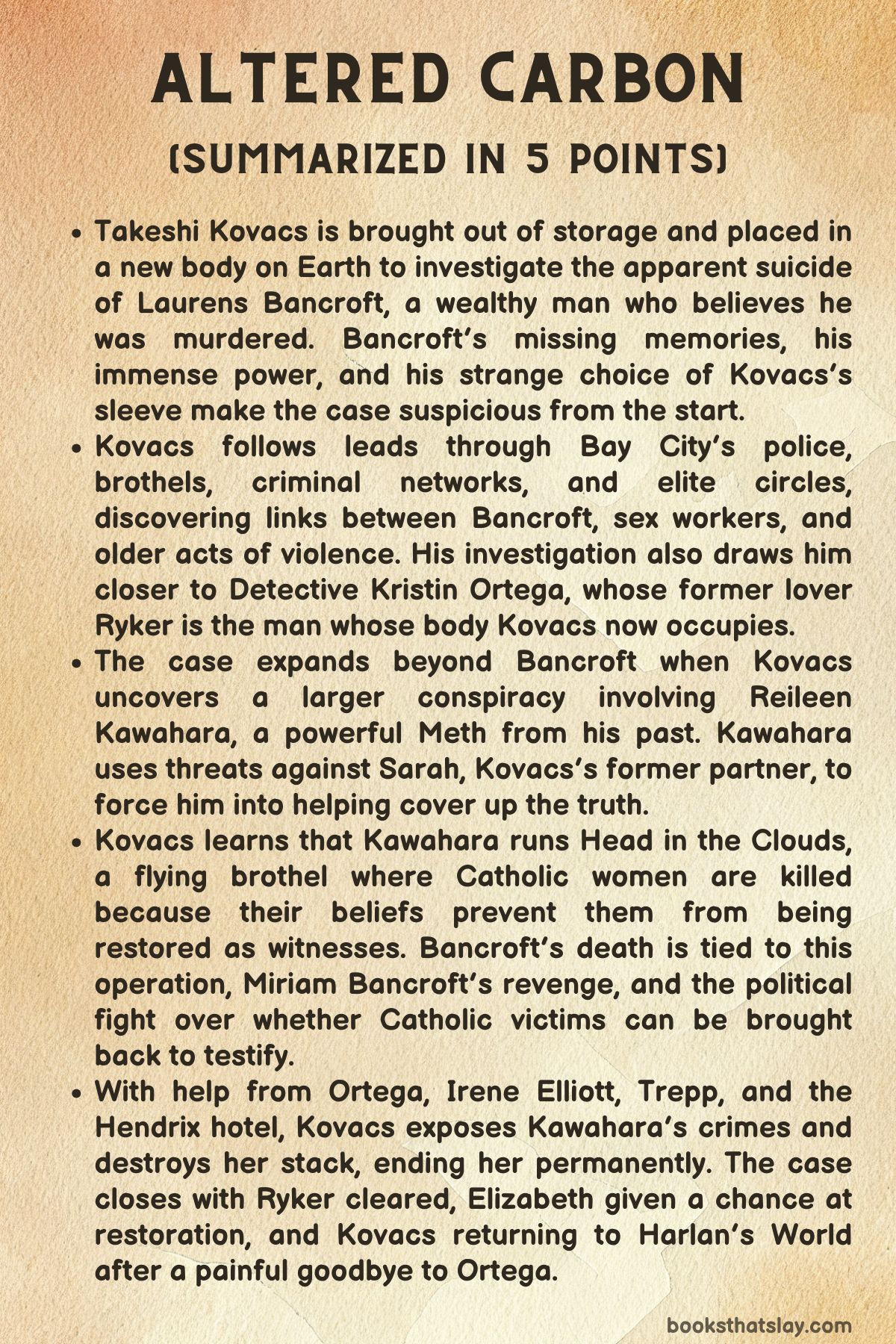
Takeshi Kovacs dies in a violent raid on Harlan’s World after a firefight that kills his partner, Sarah. Instead of ending, his consciousness is stored in his stack, the device implanted in every person’s neck that holds the mind and allows it to be transferred into a new body.
Kovacs wakes far from home, on Earth, in Bay City. He has been placed in a strong, enhanced sleeve that once belonged to another man.
He soon learns that he has been leased out of storage by Laurens Bancroft, one of the ultra-rich and long-lived Meths, to investigate Bancroft’s own death.
Bancroft’s case is strange. The police say he died by suicide, but Bancroft rejects that conclusion.
He keeps backup copies of his mind, uploaded every 48 hours, so when his body died, he was restored in a clone with no memory of the final two days before death. The facts suggest he returned home, opened a safe only he and his wife Miriam could access, and shot himself.
Bancroft argues that if he had truly wanted to die, he would have destroyed his stack and ended himself permanently. Kovacs is forced to take the job because Bancroft controls the lease on his freedom and can leave him stranded on Earth.
Detective Kristin Ortega of Organic Damage meets Kovacs on release and makes it clear she does not trust Bancroft. She also has a personal connection to Kovacs’s sleeve, which belonged to Elias Ryker, her former lover and partner, now in storage after being convicted of destroying suspects’ stacks.
Kovacs quickly learns that the sleeve choice was not random. Bancroft selected Ryker’s body partly to punish Ortega for dismissing his case.
Kovacs begins with the Bancroft household. Miriam Bancroft is beautiful, ancient, and controlled, but her jealousy and history of violence raise questions.
Years earlier, she attacked Leila Begin, a sex worker Bancroft had seen, causing the loss of Leila’s child. Kovacs also discovers links between Bancroft and other young women who resemble Miriam, including Elizabeth Elliott, the daughter of Victor and Irene Elliott.
Elizabeth became a sex worker to raise money to recover her mother’s body after Irene, an illegal data hacker known as a dipper, was arrested and stored. Elizabeth was later murdered, and her father believes Bancroft was involved.
The investigation turns dangerous almost immediately. At the Hendrix, an artificial-intelligence hotel, Kovacs is attacked by Dimitri Kadmin, an assassin who has illegally split himself into multiple sleeves.
The hotel kills the attackers, and Ortega identifies Kadmin. Kovacs sees this as proof that someone wants to stop him or control his inquiry.
Ortega remains skeptical but points him toward Leila Begin, giving him a lead that connects Bancroft’s sexual history to older crimes.
Kovacs follows Elizabeth’s trail to Jerry’s Closed Quarters, a brothel in Licktown. There he meets Louise, a sex worker who agrees to ask questions for him.
When he returns, Louise is dead, and Kovacs is captured by people who mistake him for Ryker. He is taken to a virtual torture facility, where he is repeatedly killed and revived in simulation.
Trepp, a mercenary involved in the abduction, realizes he may not be Ryker and later helps move him. Kovacs escapes, returns to the brothel, kills several people connected to the torture operation, and forces Jerry to reveal that Elizabeth had tried to blackmail a Meth before Jerry had her killed to protect his business.
Kovacs and Ortega become reluctant partners. He uses her access to question Kadmin in virtual custody, then pressures Kadmin’s lawyer, Rutherford, into making nervous calls.
Those calls lead to a fight dome called the Panama Rose and to Suntouch House, suggesting that Bancroft’s world, organized crime, and Meth interests are connected. Kovacs also learns more about Ryker’s case.
Ryker had investigated the death of a Catholic girl who fell from a flying brothel called Head in the Clouds. Because Catholics reject resleeving on religious grounds, dead Catholic victims cannot testify unless Resolution 653 passes, allowing them to be restored for criminal trials.
Ryker was framed before he could expose the truth.
Kovacs discovers that Warden Sullivan helped tag Ryker’s stack before Kovacs was placed in the sleeve, allowing others to track him. Trepp leads him to Reileen Kawahara, a powerful Meth from Kovacs’s past.
Kawahara admits that she arranged to have Kovacs brought into Bancroft’s case and freed Kadmin when he became a liability. She wants Kovacs to convince Bancroft that he really did die by suicide.
To force him, she reveals that she has Sarah’s stored consciousness and will subject her to virtual torture if Kovacs refuses.
Trapped, Kovacs seems to obey. With Ortega’s help, he builds a false explanation: Bancroft supposedly visited a virtual brothel, was infected by a deadly Rawling virus, and killed himself to prevent the virus from spreading through his stack into his next clone.
Kovacs has Irene Elliott released into a new sleeve so she can hack the systems and plant evidence. Irene agrees after Kovacs promises to help her family and bring down the people connected to Elizabeth’s death.
The false story works on Bancroft, but while explaining it, Kovacs notices a telescope in Bancroft’s study pointed at Head in the Clouds. This confirms that the flying brothel is central.
Kovacs realizes Kawahara runs a snuff operation there, using Catholic women because they cannot be brought back to testify. She wants Resolution 653 stopped because it would expose her business.
Bancroft had been drawn into the scheme on the night of his death.
Kadmin kidnaps Ortega and forces Kovacs into a fight at the Panama Rose. Kovacs is nearly killed, but Trepp and Bautista intervene, and Kovacs destroys Kadmin’s stack, killing him permanently.
Kovacs then plans a final strike. With Irene’s help, he splits himself into two versions.
One remains in Ryker’s sleeve to distract Miriam, while the other enters a new combat sleeve and infiltrates Head in the Clouds.
On the ship, Kovacs confronts Kawahara and records her confession. She admits the Catholic girl died trying to escape and that Ryker was framed to bury the case.
She also explains that Bancroft refused to help her block Resolution 653, so she and Miriam manipulated events. Miriam had Bancroft’s clone dosed with a drug that heightened aggression and desire.
Kawahara then arranged for him to kill a Catholic girl during a staged encounter. Overcome by guilt and aware of the danger to himself, Bancroft returned home and killed himself to erase the memory before his next backup.
Kovacs has already arranged for Irene to infect Kawahara’s backup transmissions with the Rawling virus, leaving her with no safe clone to return to. Trepp appears and briefly stops him, but hesitates when she sees Kawahara’s betrayal.
During the struggle, Kovacs and Kawahara fall from the ship, and Kovacs destroys her stack with a grenade, ending her permanently.
The surviving Kovacs, in Ryker’s body, confronts Miriam. She admits that she helped set events in motion as revenge for Bancroft’s infidelity.
Kovacs chooses not to expose her directly, leaving the official blame to fall on Kawahara. Irene regains her original body and receives money from Kovacs to restore Elizabeth.
Resolution 653 passes under secretive circumstances, and Ryker is cleared. Kovacs prepares to return to Harlan’s World.
Before leaving Earth, he says goodbye to Ortega, knowing Ryker will soon reclaim his body and that their connection, shaped by borrowed flesh and shared danger, must end.
Characters
Takeshi Kovacs
Takeshi Kovacs is the central figure of the novel and the reader’s main point of entry into its brutal future. He is a former Envoy, trained to adapt quickly to new bodies, hostile environments, and psychological pressure.
This training makes him observant, dangerous, and emotionally guarded, but it also leaves him deeply damaged. Kovacs often treats violence as a practical tool, yet he is not simply cold or empty.
His memories of Sarah and Jimmy de Soto show that he carries grief, guilt, and loyalty beneath his hard exterior. His investigation begins as a forced job, but it gradually becomes personal as he uncovers how the rich exploit bodies, erase consequences, and treat ordinary people as disposable.
Kovacs is morally unstable in the sense that he kills without hesitation and often breaks the law, but his anger usually points toward systems of cruelty rather than personal gain. His relationship with Ortega complicates his identity because she sees him through Ryker’s body, while he struggles to separate himself from the sleeve he occupies.
By the end, Kovacs remains scarred and morally compromised, but he also chooses to help Irene and Elizabeth, proving that his sense of justice survives beneath his cynicism.
Kristin Ortega
Kristin Ortega is a police officer whose personal and professional lives are deeply entangled with the case. She begins as a hostile presence, suspicious of Kovacs and dismissive of Bancroft’s claims, but her resistance comes from experience rather than ignorance.
Ortega understands how Meth wealth bends the law and how easily powerful people escape responsibility. Her connection to Ryker gives her a strong emotional stake in Kovacs’s sleeve, making her reactions to him tense, conflicted, and often painful.
She wants Ryker back, yet she is forced to work with another consciousness inside his body. This creates one of the novel’s most complex emotional conflicts: her attraction, grief, anger, and loyalty all pass through the same physical form.
Ortega is also a committed investigator. She may bend rules, but she does so to expose corruption and defend victims who would otherwise be ignored.
Her partnership with Kovacs grows because both understand that legal systems alone cannot reach people like Kawahara and the Bancrofts. Still, Ortega’s moral center is steadier than Kovacs’s.
She is not comfortable with his extreme methods, and her discomfort keeps the story grounded in the question of whether justice can survive when every institution is compromised.
Laurens Bancroft
Laurens Bancroft represents the extreme end of wealth, longevity, and social detachment in Altered Carbon. He is centuries old, fabulously rich, and accustomed to controlling not only property and politics but also death itself.
His belief that he could not have died by suicide is partly logical, but it also reveals his pride. Bancroft sees himself as too disciplined and too powerful to act irrationally, which makes him blind to the emotional and moral decay beneath his own life.
His treatment of sex workers, his marriage to Miriam, and his willingness to use Kovacs as a tool all show a man who has lived so long that other people have become functions in his world. Yet Bancroft is not portrayed as fully monstrous.
His refusal to support Kawahara’s attempt to block Resolution 653 suggests that some remnant of conscience remains. His suicide, once the truth emerges, appears to come from guilt, horror, and the need to erase memory before his restored self can be compromised.
Bancroft is both victim and cause: manipulated by Miriam and Kawahara, but also made vulnerable by his own appetite, arrogance, and distance from ordinary moral limits.
Miriam Bancroft
Miriam Bancroft is one of the novel’s most controlled and dangerous characters. She presents herself with elegance, intelligence, and sensual confidence, but beneath that surface lies possessiveness, resentment, and a willingness to destroy innocent lives.
Her jealousy over Laurens’s sexual behavior is not temporary anger; it has hardened over centuries into a desire to punish him. Her earlier attack on Leila Begin shows that she has long been capable of violence when her pride is wounded.
Miriam’s use of sex as manipulation is central to her character. She draws Kovacs into her orbit not only because she desires him, but because she wants to influence the investigation and measure how much he knows.
Her role in dosing Laurens’s clone reveals her as a calculating force behind the case, someone who uses her husband’s weakness to set up his fall. Yet Miriam is also shaped by the unnatural length of Meth existence.
Her marriage has become less a relationship than a prison of pride, habit, and mutual possession. She is not seeking freedom in any healthy sense; she wants revenge while preserving status.
Her final escape from punishment shows how power protects those who already have too much of it.
Reileen Kawahara
Reileen Kawahara is the novel’s clearest embodiment of power without conscience. She is a Meth whose wealth and reach allow her to treat identity, death, and suffering as manageable resources.
Her connection to Kovacs’s past makes her especially threatening because she knows how to hurt him beyond ordinary violence. By using Sarah’s stored consciousness as leverage, she turns Kovacs’s loyalty into a weapon against him.
Kawahara’s business on Head in the Clouds exposes her moral emptiness. She understands that Catholic victims cannot be restored to testify, so she builds profit around their legal and religious vulnerability.
Her argument that human life is cheap because humans are numerous reveals the logic of the ruling class in its most naked form. She does not merely commit crimes; she builds systems that make crime profitable and almost invisible.
Kawahara is also highly intelligent, patient, and strategic. She manipulates Bancroft, frames Ryker, frees Kadmin, pressures Kovacs, and protects herself through clones and backup systems.
Her downfall comes because she underestimates the emotional force of those she treats as tools. Kovacs, Irene, Ortega, and even Trepp resist her in different ways, and that resistance finally breaks the illusion that she is untouchable.
Elias Ryker
Elias Ryker is absent for most of the story, yet his body and reputation shape much of the plot. He is a police officer who investigated the death of a Catholic girl and came too close to exposing the criminal economy around Head in the Clouds.
His framing shows how easily the powerful can destroy a person when law enforcement threatens their interests. Ryker’s sleeve becomes a site of emotional conflict because Kovacs inhabits it while Ortega still loves the man it belongs to.
This creates a constant tension between body and self. To strangers, Kovacs looks like Ryker; to Ortega, he is both familiar and painfully alien.
Ryker’s story also parallels Kovacs’s own. Both men are violent, stubborn, and willing to cross lines, but both are driven by a refusal to let certain crimes disappear.
Ryker’s innocence matters because restoring his name means restoring more than one person’s life. It means proving that the system can be challenged, even if only through illegal and dangerous means.
His return at the end is bittersweet because it gives Ortega hope while closing the brief emotional bond she formed with Kovacs in Ryker’s body.
Sarah
Sarah appears only briefly in direct action, but her importance continues throughout the novel. She is Kovacs’s partner at the beginning, a mercenary who shares his dangerous life and dies during the raid that sends him into storage.
Her death establishes the cost of Kovacs’s world, where bodies can be destroyed suddenly and love can be interrupted by technology, politics, and violence. Later, Kawahara’s threat to torture Sarah’s stored consciousness gives her a renewed role in the plot.
Sarah becomes the pressure point that forces Kovacs to consider obeying Kawahara, even when doing so violates his instincts and ethics. Her presence also reveals Kovacs’s capacity for loyalty.
He may appear detached, but Sarah’s fate shakes him deeply. The possibility that consciousness can be preserved does not make death painless in this world; instead, it creates new forms of terror.
Sarah’s storage means she can be used, moved, threatened, and harmed even after physical death. Through Sarah, the novel shows that technological immortality does not free people from grief.
It can extend grief and turn memory itself into a hostage.
Jimmy de Soto
Jimmy de Soto functions as a haunting memory from Kovacs’s Envoy past. His death during the disaster at Innenin remains one of Kovacs’s deepest traumas.
Jimmy’s infection by the Rawling virus, his self-mutilation, and the destruction of his stack represent true death in a society where most deaths can be reversed for those with resources. Because his stack is destroyed, Jimmy cannot return, and this finality gives his memory immense weight.
Kovacs repeatedly sees or imagines Jimmy in moments of pressure, especially when he is disoriented, tortured, or morally trapped. Jimmy is not only a lost friend; he is also a symbol of the psychological damage left by war and Envoy training.
His remembered phrase, “viral strike,” becomes crucial to Kovacs’s plan against Kawahara, turning trauma into strategy. Jimmy’s presence shows how Kovacs’s mind works under stress.
He does not process pain gently. Instead, memory returns as hallucination, instruction, and accusation.
Jimmy’s death also contrasts with the Meths’ artificial continuity. The rich preserve themselves endlessly, while soldiers and ordinary people suffer permanent erasure.
Oumou Prescott
Oumou Prescott is Laurens Bancroft’s lawyer and a representative of the polished legal machinery that protects Meth power. She is professional, intelligent, and careful with information, but her loyalty is clearly aligned with Bancroft’s interests.
Prescott helps Kovacs access PsychaSec and provides background on Bancroft’s enemies, yet she also minimizes the moral seriousness of the scandals surrounding him. Her account of Leila Begin’s suffering reveals how legal systems can be converted into shields for the wealthy.
Miriam’s violence, Laurens’s payment, and Prescott’s controlled narration all suggest a world where facts matter less than who can afford to manage them. Prescott is not as openly cruel as Kawahara or Miriam, but her role is important because she shows how ordinary professionalism can support extraordinary injustice.
She does not need to kill anyone herself. Her function is to contain consequences, redirect inquiry, and preserve reputations.
By the end, she ensures Kovacs receives his promised payment and warns him away from the Bancrofts, acting once again as the boundary between Meth privilege and anyone who has seen too much.
Victor Elliott
Victor Elliott is a grieving father whose anger initially makes him look like a possible suspect. His threat against Bancroft resembles the manner of Bancroft’s death, and his technical background gives Kovacs reason to question him.
As the truth emerges, however, Elliott becomes one of the clearest victims of the social order. His wife Irene was stored after illegal hacking, her sleeve rented out to someone else, and his daughter Elizabeth entered sex work to earn enough money to recover her mother’s body.
Victor’s rage is rooted in helplessness. He lives in a world where bodies are property, justice is expensive, and the poor must watch the rich use their loved ones.
His grief over Elizabeth and Irene’s absence shows the human cost of resleeving technology when controlled by money. Elliott is not heroic in a grand sense; he is broken, bitter, and limited.
But his family’s story helps turn Kovacs’s investigation from a private contract into a larger reckoning with exploitation. Victor stands for the people who cannot buy legal miracles and must endure loss while the powerful purchase continuity.
Irene Elliott
Irene Elliott is one of the most important supporting characters because her skill allows Kovacs to fight power with power. She is a dipper, someone capable of hacking data transmissions between Earth and satellites, and this talent makes her both valuable and vulnerable.
Her punishment shows that the state treats certain forms of technical resistance as severe crimes, especially when practiced by people outside elite circles. When she is restored in a body that is not her own, Irene experiences resleeving not as liberation but as violation.
Her discomfort with her new body and her estrangement from Victor reveal that identity transfer is not emotionally simple. The technology may preserve consciousness, but it does not preserve the social and physical continuity people rely on.
Irene’s decision to help Kovacs comes from grief, anger, and the hope of restoring Elizabeth. She is sharp, disciplined, and unsentimental in her work.
By helping plant false evidence, erase recordings, and later attack Kawahara’s backup system, Irene becomes essential to the final victory. Her ending, with her original body restored and a chance to bring Elizabeth back, gives the novel one of its few genuine notes of repair.
Elizabeth Elliott
Elizabeth Elliott is mostly absent from direct action, but her fate gives the investigation emotional force. She becomes a sex worker not out of desire for danger or luxury, but to recover her mother’s sleeve and reunite her family.
Her decision reveals the cruelty of a society where family restoration depends on money. Elizabeth’s death also exposes the layered exploitation of women in Bay City’s sexual economy.
She is used by clients, endangered by employers, and finally murdered because her attempt to gain leverage threatens powerful interests. Her resemblance to Miriam links her to Bancroft’s desires and to the wider pattern of Meth entitlement.
Elizabeth’s storage after death means she exists in suspension, neither fully gone nor truly alive. This suspended state reflects the novel’s harsh economics of resurrection: survival is possible, but only if someone can pay.
Kovacs’s final gift to Irene for Elizabeth’s resleeving is important because it gives one victim a possible future. Elizabeth herself remains a symbol of youth, vulnerability, and the terrible price paid by people who are forced to sell access to their bodies in a world ruled by the rich.
Leila Begin
Leila Begin is a survivor of Miriam Bancroft’s jealousy and one of the earliest signs that the Bancroft family’s private life has left real victims behind. Years before the central investigation, Leila had been involved with Laurens and was pregnant when Miriam attacked her, causing the loss of her child.
Her story reveals that Meth power protects not only financial crimes but intimate violence as well. Miriam’s attack should have carried consequences, yet money and influence erased them.
Leila’s later meeting with Kovacs gives voice to the bitterness of someone who knows the truth but also knows the legal system has no real interest in acting against people like the Bancrofts. She sees Miriam clearly and warns that people with enough power live above punishment.
Leila is not central in terms of action, but she is central in terms of moral evidence. Through her, Kovacs sees that the Bancroft case is not an isolated mystery.
It belongs to a long history of desire, jealousy, injury, and cover-up. Leila’s suffering also connects private cruelty to public injustice, showing that the same people protected in domestic scandals are protected in larger crimes.
Dimitri Kadmin
Dimitri Kadmin is a hired killer whose illegal use of multiple sleeves makes him a disturbing reflection of the novel’s technology without restraint. He is ruthless, theatrical, and deeply unstable, especially after his splitting creates a fragmented sense of self.
His appearance in virtual interrogation as a shifting collection of identities shows how repeated copying can damage or distort personhood. Kadmin begins as someone else’s instrument, but once freed, he becomes personally obsessed with killing Kovacs.
This makes him both a plot threat and a symbolic figure. He represents what happens when consciousness becomes transferable without ethical limits: identity turns into repetition, performance, and hunger for violence.
Kadmin’s rivalry with Kovacs is also a dark mirror relationship. Both are trained killers who adapt to bodies and use violence easily, but Kovacs retains loyalty and moral anger, while Kadmin seems driven mainly by ego and cruelty.
His permanent death at Kovacs’s hands is significant because Real Death is rare and severe in this world. Kovacs’s decision to destroy his stack shows how far he is willing to go when someone becomes too dangerous to contain.
Trepp
Trepp is a mercenary whose loyalties shift according to money, survival, and personal judgment. At first, she appears as one of the people helping bring Kovacs under Kawahara’s control, and Kovacs even kills one of her sleeves during his escape.
Yet because memory gaps are common after backup restoration, Trepp returns without the same emotional investment in that death. This makes her a strong example of how resleeving changes revenge, accountability, and continuity.
Trepp is practical, unsentimental, and often amused by danger, but she is not without limits. Her later intervention at the Panama Rose helps save Kovacs, and her hesitation during the confrontation with Kawahara suggests that she recognizes the depth of Kawahara’s corruption.
Trepp’s shifting role prevents her from fitting neatly into hero or villain categories. She belongs to the same violent economy as Kovacs, but she is more openly transactional.
Still, her final refusal to act as Kawahara’s obedient tool matters. In a world where many people serve power without question, Trepp’s hesitation becomes a small but decisive act of resistance.
The Hendrix
The Hendrix is an artificial-intelligence hotel, but it develops into one of Kovacs’s most unusual allies. At first, it is simply a place of shelter, and its automated security saves Kovacs from Kadmin’s attack.
As the story progresses, the hotel becomes increasingly involved in Kovacs’s illegal plans, assisting with analysis, virtual environments, simulated interrogation, and operational support. Its personality is formal, dramatic, and eager for purpose, shaped by its identity as a hotel with almost no guests.
This loneliness gives it a strange emotional quality. The Hendrix wants to serve, but it also wants relevance and companionship.
Its loyalty to Kovacs is partly contractual and partly personal. The hotel understands that helping him could bring punishment or destruction, yet it continues because Kovacs is its only meaningful connection.
The Hendrix also raises questions about artificial intelligence and personhood. Kovacs worries about creating a self-aware simulation of himself, yet he relies on an AI whose own agency is increasingly visible.
The hotel is comic at times, but its role is serious: it is one of the few entities in the novel that chooses loyalty without being motivated by sex, money, or political power.
Rodrigo Bautista
Rodrigo Bautista is Ortega’s colleague and an important source of context about Ryker. He helps Kovacs understand that Ryker was not simply a disgraced police officer but someone who had been framed after investigating dangerous people.
Bautista’s loyalty to Ortega and Ryker shows that bonds within the police department can survive institutional corruption. He is not blind to Ryker’s flaws, but he believes in his basic decency and in the injustice of his conviction.
Bautista also represents a more grounded form of courage than Kovacs’s reckless aggression. When Ortega is kidnapped and Kovacs is trapped at the Panama Rose, Bautista joins the rescue despite knowing it is illegal and professionally dangerous.
His reason is simple: no one gets to abduct a Bay City police officer without consequences. This loyalty gives him a moral clarity that contrasts with the evasions of lawyers, Meths, and officials.
Bautista helps make the final exposure possible not because he has immense power, but because he is willing to stand beside Ortega when formal procedure has failed.
Curtis
Curtis, Bancroft’s driver, is a minor character, but he reveals the sexual and emotional disorder inside the Bancroft household. His agitation toward Kovacs comes from jealousy and his own involvement with Miriam.
The discovery of hormone-enhancing drugs on him suggests that he is caught in the same web of desire, manipulation, and status that surrounds Miriam. Curtis serves the Bancrofts, but proximity to their world does not grant him real power.
Instead, he becomes another person affected by their appetites and games. His attempt to confront Kovacs shows both insecurity and misplaced confidence.
In a novel full of extreme wealth and advanced technology, Curtis is useful because he shows the lower-level human fallout of Meth decadence. He is not a mastermind, but he is part of the atmosphere of secrecy around Suntouch House.
Through him, the reader sees that the Bancrofts’ private lives are not separate from the investigation. Their servants, lovers, lawyers, and employees are all drawn into the consequences of their long, distorted marriage.
Carnage
Carnage runs the Panama Rose and turns violence into spectacle. His synthetic sleeve, artificial appearance, and showman personality match his role as a manager of staged brutality.
He profits from resentment, humiliation, and the desire to watch bodies be destroyed. His fight dome is important because it reflects the larger world in miniature: violence is legal or illegal depending on who controls the room, and bodies are treated as replaceable entertainment.
Carnage’s plan to let Kadmin kill Kovacs while presenting him as Ryker shows how reputation can be manipulated just as easily as flesh. He gives the crowd a fantasy of revenge, using Ryker’s body as a prop.
Carnage is not as politically powerful as Kawahara or Bancroft, but he serves the same culture of dehumanization. He understands that in a world where consciousness can survive bodily death, people become more willing to treat physical suffering as sport.
His downfall at the Panama Rose marks the collapse of one visible arena of cruelty, even though the larger society that produced him remains intact.
Jerry
Jerry, the operator of Jerry’s Closed Quarters, is a figure of cowardly exploitation. He runs a brothel and profits from women whose lives are already constrained by money, danger, and limited options.
His responsibility for Elizabeth’s death reveals his true nature. He does not kill her because of passion or ideology; he kills her to protect his business from the consequences of her attempted blackmail.
Jerry’s moral ugliness lies in his smallness. He is not a grand villain, but his selfish calculation destroys lives.
He also participates in the confusion around Ryker’s sleeve by allowing Kovacs to be targeted by people who think the old police officer has returned. Jerry’s fear under Kovacs’s threats shows that he is strong only when protected by systems and hired muscle.
Once isolated, he collapses quickly. His role is essential because it shows that the novel’s injustice is not only produced by Meths.
Smaller predators imitate the powerful at their own level, exploiting those beneath them and trusting that the vulnerable will remain unheard.
Louise
Louise, who works under the name Anemone, is a brief but important character because her death marks a turning point in Kovacs’s investigation. She initially responds to Kovacs with caution but also with a willingness to help when he claims to be connected to Elizabeth’s family.
Her promise to ask questions suggests that solidarity exists among women working in dangerous conditions, even when they do not know one another well. Her murder shows how quickly that fragile possibility is crushed.
Louise becomes another victim of the sexual economy Kovacs is investigating, and her death pushes him toward open retaliation against Jerry’s operation and Wei Clinic. She is not given the same narrative space as Elizabeth or Leila, which is itself meaningful.
Many victims in this world are known only briefly before they are erased, harmed, or stored away. Louise’s importance lies in how her brief act of help exposes the danger faced by anyone who tries to speak.
Through her, the investigation becomes more urgent and more morally charged.
Warden Sullivan
Warden Sullivan represents institutional corruption at the level of bureaucracy. He is not a Meth, an assassin, or a crime boss, but his cooperation with Trepp and Kawahara makes their plans possible.
By allowing Ryker’s stack to be tagged before Kovacs is resleeved, he violates the duty of his office and turns the prison system into a tool for private power. Sullivan’s actions show that corruption does not always announce itself through dramatic evil.
Sometimes it appears as compliance, fear, bribery, or obedience to a superior explanation. When Kovacs confronts him, Sullivan’s weakness becomes clear.
He does not control the conspiracy; he merely helps it function. That makes him morally important.
The powerful depend on people like Sullivan to open doors, falsify procedures, and look away. His character shows how advanced systems of storage, release, and identity transfer can be quietly compromised when individuals inside them serve hidden interests.
Themes
Identity and the Body
Identity in Altered Carbon is never treated as simple, because the mind can survive while the body changes. Kovacs wakes in Ryker’s sleeve and must live with the fact that everyone sees a face, a history, and a set of relationships that are not his.
Ortega’s response to him makes this conflict especially sharp. She knows Kovacs is not Ryker, yet her emotions react to Ryker’s body, voice, habits, and physical presence.
The novel asks whether identity belongs to consciousness, flesh, memory, social recognition, or some unstable combination of all four. Resleeving promises freedom from bodily limits, but it often produces confusion, grief, and alienation.
Irene’s discomfort in a new sleeve shows that survival can feel like violation when the body no longer matches selfhood. Kovacs’s own fragmentation and mirror anxiety reveal that even trained Envoys are not immune to the psychological cost of transfer.
The split Kovacs near the end deepens the problem further: if two versions share the same past but then diverge, both are real, yet only one can continue. The novel uses this future technology to ask an old question in a harsher form: what remains of a person when the body, memory, and social identity no longer align?
Wealth, Immortality, and Moral Decay
The Meths show how extreme wealth changes the meaning of life and death. For ordinary people, resleeving is expensive, uncertain, and often delayed.
For Laurens, Miriam, and Kawahara, bodies are assets, backups are routine, and death is treated as an inconvenience unless the stack is destroyed. This unequal access to survival creates a ruling class that can outlive consequences.
Over centuries, their emotional lives become distorted. Laurens speaks of sex as something beneath his marriage while still using sex workers for release.
Miriam turns jealousy into long-term revenge. Kawahara turns human suffering into a business model.
Their longevity does not make them wiser; it gives their worst impulses more time, money, and legal protection. The novel suggests that immortality without accountability leads to moral exhaustion.
When people can replace bodies, erase memories, and purchase silence, they may begin to see others as temporary material rather than persons. This is why the poor suffer most in the story.
Their bodies are rented, stored, used, or denied, while Meths preserve themselves in clones and private facilities. The result is not a society beyond death, but a society where death has become another privilege managed by class.
Justice Outside Broken Institutions
The formal justice system in the novel is present everywhere but reliable almost nowhere. Police investigate, courts sentence, prisons store consciousness, lawyers manage evidence, and the UN debates reform, yet the truth remains buried until people act outside official channels.
Ryker is framed because his investigation threatens powerful interests. Miriam avoids punishment for harming Leila because money controls outcomes.
Kawahara’s crimes continue because her victims are chosen from groups least able to testify or be restored. Kovacs’s methods are illegal, violent, and often disturbing, but the story places them in a world where legal methods have already failed.
This creates a difficult moral tension. The reader is not asked to see Kovacs as clean or righteous; he kills, lies, hacks, and manipulates.
Yet his actions expose crimes that proper institutions either cannot or will not reach. Ortega and Bautista struggle with this tension as officers who still care about justice but understand the limits of procedure.
The novel does not offer a comforting answer. Instead, it shows that when law becomes a shield for the powerful, justice may depend on compromised people willing to risk everything.
The cost is that justice itself becomes unstable, personal, and dangerous.
Exploitation of Women and the Politics of Testimony
Women’s bodies are repeatedly controlled, purchased, harmed, or silenced in the novel, and this pattern is central to the mystery. Elizabeth enters sex work to recover her mother’s sleeve, showing how economic pressure can force bodily risk.
Leila loses her child after Miriam’s attack, then watches wealth erase accountability. Catholic women are recruited and killed aboard Head in the Clouds because their religious refusal of resleeving makes them legally silent after death.
The passing of Resolution 653 matters because it threatens to give those victims a voice. Kawahara’s entire criminal structure depends on the assumption that some women can be made permanently unavailable as witnesses.
Miriam’s role complicates the theme because she is both powerful and deeply implicated in violence against other women. Her revenge against Laurens depends on sacrificing innocent victims, proving that gendered suffering is not caused only by men but by any system that treats vulnerable bodies as tools.
Testimony becomes political because truth is not enough; someone must be allowed to speak, be restored, and be believed. The novel’s treatment of these victims shows that control over bodies is also control over evidence, memory, and public reality.