Amari and the Night Brothers Summary, Characters and Themes
Amari and the Night Brothers by B.B. Alston is a middle-grade fantasy adventure about courage, prejudice, family, and self-belief. The story follows Amari Peters, a smart and determined twelve-year-old girl from a working-class neighborhood who is desperate to find her missing older brother, Quinton.
Her search leads her into the hidden world of the Bureau of Supernatural Affairs, where mythological creatures, secret agents, magicians, and dangerous old powers all exist. As Amari faces suspicion because of her background and her magic, she must decide what kind of person she wants to become. The book kickstarts the Supernatural Investigations series by the author.
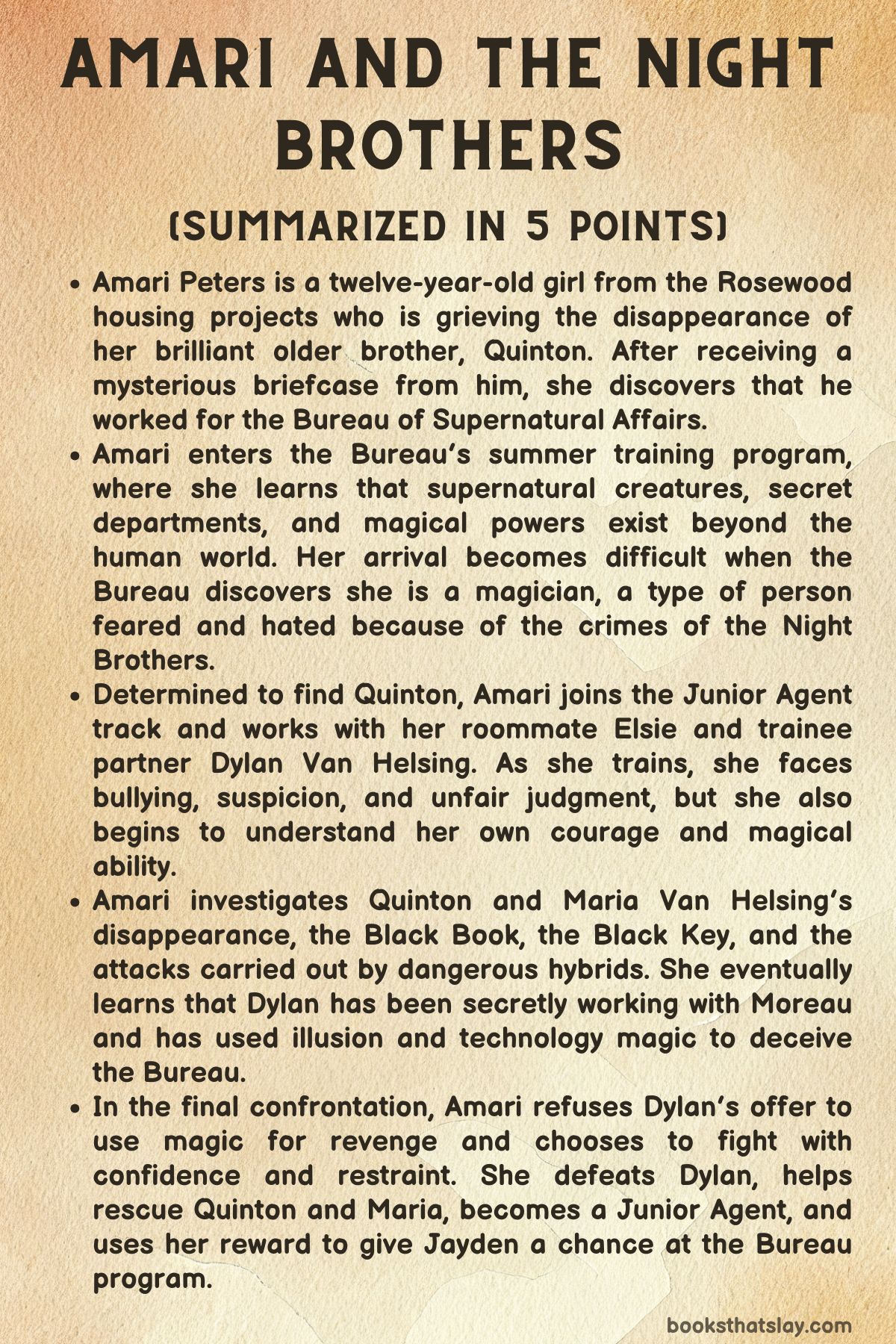
Summary
Amari Peters is twelve years old, angry, and tired of being treated like she does not belong. At Jefferson Academy, she is the only Black scholarship student, and her classmates often mock her for being poor and different.
The one person who always made her feel strong was her older brother, Quinton, a brilliant former Jefferson student who seemed destined for greatness. But Quinton has been missing for months, and when a girl cruelly jokes that he is probably dead, Amari finally loses control and shoves her.
At home in the Rosewood housing projects, Amari lives with her hardworking mother, who is already struggling with Quinton’s disappearance. Her mother wants Amari to keep her scholarship and build a better future, but Amari can barely think about school.
All she wants is to find Quinton. Then a strange delivery arrives: a briefcase from Quinton himself.
Inside is a pair of mysterious shades. When Amari puts them on, she enters an interactive recording made by her brother.
In it, Quinton shows her wonders she never imagined, including railways beneath the sea, and tells her that his work may have put him in danger. He has nominated her for something important, though the message ends before he can fully explain.
Amari follows the instructions in the briefcase and attends an interview. She learns that Quinton worked for the Bureau of Supernatural Affairs, a secret organization that protects the boundary between the human world and the supernatural one.
Every creature from legends and myths is real, and the Bureau keeps them hidden from ordinary humans. Quinton was a Special Agent in the Department of Supernatural Investigations.
His nomination gives Amari a chance to join the Bureau’s summer training program and compete for a future career there.
At first, Amari is amazed by the Bureau. It is filled with talking elevators, strange creatures, magical technology, and departments devoted to every kind of supernatural problem.
She meets Elsie Rodriguez, her roommate, who is a weredragon and a gifted inventor. Elsie becomes Amari’s first real friend in this new world.
She also explains that Quinton and his partner, Maria Van Helsing, were famous agents known together as VanQuish. They became legends after defeating Moreau, one of the terrifying Night Brothers, a pair of magicians who once caused great harm in the supernatural world.
Amari soon learns that magicians are hated and feared. During the trainee badge ceremony, each student receives a badge and a supernatural ability.
Amari expects a rare, powerful badge because her potential is unusually high. Instead, when she touches the Crystal Ball, it reveals that she is an active magician.
This is considered illegal. The Bureau’s leaders are shocked, and many want to imprison her simply because of what she is.
Director Van Helsing, Maria’s father, is especially hostile. Only Agent Magnus, Quinton’s friend, and Agent Fiona, who can read Amari’s intentions, defend her.
Since Amari only wants to find her brother, she is allowed to stay, but she must prove she belongs.
Amari chooses the Junior Agent track because it will bring her closest to Quinton’s case. Still, life at the Bureau is hard.
Many trainees judge her because she is poor, because she is not from a famous Bureau family, and because she is a magician. Lara Van Helsing, Maria’s younger sister, humiliates Amari and later becomes one of her cruelest enemies.
Dylan Van Helsing, Lara’s twin brother, is kinder and seems more willing to listen. Amari also receives secret messages from someone calling themselves magiciangirl18, who claims to know the truth about magicians.
As Amari begins training, she learns more about the danger surrounding Quinton and Maria’s disappearance. Someone claiming to be Moreau’s apprentice kidnapped them and demanded Moreau’s release along with a powerful object called the Black Book.
This book contains dangerous spells created by the Night Brothers. The Bureau refused the ransom.
Meanwhile, monster-human hybrids begin attacking the supernatural world, causing fear and panic.
Amari is allowed to question Moreau in prison, hoping he might reveal something about Quinton. He tells her that she is a born magician, an extremely rare person born with magic rather than given magic by someone else.
He tries to tempt her with power, suggesting she could punish everyone who has mistreated her. Amari is tempted for a moment because she knows what it feels like to be judged and humiliated.
But she refuses him. She wants to stand with Quinton, not become like Moreau.
The secret messenger is eventually revealed to be Dylan. He tells Amari that he is also a magician and that magic secretly runs in the Van Helsing family.
This comforts Amari because it proves that being a magician does not automatically make someone evil. Dylan teaches her about illusion magic and helps her practice.
The two become partners during the Junior Agent tryouts. In one test, Amari’s ability to look past appearances helps them succeed.
She refuses to attack a zombie that only looks threatening, recognizing that it is not dangerous. Later, she solves the true puzzle of the test by realizing that in a desert, water is the most valuable object.
Her intelligence and empathy help them win.
Despite her success, Amari continues to face hatred. Someone vandalizes her dorm room with a message saying magicians are not allowed.
She nearly quits, but Elsie and Dylan encourage her to keep going. At home, Amari also struggles with her mother’s grief and with the fact that she cannot reveal the truth about Quinton’s supernatural life.
Her old friend Jayden reminds her that she has always been special in her own way. Amari begins to understand that she has spent too long comparing herself to Quinton instead of seeing her own strengths.
The attacks by Moreau’s forces grow worse. Amari learns that Quinton once asked whether Maria might betray the Bureau, but Dylan insists his sister would never do that.
Amari also discovers that the Black Book can only be opened with the Black Key, which is protected by a secret Key Holder. Quinton had found out the Key Holder’s identity and hidden the information in a second briefcase.
If Amari becomes a Junior Agent, she will inherit Quinton’s Bureau belongings, including that clue.
During the final tryout, Amari is told she cannot demonstrate her supernatural ability because her magic is illegal. Instead of accepting this unfairness, she secretly performs an illusion demonstration.
She shows the audience her neighborhood, her family, and the truth of who she is. Her magic is beautiful and controlled, and she asks for the chance to prove that a magician can be good.
Just then, the Bureau is attacked by hybrids. A masked figure appears to steal the Black Book, and it seems to be Maria Van Helsing.
But Amari later realizes that something is wrong. The prisoner they believed was Moreau is only an apprentice disguised by illusion.
The real Moreau has been free all along.
Director Van Helsing blames Agent Magnus and removes Amari from her position, but Amari refuses to stop. She escapes with Dylan to find the Key Holder.
Elsie bravely helps them and, through that courage, begins her first step toward becoming a true weredragon. When Amari and Dylan reach the Key Holder’s location, the truth is revealed: Dylan has been Moreau’s apprentice.
He stole the Black Book himself and created the illusion of Maria to frame her. He is also a born magician, and he has lied to Amari from the beginning.
Moreau has Quinton and Maria trapped in a magical coma and is draining their life energy to resurrect his fellow Night Brother, Vladimir. Dylan asks Amari to join him.
He believes magicians should take revenge on everyone who has feared or mistreated them. Amari understands his anger, but she rejects his path.
She does not want to become cruel just because others have been cruel to her. When Moreau turns on Amari, Dylan steals Moreau’s magic, becoming even more powerful.
He asks Amari again to rule beside him, but she refuses.
Dylan attacks, intending to take her magic too. Amari nearly believes she must use harmful magic to survive, but then she remembers everything she has endured and everything she has learned about herself.
She chooses a better kind of power, one rooted in confidence instead of hatred. She uses her illusion magic with strength and creativity, summons many versions of herself, and defeats Dylan.
Afterward, Dylan is imprisoned. Maria wakes from the curse, and Quinton is rescued, though he remains in a coma.
Amari’s mother is finally brought into the supernatural world and allowed to see him. Through magic, Amari and her mother communicate with Quinton, who praises Amari and tells her how proud he is.
Maria explains that she and Quinton were not enemies; they had discovered Dylan’s suspicious actions and were taken before they could stop him.
Amari is honored by the Supernatural Congress for her bravery and officially becomes a Junior Agent. She also learns about the International League of Magicians, a hidden group separate from both the Bureau and Moreau.
Her journey is not over, especially with Dylan still alive and powerful, but Amari has changed. She no longer sees herself as someone living in Quinton’s shadow.
She is brave, talented, and ready to shape her own future. In a final act of generosity, she uses her reward from Congress to nominate Jayden for the same summer program, giving him the chance Quinton once gave her.
Characters
Amari Peters
Amari Peters is the central character of Amari and the Night Brothers, and her journey is built around the painful experience of being underestimated. At Jefferson Academy, she is treated as an outsider because she is Black, poor, and attending on scholarship.
At the Bureau of Supernatural Affairs, she faces a new version of the same prejudice when people discover she is a magician. This repetition is important because it shows that Amari’s struggle is not limited to one place; she keeps entering systems that already have fixed ideas about who deserves respect.
What makes Amari compelling is that she is not perfect or endlessly patient. She gets angry, doubts herself, and sometimes lashes out, but her anger comes from grief, fear, and exhaustion rather than cruelty.
Her love for Quinton drives much of the story, yet she eventually learns that finding him cannot be her only measure of worth. Amari’s growth comes through recognizing her own intelligence, courage, and moral strength.
She is tempted by power, especially when Moreau and Dylan suggest that magic could help her punish those who hurt her, but she chooses not to become a mirror of the people who mistreated her. By the end, Amari has become more than Quinton’s little sister.
She becomes a Junior Agent, a protector, and a young magician who wants to change the world without destroying it.
Quinton Peters
Quinton Peters is physically absent for much of the story, but his presence shapes nearly every part of Amari’s journey. To Amari, he is a brother, protector, role model, and symbol of everything she thinks she is not.
He succeeded at Jefferson Academy, earned admiration, entered the supernatural world, and became a famous Bureau agent. Because of this, Amari often compares herself to him and feels smaller.
Yet Quinton’s real importance is not just his brilliance; it is his generosity. He nominates Amari for the Bureau program because he believes she deserves to see a larger world and build a life beyond the limits others place on her.
He also helped Jayden, showing that he cared for his neighborhood and did not abandon the people around him after achieving success. His partnership with Maria shows his bravery and loyalty, while his investigation into Dylan’s suspicious behavior proves his moral seriousness.
Quinton functions as both a mystery and an emotional anchor. His disappearance gives the plot urgency, but his faith in Amari gives the story its emotional force.
When he finally communicates with her, his pride confirms what Amari has spent the story learning: she was never lesser than him, only different.
Elsie Rodriguez
Elsie Rodriguez is Amari’s roommate, friend, and one of the most emotionally significant characters in the story. As a weredragon who has not yet fully shifted, Elsie understands what it feels like to be feared for something she cannot control.
Other trainees avoid her because they are afraid of what she might become, just as many people fear Amari because she is a magician. This shared experience helps their friendship feel natural rather than convenient.
Elsie is gentle, nervous, inventive, and deeply loyal. Her skill as an inventor shows that courage is not her only quality; she is creative and intelligent in ways the Bureau sometimes overlooks.
Her ability to see emotions through auras also makes her sensitive to what others are feeling, which allows her to support Amari when Amari feels isolated. Elsie’s fear of bravery gives her personal arc weight.
She is not simply the cheerful best friend; she has her own struggle with self-belief. When she helps Amari and Dylan escape and begins to access her dragon abilities, it marks a turning point.
Elsie’s courage is quiet for much of the story, but when it matters, she proves that bravery is not the absence of fear. It is action taken despite fear.
Dylan Van Helsing
Dylan Van Helsing is one of the most complex characters in Amari and the Night Brothers because he moves from ally to betrayer while still remaining emotionally understandable. At first, he appears to be different from Lara and the rest of the privileged Bureau children.
He is kinder to Amari, shares her secret identity as a magician, teaches her spells, and becomes her partner. His friendship gives Amari comfort because he seems to prove that she is not alone.
However, Dylan’s kindness is mixed with manipulation from the beginning. He hides behind false messages, controls what Amari knows, and uses her trust to advance Moreau’s plans.
His betrayal hurts because it is personal, not just strategic. Dylan’s motivations come from pain and resentment.
As a born magician in a family and society that hates magicians, he has learned secrecy and bitterness. He believes revenge is justice, and he wants Amari to join him because he sees their shared magic as a bond stronger than morality.
Dylan is a warning about what can happen when justified anger becomes a desire to dominate others. He and Amari suffer similar prejudice, but they make opposite choices.
Amari chooses reform and protection; Dylan chooses revenge and control.
Lara Van Helsing
Lara Van Helsing is introduced as a privileged and cruel trainee who uses status as a weapon. She mocks Amari’s background, exposes private information, and tries to push her out of the Junior Agent program.
Lara’s prejudice is not only about magic; it is also tied to class and reputation. She sees Amari as someone who does not belong in elite Bureau spaces, and her behavior reflects the arrogance of someone raised inside a powerful family.
Yet Lara is not written as cruel without reason. Her anger is tied to Maria’s disappearance, and she blames Quinton for what happened.
This does not excuse her treatment of Amari, but it gives her hostility emotional roots. Her greatest fear is losing Maria forever, which reveals that beneath her confidence and cruelty is a grieving younger sister.
Lara’s later gratitude after Maria is saved suggests that she is capable of change, though the story does not erase the harm she caused. She represents the kind of person who inherits prejudice from family, fear, and social position, but who may still be forced to reconsider when the person she judged becomes the person who saves what she loves most.
Maria Van Helsing
Maria Van Helsing is a legendary Special Agent and Quinton’s partner, known as one half of VanQuish. For much of the story, she exists as a figure of suspicion.
Because Quinton had questions about whether she might betray the Bureau, and because an illusion makes it seem as though she steals the Black Book, the reader is encouraged to wonder about her loyalty. The truth restores her role as a brave and honorable agent.
Maria’s importance lies in the contrast between appearance and reality. She is accused, doubted, and used as a false image by Dylan, but she is not the villain.
Like Amari, she is a magician connected to a world that fears magic, and she has had to live with secrecy. Her decision to pass magic to Dylan becomes tragic because he uses that power for betrayal.
Maria also expands Amari’s understanding of magicians by telling her about the International League of Magicians, showing that magician identity is larger than Moreau, Dylan, or the Bureau’s fear. Maria is a bridge between past and future: she carries the legacy of Bureau heroism, the hidden history of magicians, and the promise that Amari’s path is only beginning.
Mama
Mama is Amari and Quinton’s mother, and she grounds the story in real family struggle. She works long hours at the hospital, tries to protect Amari’s future, and carries the heavy grief of not knowing what happened to her son.
Her belief in education comes from love and fear. She knows that Amari’s scholarship could open doors, and she worries that losing it will narrow Amari’s chances.
At the same time, she cannot fully understand what Amari is going through because the supernatural world is hidden from her. This creates painful distance between them.
Amari wants to comfort her mother and explain that she is trying to find Quinton, but secrecy prevents honesty. Mama’s role also reminds the reader that adventure has emotional costs.
While Amari enters magical spaces, her mother remains at home with unanswered questions. When Mama is finally allowed into the supernatural world and can communicate with Quinton, it brings emotional relief.
She represents unconditional love, sacrifice, and the pain families endure when systems keep them powerless and uninformed.
Agent Magnus
Agent Magnus is one of the first Bureau adults to treat Amari with real seriousness. As Quinton’s friend and colleague, he carries a sense of responsibility toward her, but his support goes beyond loyalty to Quinton.
He defends Amari when the Bureau’s leaders are ready to judge her as dangerous simply because she is a magician. Magnus is important because he shows what adult allyship should look like: he does not pretend the system is fair, but he also does not abandon Amari to it.
He warns her that people will judge her through prejudice, yet he gives her room to prove herself. His trust matters when he promotes her to Junior Agent and gives her access to Quinton’s briefcase.
When Director Van Helsing accuses him of betrayal, Magnus’s willingness to surrender for Amari’s safety reveals his integrity. He is not the loudest or most magical character, but he offers steadiness in a world full of suspicion.
Through Magnus, the story shows that institutions may be flawed, but individuals inside them can still choose courage, fairness, and loyalty.
Agent Fiona
Agent Fiona is a mentor figure whose strength comes from perception, wisdom, and calm authority. Her supernatural ability allows her to read intentions, but her real value lies in how she uses that insight.
When others fear Amari’s magic, Fiona sees that Amari’s true purpose is to find Quinton. This gives Amari a chance when many adults would rather lock her away.
Fiona also helps Amari develop the emotional qualities needed to become a Junior Agent. She encourages gumption, courage, and clear thinking rather than blind obedience.
Unlike Director Van Helsing, Fiona does not confuse caution with prejudice. She understands danger, but she also understands that judging a child by history and stereotype is unjust.
Her willingness to let Amari speak to Moreau shows that she can take risks when those risks are guided by reason. Fiona represents a better model of authority: firm, careful, but open-minded.
Her presence helps Amari believe that not every adult at the Bureau is against her.
Director Van Helsing
Director Van Helsing represents institutional prejudice and the fear-based thinking that dominates much of the Bureau. As the head of the Department of Supernatural Investigations and the father of Maria, Dylan, and Lara, he carries both public authority and private grief.
His hatred of magicians is intense, and he repeatedly treats Amari as guilty before she has done anything wrong. His suspicion is partly shaped by the history of the Night Brothers, but he applies that history unfairly to Amari.
In doing so, he becomes one of the clearest examples of how institutions justify discrimination by calling it safety. He is not simply cautious; he is unwilling to see Amari as an individual.
This makes his authority dangerous. His accusations against Magnus and his demotion of Amari show how quickly power can be misused when leaders are guided by fear.
At the same time, his family’s hidden connection to magic adds irony to his character. The very thing he condemns exists inside his own household.
Director Van Helsing’s role is to show that prejudice can survive even in people who believe they are protecting the world.
Moreau
Moreau is one of the Night Brothers and the story’s most direct symbol of corrupted power. He believes magic gives him the right to dominate others, and he uses fear, manipulation, and violence to pursue that goal.
His influence reaches far beyond his physical presence because the supernatural world’s hatred of magicians is largely shaped by what he and Vladimir once did. Moreau is dangerous not only because of his magic but because he understands wounded people.
When he speaks to Amari, he recognizes her anger and tries to turn it into loyalty. He offers her the fantasy of punishing everyone who has mistreated her.
This makes him a psychological threat as much as a magical one. He does not simply attack; he tempts.
His false imprisonment also shows his cunning, as the Bureau believes it has contained him while he continues working through deception. Moreau’s failure comes from underestimating Amari’s moral strength and Dylan’s ambition.
He creates a world where power is everything, and that same belief allows Dylan to turn against him.
Vladimir
Vladimir, the other Night Brother, is less present than Moreau but remains central to the danger driving the plot. His possible resurrection represents the return of an older terror, one that the supernatural world has not fully recovered from.
Even though he does not act directly through most of the story, his name carries fear because of what the Night Brothers once represented: unchecked magical power, immortality gained through cruelty, and war against the supernatural world. Moreau’s plan to bring him back shows that the conflict is not just about one villain escaping justice.
It is about the possible restoration of a destructive partnership. Vladimir functions as a shadow over the story, raising the stakes and reminding the reader why the Bureau fears magicians so intensely.
At the same time, the fear attached to Vladimir also contributes to the unfair treatment of innocent magicians like Amari. His legacy is therefore double-edged: he is a real threat, but the memory of that threat becomes a reason for society to condemn people who have done nothing wrong.
Jayden
Jayden is Amari’s childhood friend and a reminder of the world she comes from before entering the Bureau. His life shows what can happen when young people lack support, protection, and opportunity.
Without Quinton’s tutoring and guidance, Jayden begins drifting toward older boys who offer money and belonging, even if that path is dangerous. Amari’s concern for him shows that her mission is not selfish.
She wants Quinton back for herself and her mother, but she also understands that Quinton mattered to others in the neighborhood. Jayden also plays an important role in Amari’s self-recognition.
He helps her see that she is already admired in Rosewood and that she has been measuring herself unfairly against Quinton. His belief in her challenges her low self-image.
By using her reward to nominate Jayden for the summer program, Amari continues Quinton’s pattern of opening doors for others. Jayden represents the importance of opportunity and the way one person’s belief can redirect another person’s future.
Madame Violet
Madame Violet is a mysterious and wise figure connected to illusion magic. As the author of Amari’s spell book, she represents magical knowledge outside the Bureau’s official control.
Her meeting with Amari is brief but significant because she gives guidance that later helps Amari expose the illusion surrounding Moreau. Madame Violet’s warning teaches Amari not to trust surfaces, especially when something seems too neat or too performative.
She also requires a secret as payment, which makes her feel connected to an older, stranger magical tradition where knowledge has a cost. Through her, Amari gains more than a practical clue; she gains insight into how illusionists must think.
Madame Violet’s role reinforces one of the story’s key ideas: seeing clearly means questioning appearances. In a world where people constantly misread Amari, her magic becomes a way to reveal truth as well as create images.
Becca Alford
Becca Alford is a Ranger from the Department of Creature Control who serves as a small but meaningful example of changed perception. When she witnesses Amari using illusion magic intelligently during the tryout, she admits that Amari has shown her magicians are not all bad.
This moment matters because it proves that Amari’s actions can challenge prejudice. Becca does not become a major mentor or central ally, but her response shows the first signs of social change.
She represents people who may carry assumptions because of what they have been taught, yet are still open to evidence and personal experience. In a story filled with characters who cling to fear, Becca’s willingness to revise her view is important.
It suggests that Amari’s hope of changing the supernatural world is difficult but not impossible.
Themes
Prejudice, Stereotypes, and Belonging
Amari’s life is shaped by people deciding who she is before they know her. At Jefferson Academy, her classmates judge her because she is Black, poor, and from the Rosewood housing projects.
They treat her scholarship as proof that she is an outsider rather than evidence of her ability. When she enters the Bureau, the form of prejudice changes, but the structure remains familiar.
Once Amari is revealed as a magician, many people assume she is dangerous, corrupt, or connected to evil. The Bureau claims to value justice and protection, yet its leaders are ready to punish a child for a power she did not choose.
This parallel gives the theme emotional force because Amari recognizes the pattern immediately. She has already lived through being reduced to a label.
Amari and the Night Brothers uses the supernatural world to make real social prejudice visible in a new form. Magicians are feared because of the actions of the Night Brothers, but the story asks whether fear of history justifies present injustice.
Amari’s struggle to belong is not about proving she is harmless enough to be accepted; it is about demanding to be seen as a full person. Her success challenges the Bureau’s assumptions, but the story also shows that changing a society’s mind requires more than one heroic act.
Self-Belief and Identity
Amari begins the story measuring herself against Quinton. He is brilliant, admired, successful, and almost legendary in both the human and supernatural worlds.
To Amari, this makes him inspiring but also impossible to match. Her grief makes this worse because finding Quinton becomes tied to proving that she is worthy of him.
At first, she sees her own talents only in relation to his achievements, which prevents her from recognizing her individual strengths. The Bureau intensifies this insecurity by ranking trainees, assigning badges, and constantly comparing families, abilities, and reputations.
Amari’s magic also complicates her identity because society tells her that being a magician means being dangerous. She must decide whether to define herself through other people’s fear or through her own choices.
Her growth comes when she understands that power does not determine character. Neither does background, family name, school record, or public opinion.
The most important shift happens when she stops trying to be Quinton and begins trusting herself as Amari. Her illusion magic reflects this inner development.
It works best when she believes in herself, which turns self-confidence into both an emotional and magical necessity. By the end, Amari’s identity is no longer built from comparison.
It is built from courage, imagination, loyalty, and choice.
Power, Choice, and Moral Responsibility
Magic in the story is not treated as automatically good or evil. It is powerful, dangerous, creative, and deeply connected to the person who uses it.
This makes choice one of the central moral questions of the novel. Amari, Dylan, Moreau, and Maria are all connected to magic, but they use or understand it in very different ways.
Moreau sees power as a right to rule. Dylan sees power as a way to answer humiliation with revenge.
Maria hides her magic while serving the Bureau, suggesting that power can exist alongside duty and restraint. Amari must decide what her own magic will mean.
Her temptation is believable because she has been bullied, insulted, excluded, and threatened. When Moreau and Dylan offer her a path where she never has to feel powerless again, the offer touches a real wound.
The story does not pretend anger is wrong by itself. Instead, it asks what anger becomes when joined with power.
Amari’s refusal to use cruelty as justice defines her heroism. She understands that harming others would not repair the harm done to her.
Her final victory matters because she wins without surrendering her values. The theme argues that power reveals character, but it does not replace responsibility.
Family, Loyalty, and Chosen Bonds
Family drives the emotional center of the story, but family is shown in more than one form. Amari’s love for Quinton begins the quest, and her bond with Mama gives the story its emotional grounding.
Their family is marked by absence, secrecy, and grief, yet also by deep loyalty. Mama works hard to protect Amari’s future, while Amari risks everything to bring Quinton home.
The Van Helsing family offers a different picture of family legacy. Their name gives them status, but it also hides secrets, pressure, resentment, and betrayal.
Lara’s cruelty is tied to her fear of losing Maria, while Dylan’s betrayal grows partly from isolation within a family and society that cannot accept what he is. The story also values chosen bonds.
Elsie becomes Amari’s loyal friend not because she is fearless, but because she understands loneliness and chooses to stand beside Amari. Agent Magnus and Agent Fiona act as protective mentors when the institution around Amari fails her.
Even Jayden’s connection to Amari and Quinton shows how care can extend beyond a household into a community. Loyalty, however, is not blind.
Amari cares for Dylan, but she refuses to follow him into revenge. The story’s strongest bonds are built not only on love, but on trust, honesty, and moral choice.