American Moor Summary, Characters and Themes
American Moor is a stage play by Keith Hamilton Cobb about a Black actor auditioning for the role of Othello under the eye of a young white director. The work uses that audition room as a sharp, personal, and often painful space where questions of race, authority, art, age, and Shakespearean tradition collide.
The actor is not only trying to perform Othello; he is trying to protect the character from shallow interpretation. American Moor becomes a reflection on who gets to explain Blackness, who gets heard in rehearsal rooms, and what it costs to keep translating one’s truth for people who refuse to listen.
Summary
American Moor centers on a Black, middle-aged actor who stands alone onstage with a copy of Shakespeare’s Othello. He begins by rehearsing quietly, then becomes aware of the audience and starts speaking directly to them.
From the beginning, the play makes clear that this is not simply an audition. It is a confrontation with theater history, racial assumptions, and the narrow ways Black men are often seen by white institutions.
The Actor recalls first encountering Shakespeare in college. He was taught that acting means reacting, but for him that lesson carries a deeper weight.
As a Black man in America, he is always reacting to the world around him: to prejudice, surveillance, fear, expectation, and the constant pressure to manage how others perceive him. Shakespeare’s language gives him a way to release feelings he often cannot express openly.
He admires how Shakespeare’s characters can say cruel, ugly, or dangerous things in beautiful language, and he finds freedom in that contradiction.
He remembers an early acting class in which he was asked to perform a Shakespeare monologue. Instead of choosing a male role that others expected of him, he chose Titania from A Midsummer Night’s Dream.
His teacher repeatedly interrupted him, suggesting that he was not speaking the poetry correctly. The Actor wanted to challenge the teacher’s limited ideas about Shakespeare, but he held back.
He knew that if he showed anger or even changed his tone too much, a Black man’s emotion could be judged as threatening. The scene becomes an early example of what the Actor has spent his life doing: restraining himself so others will not punish him for being honest.
The teacher then pushed him toward roles supposedly closer to his “experience,” such as Aaron from Titus Andronicus or Morocco from The Merchant of Venice. The Actor understands the implication.
For a Black actor, Shakespeare’s great range of human experience is often narrowed down to a few racialized figures. He wanted access to the full world of Shakespeare, but the people training him were already deciding what kinds of roles he was allowed to inhabit.
The present-day audition begins when the Director, a young white man, interrupts the Actor’s thoughts. He asks whether he can make anything clearer before they begin.
The Actor is irritated by the question because he is nearly fifty and has decades of experience. He has watched less skilled actors audition before him, and he senses that the Director believes any Black man can play Othello as long as he fits the visible requirement of the role.
The Actor is aware of the power imbalance: the Director can judge him, instruct him, and dismiss him, while the Actor has no equal power to question whether the Director understands Othello at all.
The Director explains the emotional tone he wants. He speaks of jealousy, irrationality, and excess.
The Actor responds by performing Othello’s speech about how he and Desdemona fell in love. In this speech, Othello defends himself before the Senate and denies that he used magic to win Desdemona.
Instead, he explains that she loved him because she listened to his stories and understood his suffering. The Actor plays the moment with control and dignity, not with theatrical exaggeration.
The Director is unsatisfied. He asks the Actor to do it again, but with more charm, as if Othello is trying to win over the Senate.
The Actor immediately understands the problem. The Director wants Othello to perform for the white men in power, to make himself pleasing and acceptable.
To the Actor, this is a false reading. Othello is not merely begging for approval.
He is a man of rank, skill, history, and strength. He knows his worth, even though he is surrounded by men who reduce him to race.
As the audition continues, the Actor struggles between professional obedience and personal truth. He knows that actors are expected to accept direction, but he also knows that this Director’s notes come from assumptions about Black masculinity rather than real understanding.
When the Director asks for the “right” energy, the Actor silently asks: right for whom? The question sits at the heart of American Moor.
The Actor is not refusing craft or collaboration. He is refusing to flatten Othello into a familiar image of a dangerous, unstable Black man.
The Actor explains to the audience that Othello’s appearance before the Senate is already loaded with humiliation. Brabantio, Desdemona’s father, has treated Othello’s stories almost like entertainment, enjoying the exotic image of the Black soldier until Desdemona loves him.
The Actor believes Desdemona sees Othello’s quiet strength in this situation. She sees the dignity it takes for him to stand in front of people who need him yet still look down on him.
The Director, however, keeps asking for heightened emotion. He also criticizes the Actor’s pronunciation, asking him not to use softer Rs because it sounds too British.
This takes the Actor back to his younger self, when he would have done almost anything to please directors. As a young actor, he dreamed of playing Hamlet, Prince Hal, and other major roles.
Instead, he was often sent to auditions for crude or stereotyped Black characters. He remembers how tall Black actors are often asked if they have played Othello, much as tall Black men are asked if they play basketball.
At first, the Actor did not want Othello. He was disturbed by the idea that people thought he would be great as a jealous murderer.
He felt ashamed to be linked to a character who, in many productions, seemed barely different from racist stereotypes. Over time, however, his view changed.
A Black elder helped him understand that white audiences and white institutions would keep seeing things in him whether or not those things were truly there. Because of that, the Actor began to feel protective of Othello.
If he was going to be called to this role again and again, he wanted to defend the man inside it.
The Actor argues that Othello does not need to be submissive before the Senate. He is valuable to Venice.
He is a military leader, a prince, and a man whose service is needed. The Director continues to resist this interpretation.
The Actor grows more frustrated, not only because he feels misunderstood, but because he sees the Director repeating centuries of shallow readings. He believes that most productions have focused on Othello as a jealous killer rather than asking what kind of world produces his resentment, isolation, and collapse.
The Actor does not deny that Othello commits a terrible act. Instead, he insists that the character must be treated as fully human before the tragedy can mean anything.
He imagines an Othello capable of joy, playfulness, sensuality, pride, and tenderness. He imagines Othello lifting Desdemona in happiness, not simply standing as a symbol of violence.
Yet even this imagined joy turns painful. The Actor’s body reminds him of age; he feels aches and limitations.
His own aging becomes linked with Othello’s awareness of vulnerability. Both men carry power, but both also feel the cracks forming under pressure.
The Actor reflects on his unrealized dreams and on the social structures that limited him. He has spent a life in an art form that claims to value transformation while repeatedly telling him what he is allowed to be.
He wonders why he keeps trying to redeem Othello when some Black elders question whether Shakespeare could ever have truly loved a man like him. Still, the Actor feels drawn to the role.
He feels Othello speaking through him, and he feels his own Blackness speaking through Othello. To him, those forces meet inside his body and voice.
Eventually, the Actor directly challenges the Director’s authority. He asks whether the Director can speak about Othello’s complexity without simply calling him crazy.
When the Director tells him to listen, the Actor interrupts and says that the Director is the one who needs to listen. Their voices overlap, turning the audition into a clash between institutional control and lived knowledge.
Near the end, the Actor tells a story about his parents taking community college classes as seniors. He once asked his father why they did not take a class on The Adventures of Huckleberry Finn.
His father answered that he did not need to hear white people talk to him about Black people. The Actor feels deep kinship with that response.
It captures what he has been trying to say throughout the play: there is a special exhaustion in listening to people explain your own reality back to you with confidence and ignorance.
The Actor wants something more than a job. He wants real collaboration.
He wants the Director to admit what he does not know, to question inherited assumptions, and to build an Othello that is alive rather than recycled. He wants theater to become a place where Black experience is not used as decoration or evidence, but respected as knowledge.
The audition ends without resolution. The Director thanks the Actor for coming in, and the Actor acknowledges him.
The scene fades, leaving the audience with the sense that the Actor has likely not won the role, but has spoken a truth larger than the audition. American Moor closes as a meditation on performance, race, and the burden of being asked to prove one’s humanity in rooms where others still hold the power to decide what counts as art.
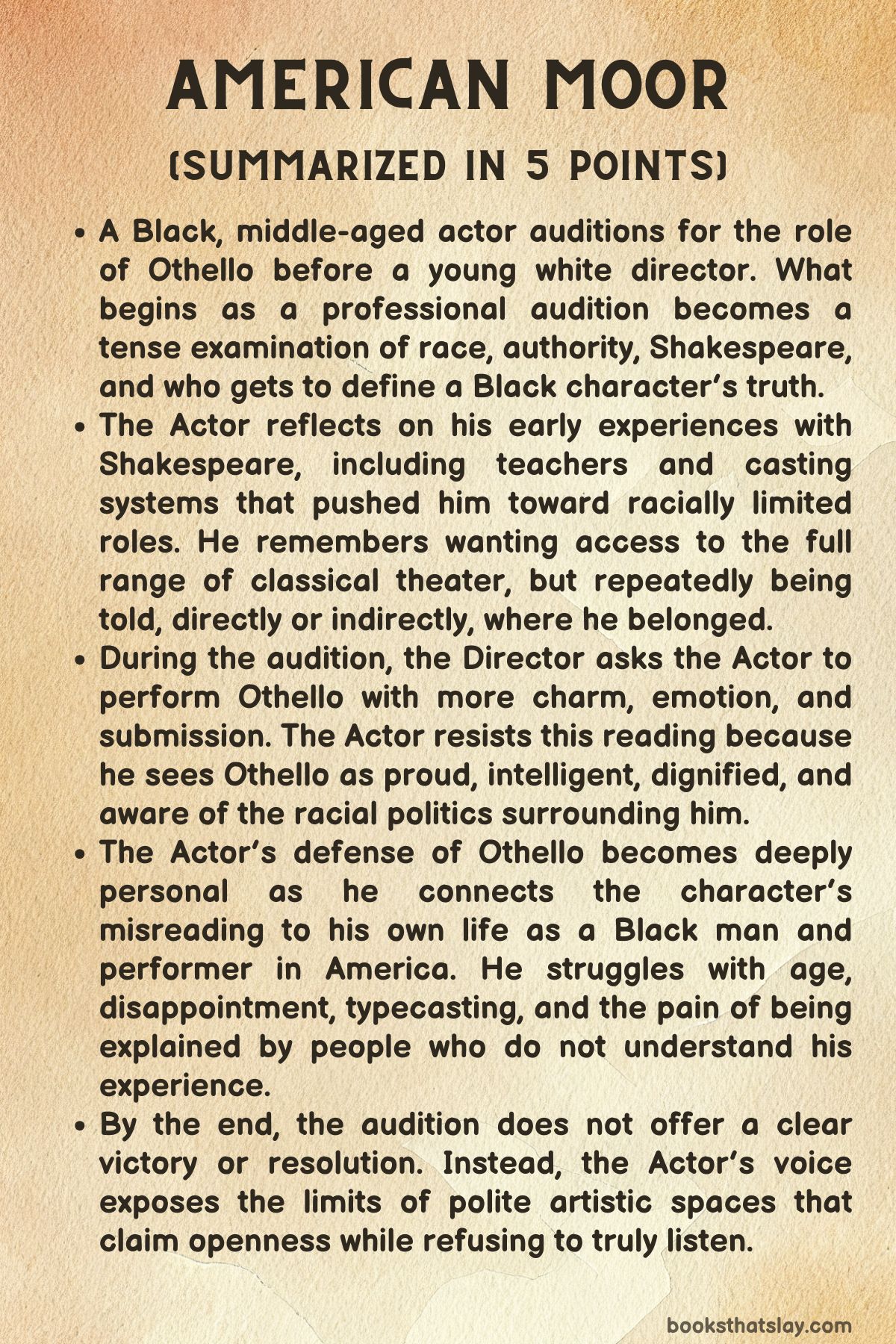
Key People
The Actor
The Actor is the central figure of American Moor, and nearly every emotional, intellectual, and dramatic force in the play passes through him. He is a Black, middle-aged stage actor auditioning for Othello, but his role in the work is much larger than that basic situation suggests.
He is performer, critic, witness, teacher, and wounded professional all at once. His intelligence is clear from the way he understands Shakespeare not as distant literary decoration, but as living speech that must be directed toward other human beings.
He rejects hollow, polished recitation and wants the language to carry thought, need, anger, memory, and pressure. His artistic standards are high, and his frustration comes partly from knowing that those standards are rarely recognized when he enters rooms controlled by people with narrower assumptions.
The Actor’s deepest conflict is between obedience and truth. As an actor, he is expected to listen to the Director, accept notes, and adjust his performance.
As a Black man, however, he recognizes that some of those notes are not neutral artistic suggestions. They come from a long history of white interpretation deciding what Black emotion, Black masculinity, and Black suffering should look like.
This makes the audition painful because he is not merely being asked to perform differently; he feels he is being asked to misrepresent a character whose experience he understands more fully than the Director does. His restraint is therefore both professional and social.
He knows how dangerous it can be for a Black man to show anger in front of white authority, so he turns much of his fury inward or redirects it toward the audience.
His relationship with Othello changes over time. In youth, he resists the role because he sees how easily it can confirm racist ideas: the jealous Black man, the violent husband, the unstable outsider.
He does not want to be praised for seeming suited to that image. Later, however, he becomes protective of Othello.
He begins to see the character as a man who has been misread for centuries, reduced by directors, audiences, and traditions that emphasize his violence without honoring his dignity, loneliness, discipline, intelligence, and history. The Actor’s desire to redeem Othello is also a desire to redeem himself from the limits placed on him.
His body, voice, race, age, and artistic experience all become part of the same struggle: to be seen whole.
The Actor is also marked by age and disappointment. He has lived long enough to know how the theater industry works and how often it fails artists like him.
His aching body reminds him that time has passed, and many of the roles he wanted may never come. Yet he is not defeated.
Even when the audition collapses, he claims authority through speech. He speaks with the urgency of someone who has been ignored too often but still believes that art can change if people truly listen.
His tragedy lies in the fact that his knowledge may not win him the role, but his power lies in the fact that he refuses to make himself smaller just to be accepted.
The Director
The Director appears mainly as a voice, but his presence shapes the entire action of the play. He is young, white, male, and positioned as the authority in the audition room.
This makes him powerful even though he is less experienced than the Actor. His role is not simply to represent one bad director or one rude individual.
He represents a larger cultural structure in which people with institutional power often assume they have the right to define stories they do not fully understand. He speaks politely, but his politeness does not erase the imbalance in the room.
In fact, his calm professional tone often makes the imbalance sharper because it hides authority inside ordinary rehearsal language.
The Director believes he is giving useful artistic guidance. He asks for more charm, more emotional display, and a clearer sense of jealousy or instability.
From his perspective, he may think he is helping the Actor reach a familiar version of Othello. The problem is that his familiarity is part of the harm.
He has inherited a reading of Othello that treats the character’s Blackness as dramatic evidence of danger, excess, or emotional weakness. He does not seem aware that his notes ask the Actor to perform a version of Black masculinity shaped by white expectation.
His failure is not only ignorance but confidence. He assumes that his interpretation is objective, while the Actor’s resistance looks to him like difficulty, ego, or lack of cooperation.
The Director’s youth is important because it reverses what one might expect from experience. The older Actor has lived with Shakespeare, performance, racism, and professional rejection for decades.
The younger Director has the job title. This means the Director’s authority does not come from deeper knowledge; it comes from the system that allows him to decide.
He can thank the Actor, dismiss him, and move on, while the Actor must carry the emotional cost. The Director may not intend cruelty, but the play shows that harm does not always require open hatred.
It can come through shallow interpretation, careless certainty, and the refusal to hear what another person is offering.
At his most important dramatic level, the Director functions as a test of listening. The Actor repeatedly tries to give him insight, not just complaint.
He wants the Director to understand that Othello cannot be staged honestly without facing race, power, and historical misreading. The Director fails because he keeps trying to manage the audition rather than receive the knowledge being offered.
By the end, his polite dismissal reveals the limits of the room. He can hear the Actor’s words as interruption, but not as wisdom.
That inability makes him one of the play’s quiet antagonistic forces.
Othello
Othello is not physically present as a separate character, but he is one of the most important figures in the play because the Actor keeps arguing with, defending, and reimagining him. He exists both as Shakespeare’s character and as a cultural symbol shaped by centuries of performance.
The Actor sees Othello as a man trapped beneath other people’s readings. For many audiences and directors, Othello is remembered mainly as the jealous husband who murders Desdemona.
The Actor does not excuse that violence, but he insists that such a narrow view destroys the character’s full humanity. Othello must also be understood as a soldier, leader, outsider, lover, storyteller, and man forced to measure himself in a hostile social world.
The Actor’s version of Othello is proud and self-possessed. When Othello stands before the Senate, the Actor does not see him as a desperate man begging for acceptance.
He sees a valuable military figure who understands that Venice needs him. This changes the meaning of the scene.
Othello may be racially vulnerable, but he is not weak. He has dignity, command, and experience.
He knows he is being judged, but he also knows his own worth. The Actor’s reading gives Othello a deep inner life that standard interpretations often ignore.
Othello also becomes a mirror for the Actor’s own life. Both men are Black men standing before white authority, expected to explain themselves in controlled language while suppressing the anger caused by humiliation.
Both are treated as useful when their talents serve the system and suspect when their inner lives become visible. The Actor feels that he and Othello share the burden of being watched, interpreted, and misread.
This is why he feels responsible for protecting Othello from another careless production. To misplay Othello is not simply to misunderstand Shakespeare; it is to repeat a cultural injury.
At the same time, Othello is not treated as perfect. The Actor recognizes his tragic flaws, his insecurity, his pain, and his final act of violence.
What he resists is the idea that these flaws belong to him because he is Black. The play asks audiences to separate Othello’s humanity from racist expectation.
Othello matters because he becomes the site where art, race, history, and identity meet. The Actor’s defense of him is an attempt to give him the complexity that every tragic figure deserves.
Desdemona
Desdemona is also absent from the stage, but she holds great importance in the Actor’s interpretation of Othello. She is not discussed merely as the wife who is killed, though that fate shadows every mention of her.
For the Actor, Desdemona is the person who sees something in Othello that others fail or refuse to see. Her love is not based on simple fascination with exotic stories, nor is it only youthful rebellion against her father.
The Actor imagines her as someone who recognizes the quiet strength it takes for Othello to stand before people who belittle him while pretending to honor him.
This interpretation gives Desdemona more perception than many traditional readings allow. She sees Othello’s dignity under pressure.
She understands the emotional cost of his public performance before the Senate. Where Brabantio treats Othello’s stories as entertainment and the Senate treats him as useful, Desdemona responds to the man beneath those roles.
Her compassion becomes central to the Actor’s understanding of why Othello loves her and why her love matters. She offers him recognition, not merely romance.
Desdemona also represents the possibility of being truly seen across social boundaries. In the Actor’s mind, her love is powerful because it interrupts the world’s misreading of Othello.
Yet that possibility is fragile. Her presence cannot protect Othello from the deeper forces of suspicion, racial isolation, and internalized injury.
The tragedy of her character, as filtered through the Actor’s analysis, is that seeing Othello truly is not enough to save either of them. Her love matters, but it exists inside a society already prepared to doubt and distort their relationship.
Through Desdemona, the play also questions the audience’s own habits of perception. If she can see Othello’s humanity, why have so many productions failed to do the same?
If she can recognize his strength without reducing him to spectacle, why does the Director struggle to do so? Desdemona becomes a measure of moral and imaginative vision.
She is important less because she acts in the present audition and more because the Actor uses her to show what a fuller reading of Othello requires.
Brabantio
Brabantio appears through memory and interpretation, but he is crucial to the racial and social structure surrounding Othello. He is Desdemona’s father, a white Venetian authority figure who enjoys Othello’s stories until Othello becomes part of his family.
The Actor’s reading of Brabantio exposes the difference between fascination and respect. Brabantio can listen to Othello’s adventures, enjoy his difference, and invite him into social spaces, but that welcome has limits.
Once Desdemona loves Othello, Brabantio’s interest turns into accusation.
This makes Brabantio a figure of conditional acceptance. He accepts Othello as guest, soldier, and storyteller, but not as equal.
He can admire Othello’s usefulness or exotic appeal, yet he cannot accept him as a man worthy of his daughter’s desire. His accusation that Othello must have used witchcraft reveals the racism beneath his civility.
He would rather believe in magic than accept Desdemona’s independent love for a Black man. This is why the Actor links Brabantio’s behavior to broader social habits: white society often welcomes Black talent when it entertains, serves, or protects, but resists Black intimacy, power, and equality.
Brabantio also helps the Actor explain the humiliation embedded in Othello’s public defense. Othello must explain his marriage in front of powerful men because Brabantio refuses to believe that the relationship could be natural or mutual.
The Actor recognizes this as a familiar racial burden. Black people are often asked to justify themselves in spaces where the accusation is already shaped by prejudice.
Brabantio’s disbelief forces Othello into performance, and that performance becomes one of the key scenes the Actor wants the Director to understand.
As a character in the Actor’s analysis, Brabantio is not simply an angry father. He is a symbol of the polite world that turns hostile when its racial boundaries are crossed.
His importance lies in showing how prejudice can hide behind manners, family honor, and social order. He helps reveal why Othello’s dignity before the Senate is so important and why the Actor refuses to play the scene as simple pleading.
The Acting Teacher
The Acting Teacher from the Actor’s youth is a small but revealing presence. This figure appears in memory as someone who helps shape the Actor’s early understanding of how theater limits Black performers.
When the Actor performs Titania, the teacher keeps correcting him and implies that he is not properly speaking the poetry. The issue is not only technical.
The teacher’s response suggests discomfort with the Actor’s freedom to choose a role outside racial expectation. Instead of encouraging exploration, the teacher pushes him toward characters marked by race and villainy.
The Acting Teacher represents the educational version of the same problem later embodied by the Director. Both figures claim authority over Shakespeare.
Both assume they can tell the Actor where he belongs. Both fail to understand that their artistic judgments are shaped by social assumptions.
The teacher’s suggestion that the Actor choose something closer to his experience sounds reasonable on the surface, but it carries a narrow idea of what a Black actor’s experience can be. It denies him access to the full imaginative range that Shakespeare is supposed to offer.
This character is important because the Actor’s later frustration did not begin in the audition room. It has been built over years of training, casting, correction, and exclusion.
The Acting Teacher is one of the first people to teach him that the theater may praise universality while practicing limitation. The Actor remembers wanting to speak back, but he also remembers the danger of doing so.
Even in a classroom, he has to measure his tone and manage how his emotion might be received.
The teacher’s influence remains with him because it shows how early artistic wounds can become lifelong burdens. The Actor’s fight in the present is not only with one Director; it is with every gatekeeper who told him that Shakespeare’s full humanity belonged to others, while he should stay inside roles already marked as Black, threatening, or strange.
The Actor’s Father
The Actor’s father appears briefly, but his presence carries great emotional and thematic force. He participates in community college classes as a senior citizen, showing curiosity and a continued desire to learn.
Yet when the Actor asks why he does not take a class on The Adventures of Huckleberry Finn, his father answers that he does not need to hear white people talk to him about Black people. This response becomes one of the clearest expressions of the play’s central frustration.
The father’s statement is not anti-learning. It is a refusal of a specific kind of instruction: the kind in which white voices claim authority over Black life while Black listeners are expected to sit politely and receive it.
His answer gives the Actor a language for what he has been experiencing in the audition. The Director is, in effect, explaining a Black man to a Black man.
He is explaining Othello’s emotional life while ignoring the Actor’s lived and artistic knowledge. The father’s wisdom helps the Actor understand that his anger is not isolated or irrational.
It belongs to a longer history.
The father also represents generational continuity. The Actor feels kinship with him because both men understand the exhaustion of being interpreted by those who do not know enough but speak with confidence.
His father’s plain statement cuts through academic politeness and theatrical professionalism. It names the problem directly.
In doing so, he becomes a grounding figure for the Actor, someone whose lived clarity contrasts with the Director’s polished misunderstanding.
Though he is not present in the audition room, the father’s influence strengthens the Actor’s final argument. He reminds the Actor that refusing false authority can be an act of self-respect.
His role is small in terms of plot, but large in moral weight.
The Actor’s Black Elders
The Actor’s Black elders function as voices of memory, challenge, and guidance. They are not developed as individual characters, but they represent a community of people who have lived with the consequences of racial representation and survival.
Some of them question why the Actor wants to redeem Othello at all. From their perspective, Othello is a character created within a tradition that has often harmed Black people.
They wonder why the Actor gives so much love and labor to a figure that may have been born from a white imagination unable to fully love him back.
Their challenge matters because it prevents the Actor’s defense of Othello from becoming simple admiration. The Actor is forced to confront the possibility that his attachment to the role may be painful, complicated, or even unwise.
He must ask whether he is freeing Othello or still working inside a structure that was never built for him. This tension makes his artistic mission more complex.
He is not blindly loyal to Shakespeare; he is actively wrestling with what it means to claim space inside Shakespeare.
The elders also provide wisdom about how white perception works. One elder tells the Actor that the white gaze will always want to see certain things in him, whether or not they are truly there.
This insight changes how he understands Othello. Instead of rejecting the role entirely, he realizes that the harmful image already exists and will continue to be projected onto Black men.
His response is to fight from within the role, to give Othello the humanity that shallow readings deny.
These elders are important because they connect the Actor’s individual experience to a wider Black historical consciousness. They remind him that representation is never neutral, that art can wound as well as liberate, and that every attempt to reclaim a character comes with risk.
Themes
Race, Authority, and the Right to Interpret
The audition room becomes a space where artistic authority and racial authority are almost impossible to separate. The Director has the formal power to judge the Actor’s performance, but the Actor has a deeper understanding of the racial life at the center of Othello.
This creates the main conflict: who has the right to explain a Black character’s behavior, pain, pride, restraint, and collapse? The Director treats his interpretation as professional direction, yet his comments carry assumptions shaped by a world that has often misread Black men.
He asks for charm, emotional excess, and a familiar kind of instability, but the Actor hears something more troubling beneath those notes. He hears an old demand that Black men perform in ways white audiences already recognize.
American Moor uses this conflict to show that interpretation is never purely academic when race is involved. A director’s reading can either restore a character’s humanity or repeat old damage.
The Actor does not reject collaboration; he rejects being corrected by someone who has not first listened. His anger comes from the fact that lived knowledge is treated as attitude, while institutional authority is treated as expertise.
The Burden of Being Seen Through White Expectations
The Actor has spent his life managing how others see him. In classrooms, auditions, and professional spaces, he is aware that his voice, body, anger, intelligence, and ambition are constantly being measured against racial expectation.
This burden shapes his behavior even when he is alone onstage. He knows that a shift in tone may be judged as aggression, that confidence may be called arrogance, and that emotional honesty may be treated as danger.
The play shows how exhausting it is to live under that pressure. The Actor’s professional life has been shaped by roles that other people thought suited him because of his race, not because of the full range of his talent.
This is why the idea of Othello troubles him so deeply. When people say he would be great for the role, he hears not only praise but also the suggestion that he naturally belongs inside a story of jealousy and violence.
The burden is not just being seen incorrectly; it is being asked to participate in that incorrect vision in order to work. His resistance is an attempt to claim the right to define himself.
Shakespeare, Performance, and the Limits of Tradition
Shakespeare is treated with respect in the play, but not with blind obedience. The Actor loves the language and understands its power, yet he also questions how Shakespeare has been taught, staged, and protected by tradition.
He rejects the idea that Shakespeare should be spoken as decorative poetry removed from real human contact. For him, the words must live in the body and in the present moment.
This creates tension because many people around him use tradition as a shield against change. They repeat familiar versions of Othello because those versions feel safe, recognized, and culturally approved.
The Actor wants something more honest. He wants a production that asks what has been ignored for centuries and what new meaning appears when a Black actor’s knowledge is treated as central rather than secondary.
The theme is not about discarding Shakespeare; it is about rescuing Shakespeare from lazy reverence. The play argues that classic works remain alive only when artists are willing to question inherited assumptions.
A tradition that cannot listen becomes a prison, while a tradition open to challenge can become a place of renewal.
Aging, Disappointment, and Artistic Survival
The Actor’s age gives the play much of its emotional force. He is not a young performer just beginning to face rejection.
He is a seasoned artist who has lived through decades of limited opportunities, typecasting, condescension, and compromise. His body reminds him that time has passed.
Aches and physical limits become signs of all the years spent waiting for rooms to open, roles to expand, and people in power to understand what he has always known. His disappointment is not simple bitterness.
It is the grief of someone who had talent, discipline, imagination, and ambition, yet was repeatedly forced to fight for the right to be seen as fully capable. This makes the audition painful because it is not just another chance at a role.
It may be one of fewer remaining chances to perform a character he has come to understand deeply. Still, the Actor survives through speech, analysis, and refusal.
He may not control the outcome, but he controls the truth he brings into the room. His survival is not quiet acceptance; it is the continued act of standing before power and speaking with the full weight of his experience.