American Lion Summary and Analysis
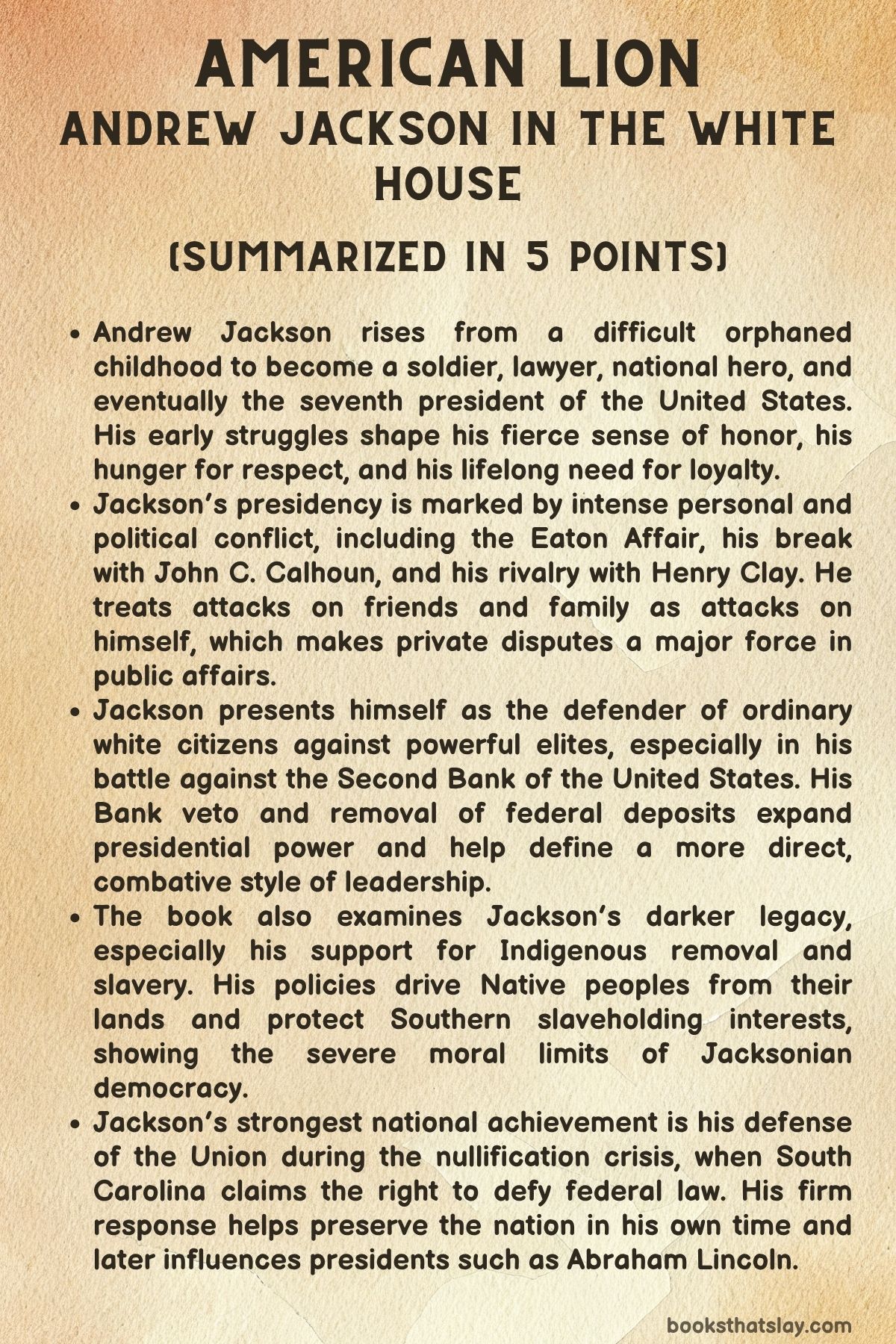
American Lion: Andrew Jackson in the White House by Jon Meacham is a biography of Andrew Jackson, the seventh president of the United States, and a study of how his personality helped reshape American politics. The book presents Jackson as a forceful, emotional, combative leader who believed he spoke directly for the people.
It follows his rise from an orphaned frontier boy to a national hero and president, while also showing the darker parts of his legacy: his support for slavery, his harsh policies toward Indigenous nations, and his hunger for power. Meacham’s portrait is admiring in places, but it does not ignore Jackson’s contradictions.
Summary
American Lion follows Andrew Jackson’s life as a story of ambition, loyalty, rage, public power, and personal loss. Jackson’s early years shaped much of the man he became.
Orphaned young and raised among relatives, he grew up feeling dependent and excluded. His mother, Elizabeth, gave him a stern moral code rooted in faith, duty, courage, and honor.
Those lessons stayed with him, but so did his anger at being treated as an outsider. He spent much of his life trying to prove that no one could dismiss him.
As a young man, Jackson became a lawyer and built a reputation for aggressiveness. His marriage to Rachel Donelson became one of the central emotional facts of his life.
Because of confusion over Rachel’s divorce from her first husband, their marriage was technically invalid at first, and critics later used the scandal to wound Jackson politically. Jackson never forgot attacks on Rachel.
Her death shortly after his election to the presidency deepened his grief and hardened his hostility toward enemies he believed had destroyed her peace.
Jackson rose to national fame through war. During the War of 1812, he became known as “Old Hickory” for endurance and toughness.
His victory at New Orleans made him a national hero and gave Americans a symbol of strength after years of uncertainty. He also fought brutal campaigns against Indigenous peoples and helped force large land cessions, revealing the expansionist and violent side of his vision for the United States.
His political rise came after the disputed election of 1824. Jackson won the popular vote but lost the presidency when the House of Representatives chose John Quincy Adams, helped by Henry Clay.
Jackson believed this was a corrupt bargain, and the defeat became a permanent grievance. In 1828, he returned as the champion of popular democracy and defeated Adams.
His election marked a new style of politics, built around mass support, loyalty, newspapers, rallies, and the image of the president as the people’s direct representative.
Jackson entered the White House convinced that entrenched elites had corrupted the government. He distrusted the Second Bank of the United States, federal officeholders, and politicians who seemed to place institutions above voters.
His inauguration reception turned chaotic as crowds overran the mansion, symbolizing both the democratic energy of his presidency and the disorder his critics feared.
His private world soon became tied to public conflict. The Eaton Affair, involving Secretary of War John Eaton and his wife Margaret, divided Jackson’s household and Cabinet.
Washington society rejected Margaret because of rumors about her past. Jackson defended her fiercely, partly because he saw in her treatment echoes of attacks on Rachel.
Emily Donelson, Jackson’s niece and White House hostess, resisted accepting Margaret fully, which brought family tension into the center of politics. The affair helped damage Jackson’s relationship with Vice President John C. Calhoun and strengthened Martin Van Buren, who handled the crisis with political skill.
At the same time, Jackson moved against Indigenous nations. He wanted Native peoples east of the Mississippi removed so white settlers could take their lands.
He framed removal as necessary for peace and national security, but the policy ignored existing treaties and Indigenous sovereignty. The Indian Removal Act and later treaties began the process that led to mass displacement, including the later Trail of Tears.
Jackson’s actions were not outside the mainstream racism and expansionism of his era, but he pushed removal with unusual force.
The conflict over federal power became sharper during the nullification crisis. South Carolina, led by Calhoun and other states’ rights advocates, claimed it could nullify federal tariff laws.
Jackson saw this as a direct threat to the Union. Though he disliked high tariffs and supported limited government in many areas, he rejected the idea that a state could defy federal law and remain in the Union on its own terms.
His Nullification Proclamation declared secession incompatible with the Constitution and warned South Carolina against rebellion. Behind the scenes, he prepared military force while also allowing tariff compromise.
The Force Bill and Henry Clay’s compromise tariff defused the crisis, but the deeper conflict over slavery, states’ rights, and national authority remained.
Jackson’s battle with the Bank became another defining struggle. He believed the Second Bank gave too much power to wealthy interests and foreign investors.
Nicholas Biddle, the Bank’s president, and Jackson’s opponents tried to force the issue by seeking early recharter. Jackson vetoed the bill, presenting himself as defender of ordinary citizens against privilege.
He then moved to remove federal deposits from the Bank, even firing Treasury Secretary William Duane when Duane refused to carry out the plan. Critics accused Jackson of expanding presidential power dangerously, and the Senate censured him.
Jackson answered with a formal protest, insisting that the president had a duty to defend the people’s will.
Foreign policy also showed Jackson’s sense of honor. When France delayed payments owed under an 1831 treaty, Jackson threatened reprisals.
The dispute nearly led to war, but British mediation helped settle it. Jackson’s posture abroad reflected the same instinct he showed at home: an attack on American rights, even commercial rights, had to be answered firmly.
The final years of Jackson’s presidency were marked by violence, illness, and succession politics. He survived a physical assault and later an assassination attempt when Richard Lawrence’s pistols misfired.
Jackson suspected his political enemies had encouraged the attack, though no conspiracy was proven. He also resisted abolitionist efforts, allowing suppression of anti-slavery mailings and supporting measures that silenced debate over slavery in Congress.
On slavery, Jackson stood with the Southern order, even while he opposed South Carolina’s effort to weaken the Union.
Jackson worked to secure Martin Van Buren as his successor, and Van Buren won the election of 1836. During this period Jackson also faced turmoil in Texas, war with the Seminoles in Florida, and the final stages of Cherokee removal policy.
Personal grief returned when Emily Donelson became ill with tuberculosis and died at only 29. Her death deeply affected Jackson and Andrew Donelson.
Before leaving office, Jackson saw the Senate expunge its censure of him, a symbolic victory that mattered greatly to him. He retired to the Hermitage in 1837, still influential and still writing to political allies.
Economic panic followed soon after his departure, with historians later debating how much blame belonged to his Bank policies, the Specie Circular, crop failures, and global financial conditions.
Jackson died in 1845. His allies and enemies continued shaping American politics.
Van Buren, Blair, Kendall, Eaton, Calhoun, Clay, Adams, and the Donelsons all carried parts of the Jackson story into later national struggles. The book closes by showing Jackson’s long influence on the presidency.
Abraham Lincoln drew strength from Jackson’s defense of the Union during the secession crisis. Later presidents also admired Jackson’s energy, his connection to voters, and his use of executive power.
American Lion presents Jackson as one of the founders of the modern presidency: a leader who used party machinery, media, personal advisers, the veto, and direct appeals to the people to strengthen presidential authority. Yet the same force that made him powerful also made him dangerous.
He defended the Union, expanded democracy for white men, and challenged entrenched privilege, while also upholding slavery and driving Indigenous peoples from their lands. The book’s Jackson is not simple hero or villain.
He is a man whose courage, anger, loyalty, prejudice, and ambition helped define the United States he served and scarred.
Key People
Andrew Jackson
Andrew Jackson stands at the center of the character structure in American Lion, and he is presented as a man shaped by injury, ambition, loyalty, and rage. His orphaned childhood leaves him with a lifelong hunger for respect, and much of his adult life is driven by the need to prove that he cannot be controlled or humiliated.
He believes deeply in honor, but his idea of honor is often personal rather than abstract; insults to his wife, his friends, his authority, or the Union all become matters he treats with emotional intensity. As president, Jackson sees himself as the direct representative of the people, not merely a constitutional officer among others.
This belief gives him political strength, especially in his battles against the Bank, nullification, and elite influence in Washington. It also makes him dangerous because he often treats opposition as betrayal.
His defense of the Union during the South Carolina crisis shows courage and national commitment, while his support for slavery and Indigenous removal exposes the moral limits of his democracy. Jackson is neither softened nor simplified.
He is a leader of great will, deep prejudice, personal tenderness, political violence, and lasting historical consequence.
Rachel Donelson Jackson
Rachel Donelson Jackson is physically absent from much of the presidential narrative because she dies before Jackson enters the White House, yet her influence remains powerful throughout the story. She represents Jackson’s most private emotional wound.
The controversy surrounding her first marriage and her union with Jackson becomes a lasting source of shame and fury for him, not because he doubts her, but because he believes political enemies used her vulnerability as a weapon. Rachel’s death turns her into a sacred memory in Jackson’s mind.
He measures later scandals, especially the attacks on Margaret Eaton, against what he believes Rachel endured. This makes Rachel more than a spouse in the narrative; she becomes the emotional standard by which Jackson judges loyalty, cruelty, and injustice.
Her presence explains why Jackson reacts so fiercely to social exclusion and gossip. He cannot separate politics from personal pain, and Rachel’s memory keeps that pain alive.
Elizabeth Jackson
Elizabeth Jackson, Andrew Jackson’s mother, appears primarily through the values she impresses on her son. Her influence is moral, religious, and psychological.
She teaches Jackson ideas of duty, honesty, endurance, faith, and courage, and these lessons become part of the heroic self-image he carries into adulthood. Elizabeth’s death leaves Jackson orphaned, but her teachings survive as a kind of internal command.
He remembers her as a figure of strength and sacrifice, and her Presbyterian seriousness helps shape his belief that life is a test of character. At the same time, because she is lost so early, her influence is mixed with abandonment and grief.
Jackson’s later hunger for family, loyalty, and emotional security can be traced partly to this loss. Elizabeth gives him moral language, but the world gives him anger.
The tension between those two inheritances defines much of his personality.
Emily Donelson
Emily Donelson is one of the most important domestic figures in Jackson’s White House. As Jackson’s niece and hostess, she is responsible for protecting the dignity and social reputation of the presidential household.
Emily is loyal to Jackson, but she is not simply obedient. Her refusal to fully accept Margaret Eaton shows that she has her own sense of social judgment and personal boundaries.
She wants the Jackson family to appear respectable in Washington, and she understands that social rituals carry political meaning. Her conflict with Jackson reveals the strain between family loyalty and public expectation.
Jackson expects emotional allegiance, but Emily must operate in a world where reputation, class, and female respectability are constantly judged. Her illness and early death add sadness to the later part of the narrative.
She becomes one of the people Jackson loves but cannot fully protect from the pressures surrounding his presidency.
Andrew Donelson
Andrew Donelson functions as Jackson’s nephew, aide, companion, and political helper. He is close enough to Jackson to be part of his inner family world, but that closeness often becomes a burden.
Andrew must manage Jackson’s moods, family tensions, and political expectations while trying to preserve his own marriage and dignity. The Eaton Affair places him in an especially difficult position because his loyalty to Emily conflicts with Jackson’s demand that the family accept Margaret Eaton.
Andrew’s role shows how Jackson’s presidency consumes the lives of those nearest to him. He is not a grand political rival or public symbol in the same way Clay, Calhoun, or Van Buren are, but he is essential to understanding Jackson’s emotional dependence on a trusted circle.
Later in life, Andrew’s fortunes decline, and his shifting loyalties during the Civil War suggest a man caught between inherited devotion, political ambition, and changing national realities.
Martin Van Buren
Martin Van Buren is the shrewdest political operator in Jackson’s circle. Unlike Jackson, whose politics often arise from instinct and emotion, Van Buren understands organization, timing, alliance-building, and public perception.
He handles the Eaton Affair more carefully than most of Jackson’s associates, and his support for the Eatons helps him gain Jackson’s trust. His resignation from the Cabinet is a calculated act that helps clear political tension while improving his own position.
Van Buren’s great strength is patience. He does not challenge Jackson’s authority directly; instead, he works within Jackson’s emotional and political world until he becomes indispensable.
His rise to the vice presidency and then the presidency shows how loyalty to Jackson becomes a path to power. Yet Van Buren is not portrayed as merely manipulative.
He also represents the emerging professional politician, someone who sees parties, newspapers, and networks as necessary tools in a mass democracy.
John C. Calhoun
John C. Calhoun is Jackson’s most serious ideological antagonist. He begins as vice president, but his political philosophy moves steadily toward states’ rights, nullification, and the defense of Southern interests.
Calhoun is intellectual, severe, and theoretical, especially compared with Jackson’s emotional and personal style of politics. He believes that states must have a mechanism to resist federal power, and he presents nullification as a constitutional safeguard against majority tyranny.
Yet the practical meaning of his position is tied closely to slavery and Southern fear of federal interference. His conflict with Jackson becomes both personal and constitutional.
Jackson sees nullification as rebellion; Calhoun sees federal coercion as despotism. Their break reveals two competing visions of America: one centered on national authority and popular presidential power, the other centered on state sovereignty and minority protection.
Calhoun loses influence in Jackson’s administration, but his ideas remain dangerous because they anticipate the arguments that later support secession.
Henry Clay
Henry Clay serves as Jackson’s great political enemy and one of the chief voices of opposition to Jacksonian power. Jackson never forgives him for supporting John Quincy Adams after the 1824 election, and Clay becomes associated in Jackson’s mind with elite bargaining and Washington corruption.
Clay is ambitious, eloquent, strategic, and deeply committed to a vision of federal development through tariffs, internal improvements, and national institutions. He believes government can actively build the country’s future, while Jackson often sees such programs as corrupt favors for special interests.
Clay’s role in the Bank struggle and the Senate censure shows his fear that Jackson is turning the presidency into an instrument of personal rule. At the same time, Clay is also a compromiser.
His work on the tariff compromise during the nullification crisis helps prevent immediate violence. He is both Jackson’s rival and, at key moments, a stabilizing force in the republic.
John Quincy Adams
John Quincy Adams represents the older political order that Jackson wants to defeat. As president, Adams is associated with education, national planning, institutional authority, and elite governance.
Jackson’s supporters view him as a beneficiary of a corrupt bargain, even though the reality is more complex. Adams’s defeat in 1828 signals a change in American politics: inherited prestige and intellectual distinction are no longer enough to command popular loyalty.
After leaving the presidency, Adams continues public service in the House of Representatives, where he becomes an important defender of the right to challenge slavery. His character contrasts sharply with Jackson’s.
Adams is restrained, principled, formal, and intellectually rigorous; Jackson is emotional, forceful, and instinctive. Their rivalry helps define the shift from an older republican politics to a louder, more participatory, more combative democratic age.
John Henry Eaton
John Henry Eaton is important less for his administrative work than for the crisis surrounding his marriage. As Jackson’s friend and secretary of war, Eaton benefits from Jackson’s loyalty, but his presence also destabilizes the Cabinet and the White House.
His marriage to Margaret places him at the center of Washington gossip, and his inability to calm the situation worsens tensions among Jackson’s advisers and family. Eaton’s pride and confrontational conduct, especially after his resignation, show how personal disputes in Jackson’s world easily become political battles.
Jackson’s defense of Eaton reflects the president’s fierce loyalty to friends, but it also reveals poor judgment. Eaton becomes a test case: to accept him and Margaret is to support Jackson; to reject them is to risk being treated as an enemy.
Margaret Eaton
Margaret Eaton is one of the most revealing figures in the social politics of the book. She is judged by Washington society for alleged sexual impropriety, bold behavior, and her relationship with John Eaton.
Whether the accusations are fair matters less than the way they are used. Margaret becomes a symbol of respectability, gender judgment, class prejudice, and political allegiance.
Jackson sees her as a victim of cruel gossip, much like Rachel, and his defense of her becomes emotionally absolute. To the women of Washington, including Floride Calhoun and eventually Emily Donelson, Margaret represents a threat to social order.
To Jackson, she represents innocence under attack. Her character exposes how women, though excluded from formal office, could shape political alliances through reputation, visits, invitations, and refusal.
Margaret’s place in the narrative shows that private life in Washington is never merely private.
Floride Calhoun
Floride Calhoun is a powerful social presence despite having no formal political office. Her refusal to accept Margaret Eaton carries major consequences because social recognition in Washington functions as a political signal.
As the wife of John C. Calhoun, Floride’s judgment affects her husband’s relationship with Jackson. Her conduct shows how elite women could enforce codes of respectability and influence public affairs from domestic spaces.
Floride’s rejection of Margaret aligns the Calhoun household against Jackson’s wishes, deepening the divide between president and vice president. She represents aristocratic Southern pride, social hierarchy, and the power of reputation.
Her role is brief compared with the leading men, but it is crucial because the Eaton Affair proves that a social slight can alter national politics when a president takes it personally.
Nicholas Biddle
Nicholas Biddle is Jackson’s major institutional opponent in the Bank War. As president of the Second Bank of the United States, he represents financial sophistication, centralized credit, and economic authority beyond direct popular control.
Biddle is intelligent and confident, but he badly misjudges Jackson. He assumes that pressure from financial distress and political allies can force the president into compromise.
Instead, Jackson turns the Bank into a symbol of privilege and uses public distrust of concentrated wealth against it. Biddle’s decision to restrict credit in response to the removal of federal deposits confirms Jackson’s accusations in the minds of many voters.
He becomes the face of a moneyed power that seems willing to hurt ordinary people to preserve its influence. His defeat marks a major expansion of presidential power and a major blow to national banking authority.
Daniel Webster
Daniel Webster is one of the strongest voices for the Union in the political world surrounding Jackson. His speeches against nullification give emotional and constitutional force to the idea that the United States is not merely a compact of convenience among states.
Webster and Jackson disagree on many issues, especially the Bank and federal power, but they share a deep commitment to preserving the Union. Webster’s importance lies in his ability to give language to national feeling.
Where Jackson threatens force against disunion, Webster explains why Union has moral and constitutional meaning. Yet Webster also fears Jackson’s executive power, especially during the Bank conflict.
This makes him a complex figure: he can stand near Jackson on Union and against him on presidential authority. He represents constitutional nationalism, eloquence, and suspicion of one-man rule.
Francis Preston Blair
Francis Preston Blair becomes one of Jackson’s most valuable media allies. As editor of the Globe, he helps defend Jackson, attack opponents, and shape public understanding of political events.
Blair’s role shows the importance of newspapers in the rise of modern party politics. He is not merely reporting events; he is helping create a political narrative in which Jackson stands for the people and his enemies stand for privilege, conspiracy, or disunion.
Blair also reflects Jackson’s reliance on a loyal inner circle outside formal Cabinet structures. His later Unionism during the Civil War connects Jackson’s legacy to later national struggles.
Blair’s career suggests that political power in this era depends not only on speeches and elections, but also on message discipline, public persuasion, and partisan print culture.
Amos Kendall
Amos Kendall is another key member of Jackson’s trusted circle. He is practical, loyal, and skilled in administration and communication.
Kendall’s work in the fight against the Bank and his role as postmaster general show his importance to Jacksonian politics. He is especially significant in the conflict over abolitionist mailings, where his handling of the issue helps Southern authorities suppress anti-slavery material without a clean, openly constitutional solution.
Kendall’s character reveals the moral compromises of Jackson’s administration. He can be an efficient political servant and a defender of Unionist Democratic power while also helping protect slavery from public challenge.
His later work with telegraph technology shows his adaptability, but within the main narrative he is most important as a disciplined operator in Jackson’s political machine.
William J. Duane
William J. Duane is a revealing figure because his conflict with Jackson shows the limits of independence inside Jackson’s administration. As treasury secretary, Duane opposes the Bank but refuses to remove federal deposits in the way Jackson demands.
His position is based on a more traditional view of institutional authority and congressional power. Jackson, however, expects executive officers to carry out the president’s will once he has decided.
Duane’s refusal leads to his dismissal, making him an example of how Jackson treats disagreement from subordinates. He is not one of Jackson’s grand enemies, but his fate marks an important moment in the growth of executive power.
Through Duane, the book shows how Jackson turns loyalty into a governing requirement.
Roger Taney
Roger Taney enters the narrative as the man willing to do what Duane would not: carry out Jackson’s removal of federal deposits from the Bank. His appointment reflects Jackson’s preference for officials who accept his understanding of presidential authority.
Taney’s importance is partly practical and partly symbolic. He enables Jackson’s Bank policy at a decisive moment, even though his nomination faces Senate resistance.
In Jackson’s world, Taney represents loyal execution of policy against institutional opposition. His later historical reputation is shaped by events beyond this narrative, but here he functions as an instrument of Jackson’s will and as a sign that the president can reshape government personnel to achieve his aims.
Robert B. Randolph
Robert B. Randolph is significant because his assault on Jackson shows the physical intensity of political conflict during the presidency. His attack is not as historically important as the later assassination attempt by Richard Lawrence, but it contributes to the atmosphere of danger surrounding Jackson.
Randolph’s presence reminds readers that Jackson’s politics stir not only debate but also personal hatred and bodily threat. Jackson’s reaction to such moments reinforces his image as a man who refuses to appear weak.
Even in old age and illness, he wants to meet aggression with aggression.
Richard Lawrence
Richard Lawrence, the man who attempts to assassinate Jackson, becomes part of the mythology of Jackson’s toughness. When Lawrence’s pistols misfire, Jackson charges at him with a cane, turning a terrifying event into another story of physical defiance.
Lawrence is described as mentally unstable, yet Jackson and his allies try to connect the attempt to the violent language of his political enemies. This response reveals Jackson’s suspicion and his tendency to see opposition as conspiracy.
Lawrence’s act also marks a turning point in presidential vulnerability. The event shows that political rhetoric, mental illness, public access, and personal hatred can combine in dangerous ways, even when no organized plot exists.
George Poindexter
George Poindexter matters mainly because Jackson accuses him of involvement in the Lawrence assassination attempt. Poindexter is an opponent of Jackson, and that opposition is enough for Jackson to suspect him.
The accusation collapses when evidence fails, but the episode shows Jackson’s readiness to believe the worst about enemies. Poindexter’s role is less about his own development and more about what he reveals in Jackson: a president who feels surrounded by hostile forces and who sometimes allows anger to outrun proof.
Through Poindexter, the narrative shows the cost of Jackson’s suspicious political imagination.
Black Hawk
Black Hawk appears as a leader resisting the loss of Indigenous land. His return to Illinois with his people leads to conflict after white settlers occupy the territory.
The episode reflects the larger violence of American expansion under Jackson. Black Hawk is not given the same narrative space as Jackson’s political rivals, but his presence is important because he represents those forced to bear the consequences of white settlement, broken promises, and military power.
His struggle exposes the human reality behind policies that Jackson frames as order, security, or national growth. Black Hawk’s resistance is treated by the government as a threat, but it also stands as a response to dispossession.
Osceola
Osceola represents Seminole resistance to removal. His early victories in Florida embarrass American forces and show that Indigenous nations are not passive victims of Jackson’s policies.
Osceola’s role highlights the gap between Jackson’s confidence in removal and the reality of war, resistance, and suffering. To Jackson, the Seminole conflict becomes another military and administrative problem.
To the Seminole, it is a fight for land, survival, and autonomy. Osceola’s presence broadens the moral field of the narrative by showing that the people targeted by removal have leaders, strategies, and courage of their own.
John Ross
John Ross, the Cherokee leader, represents lawful and organized Indigenous resistance to removal. His opposition to the Treaty of New Echota is crucial because that treaty is signed by a minority faction rather than by the Cherokee majority he represents.
Ross’s role exposes the injustice behind the claim that removal was based on agreement. He stands for Cherokee political legitimacy, while the treaty process shows how the United States uses factional division to achieve its goals.
Ross’s character is important because he challenges the idea that Indigenous nations are incapable of diplomacy, law, or national organization. His resistance makes the later forced relocation even more morally devastating.
John Marshall
Chief Justice John Marshall represents the Supreme Court’s uncertain role in conflicts between federal authority, state power, and Indigenous rights. His decisions acknowledge the serious claims of Native nations, yet the Court’s ability to protect them is limited by politics and enforcement.
Marshall’s rulings create legal tension with Georgia and Jackson, especially when the administration chooses not to fully enforce the Court’s position. His character in the narrative is that of a constitutional authority whose words matter, but whose power depends on the willingness of others to act.
Through Marshall, American Lion shows that law alone cannot protect vulnerable people when political power refuses to support it.
James Henry Hammond
James Henry Hammond represents the radical Southern mood during the nullification crisis. His readiness for violence reflects the extent to which tariff disputes, slavery fears, and state pride have created a militant political culture in South Carolina.
Hammond is not as philosophically important as Calhoun, but he gives physical form to Calhoun’s theories. He shows what nullification might mean on the ground: armed men, local mobilization, and possible civil conflict.
His eventual acceptance of compromise also shows that some radicals could retreat when national pressure became too great. Hammond helps illustrate the unstable line between constitutional argument and rebellion.
Robert Hayne
Robert Hayne is one of the major public defenders of states’ rights during the nullification debate. His Senate arguments present Southern grievances and make the case that states must retain authority against federal overreach.
Later, as governor of South Carolina, he moves closer to the practical side of resistance by preparing militia forces. Hayne’s importance lies in the way he connects rhetoric to action.
He is part of the political class that turns constitutional theory into state policy. His conflict with Webster gives national meaning to the debate, while his governorship shows how close the crisis comes to armed confrontation.
Jeremiah Evarts
Jeremiah Evarts represents moral opposition to Indigenous removal. As a Christian reformer, he sees Jackson’s policy as a grave injustice and argues that the United States is violating its obligations.
His role matters because he shows that removal is contested within white American society, even if the opposition fails to stop it. Evarts gives voice to treaty rights, conscience, and Christian responsibility.
His failure also reveals the limits of moral protest when it runs against land hunger, racism, state pressure, and presidential determination. Through Evarts, the narrative makes clear that Jackson’s removal policy was not inevitable simply because no one understood its injustice; people did understand, but power moved against them.
Theodore Frelinghuysen
Theodore Frelinghuysen stands with Evarts as a public opponent of Indigenous removal. His speeches appeal to justice, national honor, and the moral obligations created by treaties.
He challenges Jackson’s policy by asking whether the United States can claim righteousness while dispossessing Native peoples. Frelinghuysen’s role is important because he brings the moral argument into the Senate, forcing the nation’s leaders to confront what removal means.
Yet his failure also shows how little moral eloquence can achieve when political majorities want land and expansion. He is a voice of conscience in a system that chooses expedience.
Ezra Stiles Ely
Ezra Stiles Ely represents evangelical ambition in public life. He wants Jackson’s presidency to advance religious politics and supports the idea of a Christian political order.
Jackson’s response to Ely is revealing because Jackson values religion but resists clerical control over government. Ely’s involvement in the Eaton scandal also shows that religious figures are not above gossip, faction, or self-interest.
His character helps define Jackson’s complicated religious politics: respectful of faith, wary of ministers, and committed to keeping political authority separate from church command. Ely is therefore both a reformer and a meddler, a man whose moral ambitions become entangled with social scandal.
Louis McLane
Louis McLane is a moderate figure caught between Jackson’s instincts and institutional compromise. As treasury secretary and later secretary of state, he tries to manage policy with caution.
On the Bank, he appears to favor reform rather than outright destruction, which puts him at odds with Jackson’s final determination. McLane’s importance lies in showing that not everyone in Jackson’s administration shares Jackson’s appetite for confrontation.
He represents the possibility of adjustment, negotiation, and establishment respectability. Yet in Jackson’s presidency, moderation often loses to decision.
McLane’s presence helps clarify how radical Jackson’s final position on the Bank becomes.
Louis Sérurier
Louis Sérurier, the French minister, is central to the diplomatic conflict between the United States and France. He must interpret Jackson’s anger, communicate French demands, and manage the risk of war.
Through Sérurier, readers see Jackson’s foreign policy from the perspective of a foreign government trying to understand whether American threats are rhetoric or real danger. His warnings to France show that Jackson’s words carry weight abroad.
Sérurier is not an enemy in the personal sense that Clay or Calhoun are, but he is part of a test of national honor. His role reveals how Jackson’s temper and firmness affect international diplomacy.
Lincoln, Theodore Roosevelt, Franklin Roosevelt, and Truman
The later presidents who admire or invoke Jackson are not characters in the main action, but they are important to the book’s closing judgment. Abraham Lincoln is especially significant because he draws on Jackson’s defense of the Union during the secession crisis.
Theodore Roosevelt admires Jackson’s strength despite recognizing his faults. Franklin Roosevelt invokes Jackson’s spirit before World War II, and Harry Truman honors him as a model of common-man politics and national firmness.
These later figures show that Jackson’s legacy does not remain trapped in the nineteenth century. His model of executive strength, mass politics, and Unionism continues to shape how presidents understand power.
Themes
Presidential Power and the Voice of the People
Jackson’s presidency changes the meaning of executive authority by presenting the president as the direct representative of the people. He does not treat himself as merely one officer within a balanced constitutional system; he believes his election gives him a moral and political mandate that can stand against Congress, the courts, the Bank, and entrenched officeholders.
This idea appears most clearly in the Bank War, where Jackson claims the right to judge the constitutionality and justice of the Bank for himself. His veto is not just a rejection of legislation; it is a public argument that the president can defend ordinary citizens from privileged institutions.
The same pattern appears in his use of removals, his reliance on loyal advisers, and his appeal through newspapers to mass opinion. The theme is powerful because it contains both democratic promise and authoritarian risk.
Jackson expands participation for white male voters and challenges elite control, but he also treats opposition as corruption or betrayal. American Lion presents this shift as one of Jackson’s greatest legacies: the modern presidency becomes more personal, more popular, more combative, and more powerful.
The Union and the Threat of Disunion
Jackson’s defense of the Union is one of the clearest places where his force of character becomes a national asset. During the nullification crisis, South Carolina’s claim that it can void federal tariff law strikes Jackson as a direct attack on the nation’s existence.
He may support limited government in many areas, and he may dislike excessive tariffs, but he refuses to accept the idea that a state can decide unilaterally which federal laws to obey. His response combines public firmness and private preparation.
He issues a proclamation rejecting nullification, warns against secession, gathers intelligence, moves military resources, and supports the Force Bill while allowing room for tariff compromise. The theme is not simply nationalism against states’ rights.
It is about whether a democratic republic can survive when local interests claim the authority to break the whole system apart. Jackson’s Unionism is emotional as much as constitutional.
He sees the Union as sacred, purchased by sacrifice, and necessary for liberty. Yet the crisis also reveals that slavery sits beneath much of the conflict.
South Carolina fears federal power partly because federal power might one day threaten slavery. The Union survives in Jackson’s time, but the moral and political conflict remains unresolved.
Loyalty, Honor, and Personal Politics
Personal loyalty governs much of Jackson’s public life. He rewards those who stand by him, trusts a close circle of advisers and relatives, and reacts fiercely to anyone he believes has betrayed him.
This code of loyalty comes from his early life, his marriage, his military background, and his need for emotional security. It gives him strength because people around him know that he will defend friends with total commitment.
It also distorts his judgment because he often turns political disagreement into personal treachery. The Eaton Affair is the clearest example.
Jackson’s defense of Margaret Eaton is tied to his memory of Rachel and his hatred of gossip, but the issue grows into a Cabinet crisis because he demands that others share his view. His relationship with Calhoun also becomes poisoned by personal suspicion, especially after disputes over Florida and the Eaton scandal.
Honor, in Jackson’s world, is not an abstract virtue. It is bound to reputation, family, courage, and retaliation.
This theme explains why his presidency feels so emotionally charged. Public questions about banks, tariffs, appointments, social visits, and newspapers become battles over trust, insult, and respect.
Expansion, Race, and the Moral Limits of Jacksonian Democracy
Jacksonian democracy is presented with a severe contradiction: it expands political power for many white men while denying rights, land, freedom, and dignity to others. Jackson claims to defend ordinary citizens against elites, but his definition of the people excludes enslaved Black people and Indigenous nations.
His removal policy treats Native peoples as obstacles to white settlement and national security, even when treaties recognize their rights. The displacement of the Creek, Choctaw, Chickasaw, Cherokee, and Seminole peoples shows how democratic politics can serve conquest when the voting majority benefits from someone else’s dispossession.
The same moral limit appears in Jackson’s defense of slavery and his response to abolitionist mailings. He is willing to protect Southern slaveholding interests and suppress anti-slavery agitation, even while he resists South Carolina’s nullification theory.
This contradiction is central to understanding his legacy. Jackson can be a defender of the Union and a champion of white popular politics while also supporting systems of racial domination.
The result is a democracy strengthened in form but narrowed in moral scope, a nation more energetic and participatory for some while violently unjust to others.