American Kingpin Summary and Analysis
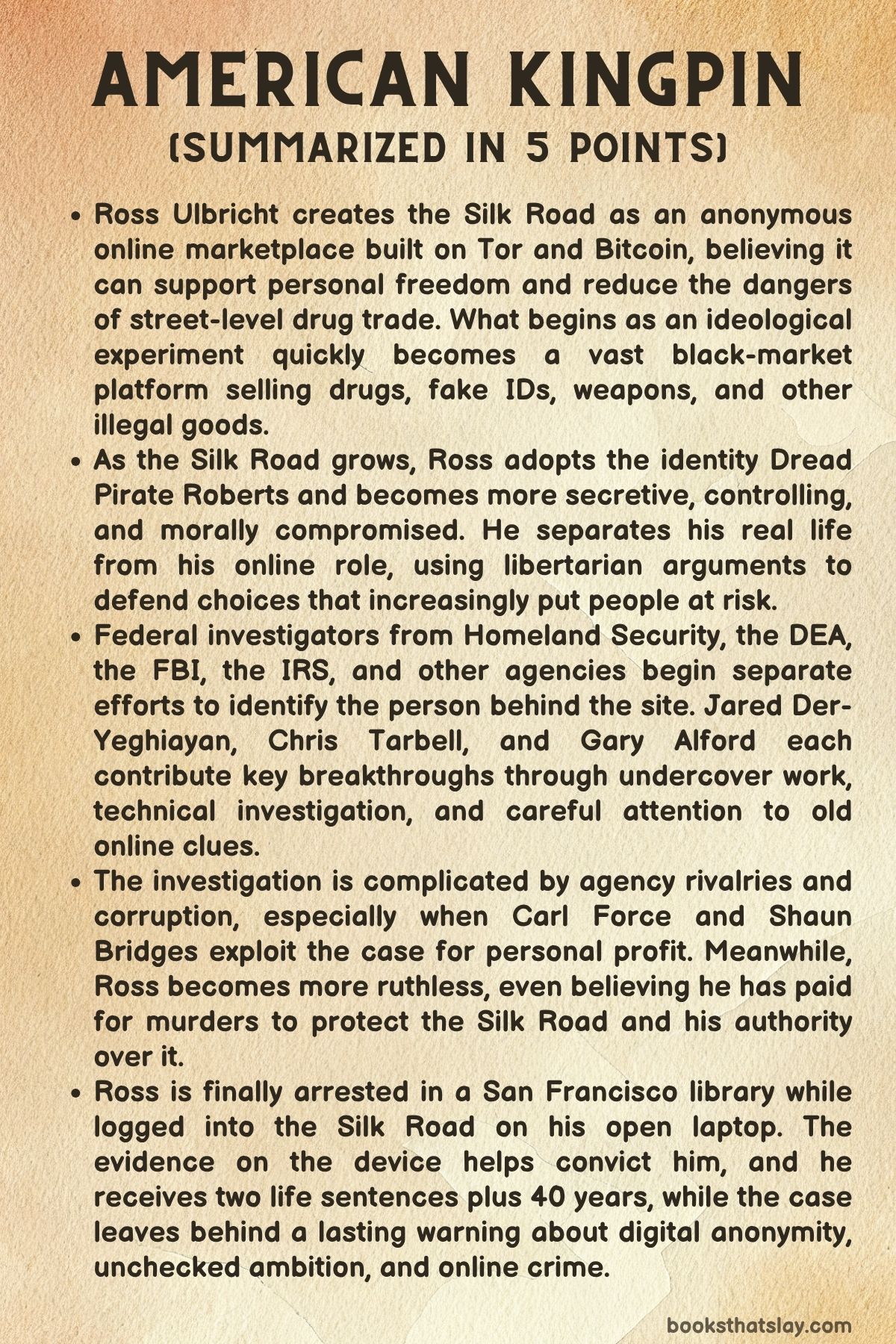
American Kingpin: The Epic Hunt for the Criminal Mastermind Behind the Silk Road is Nick Bilton’s nonfiction account of Ross Ulbricht, the young libertarian who created the Silk Road, an online black-market platform that used Tor and Bitcoin to hide buyers, sellers, and transactions. The book follows Ross from idealistic student to secretive marketplace operator, while also tracking the federal agents who slowly closed in on him.
It is both a cybercrime story and a character study of ambition, ideology, moral compromise, and law enforcement persistence. Through Ross, Julia Vie, Jared Der-Yeghiayan, Carl Force, Chris Tarbell, and Gary Alford, the book shows how one hidden website changed digital crime and policing.
Summary
American Kingpin begins with a small discovery at Chicago O’Hare International Airport: a white envelope from the Netherlands containing a single pink MDMA pill. Customs officer Mike Weinthaler flags the package, and Homeland Security agent Jared Der-Yeghiayan follows up.
The intended recipient’s roommate casually explains that drugs are arriving by mail through a website called the Silk Road, a hidden online marketplace accessed through Tor and paid for with Bitcoin. Jared expects to find an active federal investigation, but there is none.
From that one pill, he begins building a case against a website that few in law enforcement understand.
The story then turns back to Ross Ulbricht, a bright but restless young man from Texas. Ross studies physics, experiments with minimalist living, and searches for a grand purpose.
He is charming, intense, and deeply influenced by libertarian ideas. His relationship with Julia Vie becomes central to his personal life, and she sees both his intelligence and his hunger to do something meaningful.
Ross argues that drug prohibition causes violence and that individuals should be free to make choices about their own bodies. Over time, those ideas become less theoretical and more dangerous.
After struggling with graduate school, business failures, and disappointment, Ross begins building an anonymous online marketplace. He teaches himself enough coding to create the Silk Road, using Tor for anonymity and Bitcoin for payment.
To stock the site at launch, he secretly grows magic mushrooms in a rented space. Julia learns about the operation and is uneasy but fascinated.
In January 2011, Ross launches the marketplace under the name Silk Road, using the online handle Altoid to attract early visitors. At first, the site is small, but vendors soon begin selling many kinds of drugs.
The Silk Road grows quickly. Ross adds seller ratings and improves the system, trying to make illegal transactions feel orderly and reliable.
A Gawker article exposes the site to a much larger audience, bringing attention from users, journalists, and politicians. Senator Chuck Schumer publicly calls for federal agencies to shut it down.
Ross knows the site now has a target on it, but instead of quitting, he works harder. He fixes bugs, improves security, and becomes more committed to his vision.
Julia grows fearful, especially as the site expands to harder drugs and weapons. Their relationship breaks apart after her friend Erica exposes Ross on Facebook, forcing him to leave Austin and hide his role more carefully.
While Ross tries to protect himself, federal interest spreads. Jared’s investigation in Chicago gains traction as he documents drug packages arriving through the mail.
In Baltimore, DEA agent Carl Force joins a task force targeting the Silk Road. Carl creates an undercover persona called Nob and begins communicating with Ross, who now takes the name Dread Pirate Roberts.
That identity, borrowed from The Princess Bride, gives Ross a way to suggest that control of the site may have passed from one person to another. Online, he becomes DPR, a leader admired by many Silk Road users and staff.
Ross moves through Australia, Asia, Costa Rica, and eventually San Francisco, working constantly to maintain the site. He receives guidance from Variety Jones, an experienced vendor and adviser who warns him about law enforcement, security errors, and the severity of the charges he could face.
The Silk Road becomes enormously profitable, with weekly sales reaching huge sums. Ross dreams of becoming a billionaire and expands his plans to include related marketplaces.
At the same time, he separates his public self from his DPR identity, allowing himself to make colder choices online than he might have made as Ross.
Law enforcement efforts become more complicated. Jared runs controlled buys and learns how easily drugs pass through the postal system.
Carl, meanwhile, becomes increasingly reckless. He ignores orders, builds a personal relationship with DPR, and begins seeing the case as a path to money and status.
In New York, FBI agent Chris Tarbell and his cybercrime team begin a separate investigation focused on hacking tools sold through the site. Tarbell understands that if DPR is caught, agents must seize him while his laptop is open, because encryption could otherwise hide the evidence forever.
The moral center of the story darkens when the task force arrests Curtis Green, a Silk Road administrator. Secret Service agent Shaun Bridges uses Green’s credentials to steal Bitcoin from Silk Road users.
Ross believes Green is responsible for the theft and asks Nob to punish him. Carl stages a fake torture video to satisfy DPR.
Ross then escalates from wanting Green beaten to ordering him killed. Although Green is not actually murdered, Ross believes he has paid for a real hit.
Later, he orders more killings through supposed criminal contacts. These choices show how far Ross has moved from his original claim that the Silk Road is simply a free marketplace.
Another investigator, IRS agent Gary Alford, approaches the case differently. He knows little about Tor or Bitcoin at first, but he believes small mistakes can solve major crimes.
Searching old internet posts, he finds that a user named Altoid promoted the Silk Road in early 2011. Subpoenas connect Altoid to an email address containing Ross’s name.
Gary also finds links between Ross, San Francisco addresses, and technical clues tied to the Silk Road server. His discovery becomes the key that joins the online identity of DPR to a real person.
At the same time, Tarbell’s team finds a technical mistake that exposes the Silk Road server’s true location. The FBI gains access to the server and maps the site’s infrastructure.
Jared takes over the account of a Silk Road staff member named Cirrus, allowing him to work directly under DPR while secretly helping the investigation. Agents also learn that Ross ordered fake IDs with his own photo.
When Homeland Security agents visit his San Francisco address, Ross speaks too knowledgeably about Tor and the Silk Road, adding to suspicion.
By September 2013, surveillance teams are watching Ross in San Francisco. He is preparing to leave the city and reconnect with Julia, but federal agents are closing in.
On October 1, 2013, Ross leaves his apartment with his laptop and goes to the Glen Park Public Library. Jared, working undercover as Cirrus, messages DPR and gets him to open an administrative page.
Once agents confirm Ross is logged in as DPR, two undercover officers stage a loud argument near his table. As Ross turns away, another agent grabs his open laptop, and Tarbell arrests him.
The laptop becomes the government’s strongest evidence. Forensic specialists keep it awake long enough to image the drive, later extracting Ross’s password from memory and unlocking vast records: diaries, chats, financial spreadsheets, and administrative files.
Ross hopes to argue that he created the Silk Road but later handed it off, yet the recovered evidence ties him closely to DPR’s actions.
At trial, prosecutors present the Silk Road as a massive criminal enterprise involving drug trafficking, hacking tools, money laundering, and murder-for-hire plots. The defense argues that Ross was framed by the true DPR after leaving the site, but the jury rejects that claim.
Ross is found guilty on all counts. At sentencing, families of overdose victims speak, and Ross apologizes for the harm connected to the site.
Judge Katherine Forrest sentences him to two life terms plus 40 years without parole.
The final part of American Kingpin follows the aftermath. Variety Jones is arrested in Thailand.
Ross’s laptop is displayed as an artifact of a historic cybercrime case. New darknet markets replace the Silk Road almost immediately, showing that the problem did not end with Ross’s arrest.
Carl Force and Shaun Bridges are exposed as corrupt agents who stole Bitcoin and sold information; both receive prison sentences. Jared continues undercover work, Gary receives recognition, Tarbell leaves government service after threats to his family, and Julia moves on with her life.
The book ends with another drug seizure at O’Hare, a sign that the Silk Road case changed law enforcement but did not end the trade it revealed.
Key People
Ross Ulbricht
Ross Ulbricht is the central figure of American Kingpin, and his character is built around a disturbing contrast between idealism and moral collapse. At the beginning of his arc, Ross appears intelligent, restless, ambitious, and searching for a purpose larger than ordinary success.
His interest in libertarian philosophy gives him a language for freedom, personal choice, and resistance to state control. At first, he seems to believe that an anonymous marketplace can reduce violence by moving drug sales away from street crime and into a regulated user-rating system.
Yet his desire to build something meaningful soon becomes inseparable from ego, secrecy, and control. As the Silk Road grows, Ross begins to treat ideology as permission rather than principle.
He excuses the sale of harder drugs, guns, poisons, and other dangerous goods because he wants to preserve the idea of a free market without limits. His split identity as Ross and Dread Pirate Roberts lets him distance himself from the consequences of his decisions.
By the time he orders violence to protect the site, he has moved from abstract belief into direct moral corruption. Ross is tragic not because he lacks intelligence, but because he uses intelligence to justify choices he knows are dangerous.
Julia Vie
Julia Vie functions as Ross’s emotional mirror and moral witness. She meets him when she is grieving her mother’s death, and Ross initially appears to offer energy, confidence, and intellectual direction.
Their relationship is shaped by attraction, admiration, dependency, and unease. Julia sees Ross’s discipline, charm, and unconventional thinking, but she also sees the coldness that grows when his ideas become more important than human safety.
Her reactions to the Silk Road are important because she is not a law-enforcement figure or a political opponent; she is someone who loves Ross and still recognizes the danger of what he is doing. She draws moral lines that Ross keeps crossing, especially when the site expands beyond drugs into guns and other illegal goods.
Julia’s later spiritual renewal also contrasts sharply with Ross’s self-made morality. While Ross decides right and wrong for himself, Julia begins looking for accountability, forgiveness, and a source of truth outside personal desire.
Her character shows the cost of Ross’s secrecy on intimate relationships and the pain of watching someone gifted choose power over conscience.
Jared Der-Yeghiayan
Jared Der-Yeghiayan is one of the most persistent investigators in the story. His character is defined by discipline, stubbornness, and an instinct for patterns.
The investigation begins for him with a single intercepted pill, but he sees the larger structure behind it. Where others dismiss small drug packages as low-value cases, Jared understands that the real issue is the marketplace making those deliveries possible.
His earlier work tracking khat smugglers prepares him to think beyond individual seizures and look for systems. Jared is also independent to the point of conflict; he resists authority when he believes bureaucracy is slowing meaningful work.
His undercover role as Cirrus shows his patience and adaptability, because he must think like a site employee while remaining focused on gathering evidence. Jared’s importance lies in his ability to combine old-fashioned investigative persistence with the strange new world of Tor, Bitcoin, and online identities.
He is not glamorous, but he is steady, and his work turns a scattered set of clues into a case that can survive in court.
Carl Force
Carl Force is one of the most morally compromised characters in American Kingpin. At first, he appears to be a worn-down DEA agent looking for renewed purpose.
The Silk Road assignment gives him excitement and relevance after years of frustration, personal instability, and professional decline. But Carl’s undercover work soon becomes infected by greed and self-importance.
His persona Nob gives him access to DPR, and instead of using that access only for the investigation, he begins to enjoy the intimacy and power of the role. His sympathy for Ross is complicated; he seems to admire DPR while also trying to exploit him.
Carl’s creation of additional false identities to sell investigative information shows how completely he loses the boundary between law enforcement and crime. He becomes a double dealer, using government knowledge for personal profit.
His corruption also damages the moral authority of the investigation, proving that the pursuit of criminals can itself become corrupted when agents lack discipline and oversight.
Chris Tarbell
Chris Tarbell represents technical focus, strategic patience, and the pressure of cybercrime investigation. His experience with encrypted devices teaches him that arresting a suspect is not enough; agents must capture usable evidence before it disappears behind passwords and security systems.
This makes his plan to seize Ross with his laptop open one of the most important tactical decisions in the story. Tarbell is not driven by philosophical debate in the way Ross is, nor by personal profit in the way Carl becomes.
He is practical, intense, and aware that one procedural mistake could destroy the case. His work also shows how traditional law enforcement had to adapt to hidden servers, anonymous networks, and digital currencies.
Tarbell’s later exposure to threats against his family adds another dimension to his character. He wins the case, but victory carries a personal cost.
His decision to leave government work suggests that even successful investigators can be changed by the dangers surrounding their cases.
Gary Alford
Gary Alford is patient, methodical, and quietly brilliant in a way that contrasts with the more dramatic agents around him. He does not enter the Silk Road case as a technical expert, but he compensates through reading, repetition, and careful reasoning.
His “parking ticket” approach is central to his character: He believes major criminals are often caught through small overlooked mistakes. Instead of trying to break Tor directly or chase every Bitcoin movement at once, he asks who first promoted the Silk Road online.
That question leads him to Altoid, then to Ross. Gary’s frustration comes from being underestimated and excluded by other investigators, even when his discovery becomes crucial.
His character shows that intelligence in an investigation is not only technical skill; it is also patience, curiosity, and the willingness to test simple questions. Gary’s role proves that in a digital case, the smallest public trace can matter as much as the most advanced forensic work.
Variety Jones
Variety Jones, later identified as Roger Thomas Clark, is Ross’s adviser, mentor, and corrupting influence. He understands online black markets, operational security, and criminal hierarchy better than Ross does.
His guidance helps Ross sharpen the DPR identity, improve security, and think more strategically about leadership. At the same time, he pushes Ross deeper into the logic of criminal power.
Variety Jones does not merely advise caution; he teaches Ross to think like someone running an empire outside the law. His warnings often sound practical, but they carry a darker worldview in which fear, punishment, and dominance are necessary tools.
He sees Ross’s weakness as an inability to distinguish between harmless and harmful people, yet his own advice helps normalize harsher actions. Variety Jones is important because he gives Ross the language and confidence to become more ruthless.
He is not the creator of the Silk Road, but he helps shape DPR into a more dangerous figure.
Curtis Green
Curtis Green is significant because his arrest becomes the turning point that exposes the violent underside of Ross’s leadership. As a Silk Road administrator, he is part of the marketplace’s internal structure, but he is also vulnerable once law enforcement reaches him.
When Bitcoin is stolen through his credentials, Ross believes Green has betrayed him. Green then becomes the target of staged torture and a fake killing arranged by Carl Force.
His survival does not erase the importance of Ross’s decision, because Ross believes he has paid to have him murdered. Green’s character is less about personal ambition than about what happens when a supposedly clean online marketplace adopts underworld rules.
Through Green, the story shows how quickly digital crime can turn into real-world fear, physical danger, and life-or-death decisions.
Shaun Bridges
Shaun Bridges is another example of corruption inside the investigation. As a Secret Service agent, he has access to evidence, credentials, and sensitive information.
Instead of preserving that trust, he uses Green’s access to steal large amounts of Bitcoin. Bridges’s actions complicate the case because they show that the Silk Road’s criminal economy attracts not only vendors and buyers but also officials who understand its value.
His theft creates confusion, fuels Ross’s suspicion of Curtis Green, and contributes to the chain of events that leads Ross toward murder-for-hire decisions. Bridges is a reminder that institutional authority does not guarantee ethical behavior.
His betrayal damages the investigation and mirrors the greed that law enforcement is trying to dismantle.
Richard Bates
Richard Bates is important because he connects Ross’s private life to the technical creation of the Silk Road. As a programmer friend, he helps Ross debug code without initially knowing the full purpose of the project.
Once he understands what Ross has built, he becomes alarmed and urges him to shut it down. Richard’s role highlights Ross’s secrecy and his willingness to draw friends into danger while withholding crucial information.
He also represents the outside perspective of someone who knows enough to understand the risk but lacks the power to stop Ross. Richard’s fear after the site becomes public shows that Ross’s choices endanger not only himself but also anyone who has helped him, even unknowingly.
Lyn Ulbricht
Lyn Ulbricht is shown as a loving mother who believes in Ross’s intelligence, kindness, and potential. Her view of Ross stands in painful contrast to the government’s portrait of him as DPR.
She represents family loyalty under extreme strain. To Lyn, Ross is not a symbol of cybercrime or libertarian extremism; he is her son, someone she remembers as bright, gentle, and capable of good.
Her presence during the trial and sentencing adds emotional weight because it shows how a public criminal case becomes a private family catastrophe. Lyn’s character also raises the question of how well parents can ever know the hidden lives of their adult children, especially when technology allows those lives to be completely concealed.
Erica
Erica plays a brief but important role as the person who breaks the secrecy surrounding Ross and the Silk Road in his personal circle. After Julia confides in her, Erica becomes part of the secret Ross most wants contained.
Her later Facebook post accusing Ross of running a drug website terrifies him because it exposes the fragile link between his real identity and his online empire. Erica’s actions may be chaotic, but they force Ross to confront how many people already know enough to threaten him.
She represents the danger of human relationships in a world Ross wants to control through encryption, aliases, and secrecy.
René Pinnell
René Pinnell gives Ross a social cover in San Francisco and represents the ordinary life Ross continues pretending to live. Ross stays with René and Selena while secretly managing the Silk Road from cafés and other public places.
René sees Ross as a friend, not as an online crime boss. This gap between appearance and reality is central to Ross’s character.
René’s presence helps show how convincing Ross’s double life can be. He can socialize, travel, date, and discuss future plans while also running a criminal marketplace and making decisions that affect thousands of users.
Kristal
Kristal offers Ross a temporary sense of normal life during one of his darkest periods. His attraction to her and visit to Portland show that he still wants companionship, romance, and personal happiness.
Yet he never gives her the truth. Her role is important because it shows Ross’s ability to compartmentalize.
He can seek warmth and emotional renewal while hiding the fact that he is making ruthless decisions online. Kristal is less central than Julia, but she reinforces the same pattern: Ross wants intimacy, but his secret life makes honesty impossible.
Mike Weinthaler
Mike Weinthaler’s role is small but essential because his discovery of the pink pill begins the chain of investigation. He represents the ordinary frontline work that can expose a much larger system.
His attention to a small envelope contrasts with the enormous criminal network eventually uncovered. Without his initial action, Jared’s investigation may not begin in the same way.
Mike’s character shows how large cases often start with routine vigilance rather than dramatic breakthroughs.
Adrian Chen
Adrian Chen helps push the Silk Road into public awareness through journalism. His investigation and article bring the hidden marketplace to a much larger audience, including politicians and law enforcement.
Adrian’s role is complicated because his reporting both exposes the danger of the site and increases its traffic. He does not create the Silk Road’s growth, but publicity accelerates it.
His character shows the double-edged power of media attention: It can warn the public while also making forbidden spaces more visible and attractive.
Themes
Ideology as a Cover for Power
In American Kingpin, libertarian philosophy begins as Ross’s explanation for why the Silk Road should exist, but it gradually becomes a shield for choices driven by ambition and control. Ross claims that people should be free to choose what they buy and put into their bodies, and he argues that prohibition creates violence.
At first, this sounds like a political argument about markets and personal liberty. But as the site grows, Ross uses the same logic to excuse increasingly dangerous categories of trade.
The problem is not only that his beliefs are extreme; it is that he refuses to revise them when real harm becomes visible. Addiction, overdose, weapons, fraud, and threats are treated as outside his responsibility because he sees himself as a platform operator rather than a participant in consequences.
The theme becomes sharper when Ross starts ordering violence while still imagining himself as a principled builder of freedom. His ideology does not restrain him.
Instead, it gives him a story in which he can view control as liberation and profit as proof of purpose. The book shows how dangerous an idea can become when it is separated from humility, empathy, and accountability.
The Fragility of Anonymity
Anonymity in the story is powerful, but never absolute. Tor, Bitcoin, encrypted chats, hidden servers, aliases, and fake identities all give Ross and the Silk Road community a sense that they can outrun the state.
For a time, that confidence seems justified. Buyers receive drugs by mail, vendors build reputations, and DPR becomes a mythic figure without a visible body.
Yet the investigation proves that anonymity depends on human perfection, and human beings leave traces. Ross promotes the site under the Altoid name, uses emails that can be connected back to him, orders fake IDs with his own face, travels through systems that create records, and works from public Wi-Fi locations.
Law enforcement also adapts. Jared enters the site as an undercover staff member, Tarbell finds technical weaknesses, and Gary connects old internet posts to Ross’s real identity.
The theme is not that technology fails completely; rather, technology cannot erase every mistake, habit, relationship, or moment of carelessness. The Silk Road is built on the fantasy of disappearing, but the case shows that digital life often preserves evidence with unusual patience.
A person may hide for a long time online, but one old username, one login, or one careless answer can bring the hidden self back into view.
Moral Compromise and Escalation
The story shows moral compromise as a process, not a single decision. Ross does not begin by ordering violence.
He begins with a theory, then a website, then a mushroom farm, then a marketplace where other people sell drugs. Each step makes the next one easier to justify.
When harder drugs appear, he protects the market. When weapons become controversial, he experiments with separating them, then allows them back.
When theft threatens the site, he accepts intimidation. When intimidation seems insufficient, he moves toward murder-for-hire.
This pattern matters because it shows how people can cross lines while still thinking of themselves as rational and even ethical. Ross’s language changes as his power grows.
He starts thinking like a founder, then like a CEO, then like a ruler defending an empire. Other characters reflect similar escalation.
Carl Force begins as an undercover agent but becomes a corrupt operator selling information. Shaun Bridges starts with investigative access and turns it into theft.
The theme suggests that unchecked power, secrecy, and money can make moral boundaries feel negotiable. Once people learn to excuse one serious violation, the next violation can appear practical rather than shocking.
Law, Justice, and Institutional Imperfection
The pursuit of Ross is not presented as a simple battle between clean law and dirty crime. The Silk Road is clearly dangerous, and Ross’s choices cause real harm, but the institutions pursuing him are also flawed.
Agencies compete for credit, withhold information, duplicate work, and clash over strategy. Jared, Tarbell, Gary, and others make major contributions, yet their progress is slowed by rivalries and communication failures.
The corruption of Carl Force and Shaun Bridges makes the theme even more complex. They are supposed to represent the law, but they exploit the investigation for personal gain, steal Bitcoin, and damage trust in the case.
At the same time, the book does not suggest that these failures erase Ross’s responsibility. Instead, it shows justice as a messy human system: necessary, often effective, but vulnerable to ego, greed, and error.
The final conviction depends on persistence across multiple agencies, yet the aftermath reveals misconduct within that same effort. This theme gives the story its moral tension.
Law enforcement is needed to stop harm, but it must also be watched, questioned, and held accountable, because authority without integrity can begin to resemble the criminal behavior it seeks to punish.