Americanized Summary and Analysis
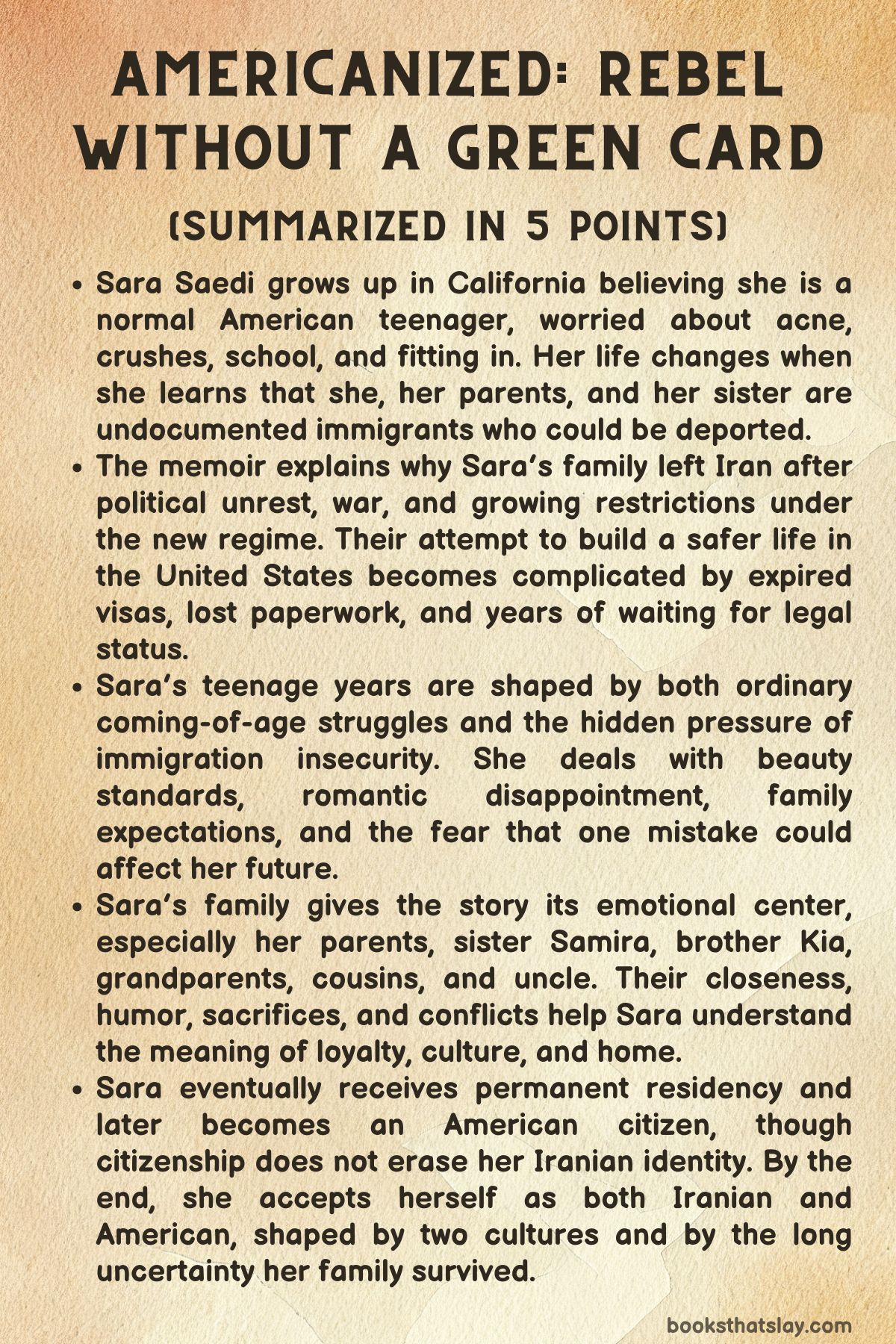
Americanized: Rebel Without a Green Card by Sara Saedi is a memoir about growing up Iranian American while quietly carrying the fear of being undocumented. Sara writes about adolescence, family, beauty standards, crushes, school, money problems, and immigration with sharp humor and clear honesty.
The book follows her life from childhood in California through her eventual citizenship, while also explaining the history and culture that shaped her family’s move from Iran to the United States. It is both a coming-of-age story and a personal account of how immigration status can affect ordinary teenage life.
Summary
Americanized follows Sara Saedi’s life as an Iranian American girl growing up in San Jose, California, after her family leaves Iran for the United States. Sara begins as a nearly thirteen-year-old who is more worried about acne, boys, and whether her body is developing normally than about politics or immigration.
That changes when her older sister, Samira, tells her that their family is undocumented. Sara learns that she, Samira, and their parents could be deported, while her younger brother Kia, born in America, is a citizen.
This discovery becomes a constant fear in the background of her teenage years.
Sara explains why her family came to America by looking back at Iran’s political history and her parents’ experiences there. Iran changes drastically after the revolution, and the new government imposes strict laws that limit personal freedom, especially for women.
The war with Iraq makes life even more dangerous. Sara’s parents decide to leave in 1982, using visitor visas to enter the United States.
After their visas expire, they apply for political asylum, but the government later says their application cannot be found. This bureaucratic failure leaves the family stuck in years of legal uncertainty.
As Sara grows up, she tries to live like a normal American teenager while knowing that her family’s situation is not secure. She and Samira attend a good high school by using a relative’s address.
Their friends know about that small deception but not about their undocumented status. Sara worries that people would judge her family if they knew the truth.
When Sara and Samira eventually receive employment authorization cards, they can legally work and get Social Security numbers, but this does not mean they are permanent residents. Their lives remain temporary, dependent on paperwork, interviews, and decisions they cannot control.
Much of the memoir focuses on Sara’s teenage insecurity. She feels embarrassed by her unibrow, body hair, acne, and large nose.
A boy she likes mocks her eyebrow, which makes her suddenly aware of how different she looks from many of her classmates. Her mother delays letting her pluck her eyebrows because, in Iranian culture, that can be treated as a rite of passage.
Sara also struggles with cystic acne and tries several treatments before eventually taking Accutane in college. She considers rhinoplasty, which is common in Iranian culture and already chosen by her mother and sister, but decides against it because her nose feels connected to her heritage.
Sara’s family life is central to the story. Her parents are loving, liberal, and trusting, which challenges stereotypes about Iranian parents.
They support her interest in writing and acting, allow her freedom, and talk openly about many subjects, though they still expect respect, modesty, and loyalty to family. They want their children to benefit from American freedom without losing Iranian values such as kindness, hospitality, and closeness.
Sara’s bond with Samira grows stronger in high school, and Samira becomes both protector and best friend. Sara also helps raise Kia, taking care of him after school and trying to teach him to treat girls well.
The memoir also introduces Sara’s extended family and Iranian customs. Sara explains the difference between being Persian and Iranian, the use of watering cans in bathrooms, Iranian weddings, the Solar Hijri calendar, and the cultural practice of taarof, where politeness can lead to long arguments over paying a bill or accepting food.
Her relatives are loud, close, and deeply involved in each other’s lives. Sara is especially connected to her mother’s side of the family, including cousins who expose her to new experiences and make her feel part of a large, loyal clan.
Sara also writes about both of her grandmothers. Her paternal grandmother, Farideh, is a devout Muslim who has survived loss, arranged marriage, abuse from in-laws, widowhood, and the death of a child.
Sara finds her difficult to live with but later recognizes her strength, independence, and love. Her maternal grandmother, Maman Soury, also has a complicated life, including an unhappy arranged marriage, a bold divorce, remarriage, and deep personal loss.
When Maman Soury dies, the family gathers to mourn her. That same night, a fire breaks out in the house, and because everyone is awake remembering her, Sara and Samira are saved from what could have been a deadly accident.
Money becomes another major source of stress. Sara’s parents run a luggage repair business, but it struggles financially.
They work long hours, pay taxes, and pay Samira’s college tuition without access to federal financial aid because of their immigration status. Eventually, they have to sell the family home.
Sara is devastated because the house represents stability and belonging. At first, she chooses to stay with wealthy relatives instead of with her parents, but when she sees how deeply this hurts her father, she returns to her family.
Their new home is farther from her school and friends, but Sara begins again and marks her room with a sense of resilience.
Sara’s romantic life is filled with insecurity, awkwardness, and disappointment. She has a long crush on Evan Parker, who does not return her feelings.
She asks him to prom, but he says he cannot afford it, leaving her hurt. Later, she dates Slash and finally experiences the milestones she once felt left out of, including prom, kissing, and sex.
When Slash stops loving her, Sara is crushed, but her mother advises her not to stay with someone who does not love her. Sara carries that lesson into adulthood.
The immigration process remains the book’s central pressure. Sara becomes angry about the long lines, dismissive officials, constant paperwork, and yearly renewals of employment authorization.
She sometimes blames her parents, then realizes they are also exhausted and trapped by the same system. The family grows especially anxious because Samira is close to turning twenty-one, which could make her ineligible for residency through her parents’ application.
After years of waiting, Samira and Sara’s mother receive interviews and green cards. Sara and her father receive theirs two years later.
The relief is enormous, but Sara understands how arbitrary and unfair the system has been.
In 2005, Sara becomes an American citizen. During the ceremony, she feels proud but also conflicted.
She does not want to seem ungrateful, but she is uncomfortable with the idea that becoming American makes her better or more complete. When Iran is announced during the ceremony, she cheers, realizing that America’s diversity is what she values most.
Citizenship gives her the right to vote and a stronger sense of security, but it does not erase her Iranian identity.
By the end of Americanized, Sara sees herself as a mix of two cultures. She imagines the version of herself who might have grown up in Iran and wonders how different that life would have been.
She thinks about language, family, politics, freedom, and belonging. The memoir closes with empathy for undocumented immigrants and a reminder that behind immigration debates are real families, children, fears, sacrifices, and lives shaped by forces far larger than themselves.
Key People
Sara Saedi
Sara Saedi is the narrator, central subject, and emotional guide of Americanized. Her character is built around contradiction: she is funny but anxious, self-conscious but observant, American in habits but deeply tied to Iranian family culture.
As a teenager, Sara worries about acne, body hair, boys, sex, and fitting in at school, yet beneath these ordinary adolescent concerns is the much heavier fear that her family could be deported. This contrast makes her character feel realistic because she is not presented only as an undocumented immigrant or only as a teenager; she is both at once.
Her humor often becomes a way to manage fear, shame, and confusion. Sara’s growth comes from slowly understanding that her parents’ choices were acts of survival, not mistakes meant to burden her.
She begins the story embarrassed by difference, whether that means her eyebrows, her bathroom habits, her accent-adjacent family, or her immigration status, but she ends with a stronger sense of identity. Her journey is not about choosing between Iran and America.
It is about accepting that she belongs to both, even when that belonging is complicated.
Samira Saedi
Samira is Sara’s older sister and one of the most important figures in Sara’s emotional life. At first, their relationship is marked by childhood bickering, but as they grow older, Samira becomes Sara’s protector, model, and closest companion.
She is more socially confident than Sara, and Sara admires her popularity, beauty, and ability to move through high school with ease. Samira is also the one who reveals the family’s undocumented status to Sara, which makes her a source of painful knowledge as well as comfort.
Her character represents the older sibling who must mature quickly because she understands adult problems before the younger children do. Samira’s immigration situation is especially urgent because turning twenty-one could damage her chances of gaining residency through her family’s application.
This adds pressure to her coming-of-age years. She is stylish, bold, and sometimes secretive, but she is also loyal and protective.
Through Samira, the memoir shows how sisterhood can shift from rivalry to deep friendship, especially when both sisters carry the same hidden fear.
Kia Saedi
Kia is Sara’s younger brother and the only member of the immediate family born in the United States. His citizenship gives him a different kind of security, but it also marks him as different from Sara and Samira.
Sara initially sees him as an annoying younger sibling, but she soon becomes deeply attached to him and takes on a caregiving role. Because their parents work long hours and Samira is often busy with college, Sara becomes almost a second mother to Kia.
She watches him, brings him along to her jobs, and tries to shape him into a sensitive and respectful person. Kia’s innocence also highlights the absurdity of immigration status.
He belongs legally in a way his parents and sisters do not, even though they are one family living the same life. His presence reveals how citizenship can divide people within the same household.
He also brings humor and warmth to the story, especially in moments when he accidentally embarrasses Sara or exposes her secrets. Kia’s role is important because he gives Sara a sense of responsibility beyond herself.
Ali Saedi
Ali, Sara’s father, is loving, emotional, liberal, and deeply committed to his family’s survival. He challenges stereotypes of strict immigrant fathers because he trusts his children, supports Sara’s creative ambitions, and encourages open conversation.
At the same time, he carries the heavy burden of providing for the family while navigating an unfair immigration system. His work ethic is central to his character.
He spends long hours at the luggage store and takes on exhausting repair work, trying to preserve stability even when the family’s finances are failing. Ali’s emotional openness makes him especially memorable.
He cries when he feels shame, fear, or hurt, and this vulnerability allows Sara to see him as fully human rather than only as a parent. His decision to leave Iran, his participation in political change, and his efforts to secure legal status all show a man shaped by history but focused on protecting his children.
Ali represents sacrifice without self-pity. He wants his children to have freedom, but he also fears losing the cultural values that matter to him.
Shohreh Saedi
Shohreh, Sara’s mother, is practical, affectionate, stylish, and emotionally intelligent. She is less openly dramatic than Ali, but her strength is clear throughout the memoir.
She supports Sara in ways that are both tender and firm. When Sara is rejected or heartbroken, Shohreh gives advice that helps her daughter develop self-respect.
She encourages Sara to take risks, accept rejection, and avoid wasting love on someone who does not return it. Shohreh also reflects the balance between modern independence and Iranian tradition.
She allows her children many freedoms but still cares about manners, modesty, family reputation, and cultural respect. Her own life story reveals how much she has given up.
She abandons plans for study abroad after marrying Ali and later leaves Iran for an uncertain future in America. Her divorce from Ali, done only as a legal strategy to help the family’s immigration case, shows the painful extremes immigrants may face under rigid laws.
Shohreh is loving without being sentimental, strict without being harsh, and resilient without asking for recognition.
Maman Farideh
Maman Farideh, Sara’s paternal grandmother, is one of the memoir’s most complex family figures. To young Sara, she is often irritating, old-fashioned, and difficult to live with.
She represents a world Sara does not fully understand: a world of arranged marriage, religious devotion, hardship, widowhood, and survival. Her life has been marked by repeated losses, including the death of her mother, separation from her sister, abuse by in-laws, the death of a son, and the death of her husband.
These experiences help explain her habits and emotional distance. Yet Farideh is not reduced to suffering.
She is independent, curious, and more open-minded than Sara first realizes. The moment when she cares for Sara after a painful accident becomes a turning point in their relationship because Sara sees her grandmother’s love in action.
Farideh’s character shows how younger generations often misunderstand elders until they learn the stories behind their behavior. Her death later brings regret, tenderness, and a clearer understanding of the love Sara had not always recognized.
Maman Soury
Maman Soury, Sara’s maternal grandmother, is bold, unconventional, and shaped by loss. Her life story is marked by orphanhood, an arranged marriage, forbidden love, divorce, remarriage, and the pain of being separated from children.
She makes choices that are daring for her time, especially when she leaves her first husband and marries the man she loves. This decision shows courage, but it does not lead to an easy life.
Her second marriage is troubled, and the losses she experiences leave lasting wounds. Maman Soury’s character adds generational depth to the memoir by showing that the women in Sara’s family have long had to make difficult decisions within restrictive social systems.
Her death becomes one of the family’s defining memories. The gathering after her passing, followed by the house fire that could have killed Sara and Samira, gives her presence an almost protective quality in Sara’s memory.
Maman Soury represents family history as something messy, painful, and powerful, not as a clean heroic legend.
Dayee Mehrdad
Dayee Mehrdad is Sara’s uncle and one of the strongest symbols of extended family unity. He is wealthy, organized, generous, and committed to keeping the Sanjideh family close.
Through him, Sara experiences the warmth and intensity of a large Iranian family network. He arranges gatherings, trips, and family events, making sure relatives remain connected despite immigration, work, money problems, and the pressure of American life.
His character shows that family closeness does not happen automatically; someone often works hard to preserve it. For Sara, Dayee Mehrdad’s home also represents comfort and privilege, especially when her family loses their house.
Yet her brief stay with him and Aunt Geneva also teaches her that wealth cannot replace the emotional security of her immediate family. Dayee Mehrdad is important because he embodies abundance, hospitality, and loyalty.
He helps make the extended family feel like a support system rather than just a group of relatives.
Neda and Mitra
Neda and Mitra, Sara’s older cousins, function as guides into adulthood. They are different from each other, with Neda seen as more responsible and Mitra viewed as more rebellious, but both help Sara understand freedom, identity, and social confidence.
They introduce her to experiences involving parties, boys, alcohol, and pop culture, often making her feel more grown-up and included. Sara looks up to them because they seem to possess the confidence she lacks.
Mitra, in particular, gives Sara one of her happiest memories by arranging for her to meet a celebrity crush, which shows how older cousins can become part sibling, part mentor, and part friend. Their role is not only comic or social; they reveal the importance of female support within the family.
Through Neda and Mitra, Sara sees versions of womanhood that are more daring and self-assured than her own teenage self. They help expand her world beyond school insecurity and family anxiety.
Evan Parker
Evan Parker is Sara’s long-term crush and one of the main figures connected to her teenage insecurity. He is not portrayed as a villain, but he represents the painful imbalance of wanting someone who does not want her in the same way.
Sara’s attraction to him shapes many of her choices, from her interest in marijuana culture to her hopes for prom. Evan’s casual treatment of Sara hurts because she invests him with meaning far beyond what he offers in return.
He becomes less important as a person than as a symbol of acceptance, desirability, and social belonging. Sara wants him to notice her, choose her, and confirm that she is attractive.
His failure to do so deepens her self-doubt but also helps her learn about rejection. Through Evan, the memoir captures the painful intensity of teenage longing, especially for someone already struggling with appearance, identity, and belonging.
Slash
Slash is Sara’s boyfriend during the later part of her adolescence and early college years. He represents Sara’s movement into romantic and sexual adulthood.
Unlike Evan, Slash actually chooses Sara, which gives her confidence and helps her feel less behind her peers. Their relationship allows Sara to experience prom, affection, and intimacy, all of which matter deeply to her because she has spent so much time feeling undesirable.
However, Slash also becomes part of another important lesson. When he admits that he no longer loves her, Sara is devastated and tempted to hold on.
Her mother’s advice helps her understand that love should not require begging for someone’s attention or affection. Slash’s role is therefore transitional.
He helps Sara grow, but he is not her final emotional destination. His character shows how first serious relationships can be meaningful even when they end badly.
Gideon Wright
Gideon Wright has a small but significant role because his comment about Sara’s unibrow changes the way she sees herself. Before his teasing, Sara does not think of her eyebrow as a major flaw.
Afterward, she becomes painfully aware of how her appearance differs from the beauty standards around her. Gideon represents the casual cruelty of adolescence, where a single remark can create years of insecurity.
His importance lies not in his personality but in the effect he has on Sara’s self-image. He becomes part of the larger pattern of comments, jokes, and judgments that make Sara feel unattractive.
Through him, the memoir shows how young people often absorb shame from brief moments that others may not even remember.
Aunt Geneva
Aunt Geneva appears most strongly during the period when Sara’s family loses their home. She and Dayee Mehrdad offer Sara comfort, wealth, and stability, but her home also reveals that material comfort is not the same as belonging.
Sara is treated well there, yet she feels separated from her parents and siblings. Aunt Geneva’s role helps clarify Sara’s emotional priorities.
At first, Sara chooses the easier and more luxurious option, but she quickly understands that her family’s hardship is something she cannot simply step away from. Aunt Geneva is not presented negatively; instead, her home becomes a mirror that helps Sara see how deeply she needs her immediate family.
Her character supports one of the memoir’s strongest ideas: home is not only a place with money, space, or comfort, but the people whose struggles and love shape one’s identity.
Themes
Immigration Status and the Loss of Security
In Americanized, undocumented status is not treated as an abstract legal label; it is shown as a condition that changes daily life, childhood, family planning, school, work, money, and emotional health. Sara’s discovery that her family could be deported turns ordinary teenage anxiety into something much heavier.
She still worries about acne, crushes, and prom, but those concerns exist beside the fear that a paperwork error or official decision could destroy the life her family has built. The memoir makes clear that undocumented people are not outside society; Sara’s parents work, pay taxes, raise children, run a business, and contribute to their community.
Yet they remain vulnerable because the legal system keeps them waiting for years. The family’s situation is made worse by missing records, confusing applications, interviews, deadlines, and the danger of Samira aging out of eligibility.
Immigration status also affects behavior. Sara cannot think about teenage rebellion in the same way as her citizen peers because mistakes could have legal consequences.
This theme shows how insecurity becomes internalized. The family lives in America, but until permanent residency and citizenship arrive, their belonging is always conditional.
Identity Between Two Cultures
Sara’s identity is shaped by both Iranian family culture and American teenage culture, and much of her growth comes from learning how to live with that combination instead of treating it as a problem. She wants to fit in with her American classmates, but her family’s customs, language, food, manners, and expectations constantly remind her that she comes from a different cultural background.
At times, she is embarrassed by these differences, whether it is the noise of relatives, bathroom habits, beauty rituals, or her limited Farsi. Yet the memoir also shows that Iranian culture gives Sara strength through family loyalty, hospitality, humor, and resilience.
The tension is not simply between an old culture and a new one. Sara’s parents are liberal in many ways, while American society can be judgmental, racist, or shallow.
By the end, Sara does not define herself by choosing one side. The image of being a combination of two worlds captures her final self-understanding.
She is not incomplete because she is bicultural. Her identity is flexible, mixed, and fully her own.
Family as Protection and Pressure
Family gives Sara love, safety, identity, and support, but it also creates expectations, embarrassment, and emotional pressure. Her immediate family protects her from the worst effects of fear, even when they cannot remove the cause of that fear.
Her parents work constantly to provide stability, her sister becomes a best friend and protector, and Sara herself helps raise Kia. The extended family adds another layer of belonging.
Cousins, aunts, uncles, and grandparents create a social world where Sara is rarely alone. This closeness helps the family survive immigration stress, financial hardship, death, and displacement.
At the same time, family can feel overwhelming. Relatives are loud, opinions matter, appearances are judged, and cultural expectations can limit personal choices.
Sara sometimes feels embarrassed by her family or burdened by their sacrifices. Her guilt as an immigrant child comes from knowing how much her parents have given up for her.
The memoir treats family honestly by showing both comfort and conflict. Family is not perfect, but it remains the strongest force holding Sara’s life together when legal status, money, and self-confidence feel unstable.
Beauty, Shame, and Self-Acceptance
Sara’s struggles with beauty reveal how deeply social judgment affects young women, especially those who feel culturally different. Her unibrow, acne, body hair, and nose become sources of shame because classmates, crushes, strangers, and even cultural beauty standards teach her to inspect herself harshly.
The pain is not only about appearance; it is about wanting to be accepted. When Sara is teased or judged, she reads those moments as evidence that she does not fit the image of a desirable American girl.
Iranian beauty standards complicate this further. Her family praises some features but also treats appearance as socially important, and rhinoplasty is presented as both common and status-linked.
Sara’s decision not to change her nose becomes meaningful because it marks a shift from shame toward self-acceptance. She does not magically stop feeling insecure, but she begins to understand that her features connect her to heritage, family, and identity.
The theme is powerful because the memoir takes teenage insecurity seriously. Appearance may seem superficial from the outside, but for Sara it shapes confidence, romance, belonging, and the long process of accepting herself.