American Gods Summary, Characters and Themes
American Gods by Neil Gaiman is a fantasy novel about belief, identity, migration, and the strange spiritual life of America. It follows Shadow Moon, an ex-convict whose life collapses when his wife dies just before his release from prison.
He accepts work from the mysterious Mr. Wednesday and is drawn into a conflict between old gods brought to America by immigrants and new gods born from technology, media, highways, and modern obsession. The book mixes road novel, myth, dark comedy, and supernatural mystery while asking what people worship, what they forget, and what survives in a changing country.
Summary
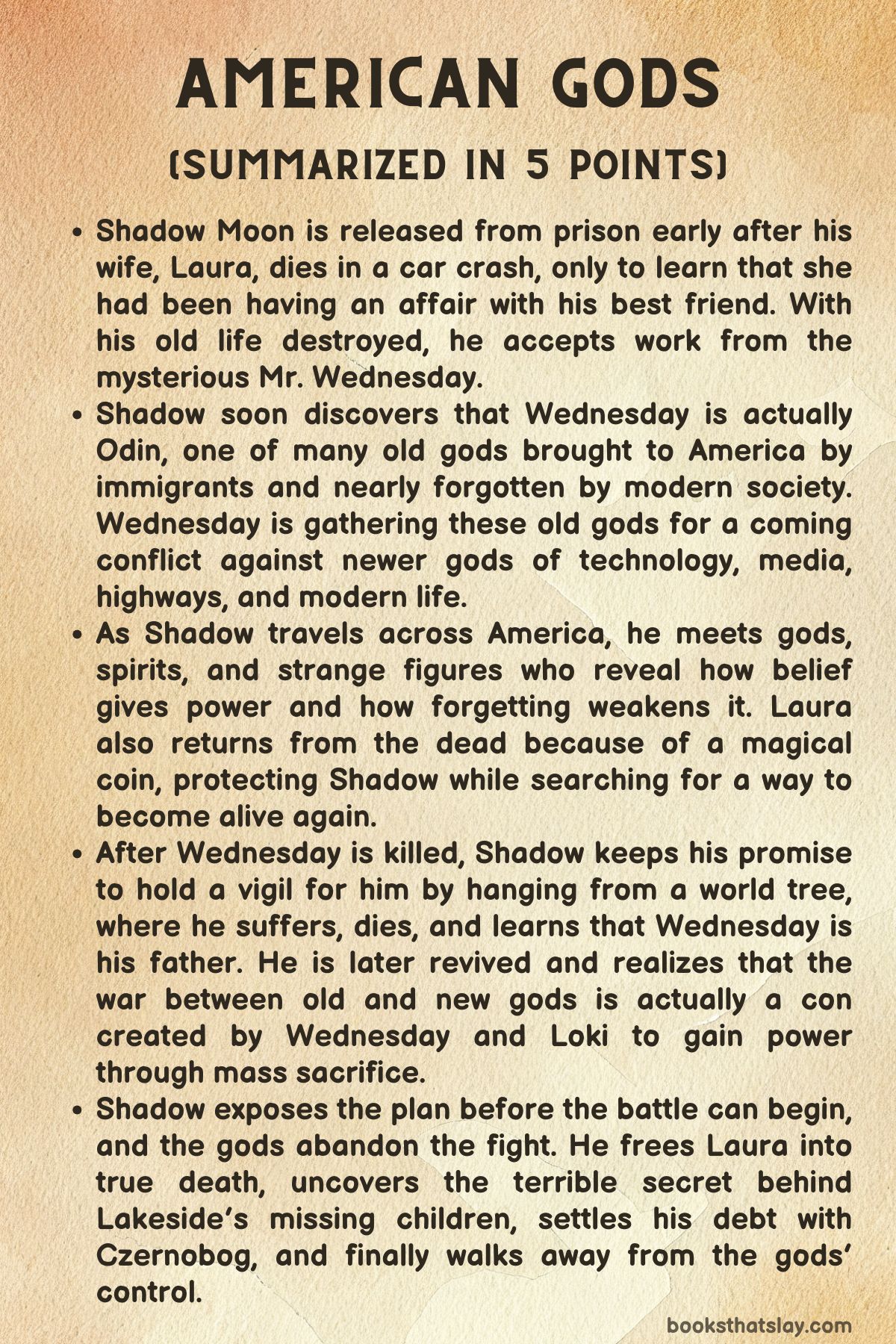
Shadow Moon is released from prison early after learning that his wife, Laura, has died in a car crash. The news destroys the future he had imagined: returning home, reuniting with Laura, and working for his friend Robbie.
On his way back, Shadow meets a strange, confident man named Mr. Wednesday, who knows too much about him and offers him a job. Shadow refuses at first, but after learning that Robbie also died in the crash and that Laura and Robbie were having an affair, he has little left to hold on to.
Wednesday finally wins him over through a rigged-seeming coin toss, and Shadow agrees to become his driver, assistant, and bodyguard.
Shadow soon learns that Wednesday is no ordinary con man. He is Odin, the old Norse god, weakened by centuries of fading worship in America.
Wednesday is gathering other old gods who were brought to the continent through the memories, prayers, and traditions of immigrants. These gods still exist, but they live in diminished forms, often poor, hidden, lonely, or nearly forgotten.
Among them are Czernobog, the Zorya sisters, Mr. Nancy, Mr. Ibis, Mr. Jacquel, Easter, and many others. They survive in a country that no longer understands them.
At the same time, Shadow encounters the new gods: figures of media, technology, commerce, transport, and modern distraction. They are powerful, arrogant, and impatient with the old gods.
Technical Boy, Media, Mr. World, and their allies see Wednesday and his companions as relics whose time has passed. Shadow is kidnapped and beaten by agents of the new gods, but he is rescued by Laura, who has returned from the grave because of a magical gold coin Shadow placed in her coffin.
Laura is dead but walking, cold, strong, and desperate to become truly alive again. Her love for Shadow remains complicated by guilt, betrayal, and regret.
Wednesday takes Shadow across America, recruiting gods and showing him hidden places of power. At the House on the Rock, Shadow sees the gods in their true forms and begins to understand the scale of the conflict.
Wednesday argues that the old gods must fight or be destroyed by the new gods. Many of them are skeptical, tired, or afraid, but some eventually agree to stand with him.
Shadow, meanwhile, struggles to understand his own place in the strange events around him. His dreams are filled with warnings from a buffalo-headed figure, images of sacrifice, and hints that America itself is speaking to him.
For safety, Wednesday hides Shadow in the small Wisconsin town of Lakeside under the name Mike Ainsel. Lakeside seems peaceful and old-fashioned, a place protected from much of the ugliness outside it.
Shadow makes friends with locals, including police officer Chad Mulligan and neighbor Marguerite Olsen. Yet the town has a dark pattern: children occasionally disappear, and the adults explain the losses away.
Shadow notices clues but cannot yet see the full truth. The annual town raffle centers on guessing when an old car placed on the frozen lake will sink through the ice.
Shadow continues traveling with Wednesday between long stays in Lakeside. He visits Mr. Ibis and Mr. Jacquel, Egyptian gods who run a funeral home in Cairo, Illinois, and he meets other figures from many traditions.
Through these encounters, the novel shows how gods arrived in America through migration, enslavement, conquest, memory, and fear. Some were cherished for generations; others were abandoned almost as soon as their believers died.
America is repeatedly described as a poor place for gods, a land where sacred beings are brought in but rarely allowed to thrive.
As the tension between old and new gods rises, Wednesday appears to lose confidence. Still, he arranges a supposed peace meeting with the new gods.
During the meeting, he is shot and killed, apparently by the enemy. His death enrages the old gods and pushes them toward war.
Shadow remembers his promise to keep vigil for Wednesday if he died. He learns that this means being tied naked to a world tree for nine days and nights, repeating Odin’s own mythic sacrifice.
Though he knows it may kill him, Shadow accepts because he believes honoring the promise is what a living person would do.
On the tree, Shadow suffers hunger, thirst, cold, pain, and visions. He speaks with Laura and Horus, and he begins to feel more alive than he has felt in years.
Eventually, he dies. In the world beyond death, Shadow meets Zorya Polunochnaya, Bast, Ibis, and Jacquel.
He learns a major truth: Wednesday is his father. Shadow is judged by the Egyptian scales, and his heart balances against a feather.
Given a choice of afterlife, he chooses rest.
But Shadow is not allowed to remain dead. Easter, helped by Horus, brings him back to life.
Shadow realizes that the coming war is not truly a battle between old and new gods. It is a long con designed by Wednesday and Loki.
Loki, disguised earlier as Shadow’s prison cellmate Low Key Lyesmith and later operating as Mr. World, has manipulated both sides. The plan is to create a massive sacrifice: if old and new gods kill each other in battle, the bloodshed will be dedicated to Odin and will restore power to Wednesday and Loki.
Laura also discovers the truth. While guiding Mr. Town to the battlefield at Rock City, she kills him and takes the branch from the world tree that Loki needs to begin the sacrifice.
She confronts Mr. World, learns that Shadow was only a tool in the scheme, and stabs him with the branch, dedicating the death to Shadow instead of Odin. She is badly wounded in return.
Shadow arrives and exposes Wednesday and Loki’s plan to the assembled gods. With the trick revealed, the gods lose their will to fight and drift away.
The great war ends before it begins.
Shadow finds Laura dying for the final time. They speak honestly, acknowledge their love, and accept that their life together is over.
Shadow removes the magic coin that has kept her undead, freeing her into true death. Afterward, he travels with Mr. Nancy, still unsure what he has learned but aware that he has passed through something that changed him.
Shadow then returns to Lakeside because he realizes the town’s mystery remains unsolved. He opens the trunk of the car on the frozen lake and finds the body of Alison McGovern, the missing girl.
When the car sinks, he sees that past cars at the bottom of the lake contain other dead children. Hinzelmann, the friendly old storyteller who helped Shadow when he arrived, is revealed as an ancient spirit who has protected Lakeside for a terrible price: one child sacrificed each year.
Chad overhears the truth, kills Hinzelmann, and burns his house. Shadow helps Chad forget enough to keep living and protect the town.
Shadow pays his old debt to Czernobog, who once won the right to strike him with a hammer. Instead of killing him, Czernobog gently taps his forehead, ending the bargain.
Months later, Shadow travels to Iceland and meets another version of Odin, separate from Wednesday. Shadow gives him Wednesday’s glass eye, performs one last coin trick, and walks away.
American Gods ends with Shadow moving onward, no longer owned by gods, grief, or the schemes of others.
Characters
Shadow Moon
Shadow Moon is the emotional and moral center of American Gods. At first, he seems passive, almost emptied out by prison, grief, and betrayal.
His name suits him because he often moves through events as a silent observer rather than a forceful hero. Yet this quietness is not weakness.
Shadow’s restraint shows a man who has learned to survive by controlling his reactions, even when he is surrounded by violence, manipulation, and supernatural danger. His grief over Laura is complicated by her affair, but he never becomes cruel or vengeful toward her.
He is hurt, confused, and angry, yet he still tries to understand her. As the story develops, Shadow becomes less of a hired bodyguard and more of a person searching for truth.
His vigil for Wednesday is a turning point because he chooses pain, duty, and sacrifice not for reward, but because he gave his word. By the end, Shadow has seen through the gods’ schemes and refuses to be used as a tool.
His growth lies in moving from numb obedience to clear moral awareness.
Mr. Wednesday
Mr. Wednesday is charming, intelligent, selfish, and dangerous. He presents himself as a con man, but that description only begins to explain him.
As Odin, he carries the weight of an older world where sacrifice, worship, fear, and story gave gods their power. In America, he has become diminished, so he survives through scams, seduction, manipulation, and performance.
Wednesday understands people’s weaknesses with chilling accuracy. He knows when to flatter, when to threaten, when to lie, and when to seem vulnerable.
His relationship with Shadow is especially complex because he is both employer and father, but he hides the truth for most of the story. He does not treat Shadow as a son to be loved; he treats him as material for a plan.
Wednesday’s apparent campaign to save the old gods is finally revealed as a scheme to feed himself and Loki through mass sacrifice. This makes him one of the most tragic and morally corrupt figures in the novel: a god so desperate to survive that he turns belief, loyalty, and fatherhood into tools.
Laura Moon
Laura Moon is one of the most morally complicated characters in the novel. In life, she is restless, dissatisfied, and capable of hurting Shadow deeply, especially through her affair with Robbie.
Yet her return from death gives her a strange clarity. As an undead woman, Laura sees herself and others with brutal honesty.
She no longer pretends to be innocent, romantic, or noble. Her body is decaying, but her will becomes stronger than ever.
Her desire to be alive again is not only physical; it is tied to regret and to her unfinished connection with Shadow. Laura’s love for him is flawed, but it is real enough that she repeatedly protects him, kills his captors, follows his trail, and finally destroys Loki’s plan.
She is not redeemed through softness but through action. Her final choice to accept true death shows that she has changed.
She stops clinging to an unnatural half-life and allows Shadow to release both of them from the past.
Low Key Lyesmith / Loki
Low Key first appears as Shadow’s former prison cellmate, a casual and clever figure who gives him books and advice. This disguise hides his true identity as Loki, the trickster god.
Loki’s power lies not in open strength but in misdirection. He enters Shadow’s life before Shadow understands that he has already become part of a larger plan.
Later, as Mr. World, Loki becomes the hidden force guiding the new gods toward war. His genius is his ability to make both sides believe they are acting from their own interests.
Loki’s partnership with Wednesday is based on fraud, sacrifice, and mutual hunger for renewed power. He is a trickster in the darkest sense: not merely a maker of jokes or confusion, but a strategist who turns grief, loyalty, and divine pride into weapons.
His defeat comes because Laura and Shadow both see through the false story he has built. Loki’s failure shows the limits of deception when truth is finally spoken aloud.
Mr. Nancy
Mr. Nancy, the American form of Anansi, brings humor, intelligence, and survival instinct into the story. He is a storyteller, and that role is central to his power.
Unlike Wednesday, who uses stories mainly as instruments of control, Mr. Nancy understands stories as forms of endurance. His jokes, songs, and casual manner often hide how much he sees.
He does not appear as desperate as some of the old gods, but he knows the danger they face. His presence gives Shadow guidance without the heavy manipulation that defines Wednesday.
Mr. Nancy also represents adaptability. He has survived by changing shape, tone, and social role while keeping his core identity intact.
After the failed war, he helps Shadow leave the battlefield and later takes him to Florida, where their conversations suggest that wisdom may come through humor as much as suffering. In American Gods, Mr. Nancy stands as a counterpoint to Wednesday: both are old gods and skilled performers, but Nancy’s performance is warmer, freer, and less corrupt.
Czernobog
Czernobog is harsh, gloomy, and violent, but he is not a simple villain. He is an old Slavic god associated with darkness, death, and brutality, now living in reduced circumstances in Chicago.
His past as a slaughterhouse worker suits his personality: he understands killing as both labor and ritual. His wager with Shadow, in which he wins the right to strike him with a hammer, makes him frightening from the start.
Yet Czernobog also has a strong sense of honor. He keeps bargains, respects courage, and recognizes change when it comes.
His bond with his lost counterpart, Bielebog, suggests that he is not pure darkness but part of a cycle in which black and white, winter and spring, violence and renewal all exist together. When he finally pays his debt by gently tapping Shadow instead of killing him, the moment reveals growth, mercy, and seasonal transformation.
Czernobog’s darkness has not disappeared, but it has softened into balance.
The Zorya Sisters
The Zorya sisters represent time, celestial order, and old-world mystery. Zorya Vechernyaya, Zorya Utrennyaya, and Zorya Polunochnaya are connected to evening, morning, and midnight, and their apartment feels like a small remnant of another spiritual universe preserved inside modern America.
They are not powerful in an obvious military sense, but they carry knowledge, protection, and ritual importance. Zorya Polunochnaya is especially significant because she gives Shadow the silver dollar that protects him and later helps him after his death.
Her presence is calm, strange, and compassionate. She guides Shadow toward hard truths rather than comforting illusions.
The sisters show that not all divine power is loud or aggressive. Some of it is quiet, watchful, and bound to cycles larger than human ambition.
Their role also deepens the novel’s interest in forgotten traditions that remain alive through memory, story, and symbolic objects.
Mr. Ibis
Mr. Ibis, the American form of Thoth, is a writer, historian, and funeral director. His role is less combative than Wednesday’s, but it is deeply important.
He records the lives and migrations that brought gods to America, turning memory into preservation. Through him, the novel treats history not as a list of dates but as a record of longing, belief, violence, and survival.
Ibis understands that gods live because people carry them in language and ritual. His funeral home work also links him to dignity in death.
He cares for bodies, tells stories, and helps guide Shadow through the afterlife. Unlike Wednesday, Ibis does not seem desperate to reclaim lost power.
He is resigned, thoughtful, and aware that even gods may have endings. His intelligence is measured, not manipulative.
He helps the reader understand that the old gods are not only supernatural beings; they are also cultural memories trying to remain meaningful.
Mr. Jacquel
Mr. Jacquel, the American form of Anubis, is closely tied to death, judgment, and passage. He works beside Mr. Ibis in the funeral home, but his nature becomes clearer when Shadow enters the world beyond death.
Jacquel’s weighing of Shadow’s heart against a feather is one of the most important moral tests in the story. He is not sentimental, but he is fair.
His presence suggests that death is not chaos; it has order, ritual, and judgment. In ordinary life, he can seem dry, practical, and even sarcastic, yet beneath that manner is an ancient seriousness.
He understands souls, endings, and the difference between bodily death and spiritual consequence. Jacquel does not try to recruit, deceive, or dominate Shadow.
Instead, he performs his role with precision. His character gives the novel a sense of moral structure in a world where many gods behave selfishly.
Bast
Bast appears first in animal form as the affectionate cat at the Cairo funeral home, but she later reveals her divine identity. Her relationship with Shadow is physical, protective, and healing.
She interrupts him during a moment of suicidal despair, and later, in a dreamlike encounter, she helps him understand what he needs after death. Bast’s power is connected to instinct, the body, sensuality, and restoration.
She does not explain everything through speeches; she acts through presence, touch, and perception. When she removes and examines Shadow’s heart, she sees him more clearly than he sees himself.
Her advice that he choose wholeness matters because Shadow’s central struggle is not only survival but inner emptiness. Bast offers a form of care that is direct and ancient.
She is not a mother figure exactly, nor a lover in any simple sense, but a divine presence who helps Shadow reconnect with life, judgment, and selfhood.
Mad Sweeney
Mad Sweeney is comic, tragic, and broken. He first appears as a loud, aggressive leprechaun who fights Shadow and introduces him to the strange reality of magical coins.
Yet his later decline reveals a much sadder figure. He is an old being displaced into a world that has little use for him.
His drunkenness, anger, and desperation come from loss: loss of belief, loss of purpose, and finally loss of the powerful coin he mistakenly gives to Shadow. That mistake leads indirectly to Laura’s return from the dead, making Sweeney more important than he first appears.
His death is pathetic rather than heroic, but his wake gives him a strange dignity. Through Sweeney, the novel shows how mythic figures can become shabby and forgotten in a country that reduces them to jokes, stereotypes, or scraps of folklore.
He is ridiculous, but he is also a casualty of cultural forgetting.
Technical Boy
Technical Boy represents the arrogance and insecurity of new power. He is young, crude, impatient, and cruel, but his cruelty masks fear.
As a god of technology, he has enormous influence in the modern world, yet he is also unstable because technology changes quickly. His power depends on attention, novelty, and constant relevance.
He dismisses the old gods as obsolete, but he does not fully understand the forces he is serving. His involvement in Bilquis’s death and his hostility toward Shadow show his capacity for violence.
Still, near the end, he begins to question the purpose of the war. He realizes that the old gods might fade without a battle and that the conflict may be serving someone else’s agenda.
This late doubt makes him more than a simple symbol of modern arrogance. He is powerful but immature, dangerous but manipulable, and ultimately another victim of Loki’s larger fraud.
Media
Media is one of the clearest embodiments of modern worship. She appears through television and popular images, speaking in borrowed forms that people recognize instantly.
Her power comes from attention, repetition, entertainment, and the way screens shape desire. Media does not need temples because living rooms, advertisements, broadcasts, and celebrity culture serve her purposes.
She is smooth, persuasive, and artificial, offering Shadow a place among the new gods with polished confidence. Unlike Technical Boy, she is not openly childish or frantic.
Her danger lies in her ability to seem familiar and harmless while representing a force that absorbs human attention on a massive scale. Media shows how worship in the modern world can happen without people naming it as worship.
Viewers give time, belief, emotion, and identity to images, and she feeds on that devotion.
Mr. World
Mr. World appears to represent global systems, surveillance, coordination, and modern power, but this identity is itself a mask. As Loki’s disguise, Mr. World is the perfect false face: large, abstract, difficult to question, and able to command the new gods through fear and strategy.
His name suggests total reach, as though he speaks for the age itself. That makes the deception more effective.
The new gods trust him because he seems to understand the structure of power better than they do. His calm authority conceals the old trickster beneath.
This character shows how easily grand language about systems and progress can hide personal ambition. Mr. World is not truly the future defeating the past; he is an old lie wearing modern clothes.
Once this is revealed, the entire war loses its meaning.
Easter
Easter, or Eostre, is an old goddess who has survived better than many others because her name remains attached to a major holiday. Yet her survival is incomplete.
People celebrate Easter without understanding her original identity, so she receives recognition without true remembrance. This makes her both powerful and vulnerable.
She has adapted to modern life, enjoying the outward success that comes from cultural continuity, but Wednesday challenges her by pointing out that most people do not actually worship her. Easter’s role near the end is crucial because she brings Shadow back to life.
This act connects her to renewal, spring, and resurrection in a direct way. Unlike Wednesday, who seeks power through sacrifice and deceit, Easter’s power restores life.
Her character raises a question about whether survival through adaptation is enough if meaning has been hollowed out.
Bilquis
Bilquis is a faded goddess of love, desire, and worship, living on the margins of modern America. Her scenes show divinity reduced to private transactions and desperate acts of survival.
She requires worship, but the world no longer offers it to her in temples or public rituals. Instead, she seeks it through sex, consuming those who adore her.
Her power is both seductive and horrifying. Bilquis’s death at the hands of the new gods marks an escalation in the conflict.
She is targeted not because she is a great military threat, but because she belongs to the old order and can be erased. Her character reveals the loneliness of gods whose sacred roles have been stripped of context.
Desire remains everywhere in modern life, but reverence has changed form, leaving Bilquis powerful in moments yet vulnerable in the larger world.
Samantha Black Crow
Samantha Black Crow is one of the most grounded human characters in the novel. She is curious, politically aware, skeptical of simple explanations, and open to impossible ones.
Her conversations with Shadow matter because she listens without immediately reducing his experiences to madness. She brings warmth and human connection into a story dominated by divine manipulation.
Sam’s identity also adds another perspective on American belief, especially when she challenges the assumptions attached to imported European gods. She is not part of the divine war, but she is affected by its consequences through Shadow, Lakeside, and her family connections.
Her willingness to believe unusual truths contrasts with the refusal of many adults in Lakeside to see the horror in front of them. Sam represents a form of clear-eyed openness: she can accept mystery without surrendering her judgment.
Chad Mulligan
Chad Mulligan appears at first to be a friendly small-town police officer, but his character becomes more important as Lakeside’s secret is revealed. He is decent, helpful, and genuinely concerned for the town, yet he has lived under the same blindness as everyone else there.
His failure is not personal corruption but participation in a protected illusion. When he overhears Hinzelmann’s confession, his entire understanding of Lakeside collapses.
His horror is intensified by the discovery that the town’s safety has been bought through the deaths of children. Chad’s desire to kill himself afterward shows the crushing weight of guilt, even though he did not knowingly allow the crimes.
Shadow’s intervention gives him a chance to continue living and serving the town. Chad represents ordinary morality in a world shaped by supernatural bargains.
He cannot undo the past, but he can remain and protect what is left.
Hinzelmann
Hinzelmann is one of the novel’s most disturbing figures because he hides monstrosity beneath neighborly charm. He tells stories, helps Shadow, welcomes him to Lakeside, and appears to embody the warmth of small-town life.
Yet he is an ancient spirit who sustains the town through annual child sacrifice. His evil is not chaotic; it is organized, ritualized, and justified as protection.
He has made Lakeside prosperous, safe, and pleasant, but the cost is unbearable. Hinzelmann’s character forces a confrontation with the moral price of comfort.
The townspeople do not know the truth, but their peace depends on not seeing too closely. He is not simply a murderer; he is a guardian whose protection has become inseparable from atrocity.
This makes him one of the clearest examples of how old powers can survive by making hidden bargains with human communities.
Audrey Burton
Audrey Burton brings raw human anger into the story. As Robbie’s widow and Laura’s betrayed friend, she has every reason to be furious.
Her grief is messy, public, and often cruel, especially when she spits in Laura’s dead face and later accuses Shadow. Yet Audrey’s behavior comes from pain rather than villainy.
She has lost her husband, discovered his betrayal, and been pulled into events she does not understand. Her hostility toward Shadow reflects her need to direct rage somewhere visible.
Audrey also serves as a reminder that the supernatural plot does not erase ordinary suffering. Affairs, deaths, shame, and anger continue to matter, even in a world of gods.
Her presence keeps Laura and Shadow’s past from becoming abstract. The damage Laura caused was real, and Audrey is one of the people left to carry it.
Robbie Burton
Robbie is dead for the main action of the novel, but his presence shapes Shadow’s emotional collapse. He was Shadow’s friend and had promised him a job after prison, making him part of the ordinary life Shadow expected to return to.
The revelation that Robbie was having an affair with Laura destroys that imagined future twice over: Shadow loses his wife and his friend, but he also loses the version of home he had preserved in his mind. Robbie is less a developed active character than a symbol of betrayal and broken expectation.
His death leaves questions that cannot be answered directly, forcing Shadow to live with uncertainty, humiliation, and grief. Through Robbie, the novel shows how the past can remain powerful even when the people involved are gone.
Themes
Belief as a Source of Power
Belief in American Gods is not abstract; it has material force. Gods exist because people imagine them, fear them, honor them, name them, and carry them across oceans and generations.
When belief fades, the gods do not vanish immediately, but they weaken, shrink, and adapt into strange modern roles. Wednesday becomes a con man, Mr. Ibis and Mr. Jacquel become funeral directors, and Bilquis survives through private acts of worship rather than public reverence.
This treatment of belief turns religion, folklore, and culture into living systems that depend on memory. The new gods follow the same rule.
Media, technology, highways, and global systems are powerful because modern people give them attention, time, trust, and emotional energy. The novel does not suggest that worship only happens in churches or temples.
It can happen before a screen, inside a car, through fear of surveillance, or through dependence on machines. The conflict between old and new gods therefore becomes a conflict between different forms of human devotion.
What people value most becomes sacred, whether they admit it or not.
America as a Difficult Place for Gods
America is repeatedly shown as a land where gods arrive but struggle to take root. Immigrants, enslaved people, travelers, and settlers bring their gods with them through memory and ritual, but the new land changes those gods.
Some are forgotten within a generation. Others survive only in weakened forms, detached from the cultures that once sustained them.
The novel presents America as spiritually crowded yet strangely inhospitable: full of belief, but restless, distracted, and quick to replace one object of devotion with another. This instability affects both old and new gods.
The old gods suffer because their original communities scatter, assimilate, die, or stop practicing old traditions. The new gods seem stronger, but their power is also fragile because modern obsessions change quickly.
What is worshipped today may be outdated tomorrow. Shadow’s encounters across the country reveal an America built from migration, violence, commerce, loneliness, and reinvention.
Sacred beings survive in roadside attractions, funeral homes, diners, small towns, casinos, and televisions. The divine is everywhere, but rarely secure.
The land allows gods to exist, yet it refuses to let them remain unchanged.
Identity, Emptiness, and Self-Knowledge
Shadow begins the novel as a man defined more by absence than certainty. Prison has trained him to be quiet, Laura’s death removes his emotional anchor, and Wednesday gives him a role before he has time to decide who he wants to be.
His name reflects this condition: he follows, watches, and absorbs, but he often seems uncertain of his own shape. Many characters project meanings onto him.
Wednesday sees a useful son and sacrifice. The new gods see a bargaining tool.
Laura sees both the husband she hurt and the person she still loves. The supernatural world repeatedly asks Shadow to believe, but his deeper task is to know himself.
His dreams, vigil, death, and judgment gradually strip away false identities. Learning that Wednesday is his father explains part of his life, but it does not define him completely.
Shadow’s most important act is not accepting divine inheritance; it is rejecting manipulation. By exposing the con, freeing Laura, returning to Lakeside, and walking away at the end, he becomes a person who chooses his own moral direction.
Sacrifice and the Cost of Survival
Sacrifice appears throughout the story as an ancient source of power and a moral test. Wednesday longs for the old forms of worship because they fed him directly: offerings, blood, fear, and public devotion.
Hinzelmann protects Lakeside through annual child sacrifice, turning murder into the hidden foundation of comfort. Loki and Wednesday plan a divine war not because they believe in justice, but because mass death would restore them.
These examples show sacrifice corrupted into appetite. The gods speak of survival, but their survival often demands that others pay the price.
Shadow’s vigil offers a contrast. His suffering on the tree is not designed to exploit others; it comes from a promise he chooses to keep.
Even so, Wednesday tries to use that sacrifice as a distraction. The novel asks whether survival is worth any cost and answers through Shadow’s rejection of the war.
A life, a town, a god, or a tradition cannot be justified if it depends on concealed slaughter. True renewal comes not from feeding on victims, but from ending the lie that made victims necessary.