American Panda Summary, Characters and Themes
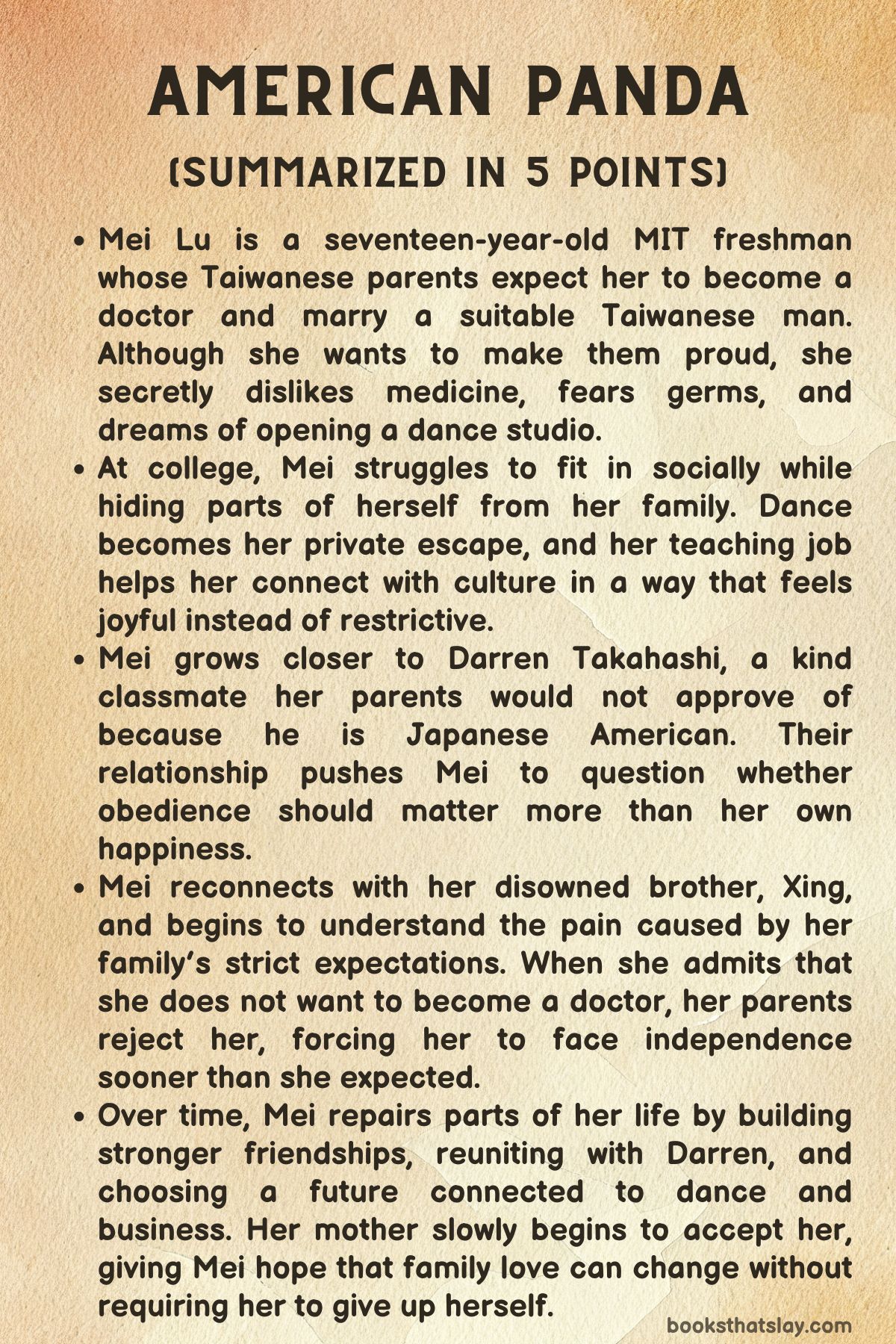
American Panda by Gloria Chao is a contemporary young adult novel about Mei Lu, a Taiwanese American teenager trying to balance family duty with her own dreams. At seventeen, Mei is already a freshman at MIT, following the future her parents have planned for her: become a doctor, marry a suitable Taiwanese man, and bring honor to the family.
But Mei is afraid of germs, dislikes medicine, loves dance, and starts falling for Darren, a boy her parents would never approve of. The book explores identity, cultural pressure, family love, rebellion, and the painful cost of choosing yourself.
Summary
Mei Lu is a seventeen-year-old freshman at MIT, a place that should feel like the beginning of freedom. Instead, it often feels like another branch of her parents’ control.
Her Taiwanese parents have already mapped out her life: she will study premed, become a doctor, marry a respectable Taiwanese man, and avoid anything that could shame the family. Mei knows these expectations come from sacrifice, fear, and tradition, but they weigh heavily on her.
She wants to please her parents, especially because their praise is rare, but the life they want for her does not match who she is.
Her mother, Mama Lu, is loving in a strict and critical way. She comments on Mei’s body, manners, studies, and future, often framing obedience as respect.
Mei’s father is quieter but firm, reminding her that success and family honor must come first. Mei’s older brother, Xing, once failed to meet their expectations and was disowned after choosing to marry Esther, a woman who was believed to be unable to have children.
Mei misses Xing deeply but has been expected to treat him as if he no longer exists.
At MIT, Mei struggles socially. She feels out of place among classmates who make assumptions about her upbringing and laugh when she misses cultural references.
Her new roommate, Nicolette, seems uninterested in friendship at first, leaving Mei feeling even more isolated. Yet MIT also gives Mei small pockets of freedom.
She discovers a hidden room where she can dance alone, away from judgment. Dance is her real passion.
Though her parents once allowed it only as an activity to strengthen college applications, Mei secretly dreams of opening her own dance studio.
Mei also teaches dance to young Chinese adoptees, helping them connect with their heritage. The work brings her joy, but it also fills her with guilt because it is another secret.
Her parents believe she is focused only on becoming a doctor. When Mama Lu panics after being unable to reach Mei and shows up at her dorm, Mei briefly sees her mother’s softer side.
They tour campus together, share moments of wonder, and Mei wishes their relationship could always be that open.
Her doubts about medicine grow stronger after a painful medical misunderstanding. When Mei experiences a burning rash, a male doctor quickly misdiagnoses her with herpes despite her saying she is not sexually active.
Later, she meets Dr. Chang, a young Asian woman doctor who correctly diagnoses an allergic reaction. Mei shadows Dr. Chang, hoping to imagine herself in that future, but she becomes overwhelmed by bodily fluids, infections, and the reality of medical work.
Her fear of germs is not a small discomfort; it is intense and difficult to control. Although Dr. Chang has learned to manage similar fears, Mei starts to realize that she cannot build her life around a career that makes her miserable.
At the same time, Mei grows closer to Darren Takahashi, a Japanese American classmate at MIT. Darren is kind, curious, and passionate about biology.
He does not mock Mei’s laugh, her anxieties, or her awkwardness. He shows her parts of campus she has never noticed and encourages her to ask what she wants for herself.
Their connection excites Mei, but it also terrifies her. Her parents would never approve of Darren because he is not Taiwanese and because Mama Lu carries prejudice linked to Japan’s occupation of Taiwan.
Mei feels trapped between attraction and duty.
Family history becomes harder for Mei to ignore when her grandmother and aunt visit. Mei sees how cruelly her mother has been treated by her husband’s family, especially for not producing a son sooner and for not meeting their standards of success.
Mei begins to understand that Mama Lu’s harshness is not simple cruelty; it is shaped by shame, patriarchy, and years of being judged. Still, understanding her mother’s pain does not erase Mei’s own.
When Xing unexpectedly appears at a restaurant with Esther, the family conflict resurfaces. Mei is shaken by seeing the brother she has missed for years and by watching her family reject him again.
She later reconnects with him in secret. Their meetings are awkward but important.
Xing explains that he stayed away because he thought it would spare Mei from having to choose sides. Mei is hurt, but she also sees that Xing has carried his own wounds.
Through him, she understands that choosing love and independence can come at a terrible cost.
Mei’s hidden life expands. She continues dancing, spends time with Darren, and performs at a Taiwanese student night market, where she feels connected to culture in a joyful way rather than a restrictive one.
The event reminds her that her heritage is not the problem; the problem is being told there is only one acceptable way to belong. With Darren, Mei feels seen.
She finally admits that her dream is not medicine but dance, and that she wants a future built around movement, creativity, and her own choices.
The secrets eventually collapse. Mei’s parents discover that she has been meeting Xing.
During a painful confrontation, Mei admits that she does not want to become a doctor. Her parents accuse her of rejecting her family and culture, and they disown her.
Mei is devastated. Even though she has feared this possibility, the reality of being cut off by her parents leaves her shaken.
Xing supports her, but his comfort is bittersweet because he knows the pain too well.
Mei begins the difficult process of living without her parents’ approval. She faces practical problems, including financial aid and legal independence, since she is still under eighteen.
She also encounters the social consequences of disownment when family friends treat her as undesirable. Yet she also gains unexpected support.
Nicolette opens up about her own insecurities, and their friendship becomes real. Darren stands beside Mei and agrees to attend Xing and Esther’s wedding with her.
At the wedding, Mei sees Xing and Esther’s love clearly. She also sees that Esther’s family, though traditional, accepts Xing in a way his own parents refuse to.
The ceremony is interrupted by Aunt Yilong, who announces that Nainai has died and blames Xing and Mei for breaking her heart. The accusation wounds Mei deeply.
Though the wedding continues, Mei is overwhelmed by grief, guilt, and family pressure. In fear that her life is too complicated for Darren, she breaks up with him, even though he wants to stay.
Nainai’s funeral brings another confrontation. Mei sneaks in to say goodbye, but her father and aunt demand that she leave.
Xing and Esther arrive too, and the family learns that Esther is pregnant with a boy. Xing makes it clear that their parents have lost the right to know his son unless they can apologize.
Mei pleads for honesty and reconciliation, but her father refuses to accept a relationship that does not require obedience. Mei finally tells him that he has failed as a father, forcing him to face the damage he has caused.
Afterward, Mama Lu begins meeting Mei in secret. At first, she still wants Mei to submit to her father’s demands, but Mei challenges her to think about what she wants.
Mei also searches for Ying-Na, the woman her community has long used as a warning story. She discovers that Ying-Na, now called Christine, is a confident comedian who has turned shame into strength.
Christine becomes a model for Mei: proof that being rejected by the community does not mean being ruined.
Mama Lu slowly changes. She admits that she raised Mei the way she had been raised because she thought it was right.
She reveals painful truths about her marriage, her resentment, and the pressure she felt to produce a son. Most importantly, she apologizes.
She tells Mei that she wants her to be happy and trusts her to choose her own path. For Mei, this does not fix everything, but it opens a door she thought was closed.
Mei also repairs things with Darren. With Nicolette’s help, she creates a campus surprise involving hot chocolate, a symbol of their earlier closeness.
She asks Darren to be her boyfriend, and they reunite. Later, he watches her dance in the hidden room, seeing the part of her she once kept secret from nearly everyone.
Six months later, Mei has begun shaping her own future. She declares a business major so she can work toward opening a dance studio.
Xing and Esther have a baby boy, Jonathan, and Esther chooses to adapt tradition rather than follow it blindly. Mei prepares for dinner with Darren and Mama Lu, nervous but hopeful.
Mama Lu still struggles with old prejudice, but she makes an effort. She approves of Darren and tells Mei she is proud of her.
Mei’s father has not fully changed, but there is a small sign of hope because he now accepts Mei’s relationship with her mother.
By the end of American Panda, Mei has not rejected her culture; she has rejected the idea that love must require obedience. She learns that family can hurt and still matter, that tradition can be honored and questioned, and that choosing herself does not make her selfish.
Her future is uncertain, but it is finally her own.
Characters
Mei Lu
Mei Lu is the central character of American Panda, and her growth comes from the conflict between the life she has been assigned and the life she quietly wants. At seventeen, she is already a freshman at MIT, which shows her intelligence, discipline, and the pressure she has lived under for years.
Her parents see her as proof of their sacrifice and ambition, but Mei experiences that pride as a burden because it leaves little space for doubt, fear, or personal desire. She is expected to become a doctor, yet she is deeply uncomfortable with germs, illness, bodily fluids, and the daily realities of medicine.
This makes her premed path not only emotionally wrong for her but physically distressing.
Mei’s love of dance reveals her true self. When she dances, she is not performing obedience or trying to meet anyone’s expectations; she is free, expressive, and honest.
Her secret dance teaching job also shows her compassion, especially because she helps adopted Chinese children connect with their heritage. This matters because Mei does not reject her culture itself.
What she resists is the narrow version of culture that demands silence, shame, and total obedience.
Her relationship with Darren helps her imagine a different future, but Mei’s real transformation does not come from romance alone. It comes from facing the possibility that choosing herself may cost her family.
She reconnects with Xing, admits she cannot become a doctor, survives being disowned, and eventually begins building a life based on her own values. Mei’s arc is not about becoming detached from family; it is about learning that love should not require self-erasure.
Mama Lu
Mama Lu is one of the most complex characters because she is both a source of pain for Mei and a person shaped by pain herself. She criticizes Mei’s body, behavior, studies, romantic choices, and future, often using shame as a tool of control.
Her love is real, but it is filtered through fear, tradition, social judgment, and her belief that a daughter’s safety depends on obedience. She wants Mei to become a doctor because she sees that career as stable, respectable, and protective.
At the same time, she is trying to prevent Mei from becoming what she fears she herself became: an unfinished, dependent woman judged by others.
Her harshness becomes more understandable when her own history is revealed. She dropped out of graduate school to care for her family, married without true love, faced pressure to produce a son, and endured criticism from her husband’s relatives.
These experiences damaged her sense of worth. Instead of breaking that pattern, she initially passes it down to Mei, believing that this is how daughters are prepared for the world.
Mama Lu’s development is important because she changes slowly and imperfectly. She first urges Mei to return to obedience, but later begins questioning her own role in the family’s pain.
Her apology to Mei is a major turning point because it shows that she can separate love from control. She does not become instantly modern or fully free from prejudice, but she begins choosing her daughter over rigid expectations.
Mr. Lu
Mr. Lu represents the strictest form of parental authority in the story. He is less emotionally expressive than Mama Lu, but his power shapes the family.
His expectations are firm: Mei must study hard, become a doctor, marry correctly, respect her elders, and avoid the fate of Xing. To him, family loyalty means obedience.
When his children make choices outside his control, he sees those choices as betrayal rather than independence.
His treatment of Xing shows how conditional his love can become. Xing is disowned for choosing Esther, and Mei is expected to participate in that rejection.
This reveals Mr. Lu’s belief that family reputation and tradition matter more than emotional connection. His refusal to reconcile unless his children submit makes him a painful figure, especially because he seems unable to understand that his authority has damaged the very family he wants to protect.
Yet Mr. Lu is not shown as a simple villain. The story suggests that he, too, was shaped by a harsh upbringing, including physical punishment and rigid ideas of respect.
His tears after Mei accuses him of failing as a father show that her words reach him, even if he cannot yet change. By the end, he still has not fully accepted Mei, but the fact that he allows her relationship with Mama Lu to continue suggests a small, uncertain possibility of future growth.
Xing Lu
Xing Lu functions as both a warning and a guide for Mei. To her parents, he is the example of what happens when a child chooses personal happiness over family duty.
To Mei, he is a lost brother whose absence has left a deep wound. His disownment teaches Mei early that rebellion has consequences, which is why she fears disappointing her parents so intensely.
When Mei reconnects with Xing, she learns that his choice was not careless. He chose Esther because he loved her and because he no longer wanted to live under the crushing pressure of being the eldest son.
His decision to leave was also shaped by his desire to protect Mei from being forced to choose between him and their parents. This reveals his love for his sister, though Mei understandably feels abandoned by him.
Xing’s character also complicates Mei’s assumptions. He is a doctor and genuinely enjoys medicine, which means he is not simply the rebellious opposite of the family ideal.
He shows Mei that the problem is not becoming a doctor; the problem is being forced into a future that does not fit. His marriage to Esther and the birth of their son represent the new family life he has built outside his parents’ approval.
He is wounded by rejection, but he refuses to let that rejection define the worth of his choices.
Darren Takahashi
Darren Takahashi is Mei’s romantic interest, but his role is larger than that. He represents a way of being that is more open, curious, and self-directed.
He is passionate about biology and academia, which contrasts with Mei’s forced connection to the same field. Through Darren, Mei sees what it looks like when a person’s academic path comes from genuine interest rather than family pressure.
Darren’s Japanese American identity also brings out one of the story’s central conflicts. Mama Lu’s prejudice against Japanese people makes Darren an unacceptable match in her eyes, even though he himself does not strongly identify with Japanese culture.
This shows how inherited historical pain can shape present relationships in unfair ways. Darren becomes a test of whether Mei can separate her own feelings from the biases she has been taught.
He is not perfect. At one point, he calls Mei’s obedience to her parents absurd and suggests she has been brainwashed, which hurts her because he does not fully understand the cultural and emotional weight she carries.
However, he apologizes and tries to listen. His willingness to support Mei without demanding that she simplify her life makes him important.
He encourages Mei to ask what she wants, but he does not rescue her. Mei’s choices remain her own.
Nicolette
Nicolette begins as an unfriendly and distant roommate, but she becomes one of Mei’s most important friends. At first, her blunt warning that she does not want friendship makes Mei feel even more isolated at MIT.
Over time, however, Nicolette’s hard exterior is revealed to be partly an act. She has been trying to escape her shy high school identity by performing confidence, just as Mei has been performing obedience.
Their friendship grows because both girls are hiding parts of themselves. Nicolette’s life is messy, bold, and sometimes chaotic, but she gives Mei permission to experience college outside the narrow boundaries Mei has known.
Chair surfing, roof adventures, and emotional honesty all become part of the friendship that helps Mei feel less alone. Nicolette does not always understand Mei’s family situation, and at times she is too quick to say Mei is better off without her parents.
Still, she offers loyalty when Mei badly needs it.
By letting Mei call her Nic, she marks their relationship as real. She helps Mei reconnect with Darren and supports her during one of the most unstable periods of her life.
Nicolette’s character shows that friendship can come from unexpected places and that people who seem confident may be struggling with their own reinvention.
Dr. Tina Chang
Dr. Chang, later known more personally as Tina, serves as a possible version of Mei’s future. At first, Mei looks to her for reassurance that becoming a doctor might still be possible.
Tina is young, Asian, professionally successful, and working in medicine, which makes her seem like the kind of person Mei’s parents would admire. Yet Tina’s discomfort, emotional distance, and lack of visible passion unsettle Mei.
Tina’s own fear of germs makes her especially significant. She has learned to compartmentalize that fear enough to function as a doctor, and this briefly gives Mei hope.
However, Mei eventually realizes that surviving a career is not the same as wanting it. Tina shows Mei that it may be possible to force oneself into an expected role, but that possibility does not make the role right.
Her later participation in Mei’s dance class is meaningful because it suggests that Tina, too, is searching for a freer version of herself. She is not only a warning; she is also someone capable of change.
Through Tina, the story shows that professional success can hide emotional dissatisfaction, and that confidence may come from reconnecting with parts of the self that were set aside.
Esther
Esther is central to Xing’s break from the Lu family, though she is not presented as the cause of the family’s problems. The family rejects her because she is believed to be unable to have children, especially a son, which exposes the family’s harsh gender expectations and their obsession with lineage.
Esther becomes the target of blame because she does not fit what Xing’s parents want from a daughter-in-law.
Despite this, Esther is not bitter or cruel. When Mei finally meets her properly, Esther apologizes and admits her anxiety about being the reason Xing was disowned.
This shows her sensitivity and the emotional burden she has carried. She knows that her relationship with Xing has caused pain, even though the fault lies with the family’s rigid values rather than with her.
Her pregnancy later exposes the emptiness of the family’s judgment. The fact that she is carrying a boy would once have made her acceptable to them, but by then Xing refuses to let them claim the child without accountability.
Esther’s later decision to adapt the sitting month tradition also shows her balanced approach to culture. She does not reject tradition entirely, but she refuses to be trapped by it.
Nainai
Nainai represents an older generation shaped by endurance, hierarchy, and strict ideas of duty. Mei admires her strength and courage, but she also recognizes that Nainai’s values are often painful and limiting.
Nainai’s treatment of Mama Lu, especially her fixation on sons and obedience, reveals how patriarchal ideas can be enforced by women as well as men.
Her dementia adds sadness and complexity to her character. When she mistakes Mei for a younger Mama Lu and demands a son, she unintentionally exposes family history that had remained hidden from Mei.
That moment helps Mei understand why Mama Lu carries so much shame and why the family’s expectations have been so damaging.
Nainai’s death becomes a source of guilt and accusation. Aunt Yilong claims that Mei and Xing caused it through rebellion, turning grief into a weapon.
In this way, Nainai’s character continues to influence the family even after death. She embodies the power of ancestral expectations, but Mei’s goodbye to her also shows respect.
Mei can mourn Nainai without accepting all the values she represented.
Aunt Yilong
Aunt Yilong acts as an enforcer of family judgment. She supports Nainai’s authority, criticizes Mama Lu, condemns Xing and Esther, and later attacks the wedding with accusations.
Her behavior shows how family pressure often comes not only from parents but from a wider community of relatives who guard tradition and reputation.
She is especially important because she turns private conflict into public shame. By bursting into the wedding and blaming Xing and Esther for Nainai’s death, she tries to make their love seem like a moral crime.
Her words are cruel because they exploit grief and superstition to punish disobedience.
Yilong does not show the same capacity for reflection that Mama Lu eventually does. She remains rigid, accusatory, and loyal to the old hierarchy.
As a character, she represents the social force that keeps families from changing: the fear of being judged, cursed, excluded, or remembered as disobedient.
Christine, Also Known as Ying-Na
Christine is important because she transforms a family warning story into a real person. For years, Mei has heard Ying-Na used as an example of failure and shame, someone parents mention to scare children into obedience.
When Mei finds her, she discovers not a ruined woman but a confident comedian who has built a life from the very material others used to shame her.
Christine’s comedy gives Mei a new model of survival. She jokes about strict cultural expectations and community judgment, proving that pain can be turned into voice and power.
She also recognizes Mei with warmth and treats her like a younger sister figure, offering the kind of encouragement Mei rarely receives from adults.
Her presence helps Mei understand that being rejected by a community does not mean losing one’s future. Christine has not escaped cultural complexity, but she has refused to let others define her story.
In American Panda, she becomes proof that the so-called cautionary tale may actually be the freest person in the room.
Helen
Helen is Mei’s childhood friend and serves as a contrast to Mei’s experience of Taiwanese American identity. When Mei visits her at Dartmouth, she expects Helen to help her make sense of the pressure she feels.
Instead, Mei sees that Helen has a healthier and less restrictive relationship with her culture. Helen’s parents are not as controlling, and Helen does not experience her heritage as a trap.
This contrast is important because it helps Mei realize that her parents’ behavior is not the only possible version of Chinese or Taiwanese family life. What Mei has been taught to see as cultural law may actually be her parents’ particular interpretation of culture, shaped by fear, trauma, and social pressure.
Helen does not provide all the answers Mei wants, but her role is still valuable. She widens Mei’s understanding of identity.
Through Helen, Mei begins to see that she does not have to choose between being herself and being connected to her heritage.
Jenn
Jenn appears briefly but leaves a strong impression on Mei. As another MIT student, she shares that her parents disowned her after she came out as lesbian.
Mei connects with her because Jenn’s experience mirrors the fear that has shaped Mei’s own life: the fear that parental love can be withdrawn when a child does not meet expectations.
Jenn’s role helps Mei recognize that parents can be wrong. This is a difficult realization for Mei because she has been raised to treat parental authority as nearly absolute.
Jenn’s story shows that family rejection is not limited to one culture or one situation. It can happen whenever parents value control over acceptance.
Although Jenn is not a major character, she helps move Mei toward a broader understanding of independence. She becomes one of the first people who makes Mei see disownment not as proof that a child has failed, but as proof that parents may be unable to love fairly.
Eugene Huang
Eugene Huang represents the future Mei’s parents want for her in romantic form. He is Taiwanese, academically successful, premed, and socially acceptable to the parent community.
Mama Lu sees him as the ideal match because he would preserve the family’s values and status.
When Mei finally encounters him directly, however, he is arrogant and dismissive. His relief at no longer being matched with Mei after her disownment reveals how shallow the matchmaking system can be.
Mei is not treated as a full person with desires and dignity; she is treated as a social prospect whose value can rise or fall depending on reputation.
Eugene’s role is brief but effective. He helps Mei feel grateful that she has escaped the future others imagined for her.
By contrasting him with Darren, the story shows the difference between being chosen for social approval and being loved for who one actually is.
Mrs. Pan
Mrs. Pan represents the wider parent community that constantly watches, judges, and ranks young people. She tries to match Mei with her son Hanwei, comments on Mei’s appearance, and participates in the social world where children’s achievements and marriage prospects become public currency.
Her behavior shows how community pressure strengthens parental control. Mama Lu is not acting in isolation; she is surrounded by people who evaluate whether Mei is successful, obedient, desirable, and respectable.
Mrs. Pan’s later lie that Hanwei is no longer single after Mei’s disownment shows how quickly that community withdraws approval.
Mrs. Pan is not deeply developed as an individual, but she is important as a social presence. She represents gossip, comparison, matchmaking, and reputation, all of which make it harder for Mei’s parents to accept her choices.
Hanwei
Hanwei is mostly significant as an idea rather than as a developed person. Mrs. Pan presents him as a possible match for Mei, but Mama Lu dismisses him as not good enough.
Through Hanwei, the story shows how children in this community can be treated as pieces in a social arrangement, judged by family status, education, and marriage potential.
His role also reveals Mama Lu’s selective standards. Although she insists that Mei marry a Taiwanese man, not just any Taiwanese man will do.
The match must also raise or preserve Mei’s status. Hanwei therefore helps expose the transactional nature of the matchmaking culture surrounding Mei.
Valerie
Valerie represents one of Mei’s early sources of social discomfort at MIT. She laughs at Mei for missing a Star Wars reference, contributing to Mei’s feeling that she does not belong.
Valerie and the other students assume things about Mei’s childhood and identity, making her feel reduced to a stereotype.
Later, Valerie appears in a medical context, which intensifies Mei’s fear of bodily functions and illness. By the end, Mei and Nicolette still do not fully get along with her, which is realistic.
Not every social conflict becomes a warm friendship. Valerie’s role is to show the everyday awkwardness, judgment, and misunderstanding Mei faces outside her family as well as within it.
Rose
Rose is one of the children Mei teaches in dance class, and her role highlights Mei’s gift as a teacher. Through Rose, Mei’s connection to dance becomes more than private pleasure.
It becomes a way of helping others understand culture through movement, joy, and learning rather than fear.
Rose also reflects one of Mei’s healthier relationships with heritage. Mei teaches Chinese dance to adopted children whose families want them to connect with their background.
This gives Mei a chance to pass on culture in a generous way, unlike the guilt-based methods often used on her. Rose helps reveal the kind of adult Mei might become: someone who creates belonging instead of enforcing obedience.
Themes
Identity and Self-Definition
Mei’s identity is constantly being defined by other people before she has the chance to define it herself. Her parents see her as a future doctor, a future wife to a Taiwanese man, a symbol of family success, and a daughter whose obedience will prove proper upbringing.
At MIT, some classmates reduce her to stereotypes about strict Asian families, while family friends judge her through marriageability and reputation. These outside definitions leave Mei feeling split between who she is expected to be and who she actually is.
Her love of dance becomes the clearest expression of self because it is not chosen for status or obedience. It belongs to her alone.
What makes her journey meaningful is that she does not simply abandon one identity for another. She does not reject being Taiwanese American, being Chinese, being a daughter, or being part of a family.
Instead, she learns to separate identity from control. She begins to understand that culture can include memory, food, dance, language, humor, and love without requiring silence or submission.
Her decision to pursue business and dance is not a rejection of intelligence or ambition; it is a claim that ambition should serve the self rather than erase it. In American Panda, identity becomes something Mei must actively choose, revise, and defend.
Family, Obedience, and Conditional Love
The Lu family is built on the belief that obedience protects the family, but that belief repeatedly damages the people inside it. Mei’s parents do love their children, yet their love is often expressed through correction, pressure, and control.
They believe that strict rules will secure success, respect, and stability. The tragedy is that their fear of failure causes them to create the very losses they dread.
Xing is disowned because he chooses Esther, and Mei is later disowned because she refuses medicine and reconnects with her brother. In both cases, parental love becomes conditional: the child is accepted only if the child obeys.
This theme is especially painful because the parents are not careless people. They have sacrificed, suffered, and lived under their own inherited pressures.
Mama Lu’s past shows how a person who has been hurt by rigid expectations can still pass those expectations on, believing them to be necessary. The story asks whether family loyalty should mean surrendering personal truth.
Mei’s answer becomes clear over time. She still wants her family, mourns their rejection, and hopes for reconciliation, but she no longer accepts obedience as the price of love.
The healthiest family bonds in the story are not the ones without conflict. They are the ones where people begin to apologize, adapt, and see one another as full human beings.
Culture, Tradition, and Change
Culture in the story is never treated as one simple thing. It can be beautiful, comforting, funny, restrictive, painful, and healing, depending on how people use it.
Mei’s memories of Taiwanese night markets, Chinese dance, family rituals, traditional food, and stories from history show that heritage gives her a sense of connection. At the same time, certain traditions are used to control women, enforce gender roles, shame sexuality, and demand obedience to elders.
The tension comes from Mei’s effort to decide what should be carried forward and what should be changed. Esther’s approach to the sitting month tradition is a strong example of this balance.
Rather than rejecting the practice completely or following it exactly, she chooses compromise and creates a version that fits her life. Mei’s dance teaching does something similar.
She shares culture with children in a way that is joyful and open, not based on fear. Christine’s comedy also changes the meaning of cultural shame by turning old warnings into public laughter and self-possession.
The story shows that tradition becomes harmful when it is treated as untouchable, especially when it protects injustice. But it also shows that change does not require abandoning heritage.
Mei’s growth depends on learning that she can honor where she comes from while refusing the parts that deny her freedom.
Shame, Reputation, and Social Pressure
Much of Mei’s conflict is intensified by the fear of what other people will say. Her parents’ expectations are personal, but they are also social.
Family friends, relatives, and the larger community constantly measure children by grades, careers, bodies, marriage prospects, and obedience. Reputation becomes a kind of public currency, and losing it can mean isolation.
This is why Mei’s disownment changes how people treat her. She is no longer seen as a promising daughter but as a risky association.
Mrs. Pan’s shift in attitude shows how quickly social approval can disappear when someone falls outside accepted rules. Shame also shapes the way Mei thinks about her body, sexuality, and desires.
Mama Lu’s warnings teach Mei to associate sexual knowledge with danger and disgrace, which makes her medical scare even more humiliating. Xing and Esther are also punished through shame, especially when their marriage is treated as an offense against family duty.
Christine’s role is powerful because she refuses to remain trapped in the shame assigned to her. She turns the community’s cautionary tale into a life of confidence and humor.
Mei learns from this that reputation is not the same as truth. Being judged does not mean being wrong, and being talked about does not mean being defeated.