American Prison Summary and Analysis
American Prison: A Reporter’s Undercover Journey into the Business of Punishment by Shane Bauer is an investigative nonfiction book about the American private prison industry and its deep roots in slavery, convict leasing, forced labor, and racial control. Bauer, a reporter for Mother Jones, takes a job as a corrections officer at Winn Correctional Center, a private prison in Louisiana, to see the system from the inside.
The book moves between his undercover experience and the long history of imprisonment for profit in the United States. It shows how cost-cutting, low pay, weak oversight, and corporate incentives shape prison life for both inmates and guards.
Summary
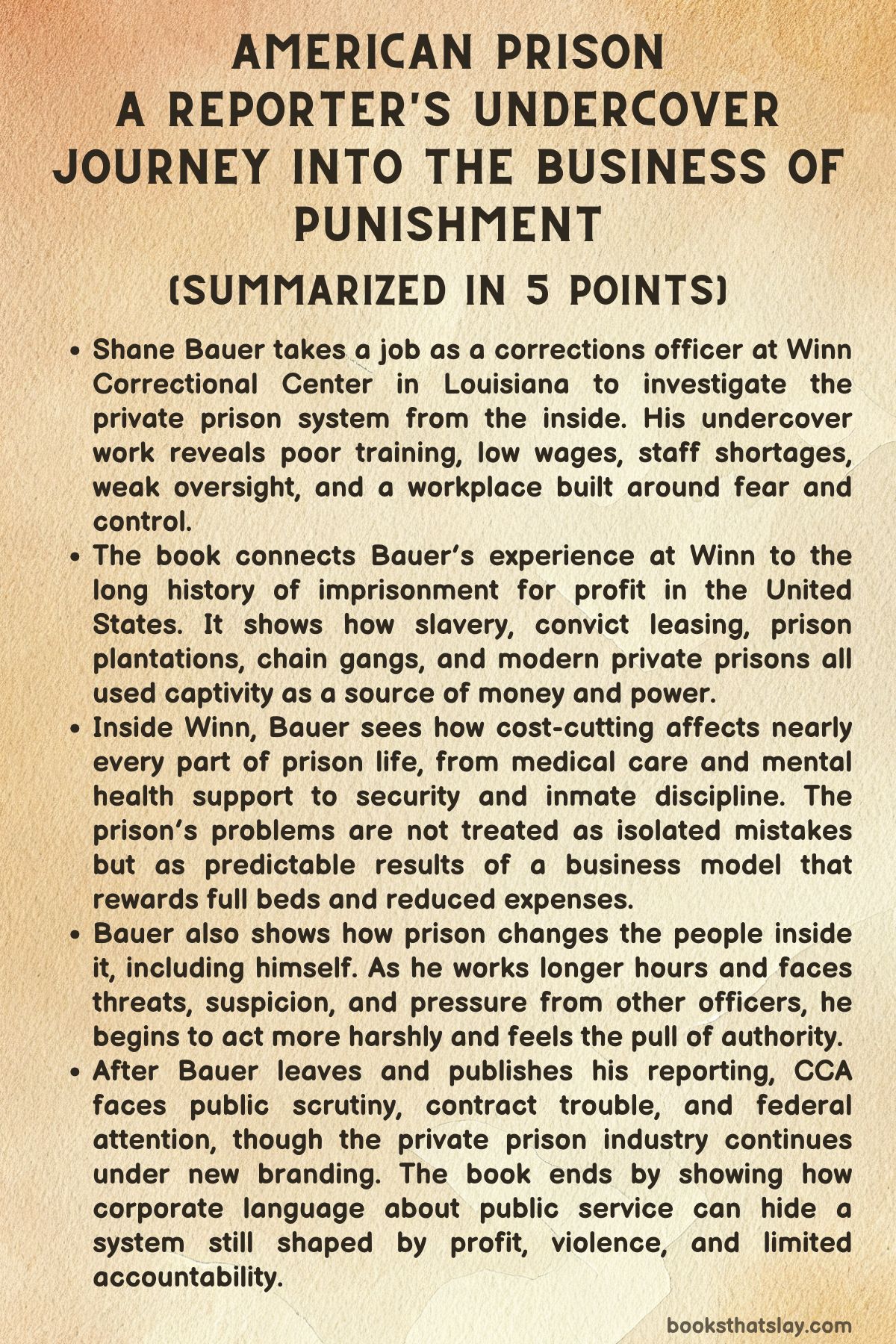
American Prison follows Shane Bauer’s undercover investigation into Winn Correctional Center, a private prison in Louisiana run by the Corrections Corporation of America, later renamed CoreCivic. Bauer begins by explaining why he feels compelled to return to a prison setting after having spent two years as a prisoner in Iran.
Although the idea unsettles him, he believes that the private prison system is too hidden from public view. Public prisons are subject to greater scrutiny, but private prisons can avoid many forms of transparency.
To understand the system, he applies for a corrections officer job, passes a light background check, and is hired for nine dollars an hour.
At Winn, Bauer enters a workplace shaped by low pay, high turnover, thin staffing, and a constant sense of danger. During training, he sees how poorly prepared guards are for the realities of prison life.
Instructors tell cadets that survival matters most. They are warned about inmate attacks, riots, hostage situations, and fights, yet they are given little more than radios and basic rules.
The training often stresses control rather than care, and some officers speak casually about violence, humiliation, or neglect. Bauer notices that many cadets are not driven by cruelty but by poverty; the job is one of the few options available to them.
Alongside his time at Winn, Bauer traces the history of American imprisonment for profit. He shows that private gain from captivity did not begin with modern corporations.
It reaches back to British convict servitude, slavery, and the post-Civil War convict leasing system. The Thirteenth Amendment abolished slavery except as punishment for a crime, and this exception allowed states and businesses to exploit incarcerated people as forced labor.
In the South, especially after emancipation, Black men were arrested under harsh laws and leased to plantations, mines, railroads, and factories. Conditions were often deadly, and profit mattered more than survival.
Bauer connects this history to later prison plantations, chain gangs, trustee systems, and the rise of private prison companies in the 1980s.
As Bauer’s training continues, he tours Winn and learns how unstable the facility is. The inmate-to-officer ratio is extremely high, with one floor officer sometimes responsible for 176 prisoners.
He sees disorder, contraband, broken routines, and weak supervision. Some inmates openly say that the prisoners, not the officers, run the place.
Staff shortages affect nearly everything: searches, food service, medical care, suicide watch, disciplinary hearings, and lockdowns. Officers cut corners because they do not have the people or resources to follow every rule.
Managers, meanwhile, focus on appearances, dress codes, inspections, and contract compliance.
Bauer is disturbed by the prison’s internal court system, where inmate discipline remains largely in company hands. He sees how rulings can affect company finances, especially when medical costs are involved.
He also learns that healthcare is often delayed or minimized because outside treatment costs money. The prison has a weak mental health system despite a large population of inmates with serious needs.
Suicide watch cells are bleak, and guards sometimes fail to monitor prisoners properly. Bauer reports complaints, threats, and distress, but he often meets indifference from staff who are overworked, hardened, or trained to see inmates as manipulators.
One of the most painful events in the book is the death of Damien Coestly, an inmate with a history of mental health issues and suicide threats. Coestly repeatedly signals that he is in crisis, but staff treat his behavior as manipulation.
After he hangs himself, he later dies. Bauer secretly shares video of Coestly with his mother, who had not understood the full extent of his suffering.
The incident becomes a clear example of how neglect, understaffing, and suspicion toward inmates can turn mental illness into a death sentence.
As Bauer spends more time as a guard, he begins to feel himself changing. At first, he tries to treat inmates with respect and restraint.
He listens, compromises, and looks for common ground. Some inmates advise him that respect works better than force.
Derik, an inmate Bauer comes to know, tells him to approach prisoners as people rather than as a uniform. Yet the job constantly pressures Bauer to become harsher.
Inmates test him, threaten him, insult him, and sometimes manipulate him. Other officers judge him by whether he can hold authority.
Bauer begins to toughen his posture, change his speech, work out, and respond more aggressively. When he writes up or segregates inmates, he sometimes feels the appeal of power even as he questions his own judgment.
The prison’s violence continues to rise. Bauer witnesses shank fights, threats, sexual domination, pepper spray incidents, sewage problems, and broken procedures.
He sees that private prisons have higher violence rates than public ones, and that Winn underreports some of its problems. He also observes how official oversight can be shallow.
The American Correctional Association accredits prisons, but Bauer suggests that its inspections may miss serious problems. When auditors visit Winn, staff and inmates scramble to make the facility look compliant, and the inspection appears brief and superficial.
Winn’s business model depends on contracts, occupancy, cost control, and keeping the facility attractive to the state. Bauer explains that CCA’s contract with Louisiana requires the prison to remain nearly full, meaning the state pays even for empty beds.
This creates a financial structure in which incarceration itself becomes a source of guaranteed revenue. The company’s public language emphasizes safety, service, and rehabilitation, but Bauer’s experience suggests that budget cuts, low wages, weak medical care, and poor staffing dominate daily life.
Near the end of his time at Winn, Bauer becomes increasingly paranoid and exhausted. He destroys some notes, worries that his identity will be discovered, and feels caught between his role as a reporter, his memories as a former prisoner, and his behavior as a guard.
He decides to quit, but when he is offered a promotion, he hesitates because it might give him more access. His exit becomes urgent after a Mother Jones photographer, James West, is arrested while photographing the prison area.
Bauer fears exposure, leaves Louisiana with his wife and West, and resigns from Winn.
After Bauer leaves, his identity becomes known. Some employees are angry, but others praise him or speak more openly.
CCA investigates and threatens Mother Jones before publication. Soon after, Louisiana cancels CCA’s contract at Winn, citing violations, though another private company takes over.
Bauer follows the broader impact of his reporting: former employees contact him, a Department of Justice official interviews him, and federal private prison contracts are briefly canceled. CCA’s stock falls, but later rises after Donald Trump’s election, as investors expect immigration detention to expand.
The book ends with Bauer attending a CoreCivic shareholder meeting. The company has rebranded itself with polished language about public service, but Bauer sees the same profit-driven business beneath the new name.
Activists ask about inmate suicide, transparency, violence, low pay, and use of force. Executives answer in vague terms and avoid direct accountability.
American Prison closes by showing that the private prison industry survives not because it solves the problems of incarceration, but because it has learned how to profit from them while presenting itself as a public good.
Key People
Shane Bauer
Shane Bauer is the central figure and guiding consciousness of American Prison, both as an investigative reporter and as a man carrying the memory of his own imprisonment in Iran. His decision to work undercover as a corrections officer is not presented as simple professional ambition; it is shaped by fear, curiosity, anger, and a need to understand a system that hides itself from public inspection.
Bauer enters Winn Correctional Center with moral clarity, but the prison tests that clarity every day. He wants to treat inmates with dignity, yet he also wants to survive, keep his cover, and prove himself to other officers.
As the job continues, he notices changes in himself: he becomes more suspicious, more aggressive, more drawn to authority, and more willing to punish. This makes him one of the most complex figures in the book because he is not only observing corruption from a distance; he is participating in it.
His strength lies in his honesty about that participation. He does not present himself as untouched by the prison environment.
Instead, he shows how quickly an institution built on control can reshape even someone who enters it with critical awareness. His final decision to leave Winn comes from exhaustion, fear of exposure, and a growing recognition that the role is damaging him from the inside.
Derik
Derik, also called Gray Shirt, is one of the most important inmates Bauer encounters because he challenges the simple guard-prisoner divide. He is intimidating, volatile, and capable of real menace, yet he also speaks with a sharp understanding of how prison dehumanizes people.
His advice to Bauer is direct: do not approach inmates only through the uniform; approach them as people. This makes Derik a kind of informal teacher for Bauer, though never a safe or sentimental one.
He reveals the anger that builds from constant noise, disrespect, confinement, and humiliation, but he also shows how that anger can become dangerous. His conversations with Bauer expose the emotional logic of prison life, where respect is survival, weakness can be punished, and every interaction carries hidden stakes.
Derik’s reflections on violence, grief, and authority are unsettling because they refuse easy moral comfort. He is neither reduced to a victim nor treated only as a threat.
Through him, the book shows that prison produces relationships based on negotiation, fear, need, and temporary trust. Bauer is drawn to Derik’s honesty, but he also fears being manipulated by him, and that uncertainty captures the unstable social world of Winn.
Bacle
Bacle is an older corrections officer who becomes a practical mentor to Bauer. Unlike the more aggressive officers, he understands that rigid enforcement is impossible in a prison with too few staff and too many inmates.
His approach depends on compromise, routine, and rapport. He knows that a guard cannot control every action, punish every violation, or win every confrontation.
For Bacle, survival comes from reading people, choosing battles, and maintaining enough respect to keep the unit from collapsing into disorder. He represents a weary, experience-based form of prison work rather than an ideological commitment to punishment.
His advice helps Bauer understand that the official rules of the institution often have little connection to its daily reality. At the same time, Bacle is not a reformer.
He works within the system as it exists, adjusts to its failures, and waits for retirement. His character shows how decent or pragmatic individuals can become part of a harmful structure without necessarily seeing themselves as cruel.
He is one of the few staff members who recognizes that human interaction matters, but his survival strategy also depends on accepting many of Winn’s broken conditions as normal.
Kenny
Kenny is one of the clearest examples of how prison culture can normalize contempt. As a trainer, he teaches cadets not only procedures but attitudes.
He emphasizes cost-effectiveness, discipline, suspicion, and the need to prevent inmates from gaining any psychological advantage. His comments often reveal a casual disregard for the suffering of both prisoners and staff, including moments when he laughs about abuse or uses fear to shape the cadets’ behavior.
Kenny’s presence makes Bauer feel watched and possibly exposed, which adds to the tension of the undercover assignment. More importantly, Kenny represents the institutional voice that tells new officers to harden themselves.
He does not simply train people to do a job; he trains them to see compassion as weakness and control as the main goal. His later hospitalization after being assaulted by an inmate also shows the danger officers face in an understaffed and volatile prison.
Yet the book does not use that danger to excuse his cruelty. Instead, Kenny illustrates how fear, low pay, weak support, and institutional pressure can combine with personal callousness to produce a damaging model of authority.
Assistant Warden Parker
Assistant Warden Parker is a symbol of managerial blindness and institutional performance. He speaks often about discipline, dress codes, order, and reforming inmate behavior, but he repeatedly avoids the deeper problems that Bauer sees every day: understaffing, poor pay, violence, medical neglect, and administrative dishonesty.
Parker’s focus on visible signs of control reveals how prison management can confuse appearances with safety. He wants inmates to be “institutionalized” rather than individualized, a phrase that captures his view of prisoners as a population to be managed rather than people with specific needs.
His speeches often sound forceful, but they do not solve the structural failures around him. When inspections or visits occur, the prison temporarily performs order, and Parker participates in that culture of presentation.
He is not portrayed as a mastermind of evil; rather, he is a mid-level authority figure whose priorities align with the needs of the company. His character shows how bureaucratic language, discipline campaigns, and official confidence can cover over a collapsing environment.
Damien Coestly
Damien Coestly is one of the most tragic figures in the narrative. His repeated suicide threats, hunger strikes, grievances, and visible distress show a man trying to make himself heard inside a system trained to dismiss cries for help as manipulation.
His death exposes the prison’s failure of mental health care in its starkest form. Coestly is not simply an isolated case; he represents the consequences of understaffing, suspicion, inadequate treatment, and cost-driven confinement.
The fact that staff knew about his condition makes the failure even more severe. Bauer’s decision to share video of Coestly with his mother gives the episode a human dimension beyond institutional records.
His mother’s grief shows how prison separates families not only physically but informationally; loved ones often do not know what is happening until it is too late. Coestly’s character forces the reader to confront what happens when a prison treats mental illness as defiance and desperation as strategy.
His death becomes a moral indictment of a system that can document suffering without responding to it meaningfully.
Corner Store
Corner Store is an inmate close to release whose story complicates any easy idea of freedom. He speaks with Bauer about wanting to return to his mother, leave behind the hard prison identity he has had to maintain, and become someone else outside.
His hopes reveal how long incarceration can force a person to perform toughness until that performance becomes difficult to remove. Yet his release is delayed because he lacks a permanent address, showing how bureaucratic requirements can keep people imprisoned even after they are technically eligible to leave.
Bauer sees in Corner Store both vulnerability and possible manipulation, and this uncertainty causes him to pull away. That reaction says as much about Bauer’s changing mindset as it does about Corner Store.
After release, Corner Store’s later arrest prevents his story from becoming a simple redemption narrative. He represents the difficulty of reentry, the long-term damage of prison life, and the limits of sympathy when serious harm remains possible.
His character keeps the book morally unsettled, refusing to turn incarceration into a story with clean emotional resolution.
T. Don Hutto
T. Don Hutto is one of the most important historical figures in the book because his career connects older prison labor systems to the modern private prison industry. Before becoming a co-founder of CCA, he learned the business of incarceration through plantation-style prisons where profit, forced labor, and discipline were deeply connected.
His background matters because it shows that private prisons did not appear as a completely new invention in the 1980s. They grew from older traditions in which captive people were treated as sources of revenue.
Hutto’s skill lies in adapting that history to new political and economic conditions. When the prison population rose sharply, he and his partners saw an opportunity to turn confinement into a corporate service.
He is not portrayed only as an individual businessman but as a carrier of institutional memory. Through Hutto, the book argues that the modern private prison is tied to the same logic that shaped convict leasing and prison plantations: reduce costs, maintain control, and extract value from captivity.
CCA and CoreCivic
CCA, later renamed CoreCivic, functions almost like a character because its corporate decisions shape nearly every part of the story. The company’s public language emphasizes safety, rehabilitation, and service, but Bauer’s experience at Winn shows a business model built around occupancy, low labor costs, limited transparency, and tight budgets.
The company benefits when prisons remain full, and its contracts can guarantee payment even for empty beds. This turns incarceration into a predictable revenue stream.
At the human level, that financial structure affects staffing, medical care, training, food, security, mental health treatment, and the daily relationship between guards and inmates. The rebranding to CoreCivic does not change the nature of the business; it changes the language around it.
At the shareholder meeting, the company presents itself as a force for public good, while activists and Bauer raise questions about violence, suicide, transparency, and pay. As a corporate presence, CCA/CoreCivic represents the gap between institutional branding and lived reality.
Miss Blanchard
Miss Blanchard is a training officer whose role is quieter than Kenny’s or Tucker’s but still revealing. She is open about the low pay and the company’s willingness to hire almost anyone who meets basic requirements.
Her honesty makes her memorable because it strips away the illusion that corrections work at Winn is a carefully selected professional calling. She also administers the personality test that leaves Bauer classified as analytical and curious, traits that do not clearly fit the job.
Her comment that personalities tend to shift over time suggests one of the book’s key psychological concerns: the prison does not merely use people as they are; it changes them. Miss Blanchard is not especially cruel, but she is part of a training system that prepares people for a damaged workplace without fully addressing why it is damaged.
Her character helps show how ordinary, even friendly, staff members can normalize an institution’s weaknesses by treating them as unavoidable facts.
Miss Roberts
Miss Roberts, the mailroom supervisor, reveals the emotional and informational control that prisons exercise over inmates. Through her, Bauer sees how letters are inspected, restricted, and sometimes dismissed even when they contain serious signs of distress.
The mailroom exposes a side of prison life that is less physically violent but deeply intimate. Letters from families and loved ones remind Bauer that inmates are connected to people outside, people who are often poor, grieving, hopeful, angry, or lonely.
Miss Roberts’s casual response to a suicide threat shows how numb staff can become to suffering. Her mention of banned materials also reveals the prison’s selective control over knowledge, especially its restrictions on material related to Black history or empowerment while allowing other disturbing texts.
She represents the bureaucratic handling of human connection. In her workspace, love letters, pleas, threats, and family news become items to be sorted, checked, and regulated.
Tucker
Tucker, the head of the tactical response team, embodies the survival-first mentality of Winn’s security culture. His training sessions teach cadets to think less about solving crises and more about getting out alive.
He describes inmate fights, hostage situations, tear gas, and possible violence with blunt practicality. His advice often suggests that officers have limited tools and limited backup, so their options in dangerous situations are narrow.
Tucker’s attitude is not simply personal toughness; it reflects a prison where staff are underprepared and under-equipped. When he exposes cadets to tear gas and speaks casually about force, he communicates that the job will be brutal and that emotional distance is necessary.
Yet his methods also reinforce fear as the foundation of authority. Tucker shows how a prison can train officers to expect violence while failing to give them the resources needed to prevent it.
Edison
Edison is a former Army Ranger and police chief whose worldview is shaped by combat, policing, and confrontation. He believes harsher discipline is the answer to Winn’s disorder, and he approaches prison work with the language of war.
His presence intensifies tension rather than calming it. When he antagonizes inmates during count, the tier becomes more hostile, showing how an officer’s attitude can quickly affect the whole unit.
Edison is frustrated by low pay, weak order, and the broader criminal justice system, but his solution is more force rather than more support, staffing, or reform. His character shows how militarized thinking can enter prison management and worsen already fragile conditions.
He is not merely an angry guard; he represents a model of authority that interprets conflict as battle and prisoners as enemies.
Albert Race Sample
Albert Race Sample appears in the historical sections as a powerful example of the brutality of prison plantation labor. His experience picking cotton under threat, punishment, hunger, and racial abuse connects the book’s modern investigation to the long history of forced labor after slavery.
Sample’s story shows how the Thirteenth Amendment’s punishment exception allowed states to continue extracting labor from incarcerated people. He is important because he gives personal form to a system that might otherwise seem abstract.
Through him, the reader sees the body-level reality of profit-driven punishment: exhaustion, humiliation, danger, and racial domination. Sample’s presence also helps explain why Bauer treats private prisons not as a recent policy mistake but as part of a much older American pattern.
Samuel Lawrence James
Samuel Lawrence James represents the entrepreneurial face of convict leasing after the Civil War. He sees incarceration as a business opportunity and imagines the prison system as a source of enormous private wealth.
By leasing prisoners, building factories, and subcontracting labor to dangerous camps, he turns punishment into a commercial empire. His character is central to the book’s historical argument because he demonstrates how quickly emancipation was followed by new systems of coerced Black labor.
James’s wealth grows while prisoners suffer from brutal conditions, meager food, and high death rates. He shows the moral emptiness of a system where the value of an incarcerated person is measured by output rather than life.
His role helps establish the continuity between slavery, convict leasing, and later forms of prison privatization.
Themes
Profit and Captivity
The book presents captivity as a recurring business opportunity in American history. In American Prison, Bauer argues that private prison companies are not an isolated modern development but part of a long tradition of making money from confined people.
British convict servitude, slavery, convict leasing, prison plantations, chain gangs, and private prisons all share a basic economic logic: people without freedom can be made profitable when their labor, bodies, or confinement are controlled by others. At Winn, that logic appears in low officer wages, thin staffing, delayed medical care, high occupancy requirements, and pressure to cut costs.
The company does not need every inmate to work in a field or factory to profit from incarceration; the body in the bed becomes a source of revenue. This changes the meaning of justice.
Imprisonment is no longer only a legal sentence but also a financial asset. The danger is that economic incentives begin to shape who is held, how long they stay, how they are treated, and how much suffering is tolerated.
Bauer’s historical sections make clear that whenever profit enters punishment, the welfare of incarcerated people becomes secondary to revenue, efficiency, and institutional survival.
Dehumanization and Institutional Power
Winn Correctional Center runs on a daily habit of dehumanization. Inmates are spoken of as threats, manipulators, cattle, children, bodies, or problems to be managed.
This language matters because it prepares staff to accept conditions that would otherwise appear intolerable. When prisoners are treated as less than fully human, ignored medical complaints, rough searches, poor food, isolation, and indifference to mental illness become easier to justify.
Bauer’s time inside the prison shows that dehumanization also affects officers. Low pay, long shifts, danger, and weak support reduce guards to replaceable workers inside the same machinery.
The institution pressures them to suppress empathy because empathy can look like weakness. Bauer’s own transformation demonstrates this process.
He enters with a strong awareness of prisoner suffering, but the job teaches him to suspect kindness, fear manipulation, and enjoy moments of control. Institutional power does not only operate through official rules; it works through habits, jokes, routines, inspections, paperwork, uniforms, and peer judgment.
The result is a place where both prisoners and guards are shaped by the need to dominate or endure domination.
Race, Labor, and the Afterlife of Slavery
The history Bauer recounts shows that American imprisonment cannot be separated from race. After the Civil War, the abolition of slavery did not end forced labor; it helped redirect it through criminal law.
The punishment exception in the Thirteenth Amendment allowed incarcerated people to be forced to work, and Southern states used harsh laws to push newly freed Black people into prisons, labor camps, mines, plantations, and chain gangs. The racial purpose was not hidden: incarceration became a way to restore white control, replace lost slave labor, and discipline Black freedom.
This history gives the modern private prison a deeper meaning. Winn is not a plantation prison in the old sense, but it exists in a country where mass incarceration has been shaped by racial inequality, harsh sentencing, and economic abandonment.
Bauer’s historical examples show that the language changes over time, from slavery to convict leasing to corrections management, but the pattern remains recognizable. Black bodies are disproportionately controlled, punished, and made useful to systems of wealth and authority.
The theme is not only that racism exists inside prisons; it is that prison systems have repeatedly helped reproduce racial hierarchy under legal cover.
The Psychological Cost of Prison
Prison damages people far beyond the official sentence. Bauer shows this through inmates with mental illness, men nearing release, guards under stress, and his own changing personality.
Winn is not only physically unsafe; it is psychologically corrosive. Inmates live under constant noise, threat, humiliation, boredom, surveillance, and uncertainty.
Some respond with anger, some with manipulation, some with withdrawal, and some with despair. Damien Coestly’s death reveals what happens when mental suffering is treated as bad behavior rather than a medical emergency.
Guards are also damaged. They face long hours, low pay, danger, and a culture that tells them to be hard at all times.
The reported suicide risk among correctional officers underscores that prison work can injure the people assigned to enforce confinement. Bauer’s experience is especially important because it shows how quickly the prison mindset can take hold.
He becomes more suspicious, more masculine in his self-presentation, more punitive, and more eager for confrontation. The institution creates emotional pressure on everyone inside it.
Its violence is not only in fights, pepper spray, or neglect; it is in the slow reshaping of how people see themselves and others.