American Slavery, American Freedom Summary and Analysis
American Slavery, American Freedom by Edmund S. Morgan is a historical study of colonial Virginia and the troubling contradiction at the center of early American life: the growth of liberty alongside the growth of slavery. Morgan argues that Virginia’s political culture, later so important to the American Revolution, developed in direct relation to its labor system.
The book follows English colonization from its early hopes of empire and Christian settlement through Jamestown’s failures, tobacco expansion, class unrest, Bacon’s Rebellion, and the rise of racial slavery. It shows how white freedom was built by denying freedom to Black and Indigenous people.
Summary
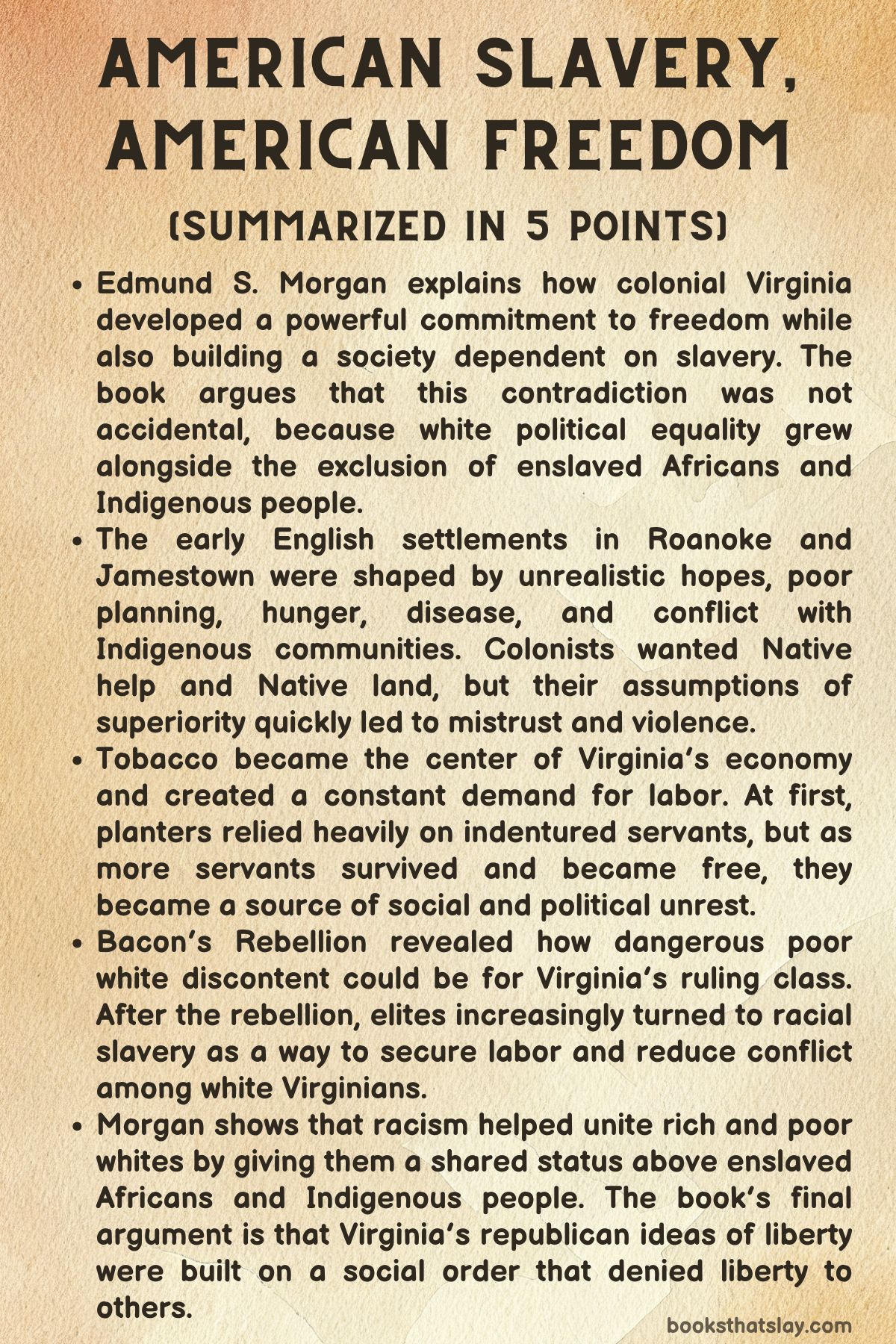
American Slavery, American Freedom traces the development of colonial Virginia from English dreams of overseas settlement to the creation of a society where republican liberty and racial slavery supported each other. Edmund S. Morgan begins by asking how the same colony that produced many champions of American freedom also became deeply committed to human bondage.
His answer is that Virginia’s history shows how ideas of equality among white men were strengthened by the exclusion and exploitation of enslaved Africans and Indigenous people.
The story begins before permanent English settlement, with English ambitions in the Atlantic world. English explorers and writers imagined colonization as a way to expand trade, fight Spain, spread Christianity, and relieve England’s social problems.
They believed America could offer land, wealth, and opportunity, while also serving as a base against Spanish power. At first, the English did not enter America with a fully formed plan for racial slavery.
They imagined cooperation with Indigenous people, whom they divided in their minds into friendly groups who might help them and hostile groups who had to be subdued. These assumptions shaped early colonial plans and later helped justify violence.
The first English attempts at settlement failed badly. Roanoke showed how far English hopes were from American realities.
Settlers depended on Indigenous food supplies but treated Indigenous communities with suspicion and aggression. Instead of building stable relationships, they reacted to conflict with force.
The result was hunger, fear, and abandonment. These early failures revealed a pattern that would continue in Virginia: the English wanted Native help, Native land, and English control all at once.
Jamestown repeated many of these problems on a larger scale. The Virginia Company sent settlers to make profits, but many were not prepared for hard agricultural work.
Gentlemen expected wealth without labor, poor men often lacked the skills or discipline needed to survive, and the colony depended heavily on Indigenous corn. John Smith tried to force order and make settlers work, but the colony still struggled with hunger, disease, weak leadership, and poor planning.
English settlers saw themselves as superior to Indigenous people, yet they could not feed themselves without Indigenous aid. This contradiction bred resentment and violence.
Tobacco changed Virginia’s future. Once settlers found that tobacco could bring wealth, the colony’s economy became centered on the crop.
Tobacco encouraged private landholding, the search for more workers, and constant expansion onto Indigenous land. The Virginia Company introduced headrights, representative government, and new land policies to attract settlers and investors.
These reforms gave English settlers more of a stake in the colony, but they also intensified pressure on Native communities. After a major Indigenous attack on English settlements, hopes of peaceful integration largely ended, and many colonists came to see Native people as enemies or obstacles.
During the tobacco boom, labor became Virginia’s central problem. Land was abundant, but workers were scarce.
Planters relied on indentured servants from England, many of whom came poor, desperate, or bound by contracts. Servitude in Virginia was harsh.
Servants could be bought and sold through their contracts, punished severely, and kept in dependence for years. High death rates made labor valuable and survival uncertain.
Those who lived through their service could sometimes gain land and voting rights, creating the possibility of social mobility. This possibility made Virginia different from England, but it also created tension between wealthy planters and newly free poor men.
As mortality slowly declined, more servants survived long enough to become free. This changed the colony’s social balance.
Freedmen wanted land, independence, and political voice, but the best land was increasingly controlled by wealthy planters. Many former servants had to move to the frontier, rent land, or fall into debt.
Low tobacco prices, heavy taxes, and corrupt officials made their lives harder. The same men who had once been needed as laborers now became a threat to the ruling class.
They were armed, angry, and numerous enough to matter politically.
This discontent helped produce Bacon’s Rebellion. Nathaniel Bacon and his followers drew support from frustrated freedmen, servants, and frontier settlers who wanted harsher action against Indigenous people and were angry at Governor Berkeley’s government.
Bacon’s forces attacked Native communities and also challenged Virginia’s ruling elite. The rebellion exposed the danger of a society filled with poor white men who felt cheated by wealthy planters.
Although the rebellion collapsed after Bacon’s death, it taught Virginia’s leaders a lasting lesson: class resentment among white laborers could threaten the colony’s rulers.
After the rebellion, Virginia’s elite looked for a more stable labor system. Indentured servitude had created too many free, dissatisfied men.
Enslaved African labor offered planters a way to secure workers for life without producing a growing class of freed white men. Economic conditions also favored slavery.
As English migration declined and tobacco profits rose, planters found it increasingly useful to buy enslaved Africans rather than temporary servants. By the end of the seventeenth century, slavery had become central to Virginia’s labor force.
Morgan shows that slavery and racism grew together. Africans entered a society already used to harsh labor discipline, but racial difference allowed planters to impose far more permanent and brutal control.
Laws made slavery hereditary, protected masters who used violence, and separated enslaved Africans and Indigenous people from white servants. Christianity no longer protected enslaved people from bondage, and interracial relationships were punished because they blurred the line between free and enslaved, white and nonwhite.
Virginia’s leaders deliberately strengthened racial divisions to prevent poor whites and enslaved people from joining together.
At the same time, the status of poor white men improved. As slavery expanded, white servants and freedmen gained new advantages.
They were given more legal protections, better freedom dues, lower taxes, and greater political recognition. Poor whites were encouraged to see themselves as members of the free white community rather than as allies of enslaved laborers.
This shift helped unite large and small white planters. Even men with little property could feel superior to enslaved Africans and Indigenous people.
Racial identity became a political tool that reduced class conflict among whites.
By the eighteenth century, Virginia had developed a society built on both slavery and freedom. Most white men shared some access to land, political participation, and a sense of equality with other whites.
Large planters still held power, but they needed the consent of smaller white farmers. This helped create a republican political culture that valued independence, representation, and resistance to arbitrary authority.
Yet this freedom rested on the labor of enslaved people who had no political rights and were treated as a separate, degraded class.
Morgan’s central argument is that Virginia’s love of liberty cannot be understood apart from slavery. The colony’s white republicans could imagine equality because they had defined an entire population as outside the community of equals.
Enslaved labor gave planters wealth and independence, while racism gave ordinary white men a sense of status and belonging. The freedom celebrated by Virginia’s leaders was therefore limited, racialized, and dependent on unfreedom.
American Slavery, American Freedom ends by showing that the American republic inherited this contradiction: a political language of liberty joined to a social order that denied liberty to hundreds of thousands of people.
Key People
Edmund S. Morgan
Edmund S. Morgan is not a character in the story’s events, but he is the guiding presence behind the entire argument. In American Slavery, American Freedom, Morgan acts as historian, interpreter, and moral analyst.
He does not simply retell Virginia’s colonial history; he studies how one society could celebrate liberty while creating and defending slavery. His role is important because he keeps the reader focused on contradiction rather than isolated events.
Morgan’s analysis is especially sharp because he refuses to treat slavery as an accidental development or freedom as a pure ideal. He shows that both developed together in Virginia, with the growth of white political equality becoming easier because Black and Indigenous people were pushed outside the political community.
His voice is analytical rather than emotional, and he often explains uncomfortable facts through economic pressure, labor needs, political fear, and social self-interest. Morgan’s importance lies in showing that America’s early ideas of liberty were shaped not only by noble principles but also by exclusion, violence, and racial control.
Sir Walter Raleigh
Sir Walter Raleigh represents the early English dream of colonization. He imagines America as a place where England can gain wealth, challenge Spain, spread English influence, and solve problems at home.
Raleigh’s plans for Roanoke reveal both ambition and illusion. He sees colonization as a grand imperial project, but he underestimates the difficulty of settlement, the independence of Indigenous people, and the practical needs of survival.
His vision depends on English superiority and assumes that Native people and others will serve English goals. Raleigh is important because he stands at the beginning of the book’s larger pattern: English leaders speak of freedom, improvement, and national glory while pursuing power, land, and profit.
His failure at Roanoke shows the gap between imperial imagination and colonial reality.
Sir Francis Drake
Sir Francis Drake appears as a figure of English anti-Spanish power. He is associated with piracy, naval violence, and England’s effort to weaken Spain’s empire in the Americas.
Drake’s role shows how freedom could be used as political language even when the actual goal was conquest and plunder. He opposed Spanish domination, but that did not mean he supported freedom in a broad human sense.
His alliances with oppressed groups were strategic rather than principled. Drake helps reveal one of Morgan’s central ideas: English claims about liberty were often tied to national rivalry and imperial advantage.
He is not presented as a simple hero of freedom but as a man whose actions exposed the limits of English moral claims.
Richard Hakluyt
Richard Hakluyt is one of the intellectual architects of English colonization. His writings help give empire a moral and national purpose.
He argues that England should expand overseas, export its institutions, and create settlements that would benefit both England and the people it claimed to civilize. Hakluyt is significant because he gives language and structure to colonial dreams.
He helps make expansion seem generous, Christian, and civilizing, even when it involves control over other lands and peoples. In Morgan’s account, Hakluyt’s ideas are powerful because they allow English colonizers to believe that their ambitions are righteous.
He represents the way ideology can make conquest appear humane.
Queen Elizabeth I
Queen Elizabeth I stands behind England’s early colonial efforts as the monarch who authorizes and encourages expansion. Her role is not deeply personal, but politically important.
She supports ventures that allow England to challenge Spain and seek opportunity in the New World. Elizabeth’s presence shows that colonization was not only the project of adventurers and merchants; it was connected to state power and national strategy.
She represents the English crown’s willingness to use private enterprise, piracy, exploration, and settlement to extend influence. Her role also shows how early colonization was shaped by international rivalry, especially with Spain, rather than by settlement alone.
John Smith
John Smith is one of the most practical and forceful figures in early Jamestown. Unlike many gentlemen settlers, Smith understands that survival requires labor, discipline, and negotiation with Indigenous people.
He is important because he sees through some of the illusions of the Virginia Company and recognizes that the colony cannot survive on dreams of quick wealth. Yet Smith is also limited by his own assumptions.
He believes Indigenous people can be bullied or threatened into cooperation, and he shares the English belief in superiority. Morgan presents him as useful but not idealized.
Smith may have kept the colony alive for a time, but his methods also reflect the coercive habits that shaped English settlement. He represents the harsh practicality that Jamestown needed but also the arrogance that damaged English-Native relations.
King James I
King James I represents royal authority over Virginia after the failure of company rule. His importance lies in the transition from private company control to direct royal oversight.
When the Virginia Company fails to protect settlers and manage the colony effectively, the king intervenes and takes control. James’s role shows that Virginia’s early disorder was not only a local problem but an imperial embarrassment.
His involvement also marks the beginning of a long struggle over who would control the colony: company officers, royal governors, local elites, or elected representatives. He is less a developed personality than a symbol of centralized authority trying to impose order on a colony shaped by private interest and local survival.
Opechancanough
Opechancanough is one of the most important Indigenous leaders in the book’s account of Virginia. He represents Native resistance to English expansion.
His attack on English settlements is not presented as random violence but as a response to growing English numbers, land hunger, and colonial encroachment. Opechancanough understands that English settlement threatens Indigenous independence and territory.
His actions end English fantasies of easy integration with Native people and push the colony toward a more openly hostile position. He is crucial because he exposes the colonial assumption that Indigenous people would simply accept English rule.
Through him, Morgan shows that Native communities were political actors defending their own interests, not passive figures in an English story.
Sir William Berkeley
Sir William Berkeley is one of the most complex political figures in Virginia’s development. As governor, he supports royal authority and the interests of the colony’s ruling class, but he also seeks stability.
He wants to maintain peace with tributary Indigenous groups, partly because he understands that endless frontier war could destabilize Virginia. At the same time, he is deeply connected to the elite system that taxes, exploits, and frustrates poorer settlers.
Berkeley’s greatest weakness is his inability to resolve the anger of freedmen, servants, and frontier planters. During Bacon’s Rebellion, he becomes the symbol of corrupt and distant authority.
His harsh punishments after the rebellion reveal his commitment to order, but they also expose the fear ruling elites felt toward popular unrest. Berkeley represents a colonial government trying to balance profit, hierarchy, Native policy, and white discontent, and failing under the pressure.
Nathaniel Bacon
Nathaniel Bacon is the central figure of rebellion in Morgan’s account. He is not portrayed as a democratic hero, even though he gathers support from discontented freedmen and frontier settlers.
Bacon channels popular anger against Berkeley’s government, but he also directs that anger toward Indigenous people. His rebellion combines class resentment, anti-elite politics, personal ambition, and racial violence.
Bacon’s significance comes from the way he reveals the instability of a colony dependent on exploited labor. Poor white men were angry at wealthy officials, high taxes, land scarcity, and lack of opportunity.
Bacon gives that anger a leader and a target. Yet his movement does not create a new social order.
Instead, it teaches Virginia’s elite that racial division can be more useful than open class conflict. In this sense, Bacon becomes important less for what he achieves than for what his rebellion teaches the ruling class.
Lord Culpeper
Lord Culpeper represents the corruption and self-interest of royal government after Bacon’s Rebellion. His role shows how governors and officeholders profited from Virginia’s tobacco economy.
Rather than easing the burdens on ordinary settlers, officials used fees, taxes, salaries, and political influence to enrich themselves. Culpeper’s attempt to make the governor less dependent on the assembly also reveals the continuing struggle between royal power and local political institutions.
He is important because he shows that the problems that led to rebellion did not disappear after Bacon’s defeat. The ruling system remained exploitative, and many officials continued to treat Virginia as a source of private gain.
Thomas Jefferson
Thomas Jefferson appears near the end of the book as a representative of Virginia’s republican tradition. He is important because he embodies the contradiction Morgan has been building toward: a man associated with liberty, equality, and resistance to tyranny who lived within and benefited from a slave society.
Jefferson’s ideas about independent farmers and republican virtue depend on a society where white men could imagine themselves as equal citizens. Yet that equality was protected by excluding enslaved people from political life.
Jefferson’s role is not treated as an isolated moral failure but as part of Virginia’s larger structure. He represents the way the colony’s history made it possible for white leaders to speak sincerely about freedom while accepting or defending slavery.
John Locke
John Locke appears as an intellectual figure connected to republican and liberal ideas, but Morgan uses him to show that English ideas of liberty often had exclusions built into them. Locke’s political thought valued property, independence, and limits on arbitrary power, but the poor and dependent were often treated as threats to liberty rather than full participants in it.
His presence helps Morgan connect Virginia’s social system to broader English assumptions. The problem was not only colonial hypocrisy; English political thought itself often tied freedom to independence and property.
Locke helps explain how Virginians could see dependent laborers, poor people, and enslaved people as outside the proper community of freedom.
Themes
Freedom Built on Unfreedom
Virginia’s political freedom develops beside systems of forced labor, and Morgan’s argument depends on showing that this was not accidental. Early settlers wanted the rights of Englishmen, representative government, land, security, and protection from arbitrary rule.
Over time, many white men gained a stronger political voice and a clearer sense of equality with one another. Yet this expanding freedom did not include everyone living in the colony.
Indigenous people were displaced, enslaved Africans were denied liberty entirely, and poor laborers were controlled until racial slavery offered elites a more permanent solution. The central irony is that white Virginians became more committed to liberty as they became more committed to slavery.
Enslaved labor gave planters the independence needed to participate in politics, resist imperial control, and imagine themselves as free men. Poorer whites, meanwhile, were drawn into the same community through racial privilege.
The result was a political culture that could speak passionately about rights while treating a large part of the population as property. American Slavery, American Freedom shows that American liberty was shaped by exclusion from the start, not simply betrayed later.
Labor, Profit, and Social Control
Virginia’s history is driven by the search for dependable labor. The colony has land, but land alone means little without workers to plant, harvest, cure, and market tobacco.
At first, colonists rely on English servants, but this system creates problems for masters. Servants are temporary, costly to discipline, and likely to become free if they survive.
Once free, they want land, wages, votes, and independence. This makes them useful and threatening at the same time.
Wealthy planters respond by extending service terms, imposing punishments, controlling credit, and limiting political rights, but these measures do not remove the danger. The shift to enslaved African labor gives planters a more permanent workforce and reduces the number of freed white men entering society with grievances.
Labor is therefore not just an economic concern; it becomes the foundation of political order. The people who control labor control wealth, and the people who control wealth shape law.
Morgan shows that Virginia’s ruling class did not adopt slavery only because of prejudice or convenience. They adopted it because it solved a labor crisis, protected profits, and helped stabilize a society that had been threatened by poor white unrest.
Race as a Political Invention
Racial division becomes a tool for managing class conflict. In early Virginia, poor white servants, freedmen, enslaved Africans, and Indigenous people sometimes occupied overlapping positions of hardship and exploitation.
Their shared suffering created a possible danger for elites: different oppressed groups might recognize common interests. Bacon’s Rebellion made that danger visible.
After the rebellion, Virginia’s leaders increasingly used race to separate poor whites from enslaved and Indigenous people. Laws hardened the differences between white servants and nonwhite laborers.
White servants received better legal treatment and clearer rewards at the end of service, while Africans and Indigenous people were marked as permanently inferior. This did not simply reflect racial attitudes that already existed; it strengthened and organized them.
Race became a way to give poor whites status without giving them real equality with the elite. A man with little wealth could still see himself as superior because he was white and free.
This racial identity helped bind white Virginians together across economic divisions. Morgan’s analysis makes clear that racism was not only personal hatred.
It was also a political system that protected property, labor control, and elite authority.
Tobacco and the Shape of Virginia Society
Tobacco determines Virginia’s economy, settlement patterns, labor needs, and political conflicts. Once tobacco becomes profitable, nearly every major decision in the colony is shaped by it.
Settlers need land to grow it, workers to produce it, merchants to sell it, and credit systems to survive between harvests. Tobacco encourages expansion into Indigenous territory because planters constantly seek fresh land.
It discourages diversification because even when leaders know the colony needs other industries, tobacco remains the easiest path to profit. It also creates instability.
Prices rise and fall, crops fail, debts grow, and small farmers become dependent on larger planters who control trade and credit. The crop enriches officials and merchants as much as growers, creating resentment among poorer settlers who feel squeezed by taxes, fees, and low prices.
Tobacco also increases the demand for labor, first through indentured servitude and later through slavery. Morgan presents tobacco not merely as a crop but as a social force.
It shapes how people work, where they live, whom they exploit, how they vote, and how they understand freedom. Virginia’s political culture cannot be separated from the tobacco fields that sustained it.