Among School Children Summary and Analysis
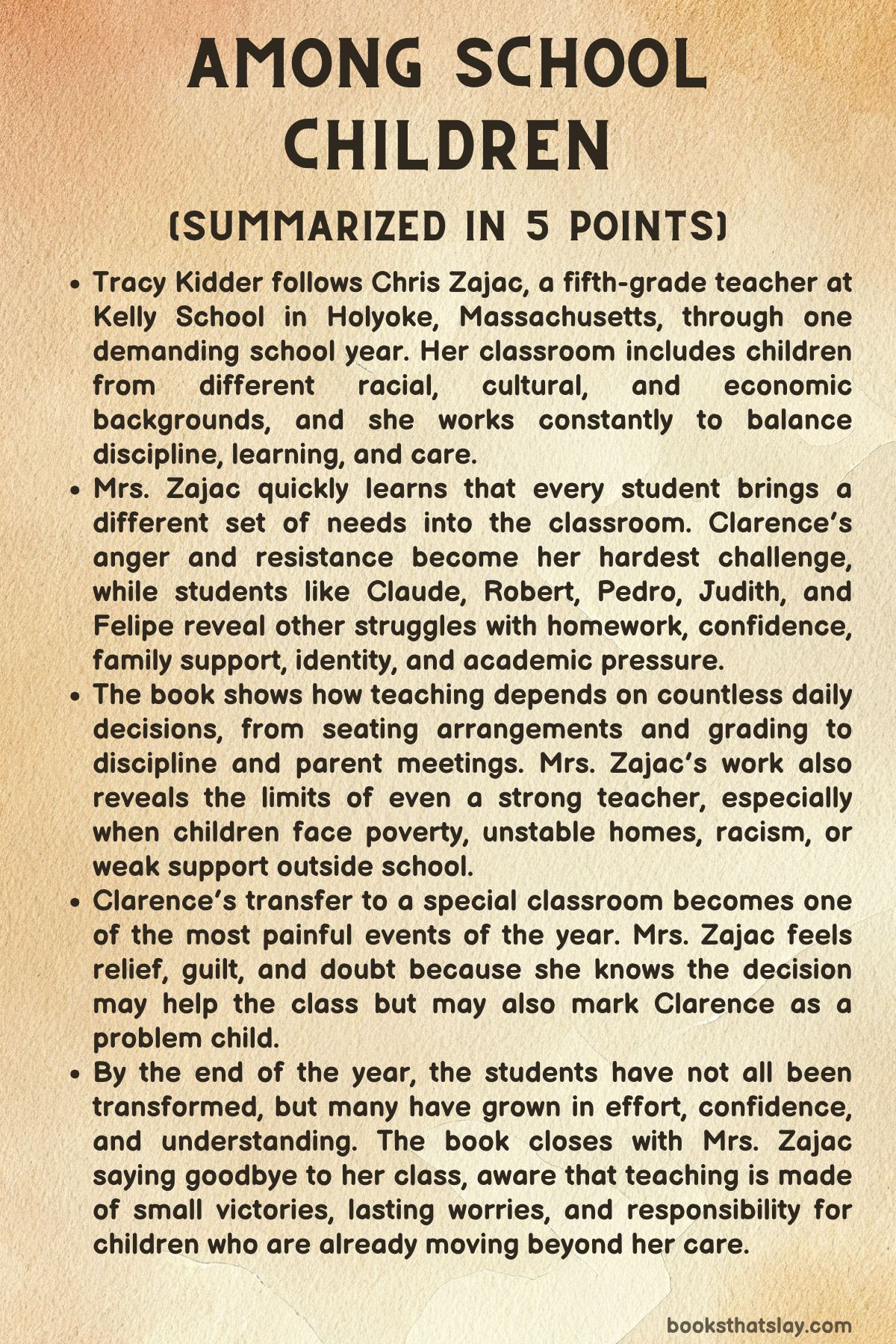
Among School Children is Tracy Kidder’s close observation of one school year in a fifth-grade classroom at Kelly School in Holyoke, Massachusetts. The book centers on Chris Zajac, a skilled and demanding teacher who tries to help children facing unequal resources, difficult home lives, language barriers, and uneven academic preparation.
Rather than treating school as an abstract policy debate, Kidder shows education through daily routines: homework, discipline, testing, parent meetings, classroom jokes, failures, and small victories. The result is a clear, human portrait of teaching as both practical labor and moral responsibility.
Summary
Among School Children follows Chris Zajac through one year as a fifth-grade teacher at Kelly School in Holyoke, Massachusetts. The school serves children from different racial, cultural, and economic backgrounds, with many students coming from Puerto Rican families and many qualifying for free or reduced-price lunch.
Mrs. Zajac begins the year with strong expectations. She cares about order, effort, neatness, and respect, but she is not cold or distant.
She is energetic, funny, observant, and deeply involved in the lives of her students.
At the start of the year, she receives the official records for each child. These files contain grades, behavior reports, notes from earlier teachers, and signs of past trouble.
She does not read them immediately because she wants to form her own first impressions. In the first days, she watches how students choose seats, how they respond to work, how they speak to one another, and how they handle rules.
Soon she rearranges the classroom to fit what she has learned. Her decisions show how teaching depends on hundreds of small judgments made quickly and repeatedly.
One student stands out from the beginning: Clarence. He is often angry, refuses work, and sometimes hurts or bothers other children for reasons that are not clear.
Mrs. Zajac tries discipline, patience, pressure, and encouragement, but Clarence remains hard to reach. He follows her home in her thoughts.
Although she tries not to bring school into her family life, certain students make that impossible. Clarence becomes the child she cannot stop worrying about.
The book also shows the structure of the school day. Students move between classrooms for subjects like reading and math, depending on their level.
Some are advanced, while others need basic help. Mrs. Zajac often sees that the children who need the most support also require the most time, leaving stronger students to work more independently.
New educational programs are presented to teachers, but Mrs. Zajac notices that many are designed for children who already have skills her weakest students lack. A math lesson cannot help much if a child cannot read the directions.
The principal, Al Laudato, is supportive and well liked. He tries to help teachers and students, but he is limited by school bureaucracy, funding problems, and the slow machinery of public education.
He tends to see things in a positive light, sometimes more positively than the facts allow. Through him and the school, the book examines the larger system around the classroom: testing, special services, paperwork, rules, and reform efforts.
Holyoke itself is important to the story. Once a successful industrial city known for its paper mills, it declined over the decades as industry faded.
Kelly School stands in the Flats, a neighborhood shaped by working-class history, poverty, and Puerto Rican migration. Mrs. Zajac grew up near the school, and her father worked in the mills.
Her own past connects her to the city, even as the city has changed. The school building was meant to inspire children, but graffiti and neglect now make it look worn down.
Mrs. Zajac spends much of her time grading, planning, correcting behavior, and trying to understand what each child needs. Pedro struggles with spelling and may need formal evaluation.
Claude frequently has excuses for missing homework. Blanca’s home life worries Mrs. Zajac because she fears the child may not be safe.
Dick, from a wealthier part of town, offers help to other students. Jimmy is tired and performs poorly because he stays up too late.
Each child brings a different problem into the room, and Mrs. Zajac must decide which ones she can address and which ones are beyond her reach.
Classroom discipline becomes one of the book’s central concerns. Mrs. Zajac has developed the ability to teach while monitoring the entire room.
She can notice a child out of place, stop a distraction, and continue the lesson almost without pause. Her student-teacher, Pam, struggles with this.
Pam can teach, but she lacks the authority and timing needed to keep students focused. Through Pam, the book shows how difficult teaching is to learn and how little practical preparation many new teachers receive before being given their own classrooms.
Mrs. Zajac works hard to make lessons active and meaningful. She turns work into contests, uses stories to connect history to children’s lives, and avoids humiliating weaker students by comparing them to stronger ones.
She believes children should understand that achievement comes from study, homework, and effort. She pushes parents to attend meetings and tries to build trust with families.
As the year continues, Clarence’s behavior leads to a formal evaluation. Kelly School has several steps for children with academic or behavioral problems: extra help, special classrooms, and eventually more separate placements.
Clarence is recommended for an Alpha classroom at another school. Mrs. Zajac is torn.
She argues that he should stay, but she is eventually persuaded that the move may be best. Still, she feels guilty.
She wonders whether she secretly wanted relief from him, whether she failed him, and whether sending him away will mark him permanently as a problem child.
Clarence senses that something serious is happening and briefly improves. He does his work and behaves better, which makes the decision even harder for Mrs. Zajac.
When he learns he must leave, he feels rejected and writes that he does not want to go. Mrs. Zajac visits the new classroom with him.
It is structured, and Clarence behaves better than many of the students there, giving her a little hope. When his classmates say goodbye, even those he fought with wish him well.
After Clarence leaves, the classroom changes. There is more calm, but also sadness and uncertainty.
Mrs. Zajac begins to focus more closely on other students. Claude still avoids homework, and Robert resists effort, though he shows ability.
Mrs. Zajac uses classroom rewards, parent contact, isolation, praise, and new routines to move them forward. Robert, who craves attention, begins doing work for several days and even succeeds on tests.
Mrs. Zajac hopes this improvement will last.
The book then widens its focus to Puerto Rican identity, racism, and cultural separation in Holyoke. Mrs. Zajac attends a church with English and Spanish Masses and notices the different styles of worship.
Her student Judith, bright and serious, teaches Sunday school at her father’s church and imitates some of Mrs. Zajac’s classroom methods. Mrs. Zajac sees prejudice toward Puerto Rican students from parents, townspeople, and even some educators.
She is angered by the assumption that Puerto Rican children are less capable or less deserving.
Mrs. Zajac travels to Puerto Rico because so many of her students or their families come from there. She wants to understand their background better.
On the island, she notices differences in food, time, schools, and attitudes, but also similarities. She sees that Puerto Ricans who moved to the mainland are judged by some island residents in ways similar to how they are judged in Holyoke.
Her trip helps her see the complicated position of children who live between cultures and are not fully accepted in either place.
Later in the year, the class visits Old Sturbridge Village, where students learn about life in 1830. Mrs. Zajac enjoys seeing their curiosity.
The visit also raises questions about how history is presented. The old village seems orderly and peaceful, but the book reminds us that hardship, poverty, and poor living conditions existed in earlier times too.
The Science Fair becomes another test of inequality. Students must prepare reports and demonstrations.
Some children receive strong help from parents and produce polished projects. Others, without support at home, bring weak or unfinished work.
Mrs. Zajac is proud of some students, including Claude and Felipe, but she sees how school assignments can expose family differences. Robert tries to make an electrical circuit but fails because he lacks guidance.
Mrs. Zajac realizes he made a real effort and was hurt by failure. She decides to seek counseling support for him.
As June arrives, the book reflects on American education more broadly. Schools have long been expected to create informed citizens, reduce inequality, and improve society.
Yet reform after reform has failed to solve the deepest problems. Mrs. Zajac teaches about Reconstruction, segregation, and racism, connecting history to her students’ own lives and hopes.
She tells them education matters because it gives them a chance to reach the futures they imagine.
By the end of the year, Mrs. Zajac knows she has not solved every problem. Some students still struggle, and some outcomes remain uncertain.
But many have grown. They work harder, understand school better, and believe a little more in their own ability.
Judith may move back to Puerto Rico, which worries Mrs. Zajac. Clarence returns briefly on the last day, still small and childlike despite the large place he has occupied in her mind.
The final scenes show Mrs. Zajac handing out report cards and saying goodbye. Some students are happy to have her again the next year; others are disappointed to leave her.
As they line up for buses and walks home, she already misses them. Among School Children ends by showing teaching not as a story of perfect success, but as a year of effort, care, frustration, discipline, and responsibility carried one child at a time.
Key People
Chris Zajac
Chris Zajac is the central figure of Among School Children, and the book presents her as a teacher whose work is built on discipline, alertness, emotional investment, and constant judgment. She is not shown as a sentimental idealist who believes kindness alone can solve classroom problems.
Instead, she is practical, demanding, and deeply aware that children need structure before they can learn. She values effort, completed homework, orderly behavior, and self-respect.
At the same time, she is not mechanical in her teaching. She studies each child carefully, notices changes in mood and behavior, and adjusts her methods depending on what she believes each student needs.
Her refusal to read student records immediately shows her desire to meet children as individuals rather than as files filled with past labels.
Mrs. Zajac’s strength lies in her ability to hold together authority and care. She can stop misbehavior quickly, but she does not enjoy humiliating children.
She avoids comparing weaker students to stronger ones because she understands how damaging that can be. She wants students to believe that intelligence is connected to work, study, and persistence.
Her classroom is controlled, but it is not lifeless. She turns lessons into games, brings energy into instruction, and tries to make history, reading, and math feel connected to the lives of her students.
Her emotional conflict is clearest in her relationship with Clarence. He tests her patience more than any other student, and his removal from her classroom leaves her feeling both relieved and guilty.
She wonders whether she failed him or whether the system gave her no real choice. This inner conflict shows how deeply she feels responsible for her students.
She knows she cannot fix every problem, yet she cannot detach herself from the children either. By the end, Mrs. Zajac emerges as a portrait of the teacher as worker, protector, judge, guide, and sometimes exhausted human being.
Her success is not measured by perfect outcomes, but by steady effort in a system where every gain is difficult.
Clarence
Clarence is one of the most important students in the narrative because he represents the child a teacher cannot easily reach but also cannot easily give up on. From the beginning, he is disruptive, angry, and resistant to schoolwork.
He lashes out at classmates, refuses assignments, and seems to carry frustration into the classroom without knowing how to manage it. To Mrs. Zajac, Clarence is not simply a badly behaved child.
He is a student whose behavior suggests deeper wounds, unmet needs, and a history of being seen as trouble.
Clarence’s character is important because he forces the limits of ordinary classroom teaching into view. Mrs. Zajac tries consequences, attention, patience, and firmness, but none of these fully changes him.
His presence affects the entire classroom because one child’s behavior can shape the learning environment for everyone else. Yet the book does not reduce him to a classroom problem.
When he senses that adults have made decisions about him, he briefly improves. He does homework, behaves better, and shows that he is capable of responding when he feels something important is at stake.
That sudden improvement makes his transfer even more painful because it suggests that he is not unreachable.
His move to the Alpha classroom is one of the saddest parts of the story. Clarence does not fully understand why he is being sent away, and he experiences the decision as rejection.
His journal response shows hurt more than rebellion. Mrs. Zajac’s guilt grows because she knows that once children are moved into special behavioral settings, they often do not return to ordinary classrooms.
Clarence becomes a symbol of the children most at risk of being pushed out of mainstream schooling. His brief visit at the end reminds Mrs. Zajac, and the reader, that behind all the disruption he is still a child.
Al Laudato
Al Laudato, the principal of Kelly School, is presented as a supportive administrator trying to keep a difficult school functioning under pressure. He is liked by teachers because he is not distant or hostile.
He wants to help them, listens to their concerns, and tries to make solutions possible. His role shows that school leadership is not simply about giving orders.
It involves managing teachers’ needs, students’ difficulties, district rules, testing demands, and the limits created by bureaucracy.
Al’s defining trait is his habit of framing problems positively. This can be comforting because schools need morale, especially when test scores are low, resources are strained, and teachers feel worn down.
Yet his optimism can also seem inadequate when the problems are too serious to be softened by hopeful language. He is not portrayed as foolish or uncaring.
Rather, he represents the administrator who must keep moving even when he knows the system does not give him enough power to solve what he sees.
His importance lies in the contrast between authority and limitation. As principal, he appears to be in charge, but many decisions are shaped by outside procedures, special education systems, district expectations, and state testing.
He can support Mrs. Zajac, but he cannot remove the deeper obstacles that affect her students. Through Al, the book shows that even sympathetic administrators are trapped within systems larger than themselves.
He is a decent man trying to maintain order, encouragement, and forward motion in a school where many problems begin far beyond the building.
Pam
Pam, the student-teacher, serves as a mirror for what teaching looks like before experience has hardened into instinct. She has promise and can deliver lessons, but she struggles with classroom control.
Her presence makes Mrs. Zajac’s skill more visible. What appears natural in Mrs. Zajac is revealed as the result of years of practice: watching the room, anticipating disruption, pacing lessons, setting boundaries, and knowing when to be strict.
Pam’s difficulty is not a sign that she lacks intelligence or goodwill. Instead, she shows how little preparation new teachers often receive before they are expected to manage real classrooms.
She learns that knowing a subject and teaching children are not the same thing. A lesson can be well planned and still fail if students are restless, distracted, or testing the adult in front of them.
Pam tries to cover too much and does not yet understand how much classroom management shapes instruction.
Her character also highlights Mrs. Zajac’s role as mentor. Mrs. Zajac watches Pam, gives advice, and tries to pass on what she knows from experience.
The relationship between them shows that teaching knowledge is partly formal and partly practical. Some of it can be explained, but much of it must be learned through repeated encounters with students.
Pam represents the vulnerability of beginning teachers and the gap between training programs and the daily reality of schools.
Judith
Judith is one of the most capable and striking students in the class. She is intelligent, mature, and serious about learning.
Her ability makes her stand out, but it also exposes her to the racial and social assumptions of others. People are surprised that she is Puerto Rican and from the Flats because they have absorbed the idea that a bright, high-performing child cannot come from that background.
Judith understands these assumptions and resists them, but they clearly affect her.
Her character shows how academic success does not protect a child from prejudice. In fact, her success often makes prejudice more visible.
She has to correct people’s assumptions about where she lives and who she is. She also lives with divisions among students themselves.
Her friendship with Alice, a white girl from a wealthier area, is limited by social boundaries. They may be friends, but they do not fully cross into each other’s worlds.
Judith does not invite Alice home, and racial separation remains present during lunch.
Judith’s role as a Sunday school teacher adds depth to her character. She imitates Mrs. Zajac’s authority and methods, showing that she has absorbed lessons beyond academics.
She is already learning how to command a room, guide younger children, and take responsibility. Her possible move back to Puerto Rico worries Mrs. Zajac because Judith’s promise feels both real and fragile.
She is a child with exceptional ability, but her future depends on forces beyond her own talent.
Claude
Claude is a student whose pattern of excuses frustrates Mrs. Zajac, especially when it comes to homework. He often seems careless or evasive, and at first he appears to be one of the students who may drift through school without developing strong habits.
Yet Claude is not presented as hopeless. His progress later in the year shows that some children need persistent pressure, attention, and the right circumstances before they begin to respond.
Mrs. Zajac’s work with Claude demonstrates her belief that disorganization and avoidance can become barriers as serious as low ability. She gives him time to clean out his desk and backpack, works with his parents, and tries to build a system that will make homework harder to ignore.
Her handling of Claude suggests that some students fail not because they cannot learn, but because they have not learned how to manage the ordinary routines of school.
Claude’s success with his Science Fair report and his ability to explain his project are important because they show a child beginning to take ownership of his work. He becomes a reminder that growth is often uneven.
A student may disappoint a teacher for months and then produce something that reveals real intelligence and effort. Claude’s development is modest but meaningful.
He shows that progress in the classroom is often measured through small changes in responsibility, confidence, and follow-through.
Robert
Robert is a difficult student in a quieter but equally troubling way. Unlike Clarence, he is not defined mainly by aggression.
His problem is resistance, lack of effort, and a hunger for attention. Mrs. Zajac senses that he has ability, which makes his refusal to work especially frustrating.
He seems to prefer negative attention to no attention at all, and even hurts himself to leave class and go to the nurse.
Robert’s character becomes more complex during the Science Fair. He tries to make an electrical circuit but fails because he does not have the guidance or support he needs.
Mrs. Zajac initially does not recognize the meaning of his effort, and this causes her pain later. For once, Robert was not simply avoiding work.
He tried, failed, and was exposed in front of others. This moment helps Mrs. Zajac understand that his behavior may be protecting him from the shame of failure.
If he refuses to try, he cannot be judged for not succeeding.
Robert represents children whose emotional needs interfere with academic growth. He needs more than ordinary classroom discipline, and Mrs. Zajac eventually decides to pursue counseling support.
His character shows how easily a child’s real effort can be missed when adults are used to expecting trouble from him. He also shows how failure without support can deepen a child’s resistance to school.
Pedro
Pedro is one of the students whose academic struggles make Mrs. Zajac consider formal evaluation. He needs help with spelling and appears to require more support than ordinary classroom instruction can provide.
His character is important because he shows the process by which teachers identify children who may have learning difficulties and try to move them toward additional services.
Pedro’s story is less dramatic than Clarence’s or Robert’s, but it is important because it reflects a common reality in schools. Some children struggle quietly.
They are not always disruptive enough to draw attention, but their academic problems can still shape their future. Mrs. Zajac’s decision to seek a core evaluation for Pedro shows her attention to students whose needs may otherwise be overlooked.
Through Pedro, the book shows both the value and frustration of school support systems. Evaluations can help identify what a child needs, but they take time and do not always lead to clear improvement.
Pedro’s presence reminds the reader that good teaching involves more than whole-class instruction. It also requires noticing specific weaknesses and pushing the system to respond before a child falls too far behind.
Blanca
Blanca represents the students whose home lives weigh heavily on their school experience. Mrs. Zajac worries about her safety, but she has limited power to change what happens outside school.
Blanca’s character brings attention to one of the hardest parts of teaching: the teacher sees signs of trouble but cannot fully enter the child’s private world.
Mrs. Zajac’s concern for Blanca shows her emotional responsibility as more than an academic instructor. She must care about whether children are safe, rested, fed, supported, and emotionally stable.
Yet the school can only do so much. Blanca’s situation reveals the painful gap between what teachers notice and what they can fix.
Although Blanca is not developed as extensively as some other students, her role matters because she represents a group of children who arrive at school carrying burdens that are not visible in test scores. Her presence reminds us that classrooms are not separate from family instability, poverty, fear, or neglect.
Learning becomes much harder when a child’s basic sense of safety is uncertain.
Felipe
Felipe is connected to the book’s treatment of Puerto Rican identity, migration, and family history. Through his family background, the narrative explores the movement between Puerto Rico and Holyoke, including the economic reasons families leave and sometimes return.
Felipe’s father’s experience shows how work, unemployment, cultural memory, and disappointment shape immigrant and migrant life.
As a student, Felipe is also capable of strong academic work. His successful Science Fair report gives Mrs. Zajac pleasure because it shows effort and understanding.
He is not only a representative of a cultural group; he is an individual student with his own abilities and growth. His work challenges any easy assumption that students from poorer or migrant backgrounds lack intelligence or seriousness.
Felipe’s character helps connect the classroom to a larger history of movement and belonging. His family’s relationship to Puerto Rico is marked by memory and change.
The island is both familiar and altered, both home and not fully home. Through him, the book shows how children inherit complicated identities shaped by economics, language, race, and place.
Alice
Alice is a white student from the more affluent Highlands, and her character helps reveal social divisions among the children. Her friendship with Judith is especially important because it shows both connection and distance.
The girls can like each other and spend time together, but race, class, and neighborhood boundaries still shape what their friendship can become.
Alice’s background gives her a different position in the classroom. She comes from a more privileged part of town, and this affects how she is seen and what kinds of support she may have.
Her presence helps contrast the experiences of students from wealthier families with those from the Flats. The differences may appear ordinary to adults, but children notice them, especially in projects and social relationships.
Alice is not portrayed as cruel or prejudiced. Her importance lies in what her friendship with Judith reveals about the world around them.
Even children who like one another live within divisions they did not create. Alice’s character shows how class and race shape childhood relationships quietly, not only through open conflict but through invitations not made, lunches not shared, and homes not visited.
Dick
Dick is another student from the upper-class Highlands, and he is shown as helpful and academically secure. He offers to assist Pedro with spelling, which suggests confidence, kindness, and comfort in the classroom.
He is one of the students who seems to understand school expectations more easily than many of his classmates.
His character highlights the unequal starting points among students. Children like Dick often arrive with habits, support, and confidence that make school easier to navigate.
He is not blamed for this advantage, but his presence makes the contrast clear. He can help others because he is not struggling in the same way.
Dick also shows that the classroom is not divided simply into good and bad students. Some children are prepared, steady, and generous.
His role is quieter than that of Clarence or Robert, but he helps create the social and academic range that Mrs. Zajac must manage every day. He represents the students who benefit from the system because they already know how to succeed within it.
Jimmy
Jimmy is remembered as a sleepy student who performs poorly partly because he stays up too late. His character shows how basic physical needs affect learning.
A child who is exhausted cannot concentrate, complete work well, or show his true ability. In Jimmy’s case, academic performance is tied to conditions outside the classroom.
He represents students whose struggles may appear as laziness or weakness but are actually connected to home routines and lack of rest. Mrs. Zajac can grade his work and notice his fatigue, but she cannot fully control what happens after school.
Jimmy’s situation shows the limits of classroom authority.
His role also adds realism to the book’s view of education. Not every problem is dramatic.
Sometimes the issue is sleep, routine, supervision, or a household pattern that makes school harder the next day. Jimmy reminds us that learning depends on the whole life of the child, not just the hours spent at a desk.
Suzanne
Suzanne appears near the end as a former or older student who remembers how Mrs. Zajac made her feel smart and capable. Her character is important because she shows the lasting influence a teacher can have.
The effects of good teaching may not always be visible immediately, but they can remain in a child’s memory as proof that someone once believed in them.
Suzanne’s memory of Mrs. Zajac gives emotional weight to the teacher’s work. It suggests that encouragement, structure, and recognition can become part of a student’s self-image.
Mrs. Zajac may spend much of the year worrying about what she has failed to accomplish, but Suzanne shows that her work has mattered before and may matter again.
Her character functions as evidence of hope without making teaching seem easy. She does not erase the difficulties of Clarence, Robert, or Blanca.
Instead, she reminds the reader that even in a flawed system, a teacher’s daily actions can shape how a child sees herself. Suzanne represents the long memory of care.
Father Joyce
Father Joyce, the parish priest, represents an effort to bridge cultural separation in Holyoke. By initiating bilingual services, he tries to bring English-speaking and Spanish-speaking communities together.
The contrast between the two Masses shows that these communities do not simply differ in language; they differ in customs, sound, space, family presence, and ways of gathering.
His role is connected to the broader social world outside Kelly School. The school’s divisions are not isolated.
They exist in churches, neighborhoods, and public attitudes. Father Joyce’s attempt at bilingual worship shows a desire for unity, but the differences between the groups remain visible.
Father Joyce matters because he shows that institutions outside school also struggle with race, language, and belonging. His efforts are well intentioned, but the community’s separation cannot be solved through one change alone.
He helps place Mrs. Zajac’s classroom within a larger Holyoke marked by cultural tension and partial attempts at repair.
Judith’s Father
Judith’s father is a pastor and a Puerto Rican migrant whose life reflects the economic pressures behind movement to the mainland. He left Puerto Rico seeking better opportunities, but injury and financial hardship left him dependent in part on welfare.
His situation exposes the unfair stereotypes applied to Puerto Rican families, especially the assumption that people moved simply to receive assistance.
His character gives context to Judith’s life. She is not an isolated high-achieving student; she belongs to a family shaped by faith, migration, work, injury, and economic difficulty.
Her father’s church also gives her a space where she practices leadership by teaching Sunday school.
Judith’s father helps show the gap between stereotype and reality. His life is not simple failure or dependency.
It is marked by ambition, hardship, and adaptation. Through him, the book presents Puerto Rican migration as a human story shaped by limited choices and unequal opportunity rather than by the shallow judgments made by outsiders.
Themes
Teaching as Labor, Skill, and Emotional Responsibility
In Among School Children, teaching is shown as demanding work that requires far more than presenting lessons. Mrs. Zajac must manage behavior, grade assignments, plan instruction, speak with parents, monitor emotional problems, identify learning difficulties, motivate tired children, and make quick decisions that affect the whole classroom.
Her authority is not automatic. It is built through voice, timing, consistency, and the ability to notice everything happening at once.
The contrast between Mrs. Zajac and Pam makes this especially clear. Pam may understand how to teach a lesson, but she has not yet learned how to hold a room.
The book treats classroom control as a professional skill, not as a personality trait or simple strictness.
The emotional weight of teaching is just as important as the practical work. Mrs. Zajac tries not to carry school home, yet certain children stay with her after the day ends.
Clarence becomes the clearest example of this burden. His behavior exhausts her, but his removal leaves her guilty and uncertain.
She asks herself whether she did enough and whether the decision to send him away has damaged his future. Teaching, then, becomes a form of responsibility without full power.
Mrs. Zajac is expected to change children’s lives, but she cannot control poverty, family instability, school policy, or social prejudice. Her work is meaningful because she continues anyway.
Inequality Inside and Outside the Classroom
The classroom contains children who sit in the same room but do not begin from the same place. Some have steady family support, better academic preparation, organized home lives, and parents who can help with projects.
Others lack sleep, safety, materials, confidence, or adult guidance. The Science Fair makes this inequality visible.
Students with help at home produce stronger projects, while students without that support struggle, even when they try. Robert’s failed electrical circuit is painful because it shows effort without guidance.
His failure is not simply personal; it reflects the absence of support that other children quietly receive.
Economic inequality also shapes the geography of Holyoke. Students from the Highlands and students from the Flats live in different social worlds.
These differences affect how children see themselves and one another. A student like Dick can offer help from a place of confidence, while others must first overcome disorganization, weak skills, or unstable routines.
The school tries to treat students equally, but equal assignments do not produce equal chances when children’s lives outside school are so different. Mrs. Zajac recognizes this, but she cannot remove the conditions that create it.
The theme is powerful because it shows inequality not as an abstract political issue, but as something that appears in homework, science projects, test scores, friendships, tired faces, and children’s expectations for themselves.
Race, Culture, and Belonging
Holyoke’s racial and cultural divisions shape the lives of the students even when the school day appears ordinary. Many children at Kelly School come from Puerto Rican families, and they face assumptions from white parents, townspeople, and sometimes educators.
Mrs. Zajac becomes angry when people treat her students rudely or assume they are less capable because of their background. Judith’s experience shows how damaging these assumptions can be.
Her intelligence surprises people who believe a Puerto Rican girl from the Flats should not be academically gifted. Instead of being praised simply as bright, she is forced to confront the prejudice hidden inside other people’s surprise.
The book also shows that belonging is complicated for Puerto Rican families. Some moved to the mainland for economic opportunity, while others return to Puerto Rico during hard times.
Children may inherit a sense of being between places, not fully accepted in Holyoke and not always fully understood on the island. Mrs. Zajac’s trip to Puerto Rico helps her see that mainland Puerto Ricans may be judged from both sides.
Culture is not treated as decoration or background. It affects worship, language, family history, schooling, and identity.
The students’ lives are shaped by racism, migration, pride, shame, and the effort to claim dignity in a place where others often misread them.
The Limits and Possibilities of Public Education
Public education in the book is both necessary and deeply limited. Schools are expected to prepare citizens, reduce inequality, teach skills, build character, and offer children a path toward better futures.
Mrs. Zajac believes in education enough to insist that her students work hard and take their futures seriously. She tells them that schooling matters because it is tied to the lives they hope to have.
In many moments, the classroom does create real growth. Claude becomes more responsible.
Robert shows flashes of ability. Judith gains confidence and models herself partly on Mrs. Zajac.
Students learn not only facts but habits of attention, effort, and self-belief.
Yet the school cannot do everything society asks of it. Testing reveals low achievement, special education procedures move slowly, and troubled students may be sent into separate settings without any guarantee that their lives will improve.
Clarence’s transfer shows how the system can appear to help while also pushing a child farther from ordinary classroom life. Mrs. Zajac can influence students, but she cannot remake their homes, neighborhoods, finances, or social status.
The book does not dismiss education as useless, nor does it present it as a cure for every social problem. Its view is more honest: schools matter greatly, but they are asked to repair damage created far beyond their walls.