Amity and Prosperity Summary and Analysis
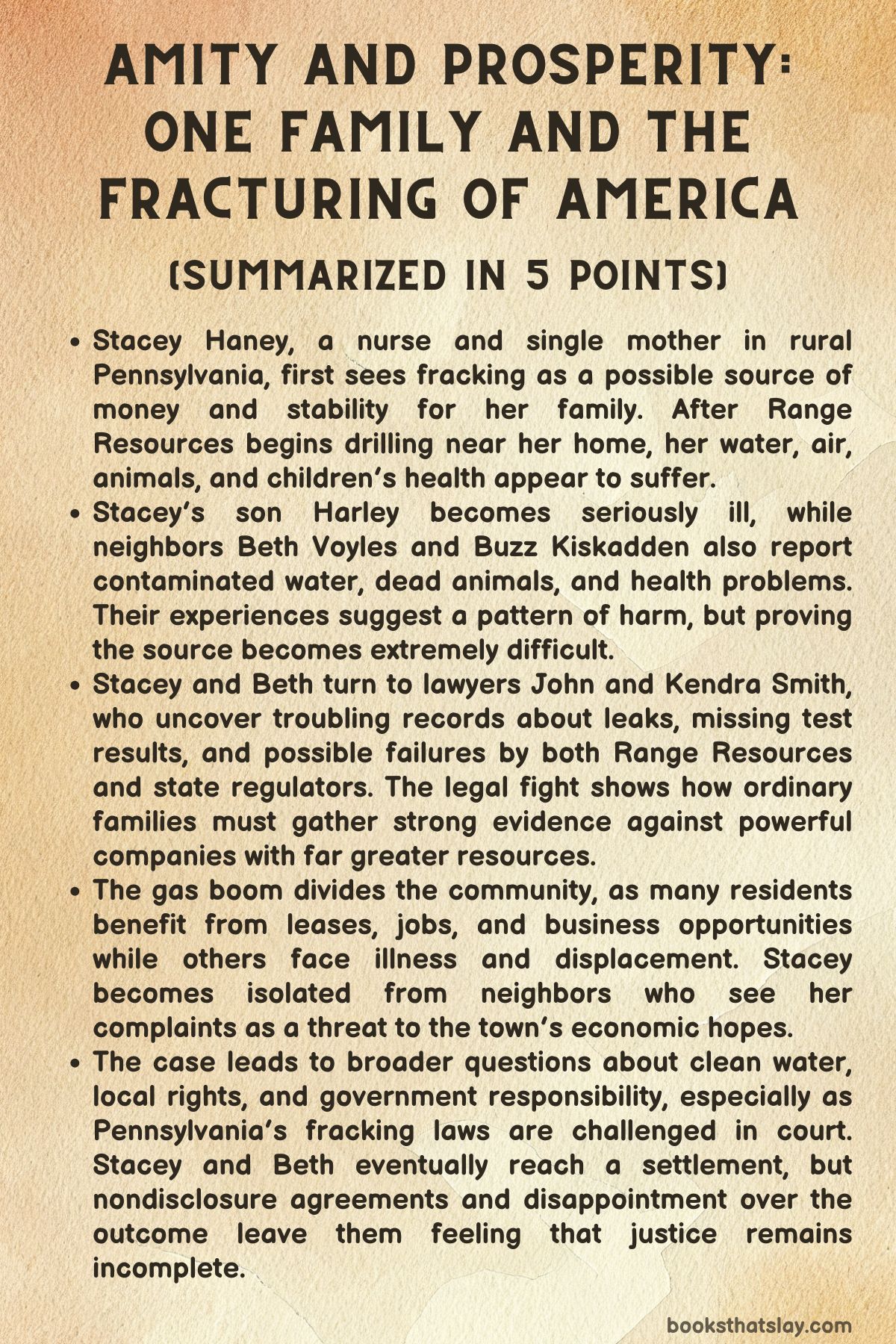
Amity and Prosperity: One Family and the Fracturing of America by Eliza Griswold is a nonfiction account of shale-gas drilling in rural Pennsylvania and the people forced to live with its costs. The book follows Stacey Haney, a nurse and single mother in Amity, whose family, animals, water, and home are harmed after Range Resources begins fracking near her property.
Griswold uses Stacey’s fight, along with the struggles of her neighbors Beth Voyles and Buzz Kiskadden, to show how poor communities can be left to prove harm against powerful companies, weak regulators, and political systems shaped by money. It is a story about health, land, law, class, and survival.
Summary
Eliza Griswold’s Amity and Prosperity begins in rural Washington County, Pennsylvania, where Stacey Haney lives with her children, Harley and Paige. Stacey grew up poor in Amity and built a life through hard work, first training in beauty school and later becoming a nurse.
Her family keeps animals, attends the county fair, and belongs to a close but economically strained community. The old coal and steel industries have faded, and many residents welcome natural gas drilling as a chance for jobs, lease payments, and renewed local pride.
When Range Resources begins drilling in the area, Stacey is not automatically against it. Like many of her neighbors, she sees possible benefits.
She needs money for repairs and believes gas production may help the country. She and her neighbor Beth Voyles discuss leasing land rights together so they can negotiate better terms.
Stacey asks for a promise of clean water if drilling damages her supply, but the final paperwork is rushed, and she later realizes the agreement is not what she thought it was. Soon after, the roads near her home fill with company trucks, dust, noise, and industrial activity.
The main drilling operation is placed uphill from Stacey’s and Beth’s homes, on the Yeager property. This location matters because the families rely on water connected to underground springs and the local watershed.
Range builds a well site and large waste ponds meant to hold drilling byproducts. Before long, sludge and wastewater become a source of fear.
Stacey and Beth notice foul smells drifting downhill. The waste appears to be poorly contained, and the families begin to suspect that their air, soil, and water are no longer safe.
Stacey’s son Harley becomes seriously ill. He misses school, loses energy, and withdraws from normal teenage life.
Stacey also develops health problems, including a wound that will not heal properly. Their animals begin to suffer and die.
Beth reports similar trouble with her own animals, including a dead puppy and later a horse. Stacey’s boyfriend discovers sludge on the family’s water filter.
Range representatives tell Stacey the water is safe, but her trust begins to break as symptoms and animal deaths pile up.
A doctor tests Harley and finds elevated arsenic in his body. Stacey borrows a water tank from her father and starts documenting everything in a notebook.
She contacts experts, speaks to other residents who have fought Range, and begins to understand how difficult it is to prove that drilling caused the damage. Company-funded water tests say one thing; independent testing and lived experience suggest another.
Stacey learns that contamination may not only be in the water. Chemicals may also be traveling through the air.
As Stacey searches for answers, she becomes more isolated in Amity. Many residents see Range as an economic lifeline and view Stacey’s complaints as a threat.
Farmers and business owners who benefit from leases, pipelines, and local spending do not want drilling challenged. Stacey is accused of exaggerating or seeking money.
Her family’s absence from community life adds to suspicion, though she is mainly busy working, caring for Harley, and trying to keep her household from falling apart.
Stacey eventually speaks publicly about what has happened to her family. At a meeting about fracking, she describes the illnesses, dead animals, smells, water problems, and fear that have taken over her life.
This brings her into contact with Eliza Griswold, who begins following the story. Stacey also meets lawyers John and Kendra Smith.
Kendra, a former corporate attorney, is initially cautious because chemical exposure cases are hard to prove. After visiting Stacey’s property and experiencing a metallic taste that lingers, she agrees to help.
The legal fight grows. Beth pushes the Pennsylvania Department of Environmental Protection to act, while Kendra and John begin gathering records from the state, Range, laboratories, and contractors.
They find signs that the waste ponds leaked and that regulators and company personnel knew about serious problems. They also uncover missing or altered water-test information, suggesting that harmful chemicals were not fully disclosed to Stacey and Beth.
The case expands beyond individual suffering into a larger question: who controls the evidence when ordinary people accuse an energy company of poisoning them?
Another neighbor, Buzz Kiskadden, reports that his water has turned bad. Buzz lives near the same industrial activity, but his background makes him a difficult plaintiff in court.
He has a criminal record, struggles financially, and lives on an old junkyard, which gives Range and regulators another possible explanation for contamination. Still, his health declines, and tests show troubling chemicals in his body and water.
Kendra believes his case can expose how the state mishandled complaints and protected the industry.
At the same time, Pennsylvania passes Act 13, a law that gives gas companies broad power and limits the ability of towns to control drilling through local zoning. The law also includes a rule restricting what doctors can say about chemicals used in fracking.
John Smith joins a legal challenge against Act 13, arguing that towns have the right to decide where industry belongs. Jordan Yeager adds a constitutional argument based on Pennsylvania’s guarantee of clean air and pure water.
The Pennsylvania Supreme Court later strikes down key parts of the law, giving real force to that environmental right. Stacey takes some comfort in knowing her suffering helped shape a wider legal victory.
But her personal life keeps getting worse. Stacey cannot safely live at the farm, yet she cannot easily sell it or buy a new home.
She and her children move into a camper. Harley’s health improves when he stays away from the property, but his childhood has been damaged.
He becomes withdrawn, misses ordinary school life, and struggles emotionally. Paige also feels the strain.
Stacey faces debt, fear, exhaustion, and post-traumatic stress. Her animals are gone, her house is broken into, and her relationship with the town continues to fray.
The lawsuit against Range moves slowly. Defendants argue that they are not responsible.
Regulators avoid firm conclusions. The Environmental Protection Agency studies fracking but does not give Stacey the clear proof she needs.
Kendra tries to identify chemicals used in the wells, including hidden or proprietary substances and tracer materials, but the company resists full disclosure. The central problem remains the burden of proof: Stacey, Beth, and Buzz must show exactly how contamination traveled, what chemicals were involved, and how those chemicals harmed them, even though much of the information is controlled by the company and government agencies.
Buzz loses his case before the Environmental Hearing Board, though the decision still criticizes Range’s unsafe practices. Beth continues to lose animals and suffers from health problems.
Stacey tries to rebuild a life while the case drags on. By the 2016 county fair, Range remains deeply embedded in local life through sponsorships, banners, hats, and public goodwill.
Stacey sees this as an attempt to buy acceptance. Harley calls it blood money.
The community has moved on in many ways, but Stacey’s family remains stuck with the consequences.
In the end, Stacey and Beth enter settlement talks with Range Resources. The families hope for closure after years of illness, legal pressure, debt, and public judgment.
A settlement is reached, but it comes with nondisclosure agreements that prevent them from speaking freely about the terms. The amount leaves them angry and defeated rather than restored.
Amity and Prosperity closes not with full justice, but with a hard picture of what happens when rural families must fight corporations and regulators for the right to clean water, safe homes, and believable proof of their own suffering.
Key People
Stacey Haney
Stacey Haney is the central human force of Amity and Prosperity, a nurse, mother, rural landowner, and reluctant activist whose life is reshaped by fracking near her home. She begins as someone who wants stability rather than conflict.
Her interest in leasing land comes from practical need, patriotism, and hope that gas development might help her family and community. What makes Stacey compelling is that she is not introduced as an ideological opponent of drilling.
Her resistance grows from lived experience: sick children, dead animals, contaminated water, foul air, and the slow realization that the institutions meant to protect her may not do so. Stacey’s strength lies in persistence.
She keeps records, asks questions, seeks doctors, contacts experts, speaks publicly, and continues fighting even as her neighbors turn against her. At the same time, she is not idealized.
Her anger, suspicion, exhaustion, and trauma deepen as the years pass. She becomes a portrait of what happens when an ordinary person is forced to carry the burden of proof against a wealthy industry.
Harley Haney
Harley Haney represents the most painful personal cost of the gas boom. As Stacey’s son, he moves from being a child involved in farm life and community events to someone whose illness isolates him from school, sports, and friends.
His symptoms are not only medical; they alter his identity. He becomes withdrawn, frustrated, and separated from the ordinary rhythms of adolescence.
Harley’s worsening health gives Stacey’s fight its emotional urgency, because the conflict is no longer only about property or water but about a child’s future. His improvement when away from the farm strengthens Stacey’s belief that the land itself has become unsafe.
Yet the damage to Harley is not easily repaired. Even when his body begins to recover, he carries social and emotional scars.
His later anger at Range’s community sponsorships shows that he understands the moral contradiction around him: the company can appear generous in public while families like his live with private loss.
Paige Haney
Paige Haney’s role is quieter than Harley’s, but she is deeply important because she shows how environmental harm affects children who may not be the most visible victims. Paige lives through displacement, uncertainty, financial stress, and the emotional strain of watching her family’s life fall apart.
Her struggles in school reflect the wider instability surrounding her. She is not only Stacey’s daughter; she is a child growing up in a household where every normal routine has been disrupted by illness, lawsuits, fear, and debt.
Paige’s character also shows how legal battles can invade family life. Depositions, questions, public attention, and community judgment become part of her childhood.
Through Paige, the story widens beyond the person who is sickest or the adult who speaks loudest. She reminds the reader that damage can be quiet, cumulative, and psychological.
Beth Voyles
Beth Voyles is Stacey’s neighbor and one of her closest allies in the fight against Range Resources. She is direct, suspicious, outspoken, and less hesitant than Stacey about accusing the company of wrongdoing.
Beth’s animals suffer early, and her anger grows from the same place as Stacey’s: the belief that something unnatural has entered their land and water. Beth often acts as a catalyst, pushing complaints forward and pressing government agencies when Stacey is still uncertain.
Her personality is sharp and confrontational, but that sharpness comes from fear and repeated disappointment. Beth also reveals the social cost of resisting powerful local interests.
Like Stacey, she loses faith in government protection and becomes increasingly aware that rural residents can be dismissed or discredited. Her relationship with Stacey is important because their shared experience gives each woman support, but it also places them together against a community that often prefers silence.
John Voyles
John Voyles is less central than Beth, but his presence helps define the household affected by the contamination. He represents the family members who endure the crisis without always being at the front of the public fight.
Through the Voyles family, the damage caused by drilling is shown as domestic and ongoing, not limited to a single dramatic event. John’s role also helps make clear that Beth is not acting alone or imagining isolated trouble.
The Voyles property, animals, and water become part of the evidence trail that supports Stacey’s suspicions. His character matters because the story is not about one complainant against a company; it is about neighboring households seeing similar patterns and trying to make those patterns count as proof.
Kendra Smith
Kendra Smith is one of the most important figures in the legal side of the narrative. A former corporate lawyer, she understands how companies defend themselves against exposure claims, and this background makes her both skeptical and valuable.
She does not simply accept Stacey’s story out of sympathy. She studies the facts, visits the property, reviews records, and slowly becomes convinced that the case is serious.
Kendra’s character is defined by discipline, intensity, and moral transformation. Her legal work becomes consuming as she searches through documents, test results, laboratory records, and regulatory files.
She understands that the central problem is not only contamination but proof: without the right documents, chemical lists, and scientific links, suffering can be treated as legally invisible. Kendra also exposes how exhausting justice can be when the opposing side has more money, more lawyers, and more control over information.
John Smith
John Smith complements Kendra’s work by connecting the private lawsuits to a wider fight over local democracy and environmental rights. He is a local attorney who understands the towns, landowners, and political culture of Washington County.
His challenge to Pennsylvania’s pro-drilling law shows his belief that communities should be able to decide what kinds of industry can operate near homes, schools, and farms. John’s importance lies in his ability to see fracking not only as a property dispute but as a constitutional and civic issue.
His arguments about zoning and clean air and water give Stacey’s suffering a larger legal meaning. He stands as a figure of principled resistance, though the story also shows how difficult and costly such resistance becomes.
His work suggests that law can protect ordinary people, but only when someone is willing to force the system to honor its own promises.
Buzz Kiskadden
Buzz Kiskadden is one of the most tragic characters because his suffering is filtered through social prejudice. His water turns bad, his health declines, and his family appears to experience serious harm, yet he is vulnerable to being dismissed because of his past, poverty, and the condition of his property.
Buzz’s old junkyard gives regulators and Range another explanation for contamination, making it easier to cast doubt on his claims. His character reveals how the burden of proof falls hardest on people who already lack social credibility.
Even when evidence points toward industrial harm, Buzz must overcome assumptions about who he is. The legal system does not treat all plaintiffs equally, and Buzz’s story shows how class, reputation, and appearance can shape whether suffering is believed.
His loss in court, despite criticism of Range’s practices, captures the painful difference between moral suspicion and legal victory.
Chris Rush
Chris Rush, Stacey’s boyfriend and later fiancé, gives Stacey emotional support during years of stress and uncertainty. His role is not as public as Stacey’s or Kendra’s, but he matters because he represents the private relationships that help Stacey keep going.
Chris shares Stacey’s rural identity and understands the life she is trying to preserve. He is present during discoveries around the house and supports the family as their living situation becomes unstable.
His proposal also offers Stacey a moment of personal happiness within a story dominated by illness, law, and loss. Chris’s character helps keep Stacey from being seen only as a plaintiff or activist.
She is also a partner, mother, worker, and woman trying to hold together a life that still contains love and hope.
Shelly
Shelly, Stacey’s sister, adds another view of Amity’s water problems and rural hardship. Her work to bring public water to the area shows that the community’s problems existed before fracking but were made worse by extractive industries.
Shelly is practical and loyal, and she understands the emotional toll Stacey faces from neighbors, debt, and displacement. She also voices anger at the hypocrisy of people who present themselves as moral and neighborly while ignoring the suffering caused by gas development.
Through Shelly, the story connects private family loyalty with public infrastructure. Her efforts around water access show that survival in Amity depends not only on individual toughness but on systems that many residents cannot afford or do not trust.
Ron Yeager
Ron Yeager is important less as a fully explored personality and more as the landowner whose property becomes the industrial site affecting Stacey, Beth, and Buzz. His farm’s location uphill from the affected homes makes him central to the environmental conflict.
The Yeager site becomes the physical source of fear: pits, waste, smells, leaks, trucks, and testing disputes. Ron’s role also reflects the difficult position of rural landowners in gas country.
A lease can bring financial benefit to one property while creating risk for neighbors. His character helps show how fracking changes the meaning of land.
A farm is no longer only a farm; it becomes part of a network of wells, ponds, pipelines, contractors, regulators, and legal claims.
Range Resources Representatives
The Range Resources representatives function as the public and corporate face of the gas industry. Figures such as Ray Walker, Tony Berardi, Laura Rusmisel, Carla Suszkowski, and Matt Pitzarella represent different forms of company power: community presence, public relations, test-result management, legal defense, and strategic messaging.
They are not presented as one-dimensional villains, but their actions reveal a corporate system built to protect itself. They attend fairs, manage complaints, reassure residents, dispute responsibility, and shape public perception.
Their role shows how a company can be both highly visible and difficult to hold accountable. The representatives help maintain the idea that drilling is safe and beneficial, even while families near the well site experience sickness, contamination, and fear.
In Amity and Prosperity, this corporate presence becomes especially troubling because it blends neighborly gestures with legal and informational control.
Government Regulators and Investigators
The regulators and investigators in the narrative reveal the uneven power of the state. The Pennsylvania Department of Environmental Protection appears repeatedly as an agency that tests, records, delays, omits, and sometimes minimizes.
Individual figures, such as John Carson, can notice real problems, but the institution as a whole often fails to give residents the protection or clarity they need. Federal investigators and EPA agents sometimes seem more sympathetic, especially Jason Burgess, but sympathy does not always become action.
These characters show the difference between personal concern and institutional accountability. Stacey and Beth do not simply fight a corporation; they also fight the silence, caution, and limitations of agencies that should protect public health.
The regulators’ role is one of the most unsettling parts of the story because it suggests that harm can continue even when officials know something has gone wrong.
Themes
The Burden of Proof
The phrase “burden of proof” captures the central injustice faced by Stacey, Beth, Buzz, and their families. They experience sickness, animal deaths, foul water, strange smells, and displacement, but experience alone is not enough to win recognition.
They must prove what chemicals were present, where those chemicals came from, how they traveled, and how they affected bodies. This requirement sounds reasonable in legal terms, but the story shows how unfair it becomes when the company controls key information and regulators fail to provide full transparency.
Stacey does not know all the chemicals used near her home. Kendra must fight for documents, test results, lab records, and hidden data.
Even then, missing pre-drill tests and incomplete disclosures make certainty difficult. The theme exposes a painful imbalance: industry can create risk first, while ordinary families must later produce near-perfect evidence of harm.
Amity and Prosperity shows that proof is not only scientific; it is political, financial, and social. People with money can delay, dispute, and complicate proof, while poor families are left to live inside the damage.
Environmental Harm and the Human Body
Contamination in the story is not abstract. It enters water filters, animal bodies, children’s blood, household air, and daily routines.
The land around Stacey’s home becomes frightening because ordinary signs of rural life are replaced by symptoms of industrial invasion: sludge, chemical odors, dead animals, rainbow-colored water, and unexplained illnesses. This theme is powerful because environmental harm is shown through the body before it is confirmed by law.
Harley’s illness, Stacey’s wound, Buzz’s declining health, and Beth’s animal losses turn pollution into something intimate and physical. The body becomes the first witness, but also a contested witness.
Doctors test for arsenic, benzene-related exposure, toluene-related exposure, and other signs, yet the medical evidence still has to survive corporate and legal challenge. The theme also shows how environmental damage creates psychological harm.
Stacey’s trauma, Harley’s isolation, Paige’s school struggles, and Beth’s fear demonstrate that contamination does not stop at chemistry. It changes how people sleep, parent, work, trust, and imagine the future.
The land becomes unsafe, and once home is unsafe, the entire structure of life is shaken.
Class, Credibility, and Rural Powerlessness
The families at the center of the story are not wealthy people with easy access to influence. Stacey comes from a poor rural background, and Buzz is especially vulnerable because of his criminal record, poverty, and junkyard property.
Their social positions shape how others interpret their claims. Stacey is called hysterical or greedy.
Buzz is treated as an unreliable plaintiff whose own land can be blamed for his contaminated water. This theme shows that credibility is not evenly distributed.
People with polished reputations, money, and institutional backing are more likely to be believed, while poor rural residents must fight to make their suffering sound legitimate. The gas boom also divides the community by money.
Some residents benefit from leases, jobs, business, and rising property values, while others live with illness and loss. Because the industry brings income to a struggling region, criticism of drilling can be treated as betrayal.
Stacey’s isolation shows how economic dependence can silence a town. The theme is not only about poverty; it is about how poverty makes people easier to dismiss, pressure, and exhaust.
Law, Democracy, and the Right to Clean Water
The legal battles in the story raise a larger question about what rights mean when industry arrives in a community. Clean air and pure water sound like basic protections, but the families learn that these rights require lawyers, evidence, money, and years of conflict.
The challenge to Pennsylvania’s drilling law becomes especially important because it shifts the conflict from private injury to public power. If towns cannot control zoning or decide where industrial activity belongs, then local democracy is weakened.
Residents may own homes and land, but their control over the safety of those places becomes limited. John Smith’s fight against the law shows that environmental protection is also a constitutional issue.
The victory before the Pennsylvania Supreme Court gives meaning to the state’s promise of clean air and water, yet the personal lawsuits remain unresolved for years. This contrast is important.
A major legal principle can be affirmed while individual families still wait for relief. The theme shows both the necessity and limits of law.
Law can name rights, but it does not automatically repair bodies, restore homes, or return lost years.