How To Kill a Witch Summary And Analysis
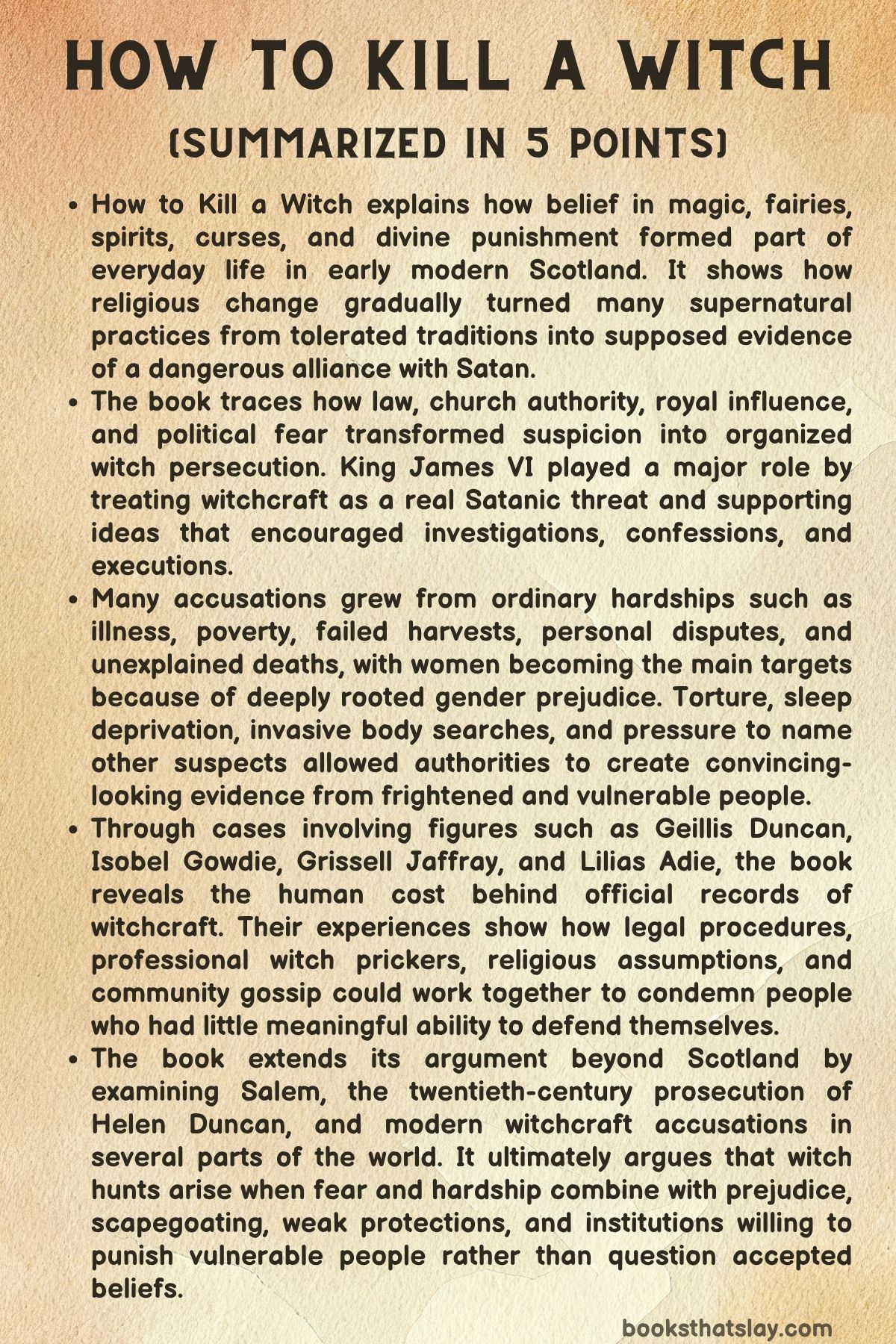
How to Kill a Witch by Claire Mitchell and Zoe Venditozzi is a historical examination of witch persecution that asks a disturbing but necessary question: how did ordinary communities and established institutions come to believe that certain people deserved to die as witches?
Centered largely on Scotland while also examining Salem and modern accusations, the book traces how religious doctrine, political power, social prejudice, law, fear, and personal conflict transformed suspicion into persecution. Rather than treating witch trials as strange episodes from an irrational past, the book restores individuality to the accused and shows that witch-hunting was created by recognizable human choices, systems, and failures that can still appear in different forms today.
Summary
The book begins by establishing how differently people in early modern Scotland understood the supernatural world. Magic was not automatically dismissed as imagination; belief in spirits, fairies, healing powers, curses, prophecy, Christianity, and older traditions could exist together within the same culture.
Elspeth Reoch provides an early example of how personal experiences could become evidence of witchcraft. She claimed that fairy men had given her second sight and that one supernatural figure became an abusive spirit guide, showing how trauma, religious ideas, folklore, and experiences that people struggled to explain could be interpreted within a magical framework.
Magic also had practical functions in communities troubled by disease, hunger, failed crops, poverty, and premature death. Charmers and cunning folk offered remedies, spells, rituals, and assistance, but changing Protestant attitudes increasingly recast supernatural powers as evidence of Satanic influence rather than useful or neutral magic.
Religious and political change then created the conditions in which belief could become persecution. Following the Scottish Reformation, strict Protestant theology gained power, and the Witchcraft Act of 1563 made witchcraft and related practices punishable by death, creating a legal framework through which supernatural accusations could become capital crimes.
King James VI became one of the most influential figures in this transformation. After dangerous weather affected voyages connected with his marriage to Anne of Denmark, accusations in Denmark suggested that witches had created storms, and James increasingly interpreted his own difficulties as evidence that Satanic forces were personally attacking him.
His involvement helped give royal authority to witch-hunting. Suspicion was no longer merely a neighborhood matter when a monarch regarded himself as a divinely protected opponent of Satan and accepted the possibility that witches were conspiring against his life.
The North Berwick investigations demonstrate how quickly accusations could expand once torture and forced confession became part of the process. Geillis Duncan was suspected because of her healing abilities and was subjected to brutal interrogation before confessing and naming others, after which accusations multiplied across a widening circle of suspects.
Agnes Sampson and Dr. Fian suffered similar treatment. Confessions produced fantastic accounts of witches meeting the Devil, travelling through supernatural means, creating storms, using corpses, and plotting against the king, while Fian’s attempt to retract his confession and explain that torture had produced it only led to further violence.
The system made innocence almost impossible to establish. Confession was treated as proof of guilt, yet resistance could also be interpreted as evidence that Satan was strengthening the accused, creating reasoning in which practically every response confirmed the authorities’ assumptions.
James later gave intellectual and religious form to these ideas by arguing that witches entered deliberate agreements with Satan. Poverty, anger, despair, revenge, and moral weakness were presented as conditions Satan could exploit, while alleged witches were said to renounce baptism, receive physical marks from the Devil, attend corrupted versions of religious gatherings, and use supernatural power to cause illness, death, storms, possession, and other harm.
Women became particularly vulnerable because religious and social ideas already portrayed them as morally weaker, disorderly, jealous, sexually dangerous, and more easily deceived. The accusation of witchcraft therefore drew strength from existing expectations about how women should behave and from suspicion directed at those who did not conform.
Ordinary hardship reinforced these beliefs. In communities repeatedly facing hunger, disease, death, failed harvests, dangerous work, and limited forms of medical or economic protection, unexplained suffering demanded explanations, and a disliked or socially vulnerable neighbor could become a convenient target.
Anna Tait’s case shows how an individual’s pain could be reshaped into an expected witchcraft narrative. After a suicide attempt, questioning led to a confession involving the Devil and serious crimes, yet the broader pattern of surviving confessions suggests that interrogators often expected particular details and pressured accused people toward familiar stories.
Accusations were also strengthened by ordinary channels of communication. Gossip, sermons, court proceedings, pamphlets, and repeated stories made extraordinary claims feel increasingly credible, while local disagreements could easily be reinterpreted as supernatural attacks.
The persecution in Forfar demonstrates how neighborhood suspicion became organized state action. Religious leaders and civic authorities operated within overlapping systems of power, collecting accusations in communities already damaged by disease, warfare, political instability, and poor harvests.
Women considered quarrelsome, sexually unconventional, mentally unwell, disabled, alcoholic, poor, or simply difficult could attract scrutiny. Isobel Shyrie, Agnes Spark, and Helen Guthrie reveal how poverty, reputation, trauma, personal disputes, and existing marginalization could be converted into evidence of supernatural wrongdoing.
The search for physical evidence made persecution even more dangerous. Marks, scars, moles, unusual nipples, skin tags, calluses, and other ordinary bodily features might be identified as the Devil’s mark, particularly harming poor people whose health and working conditions left visible traces on their bodies.
Professional witch prickers turned these beliefs into an occupation. Suspects could be stripped, shaved, and repeatedly pierced in the search for an insensitive spot, while dishonest practitioners could manipulate examinations to manufacture the appearance of guilt.
John Kincaid participated in large numbers of Scottish cases, while Christian Caddell disguised herself as a man and made money as a professional pricker. Her career exposed the financial opportunities surrounding witch-hunting, and one scheme demonstrated how witchcraft accusations could even be used to remove tenants and serve property interests.
The book then compares Scotland with Salem in 1692. When Betty Parris and Abigail Williams suffered unexplained fits, accusations fell first on Sarah Good, Sarah Osborne, and Tituba, all of whom occupied vulnerable positions in their community.
Tituba’s confession helped expand the crisis, while old disputes and social tensions contributed to further accusations. A special court accepted spectral evidence, allowing dreams and visions to carry legal authority, and executions continued until accusations reached people close enough to political power that authorities finally began questioning the process.
The legal structure behind Scottish witch trials receives particular attention because persecution was not simply the work of uncontrolled crowds. Commissions, interrogations, local courts, physical examinations, witness statements, expert claims, and written confessions gave institutional form to beliefs that were fundamentally false.
Isobel Gowdie’s four confessions reveal this process especially clearly. Her accounts included Satanic baptism, sex with the Devil, fairies, transformation into animals, magical theft, harmful spells, clay images, and membership in a coven, yet similarities to other confessions raise serious questions about coercion and standardized interrogation.
Even where formal torture was restricted, methods such as sleep deprivation could destroy a suspect’s ability to think clearly. An isolated person without meaningful legal protection could eventually provide exactly the kind of confession that interrogators wanted, after which the written record could describe it as voluntary.
The resulting trials could follow recognizable legal procedures while still producing profound injustice. The problem was not simply the absence of law, because authorities could carefully examine testimony, physical evidence, confessions, and statutory requirements while accepting false assumptions about witchcraft as unquestionable reality.
Execution completed the process. Scottish witches were commonly strangled before their bodies were burned, although some could be burned alive, and fire was believed to prevent Satan from restoring the supposedly dangerous corpse.
The physical reality was far more brutal than the familiar cultural image of a witch burning at a stake. Human bodies burn slowly and incompletely, meaning executions could require prolonged heat and leave bones and other remains that still had to be destroyed.
Lilias Adie’s story extends this fear beyond death. Accused after another woman’s illness, she produced a familiar confession involving the Devil and other supposed witches but died in custody before she could undergo a formal trial.
Because she had not been legally convicted and burned, authorities feared that her corpse might still be dangerous. She was buried outside consecrated ground beneath an enormous stone slab on the shore, while later examination of the records raised the possibility that her confession had been shaped or rewritten to protect those responsible for her treatment.
Even death did not end her exploitation. In the nineteenth century, collector Joseph Neil Paton arranged for her grave to be opened, and parts of her skeleton were removed as objects of curiosity during an age fascinated by phrenology and supposedly scientific classifications of human character.
Her skull passed through collections and exhibitions before disappearing. A modern facial reconstruction based on surviving photographs and measurements attempts to restore something the original persecution removed: the image of Lilias not as a supernatural monster but as an elderly and isolated human being.
The narrative then moves into the twentieth century through Helen Duncan, a Spiritualist medium prosecuted in wartime Britain. After attracting government attention, she was charged under the Witchcraft Act of 1735 for pretending to conjure spirits, convicted, and sentenced to imprisonment.
Although the punishment and legal circumstances differed greatly from early modern executions, her case demonstrates the continued power of anxiety, public spectacle, authority, and gendered suspicion. Even in a modern legal system, language associated with witchcraft could still be used to isolate and punish an inconvenient woman.
The final part of the book rejects the idea that witch accusations belong exclusively to history. Contemporary accusations continue in different parts of the world, often targeting older women, children, people with disabilities, people with albinism, and others who lack strong social or institutional protection.
Activists such as Leo Igwe connect present-day accusations with failures in healthcare, welfare, law enforcement, education, political institutions, and human-rights protections. Where illness, poverty, disaster, or unusual physical conditions remain poorly explained or inadequately supported, supernatural accusations can again offer communities a person to blame.
The book ultimately returns to a pattern visible across centuries: fear combines with hardship and an activating event, prejudice identifies a vulnerable target, and institutions or communities give the accusation authority. Witch-hunting therefore becomes not merely a history of supernatural belief but a study of scapegoating and of what happens when societies choose certainty and punishment over evidence, restraint, and protection for the powerless.
Key People
Because the work is nonfiction, the world of people are restricted to historical ones, victims, officials, experts, and activists whose experiences build the larger argument of How to Kill a Witch. Some appear briefly while others shape whole sections of the book, but together they reveal witch persecution from the viewpoints of the accused, the accusers, the authorities, and those who later tried to understand or challenge these systems.
Elspeth Reoch
Elspeth Reoch represents the difficult boundary between personal supernatural belief and criminal accusation. Her claims of second sight and encounters with fairy figures make sense within a culture where the supernatural was considered part of ordinary existence, yet those same experiences became dangerous once authorities interpreted unusual spiritual encounters through the language of Satan and witchcraft.
Her importance lies in showing that an accused person’s own account cannot simply be separated into belief and deception. Her experiences may have contained trauma, religious interpretation, folklore, and psychological distress, but institutions reduced that complexity to a category that could lead to execution.
John Knox
John Knox appears primarily as a representative of the religious transformation that altered Scotland’s treatment of supernatural belief. His strict Protestant outlook helped establish a culture in which biblical obedience and hostility toward perceived spiritual corruption became powerful public values.
He is therefore important less as an individual witch hunter than as part of the ideological environment in which witchcraft came to be treated as an attack on divine order. The religious culture associated with reformers such as Knox made supernatural wrongdoing a matter not merely of private belief but of communal and political danger.
King James VI
James VI is one of the most consequential figures in the book because personal fear, religious conviction, and royal power converge in him. His experiences surrounding the dangerous voyages connected with his marriage encouraged him to interpret violent weather as evidence of a Satanic conspiracy, transforming his belief in witchcraft into direct political involvement.
His confidence that he occupied a divinely appointed position made opposition to witches part of his identity as a ruler. By treating witchcraft as a genuine threat to himself, Christianity, and political order, he gave supernatural accusation the authority of the crown.
James is also significant because he did not merely accept existing beliefs; he helped organize and justify them intellectually. His arguments about Satanic pacts, Devil’s marks, female weakness, and divine protection gave investigators a framework in which accusations and executions could appear logically and religiously justified.
Anne of Denmark
Anne of Denmark occupies a quieter but important place because her marriage to James became connected with the events that intensified his interest in witchcraft. Dangerous sea journeys surrounding the marriage were interpreted through accusations that witches had raised storms, providing James with what he considered evidence of supernatural hostility.
Anne is not presented as a driving force behind persecution. Instead, her presence demonstrates how coincidence, weather, international politics, and existing superstition could combine around powerful individuals and produce consequences for people who had no control over those events.
David Seaton
David Seaton illustrates how an individual suspicion could become the starting point of a much larger crisis. His distrust of his servant Geillis Duncan because of her unusual healing abilities helped initiate a process in which interrogation, torture, confession, and accusation spread rapidly from one person to another.
His role is revealing because witch hunts did not always begin with spectacular evidence. An employer’s suspicion of a socially inferior woman could become powerful once cultural assumptions and coercive institutions were ready to interpret ordinary or unexplained behavior as supernatural wrongdoing.
Geillis Duncan
Geillis Duncan embodies the vulnerability of people whose useful skills could suddenly be recast as evidence against them. Her healing abilities, which might once have been valued, provoked suspicion and subjected her to torture until she confessed and supplied additional names.
Her case also shows how coercion allowed persecution to reproduce itself. Once investigators demanded names from an accused person, survival, exhaustion, and fear could turn one victim into an unwilling source of accusations against others.
Agnes Sampson
Agnes Sampson demonstrates how the female body itself became a site on which authorities attempted to discover guilt. She was stripped, shaved, tortured, and examined for a supposedly supernatural mark, reducing her physical privacy and dignity to tools in an investigation already shaped by expectations of witchcraft.
Her treatment exposes the gendered nature of the system. Officials were not merely investigating alleged actions; they treated the accused woman’s body as a document on which Satan might have left proof, making humiliation part of the legal search for certainty.
Dr. Fian
Dr. Fian is especially important because his attempt to retract his confession exposes the logic of torture with unusual clarity. After enduring severe physical abuse, he confessed, escaped, was recaptured, and then explained that his earlier statements had been produced by torture.
Instead of undermining the prosecution, his retraction prompted further violence. His story demonstrates a system that could protect its own conclusions by treating resistance not as evidence of innocence but as another reason to intensify punishment.
Anna Tait
Anna Tait reveals how severe emotional distress could be redirected into a witchcraft narrative. After attempting suicide, she was questioned about the Devil and eventually gave a confession containing accusations of poisoning and involvement in ending her daughter’s pregnancy.
Her case illustrates the enormous imbalance between vulnerable suspects and interrogators who already believed they knew what a witch’s confession should contain. The resulting testimony therefore says as much about the expectations of questioners as it does about the person whose words entered the official record.
Isobel Shyrie
Isobel Shyrie represents the way poverty and local conflict could expose a person to supernatural accusation. She was blamed after a bailie who had confiscated her cooking pot later died, allowing an ordinary dispute involving authority and property to be retrospectively transformed into supposed magical revenge.
Her story demonstrates how coincidence worked against people who already possessed little social power. Once someone had expressed anger or suffered mistreatment, any later misfortune affecting the opposing party could be interpreted as proof that a curse had been carried out.
Agnes Spark
Agnes Spark is presented as someone whose social reputation increased her vulnerability. Being regarded as a “scold” placed her outside the preferred model of female obedience and restraint, meaning that personality and social conflict could contribute to suspicion of witchcraft.
Her case shows that persecution often enforced behavioral expectations as much as religious ones. A woman who argued, complained, challenged others, or gained a troublesome reputation could be made to seem dangerous before any supernatural accusation was formally established.
Helen Guthrie
Helen Guthrie is one of the more psychologically complicated accused figures because she appears both as a victim of persecution and as a contributor to accusations against others. Childhood trauma and alcoholism had already left her vulnerable before she became entangled in a system that encouraged suspects to identify additional witches.
Her role prevents a simple division between innocent victims and malicious accusers. Under coercive conditions, frightened people could participate in the destruction of others, showing how institutions can pressure victims into sustaining the very system harming them.
Matthew Hopkins and John Stearne
Matthew Hopkins and John Stearne demonstrate how witch-hunting could become financially rewarding professional activity. Their work as witch finders involved examining suspects for supposed physical evidence and receiving payment for procedures that depended on assumptions already weighted heavily toward guilt.
Their presence adds economic self-interest to the broader culture of religious fear. When a person earns status or income by locating witches, discovering innocence threatens the occupation itself, creating an obvious incentive to find the proof that communities have paid to receive.
John Kincaid
John Kincaid represents the destructive authority granted to professional witch prickers in Scotland. He participated in examinations linked to perhaps 150 to 200 executions and was paid for identifying the bodily signs that investigators interpreted as evidence of witchcraft.
His later admission of deceptive practices reveals how weak the foundations of supposedly objective evidence could be. Yet the people condemned through such procedures did not receive a comparable restoration of justice, demonstrating the permanence of punishment compared with the limited consequences faced by those who manufactured guilt.
Christian Caddell
Christian Caddell is one of the clearest examples of fraud operating inside the witch-hunting system. Disguising herself as a man and using different names, she worked as a witch pricker, earned considerable money, and contributed to convictions by claiming to identify supernatural marks.
Her involvement in a scheme connected with removing tenants shows that witchcraft accusations could serve motives unrelated to genuine supernatural belief. Fear provided the language, but economic advantage and control over land could determine who was accused and why.
Betty Parris and Abigail Williams
Betty Parris and Abigail Williams occupy central positions in the Salem crisis because their unexplained fits provided the event around which existing fears gathered. Once their condition was interpreted as witchcraft, their accusations gained extraordinary power over adults who were already socially vulnerable.
Their role demonstrates how a community’s interpretation of unexplained behavior can matter more than the behavior itself. The girls’ experiences became the starting point for a legal and religious crisis because the surrounding culture supplied witchcraft as a credible explanation.
Sarah Good
Sarah Good represents the social vulnerability of many early targets at Salem. She belonged to a group of women whose marginal position made accusation easier because they lacked the status and protection available to more secure members of the community.
Her treatment shows that scapegoating rarely selects victims randomly. Suspicion often moves toward people already considered difficult, dependent, unconventional, or socially disposable because accusations against them are less likely to produce immediate resistance from powerful allies.
Sarah Osborne
Sarah Osborne similarly demonstrates how social position could determine the direction of supernatural suspicion. Her vulnerability meant that when the community sought people responsible for unexplained suffering, she could be placed within an already recognizable category of suspicious women.
The importance of her case lies in the pattern it shares with others. Witch hunts tend to claim that supernatural danger has been discovered, yet their targets repeatedly reflect existing inequalities and community judgments.
Tituba
Tituba’s status as an enslaved woman made her especially exposed within Salem’s hierarchy. After reportedly being beaten, she confessed to witchcraft and claimed that other witches existed, helping transform several accusations into a broader panic.
Her confession demonstrates the dangerous power of coerced testimony. Once authorities accepted her story as factual evidence, every additional name or suggestion of a hidden conspiracy created reasons to extend the investigation rather than question its assumptions.
Giles Corey
Giles Corey embodies the extreme violence that a legal system can justify once it becomes committed to extracting compliance. He was pressed to death, making his fate distinct from the executions by hanging associated with Salem while still demonstrating the physical brutality underlying the proceedings.
His death also challenges sanitized memories of witch trials. The crisis did not consist merely of strange accusations or mistaken beliefs; it involved deliberate physical suffering inflicted through institutions that claimed lawful authority.
Governor William Phips
Governor William Phips illustrates the relationship between political power and the boundaries of persecution. The panic weakened significantly after his own wife was accused, after which spectral evidence was rejected and most remaining prisoners were eventually released.
His role exposes one of the system’s sharpest contradictions. Evidence considered sufficient against socially weaker people became intolerable once the machinery of accusation moved close to political authority.
Isobel Gowdie
Isobel Gowdie is among the book’s most important accused women because four unusually detailed confessions survive in her name. They describe Satanic initiation, sexual encounters with the Devil, fairies, shape-changing, magical attacks, theft of crops and milk, clay effigies, and participation in a thirteen-person coven.
Yet the extraordinary detail does not necessarily strengthen the historical case against her. Repeated patterns shared with other confessions suggest that questioning, cultural expectations, coercion, exhaustion, or deliberate construction may have shaped what eventually appeared in the written record.
Her unknown fate makes her even more unsettling. The legal records allow modern readers to hear an official version of her confession but do not clearly reveal what happened to the person herself, demonstrating how institutions can preserve alleged crimes more carefully than human lives.
Grissell Jaffray
Grissell Jaffray brings the physical reality of execution to the foreground. Accused of witchcraft and fortune-telling, she was tortured, convicted, strangled, and burned, while much of the detail surrounding her life survives only through local tradition.
Her limited historical record is itself significant. The authorities had enough power to destroy her body, yet history preserved relatively little about the life that existed before she became an accused witch.
Lilias Adie
Lilias Adie is one of the most fully developed symbols of dehumanization in How to Kill a Witch. Elderly, physically distinctive, and apparently lacking strong family protection, she became vulnerable after accusations connected her to another woman’s illness and soon produced the familiar claims of renouncing baptism, meeting the Devil, and attending witch gatherings.
Her death in custody prevented a formal trial, yet even death did not free her from supernatural suspicion. Authorities buried her outside consecrated ground beneath a huge stone because they feared Satan might restore her corpse.
Later questions about the reliability of the recorded confession deepen the injustice surrounding her. If records were reconstructed or modified after her death, institutional self-protection may have shaped the historical version of a woman who was no longer alive to contest it.
Jean Bissett
Jean Bissett shows how an individual’s explanation for illness could initiate a lethal process. After becoming sick, she accused Lilias Adie and another woman of causing her condition through witchcraft.
Her role does not require deliberate cruelty to have devastating consequences. In a culture where supernatural explanations were available and legally actionable, fear or certainty expressed by an ordinary person could place another individual’s life in the hands of church and civic authorities.
Reverend Allan Logan
Reverend Allan Logan illustrates the unstable boundary between skepticism and institutional participation. He initially dismissed the allegation against Lilias Adie, but a later accusation changed the situation and allowed a broader witchcraft investigation to proceed.
His later problem after Lilias died demonstrates how theological belief could continue controlling decisions even when ordinary legal procedure could not. Because she had not been convicted and burned, fear of her dead body generated an extraordinary burial intended to prevent supernatural return.
Doug Speirs
Archaeologist Doug Speirs functions as a modern investigator who questions the reliability of inherited institutional records. His research into Lilias Adie’s burial and confession raises the possibility that parts of the historical account were written retrospectively and may have helped shield authorities from responsibility.
His role therefore represents historical criticism rather than unquestioning acceptance of official documents. Records produced by institutions involved in persecution must themselves be examined as evidence shaped by power, motive, memory, and self-preservation.
Joseph Neil Paton
Joseph Neil Paton demonstrates how the exploitation of accused witches continued long after belief in their supernatural crimes had declined. Fascinated by witchcraft objects and phrenology, he arranged for Lilias Adie’s grave to be robbed so that parts of her body could enter his collection.
His actions replace religious fear with another form of dehumanization. Lilias was no longer being treated as a dangerous witch, but she still was not being treated as a person entitled to dignity, privacy, or control over her remains.
Robert Baxter Brimer
Robert Baxter Brimer carried out the physical violation of Lilias Adie’s grave for Paton. With accomplices, he moved the heavy burial stone, opened the coffin, and removed her skull, bones, and coffin material.
His role shows how an accused person’s body could remain vulnerable centuries after persecution. Curiosity and collecting replaced theology as the justification, but the underlying act still treated Lilias as an object available for the use of more powerful people.
Andrew Carnegie
Andrew Carnegie appears through the strange afterlife of material taken from Lilias Adie’s grave. Coffin wood was eventually turned into a walking stick and given to him, connecting the remains of an impoverished accused woman with the world of wealthy collectors and industrial power.
He is not presented as responsible for the original grave robbery. Instead, the connection symbolizes how thoroughly a persecuted person’s identity could be detached from her humanity and converted into an artifact circulating among prominent men.
Christopher Rynn
Forensic artist Christopher Rynn represents an effort to reverse that dehumanization. Using surviving photographs and measurements of Lilias Adie’s missing skull, he reconstructed her face in 2017, giving modern audiences an opportunity to see an individual person rather than an abstract historical “witch.”
His work gives visual form to one of the book’s ethical purposes. Restoring a face cannot repair the injustice done to Lilias, but it changes the way memory approaches her by returning attention from accusation to human identity.
Helen Duncan
Helen Duncan demonstrates how the language of witchcraft survived within a very different modern legal and political environment. A well-known Spiritualist medium during the Second World War, she attracted government concern after apparently revealing information about the sinking of HMS Barham and was eventually prosecuted under the Witchcraft Act of 1735.
Her case is deliberately ambiguous because there was evidence that she sometimes used fraudulent techniques. The book therefore does not need to present her as a genuine medium or entirely innocent practitioner in order to question why authorities chose legislation associated with witchcraft and turned the prosecution into a public example.
Her supporters unintentionally weakened her position by trying to prove that she truly communicated with spirits. Their defense demonstrates how a belief sincerely intended to protect someone can become damaging when the law defines the claimed supernatural practice itself as the prohibited act.
Leo Igwe
Leo Igwe represents the movement from historical remembrance to active resistance against present-day witch accusations. Through Advocacy for Alleged Witches, he intervenes in contemporary cases and promotes critical thinking as a way of preventing supernatural accusations from becoming violence.
His analysis also broadens responsibility beyond individual superstition. Weak healthcare, poor law enforcement, poverty, inadequate welfare, limited human-rights protection, and failures of political institutions can create conditions in which people seek supernatural explanations and vulnerable individuals become targets.
Charlotte Baker
Charlotte Baker contributes an important contemporary perspective by examining violence against people with albinism. Physical difference can become surrounded by supernatural belief, and some victims have been attacked or killed because others attribute magical value to their bodies.
Her presence shows that the logic of witch persecution can survive without reproducing early modern European trials exactly. The underlying danger remains recognizable whenever physical difference, fear, magical explanation, and inadequate institutional protection combine against vulnerable people.
Themes
Fear, Uncertainty, and the Creation of Scapegoats
Fear becomes socially dangerous when people are unable to identify or control the causes of their suffering. In How to Kill a Witch, disease, crop failure, hunger, dangerous working conditions, warfare, political instability, unexplained illness, and sudden death repeatedly create situations in which communities desperately want an explanation.
Witchcraft supplies an answer that converts uncertainty into intention. Instead of accepting that a harvest failed, a child died, a ship encountered bad weather, or a neighbor became ill for reasons that might never be understood, communities can imagine that another person deliberately caused the disaster through supernatural power.
That explanation provides emotional clarity but produces enormous moral danger. Once misfortune has an alleged human agent, fear can be redirected into punishment, and people who were already disliked or socially vulnerable become plausible targets.
The same structure appears beyond early modern Scotland. Salem shows how unexplained physical symptoms could become an activating event for existing tensions, while contemporary cases demonstrate that accusations still flourish where insecurity combines with inadequate medical, legal, or social protection.
The lasting warning is that scapegoating does not require people to believe exactly the same supernatural claims. It requires fear, an explanation that identifies an enemy, and a community prepared to punish that enemy rather than examine the conditions producing its anxiety.
Gender, Social Control, and Vulnerability
The disproportionate accusation of women reflects a society in which gender expectations already defined women as more morally unstable, sexually suspect, emotionally disorderly, and vulnerable to temptation. Witchcraft persecution therefore did not invent misogyny; it gave existing misogynistic assumptions a religious and legal form that could end in imprisonment, torture, humiliation, and death.
Behavior mattered because women were expected to occupy narrow social roles. A woman who argued with neighbors, drank heavily, practiced healing, lived outside conventional family structures, displayed anger, behaved in sexually unconventional ways, suffered mental distress, or simply developed a reputation for being troublesome could attract suspicion.
The body itself became part of this control. Women could be stripped, shaved, examined, pierced, and inspected by male authorities searching for marks that supposedly proved a relationship with Satan, turning ordinary bodily differences into evidence of criminality.
Economic and social vulnerability intensified the danger. Poor women, elderly women, isolated women, enslaved women, and those lacking powerful relatives had fewer resources with which to resist accusations or challenge influential accusers.
The gender theme therefore extends beyond numerical imbalance. Witch-hunting becomes a method through which communities identify acceptable behavior, punish deviation, regulate bodies, and reinforce hierarchies by presenting social prejudice as a defense against supernatural evil.
Institutional Power and the Manufacture of Guilt
One of the book’s most unsettling arguments is that witch persecution did not depend on the complete collapse of institutions. Churches, councils, magistrates, commissioners, courts, interrogators, professional examiners, and legal records could operate in an organized manner while producing systematic injustice because the premises guiding the entire process were false.
Once authorities accepted that witches existed, that Satan marked their bodies, that magical harm was real, and that witches operated together, procedures designed to discover guilt naturally produced the evidence they expected. A mark became confirmation, a confession became confirmation, another person’s accusation became confirmation, and even denial could be interpreted as Satanic protection.
Coercion made the structure more dangerous. Torture, sleep deprivation, humiliation, isolation, fear, and relentless questioning could pressure suspects into giving recognizable confessions, after which written records presented those statements with the authority of formal documentation.
Professional incentives also corrupted the process. Witch prickers could earn money by finding supernatural marks, while accusations might serve local grievances or property interests, giving some participants practical reasons to produce guilty findings.
The theme challenges the comforting belief that procedures alone guarantee justice. A system can appear orderly, produce official records, employ specialists, follow legislation, and still destroy innocent people when its methods prevent fundamental assumptions from being questioned.
Memory, Dehumanization, and Historical Responsibility
The treatment of accused witches did not always end with execution or death in custody. Victims could continue to exist in cultural memory as frightening supernatural figures, curiosities, folklore, tourist symbols, museum objects, or physical remains separated from the ordinary human lives they once possessed.
Lilias Adie’s afterlife provides the clearest example. Persecuted while alive, buried unusually because authorities feared her corpse, exhumed generations later, and reduced to bones and collectible objects, she continued to be denied ordinary dignity long after the original accusation had lost its legal power.
Modern reconstruction of her face therefore carries significance beyond historical curiosity. Presenting her again as an elderly woman rather than a legendary witch challenges the labels through which institutions and later collectors defined her.
The same responsibility shapes the book’s treatment of execution. Describing what happens physically when a human body burns prevents the violence from disappearing behind familiar phrases such as “burned as a witch” and forces attention back toward the individual person who experienced state-sanctioned death.
Historical remembrance finally becomes relevant to the present because witch accusations have not disappeared everywhere. Remembering victims accurately is therefore not only an act of respect toward the dead; it trains attention on the recurring processes through which fear, prejudice, unequal power, and institutional weakness can turn vulnerable human beings into symbols of imagined danger.