Hide and Seeker Summary, Characters and Themes
Hide and Seeker by Daka Hermon is a middle-grade horror novel that combines supernatural danger with a story about grief, friendship, fear, and learning to accept painful change. The story follows Justin and his friends after the mysterious return of Zee, a boy who vanished for more than a year and came back deeply changed.
What begins as an ordinary game of Hide-and-Seek soon exposes an ancient force that feeds on children’s fears. Beneath its frightening events, the book examines how people respond to loss, guilt, loneliness, trauma, and the difficult choice to keep moving forward.
Summary
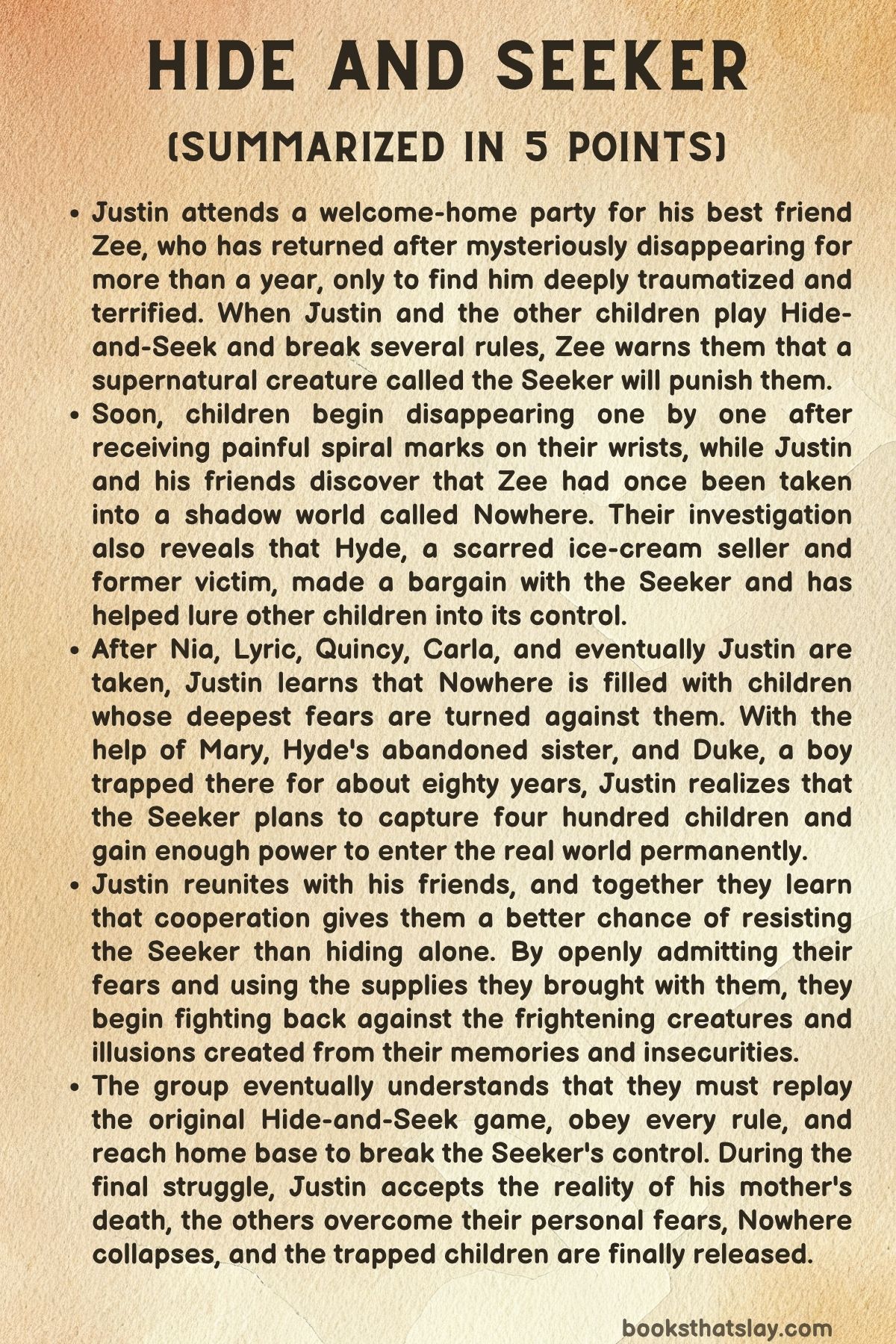
Justin attends a welcome-home party for his best friend, Zechariah “Zee” Murphy, who disappeared more than a year earlier and has only recently returned. Instead of feeling relieved, Justin is disturbed by the atmosphere inside Zee’s house, where damaged furniture, scratches on the walls, and three locks placed outside Zee’s bedroom suggest that something is seriously wrong.
Justin is already carrying his own emotional burden. His mother died shortly after Zee disappeared, and he continues to experience panic attacks while holding onto a puzzle piece from the last puzzle they worked on together as a reminder of her.
At the party, Justin reunites with Nia and Lyric, who once formed the Fantastic Four with him and Zee. Other children arrive as well, including Carla Jenkins, her twin brother Quincy, and Shae Davidson, who unexpectedly suggests that everyone play Hide-and-Seek while they wait for Zee.
Justin becomes the Seeker and carefully establishes rules meant to keep the game fair and safe. Almost immediately, however, the players begin breaking those rules: Carla reveals Shae’s hiding place, Quincy hides inside a shed, Nia blocks him from reaching home base, Lyric becomes physical with him, and the game ends before everyone has properly finished.
Zee suddenly appears and reacts with terror, particularly when he sees Shae. He warns the children that something is watching them, feeding on fear, and preparing to take them, while repeatedly referring to a mark, a count, and the number four hundred.
As Justin leaves, he narrowly avoids being hit by a Sweet Dreams ice-cream truck driven by a scarred young man named Hyde Miller. Hyde becomes unusually interested when he learns that the children were playing an unfinished game of Hide-and-Seek, making Justin suspicious of his motives.
The following morning brings proof that Zee’s warnings cannot simply be dismissed as the effects of trauma. Justin learns that the real Shae disappeared from a camp hours before she supposedly appeared at Zee’s party, while Quincy reports that Carla has also vanished after developing a painful spiral mark on her wrist.
Justin, Nia, Quincy, and Lyric return to Zee’s house looking for answers. They find Zee’s room covered with disturbing drawings, strange numbers, and images of a winged creature covered in red eyes, while Zee himself bears the same spiral mark that appeared on Carla.
Zee explains through fragmented warnings that breaking the rules of Hide-and-Seek allows a supernatural Seeker to claim the players one by one. Soon afterward, Quincy develops the spiral mark, confirming that another disappearance is approaching.
The children investigate Zee’s original disappearance and find Rodrigo, his former camp roommate. Rodrigo explains that he saw Zee pulled into a strange black opening in the woods after the same mark appeared on him, strengthening the belief that another world exists behind the disappearances.
Their investigation eventually leads them to Hyde’s junkyard, where they discover records of missing children and evidence that Hyde himself disappeared as a child. During a supernatural disturbance, Quincy is dragged underground, and the spiral mark immediately appears on Nia.
Hyde finally explains that the creature hunting them is the Seeker, an ancient force connected to Hide-and-Seek. Children who violate the rules of the game become marked and are eventually taken into a shadow world known as Nowhere, where the Seeker uses their deepest fears to torment them and increase its own power.
Hyde also reveals that he once became one of the Seeker’s victims. Rather than defeating the creature, however, he escaped by making a bargain that required him to help provide new children, using Sweet Dreams ice cream and Hide-and-Seek games to place victims within the Seeker’s reach.
The children also discover that time behaves differently in Nowhere. Captives do not physically age while trapped there, but the missing years return to their bodies when they escape, meaning someone imprisoned for decades could instantly become elderly or even die upon returning.
Nia is eventually taken, leaving Justin overwhelmed by another apparent failure to protect someone he loves. Lyric reminds him that courage does not mean saving everyone by himself and points out that Justin has consistently supported the people around him despite his fear, grief, and uncertainty.
Knowing that their own disappearances are approaching, Justin and Lyric prepare backpacks filled with food, flashlights, tools, and other supplies. Lyric is marked next, followed by Justin, who realizes that the Seeker intends to claim every person connected to the original game.
Before Justin disappears, conflict with his older sister Victoria exposes another part of his emotional struggle. Victoria wants to rent their mother’s untouched bedroom because the family desperately needs money, but Justin sees changing the room as another form of losing his mother.
The Seeker eventually pulls Justin through his television and sends him into Nowhere. He awakens buried inside a coffin beneath a distorted version of the cemetery where his mother is buried, forcing him to confront confinement, death, panic, and the grief he has spent months avoiding.
Justin manages to control his panic and escape the grave using techniques he learned in counseling. Soon he encounters an imitation of his mother, a decaying figure created by the Seeker that uses his guilt and longing against him by insisting that he belongs with her.
While escaping this false version of his mother, Justin meets Mary, a girl who has been trapped in Nowhere for years. She reveals that she is Hyde’s younger sister and that Hyde abandoned her when he accepted his bargain with the Seeker.
Mary explains that captured children eventually lose their spiral marks and receive numbers instead, becoming part of the Seeker’s collection. She also warns Justin that physical contact between captives allows their fears to transfer between them, giving the Seeker more material to use against its victims.
Mary introduces Justin to Duke, a boy who has survived in Nowhere for approximately eighty years without aging. Duke explains that the Seeker becomes stronger with every child it captures, while the size and power of Nowhere expand along with its growing collection of victims.
Justin connects Duke’s information with Zee’s repeated warnings about the number four hundred. He concludes that the Seeker intends to capture four hundred children, gaining enough power to leave Nowhere permanently and hunt freely in the ordinary world.
Justin, Mary, and Duke eventually reunite with Nia and Lyric. Although Duke believes isolation is the safest way to survive, Justin and his friends argue that isolation is exactly what the Seeker wants because frightened children are easier to control when they believe they must face everything alone.
The group begins using the supplies from their backpacks to fight the physical forms created from their fears. Ordinary objects can hurt these supernatural manifestations, proving that the children are not as powerless as generations of prisoners had believed.
They later find Quincy, injured by monstrous insects created from his fears, and eventually locate Carla, Shae, and many other captured children. Shae confirms that Hyde encouraged children at her camp to play Hide-and-Seek, after which she became marked when she abandoned the game before it was completed.
As the group prepares for a larger confrontation, each child admits the fear the Seeker is most likely to use. Mary fears rat-snake creatures, Shae fears disturbing dolls, Quincy fears insects, Lyric fears abandonment, Carla fears being unlovable, Nia fears losing her memory, and Justin fears the dead imitation of his mother.
Their honesty changes the way they approach danger. Instead of hiding their vulnerabilities, they learn one another’s fears so that each person can recognize when someone else is under attack and provide the right kind of support.
Justin eventually returns with the others to the shadow version of Zee’s home. By listening carefully to Zee’s warnings, he realizes that the original game itself provides the solution: because the curse began when they broke the rules and failed to finish, they must play again, obey every rule, and safely reach home base.
The children begin one final Hide-and-Seek game with the oak tree as home base. This time their goal is not individual victory but making sure everyone reaches safety, even as the Seeker attacks them with every fear they have admitted.
Nia begins aging and forgetting everyone around her, but Justin restores her memory by reminding her of their friendship and the important moments they have shared. When she reaches home base, the terrifying changes disappear, proving that reaching the tree can release a person from the Seeker’s control.
The others gradually reach safety as well. Carla appears to betray the group by offering the Seeker a bargain, but she is actually deceiving the creature long enough to move closer to home base, showing that the harshness she often displays does not define the full extent of her loyalty.
Duke learns that he was the Seeker’s first victim and that the monster deliberately chose him decades earlier to begin building Nowhere. Although the Seeker argues that he has nothing left to return to, Duke rejects the life the creature forced upon him and reaches the tree.
Justin is the last person who must overcome his fear. The imitation of his mother changes from a decaying body into the loving woman he remembers and offers him the unfinished puzzle along with the possibility of remaining with her forever.
Justin finally understands that holding onto an illusion is not the same as honoring his mother. He accepts that she is dead, recognizes that she would want him to continue living, and chooses his friends, his sister, and his own future by reaching home base.
The completed game destroys the Seeker’s control, causes Nowhere to collapse, and releases the children who were imprisoned there. Justin returns home alongside his friends with a changed understanding of family, fear, and grief, while Mary finally returns to confront Hyde after the years he left her behind.
Characters
Justin
Justin is the emotional and narrative center of Hide and Seeker, and much of his development comes from the difference between how powerless he feels and how much strength other people already see in him. His mother’s death has damaged his confidence, and he interprets many painful events as evidence that he fails the people he loves.
His panic attacks are therefore not simply moments of fear but expressions of grief, responsibility, and the pressure he places on himself. He repeatedly believes that if he had been stronger, more capable, or faster, he might have saved his mother, protected Zee, stopped the disappearances, or prevented his friends from being taken.
The unfinished puzzle piece he carries represents his refusal to accept endings. He keeps his mother’s room unchanged, avoids her grave, resists completing their final puzzle, and reacts angrily when Victoria suggests allowing someone else to use the bedroom.
Justin’s growth occurs when he understands that love does not require him to preserve the past exactly as it was. By rejecting the false version of his mother, he finally distinguishes remembering someone from refusing to continue living without them.
His leadership develops in a similar way. Early in the book, he assumes that leadership means having answers and personally preventing every disaster, but in Nowhere he learns to listen to Mary, Duke, Nia, Lyric, Quincy, Carla, and the others.
By the final game, Justin becomes effective precisely because he stops behaving like someone who must carry everyone alone. His courage comes from accepting fear, trusting other people, and continuing to act even when he cannot guarantee the outcome.
Zechariah “Zee” Murphy
Zee is both the mystery that begins the story and one of its clearest examples of psychological trauma. His return should represent hope, but his scars, nightmares, damaged room, unstable behavior, and desperate warnings show that physically coming home has not truly freed him from what happened.
His fragmented chants initially make him appear unreliable. As more information emerges, however, almost everything he says proves meaningful, showing that his difficulty lies not in knowing the truth but in communicating experiences so terrifying that ordinary language has almost failed him.
Zee is also an important contrast to Hyde. Both were trapped in Nowhere, both returned with deep psychological and physical scars, and both were apparently offered ways to cooperate with the Seeker.
Where Hyde ultimately serves the monster to preserve himself, Zee resists enough to interfere with its plans. Even when he frightens or attacks Justin, his actions are repeatedly connected to his desperate attempt to keep his friends from sharing his fate.
His loyalty is particularly visible when the false Shae tries to start another dangerous game. Zee recognizes what she is immediately, and although he cannot explain everything clearly, his terror is directed toward protecting his friends rather than simply protecting himself.
Zee therefore represents survival without easy recovery. Escaping danger does not erase what happened, and the book refuses to treat his return as a complete restoration of the person he was before his disappearance.
Nia
Nia is intelligent, determined, practical, and deeply loyal. Her exceptional memory and constant supply of facts make knowledge central to her identity, which is why the Seeker’s decision to attack her memory is especially cruel.
She frequently pushes the group toward action when Justin would prefer to withdraw. After the disappearances begin, she refuses to accept comforting explanations and insists that Zee’s warnings deserve investigation.
Her friendship with Justin also reveals a quieter side of her character. She supports him through grief without treating him as fragile, and the final confrontation shows how deeply their shared history matters when Justin restores her memory by reminding her who they are to each other.
Nia’s fear of forgetting is connected to changes she has witnessed in her grandmother. Her terror is therefore not simply about losing information; it is about losing relationships, identity, and the ability to recognize the people who give her life meaning.
When she reaches home base, her recovery becomes one of the decisive moments in the final game. It proves that the Seeker’s attacks can be reversed and prevents the creature from maintaining the number of victims it needs to achieve its larger goal.
Lyric
Lyric combines humor, loyalty, emotional perception, and anger toward injustice. Although he often uses jokes to manage tension, his most important quality is his ability to recognize strength in other people when they cannot recognize it in themselves.
His conversation with Justin after Nia disappears is crucial because he challenges Justin’s belief that failing to prevent tragedy means failing as a person. Lyric reminds him that his value comes from the choices he makes for others, not from having the power to control death, loss, or supernatural forces.
Lyric’s deepest fear is abandonment. The Seeker exploits this by making the people around him disappear from his perception, forcing him to experience the belief that everyone has left him.
That fear also helps explain why friendship matters so intensely to him. His loyalty is not sentimental decoration but a direct response to the possibility of isolation, and he repeatedly chooses connection even when connection creates danger inside Nowhere.
His feelings about his imprisoned father add another dimension to his distrust of authority. Lyric believes that systems that claim to provide order can still fail people, which helps make him willing to question adults and follow evidence that others might dismiss.
Carla Jenkins
Carla initially appears abrasive, insulting, selfish, and deliberately provocative. She hurts people with personal remarks, breaks the original game’s rules, and often seems more interested in winning or defending herself than maintaining harmony.
The Seeker’s chosen attack reveals that Carla’s harsh behavior hides an intense fear that other people secretly agree with the worst things she believes about herself. Her double tells her that she is cruel, unwanted, impossible to love, and destined to be abandoned, exposing the insecurity beneath her aggression.
Her relationship with Quincy complicates any simple judgment of her character. Even when she behaves badly, their bond remains powerful, and her vulnerability becomes especially clear once the supernatural threat separates them.
Carla’s most important moment occurs when she appears ready to accept the Seeker’s offer. The scene initially suggests that the frightened and self-protective side of her personality will win, but she instead manipulates the creature and uses the apparent betrayal to create an opportunity for survival.
That decision does not erase her earlier cruelty. It shows instead that a difficult personality and genuine loyalty can exist in the same person, allowing Carla to grow without being transformed into an unrealistically perfect character.
Quincy Jenkins
Quincy provides a strong contrast to Carla despite being her twin. He is gentler, more cooperative, and often more emotionally considerate, yet his devotion to his sister is as fierce as her personality is confrontational.
His preparation for Carla’s needs is one of the clearest demonstrations of his character. Even after being taken into Nowhere and suffering attacks based on his fear of insects, he protects the backpack containing the inhaler she may need.
Quincy’s love is practical rather than merely verbal. He thinks ahead, carries what Carla requires, searches for her after his own disappearance, and places her well-being at the center of his decisions.
His fear of insects also demonstrates the Seeker’s method of taking an ordinary fear and turning it into prolonged punishment. Quincy suffers physically from bites and stings, but the experience does not make him abandon his purpose.
Through Quincy, the story presents loyalty as a sustained action. He cannot remove Carla’s flaws or protect her from every danger, but he continues choosing her even when doing so becomes difficult.
Shae Davidson
Shae is initially mysterious because the girl who appears at Zee’s party is not actually Shae. This deception allows her identity to become one of the first major clues proving that the supernatural threat can imitate its victims.
The real Shae is eventually revealed as another child manipulated through Hyde’s scheme. She begins playing Hide-and-Seek at camp after encountering Sweet Dreams ice cream and becomes vulnerable when she quits before the game properly ends.
Her disappearance demonstrates how minor actions can have enormous consequences within the Seeker’s rigid system. Shae does not knowingly invite supernatural danger; she simply behaves as an ordinary child would when she becomes uncomfortable.
Her fear of creepy dolls gives the Seeker another highly personal weapon. During the final game, those dolls turn an existing discomfort into a physical threat, reinforcing how the creature studies its victims before attacking them.
Shae’s presence in the final team also restores something that the false version of her tried to corrupt. The Seeker used her image to manipulate the group, but the actual Shae eventually participates in the effort that destroys its control.
Hyde Miller
Hyde is one of the most morally complicated figures in Hide and Seeker because he is simultaneously a former victim and an active participant in the victimization of others. His scars and childhood disappearance prove that he understands the horror awaiting the children, which makes his later cooperation with the Seeker more disturbing.
His decision begins in fear rather than simple cruelty. After surviving Nowhere, Hyde chooses escape when the Seeker offers him a bargain, but the price of that survival is helping provide future victims.
The Sweet Dreams business becomes part of his method for creating opportunities in which children will play Hide-and-Seek and violate its rules. As a result, his personal trauma becomes the justification for repeatedly transferring suffering onto people who had nothing to do with what happened to him.
His betrayal of Mary is even more damaging than his assistance to the Seeker. He does not merely abandon another victim; he abandons his younger sister and allows their family to continue believing she disappeared without explanation.
Hyde demonstrates how victimhood does not automatically produce moral goodness. Trauma can explain his fear and desperation, but it does not excuse years of choices that keep the Seeker’s system functioning.
His eventual confrontation with Mary creates an unresolved moral reckoning. The sister he sacrificed has survived long enough to return, forcing Hyde to face a past he built his later life around escaping.
Mary
Mary has been shaped by abandonment as much as by supernatural imprisonment. She survives in Nowhere after Hyde chooses his own freedom, leaving her with both fear of the Seeker and deep resentment toward the brother who valued his escape above her life.
Her initial reluctance to trust Justin is therefore understandable. She has learned that promises of loyalty can collapse when survival becomes difficult, and Hyde’s betrayal gives her little reason to believe strangers will behave differently.
Mary is also an important source of knowledge about Nowhere. She explains the numbering of captives, the transfer of fears through physical touch, and the shadow-like relationship between Nowhere and the ordinary world.
Her fear of rats and snakes originates in an earlier childhood experience, but the Seeker combines those memories into monstrous creatures. The attack demonstrates how the monster does not need to invent fear when it can distort something already buried in a victim’s memory.
Joining Justin’s group requires Mary to challenge the survival habits she has developed over years. Her return to the real world becomes more than an escape because it gives her the opportunity to confront Hyde and reclaim control over a story in which he once treated her as expendable.
Duke
Duke represents the extreme consequences of long-term survival without freedom. Although he still appears to be a child, approximately eighty years in Nowhere have made him cautious, exhausted, emotionally guarded, and deeply suspicious of cooperation.
His strategy has always been isolation. By avoiding attachments and limiting contact, he reduces the number of fears he may absorb, but the cost is a life defined entirely by surviving one day after another.
Justin challenges Duke by distinguishing survival from freedom. Remaining hidden may keep him alive, but it will never defeat the Seeker, rescue the other children, or return anyone to the ordinary world.
The discovery that Duke was the first numbered victim gives his character even greater importance. He is not simply someone who has endured the Seeker longer than most; his capture helped establish the system that later consumed hundreds of other children.
Duke’s decision to reach home base despite learning that eighty missing years may instantly return to his body is especially courageous. He accepts the possibility that freedom could cost him the youth he never had, because allowing the Seeker to continue would sacrifice countless other children.
His final refusal of the monster transforms endurance into resistance. The child who spent decades hiding finally chooses action even though he understands the personal cost more clearly than anyone else.
Victoria
Victoria is Justin’s older sister and the person carrying much of the practical responsibility after their mother’s death. She balances school, work, financial pressure, and caring for Justin while also experiencing grief of her own.
Her disagreement with Justin over renting their mother’s bedroom is important because neither sibling is responding to the loss in the same way. Justin tries to preserve the room, while Victoria understands that the household cannot remain frozen around their mother’s absence.
Victoria therefore represents adaptation rather than forgetting. Her willingness to change the use of the room does not mean she loves their mother less; it means she recognizes that survival sometimes requires allowing life to take a new form.
Justin’s visit to his house while trapped in Nowhere also corrects his belief that people eventually leave him. Victoria is shown desperately trying to convince authorities that his disappearance is serious, proving that she is actively fighting for him even when he cannot reach her.
Mrs. Murphy
Mrs. Murphy is a parent caught between relief that her son has returned and fear of the person trauma has made him appear to become. She tries to create normality through Zee’s welcome-home party, hoping that familiar friends and ordinary activities might help restore the child she remembers.
The damaged house and scratches on her arms reveal how difficult life has become. Her decision to place locks outside Zee’s bedroom shows the frightening level of instability she is managing, even though she continues trying to protect and care for him.
She does not understand the supernatural explanation behind Zee’s behavior. As a result, she interprets his violence and distress through the limited information available to her, which makes her both compassionate and tragically unable to address the real cause.
Her character also demonstrates how trauma affects families beyond the direct victim. Zee’s captivity occurred elsewhere, but the consequences of his suffering now shape every part of his mother’s home.
Rodrigo
Rodrigo serves as an important witness to Zee’s original disappearance. His account of seeing Zee pulled into a strange dark opening provides one of the earliest independent confirmations that Zee’s experiences were not simply hallucinations or the result of ordinary kidnapping.
His reluctance to speak is shaped by the response he received from adults. Counselors and police dismissed his story as a dream or fabrication, teaching him that telling the truth does not guarantee being believed.
Rodrigo therefore represents another kind of isolation created by the supernatural events. He witnessed something terrifying and then had to carry the memory without validation from the people who were supposed to help him understand it.
His information about Hyde also helps connect separate parts of the mystery. Although Rodrigo does not participate in the final resistance, his testimony gives Justin and the others the evidence they need to continue investigating.
Justin’s Mother
Justin’s mother is dead before the central events begin, yet her presence remains one of the strongest emotional forces in the story. Justin measures safety, family, and his former sense of stability against his memories of life with her.
The unfinished puzzle becomes the clearest symbol of their relationship. Justin preserves the final piece because finishing the puzzle feels emotionally similar to admitting that his time with his mother has ended.
The Seeker recognizes this unresolved grief and transforms it into Not-Mom. By using the appearance of Justin’s mother, the creature turns love, guilt, illness, and death into a weapon designed to make Justin choose the past over the living people who still need him.
Justin’s eventual rejection of the false mother is not a rejection of his real one. It represents his realization that continuing to live is compatible with loving someone who has died.
Justin and Victoria’s Father
The children’s father is largely defined through absence. He left the family long before the current crisis, forcing Justin and Victoria to experience their mother’s death and the household’s financial instability without dependable parental support from him.
His absence contributes to Justin’s larger fear that people disappear from his life. Zee vanishes, his mother dies, and his father has already left, making loss feel less like an exceptional event and more like a pattern Justin expects to continue.
Although he does not actively participate in the central conflict, the emotional consequences of his choices help explain why Justin is especially sensitive to abandonment. They also increase the burden carried by Victoria, who has been pushed into responsibilities that would normally belong to an adult guardian.
The Seeker
The Seeker is the supernatural antagonist of the book, but its power is psychological as much as physical. It does not merely capture children; it studies their private fears, transforms those fears into visible threats, and then feeds on the terror created by the experience.
Its connection to Hide-and-Seek is based on rules and broken agreements. By claiming children after violations, it turns a familiar childhood game into a system of punishment in which harmless mistakes carry terrifying consequences.
The creature’s greatest advantage is isolation. Children trapped in Nowhere are encouraged to hide alone, fear physical contact, distrust one another, and believe that survival depends on avoiding everyone else.
This is why Justin’s group becomes dangerous to it. Once the children begin sharing information about their fears and deliberately helping one another, the Seeker loses part of the uncertainty and secrecy that made those fears so effective.
The Seeker also understands temptation. It manipulates Hyde through the desire for escape, attempts to manipulate Carla through self-preservation, tries to convince Duke that nothing remains for him outside Nowhere, and offers Justin the illusion of having his mother back.
Its defeat therefore depends on more than weapons or physical strength. The children must reject the individual emotional bargains the creature offers and choose relationships, reality, and freedom even when those choices require accepting pain.
Themes
Fear, Courage, and the Power of Naming What Frightens Us
Fear functions as both a weapon and a source of information in Hide and Seeker. The supernatural threat becomes stronger when children hide their fears, experience them alone, and treat vulnerability as something shameful that must never be revealed.
Each character’s fear is specifically connected to identity or personal history. Nia fears losing her memory because knowledge gives her confidence, Lyric fears isolation because relationships provide emotional security, Carla fears being unlovable beneath her harsh exterior, and Justin fears the corrupted image of his mother because grief has become inseparable from guilt.
The turning point occurs when the children openly tell one another what the Seeker may use against them. Speaking about fear does not make the threats disappear, but it removes the monster’s advantage of surprise and allows the group to recognize what is happening when one person begins to struggle.
The story therefore separates courage from fearlessness. Justin frequently panics, Duke remains afraid despite decades of experience, and the other children continue experiencing terror even during their most courageous actions.
What changes is their relationship with fear. Instead of allowing it to dictate isolation or surrender, they acknowledge it and continue acting, which transforms fear from something that controls them into something they can understand, prepare for, and survive.
Grief, Acceptance, and Continuing After Loss
Justin’s grief shapes almost every major emotional decision he makes. His mother’s death has become a point around which his life has stopped moving, and he tries to preserve objects and spaces because changing them feels dangerously close to losing her again.
The unfinished puzzle is especially significant because Justin can physically complete it at any time, yet emotionally he cannot bring himself to do so. Leaving it unfinished allows him to imagine that one small part of his life with his mother has never truly ended.
The same pattern appears in her untouched bedroom and his avoidance of the cemetery. Justin tries to protect himself by refusing finality, but this strategy gradually makes his grief more powerful because he never allows himself to establish a relationship with the reality of her death.
The Seeker exploits precisely this vulnerability when it creates Not-Mom. At first the false mother appears decayed and terrifying, but its most dangerous form is the loving version that offers Justin exactly what he wants: his mother restored, the puzzle unfinished no longer, and freedom from separation.
Rejecting that offer becomes the true resolution of Justin’s grief. He does not stop loving his mother or decide that her death no longer hurts; he accepts that honoring her does not require sacrificing the rest of his life to the past.
Friendship, Cooperation, and Resistance to Isolation
Nowhere is designed to keep children separated. Touching transfers fears, individual nightmares encourage everyone to run in different directions, and years of suffering teach survivors like Duke that staying away from other people is the safest possible strategy.
Justin and his friends gradually discover that this safety is deceptive. Isolation may help one person survive longer, but it also prevents the prisoners from sharing knowledge, combining resources, or challenging the system responsible for trapping them.
Their backpacks become one practical symbol of cooperation. Different children bring useful objects, exchange information about how those objects affect supernatural manifestations, and begin protecting one another rather than treating every attack as an individual problem.
More important than the equipment, however, is emotional knowledge. Justin can help Nia when she loses her memory because he knows the history of their friendship, while Quincy can help Carla because he understands her physical needs and carries her inhaler even while facing his own suffering.
The final game completely reverses the values of the original one. Instead of hiding competitively and breaking rules for personal advantage, the children treat victory as something that only matters if everyone reaches safety.
Their resistance succeeds because they reject the Seeker’s belief that frightened individuals will always choose themselves. Cooperation does not eliminate personal fear, but it prevents fear from isolating each person enough for the monster to control them.
Responsibility, Choice, and the Moral Consequences of Survival
The contrast between Hyde, Zee, Duke, Carla, and Justin repeatedly raises the question of what people are responsible for when fear narrows their choices. None of these characters responds to danger from a position of complete freedom, yet the story still distinguishes understandable desperation from decisions that repeatedly harm others.
Hyde is the clearest example. His original desire to escape Nowhere is easy to understand, especially because he was a frightened child, but his later actions require him to continue directing new victims toward the same suffering he escaped.
His history demonstrates that being harmed does not automatically excuse harming someone else. Trauma explains why he accepted the bargain, but each later opportunity to cooperate with the Seeker becomes another moral choice that extends the consequences of that first decision.
Zee provides the opposite example. He is also traumatized and may have been offered a similar bargain, yet his behavior after returning shows repeated attempts to resist the creature and protect his friends even when he can barely communicate clearly.
Duke faces another version of the dilemma when freedom may force eighty missing years onto his body. Carla faces it when the Seeker appears to offer personal survival, while Justin faces it when the false version of his mother offers an escape from grief.
Their choices establish the story’s moral argument: courage is not determined by whether someone feels tempted to protect themselves. It is determined by what they finally choose when safety, loyalty, responsibility, and personal loss come into conflict.