Her Hidden Fire Summary, Characters and Themes
Her Hidden Fire by Cliodhna O’Sullivan is a fantasy novel about hidden power, sacrifice, and the cost of protecting someone through a lie. The story follows Éadha, a young herder who discovers she has a rare Channeller’s gift in a world where power is built on cruelty.
Channellers are honored, Keepers serve them, and Fodder are drained to feed their magic. When Éadha secretly saves Ionáin, the boy meant to preserve the Ailm Family’s future, she traps herself inside a dangerous deception. The book explores courage, oppression, loyalty, and the moment a girl raised to obey chooses freedom instead.
Summary
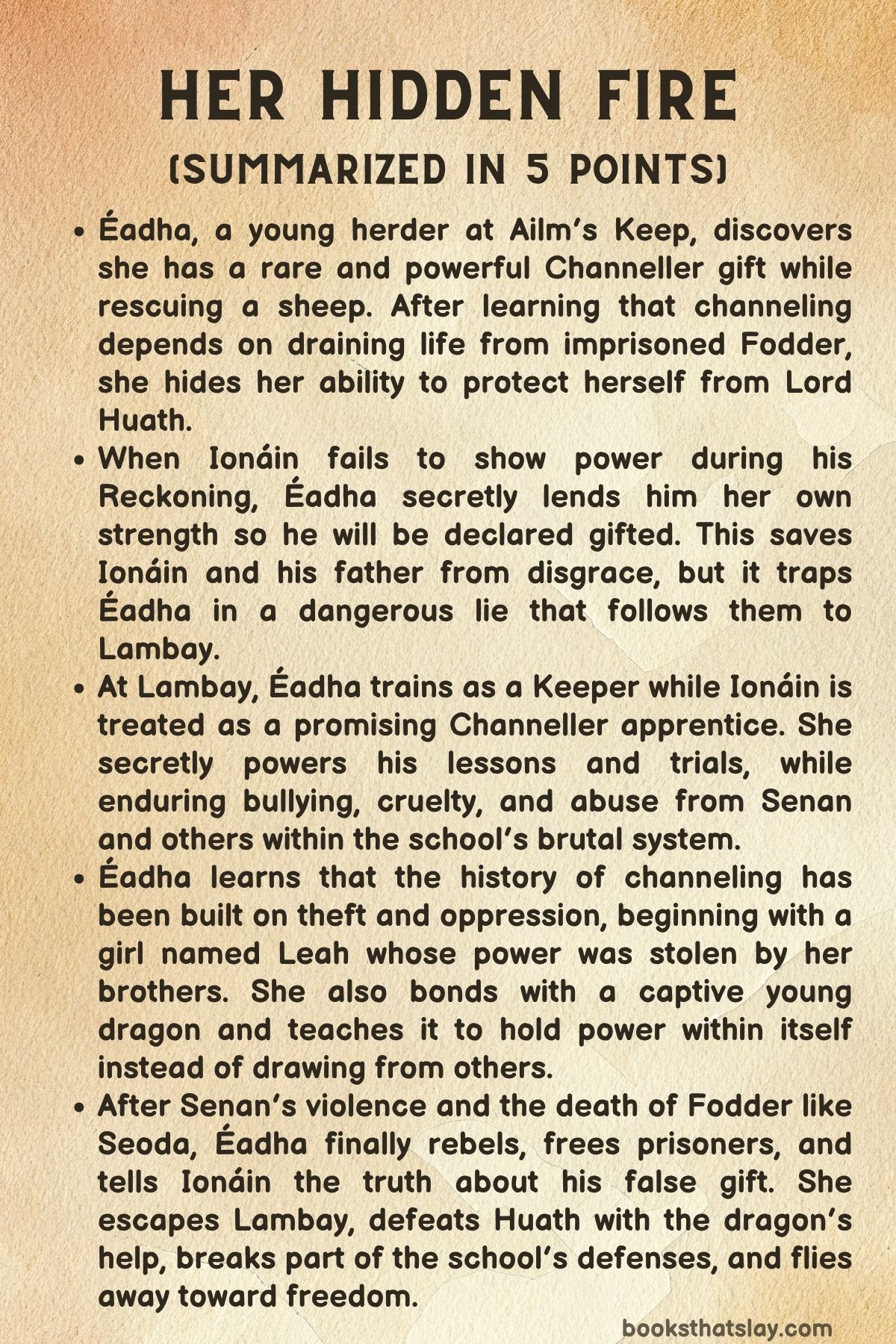
Éadha is a young herder living at Ailm’s Keep, where power, family duty, and fear shape the lives of everyone around her. Her closest concern is Ionáin, the son of Lord Ailm and the last hope of his family’s line.
Ionáin is about to face his Reckoning, the ritual that will reveal whether he has the Channeller’s gift. If he fails, he and his father will lose everything.
Their future, the Keep, and the safety of those under Ailm rule will fall into the hands of Lord Huath, Ionáin’s cruel uncle. Huath is ambitious, vicious, and ready to claim authority the moment Ionáin is judged powerless.
Before Ionáin’s Reckoning, Éadha discovers something impossible about herself. While trying to rescue a sheep stranded on a quarry ledge, she calls on a force she does not understand.
Power answers her. The moment leaves her shaken, because Channeller gifts are rare, controlled, and dangerous.
Soon after, Magret, a singer who seems to know more than she says, tests Éadha and confirms the truth: Éadha is not merely touched by power; she is an unusually strong Channeller.
Magret explains the hidden cost of channeling. Channellers do not create power freely.
They draw life and strength from other people, known as Fodder. These people are treated as resources rather than human beings.
Huath keeps chained prisoners and drains them for magical strength. When Éadha sees what channeling truly costs, she is horrified.
She understands that her gift does not offer simple freedom or glory. It places her within a brutal system that survives by consuming the weak.
Magret warns her to hide what she is, and Éadha agrees.
Ionáin’s Reckoning arrives. The ritual is meant to prove whether he can channel, but Master Dathin, the official testing him, finds nothing.
Ionáin has no gift. Éadha cannot bear to watch him fail, knowing that failure will ruin him, condemn his father, and give Huath control.
Acting in secret, she sends her own power into Ionáin. Dathin senses the strength and declares Ionáin gifted.
The Ailm Family is saved, but Éadha immediately understands that she has not solved the problem. She has created a lie that will demand more lies to survive.
The next day, Éadha faces her own Reckoning. She hides most of her power, keeping Huath from learning what she truly is.
Because she reveals only a lesser ability, Huath mistakes her for a Keeper, someone trained to serve Channellers by managing the supply of power from Fodder. Éadha is sent to Lambay, the training school, along with Ionáin.
She decides that she will become Ionáin’s Keeper and secretly give him her own strength whenever he needs it. In her mind, this is the only way to protect him and keep the truth from destroying them both.
Lambay is nothing like a place of learning should be. It is harsh, ordered by rank, and ruled through fear.
Channeller apprentices are honored and indulged, while Keepers are treated as servants. Fodder are treated even worse, reduced to bodies that exist only to be used.
Éadha enters the Keeper ranks and quickly learns that survival depends on silence, obedience, and control. Ionáin joins the Channeller apprentices, where he is praised for power that is not truly his.
Éadha struggles to remain close enough to Ionáin to keep lending him strength. Every lesson and trial becomes dangerous, because if she fails to supply him at the right moment, he will be exposed.
If anyone discovers that the power comes from her, both of them may be destroyed. Her task becomes harder because the school separates them by status and duty.
She is bullied by Ailbhe and forced under the authority of Senan, a cruel Channeller apprentice who enjoys control. Eventually, Éadha is assigned to him, which makes her position even more dangerous.
Not everyone at Lambay is blind to her secret. Gry, another apprentice, realizes that Éadha is hiding a Channeller’s gift.
Instead of betraying her, he becomes an ally. Through Gry and her own discoveries, Éadha begins to understand that the official history of channeling is false.
The story taught by the powerful has erased its true beginning. The first Channeller was a girl named Leah.
Her brothers stole from her, reshaped her power for themselves, and built a system that turned others into tools. This revelation changes Éadha’s understanding of Lambay.
The cruelty around her is not an accident or a corruption of a noble tradition. It is part of the system’s foundation.
As training continues, Ionáin appears to grow stronger. His teachers admire him.
Other students see him as gifted. Each success, however, belongs to Éadha’s hidden strength.
She gives him power during lessons and tests, making him look brilliant while draining herself. The more Ionáin is praised, the heavier the lie becomes.
Éadha wants to protect him, but she also sees that he is being shaped by a false identity. He believes he is becoming what his family needs him to be, while Éadha bears the burden in silence.
Éadha also discovers a captive young dragon. The creature is imprisoned and treated as another source of control.
Instead of using it, Éadha teaches it to draw power from within itself. This act creates a strange bond between them.
The dragon becomes a sign of another possibility: power that does not depend on draining others, strength that is not built on chains. Éadha does not fully understand the importance of what she has done, but the connection will later save her life.
Senan’s cruelty grows worse. He abuses Éadha, drains her strength, and later assaults her.
His treatment of her, combined with Lambay’s treatment of Fodder, pushes Éadha toward a breaking point. She sees Fodder such as Seoda suffer and die because the school considers them expendable.
The death of Seoda marks a major turn in Éadha’s mind. She can no longer pretend that endurance is enough.
The lie protecting Ionáin has trapped her inside the same violence she hates.
After Senan causes Seoda’s death and continues to torment her, Éadha finally fights back. She overpowers him and frees the Fodder wagon.
This act is not only revenge against Senan; it is a rejection of the role Lambay forced on her. She refuses to keep helping a system that feeds on helpless people.
Éadha then goes to Ionáin and tells him the truth. He never had the Channeller’s gift.
Since his Reckoning, every display of power has come from her. Ionáin is devastated.
Everything he believed about himself collapses at once. His achievements, his future, and his sense of worth have all depended on a deception he did not know existed.
Éadha has saved him, but she has also taken away the truth of his life. The two do not have time to repair the damage between them before danger closes in.
Master Dathin discovers Éadha’s secret. Ionáin helps her escape, proving that despite his pain, he still cares for her.
Yet he refuses to flee with her. Éadha is forced to run alone through Lambay.
During her escape, she finds Gry imprisoned. Gry gives her his power so she has a chance to survive.
With that strength, she fights Masters, evades capture, and reaches a dead-Fodder chute. The route is horrifying, a passage meant for discarded bodies, but it becomes her way out.
She escapes into the sea and swims to First Island, wounded and nearly spent.
Huath finds her there. She is badly injured, exhausted, and almost defenseless.
He prepares to kill her, seeing her as a threat to everything he wants to control. At the moment when Éadha seems trapped, the young dragon she once helped returns.
The dragon reveals that it has learned what she taught it. It has kept power within itself, and now it gives that power back to her.
Strengthened by the dragon, Éadha heals herself and rises against Huath. Their fight moves into the sky, where Éadha finally confronts the man whose greed and cruelty have shaped so much of her suffering.
She cuts him off from the Fodder he depends on, severing his access to stolen strength. Without that power, Huath falls to his death.
After defeating him, Éadha does not return to the old order. She joins the dragon and attacks Lambay’s defenses, burning open part of the system that held so many captive.
Then she flies away north and west, leaving the Channellers behind. Her escape does not solve every injustice in the world, but it marks the beginning of freedom.
Éadha has stopped hiding, stopped serving the lie, and chosen a future beyond the rules built to contain her.
Characters
Éadha
Éadha is the central character of Her Hidden Fire, and her journey is built around secrecy, moral pressure, and the painful discovery of power. At the beginning of the book, she appears to be a young herder living a modest life at Ailm’s Keep, but her rescue of the sheep reveals that she carries a rare and dangerous Channeller’s gift.
What makes Éadha compelling is not simply that she has power, but that she immediately understands the cost of using it. Once Magret shows her that channeling depends on draining life from Fodder, Éadha’s gift becomes a burden rather than a privilege.
She is horrified by the cruelty hidden beneath the system and chooses concealment over ambition. This makes her different from the Channellers who accept power as a mark of superiority.
Éadha’s first major moral compromise comes when she secretly gives Ionáin her power during his Reckoning. She does this out of love, loyalty, and desperation, but the act creates the central lie of the story.
From that moment onward, she is trapped between protecting Ionáin and preserving a false identity that endangers both of them. Her time on Lambay deepens this conflict.
She enters the Keeper ranks, where she witnesses the machinery of oppression from inside the system. She is bullied, controlled, drained, and abused, yet she continues to survive because of her stubborn loyalty and hidden strength.
Her suffering does not make her passive; instead, it slowly transforms her fear into resistance. By the end of the story, Éadha becomes a figure of rebellion.
She breaks from the role forced upon her, exposes the lie surrounding Ionáin, frees Fodder, confronts Huath, and finally chooses flight and freedom over obedience. Her character represents hidden female power, the cost of survival, and the courage required to reject a corrupt tradition.
Ionáin
Ionáin is one of the most tragic characters in the book because his identity is built around expectations he cannot meet. As the last hope of the Ailm Family, he carries the burden of inheritance before he has any real control over his future.
His Reckoning is not merely a personal test; it determines the fate of his father, his family, and the Keep itself. This pressure makes him vulnerable, and Éadha’s secret intervention saves him while also trapping him in a false life.
After he is declared gifted, Ionáin becomes admired as a Channeller apprentice, but his success is never truly his own. This creates a painful irony: the more brilliant he appears, the more deeply dependent he becomes on Éadha without knowing it.
Ionáin’s tragedy lies in the fact that he is not deliberately fraudulent. He believes in the identity that others give him because no one tells him the truth.
When Éadha finally reveals that he has never had power and that she has been supplying it since his Reckoning, his devastation is understandable. Every achievement, every moment of praise, and every part of his self-worth collapses at once.
His refusal to escape with Éadha shows how deeply wounded he is and how strongly he remains tied to the world that has defined him. Yet he is not without courage or feeling, because he helps her escape even while he cannot follow her.
Ionáin represents the damage caused by inherited expectations and by a society that values people only through power, status, and usefulness.
Magret
Magret is a guiding figure whose knowledge changes the direction of Éadha’s life. At first, she appears to be a singer, someone who might seem peripheral to the political and magical struggles of the story, but she quickly proves to know far more than she reveals.
Her testing of Éadha confirms the young herder’s gift and introduces her to the darker truth of channeling. Magret’s importance comes from her role as both teacher and warning voice.
She does not romanticize power or encourage Éadha to seek recognition. Instead, she shows her the chained and drained Fodder, forcing Éadha to see the human cost behind the system’s grandeur.
Magret understands that power in this world is inseparable from exploitation, and her advice to hide the gift is shaped by fear, experience, and moral clarity. She is not simply protecting Éadha from danger; she is also protecting others from what Éadha might be forced to become if Huath or Lambay controlled her.
Magret’s character represents hidden knowledge, resistance through secrecy, and the painful wisdom of someone who has seen how institutions corrupt gifted people. She gives Éadha the first real understanding of what her power means, and that knowledge shapes every decision Éadha makes afterward.
Lord Huath
Lord Huath is the clearest embodiment of cruelty, ambition, and institutional corruption in the story. He is not merely a personal villain; he represents the kind of authority that thrives when power is separated from compassion.
His desire to take control of Ailm’s Keep reveals his political hunger, while his use of chained and drained Fodder reveals his moral emptiness. Huath treats human life as fuel, and that attitude makes him a terrifying figure long before the final confrontation.
He is especially dangerous because his cruelty is supported by the wider Channeller system. He does not have to hide his exploitation completely, because the society around him already accepts the idea that some lives exist to feed the power of others.
His mistake with Éadha at her Reckoning shows both his arrogance and his limited imagination. He cannot see her full strength because he looks at her through the assumptions of his own hierarchy.
To him, a girl like Éadha can be categorized, controlled, and used. This underestimation becomes his downfall.
In the final battle, Éadha’s victory over Huath is not only personal revenge; it is a symbolic rejection of everything he represents. When she cuts him off from the Fodder and watches him fall, the story shows that his power was never truly self-sustaining.
Huath’s strength depends on domination, and once that domination is broken, he collapses.
Master Dathin
Master Dathin is a figure of authority whose role exposes the cold, procedural nature of the Channeller world. He is responsible for testing Ionáin during the Reckoning and later becomes the person who discovers Éadha’s secret.
Unlike Huath, Dathin is not presented mainly through open personal cruelty, but his danger lies in his loyalty to the system. He functions as an agent of institutional judgment.
When he cannot find power in Ionáin, the ritual threatens to condemn not only the boy but also his family. This shows how much power people like Dathin hold over the lives of others.
His declaration that Ionáin is gifted, after Éadha secretly channels power into him, demonstrates how easily the system can be deceived despite its confidence in its own authority. Later, when Dathin uncovers Éadha’s hidden gift, he becomes a direct threat because he understands what her existence means.
A powerful Channeller hiding among Keepers challenges the entire structure Lambay depends on. Dathin’s character represents the danger of official power that presents itself as order, discipline, and expertise while enforcing a deeply unjust world.
Senan
Senan is one of the most disturbing characters in the book because he shows how entitlement and cruelty are cultivated within Lambay’s hierarchy. As a Channeller apprentice, he benefits from a system that teaches him to see Keepers and Fodder as tools rather than people.
His control over Éadha is not accidental; it is an expression of the power imbalance the school normalizes. He drains her, abuses her, and later assaults her, making him a deeply personal source of trauma in Éadha’s life.
Senan’s cruelty is especially important because it is ordinary within the world of Lambay. He is not an outsider breaking the rules; he is a product of rules designed to privilege Channellers and dehumanize everyone beneath them.
His role in Seoda’s death further reveals his carelessness toward vulnerable lives. To Senan, suffering matters only when it affects his own status or comfort.
Éadha’s eventual decision to overpower him is therefore a major turning point. It marks the moment when her endurance becomes active resistance.
Senan represents the intimate violence of oppressive systems, showing how large structures of exploitation are carried out through individual acts of domination.
Gry
Gry is one of Éadha’s most important allies because he recognizes the truth she is hiding and chooses solidarity instead of betrayal. As another apprentice, he has enough insight to understand that Éadha is not merely a Keeper, yet he does not use that knowledge to control her.
This separates him from the more ambitious and cruel figures around them. Gry’s alliance with Éadha gives her a rare source of understanding within Lambay, a place where nearly every relationship is shaped by fear, rank, or manipulation.
His character is significant because he proves that not everyone inside a corrupt system is equally corrupted by it. He is observant, brave, and morally awake enough to see that Éadha’s secret matters beyond personal advantage.
His final act of giving her his power so she can survive is one of the most selfless gestures in the story. It contrasts sharply with the forced draining of Fodder because Gry gives willingly.
That distinction matters deeply. Through Gry, the book shows that power can be shared through compassion rather than theft, and that trust can exist even in a world built to destroy it.
Ailbhe
Ailbhe represents the cruelty that can grow among those trying to survive inside a rigid hierarchy. Her bullying of Éadha at Lambay shows that oppression does not only come from masters and powerful Channellers; it can also appear among peers who have internalized the values of the institution around them.
Ailbhe’s behavior helps make Lambay feel socially brutal as well as politically corrupt. She contributes to Éadha’s isolation and makes it harder for her to maintain the secrecy surrounding Ionáin.
While Ailbhe may not carry the same villainous weight as Huath or Senan, her role is still important because she shows how everyday cruelty supports larger systems of control. In a world where rank determines worth, characters like Ailbhe learn to protect themselves or assert importance by pushing others down.
Her presence adds emotional pressure to Éadha’s life and reveals how Lambay trains its students not only in channeling, but also in contempt.
Leah
Leah is a foundational figure in the history of channeling, even though she belongs more to the past than to the main present action of the story. Her importance comes from the revelation that the official history is false.
The first Channeller was not the kind of figure celebrated by the current system, but a girl whose power was stolen by her brothers. Leah’s story reshapes the reader’s understanding of the entire magical order.
What appears to be tradition is actually built on theft, betrayal, and the erasure of a woman’s power. Leah becomes a mirror for Éadha, because both girls possess extraordinary gifts that others seek to hide, control, or exploit.
Her history explains why the system is so deeply unjust: it was founded not on noble discovery, but on appropriation and domination. Leah’s character represents silenced origins, stolen inheritance, and the buried truth beneath official power.
Through her, the novel suggests that history itself can become a tool of oppression when those in power rewrite it to protect their authority.
Seoda
Seoda is a deeply important Fodder character because her death gives personal weight to the suffering that Éadha has already witnessed in broader terms. The Fodder are often treated by the Channeller system as nameless sources of power, but Seoda’s presence helps restore individuality and humanity to those being exploited.
Her death shows that the cruelty of Lambay is not abstract. It destroys real people, and it does so with horrifying casualness.
Senan’s role in causing her death intensifies Éadha’s anger and helps push her toward rebellion. Seoda’s importance lies not in political power or magical strength, but in what she reveals about innocence, vulnerability, and the cost of a system that feeds on human lives.
Her fate becomes one of the emotional breaking points for Éadha. Through Seoda, the story reminds the reader that every act of channeling built on unwilling Fodder carries suffering behind it.
The Young Dragon
The young dragon is one of the most symbolically powerful figures in the book. At first, it appears as a captive creature, another being trapped and controlled by the world of Lambay.
Éadha’s bond with it is unusual because she does not treat it as a tool. Instead, she teaches it to draw power from within itself, offering it a form of independence that directly opposes the Channeller system’s dependence on draining others.
The dragon therefore becomes a living alternative to the corrupt model of power around Éadha. Its later return is crucial because it gives back the strength she once helped it learn to hold.
This moment transforms their bond into an act of mutual rescue. Unlike the forced extraction of energy from Fodder, the dragon’s gift is voluntary and reciprocal.
Its presence in the ending also expands Éadha’s freedom beyond human society. When she joins the dragon and flies away, the escape feels larger than survival; it becomes a rejection of the entire world that tried to define and imprison her.
The dragon represents wild power, freedom, memory, and the possibility of strength that does not depend on exploitation.
Ionáin’s Father
Ionáin’s father is important because he represents the older generation whose fate depends on the success or failure of inherited power. Although he is not as active as Éadha, Ionáin, or Huath, his threatened condemnation raises the stakes of Ionáin’s Reckoning.
Through him, the story shows that the Channeller system does not only punish individuals; it punishes families and bloodlines. His position also explains why Ionáin’s failure would be so catastrophic and why Éadha feels driven to interfere.
Ionáin’s father stands for a fragile form of authority that is already being overtaken by harsher forces like Huath. His vulnerability gives emotional context to the opening conflict and helps show why Éadha’s choice, though dishonest, feels necessary to her in the moment.
Themes
Hidden Power and Self-Discovery
Éadha’s journey is shaped by the painful discovery that the power inside her is both rare and dangerous. In Her Hidden Fire, her gift first appears in an act of care, when she rescues a sheep, which shows that her strength is rooted in instinct, courage, and compassion rather than ambition.
However, the world around her teaches her to fear what she carries. Instead of being allowed to understand her ability freely, she is forced to hide it, control it, and use it in secret.
This creates a deep conflict between who she is and who she must pretend to be. Her power becomes a burden because revealing it would place her under the control of people who exploit Channellers and Fodder alike.
Yet the more Éadha is pushed into silence, the more clearly she understands her own worth. Her self-discovery is not only about accepting her gift, but also about realizing that her identity cannot be defined by fear, class, or the lies of others.
Lies, Identity, and the Cost of Protection
The lie Éadha creates to save Ionáin begins as an act of love and loyalty, but it slowly damages both of them. By secretly giving him power, she protects him from disgrace and danger, yet she also builds his identity on something false.
Ionáin’s confidence, success, and sense of purpose depend on a gift he does not truly possess, which makes the truth devastating when it finally reaches him. Éadha’s choice shows how protection can become harmful when it takes away another person’s right to know reality.
At the same time, the lie traps Éadha in constant fear. She must keep giving parts of herself away while watching Ionáin receive praise for what she has done.
This creates emotional exhaustion and moral guilt. The theme becomes powerful because the lie is not simple selfishness or cruelty; it comes from desperation.
The story shows that even loving deception can break trust, distort identity, and leave both the protector and the protected wounded.
Oppression, Exploitation, and Power
The society Éadha enters is built on a cruel system where power depends on draining others. Channellers are treated as superior, while Keepers and Fodder are reduced to tools that exist to serve them.
This structure reveals how oppression survives by making cruelty seem normal, organized, and even necessary. The chained prisoners used as Fodder expose the true cost of the magic system.
Every act of power depends on someone else’s suffering, yet those in control hide this violence behind tradition, training, and authority. Lambay strengthens this theme through its harsh hierarchy, where status decides who is protected and who is disposable.
Éadha’s horror grows as she sees that the system is not broken by accident; it is designed to benefit the powerful. Her rebellion is therefore not only personal revenge, but a rejection of an entire order based on theft and pain.
The story questions any society that calls exploitation natural simply because it has existed for generations.
Resistance, Survival, and Freedom
Éadha’s resistance develops slowly because survival comes first. At the beginning, she hides, obeys, and endures because open rebellion would destroy her.
Her silence is not weakness; it is a strategy forced on someone with very little protection. However, the abuse she suffers and the deaths she witnesses push her toward action.
Her decision to fight Senan and free the Fodder marks a turning point because she stops using her power only to preserve a lie and begins using it to challenge injustice. Survival in the story is physical, emotional, and moral.
Éadha must survive violence, betrayal, exhaustion, and guilt while still holding on to compassion. The dragon becomes an important symbol of freedom because it learns, like Éadha, to hold power within itself rather than depend on stolen strength.
By the end, Éadha’s escape is not a simple victory, but a refusal to remain trapped inside a world that feeds on obedience. Freedom is earned through pain, courage, and the decision to break away.