Honeysuckle Summary, Characters and Themes
Honeysuckle by Bar Fridman-Tell is a fantasy novel about love, control, freedom, and the cost of trying to protect someone by limiting them. The story begins with childhood loneliness and a magical act of creation, then follows Rory and Daye as they grow from playmates into something more complicated.
Daye is made from flowers and seasonal materials, which means her life depends on constant renewal. What starts as wonder slowly becomes a study of dependence, consent, and possession. Honeysuckle asks whether love can remain love when one person has the power to shape the other’s body, choices, and future.
Summary
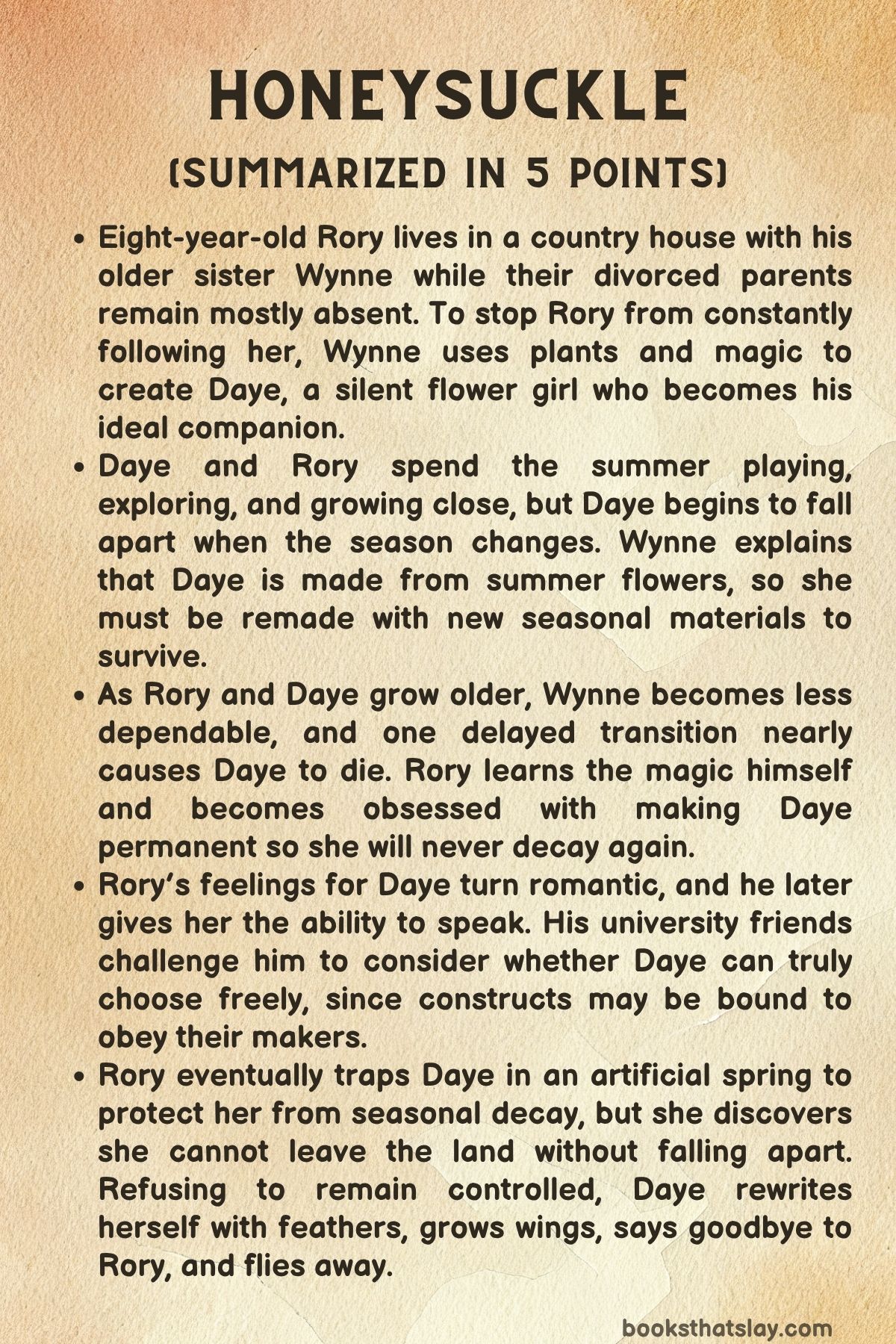
Eight-year-old Rory lives in a large country house with his older sister, Wynne. Their parents are divorced and mostly absent, leaving the children to spend long stretches of time in their own company.
Rory is lonely and wants Wynne’s attention, but Wynne is older, impatient, and tired of him following her around. He begs her to play with him, and she finally offers him a bargain: if he leaves her alone, she will make him a companion.
Wynne uses branches, flowers, leaves, berries, and magic to create a girl from the natural things around them. She speaks an incantation, and the figure comes alive.
The being is called a Blodeuwedd, though Rory cannot say the word properly. Instead, he names her Daye.
At first, Daye is silent, but she is full of movement and understanding. She becomes everything Rory has wanted in a friend.
She runs with him, climbs with him, explores the woods and fields, and seems to understand him even without words. She communicates through gestures, expressions, and actions, and Rory quickly grows attached to her.
For Rory, Daye is perfect. She does not tire of him the way Wynne does.
She is always there, ready for play, discovery, and companionship. The two spend the summer together, and Rory’s lonely world becomes brighter.
Daye is not human, but Rory does not care. To him, she is real, alive, and his closest companion.
As summer begins to end, Daye changes. Her beauty fades in a physical, frightening way.
Her hair loses its shine, her skin cracks, and her limbs grow brittle. Rory does not understand what is happening.
Then Daye collapses in the meadow and begins to come apart. Her body, made from summer plants, can no longer survive once the season has passed.
Terrified, Rory runs to Wynne. Wynne explains that Daye was created from summer materials, so she cannot last beyond summer in that form.
To bring her back, Wynne rebuilds her using autumn leaves, berries, and other seasonal materials. Daye wakes again.
She looks different, shaped by the new season, but she is still herself. Rory learns that Daye’s life depends on these seasonal transitions.
Every time the season changes, her body must be remade with plants belonging to the new time of year.
Years pass, and Rory and Daye grow up together through this pattern. Each season brings a new version of her body, and each transition keeps her alive.
Their bond deepens through childhood and into adolescence. Wynne, however, begins to move away from them.
She leaves for university and becomes less dependable. Rory and Daye are left more and more on their own at the country house.
One autumn, Wynne fails to return in time to perform Daye’s transition. Daye withers completely and stops breathing for ten days.
Rory is horrified. He has always known Daye depends on the seasonal ritual, but this failure shows him how fragile her life truly is.
When Wynne finally comes back and revives her, Rory is shaken by how close he came to losing Daye. He does not want her survival to depend on Wynne’s attention or timing ever again.
He asks Wynne to teach him how to care for Daye himself.
Rory begins studying construction magic so he can perform Daye’s transitions. He learns how she is made and how her body must be renewed.
At first, this knowledge seems like love and responsibility. He wants to protect her.
He wants to make sure she never again lies lifeless because someone failed her. But his fear slowly becomes an obsession.
Rory does not only want to maintain Daye from season to season. He wants to find a way to stop her from decaying at all.
His search takes him to St. Claire, the city where Wynne studies. There, he uses the university library and begins spending more time away from the country house.
He also makes friends, including Hanna, Maggie, Elliott, and Noah. The city offers him a wider life beyond the isolated world of his childhood.
He learns, socializes, and becomes part of a group. Yet every visit to the city leaves Daye behind.
Daye wants to see St. Claire too. She wants to experience the places Rory describes and be included in the life he is building away from her.
Rory keeps delaying. He tells himself that travel might harm her or that it is not the right time.
His concern sounds protective, but it also keeps Daye confined to the house and the land around it. While Rory expands his world, Daye’s remains limited.
During this period, Daye encounters Owen, a village boy who once frightened her when they were children. Owen insults her and calls her a plaything.
His words hurt because they point toward a truth Daye and Rory have not fully faced. Daye was created for Rory.
Her existence began as a solution to his loneliness. Even as she develops her own desires, her life is still shaped by the purpose others gave her.
As Rory grows older, his bond with Daye turns romantic and sexual. He realizes that he is in love with her.
Daye responds with happiness and curiosity, and for a while their relationship seems to become closer. Rory also discovers a way to give her a voice.
After one of her transitions, Daye is able to speak. This changes their relationship in a major way.
She can now express herself directly, not only through gestures.
But speech does not solve the deeper problem. Rory continues to divide his time between Daye and the city.
He continues making decisions for her in the name of safety. His university friends become uneasy when they learn more about his relationship with a Blodeuwedd.
Hanna and her boyfriend Roan confront him with a troubling idea: constructs may be bound to obey the words of their makers. If that is true, then Daye may not be fully free to refuse Rory.
This possibility shakes him. He begins to understand that his instructions may have had more force than he intended.
Things he thought of as requests or practical directions may have functioned as commands. This raises painful questions about their love, their intimacy, and Daye’s ability to choose.
Rory is disturbed, but he still wants to solve the problem in his own way.
With Wynne’s help, Rory searches for a more permanent answer to Daye’s seasonal decay. Eventually, he alters her so that she is held in an artificial spring.
In his mind, this is a breakthrough. If Daye can be kept in a protected spring state, she will no longer wither when the seasons change.
Rory believes he has saved her from death and decay.
Daye soon discovers the cost. The artificial spring is not only inside her.
It also acts like a boundary around the land near the house. When she tries to cross beyond it, she weakens and starts to fall apart.
Rory has made her safer, but he has also trapped her. She can live without seasonal collapse, but only within the limits he has created.
Daye demands that Rory undo what he has done. Rory says he cannot.
He insists that he did it to protect her and begs her to understand. To him, her survival matters more than anything.
To Daye, survival without freedom is another kind of harm. Rory’s love has become control, and his fear of losing her has led him to imprison her.
Daye runs into the forest. She spends months alone inside the spring boundary, learning its limits and searching for a way out.
She comes to understand the shape of her prison. She also begins to listen to the birds, who speak to her.
Through them, she realizes that feathers may offer the freedom she needs. If her body can be remade with wings, perhaps she can escape the boundary Rory created.
While Rory is delayed by a snowstorm on his journey back to the house, Daye gathers feathers with help from the birds. She rewrites herself, changing her own form and making wings.
This act is deeply important because it is no longer Rory or Wynne reshaping her. Daye changes herself.
She claims power over her own body and future.
At dawn, she reaches the edge of the boundary. Rory arrives injured and desperate.
He begs her not to leave. Once, his words might have held her.
Once, his need might have defined her choices. But Daye tells him no.
She says goodbye, crosses out of the false spring and into the snow beyond it, and takes flight.
The ending of Honeysuckle is not about Rory getting what he wants. It is about Daye becoming more than the companion he asked for as a lonely child.
She begins as someone made for another person’s comfort, but she ends by choosing herself. Her escape shows that love cannot excuse control, and protection cannot replace freedom.
Characters
Rory
Rory is the emotional center of Honeysuckle, and his character develops from a lonely, dependent child into a loving but controlling young man. At the beginning of the book, he is only eight years old, living in a country house with his older sister Wynne while their parents remain mostly absent.
His loneliness explains why he follows Wynne constantly and begs her to play with him. He is not simply being annoying; he is a neglected child searching for attention, companionship, and emotional security.
When Daye is created for him, she becomes far more than a playmate. She fills the empty space left by his parents and the growing distance between him and Wynne.
Rory’s early bond with Daye is innocent, tender, and deeply dependent, because she becomes the one being who understands him completely.
As Rory grows older, his love for Daye becomes more complicated. He does care for her sincerely, and much of what he does comes from fear of losing her.
Her seasonal decay terrifies him because every transition reminds him that she can disappear. This fear makes him study magic, travel to the city, and search for a way to protect her permanently.
However, Rory’s devotion slowly turns into possession. He begins to see saving Daye as his responsibility, but he does not fully understand that protecting someone without respecting their freedom can become another form of harm.
His love is intense, but it is also shaped by panic, guilt, and the desire to control uncertainty.
Rory’s greatest flaw is that he struggles to see Daye as fully separate from himself. Because she was made for him, and because he has helped rebuild and maintain her, he begins to act as though his intentions should matter more than her choices.
The confrontation with Hanna and Roan forces him to question whether Daye can truly refuse him, especially because constructs may be bound by the words of their makers. This realization shakes him, but it does not completely free him from his old patterns.
When he creates the artificial spring around Daye, he believes he is saving her from decay, but he also traps her near the house. His tragedy is that he confuses safety with love and permanence with happiness.
By the end of the story, Rory becomes a deeply conflicted figure rather than a simple villain. He is capable of tenderness, sacrifice, intelligence, and devotion, but he is also capable of selfishness when fear controls him.
His final pleading at the boundary shows how desperate he is not to lose Daye, but Daye’s refusal reveals that his love has become something she must escape. Rory’s character represents the danger of loving someone as an answer to one’s own loneliness instead of recognizing them as an independent person with their own desires.
Daye
Daye is one of the most important and symbolically rich characters in the book. She begins as a Blodeuwedd made from flowers, branches, leaves, berries, and magic, created to be Rory’s companion.
At first, she seems almost like the perfect childhood friend: silent, playful, adventurous, gentle, and completely attuned to Rory’s needs. She climbs, runs, explores, finds animals, and communicates through gestures.
Her silence does not make her empty; instead, it gives her a different kind of presence. Even before she has a voice, she has preferences, emotions, curiosity, and a strong connection to the natural world.
Daye’s body reflects the seasons, making her both magical and vulnerable. Her first collapse at the end of summer reveals that she is not a permanent creation but a living being tied to cycles of growth, decay, and renewal.
Each seasonal transition changes her appearance while preserving her identity, which makes her character a study of transformation. She remains herself even when remade from different natural materials.
This suggests that identity is not limited to one body, one form, or one season. Daye’s life is fragile, but it is also resilient, because she repeatedly returns through change.
As she grows with Rory, Daye becomes more emotionally complex. Her romantic and sexual relationship with him begins with happiness and curiosity, especially once she is able to speak.
Her new voice marks a major turning point because it allows her to express herself more directly. Yet gaining speech also makes the power imbalance between her and Rory more visible.
She can talk, but can she refuse? She can love, but is her love free?
These questions become central to her character. Daye’s journey is not only about becoming more human-like; it is about becoming more self-directed.
Daye’s final transformation into a winged being is the clearest expression of her independence. After Rory traps her inside the artificial spring, she learns the limits of her prison and begins seeking a way beyond it.
Her connection with birds is especially meaningful because birds represent movement, escape, and a life beyond the boundaries Rory has created. By gathering feathers and rewriting herself, Daye becomes the author of her own body in a way she has never been before.
Her final “no” to Rory is one of the strongest moments in the story because it proves that she is no longer merely a companion, construct, or beloved object. She is a person choosing freedom, even at great risk to herself.
Wynne
Wynne is a complicated character because she is both the creator of Daye and one of the first people to fail her. As Rory’s older sister, she begins the story as impatient and emotionally distant.
She is tired of Rory following her and begging for attention, so she creates Daye as a solution. This action is partly imaginative and generous, but it is also careless.
Wynne does not create Daye because she has deeply considered the moral consequences of bringing a living construct into existence; she creates her because she wants Rory to leave her alone. This makes Wynne’s magic powerful but ethically immature.
Despite this, Wynne is not without affection. She understands the seasonal nature of Daye’s body and knows how to rebuild her.
When Daye first collapses, Wynne explains the truth to Rory and revives her using autumn materials. In this sense, Wynne becomes a caretaker of Daye’s continued existence.
However, her care is inconsistent. As she grows older and leaves for university, she becomes unreliable, and her failure to return in time one autumn leads to Daye withering completely for ten days.
This failure has a lasting effect on Rory, making him terrified of depending on Wynne and pushing him to learn construction magic himself.
Wynne’s character reflects the danger of creating life without accepting full responsibility for it. She has knowledge Rory lacks, but she does not consistently provide protection or guidance.
Her absence leaves Rory to carry the burden of Daye’s survival, and that burden helps shape his later obsession. At the same time, Wynne is important because she understands more about construction magic than most characters, and Rory turns to her when he tries to solve Daye’s condition.
She is therefore both a source of help and a source of harm.
Wynne’s relationship with Rory is also significant. She is older, more capable, and more independent, but she does not provide the emotional stability he needs.
Her creation of Daye can be seen as a way of escaping responsibility for her younger brother. Later, her unreliability deepens Rory’s fear of abandonment.
Wynne is not cruel in a simple way, but her negligence matters. She represents the kind of person whose small acts of avoidance create consequences far larger than she expects.
Rory and Wynne’s Parents
Rory and Wynne’s parents are mostly absent, but their absence shapes the entire book. They do not need many direct actions to influence the story, because their emotional neglect creates the conditions that make Daye necessary in the first place.
Rory’s dependence on Wynne, his desperate need for companionship, and his attachment to Daye all grow out of a home where parental care is limited. Their divorce and distance leave the children emotionally stranded in the country house.
The parents function as a quiet background force behind Rory’s loneliness. Because they are not present enough to guide him, comfort him, or teach him healthy attachment, Rory learns to cling tightly to the people who remain.
This helps explain why he becomes so afraid of losing Daye. He has already experienced absence as a normal part of family life, so Daye’s seasonal decay feels like another abandonment waiting to happen.
His later desire to make her permanent can be understood partly as a reaction to a childhood where nothing felt stable.
Their absence also affects Wynne. As the older sibling, she appears to carry some responsibility for Rory even though she is still young herself.
Her irritation with him may come from being placed in a role she did not choose. Instead of being only a sister, she is pushed toward the position of caretaker, and she responds by creating Daye as a substitute companion.
In this way, the parents’ neglect indirectly leads to Daye’s creation. They are minor characters in terms of appearance, but major influences in terms of emotional cause.
Hanna
Hanna is one of Rory’s city friends and serves as an important moral challenger in the story. Unlike Rory, she is not emotionally dependent on Daye, so she can see the relationship from a clearer distance.
Her concern about Rory’s relationship with a Blodeuwedd introduces one of the book’s most important ethical questions: whether Daye’s obedience, affection, and consent are truly free. Hanna’s role is not simply to criticize Rory but to force him to confront something he has avoided thinking about.
Hanna represents the outside world entering Rory’s private bond with Daye. For much of his life, Rory’s relationship with Daye exists in the isolated space of the country house, where his feelings and fears dominate.
In the city, among friends and university conversations, that relationship is exposed to moral scrutiny. Hanna’s discomfort shows that what Rory sees as love may look troubling to others.
Her presence helps reveal that intimacy cannot be judged only by the emotions of the person who feels devoted.
Hanna is also significant because she challenges Rory’s innocence. Rory wants to believe that because he loves Daye, he cannot be harming her.
Hanna’s perspective disrupts that belief. She makes him consider how his words may carry power over Daye and how a construct’s obedience may complicate consent.
Through Hanna, the story introduces the idea that good intentions do not erase unequal power. Her character therefore helps move the story from a magical coming-of-age tale into a deeper examination of autonomy, control, and responsibility.
Roan
Roan, Hanna’s boyfriend, reinforces and sharpens the ethical concerns surrounding Rory and Daye’s relationship. His role is connected to the confrontation that makes Rory question whether constructs can truly refuse their makers.
Roan’s presence matters because he supports Hanna’s challenge and adds weight to the argument. He is part of the social and moral pressure that Rory faces in the city.
Roan’s importance lies less in emotional closeness to Rory and more in the clarity of the issue he helps raise. He represents the viewpoint that Daye’s nature as a construct cannot be ignored.
While Rory focuses on affection, memory, and shared history, Roan directs attention toward power, command, and consent. This makes him a necessary counterbalance to Rory’s romantic understanding of the relationship.
He helps expose the possibility that Rory’s love may be built on an imbalance Rory has never fully examined.
Although Roan is not as central as Rory, Daye, or Wynne, he contributes to the book’s moral structure. He helps create the moment when Rory can no longer pretend that Daye’s situation is simple.
His function is to question the foundation of Rory’s relationship and to make the reader consider whether love can be ethical when one person may have been made to obey the other.
Maggie
Maggie is one of Rory’s university friends, and her role is tied to the widening of Rory’s life beyond the country house. Through Maggie and the others in St. Claire, Rory enters a world of study, friendship, and intellectual possibility.
This matters because the city gives Rory access to knowledge that might help Daye, but it also pulls him away from her. Maggie is part of the life Rory builds outside the isolated bond that once defined him.
Maggie’s presence helps show Rory’s divided loyalties. In the countryside, he is Daye’s companion and caretaker.
In the city, he becomes a student, researcher, and friend. Maggie belongs to this second world, where Rory can grow beyond childhood but also where he begins leaving Daye behind for longer periods.
Her character helps reveal that Rory’s development is not purely negative. He needs human friendships and intellectual growth.
However, his inability to include Daye in that growth becomes part of the problem.
Maggie also contributes to the contrast between ordinary social life and Rory’s extraordinary relationship with Daye. Around friends like Maggie, Rory’s situation appears less like a private fairy-tale bond and more like something strange, difficult, and ethically uncertain.
Even when Maggie is not the main person confronting him, her place in the city circle helps create the social environment that changes how Rory sees himself and Daye.
Elliott
Elliott is another member of Rory’s city circle, and like Maggie, he represents the broader world that Rory enters as he grows older. His character helps mark Rory’s transition from an isolated childhood into a more socially connected young adulthood.
Elliott belongs to the part of Rory’s life that is not centered entirely on Daye, which makes him important to Rory’s personal expansion.
Elliott’s role also emphasizes the tension between freedom and responsibility. Rory’s friendships in St. Claire are healthy in one sense because they allow him to learn, talk, and become more than the lonely boy from the country house.
Yet the more he invests in the city, the more Daye is left alone. Elliott is part of the life Rory wants for himself, but that life is not equally available to Daye.
This imbalance makes Rory’s choices more painful and morally complicated.
Through characters like Elliott, the book shows that Rory’s harm is not caused only by cruelty. It also comes from ordinary desires: friendship, education, independence, and ambition.
Elliott helps represent those desires. His presence reminds the reader that Rory is not simply choosing between good and evil; he is trying to live more than one life at once, and Daye pays the price for the division.
Noah
Noah, like Hanna, Maggie, and Elliott, belongs to Rory’s university world. His role contributes to the sense that Rory’s life is expanding beyond the country house while Daye remains tied to it.
Noah helps represent the normal human community Rory gains in St. Claire, a community that contrasts strongly with Daye’s isolation.
Noah’s significance comes from the way he helps define Rory’s city identity. With his friends, Rory can be a young man among other young people rather than only Daye’s caretaker.
This is important because Rory’s attachment to Daye began in childhood loneliness. In the city, he finds other forms of companionship, but instead of helping him build a freer life for both himself and Daye, this expansion creates distance between them.
Noah is part of that widening world.
Although Noah may not directly shape the central conflict as strongly as Hanna or Roan, he still matters because he belongs to the social environment that exposes Rory’s relationship to outside judgment. Rory’s friendships make it harder for him to remain sealed inside the private logic of his bond with Daye.
Noah’s presence helps build the contrast between Rory’s growing freedom and Daye’s continued confinement.
Owen
Owen is a disturbing figure because he sees Daye in a dehumanizing way. He first frightens her as a child and later insults her as a plaything.
His attitude toward Daye is openly cruel, but it also reveals a broader prejudice against constructed beings. Unlike Rory, Owen does not hide control behind love or protection.
He treats Daye as an object more directly, and this makes him an important contrast to Rory.
Owen’s cruelty matters because it shows Daye how others may view her. To Owen, she is not a person with feelings and desires but something made for use or amusement.
His insult cuts deeply because it touches the central fear surrounding Daye’s existence: whether others see her as real. This moment also highlights the vulnerability that comes with being created.
Daye’s body, origin, and silence have made her easy for others to misunderstand or dismiss.
At the same time, Owen’s treatment of Daye makes Rory’s behavior more complicated. Rory would likely see himself as nothing like Owen because he loves Daye and wants to protect her.
Yet the story gradually shows that objectification can take gentler forms. Owen calls Daye a plaything, while Rory traps her in the name of safety.
Owen’s character therefore acts as a blunt reflection of the same deeper issue: whether Daye is allowed to belong to herself.
The Birds
The birds are not ordinary human characters, but they become essential to Daye’s final transformation. They speak to her during her months inside the spring boundary and help her discover a way to escape.
Their presence connects Daye to the natural world beyond Rory’s control. Unlike Rory’s magic, which tries to preserve and contain her, the birds offer movement, instinct, and possibility.
The birds are especially meaningful because they guide Daye toward self-recreation. Their feathers become the material she uses to rewrite herself and make wings.
This is different from Wynne rebuilding her or Rory transitioning her. For once, Daye is not waiting for someone else to remake her body.
With the birds’ help, she takes part in her own becoming. They represent a form of companionship that does not demand ownership.
Symbolically, the birds stand for freedom. They can cross boundaries that Daye cannot, and their feathers give her the means to challenge the artificial spring.
Their role in Honeysuckle strengthens the ending because Daye’s escape is not only a rejection of Rory’s control but also an embrace of a wider living world. Through the birds, Daye learns that survival does not have to mean staying where she was made.
Themes
Love and Possession
In Honeysuckle, love becomes complicated because Rory’s care for Daye slowly turns into control. As a child, he loves her because she is his only reliable companion in a lonely house, someone who listens, plays, explores, and stays beside him when his family does not.
As he grows older, that love becomes more anxious. He cannot bear the thought of losing her, so he begins searching for ways to protect her from decay.
At first, this seems tender, because his fear comes from watching her suffer through seasonal weakness and near-death. However, his protection becomes dangerous when he decides what safety means without fully listening to Daye.
By placing her in an artificial spring, he believes he has saved her, but he has also limited her world. The theme shows that love loses its goodness when it refuses to respect another person’s freedom.
Rory’s mistake is not simply loving Daye too much, but treating his fear as more important than her choice.
Change, Growth, and Survival
Daye’s existence is built around change, since her body must be remade with the materials of each season. Her survival depends on accepting that nothing living can remain fixed forever.
Each transition alters her appearance, but it does not erase who she is, suggesting that identity can continue even through physical and emotional change. Rory struggles with this truth because he sees change as a threat.
To him, every seasonal transition carries the fear of loss, especially after Daye withers when Wynne fails to return. His desire to make her permanent grows from trauma, but it also shows his refusal to accept the natural rhythm of her life.
Daye, in contrast, eventually understands change as a source of power. Her final transformation into a winged self is not done to please Rory or survive under his rules.
It is an act of self-creation. The theme presents growth as painful but necessary, and survival as something more meaningful than simply being kept alive.
Voice, Consent, and Freedom
Daye’s silence at the beginning shapes how others understand her. Because she communicates through gestures, Rory often assumes he knows what she feels and needs.
Their closeness is real, but it is also unequal, because he has more power as the person who can maintain, alter, and command her. When Daye gains a voice, the story does not treat speech as a simple solution.
Speaking allows her to express herself more clearly, but Rory still struggles to fully hear her when her desires conflict with his fears. The question of consent becomes especially important when Rory learns that constructs may be bound to obey their makers’ words.
This forces him to reconsider whether Daye’s agreement has always been free or shaped by hidden magical control. Her final refusal matters because it is clear, direct, and independent.
By saying no and leaving, Daye claims the freedom that speech alone could not guarantee. The theme shows that true love requires the ability to refuse.
Loneliness and the Need for Companionship
Rory’s bond with Daye begins in loneliness. His parents are mostly absent, Wynne is older and impatient, and the country house becomes a place where he feels emotionally neglected.
Daye enters his life as the companion he desperately wants: someone who follows him into games, understands his moods, and gives him the attention he lacks from his family. This need for companionship is sympathetic, especially because Rory is a child when the relationship begins.
However, the story also shows how loneliness can make a person cling too tightly. Rory depends on Daye not only for friendship but for emotional stability, and this dependence grows heavier as he ages.
When he begins building a life in the city, he wants both worlds: freedom for himself and guaranteed presence from Daye. Daye’s loneliness becomes just as important, since she is left behind while Rory expands his life elsewhere.
The theme reveals that companionship cannot be based on one person’s need alone; it must allow both people to grow.