Hooked by Asako Yuzuki Summary, Characters and Themes
Hooked by Asako Yuzuki, originally published in Japanese as Nairu pāchi no joshikai, is a contemporary novel about loneliness, female friendship, online identity, and the hunger to be seen. At its center are two women in their thirties: Eriko, an isolated office worker who has built her life around duty and control, and Shōko, a casual homemaker blogger whose messy, easygoing posts seem to offer the freedom Eriko lacks.
What begins as admiration slowly becomes dependence, then obsession. Through their uneasy bond, the book explores how friendship can become distorted when one person asks it to replace self-worth, family, work, and a whole missing life.
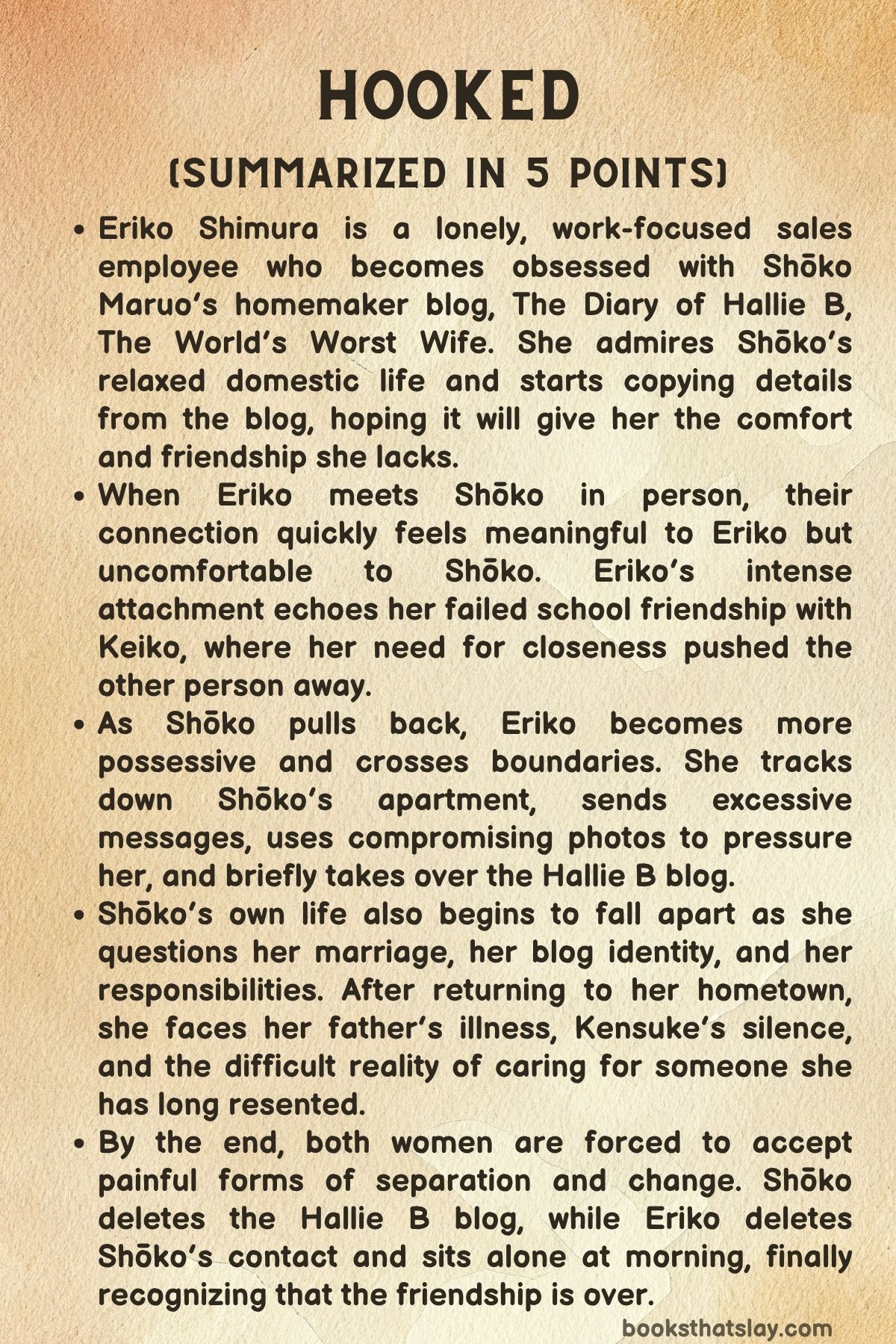
Summary
Eriko Shimura is thirty years old and works in sales at Nakamaru, where her life is orderly, demanding, and almost entirely centered on her job. She still lives with her parents, has few close personal connections, and has never managed to build the kind of relaxed female friendship she longs for.
Her daily routine leaves little room for pleasure, but she finds comfort in reading a popular homemaker blog called The Diary of Hallie B, The World’s Worst Wife. The blog is written by Shōko Maruo, a thirty-year-old married woman who lives nearby with her husband, Kensuke.
Shōko’s blog presents a style of life that fascinates Eriko. Shōko writes about simple meals, cheap restaurants, domestic laziness, minor annoyances, and small pleasures.
She does not seem polished or ambitious, and that is exactly what draws Eriko in. To Eriko, Shōko represents a kind of freedom: a woman who can be careless, funny, married, ordinary, and still interesting.
Eriko begins copying things from the blog, including food preferences and habits, as though borrowing Shōko’s lifestyle might help her enter a warmer, easier world.
At work, Eriko mentions the blog to Sugishita, a male colleague. He teases her about it but also remembers details, including Shōko’s fondness for inexpensive engawa sushi.
Meanwhile, Shōko’s blog attracts professional attention. An editor named Satoko Hanai approaches her about turning the blog into a book.
During their meeting at a café, Eriko happens to see Shōko and recognizes her from the blog. She introduces herself as a loyal reader.
Shōko is pleased and flattered by the attention, and the two women exchange contact information.
Their first real meeting takes place late at night at Denny’s. Eriko is thrilled by Shōko’s openness and casual warmth.
Shōko seems different from the women Eriko usually knows: she is not competitive, formal, or guarded. She gives Eriko a ride home on her bicycle, and Eriko feels she may finally have found the intimate female friendship she has always wanted.
But the scene is followed by a reminder of Eriko’s past. Outside her apartment, she runs into Keiko, an old school friend.
Keiko’s presence suggests that Eriko has been here before: wanting closeness so badly that she overwhelms the person she wants to keep.
The past between Eriko and Keiko gradually comes into focus. In school, Eriko clung to Keiko with an intensity Keiko could not bear.
Eriko’s need for constant reassurance damaged the friendship until it broke. Rather than learn from that loss, Eriko carries the same hunger into her new connection with Shōko.
At first, Shōko enjoys being admired. She likes Eriko’s attention and the strange thrill of having a reader become a real-life friend.
But Eriko’s admiration soon begins to feel less like friendship and more like possession.
When Shōko stops updating her blog for a short time and does not reply to messages, Eriko becomes anxious and desperate. Instead of waiting, she uses details from the blog to locate Shōko’s apartment and appears there early in the morning.
Shōko is frightened by the visit. She tries to remain polite, but her trust is shaken.
Eriko, however, convinces herself that Shōko only needs to understand her intentions. She believes that if she explains herself clearly enough, the friendship can return to the warmth of their first meeting.
The distance between them grows. After a tense sushi outing, Eriko sends too many messages and reads every silence as a threat.
Shōko becomes increasingly uncomfortable and begins to wonder whether Eriko is behind negative comments appearing on her blog. She considers quitting, but Satoko urges her not to give up, especially as the possibility of publication becomes more real.
Shōko also begins meeting other homemaker bloggers, and their influence pushes her to think more carefully about her online image, lifestyle, and future as a writer.
While Shōko tries to move forward, Eriko travels to Tanzania for work on a Nile perch import project. Professionally, she does well.
Her work brings success and recognition, proving that she is capable and disciplined. Yet her private life continues to fall apart.
She sleeps with Sugishita, only to learn that he is marrying Maori, a temporary employee. The news humiliates and unsettles her.
Instead of facing her own loneliness directly, she turns her attention even more fiercely toward Shōko, treating that friendship as the answer to everything missing in her life.
Shōko eventually meets Keiko, who explains the damage Eriko caused in their school friendship. This confirms Shōko’s fears.
She understands that Eriko’s behavior is not a simple misunderstanding but part of a deeper pattern. Shōko pulls away further.
At the same time, her own life becomes complicated. She starts seeing Hashimoto, a younger waiter from a restaurant called Gisele.
This relationship gives Eriko new leverage when she obtains compromising photos involving Shōko. Eriko uses the photos to pressure her, gaining control over the person she claims to love as a friend.
In one of the clearest signs of Eriko’s obsession, she takes over Shōko’s blog for a week. She tries to recreate the old “Hallie B” voice that first attracted her.
To Eriko, this is almost an act of devotion. She believes she understands the real spirit of the blog better than Shōko does now.
But the attempt fails. The blog’s ranking drops, showing that Eriko cannot simply inhabit Shōko’s identity or restore the past she has idealized.
What she loved was never fully real; it was an image shaped by distance, fantasy, and need.
Eriko and Shōko take a trip to Hakone, but instead of repairing the friendship, the trip exposes how different their expectations are. Eriko has planned carefully and wants the journey to prove their bond.
She treats the trip as a test, hoping each shared moment will confirm that Shōko belongs to her in some special way. Shōko, however, feels trapped.
She cannot give Eriko the emotional certainty Eriko demands. The more Eriko tries to force closeness, the more Shōko withdraws.
After the trip, the relationship reaches its breaking point. Eriko meets Shōko at Denny’s, the same kind of place where their friendship first seemed possible.
This time, instead of trying to hold on, Eriko deletes the incriminating photos and releases Shōko from her control. The act does not erase the harm she has caused, but it marks a moment of recognition.
Eriko finally understands that friendship cannot survive as ownership, and that forcing someone to stay only destroys whatever affection once existed.
Shōko returns to her hometown, where her father is found collapsed. At first, when she thinks he may have died, she feels a disturbing sense of freedom.
His survival complicates that feeling. He is hospitalized, and Shōko is left to deal with the practical and emotional weight of caring for him.
Kensuke, her husband, stops responding to her, leaving her isolated in a way she has not fully experienced before. The woman who once wrote lightly about domestic life now faces the unglamorous labor of responsibility.
Shōko begins cleaning the house, paying bills, bathing, and visiting her father in the hospital. These tasks change her understanding of care.
They are not charming blog material or proof of an easy life; they are tiring, physical, and necessary. She also calls Kensuke and asks honestly if they can begin again.
She knows he may not come back, but the call matters because it is direct. For once, she is not hiding behind a persona or a performance of careless domesticity.
Eriko, meanwhile, takes time off work after a humiliating incident. At home, she quarrels with her mother, who reveals her own resentment at being treated like a servant.
This forces Eriko to see her family life more clearly. Her mother has also been trapped in a role, expected to serve without being recognized.
Maori tells Eriko that she needs distance from her parents and from the old patterns that keep her stuck. Eriko’s problem is not only Shōko; it is the whole structure of dependence, fear, and avoidance that has shaped her life.
In the end, Shōko deletes the Hallie B blog. Eriko notices before dawn.
The deletion signals the end of the fantasy that first connected them. The blog, which once seemed to Eriko like a doorway into another life, is gone.
Eriko walks through the neighborhood and enters a family restaurant where Keiko now works. This quiet meeting with the past brings the story full circle.
Eriko deletes Shōko’s contact from her phone and sits alone as morning arrives. She accepts that the friendship is over, and that the life she wanted cannot be taken from someone else.
The ending leaves her not healed, but awake to the truth that she must begin from herself.
Characters
Eriko Shimura
Eriko Shimura is the central figure of Asako Yuzuki’s Hooked, and her character is built around loneliness, emotional hunger, and the dangerous need to be recognized by another person. At thirty, she appears outwardly successful because she works hard at Nakamaru and proves herself capable in a demanding sales environment, yet her inner life is marked by emptiness.
She lives with her parents, has no close female friends, and pours most of her energy into work because it gives her structure and a sense of worth. Her fascination with Shōko Maruo’s blog begins as admiration, but it quickly becomes something more intense.
Eriko does not simply enjoy Shōko’s writing; she tries to absorb Shōko’s lifestyle, copying her tastes, routines, and emotional atmosphere as if this will give her access to the relaxed, intimate life she feels she lacks.
Eriko’s greatest weakness is her inability to understand emotional boundaries. When she meets Shōko, she believes she has finally found the female friendship she has always wanted, but her joy quickly turns into possessiveness.
She wants closeness so badly that she mistakes access for intimacy and attention for loyalty. Her decision to track down Shōko’s apartment shows how easily affection becomes intrusion for her.
Eriko often believes that if she can explain herself properly, others will understand that her intentions are not harmful. This makes her a deeply complicated character, because she is not simply cruel or malicious.
She is needy, frightened, and desperate for connection, but her desperation makes her behave in ways that frighten and trap the people around her.
Her past friendship with Keiko reveals that Eriko’s behavior is not a sudden development but part of a long emotional pattern. She has clung too tightly before, and the damage she caused in that earlier friendship explains why her relationship with Shōko begins to feel so unstable.
Eriko’s professional competence contrasts sharply with her personal immaturity. At work, she can travel abroad, handle difficult projects, and contribute meaningfully to the Nile perch import plan.
In her private life, however, she becomes increasingly dependent on Shōko’s attention and cannot bear being ignored. This contrast makes her one of the most psychologically detailed characters in the book, because she is neither a failure nor a villain.
She is someone who functions in one part of life while quietly collapsing in another.
By the end of the story, Eriko’s arc moves toward painful acceptance. Her deletion of Shōko’s contact is not a triumphant moment, but it is an important act of release.
She finally accepts that friendship cannot be forced, monitored, or preserved through pressure. Sitting alone in the family restaurant as morning arrives, Eriko appears stripped of illusion.
She has lost the fantasy of Shōko, the fantasy of perfect female intimacy, and perhaps the fantasy that another person can rescue her from her own loneliness. Her ending is quiet but meaningful because it suggests the first step toward emotional maturity: the recognition that love, friendship, and belonging cannot exist without distance and consent.
Shōko Maruo
Shōko Maruo is a thirty-year-old homemaker whose blog, The Diary of Hallie B, The World’s Worst Wife, creates the image of a lazy, humorous, ordinary domestic life. She writes about cheap food, restaurants, her marriage, and everyday routines in a casual voice that attracts readers like Eriko.
At first, Shōko seems relaxed and unserious, almost the opposite of Eriko’s tense, work-driven personality. This is exactly why Eriko becomes fascinated by her.
Shōko seems to possess a kind of freedom that Eriko does not have: the freedom to be imperfect, idle, funny, and unashamed of ordinary pleasures. Yet as the story develops, it becomes clear that Shōko’s easygoing persona is also a performance, and that her life is far less secure than her blog suggests.
Shōko’s relationship with her blog is central to her character. The Hallie B persona gives her attention, identity, and a way to turn domestic idleness into entertainment.
However, it also traps her inside an image that other people begin to claim. Eriko wants the old version of Hallie B to remain unchanged because that version comforts her.
Satoko wants Shōko to continue because the blog has publishing potential. Other homemaker bloggers make Shōko more aware of how she presents herself.
As a result, Shōko becomes caught between authenticity and performance. She begins as someone who writes casually, but once her private life becomes visible to readers, she loses control over how she is understood.
Shōko is also morally complicated because she is not only a victim of Eriko’s obsession. She can be evasive, passive, selfish, and emotionally careless.
Her marriage to Kensuke appears neglected, and her involvement with Hashimoto suggests her desire to escape the boredom and dissatisfaction of her domestic life. She often avoids direct confrontation, which makes her problems worse.
Rather than clearly setting boundaries with Eriko early on, she withdraws, hesitates, and allows tension to grow. Still, her fear of Eriko is understandable, especially when Eriko begins invading her privacy and using compromising photos as leverage.
Shōko’s weakness lies in avoidance, while Eriko’s lies in pursuit, and the conflict between them becomes one of the central emotional tensions of Hooked.
Shōko’s later return to her hometown changes her character significantly. When her father collapses, she is forced into responsibilities she had avoided or mocked through her domestic persona.
Cleaning the house, paying bills, bathing, and caring for her father bring her into contact with the unglamorous reality of dependence and family duty. Her initial feeling of freedom when she believes he may have died exposes a harsh truth about her resentment, but his survival forces her to confront that resentment rather than escape it.
By deleting the Hallie B blog, Shōko symbolically gives up the identity that once protected and entertained her. Her final movement is toward honesty, especially when she calls Kensuke and asks to begin again without knowing whether he will return.
This makes her ending uncertain but emotionally sincere.
Sugishita
Sugishita is Eriko’s colleague at Nakamaru, and he plays an important role in showing the gap between Eriko’s work life and emotional life. He is casual, teasing, and observant, noticing Eriko’s interest in Shōko’s blog and joking about it without fully understanding how serious her attachment will become.
His presence at work helps reveal that Eriko is not socially invisible in every setting. She can talk to colleagues, handle teasing, and perform competently in professional situations.
However, Sugishita also becomes part of Eriko’s private unraveling when their relationship crosses a physical boundary.
His brief sexual connection with Eriko is important because it does not give her the emotional security she needs. Instead, it intensifies her sense of rejection when she learns that he is marrying Maori.
For Eriko, this becomes another experience of being chosen only temporarily and then left behind. Sugishita may not intend to hurt her deeply, but his casualness contrasts with Eriko’s tendency to attach meaning to moments of closeness.
He represents the kind of ordinary adult relationship that Eriko cannot manage safely because she enters it with too much hidden need. His engagement to Maori also deepens Eriko’s humiliation, making her feel displaced by someone younger, more socially adaptable, and more capable of moving forward.
Sugishita is not developed as intensely as Eriko or Shōko, but his function in the story is significant. He exposes Eriko’s vulnerability in a setting where she otherwise appears strong.
Through him, the book shows that professional success does not protect Eriko from emotional confusion. He also reflects the casual cruelty of ordinary life, where one person may treat an encounter as minor while another experiences it as deeply wounding.
Sugishita’s character matters because he becomes one more reminder that Eriko cannot control how others value her.
Satoko Hanai
Satoko Hanai is the editor who sees commercial potential in Shōko’s blog and encourages her to turn it into a book. She represents the world of publishing, ambition, and public identity.
Satoko is practical and persuasive, and she recognizes that Shōko’s casual domestic writing has appeal beyond a small online audience. Her interest flatters Shōko and gives the blog a new direction, but it also increases the pressure on Shōko to maintain her persona.
What began as a relaxed personal outlet becomes something that can be shaped, marketed, and judged.
Satoko’s role is especially important because she encourages Shōko not to quit when negative comments and anxiety begin to threaten the blog. From one perspective, this makes Satoko supportive, because she pushes Shōko to value her own work and not disappear at the first sign of difficulty.
From another perspective, she also benefits from Shōko continuing to perform as Hallie B. Satoko does not fully understand the emotional danger surrounding Eriko’s obsession, and her professional encouragement may unintentionally keep Shōko tied to the very public identity that is making her vulnerable.
Satoko is not portrayed as cruel, but she is a reminder that public attention can turn private life into material. She sees Shōko as a writer and potential author, which is validating, yet she also participates in transforming Shōko’s ordinary domestic existence into a product.
Her character helps widen the story beyond the relationship between Eriko and Shōko. Through Satoko, the book explores how blogs, readership, publishing, and personal branding can complicate identity.
Shōko’s problem is not only that Eriko wants to possess her; it is also that the world around her begins to treat her persona as something useful.
Kensuke Maruo
Kensuke Maruo is Shōko’s husband, and his character is important because of what his absence and silence reveal about Shōko’s marriage. He is part of the domestic world that Shōko writes about, but he often feels distant from the emotional center of her life.
Shōko’s blog turns marriage into comic material, presenting domestic laziness and everyday couplehood in an entertaining way. Yet beneath this light tone, the marriage appears fragile.
Kensuke’s relationship with Shōko lacks the intimacy and communication that would make their home feel secure.
Kensuke’s eventual withdrawal from Shōko is one of the clearest signs that her old life is falling apart. When he stops responding, Shōko is forced to recognize that she cannot rely on the marriage as a stable background while she experiments with other identities and attachments.
His silence is painful because it leaves her alone at the exact moment when she is burdened with caring for her father. At the same time, his withdrawal suggests that he too has reached a limit.
Shōko’s emotional evasiveness, her dissatisfaction, and her possible betrayal through Hashimoto have consequences.
Kensuke is not presented as a fully explored inner life in the same way as Eriko or Shōko, but his role is still essential. He represents the neglected reality behind Shōko’s comic domestic persona.
The husband in the blog may be part of a funny lifestyle narrative, but the actual Kensuke is a person who can leave, refuse, and withhold forgiveness. When Shōko calls him honestly and asks to begin again, her request shows growth because she is no longer hiding behind the Hallie B voice.
Kensuke’s uncertain response keeps the ending emotionally realistic. Repair is possible, but it is not guaranteed.
Keiko
Keiko is Eriko’s old school friend, and she functions as a key to understanding Eriko’s past. Her appearance reveals that Eriko’s obsessive attachment to Shōko is not an isolated event.
In school, Eriko once clung too intensely to Keiko and damaged their friendship. Keiko therefore carries the memory of an earlier version of the same emotional pattern.
She is not merely a figure from the past; she is evidence that Eriko’s loneliness has roots and that her way of seeking closeness has harmed others before.
Keiko’s character also provides an outside perspective on Eriko. Shōko experiences Eriko’s pursuit directly and may initially struggle to understand it, but Keiko can name the pattern because she has already lived through it.
Her explanation helps Shōko see that Eriko’s behavior is not just enthusiasm or awkwardness. It is a kind of emotional dependency that can become suffocating.
Keiko’s presence therefore protects Shōko by giving her context, but it also deepens the reader’s understanding of Eriko. The story becomes less about one failed friendship and more about a repeated inability to form balanced relationships.
By the end, Keiko’s role changes from a painful reminder to a quiet symbol of continuity. Eriko enters the family restaurant where Keiko now works, and this setting brings the past and present together.
Keiko does not need to dramatically forgive or confront Eriko for the moment to matter. Her presence shows how life continues around Eriko, even after intense relationships end.
Eriko’s final solitude near Keiko suggests that she is finally facing the consequences of her past without trying to force a repair. Keiko represents the damage Eriko has caused, but also the possibility that Eriko may begin to understand that damage.
Maori
Maori is the temp worker who becomes engaged to Sugishita, and her character is important because she represents the life path Eriko feels excluded from. To Eriko, Maori’s relationship with Sugishita is humiliating because it confirms that Eriko was not chosen.
Maori’s presence forces Eriko to confront the difference between a casual encounter and a committed future. This makes Maori emotionally significant even though she is not at the center of the story’s main friendship conflict.
Maori also gives Eriko one of the most direct and practical pieces of advice in the book when she tells her that she needs distance from her parents and her old life. This moment complicates Maori’s character.
She is not merely a rival or a symbol of Eriko’s rejection. She sees something true about Eriko’s situation and says it plainly.
Eriko’s dependence on her parents’ home, her old routines, and her unresolved emotional patterns has kept her trapped. Maori recognizes that Eriko cannot change while remaining inside the same environment that reinforces her helplessness and resentment.
Through Maori, the story presents a younger woman who appears more capable of making adult transitions. She is moving toward marriage, while Eriko remains stuck in emotional adolescence despite being professionally accomplished.
This contrast is painful for Eriko, but it is also necessary. Maori’s role is not to defeat Eriko, but to expose the truth that Eriko needs separation, independence, and a new structure for her life.
Her character helps push Eriko toward the realization that change cannot come only through another person’s affection.
Hashimoto
Hashimoto is the younger waiter from Gisele whom Shōko begins seeing, and his character reveals Shōko’s dissatisfaction with her married life. He represents temptation, escape, and the appeal of being seen outside the role of wife and blogger.
With Hashimoto, Shōko can step away from the comic domestic identity she has created and experience herself as desirable in a different way. This does not necessarily make the relationship deep, but it makes it meaningful as an expression of Shōko’s restlessness.
Hashimoto’s involvement also increases Shōko’s vulnerability. The compromising photos connected to him give Eriko power over Shōko, turning Shōko’s private mistake into a tool of pressure.
In this sense, Hashimoto is less important as an individual than as the person through whom Shōko’s hidden life becomes exposed. His presence reveals that Shōko’s casual, lazy, humorous persona conceals more serious forms of dissatisfaction and risk.
She is not simply drifting through harmless domestic idleness; she is making choices that can damage her marriage and expose her to manipulation.
As a character, Hashimoto helps show that Shōko is seeking escape without fully considering consequences. He is part of her attempt to feel alive and separate from the roles that define her, but that attempt leaves her more trapped.
The relationship with him does not free her. Instead, it gives Eriko leverage and deepens Shōko’s crisis.
Through Hashimoto, the story shows how private desire can become dangerous when it is hidden, photographed, and placed in the hands of someone emotionally unstable.
Eriko’s Mother
Eriko’s mother is a significant figure because she reveals the family environment that has shaped Eriko’s emotional life. For much of the story, Eriko lives at home and benefits from the domestic labor around her without fully recognizing the resentment beneath it.
Her mother’s outburst, in which she reveals that she feels treated like a servant, exposes a hidden structure of dependence and bitterness within the household. Eriko’s loneliness is not only social; it is also domestic.
She lives close to her family physically, but that closeness does not create genuine understanding.
Her mother’s resentment also mirrors some of the book’s larger concerns about women’s roles, care, and invisible labor. Shōko writes jokingly about being a lazy wife, while Eriko’s mother experiences domestic service as a burden.
The contrast is important because it shows different forms of female dissatisfaction. Shōko turns domestic failure into performance, while Eriko’s mother has lived with domestic expectation as a source of anger.
Her frustration suggests that the home, which may appear safe or ordinary, can also become a place of emotional confinement.
For Eriko, the quarrel with her mother is painful but necessary. It forces her to see that she is not the only person in the household with unmet needs.
Her mother is not merely a background parent; she is a woman with her own disappointments. This realization contributes to Eriko’s growing awareness that her life must change.
The conflict helps reveal why Maori’s advice about distance matters. Eriko cannot become emotionally independent while remaining in a home where dependence, resentment, and silence have become routine.
Shōko’s Father
Shōko’s father becomes especially important in the later part of the story, when his collapse forces Shōko back into a world of family responsibility. He represents obligation, aging, dependency, and the parts of life that cannot be turned into charming blog material.
Shōko’s initial feeling of freedom when she thinks he may have died is shocking, but it is also psychologically revealing. It shows how burdened she feels by family ties and how strongly she has wished to escape them.
This reaction does not make her heartless; rather, it exposes the depth of her exhaustion and resentment.
When her father survives and is hospitalized, Shōko must confront the reality of care. She cleans, pays bills, bathes, and tends to him, performing the kinds of tasks that are repetitive, intimate, and often invisible.
This experience changes her because it pulls her away from the artificial freedom of the Hallie B persona and into direct responsibility for another human being. Unlike the blog, caregiving cannot be controlled through tone, humor, or selective presentation.
It demands presence.
Shōko’s father therefore becomes a catalyst for her maturity. Through him, she is forced to face the difference between performing domestic life and actually living through duty, decay, and dependence.
His survival prevents her from escaping too easily. He anchors her in a difficult reality at the same time that Kensuke withdraws and Eriko disappears from her life.
By caring for him, Shōko begins to shed the evasiveness that has defined much of her character. His role is quiet but powerful because he brings her into contact with responsibility in its least glamorous form.
Themes
Obsession and Emotional Dependence
Eriko’s attachment to Shōko begins as admiration but slowly turns into a need to possess the friendship completely. In Hooked, her loneliness makes Shōko’s blog feel like a private doorway into a softer, easier life, and when she finally meets the woman behind it, Eriko treats the relationship as proof that she can belong somewhere.
Her fear of being ignored or replaced makes ordinary distance feel like rejection. This is why unanswered messages, delayed replies, and small changes in Shōko’s behaviour unsettle her so deeply.
Eriko does not simply want companionship; she wants certainty, constant access, and emotional control. Her behaviour shows how dependence can disguise itself as loyalty or care, especially when a person has not learned how to accept boundaries.
The breakdown of the friendship becomes painful because Eriko’s longing is real, but it becomes harmful when she tries to force closeness instead of allowing trust to grow naturally.
Performance of Identity
Shōko’s online identity as Hallie B allows her to turn ordinary domestic life into something readable, amusing, and attractive. Her posts make laziness, cheap food, marriage, and casual routine seem charming because they are shaped for an audience.
Yet this public image begins to separate from her actual life. She is not always as relaxed, carefree, or satisfied as the blog suggests, and the pressure to maintain that image grows once editors, readers, and other bloggers become involved.
Eriko’s fascination also comes from mistaking the performed version of Shōko for the whole person. The theme becomes important because both women are caught between who they are and who they appear to be.
Shōko uses the blog to make her life feel meaningful, while Eriko uses it to imagine a lifestyle and friendship she lacks. The collapse of this image reveals how online self-presentation can create admiration, envy, and misunderstanding, while hiding deeper dissatisfaction.
Female Loneliness and the Desire for Friendship
The story treats female friendship as something deeply desired but also fragile when shaped by insecurity, comparison, and past wounds. Eriko’s life is filled with work and family routine, but she lacks the easy intimacy she imagines other women have.
Her friendship with Keiko failed because her need for closeness became too intense, and the same pattern returns with Shōko. What makes this theme moving is that Eriko’s desire is not shallow; she genuinely wants to be seen, chosen, and included.
Shōko, too, is lonely in her own way, even though she has a husband, readers, and a public identity. Their bond briefly offers both women relief from isolation, but they want different things from it.
Eriko wants emotional permanence, while Shōko wants lightness and freedom. The mismatch exposes how friendship cannot survive when one person treats it as rescue and the other experiences it as pressure.
Freedom, Responsibility, and Self-Recognition
Both Eriko and Shōko spend much of the story avoiding difficult truths about their lives. Eriko hides behind work, fantasy, and fixation, while Shōko hides behind the blog, casual domesticity, and the role of a carefree wife.
By the end, both are forced into moments of recognition. Eriko begins to understand that holding onto Shōko will not heal her loneliness, and deleting the contact becomes a quiet act of release.
Shōko’s return to her father’s home also changes her understanding of freedom. At first, she imagines escape from family obligation, marriage, and the blog, but caring for her father forces her to face responsibility in a more honest way.
This theme is not about sudden transformation. Instead, it shows small, painful movements toward maturity.
Freedom does not mean running from every burden, and responsibility does not mean surrendering the self. Both women begin to see that they must live without relying on false images or forced attachments.