How to Be Okay When Nothing Is Okay Summary and Analysis
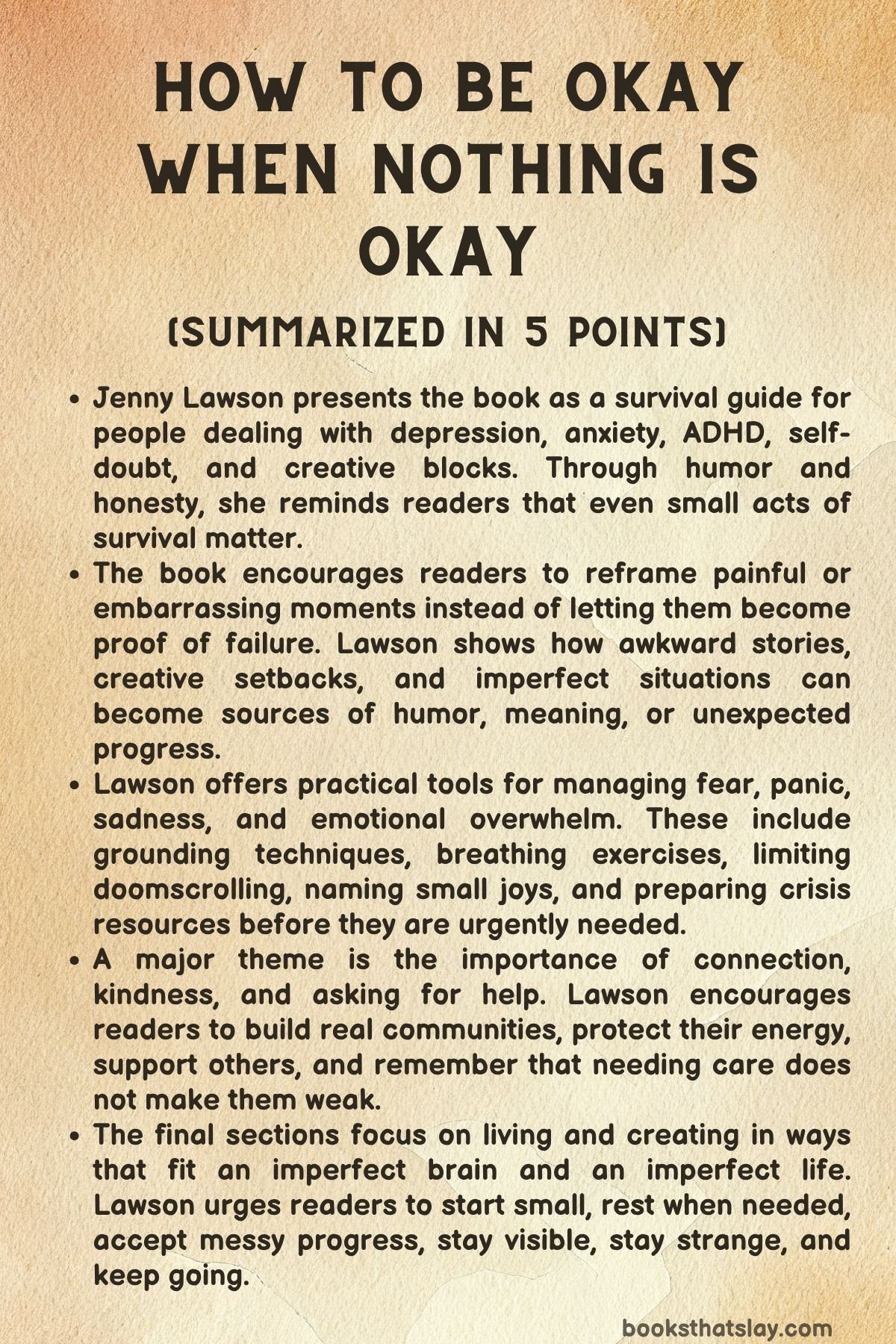
How to Be Okay When Nothing Is Okay by Jenny Lawson is a practical, funny, and honest guide for people living through anxiety, depression, ADHD, self-doubt, creative fear, and the ordinary exhaustion of being human. Lawson writes from her own experience, not as someone who has solved pain forever, but as someone who has learned ways to keep going when life feels strange, heavy, or impossible.
The book offers short reflections, survival tools, personal stories, and gentle reminders that readers can return to whenever they need comfort, humor, or proof that they are not alone.
Summary
Jenny Lawson begins How to Be Okay When Nothing Is Okay by explaining the unstable movement of her own mind. Some days she feels shut down, some days she is anxious, some days she is deeply sad, and other days she is filled with restless energy that can feel both useful and overwhelming.
Rather than presenting herself as cured or perfectly wise, she writes as someone who has lived with mental illness, creative pressure, family change, and self-doubt for many years. The book is shaped as a collection of reminders, coping tools, stories, jokes, and small acts of survival that can help when life feels unmanageable.
Lawson introduces her world through her family, her pets, her bookstore, and the emotional changes that came after her child left for college. That transition leaves her dealing with loneliness and depression, and it becomes one of the reasons she gathers these thoughts in one place.
She explains that the book does not need to be read in a strict order. A reader can move through it from beginning to end, or open it on a hard day and find a short passage that offers support.
This loose structure matches the book’s purpose: it is less a formal program and more a companion for people who need help getting through difficult moments.
A major theme of the book is the need to reframe negative thoughts. Lawson argues that survival itself deserves credit.
A day may be messy, embarrassing, unproductive, or painful, but if a person makes it through, that still counts as a real achievement. She uses humor to soften this message, but the point is serious: people who struggle often dismiss their own endurance because it does not look impressive from the outside.
Lawson wants readers to see that staying alive, trying again, and doing the smallest possible thing can be enough.
She often uses odd and funny comparisons to make emotional truths easier to understand. At one point, she compares herself to a hippo, showing how something that may appear awkward or harmless can also be strong and dangerous when necessary.
This becomes a way of talking about hidden power. People may underestimate themselves because they feel strange, anxious, or broken, but those qualities do not erase their strength.
They may even be connected to the ways they survive.
Creativity is another important part of the book. Lawson writes about periods when she feels blocked, doubtful, or unable to begin.
Instead of treating creative blocks as proof of failure, she shows how they can lead to unexpected work. Drawing during one such slump eventually helped produce a bestselling coloring book.
A damaged ceiling in her bookstore becomes something magical after it is covered with an Alice in Wonderland rabbit sticker. These stories show Lawson’s belief that problems do not always have to be hidden.
Sometimes they can be turned into something strange, funny, useful, or beautiful.
Embarrassment also becomes material for survival. Lawson tells stories about humiliating moments, such as accidentally offering a hotel key instead of a credit card.
Rather than treating these incidents as proof that she is foolish, she turns them into funny stories. This approach does not erase the discomfort, but it gives her a little control over it.
Shame becomes less powerful when it can be named, laughed at, and shared with others.
The book then moves into fear, panic, and self-doubt. Lawson explains that comparison is especially harmful because people usually compare their private struggles to other people’s public successes.
It can feel as if everyone else is moving quickly and confidently while one’s own life is slow, awkward, and uncertain. She reminds readers that success often looks sudden only because the years of failure, rejection, and persistence are hidden.
Her own career took many years before she was seen as an “overnight success.”
Even after publishing bestselling books, Lawson continues to struggle with imposter syndrome. She doubts whether her work matters, worries about being exposed as inadequate, and questions her place in creative spaces.
She writes about rejection sensitivity, confidence, awkwardness, and memory problems, including a moment when she forgets her own story during a podcast. These examples make the book feel grounded because Lawson does not pretend that success removes insecurity.
Instead, she shows that fear may remain, but people can still create, speak, publish, and participate.
Lawson offers several tools for anxiety and panic. She suggests checking the body first: drink water, eat something, unclench the jaw, relax the shoulders, and notice physical tension.
She recommends strong sensory experiences, such as sour candy or sharp scents, to help bring the mind back into the present. She also describes breathing techniques, including belly breathing and box breathing.
These tools are simple, but Lawson presents them as useful because anxiety often makes even simple actions hard to remember. Having a list of options can help when the brain feels too loud.
The book also makes space for joy. Lawson argues that happiness is not selfish, even when the world is full of pain.
In fact, joy can be necessary for endurance. She limits doomscrolling by pairing time spent reading upsetting news with time spent taking action.
This helps keep awareness from becoming helplessness. She encourages readers to make lists of comforting things, smile on purpose, notice small pleasures, and name the day’s “roses,” “thorns,” and “buds”: the good parts, the hard parts, and the things to look forward to.
Kindness becomes another form of strength. Lawson praises small acts such as clapping for strangers, encouraging others, and choosing decency when it would be easier to withdraw.
These gestures are not presented as shallow positivity. They are ways of staying connected to the world and reminding oneself that goodness still exists.
Being kind to others can also help a person feel more solid inside.
The book becomes more serious when Lawson discusses depression and crisis. She urges readers to prepare before the worst moments arrive.
This includes saving crisis hotline numbers, writing messages in advance that can be sent to friends or family, and creating systems for asking for help when words are difficult. She suggests using tools like light therapy for seasonal depression and a 1-to-5 scale to explain emotional states to loved ones.
These strategies acknowledge that depression can make communication almost impossible, so planning ahead can be lifesaving.
Music becomes another emotional tool. Lawson describes making playlists for different moods, but she also recognizes that depression can become so severe that even music feels unreachable.
In the lowest moments, her message becomes direct and urgent. She tells readers that depression lies, that they matter, that they should keep breathing, and that they should reach out for help.
She also thanks caretakers and recognizes the complex relationship between giving help and needing it. No one is always only one thing; people can be both struggling and supportive.
Community and relationships are another key concern. Lawson encourages readers to seek real friendship rather than chasing professional contacts.
She supports writing groups, creative circles, online communities, local gatherings, and quiet work sessions where people can simply exist together while doing their own tasks. She also advises choosing beta readers carefully, because feedback should help the work grow rather than crush the person making it.
At the same time, Lawson respects the need for boundaries. She supports “airplane mode” breaks, especially for introverts, and gives permission to leave parties without long explanations.
She argues that people are allowed to protect their energy. They do not have to apologize endlessly for needing quiet, rest, or distance.
Saying no can be healthy, even when the full reason is private.
Later, Lawson offers practical life hacks for working with one’s brain instead of against it. She reminds readers that many social and professional rules are arbitrary.
Doing something differently does not mean doing it wrongly. She gives examples such as asking to move an in-person meeting to Zoom, breaking difficult tasks into two-minute steps, saying no “for secret reasons,” and telling people when her brain is buffering.
These strategies reduce pressure and make life more manageable.
She also recommends small daily acts of self-care: sleeping, checking in with oneself, spending time with animals, going on Weird Walks to notice strange things outside, and leaving blank space in the schedule for rest. For ADHD, she suggests body-doubling, reminders, labels, phone limits, and planning for the needs of one’s future self.
The goal is not to become perfectly organized, but to create enough support to move through the day.
In the final sections, Lawson focuses on creativity and courage. She encourages readers to begin before they feel ready, take risks, face blank pages, accept being an amateur, and try new skills without needing immediate mastery.
She reminds creative people that not everyone will understand their work, and that this does not mean the work is worthless. Rest is allowed.
Imperfect progress still matters. Finishing something flawed can be more powerful than never finishing anything at all.
How to Be Okay When Nothing Is Okay ends with Lawson urging readers to remain visible, strange, honest, and alive. She celebrates the people who keep going even when their minds are difficult places to live.
The book’s central message is that being okay does not always mean feeling happy or fixed. Sometimes it means breathing through the next minute, asking for help, laughing at the absurdity of life, resting without guilt, making something strange, or simply making it through the day.
In Lawson’s view, that survival is not small. It is a win.
Key Figures (includes metaphorical figures as well)
Jenny Lawson
Jenny Lawson is the central figure of the book and the voice through which every emotional experience is filtered. She appears as honest, self-aware, anxious, funny, vulnerable, and deeply determined to survive even when her own mind makes that survival feel difficult.
Her personality is built around contrast: she can be overwhelmed by depression, anxiety, ADHD, creative blocks, and self-doubt, yet she also has a sharp sense of humor that allows her to turn embarrassment, fear, and pain into something meaningful. She does not present herself as someone who has solved all her problems.
Instead, she becomes powerful because she admits that she is still struggling and still trying. This makes her a deeply relatable figure in the book, because her strength does not come from being perfectly healed but from continuing to exist, create, laugh, rest, and reach for help even when things feel impossible.
Jenny’s emotional complexity is one of the most important parts of her character. Her mind moves between shutdown, sadness, panic, chaotic energy, and bursts of creativity, which makes her seem both fragile and resilient at the same time.
She often doubts her own worth and questions whether her work matters, even after achieving success. This shows that external achievement does not automatically erase inner insecurity.
Her imposter syndrome, rejection sensitivity, memory struggles, and creative fears make her feel intensely human. At the same time, her ability to reframe painful moments into stories shows her gift for emotional transformation.
She turns awkwardness into humor, fear into practical advice, and despair into reminders that readers can hold onto when they are struggling.
Jenny is also important because she acts as both narrator and companion. She does not speak from above the reader as an expert who has all the answers.
Instead, she speaks from beside the reader as someone who has needed the same reminders herself. Her advice about grounding techniques, crisis planning, rest, creativity, and self-kindness comes from lived experience rather than distant instruction.
This gives her character warmth and credibility. She understands the irrational nature of anxiety, the heaviness of depression, and the frustration of a brain that will not always cooperate.
Her voice is funny, strange, tender, and direct, and these qualities make her the emotional anchor of the story.
Lawson’s Mind
Lawson’s mind functions almost like a character in the book because it has moods, patterns, conflicts, and unpredictable movements of its own. It is not described as a calm or obedient part of her.
Instead, it can shut down, spiral into anxiety, sink into sadness, leap into chaotic energy, or become trapped in self-doubt. This inner presence creates much of the tension in the book.
Lawson is often not battling an outside villain but trying to understand and survive the difficult messages her own brain sends her. Her mind can distort reality, exaggerate danger, make embarrassment feel unbearable, and convince her that she is failing even when she is doing enough.
At the same time, her mind is not only a source of suffering. It is also imaginative, observant, strange, and creative.
The same unusual way of seeing the world that contributes to her anxiety also allows her to notice absurd details, invent funny comparisons, create art, and find magic in ordinary things. Her comparison of herself to a hippo, her transformation of embarrassing moments into stories, and her ability to see wonder in a damaged ceiling all show that her mind contains both difficulty and brilliance.
This makes the mind one of the most complicated forces in the book. It hurts her, but it also helps her create, connect, and survive.
Depression
Depression is presented as one of the darkest and most dangerous presences in the book. It is not treated as a simple mood or temporary sadness.
Instead, it appears as a force that can drain meaning from music, make ordinary life feel impossible, and convince a person that they do not matter. Lawson gives depression a kind of deceptive personality by repeatedly emphasizing that it lies.
This is important because it separates the person from the illness. Depression may speak in the voice of truth, but the book insists that its messages are false, harmful, and survivable.
Depression also reveals Lawson’s deepest compassion. When she writes about crisis, hotline numbers, prewritten messages, breathing, and reaching out, she is not being abstract.
She is speaking to people who may be in frightening emotional states, and she treats their pain with seriousness. Depression’s role in the book is therefore both threatening and clarifying.
It shows why small tools matter. A glass of water, a message to a friend, a playlist, a scale from one to five, or a reminder to keep breathing may seem simple, but against depression they become acts of resistance.
Depression is one of the book’s central antagonistic forces, but it is also the reason the book’s tenderness becomes so urgent.
Anxiety
Anxiety appears as a restless, physical, and mental force that pushes Lawson into fear, panic, comparison, and overthinking. It makes the body tense, the breath shallow, and the mind suspicious of ordinary moments.
Lawson’s treatment of anxiety is practical because she understands that anxiety often cannot be defeated by logic alone. This is why she focuses on bodily tools such as drinking water, eating, unclenching muscles, using sour candy, noticing strong scents, and practicing breathing techniques.
Anxiety is shown as something that lives not only in thoughts but also in the body.
As a character-like force, anxiety is exhausting but not unbeatable. It creates false urgency and makes embarrassment, rejection, and uncertainty feel larger than they are.
However, Lawson’s response to anxiety is not shame. She treats it with humor, patience, and strategy.
Her stories about awkward moments and self-doubt show that anxiety may make a person feel alone, but those experiences can later become points of connection. In this way, anxiety becomes one of the emotional forces the book learns to work around.
It is not erased, but it is managed, questioned, grounded, and sometimes laughed at.
ADHD
ADHD is presented as another important inner force shaping Lawson’s daily life, creativity, memory, planning, and energy. It appears through moments of forgetfulness, mental buffering, difficulty with tasks, and the need for practical systems.
Lawson does not describe ADHD as a simple flaw or failure of discipline. Instead, she frames it as a different way of functioning that requires different tools.
This is significant because the book repeatedly challenges the idea that there is only one correct way to live, work, create, or organize oneself.
ADHD also contributes to the book’s energy and humor. Lawson’s scattered thoughts, sudden shifts, unusual observations, and creative problem-solving all connect to a mind that does not move in a straight line.
Her suggestions about body-doubling, reminders, labels, phone limits, future planning, and breaking tasks into tiny steps show her attempt to build a life that works with her brain rather than against it. ADHD is therefore portrayed with both frustration and acceptance.
It complicates daily life, but it also belongs to the larger pattern of weirdness, creativity, and adaptation that the book ultimately celebrates.
Lawson’s Family
Lawson’s family functions as an important emotional background in the book. They are not analyzed through dramatic scenes in the way characters might be in a traditional novel, but their presence shapes Lawson’s sense of love, change, responsibility, and vulnerability.
Her family represents the intimate world around her, the place where her mental health struggles are not theoretical but lived. The mention of her child leaving for college is especially meaningful because it brings a major emotional shift into the book.
It suggests grief, transition, loneliness, and the painful adjustment that can come when a familiar role in life changes.
Her family also helps show that mental health does not exist separately from ordinary life. Depression and anxiety do not happen in empty rooms; they happen while people are raising children, loving partners, caring for animals, working, and trying to keep going.
Lawson’s relationship to her family reveals her tenderness and fear of loss. It also shows that love itself can be complicated, because the people who give life meaning can also make change feel more painful.
Through her family, the book becomes not only a guide to surviving inner struggles but also a reflection on how deeply connected people are to those they love.
Lawson’s Child
Lawson’s child is one of the most emotionally significant figures in the book, even though the child is not presented as a heavily developed individual character. The child’s departure for college marks a major emotional turning point for Lawson.
This moment represents separation, transition, and the grief that can come when a parent’s daily life changes. The child’s role is important because it shows how even positive or natural life events can trigger sadness.
A child growing up and leaving home may be a sign of success, but it can still create emptiness, uncertainty, and depression for the parent left behind.
The child also represents the passage of time. Through this figure, Lawson faces the reality that life keeps changing even when the mind is not ready.
The emotional weight of this transition helps explain some of the sadness that follows. It gives the book a personal foundation, showing that Lawson’s struggles are not vague or disconnected from life events.
Her child’s movement into independence becomes a symbol of love changing shape. The relationship still matters, but it no longer looks the same every day, and Lawson must learn how to exist inside that new emotional space.
Lawson’s Pets
The pets in the book serve as sources of comfort, grounding, humor, and companionship. They are part of Lawson’s emotional survival system because animals often offer a form of presence that does not require explanation.
For someone dealing with depression, anxiety, ADHD, and self-doubt, this kind of uncomplicated companionship can be deeply stabilizing. Pets can pull attention back into the present moment, provide affection, create routine, and make life feel less lonely.
Their role is not decorative; they help create the warm, strange, lived-in world that supports Lawson when her mind becomes difficult.
The pets also fit the book’s larger celebration of small joys. Lawson often emphasizes that survival is not always built from grand solutions.
Sometimes it is built from animals, weird walks, tiny pleasures, rest, and small reasons to stay. The pets represent this kind of ordinary rescue.
They do not solve every problem, but they make life softer and more bearable. They also contribute to the book’s humor and sense of eccentricity, reminding readers that comfort can come from unexpected places.
The Bookstore
The bookstore is more than a setting; it becomes a symbol of creativity, community, imperfection, and transformation. Lawson’s description of a damaged ceiling being turned into something magical through an Alice in Wonderland rabbit sticker captures one of the book’s central ideas: broken or awkward things do not always have to be hidden.
Sometimes they can be reimagined. The bookstore reflects Lawson’s ability to take something flawed and make it strange, beautiful, or funny.
In this sense, it mirrors her larger approach to life.
The bookstore also represents connection. It is a place linked to books, readers, imagination, and shared weirdness.
For Lawson, creativity is not only private; it becomes a way of reaching other people. The bookstore suggests that stories can become a shelter, and that communities can form around honesty, humor, and oddness.
It stands as a physical expression of the book’s emotional values. It shows that even damaged spaces can become meaningful, and even imperfect places can hold wonder.
Friends and Helpers
Friends and helpers play an important role in the book because Lawson repeatedly emphasizes the need to reach out before, during, and after emotional crisis. These figures represent support systems, even when asking for help feels difficult.
Lawson’s suggestion to prepare prewritten messages shows that she understands how hard it can be to communicate while depressed or panicked. Friends and family members become lifelines, not because they always know exactly what to say, but because connection itself can interrupt isolation.
These helpers also show that survival is not meant to be a solitary achievement. The book values independence in some ways, but it strongly rejects the idea that people should have to suffer alone.
Friends, caretakers, and supportive loved ones become part of the emotional safety net. They remind the reader that needing help is not a moral failure.
Lawson’s gratitude toward people who care for others, as well as toward those who receive care, makes these figures deeply important. They represent the human bonds that depression tries to weaken but cannot fully erase.
Caretakers
Caretakers are treated with special tenderness in the book. They are the people who stand near pain, offer help, remain patient, and support those who may not always be able to explain what they need.
Lawson recognizes that caretaking can be emotionally demanding, especially when someone is dealing with depression, anxiety, crisis, or long-term mental health struggles. By thanking caretakers, she acknowledges that their role matters and that their efforts are often quiet but deeply valuable.
At the same time, caretakers are not presented as magical rescuers who can fix everything. Their importance lies in presence, patience, and compassion.
They help create conditions in which survival becomes more possible. The book’s treatment of caretakers is balanced because it honors both sides of support: the courage it takes to ask for help and the love it takes to give help.
Through them, the story becomes more communal and less isolated.
Readers
The readers become an implied character in the book because Lawson speaks to them directly and personally. She imagines readers who are anxious, depressed, ashamed, creatively stuck, lonely, overwhelmed, or unsure whether they matter.
Her tone suggests that she is writing not for a distant audience but for people who may open the book during difficult moments. The reader is treated as someone worth saving, comforting, and reminding.
This makes the relationship between Lawson and the reader one of the most important emotional connections in the book.
The reader’s role is especially clear when Lawson offers direct reassurance. She tells readers that depression lies, that they matter, that they should keep breathing, and that simply making it through can be a win.
These moments turn the book into a conversation rather than a one-sided reflection. The reader becomes a companion in survival.
Lawson’s honesty invites the reader to feel less alone, and her humor gives the reader permission to be imperfect, strange, frightened, and still worthy of care.
Strangers
Strangers appear in the book as part of Lawson’s larger belief in kindness and shared humanity. When she praises clapping for strangers, noticing others, and being decent, she suggests that even brief interactions can matter.
Strangers are important because they widen the emotional world of the book beyond private suffering. They remind readers that small gestures of kindness can create connection, even between people who do not know each other.
The presence of strangers also supports the idea that joy and goodness are not meaningless just because the world is painful. Lawson argues that happiness is necessary even when the world is awful, and strangers become part of that argument.
A kind act toward someone unknown may seem small, but it can strengthen both the giver and the receiver. In this way, strangers represent the possibility of unexpected comfort in public life.
Creative Communities
Creative communities are important because Lawson sees creativity as both personal and communal. Writing groups, online spaces, local communities, beta readers, silent Zoom work sessions, and supportive creative circles all appear as ways for people to keep going when motivation fades.
These communities matter because creative work can be lonely, especially when self-doubt and rejection sensitivity are strong. A good community can remind a person that they are not creating in a vacuum.
However, the book also shows that community must be chosen carefully. Lawson encourages friendship over professional networking and suggests choosing beta readers with care.
This means she values genuine support more than shallow connection. Creative communities are helpful when they make people braver, kinder, and more willing to continue.
They become part of the book’s message that creativity does not require perfection. It requires starting, risking, resting, continuing, and finding people who understand or at least respect the process.
The Inner Critic
The inner critic is one of the most persistent opposing forces in the book. It appears through imposter syndrome, shame, comparison, embarrassment, and the belief that one’s work does not matter.
This inner voice tells Lawson that she is behind, inadequate, or foolish. It makes her compare her real life to other people’s most polished moments, which intensifies feelings of failure.
The inner critic is powerful because it sounds personal and convincing, even when it is unfair.
Lawson resists the inner critic through humor, perspective, and action. She reminds herself that success can take years, that embarrassment can become a story, and that imperfect work still counts.
The inner critic never fully disappears, but the book teaches ways to answer it. By continuing to write, draw, rest, try new things, and finish imperfectly, Lawson proves that the inner critic does not get the final word.
This makes it one of the book’s most important invisible characters.
Themes
Survival as a Form of Strength
In How to Be Okay When Nothing Is Okay, survival is presented not as something small or passive, but as a serious act of endurance. Jenny Lawson repeatedly shifts attention away from society’s usual idea of success and toward the quieter victory of simply making it through a difficult day.
Her humor does not erase pain; instead, it gives pain a shape that can be faced. When she treats staying alive, getting out of bed, eating, breathing, or asking for help as real achievements, she challenges the belief that a person must be productive or impressive to have value.
This theme is especially powerful because it speaks to people who may feel that their efforts are invisible. Lawson reminds readers that survival often happens in private, without applause, yet it still matters.
By turning ordinary acts of persistence into proof of courage, she gives dignity to people living with anxiety, depression, ADHD, grief, and self-doubt.
Reframing Pain Through Humor and Imagination
Humor becomes a way of changing the emotional weight of painful, awkward, or frightening experiences. Lawson does not pretend that embarrassment, fear, sadness, or failure are harmless, but she shows that they can sometimes be re-seen through a comic or creative lens.
A mistake, a strange moment, or a humiliating memory can become a story rather than a permanent wound. This does not mean that laughter solves mental illness, but it can create a little distance from it.
Her use of strange images, personal mishaps, animals, art, and playful exaggeration helps readers see that the mind can create relief even inside discomfort. The damaged ceiling that becomes something magical is a strong example of this attitude: what looks ruined can sometimes be transformed with imagination.
Through this theme, Lawson suggests that humor is not denial. It is a survival tool, a way of taking back some control from shame, fear, and despair.
The Importance of Asking for Help
The need for help is treated as natural, practical, and deeply human. Lawson pushes against the idea that people should manage emotional crisis alone or wait until they are completely broken before reaching out.
Her suggestions, such as saving hotline numbers early, preparing messages in advance, using emotional rating scales, and creating systems for hard days, make help feel less frightening and more accessible. This theme is important because depression and anxiety often make communication difficult at the exact moment when support is most needed.
By offering scripts and tools, Lawson recognizes that asking for help can require planning, not just courage. She also honors both sides of care: the people who need support and the people who give it.
The message is not that community fixes everything, but that connection can interrupt isolation. Lawson presents help as a bridge back to safety, reminding readers that needing others does not make them weak or burdensome.
Accepting Imperfection and Continuing Anyway
Creativity, self-care, friendship, and daily life are all shown as imperfect processes rather than smooth paths. Lawson encourages starting before feeling ready, finishing even when the result is flawed, resting without guilt, and allowing oneself to work differently from others.
This theme rejects the pressure to be polished, consistent, or constantly confident. Her reflections on creative blocks, imposter syndrome, rejection sensitivity, memory problems, and unfinished attempts show that progress often looks messy from the inside.
Instead of demanding perfection, she values movement, experimentation, and return. A person may fail, pause, forget, panic, or doubt themselves and still keep going.
This idea applies not only to writing or art but also to mental health and everyday survival. Lawson’s approach gives readers permission to be unfinished people making unfinished work in an unfinished world.
The real achievement is not becoming flawless, but remaining present, trying again, and allowing small efforts to count.